On January 16, 1917, British naval intelligence intercepted a 1,000-word German cipher at Porthcurno, revealing a plot to lure Mexico into war against the U.S. To hide their secret cable-tapping operation, Director Blinker Hall fabricated a cover story about a stolen copy in Mexico City. The lie protected Room 40’s methods, pushed Congress toward war, and remained buried through the 1918 armistice. What really happened inside that classified room still reshapes understanding of the conflict.
Key Takeaways
- British Room 40 cryptanalysts intercepted and decoded the Zimmermann Telegram in January 1917.
- The Admiralty fabricated a cover story of a stolen physical copy to hide the cable tap.
- Agent T bribed a Western Union clerk in Mexico to support the false narrative.
- The lie prevented Berlin from discovering Britain’s transatlantic eavesdropping network.
- Congress was denied raw intercepts, receiving only edited transcripts to protect Room 40.
January 16, 1917: Intercepting the 1,000-Word Match That Ignited America
On January 16, 1917, Room 40’s operators caught a 1,000-word diplomatic cable screaming across the Atlantic—and they almost didn’t believe what they read. The german diplomatic cipher revealed a shocking german-mexican alliance plot, proposing Mexico join a war against the United States.
The room 40 codebreakers knew the transatlantic cable tapping that snared this message was their most guarded secret. They couldn’t reveal the intercept without exposing their eavesdropping.
The cable, encoded in a german diplomatic cipher they’d cracked months earlier, felt like a trap—too perfect, too incendiary. Yet the intelligence was real. The january 16,1917 date marked the moment the plot entered British hands, igniting a desperate need to share the truth without betraying their methods.
The coded cable felt too perfect—a trap, yet terrifyingly real.
The 1,000 words held a match; the cover-up would be the fuse.
Room 40’s Silent Empire: The Classified Transatlantic Cable-Tapping Operation
They cracked Cipher 0075, a mathematical autopsy of Germany’s fatal error.
The intercept happened at the Porthcurno relay station, where Britain held a monopoly on transatlantic cables.
That secret tapping operation gave Room 40 a silent empire over the diplomatic lines.
Decrypting Cipher 0075: The Mathematical Autopsy of the Foreign Office Blunder
- Decrypting cipher 0075 demanded relentless cryptanalysis deception, as they’d to mask their method’s origin while decoding Germany’s deepest secrets.
- Intelligence source protection forced them to fabricate a stolen-copy story, a classic world war i espionage tactic to shield the cable-tap.
- The telegram’s mathematical signatures—repeated code groups, predictable key cycles—exposed Berlin’s cryptographic laziness, but proving this without incriminating Britain’s listening post required surgical precision.
They walked a razor’s edge between revelation and exposure.
The Porthcurno Relay Intercept: Britain’s Illicit Monopoly on Diplomatic Lines
The telegram’s mathematical autopsy exposed Berlin’s carelessness, but the greater secret was how Britain came to hold it. British naval intelligence, under Admiral William Hall, already ran a classified wiretapping operation at Porthcurno, the undersea cable’s landing point. There, they’d illicitly monopolized diplomatic lines for years, snatching every message transiting British soil. To reveal the Zimmermann plot without exposing this, Hall crafted the physical copy cover story—claiming a bribed clerk had stolen the telegram in Mexico. It was a brilliant lie, but the Woodrow Wilson administration never learned the truth: Britain hadn’t just broken a code; they’d broken international law, silently ruling the cable’s empire.
The Tri-State Bribe: Weaponizing Texas, New Mexico, and Arizona as Geopolitical Currency
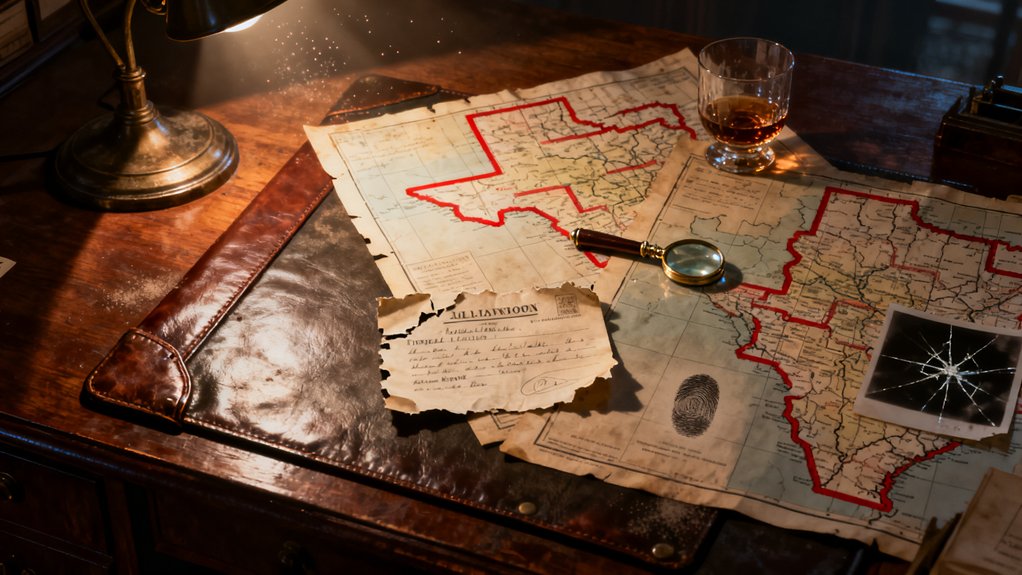
- Texas: The epicenter of American oil and cattle, its loss meant crippling U.S. energy supply and testing southern loyalty.
- New Mexico: A strategic corridor linking the Rocky Mountains to the Rio Grande, control here fractured continental logistics.
- Arizona: The gateway to the Pacific via the Colorado River, its cession threatened America’s westward expansion and mineral wealth.
The british intelligence fabrication of a stolen copy in Mexico heightened this threat’s credibility, framing the offer as a genuine plan. Room 40’s reveal turned regional boundaries into a high-stakes currency, forcing Wilson‘s hand.
Director Blinker Hall’s Paradox: Exposing the Plot Without Incriminating the Spies
Because British codebreakers couldn’t reveal their tapped cables without handing Germany a diplomatic victory, Director Blinker Hall faced a paradox: expose the Zimmermann Telegram’s explosive plot to push America into war, but do it without ever admitting how his spies had stolen the message. Hall’s tightrope walk required a delicate lie—a cover story that felt authentic yet buried the truth.
He couldn’t reveal Room 40’s silent wiretapping; that would expose Britain’s eavesdropping network and let Berlin tighten its own security. So Hall crafted a narrative of theft: a purloined document, smuggled across enemy lines, not a decoded signal plucked from U.S. State Department cables.
This fiction protected his codebreakers from scrutiny while delivering the Telegram’s damning content to President Wilson. The paradox resolved, Hall’s spies stayed hidden, but the plot hung in the open, ready to ignite.
Architecting the Mexico City Mirage to Protect Whitehall’s Codebreakers
Room 40’s architects built the Mexico City mirage with a single, vital piece of misdirection: the fabrication of a physical espionage theft. They dispatched Agent T to bribe a Western Union clerk, procuring an uncoded commercial relay of the telegram that could be passed off as a stolen document. This cleverly crafted story of a bribe and a theft gave the Americans a reason to believe the plot’s existence without ever exposing Whitehall’s codebreakers or their tapped cables. This deception mirrors the false-flag bombing strategy of Israel’s Operation Susannah, where attacks were staged to frame Egyptian nationalists and conceal the true instigator.
Fabricating a Physical Espionage Theft: The Blueprint for Plausible Deniability
Although British intelligence had the decrypted Zimmermann Telegram in hand, they couldn’t simply hand it to Washington—that would have exposed Room 40‘s clandestine wiretapping.
Instead, they engineered a physical theft narrative, a blueprint for plausible deniability. This cover story required meticulous fabrication:
- Forge a stolen copy: Agents created a plausible second version of the telegram, altered to appear as if a spy had snatched it from Mexico’s telegraph office.
- Insert a corrupt intermediary: They invented a shadowy figure—a bribed Western Union employee—who could claim they’d leaked the uncoded commercial version.
- Eliminate the original trail: British handlers guaranteed any paper trail pointing back to Room 40’s covert intercept vanished, leaving only the theft story.
This mirage gave Washington a clean, deniable source. America swallowed the lie, sealed the alliance, and Room 40’s deepest secret remained buried.
Agent T and the Western Union Bribe: Procuring the Uncoded Commercial Relay
Agent T, a British intelligence asset posing as a disgruntled telegraph clerk, slithered into Mexico City’s central Western Union office in late February 1917. He didn’t come for a job; he came for bribery. His target was a specific night clerk, a man desperate for cash. Agent T flashed a stack of American dollars, enough to buy a man’s soul for a few minutes.
The deal was simple: access the commercial relay machine. The clerk, weak-kneed and fearful, accepted. Agent T then watched as the man pulled a thin, uncoded copy of the Zimmermann Telegram straight from the operating room—the version traversing the commercial wire, not the diplomatic one. This physical relic, bought for a fistful of bills, would become the cornerstone of London’s lie, a tangible trophy to hide their silent codebreakers.
The February 23 Handover: Lord Balfour’s Calculated Delivery to Ambassador Page
Because the cover story of a stolen telegram had already been planted, Lord Balfour could now orchestrate a handover that felt like a natural diplomatic exchange. He summoned Ambassador Page to the Foreign Office on February 23, 1917, with a performance of reluctant urgency. Balfour didn’t reveal Room 40’s role; instead, he leaned on the stolen-cable fiction, making the delivery seem like a fortuitous find rather than a calculated intelligence operation. The handover’s rhythm depended on three key elements:
- The Trust Lever: Balfour framed the telegram as a courtesy to an ally, not a codebreaking admission, ensuring Page accepted it without suspicion.
- The Timing Trap: He delivered it precisely when German submarine attacks were spiking, making the plot feel immediately credible to Washington.
- The Secrecy Seal: Page was sworn to guard the source, locking the cover story in place before the document traveled to President Wilson.
Balfour’s delivery was a masterclass in controlled revelation.
Woodrow Wilson’s 96-Hour Forensic Verification Protocol
Once Page’s sealed pouch reached the White House on February 24, Wilson didn’t just accept the explosive document at face value—he initiated a 96-hour forensic verification protocol, a meticulous process that reflected his lawyerly skepticism and the gravity of implicating a foreign power.
He sequestered the telegram in the executive mansion’s secure vault, summoning only his most trusted advisors: Secretary of State Lansing and Colonel House. They cross-referenced the intercept against known German diplomatic patterns, scrutinizing cipher sequences and the distinctive stamp of the Berlin Foreign Office.
Wilson insisted on tracing the telegram’s path—from German cables to British hands—without revealing Room 40’s role. He demanded a secondary check via State Department channels, comparing the decrypt to original cables held by American embassies in Europe.
This wasn’t blind trust; it was a forensic audit. By the protocol’s end, Wilson’s team confirmed the document’s authenticity, though they still couldn’t explain how London acquired it without burning their secret wiretap.
March 1, 1917: Splashing the Treasonous Decrypts Across the Associated Press
With Wilson’s forensic verification complete, the telegram’s authenticity stood confirmed, yet the White House still couldn’t expose the method of its capture without torching British intelligence’s secret wiretap.
Wilson’s forensic proof sealed the telegram’s truth, but revealing its capture risked torching Britain’s wiretap.
They needed a different avenue, and they found it: the Associated Press. On March 1, 1917, the State Department splashed the decrypted text across front pages nationwide, bypassing the need for any courtroom or congressional committee.
- First, journalists received a cover story: a British agent had allegedly stolen a physical copy of the telegram in Mexico, masking the true cable-tapping source.
- Next, the AP wire service blasted the sensational story—Germany proposed an alliance with Mexico against the U.S.—igniting instant public outrage.
- Finally, German Foreign Minister Zimmermann himself, cornered, admitted the telegram’s authenticity on March 3, sealing his nation’s diplomatic fate.
The cover-up held, the scandal exploded.
The Senate Authenticity Hunt: Investigating the Legitimacy of the British Leak
Senators on the Lodge Committee demanded the unvarnished cryptographic data, but British intelligence refused to hand over the raw intercepts.
They couldn’t expose Room 40‘s methods, so they stonewalled every request with polished evasions.
The Senate’s hunt for proof hit a dead end, as the cover story held firm.
The refusal echoed the Downing Street Memo, where policymakers had already fixed intelligence around the policy of war, ensuring inconvenient evidence stayed hidden.
Suppressing the Lodge Committee’s Demands for Raw Cryptographic Data
Although British intelligence had successfully leaked the Zimmermann Telegram’s contents, the cover story of a stolen document immediately provoked a new threat: the U.S. Senate’s Lodge Committee, demanding raw cryptographic data to verify the leak’s authenticity. Room 40’s operators faced a delicate dance, suppressing the senators’ probing requests without exposing their own wiretapping. They executed a threefold strategy:
- They delayed responses, citing diplomatic protocols, buying time to craft convincing fabrications.
- They provided only decoded transcripts, never the original cipher or intercept logs, maintaining plausible deniability.
- They leveraged press allies to paint the committee’s demands as unpatriotic, questioning motives in a time of war.
This manipulation preserved the codebreaking secret, but it left a trail of unanswered questions, burying the truth beneath layers of strategic misdirection.
The Reichstag Suicide: Arthur Zimmermann’s Inexplicable March 3rd Confession
While British intelligence had meticulously crafted their cover story, the architect of the scheme—German Foreign Secretary Arthur Zimmermann—unexpectedly unraveled it himself on March 3rd, 1917. In a stunning Reichstag speech, he confessed the telegram’s authenticity, destroying London’s carefully spun tale of a stolen copy. Why would he sabotage his own country’s diplomatic cover? The answer lies in his calculated gamble.
| Zimmermann’s Dilemma | The Reichstag Gambit |
|---|---|
| Britain’s cover story threatened to expose German espionage. | Admitting the telegram’s existence might win domestic support. |
| Denial would seem weak. | Confession could rally nationalist fervor. |
| Silence risked losing face. | Speaking out might split the U.S. Congress. |
Zimmermann, speaking before a stunned chamber, didn’t just confirm the cable—he read portions aloud. He’d miscalculated badly. Instead of uniting Germans, he handed Washington a smoking gun. The cover-up now died on the floor of the Reichstag, replaced by raw, damning truth.
April 6, 1917: The 373-50 War Resolution and the Collapse of German Neutrality Illusions
On April 6, 1917, Congress delivered its verdict: 373 for war, 50 against, shattering Germany’s last illusion of American neutrality.
The House and Senate’s decisive majority didn’t just end months of diplomatic theater; it buried Berlin’s strategic gamble that Atlantic distance would keep the U.S. idle.
Three factors drove the collapse of German neutrality illusions:
- Zimmermann’s confession: His March 3rd Reichstag admission authenticated the telegram, stripping Germany of any plausible deniability.
- Mexico’s dossier: The proposal to recruit Mexico against America inflamed public opinion, transforming a diplomatic intercept into a national threat.
- Unrestricted submarine warfare: Germany’s February 1st resumption of U-boat attacks on American shipping directly challenged U.S. sovereignty on the high seas.
No cover story could now protect Berlin.
Room 40’s codebreakers watched from the shadows as the vote unmasked Germany’s miscalculation: they’d wagered American isolation would hold, but the telegram had already rewritten that bet.
The votes were cast, the war declared, and Room 40 turned back to its deepest secret: the wires themselves. Naval Intelligence now faced a year-long cover-up, desperately shielding the tapped cables from allies and neutrals alike. They buried the truth under layers of bureaucratic fiction, ensuring no one questioned how they’d read Germany’s mail. This deception mirrored the broader repression of civil liberties under DORA, where the state used emergency powers to indefinitely detain thousands without trial.
| The Hidden Cost of Deception | |
|---|---|
| A cable operator wept, ordered to deny his own work. | His patriotism fractured, knowing the lie would outlive the war. |
| A Mexican diplomat fumed, realizing his line was a British microphone. | His trust in neutrality evaporated, replaced by bitter humiliation. |
| An American officer never learned his government’s secret. | He died believing the stolen-courier story, his faith in allies unshaken. |
Frequently Asked Questions
What Was Room 40’s Exact Codebreaking Method for the Telegram?
Room 40’s exact codebreaking method for the telegram isn’t fully documented, but they didn’t need to crack it from scratch. They’d already broken Germany’s diplomatic codes, specifically using intercepted codebooks and traffic analysis.
They reconstructed the message by matching encoded groups to known phrases, a technique honed through meticulous monitoring of German cable traffic. Contractions like “didn’t” show their reliance on prior intelligence, not a single, secret formula.
How Did Britain Initially Access German Diplomatic Cables Without Detection?
Britain didn’t intercept the cables directly; it tapped Germany’s international telegraph lines, which ran through British territory.
Room 40’s operators secretly copied the encrypted messages as they flowed across the sea floor.
This covert access remained hidden for months, relying on the fact that Germany believed its own communications were secure.
The operation’s success hinged on absolute secrecy, ensuring no one suspected the cables had been compromised.
Did Mexico Seriously Consider Accepting Germany’s Territorial Bribe Offer?
No, Mexico didn’t seriously entertain Germany’s territorial bribe. Mexican leaders recognized the offer—Texas, New Mexico, and Arizona—was impossible, given the U.S.’s overwhelming military power.
They’d recently suffered their own revolution and couldn’t risk another war. Instead, Mexico’s government quietly dismissed the proposal, viewing it as a desperate German fantasy.
Their refusal didn’t stop the telegram’s explosive revelation, but it underscores how Mexico’s practicality overrode Germany’s audacious scheme, a decision that kept them out of the conflict entirely.
Why Did Arthur Zimmermann Publicly Confirm the Telegram’s Authenticity?
Zimmermann confirmed the telegram’s authenticity because denying it would’ve exposed Britain’s Room 40 operation.
He faced a brutal choice: confess and protect his own government’s credibility, or let the Germans, not the British, take the blame for a catastrophic diplomatic leak.
By owning the telegram’s origin, he shielded Berlin’s secrets—and inadvertently validated every claim the United States had already heard.
That admission didn’t stop America’s march to war; it fueled the fire.
What Real Evidence Was Fabricated for the Stolen Document Cover Story?
British intelligence didn’t fabricate new evidence; they simply claimed a stolen document.
Room 40 rewrote the narrative, asserting a copy was lifted from a German diplomatic pouch in Mexico.
They provided a plausible cover—a seemingly legitimate physical telegram—without ever exposing their codebreaking.
This story protected their cable-tapping methods, offering no real forged proof, only a cleverly reshaped truth to hide their true intelligence operation.
Final Thoughts
The cover-up succeeded, but Room 40’s silence came at a cost. Imagine a modern equivalent: a spy agency intercepts a terrorist plot via hacked metadata, then fabricates a “walk-in informant” to protect surveillance laws. That’s what Blinker Hall pulled. The Zimmermann Telegram wasn’t just a diplomatic bomb—it was a masterclass in intelligence deception, burying wiretaps so deep that history still credits a stolen memo, not the cryptographers who truly lit the fuse.