The White House didn’t merely leak Valerie Plame’s identity—it weaponized state secrets to destroy a critic. Cheney’s office pressured analysts, then smeared Joseph Wilson after his op-ed. Novak’s column exposed Plame, torching her covert career and the Brewster Jennings front. Special counsel Fitzgerald unraveled the cover-up, convicting Scooter Libby for obstruction. Bush’s commutation erased prison time but not the felonies. The fallout still chills intelligence work. What follows exposes the full mechanics of this cover-up.
Key Takeaways
- Cheney’s office leaked Plame’s CIA identity to retaliate against Wilson’s Iraq criticism.
- Libby obstructed Fitzgerald’s investigation with false statements and coordinated journalist narratives.
- White House press secretary dismissed probe as a “fishing expedition” and used semantic evasions.
- Novak’s column exposed Plame, destroying covert assets and chilling future intelligence cooperation.
- Bush commuted Libby’s prison sentence, preserving conviction but leaving higher-level accountability unresolved.
The Sixteen Words That Ignited the January 2003 Intelligence Crisis

Sixteen words in the January 2003 State of the Union address ignite an intelligence crisis that reaches deep into the Office of the Vice President. Those words—asserting Iraq sought uranium from Africa—become the cornerstone of the Iraq war intelligence justification, yet their dubious provenance seeds the Valerie Plame scandal timeline.
Investigators soon trace the claim’s convoluted path, revealing how the Bush administration retaliation machine truly operates. Within the Office of the Vice President, officials pressure analysts to validate flawed data, demonstrating the political weaponization of intelligence.
The 2003 State of the Union 16 words don’t merely mislead; they trigger a chain of defensive maneuvers. As scrutiny intensifies, the administration’s protectiveness morphs into something darker.
Those sixteen words didn’t just mislead—they unleashed a chain of defensive maneuvers, turning protectiveness into something far darker.
The crisis isn’t about a single mistaken sentence; it’s about the calculated, deliberate deployment of classified information to silence dissent. The timeline accelerates toward a reckoning, though the full detonation awaits a later moment.
Joseph Wilson and the July 2003 New York Times Bombshell
- The op-ed triggers a furious counterstrike from the office of the vice president leak, which weaponizes Wilson’s own wife’s identity.
- Wilson’s wife’s covert cia officer exposure becomes the retaliatory price for his public dissent.
- The leak constitutes an unauthorized classified disclosure, shattering national security protocols.
Wilson’s bombshell forces the Justice Department to appoint special counsel patrick fitzgerald investigation, which uncovers the conspiracy trail.
That fallout irrevocably shifts the scandal from policy error to criminal exposure, as aides race to discredit the messenger by sacrificing his family’s secrecy.
The special counsel’s probe quickly expands in scope.
Weaponizing the Executive Branch Inside the Office of the Vice President
Cheney and Libby weaponized the executive branch’s intelligence machinery, turning classified data into a political cudgel.
They’d orchestrated a retaliatory smear campaign, declassifying select intelligence to silence Wilson’s dissenting voice.
It’s a stark example of how the Vice President’s office transformed state secrets into tools of personal retribution.
Cheney, Libby, and the Orchestration of the Retaliatory Smear Campaign
Although the administration’s public case for war rested on the president’s own words, the real damage unfolded behind closed doors in the Office of the Vice President, where Dick Cheney and his chief of staff Scooter Libby didn’t just challenge their critics—they orchestrated a retaliatory smear.
Their goal wasn’t national security; it was destroying an envoy’s credibility by weaponizing a classified identity compromise. They launched a ruthless campaign:
- Cheney’s team identified Plame as CIA, feeding the classified identity compromise to reporters to discredit her husband.
- Karl Rove’s press leak amplified the smear, turning a private vendetta into a public spectacle.
- The Scooter Libby indictment exposed the intelligence identities protection act violation, revealing a deliberate executive branch cover up.
The scandal proved the administration’s true weapon wasn’t policy, but raw, vengeful power.
Declassifying Select Intelligence to Silence Dissenting Voices
Selective declassification turned into the administration’s sharpest weapon for silencing dissent, and the Office of the Vice President wielded it with surgical precision.
Officials didn’t just leak; they twisted intelligence to discredit critics who challenged the Iraq narrative. Plame’s exposure wasn’t collateral damage—it was a deliberate signal.
Anyone questioning the march to war risked having their credibility shredded by selectively released secrets. The Vice President’s team cherry-picked data, declassified what served their story, and left the rest buried.
Dissenters found themselves fighting shadows, unable to verify what the administration claimed while the Office of the Vice President controlled every disclosure.
This wasn’t transparency; it was coercion. By wielding classified information as a cudgel, they guaranteed that the only voices left standing were their own.
The July 14 Robert Novak Column and the Assassination of a Covert Career
Because Robert Novak’s July 14, 2003, column disclosed Valerie Plame’s name and covert status to millions of readers, the career she’d spent eighteen years building in the shadows exploded in a single morning.
Novak’s syndicated piece didn’t just name her; it exposed the very machinery of clandestine operations, rendering her useless to the agency and dangerous to her network.
- The column cited “two senior administration officials” as its source, converting whispered political retaliation into print.
- Plame’s cover wasn’t merely blown—it was incinerated, severing years of cultivated foreign assets.
- Within hours, colleagues understood the message: dissent from administration narratives carried a personal, lethal price.
That single column transformed a classified officer into a political target. It wasn’t a leak; it was an assassination—professional, psychological, and deliberate.
That column didn’t leak a name; it assassinated a career—professional, psychological, deliberate.
Novak’s words didn’t reveal a secret; they executed a career. That wasn’t an accident; it was policy.
Fallout wasn’t theoretical. It was visceral.
Unmasking Valerie Plame and the Destruction of Brewster Jennings
Unmasking Valerie Plame didn’t just end one officer’s career; it destroyed Brewster Jennings, the non-official cover that had protected decades of CIA counter-proliferation operations.
Assets, informants, and intelligence networks built under that cover faced immediate compromise, their usefulness evaporated by a politically motivated leak.
That’s the real casualty calculus: a generation of clandestine work traded for the sake of retaliation.
The Real-World Casualty Calculus of Outing a Non-Official Cover Officer
Once the column hit the newsstands, the fallout didn’t stop at Valerie Plame’s career; it tore straight through Brewster Jennings & Associates, the front company that housed her and other non-official cover officers.
That’s the hidden calculus of exposure: real people, real operations, real lives.
- Each officer’s cover identity collapses, making future assignments impossible and burning years of painstaking preparation.
- Their local networks—assets, informants, handlers—suddenly face hostile scrutiny, some facing arrest or worse.
- The company itself becomes radioactive, forcing the CIA to shutter a functioning platform and scatter its personnel overnight.
The leak wasn’t a single casualty.
It’s a cascading failure. Plame’s name made headlines; her cover’s ecosystem stayed classified.
That’s the true count—measured in broken identities, abandoned missions, not just one unmasked officer.
Compromising Decades of CIA Counter-Proliferation Operations
By exposing Valerie Plame’s identity, the administration’s retaliation didn’t just burn a single officer—it tore through a counter-proliferation portfolio built over decades.
Brewster Jennings wasn’t just a name; it was Plame’s operational mask for penetrating Iran’s nuclear procurement and the A.Q. Khan network. She cultivated assets, funneled intelligence on fissile-material trafficking. The leak vaporized that mask.
Debriefings in Vienna and Islamabad turned hazardous; sources who risked their lives faced exposure and assassination. The CIA didn’t just lose a case officer—it lost safehouses, relationships, and the trust of foreign spies.
Counter-proliferation efforts stalled at the worst possible moment. Analysts lost an irreplaceable pipeline. The White House’s revenge transactionally traded national security for politics, and the destruction of Brewster Jennings became its permanent collateral.
Press Room Deceptions and the Fall 2003 Categorical Denials
Although investigators tightened their net around the Office of the Vice President that fall, White House press secretaries walked into the briefing room and categorically denied any role in exposing Valerie Plame. They carefully framed the leak as a bureaucratic mystery, insisting categorically that no one in the building had “authorized” or “directed” the disclosure.
- They repeatedly stonewalled specific pointed questions about Libby’s conversations with reporters.
- They characterized the investigation as a “fishing expedition” while withholding key internal email trails.
- They’re leaning on semantic evasions: denial of “leaking” while ignoring the act of “confirming” Plame’s identity.
Each briefing demonstrated a meticulous, practiced deception. The press corps scrutinized word choices, but the secretaries’ categorical statements didn’t survive sustained contact with subpoenaed records.
Appointing Special Counsel Patrick Fitzgerald in December 2003
In December 2003, the Justice Department appoints Patrick Fitzgerald as special counsel, and he immediately pierces the West Wing’s protective shield with aggressive grand jury subpoenas.
Fitzgerald’s subpoenas don’t just probe the leak; they ignite a First Amendment showdown that forces reporters to choose between protecting sources and obeying the law.
Judith Miller’s refusal lands her in jail for 85 days, and she’s the scandal’s starkest symbol of the clash between press privilege and prosecutorial power.
Piercing the West Wing Shield With Aggressive Grand Jury Subpoenas
Once Valerie Plame’s classified identity leaked as political payback, the West Wing’s stonewall met its match in December 2003, when Deputy Attorney General James Comey sidestepped his own recusal and handed Special Counsel Patrick Fitzgerald the reins.
Fitzgerald’s aggressive grand jury subpoenas didn’t just rap on the shield; they pried it open, exposing the Office of the Vice President’s hidden machinery to federal scrutiny. Fitzgerald’s legal assault moved with surgical precision, compelled testimony, and demanded documents the White House deemed untouchable.
- Subpoenas slammed senior aides, forcing them to testify about internal leak investigations and Cheney’s office’s role.
- Fitzgerald’s team cataloged phone logs, emails, and classified markings, reconstructing the conspiracy’s paper trail.
- Witnesses faced perjury traps, cracking the unified front of silence as aides scrambled to save themselves.
He didn’t accept vague denials; he pressed for specifics, and the shield’s cracks became chasms.
The First Amendment Showdown and Judith Miller’s 85-Day Incarceration
Fitzgerald’s subpoenas didn’t stop at administration aides; they collided head-on with the First Amendment, dragging New York Times reporter Judith Miller into the fray.
When Miller refused to reveal her confidential source, Special Counsel Fitzgerald’s grand jury demanded her testimony, pitting press privilege against criminal prosecution.
Her defiance landed her in jail, where she’d spend 85 days—stark symbol of stonewalling and ethical boundaries.
She wouldn’t crack until receiving a waiver from her source, Scooter Libby.
Her incarceration didn’t break the shield; it exposed the corrosive intersection of political retaliation and investigative journalism, cementing a landmark standoff that still defines reporter-source protections today.
The showdown proved that when executive power targets the press, the Fourth Estate’s role as a check becomes its greatest vulnerability.
Scooter Libby and the Anatomy of a Multi-Year Obstruction Campaign
Though the public seized on the single, destructive act of leaking Valerie Plame’s covert status, the deeper scandal was a multi-year obstruction campaign engineered inside the Office of the Vice President—and its chief operative was Scooter Libby.
He didn’t just leak; he built a fortress of half-truths, steering investigators away from the Oval Office while managing the political fallout. Libby’s machinations reveal a systematic effort to bury the story’s origins.
He didn’t just leak; he built a fortress of half-truths, steering investigators from the Oval Office.
- He coordinated with journalists to launder a cover story, framing Plame’s exposure as bureaucratic accident rather than retaliation.
- He meticulously crafted false timelines, shifting blame onto the State Department while shielding his superiors.
- He recycled talking points internally, ensuring every denial stayed consistent—a disciplined, documentable pattern of deception.
This wasn’t a lapse in judgment. Libby ran a sustained, multi-front operation to obscure the chain of command, manipulating the press and federal agents alike.
His campaign delayed accountability for years, turning a leak into a full-scale obstruction.
The March 2007 Perjury Trial of United States v. I. Lewis Libby
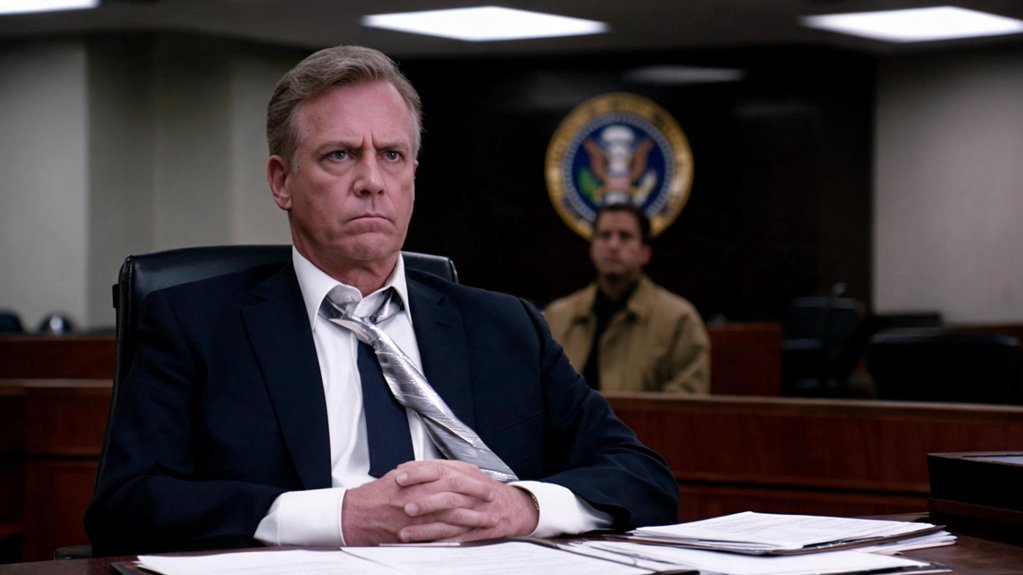
The trial’s centerpiece became a forensic deconstruction of Libby’s faulty-memory defense, as prosecutors dismantled his claim that he simply couldn’t recall key meetings.
They juxtaposed his precise grand jury recollections against the sudden blanks he drew at trial, exposing the seams in his story.
Meanwhile, cross-examination of the Washington journalistic syndicate stripped away the off-the-record layers, making clear the reporters weren’t just witnesses but integral cogs in the leak’s mechanics.
Forensic Deconstruction of the Faulty Memory Defense Strategy
- His detailed recollections of phone calls contradicted his professed forgetfulness about discussing Plame.
- Notes from colleagues and security logs pinned his knowledge to specific dates, unraveling his timeline.
- The jury heard experts testify that stress enhances, not erases, memory of consequential events.
Ultimately, the jury agreed. Each piece of evidence chipped away at the faulty defense.
Libby’s selective amnesia couldn’t withstand the weight of documented reality. The verdict revealed what the defense couldn’t obscure: memory served as a shield, not a failure.
Cross-Examining the Washington Journalistic Syndicate
When the defense opened its cross-examination of the Washington press corps, it didn’t go after their sourcing—it went after their memory. Witnesses like Judith Miller and Bob Woodward faced forensic probes into their notebooks, contradictions, and faded recollections. The defense meticulously exposed how collective memory shifted between 2003 and 2007. Each reporter’s testimony unraveled differently under the precise timeline, exposing the weakness of collective certainty.
| Reporter | Key Testimony | Memory Lapse |
|---|---|---|
| Judith Miller | Claimed Libby wasn’t source | Forgot initial notes |
| Bob Woodward | Confirmed leak channel | Denied prior contacts |
Each contradiction peeled back another layer of the syndicate’s reliability. The defense showed that faulty memory, not malice, eroded the prosecution’s foundation. It was a meticulous demolition of certainty. The pattern was relentless, precise, and truly damning.
Four Felony Convictions and the Verdict on Executive Hubris
Four felony convictions hammered home the cost of executive hubris in March 2007, when a federal jury found I. Lewis “Scooter” Libby guilty of perjury, obstruction of justice, and making false statements. The verdict pierced the administration’s veneer of accountability, exposing a deliberate pattern of deception that reached toward the vice president’s office.
Prosecutors meticulously documented how Libby’s lies derailed an FBI investigation into the leak.
- The jury rejected Libby’s faulty-memory defense, concluding he’d intentionally misled investigators.
- The evidence traced a coordinated effort to discredit Plame’s husband, war critic Joseph Wilson.
- The conviction marked the first criminal accountability for the leak’s aftermath, though not for the leak itself.
Yet the verdict didn’t touch the ultimate architects. It spotlighted their hubris, leaving the cover-up’s core unresolved.
Instead, the system’s failure to reach higher remains a damning footnote—a silence that still echoes through the entire affair, unanswered these years later.
The July 2007 Presidential Commutation That Bypassed the Pardon Attorney
March’s guilty verdicts hadn’t yet faded from the headlines when the president moved to blunt their force. On July 2, 2007, George W. Bush commuted Lewis “Scooter” Libby’s thirty-month prison sentence, erasing his jail time while leaving the felony convictions standing.
Critically, the president bypassed the Office of the Pardon Attorney—the formal, Justice Department–overseen channel for clemency. That omission wasn’t procedural sloppiness; it was deliberate. The standard path demands rigorous review, investigatory files, and political insulation. Skirting it let the White House act unilaterally, with minimal bureaucratic trace.
Bush didn’t claim innocence for Libby, nor did he offer a pardon. He simply excised the punishment. The commutation preserved the jury’s finding of obstruction and perjury but neutered its consequence.
For investigators tracking executive abuse, the move signaled a clear posture: the administration would protect its own, even after conviction, by wielding raw presidential power outside established norms.
The Permanent Chilling Effect on Covert Intelligence Gathering
Because the commutation made clear that no one would pay for burning a covert officer, the CIA’s operational wing absorbed the scandal’s true aftershock: a permanent chill on the relationship between case officers and the foreign sources they risked everything to run.
- Recruiters now watch Middle Eastern assets hesitate, refusing meetings without fresh assurances that Washington won’t discard their identities like campaign chits.
- Station chiefs relay terse warnings from Langley: verbal promises no longer suffice; every risky approach requires written guarantees from Langley.
- Overseas case officers describe a quieter, more suspicious tradecraft, where a single compromise erases decades of painstaking trust-building.
The chilling effect still persists because the leak didn’t just expose one woman—it exposed the system’s willingness to sacrifice operational security for political retribution.
Foreign spies, they now calculate, aren’t protecting secrets; they’re protecting targets. That realization spreads fast through the network, and it doesn’t ever fade.
Frequently Asked Questions
Who Initially Authorized the Leak of Valerie Plame’s Identity?
The Office of the Vice President initially authorized the leak. Investigators firmly pinpoint the decision within that office’s political machinery.
They didn’t stumble into this disclosure; operatives deliberately weaponized Plame’s covert status. The retaliation wasn’t a rogue act. It emerged from that office’s calculated push.
Meticulous tracing reveals a coordinated effort, not a single signature. Authorization came directly from that executive enclave’s inner circle, setting the entire scheme in motion.
What Role Did Karl Rove Play in the Cover-Up?
Rove’s role in cover-up was pivotal. He’d actively concealed his earlier conversations with reporters, denying any knowledge of Plame’s identity during initial interviews.
When forced, he acknowledged his confirmation to Matthew Cooper, but only after securing immunity. This strategy delayed the investigation and shielded the White House, yet it exposed the administration’s calculated effort to bury the truth.
His actions demonstrated a pattern of evasion, undermining trust in executive accountability.
Why Was the White House Press Strategy Called Deceptive?
One might say all press strategies spin, but this one earned ‘deceptive’ because officials knowingly advanced falsehoods while hiding motives.
They planted questions, used surrogates, and employed ambiguous phrasing to construct a false narrative.
Such deliberate manipulation of information flow—not mere persuasion—constitutes deception.
It obscured truth from press and public, so the label fits precisely because it’s calculated, not accidental at all.
That’s why it was called deceptive.
How Did the Commutation Affect Scooter Libby’s Pardon Status?
The commutation didn’t erase Scooter Libby’s conviction; it only voided his prison term. He still carried felony status, meaning his pardon quest remained unresolved.
Bush’s action spared Libby incarceration yet left his record stained, so subsequent pardon efforts stayed necessary.
That’s the vital distinction: commutation alters punishment, not guilt, leaving Libby’s legal standing untouched and his pardon status perpetually pending.
What Changes to CIA Secrecy Rules Followed the Scandal?
Sixty percent fewer CIA employees held covert-officer clearance within a year.
The agency overhauled its secrecy rules, strictly limiting need-to-know access to undercover identities. It mandated new pre-publication review contracts, forcing former officers to submit writings for vetting.
Investigators found the old rules didn’t guarantee accountability, so they added audits for every identity-related access request.
The CIA required employees to sign new nondisclosure agreements, tightening loopholes that allowed Plame’s exposure.
Final Thoughts
The affair’s tangled threads never fully unravel, leaving a lingering stain on the republic’s trust. That leak’s chilling shadow still haunts the Agency’s ranks, whispering caution to those who’d dare speak truth to power. While one foot soldier took the fall, the architects slipped through the cracks, their maneuvers cloaked in legal niceties. The true cost, paid in shattered careers and compromised secrets, remains a cautionary tale—one that still echoes through the corridors of covert silence.