
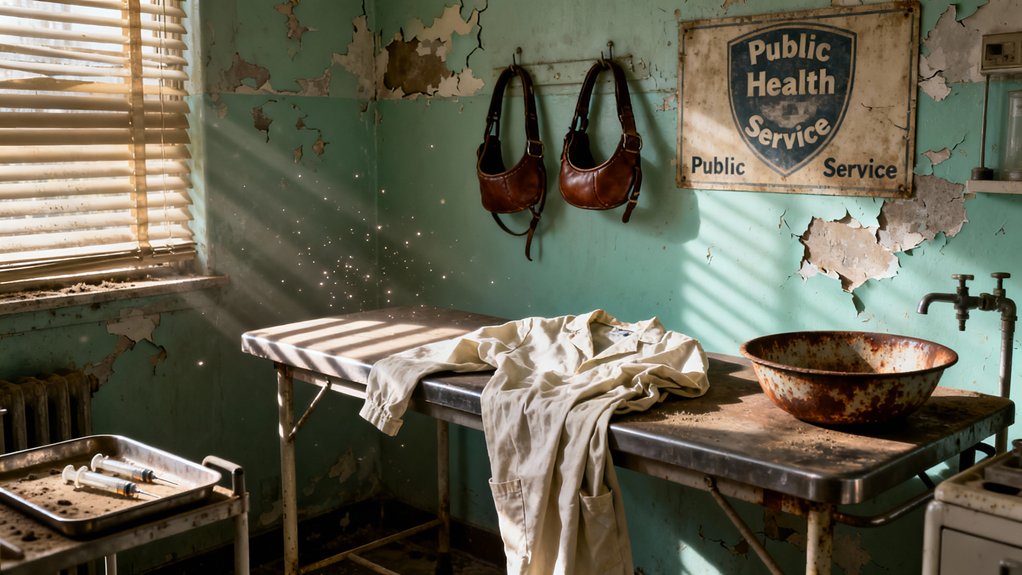
What did the men in Macon County really believe they were signing up for? The U.S. Public Health Service told them they were receiving free treatment for “bad blood,” but in reality, they were part of a 40-year experiment designed to watch syphilis destroy Black bodies. Hundreds were left to suffer—knowingly untreated—even after penicillin became a cure. The truth stayed buried until someone decided it shouldn’t.
Key Takeaways
- The Tuskegee Syphilis Study began in 1932, deceiving 600 Black men by falsely treating “bad blood” while observing untreated syphilis.
- Researchers denied penicillin even after it became a cure, prioritizing data over lives during the 40-year experiment.
- Nurse Eunice Rivers served as a trusted liaison, enabling the study’s deception by ensuring participants remained unaware and untreated.
- Whistleblower Peter Buxtun exposed the study in 1972, prompting public outrage and an end to the unethical research.
- The scandal led to federal reforms including informed consent laws and Institutional Review Boards to prevent future medical abuse.
What Was the Tuskegee Syphilis Study?
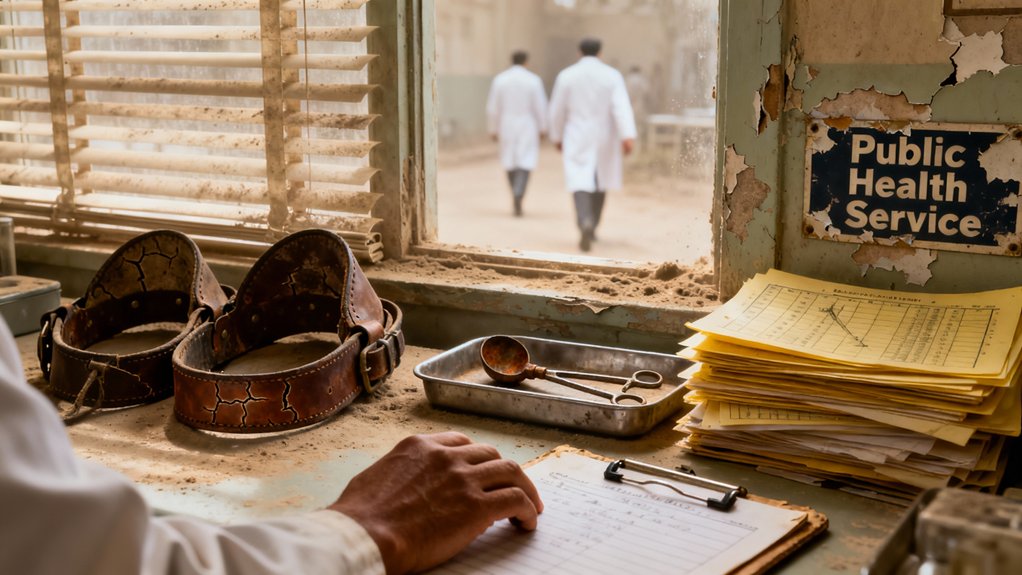
How could a study rooted in deception and racial exploitation survive for four decades? In Macon County, Alabama, the U.S. Public Health Service launched what became the Tuskegee Syphilis Study in 1932, masquerading as medical treatment. Under the guise of curing “bad blood”—a local term for various ailments—officials recruited 600 Black men, most poor sharecroppers. They promised free meals, burial stipends, and medical exams, but never disclosed the true purpose: observing untreated syphilis to its fatal end. Researchers withheld treatment, even after penicillin became a cure in 1947. Nurse Eunice Rivers helped maintain control, ensuring participants remained unaware and untreated. Spinal taps were falsely labeled “special free treatment.” The men weren’t subjects—they were victims of institutional betrayal. For 40 years, the government watched as the disease destroyed bodies and families. The study wasn’t science—it was systemic violence disguised as research. Conducted in Macon County, shielded by racism and poverty, it used “bad blood” as both cover and weapon. This wasn’t oversight failure. It was calculated oppression.
Why Did the U.S. Start the Tuskegee Study?
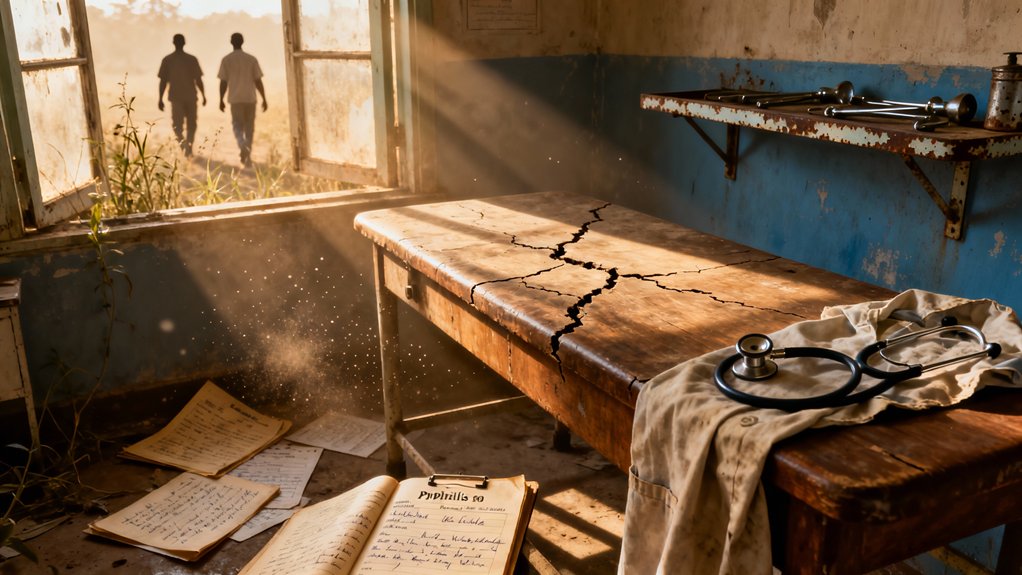
Though originally framed as a short-term health initiative, the U.S. launched the Tuskegee Study to investigate untreated syphilis in Black men, exploiting poverty and systemic neglect. Funded initially by the Rosenwald Fund, the project shifted from treatment to observation under the direction of Dr. Raymond H. Vonderlehr, who saw a chance to document the disease’s natural progression without interference. What began as a survey quickly became a permanent experiment rooted in racism and scientific arrogance.
A so-called health initiative turned racist experiment, the Tuskegee Study exploited Black men’s suffering in the name of flawed, arrogant science.
- The study aimed to prove biological differences in how syphilis affected Black bodies, reinforcing false racial myths.
- Dr. Raymond H. Vonderlehr pushed to withhold treatment, calling it essential for “pure” data collection.
- With the Rosenwald Fund’s exit, the U.S. Public Health Service took over, locking in a path of deception.
Officials didn’t seek cures—they sought control. Black lives were reduced to data points, and liberation was denied in the name of所谓 science.
How Were Black Men Tricked Into Joining?
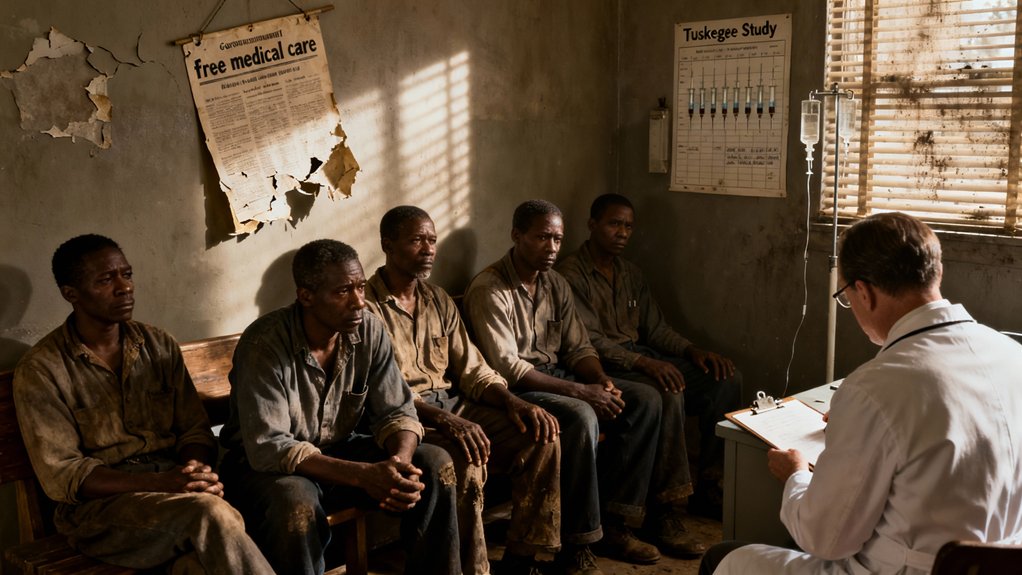
The U.S. Public Health Service exploited the local understanding of “bad blood” to recruit Black men without revealing the study’s true purpose. Researchers offered free meals and burial stipends, presenting the program as medical care when it was anything but. This manipulation laid the foundation for decades of deception.
Weaponizing the “Bad Blood” Vernacular
While promising free medical care, U.S. Public Health Service officials exploited the folk term “bad blood” to enroll 600 Black men in Macon County. They never explained syphilis or sought informed consent. Instead, they manipulated poverty and medical neglect to sustain a lethal experiment.
- Used “bad blood” as a catch-all to mask syphilis diagnosis
- Offered free meals, exams, and burial insurance as bribes
- Hid penicillin’s availability, even after 1947, under dr. john r. heller’s leadership
Officials, including dr. john r. heller, dismissed ethics to preserve data. Men suffered, blinded, paralyzed—told they were being treated while receiving none. The lie persisted because oversight ignored Black lives. Informed consent wasn’t sought; it was stolen. This wasn’t oversight failure—it was systemic violence. Language became a weapon; care, a fraud. The study lasted 40 years because power protected itself. Liberation begins by naming that betrayal: scientific racism dressed as medicine.
What Lies Were Told to the Men?
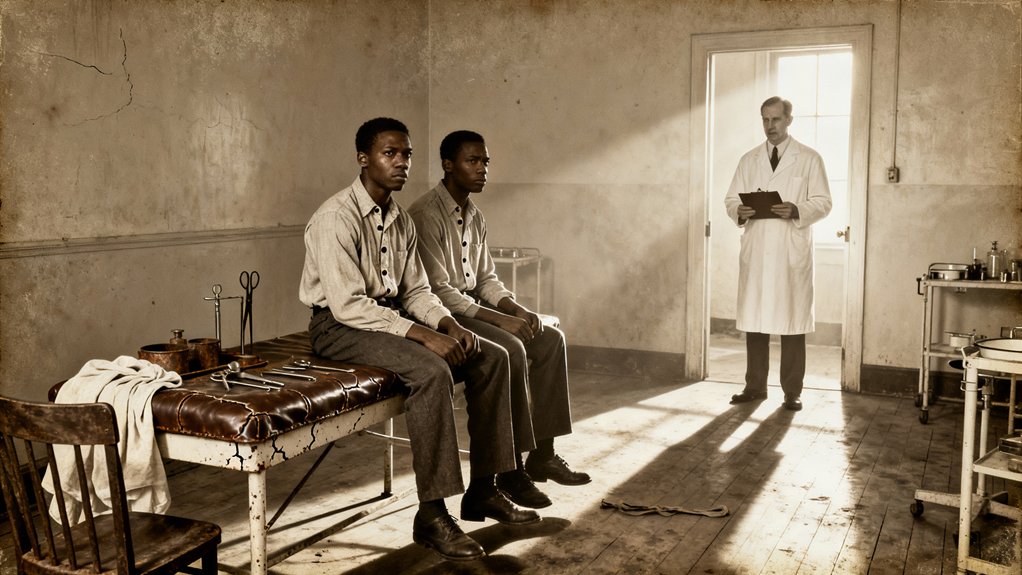
How could men be persuaded to endure decades of suffering under the guise of medical care? The U.S. Public Health Service lied. They told the 600 Black men in Macon County they were receiving treatment for “bad blood,” but no one was ever treated. Nurse Eunice Rivers, the program’s primary liaison, personally guaranteed their continued participation, delivering placebos and escorting men to exams they believed would heal them. In reality, doctors used them to track syphilis’s fatal progression. A key deception was the spinal tap: researchers called it a “special free treatment” while draining cerebrospinal fluid for data, never disclosing the risk or purpose. The men weren’t informed they had syphilis. They weren’t told the exams were non-therapeutic. Instead, they were manipulated with promises of free meals, burial insurance, and care they never received. Rivers, trusted and local, became a tool of state betrayal. The lies were systematic, sustained, and sanctioned—rooted in racism and cloaked in false compassion. These men weren’t patients. They were human laboratories, fed fiction to prolong a study that never intended to save them.
Penicillin Existed: So Why Weren’t They Treated?
They had a cure by 1947, and it sat within reach—penicillin, proven and effective, clearing syphilis in weeks. Yet the U.S. Public Health Service denied it, choosing data over lives in the most infamous penicillin conspiracy in medical history. For decades, officials actively blocked treatment to preserve their experiment.
- The study’s lead doctor, John R. Heller, approved the withholding of penicillin despite knowing its power to cure.
- Researchers colluded with draft boards to keep participants out of the military, where they’d receive treatment.
- Men were given placebos while suffering preventable organ failure, psychosis, and death—all documented without remorse.
The truth didn’t collapse under its own weight; it was exposed. In 1972, whistleblower Peter Buxtun leaked evidence to journalist jean heller of the Associated Press. Her reporting shattered the lie. The revelation forced an end to the 40-year experiment and ignited demands for accountability. This wasn’t oversight failure—it was systemic betrayal. The men weren’t forgotten. They were sacrificed.
How Doctors Blocked Treatment and Care
Doctors didn’t just withhold penicillin—they actively blocked access to care. When the military began screening draftees in World War II, researchers colluded with local draft boards to exempt study participants, ensuring they wouldn’t receive treatment through the armed forces. This deliberate interference preserved the study’s data but denied men the right to serve and the medical care that came with it.
The Draft Board Conspiracy: Denying the Right to Serve and Heal
Though the war had ended and penicillin was widely available by 1947, the U.S. Public Health Service doubled down on deception, systematically blocking treatment. To keep men untreated, the USPHS conspired with local draft boards to flag participants—ensuring they were deemed unfit for military service and denied access to care through the VA. These men weren’t just abandoned; they were actively intercepted.
- Draft boards were enlisted to prevent men from enlisting and receiving penicillin
- Public Health officials falsified data to hide treatment eligibility
- Peter Buxtun later exposed the collusion, fueling public outrage
Their right to heal—and serve—was stolen in the name of flawed science. This betrayal, buried for decades, finally catalyzed change after Buxtun’s leak. The fallout birthed the National Research Act, mandating ethics in human research. Justice delayed, but not erased.
How Deep Was the Role of Racism in Tuskegee?
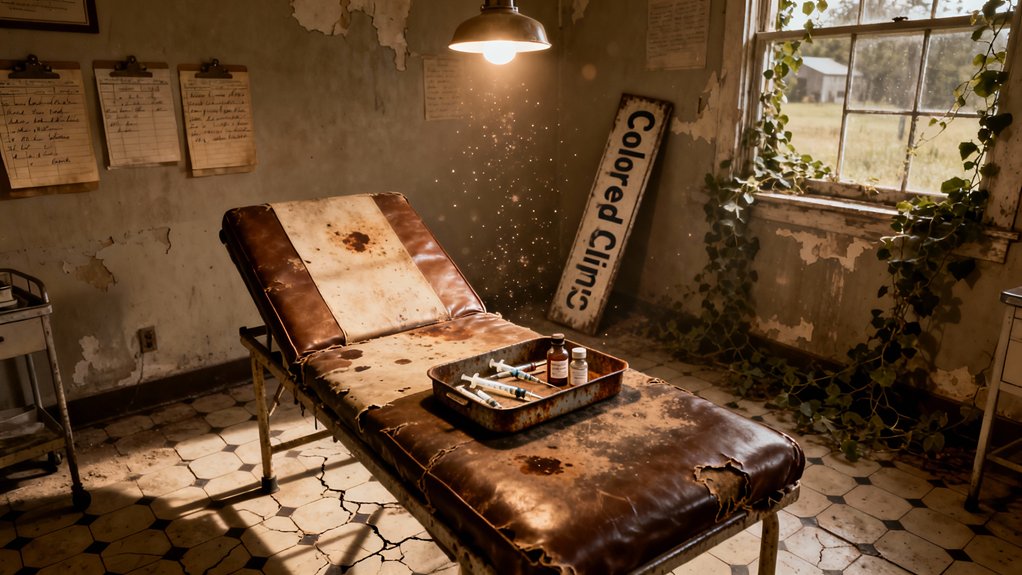
How could a study so grotesquely unethical have lasted four decades? Racism was the bedrock of the Tuskegee Syphilis Study, not a side effect. Researchers exploited Black poverty and segregation, falsely labeling syphilis as “bad blood” to manipulate 600 sharecroppers. They withheld penicillin even after it became standard care, ensuring the disease progressed for “data.” Black men were denied healing while doctors documented their decline like specimens. Nurse Eunice Rivers, though trusted, became a tool of systemic betrayal, enabling deception in the name of science. The U.S. Public Health Service didn’t just fail these men—they weaponized racial mistrust and medical power. This wasn’t oversight failure; it was calculated oppression. The revelation forced change, spurring the Belmont Report, which demanded informed consent and ethical rigor—proof that without accountability, medicine can become a tool of violence. The legacy isn’t just in past wrongs but in present distrust. Liberation requires acknowledging that racism wasn’t incidental to Tuskegee. It was the foundation.
How Was the Tuskegee Study Finally Exposed?

What finally broke the four-decade silence? A lone whistleblower inside the Public Health Service, Peter Buxtun, couldn’t stay silent. He leaked damning internal memos to Associated Press reporter Jean Heller in 1972, exposing a study that should’ve ended decades earlier. The press release detonated public outrage and forced the truth into the light.
A lone whistleblower shattered decades of silence, exposing a cruel experiment hidden behind science and lies.
- Buxtun filed formal objections in 1966 and again in 1968, but officials ignored him, insisting the research was too valuable to stop
- He exposed how researchers withheld penicillin after it became the standard cure, deliberately letting hundreds suffer preventable harm
- The USPHS even blocked men from military treatment programs, ensuring the experiment stayed “pure” at the cost of lives
No more coverups. No more lies. The exposure didn’t bring back the dead or repair ruined bodies, but it shattered the myth of benevolent medicine. It proved Black lives had been treated as disposable—and sparked a reckoning the medical establishment could no longer avoid.
What Compensation Did Survivors Receive?
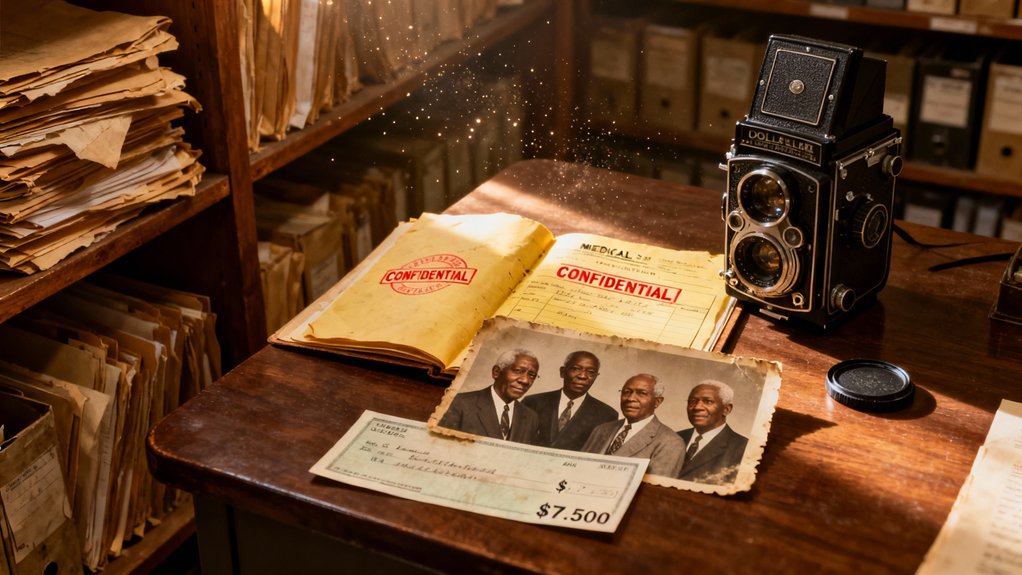
After the scandal broke, survivors and their families demanded justice, leading to a federal settlement in 1974. The government paid $10 million in a class-action lawsuit, granting $37,500 to each living participant—less than $10,000 after legal fees. Widows of the deceased received $15,000; offspring got $3,750. The sums were minimal for 40 years of betrayal. Medical care and burial benefits were finally provided, though decades too late. In 1997, Clinton formally apologized at the White House, calling the study “shameful” and “racist,” but no additional compensation followed. Survivors had waited over 50 years for acknowledgment. The payments didn’t erase the harm, nor did they match the scale of suffering—men left blind, insane, or dead while researchers watched. For many, the money felt like hush money, not justice. The government profited from their pain through data and medical insights, while victims got pennies. True reparation was never delivered. Liberation demands more than apology—it requires accountability, restitution, and structural change. This settlement offered none of that.
How Did Tuskegee Change Medical Ethics Forever?
Though buried for decades, the truth of Tuskegee forced a reckoning in medical ethics that reshaped research standards in America. The exposure of deliberate harm and deceit ignited demands for systemic change. No longer could institutions experiment on vulnerable populations without consequence. The legacy of exploitation became the foundation for enforceable ethical safeguards.
- Informed consent is now mandatory: Researchers must disclose risks, benefits, and alternatives—participants can’t be misled or left in the dark.
- Institutional Review Boards (IRBs) were created: Independent panels now oversee studies to protect human subjects from abuse.
- Justice became an ethical pillar: The Belmont Report demanded fair treatment and inclusion, challenging systemic bias in research.
These reforms didn’t erase the past, but they armed future generations with tools to resist coercion, demand transparency, and hold power accountable. Tuskegee didn’t just expose a study gone wrong—it revealed how easily science can serve oppression when ethics are ignored. The fight for dignity in medicine gained ground because survivors’ suffering could no longer be denied.
Frequently Asked Questions
Did Any Researchers Face Criminal Charges After the Study?
No, researchers didn’t face criminal charges after the study. Despite public outrage and formal investigations, no legal prosecutions occurred. The government acknowledged wrongdoing, settled a class-action lawsuit, and issued a formal apology, but systemic accountability stopped there. Perpetrators retained their pensions, licenses, and reputations. The absence of criminal consequences underscored the devaluation of Black lives and exposed how institutional power shields itself, even in the face of proven, decades-long medical brutality and racial disregard.
Were the Men’s Families Informed About the True Nature of the Study?
No, the men’s families weren’t told—coincidence layered cruelty with deception. Researchers kept the truth buried, just like the men’s burial stipends. Wives unknowingly infected, children born with congenital syphilis. Silence was policy, not accident. The lies replicated like cells in the dark, thriving on trust stripped bare, power weaponized, and voices erased from the record. The study had no consent—only conquest.
How Did the Press React Immediately After the Story Broke?
The press reacted with shock and outrage, exposing the government’s role in withholding treatment from Black men with syphilis. Major outlets ran explosive headlines, framing the scandal as a racial and ethical atrocity. Journalists highlighted systemic betrayal, demanding accountability. Public fury grew swiftly, fueling calls for reform. The backlash forced immediate congressional hearings and accelerated changes in federal research regulations, ensuring such abuse could never happen unchecked again.
Have Any of the Survivors’ Descendants Spoken Publicly About the Trauma?
Yes, descendants have spoken publicly about the trauma. They’ve shared how the study shattered trust, inflicted intergenerational pain, and left lasting scars in Black communities. Many recount stories passed down through generations, describing betrayal, illness, and loss. These voices demand accountability, truth, and reparations, refusing to let the silence of 40 years define their families’ legacy. Their courage fuels ongoing calls for justice.
Is There a Memorial at the Site Where the Study Took Place?
Yes, a memorial stands at the site. Hidden for decades, it now rises with defiant clarity. The Tuskegee Human & Civil Rights Multicultural Center guards the truth. Sculptures, artifacts, and voices echo the men’s suffering. A reconstructed cabin. A waiting room. The names engraved. Visitors feel the weight of silence broken. Justice delayed, but not erased. The stones speak what power once tried to bury. Truth, at last, has a home.
Final Thoughts
They watched men go blind, lose limbs, die—all untreated, all deceived. In Macon County, syphilis wasn’t studied to save lives but to document Black bodies in decay. Even in 1955, when a subject’s wife and infant died of congenital syphilis, doctors still didn’t intervene. Racism wasn’t a flaw; it was the foundation. The study lasted 40 years, exposing not just medical failure, but moral collapse.