“As an Amazon Associate I earn from qualifying purchases.”
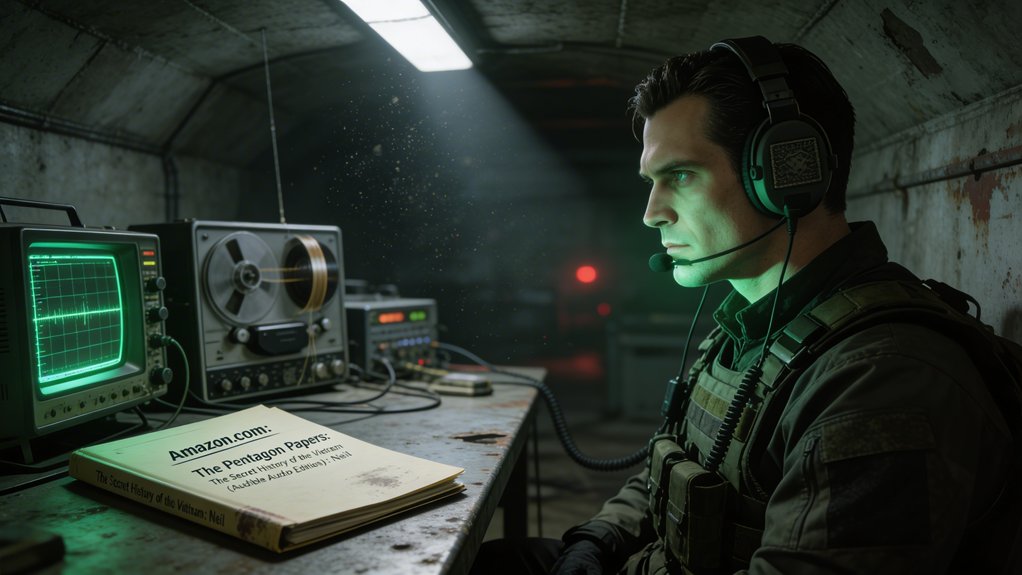
The Pentagon Papers delivers a stark, evidence-driven account of systemic deception across four presidential administrations. Sourced from declassified Defense Department records, it traces how Vietnam policy was crafted in secrecy, with public statements routinely contradicting internal intelligence. The audiobook’s strength lies in its methodical exposition—complex bureaucratic decisions are rendered with clarity and precision. This isn’t historical drama; it’s a forensic unpacking of how institutional narratives diverged from strategic realities. The result challenges more than Vietnam’s official history—it underscores a recurring vulnerability in democratic oversight. The imbalance between classified decision-making and public accountability remains unresolved, with implications reaching well beyond the war itself. For listeners seeking to understand the mechanics of policy distortion and the long-term costs of opaque governance, this audiobook offers essential insights. It doesn’t advocate a position but lays bare the record, forcing critical engagement with the tradeoffs between national security and democratic transparency. Value is maximized for those interested in intelligence ethics, Cold War strategy, and the institutional behaviors that shape prolonged conflicts.
The Briefing: Overview and Core Thesis
Although commissioned by the Department of Defense to evaluate U.S. decision-making in Vietnam, the Pentagon Papers exposed a deep pattern of governmental deception across four presidential administrations. The core revelation: systemic secrecy eroded democratic accountability during the Cold War.
Internal reports consistently contradicted public statements, revealing leaders escalated military involvement while privately doubting its viability. Officials suppressed pessimistic intelligence, misled Congress, and manipulated public perception to sustain geopolitical narratives.
This institutional habit of concealment didn’t just distort policy—it fractured public trust. The leak itself became a pivotal act of accountability, underscoring the press’s role as a check on power.
Secrecy distorted policy and shattered public trust—yet the leak affirmed the press as a vital check on power.
What emerges is a stark warning: when secrecy overrides transparency, especially in matters of war, democracy falters. The Papers are not just historical artifacts—they’re a durable case study in the cost of operating behind closed doors.
For listeners interested in national security, civil oversight, and the balance of power, this audiobook delivers essential insights into how information controls can undermine institutional integrity. The narrative is dense but well-structured, making complex bureaucratic behavior accessible without oversimplifying the stakes.
Historical Accuracy Check: Analyzing the Evidence
How can a government document withstand the scrutiny of history? The Pentagon Papers endure because they’re built on internal records, policy memos, and firsthand assessments from 1945 to 1967.
Compiled by the Defense Department, their credibility stems from cross-referenced military and diplomatic sources. Declassified data, court rulings, and investigative journalism have repeatedly confirmed key findings.
No credible evidence undermines their central conclusions—only the timing and framing remain debated. These documents don’t reveal fabrication; they expose a pattern of systemic deception across multiple administrations.
Their strength lies in documentation, not assertion. For over five decades, they’ve resisted revisionism because they’re anchored in primary sources, not opinion.
In an era of misinformation, the Papers set a standard: official narratives must be subject to factual verification, especially when national policy unfolds behind closed doors.
As an intelligence analyst, I value source integrity above all—the Pentagon Papers deliver that. They’re not flawless, but they’re foundational.
For listeners interested in U.S. foreign policy, military decision-making, or government transparency, this audiobook offers unfiltered access to one of the most consequential leaks in American history. It's not commentary—it's raw signal from the past.
Declassified Insights: Key Takeaways
- The Pentagon Papers offer a rare, institutionally sourced critique, drawn from decades of classified records.
- They reveal a persistent pattern: successive administrations escalated U.S. involvement in Vietnam while minimizing or concealing doubts from Congress and the public.
- Under Truman, military aid began silently—no public debate, no formal declaration of intent.
- Eisenhower expanded commitments covertly, setting a precedent for bypassing democratic oversight.
- Kennedy authorized troop increases while issuing optimistic, misleading assessments that masked strategic uncertainty.
- Johnson oversaw full-scale war, yet internal memos show private skepticism incongruent with public resolve.
- This continuity across administrations underscores a systemic issue: executive overreach enabled by classified discretion.
- The Papers do not expose isolated misjudgments but a structural drift toward opaque, centralized war-making.
- For today’s listeners, the key takeaway is clarity: government transparency isn’t optional—it’s a safeguard against prolonged policy failure.
- As an intelligence analyst, I stress this: the real value of the Papers lies not in historical detail alone, but in their warning about unchecked executive power.
- Audiences concerned with accountability will find the documents affirm the necessity of oversight mechanisms—even during national security crises.
Operational Assessment: Strengths, Limitations, and Ethics
| Strengths | Limitations | Ethical Implications |
|---|---|---|
| Comprehensive empirical scope, exposing cross-administration policy continuity through declassified documentation | Structurally confined to an internal government perspective—lacks external moral or civilian critique | Release served as a check on executive overreach, reinforcing public accountability |
| Audiobook format increases accessibility, converting complex archival material into digestible, widely available content | Passive listening may encourage superficial engagement; risks reducing critical analysis of systemic deception | Format democratizes knowledge but demands active listener discernment to avoid uncritical acceptance |
| Highlights systemic patterns of concealment, offering intelligence-community-relevant insights into information control | Does not address broader geopolitical consequences or long-term societal impacts beyond U.S. policy circles | Listeners inherit responsibility to question institutional narratives and pursue truth beyond official accounts |
Target Profile: Who Should Listen to This Audiobook?
The ideal listener is one who demands factual clarity on national security and government accountability. This audiobook targets individuals committed to understanding the mechanisms of state power, particularly how transparency erodes or endures under pressure. It offers critical context for those examining the line between legitimate secrecy and systemic deception.
Historians will find value in the primary-source tracing of U.S. policy shifts, especially around surveillance and wartime decision-making.
Journalists receive a field-level assessment of press complicity and resistance, with lessons on protecting sources and challenging official narratives.
Civilians gain a rare unclassified lens into intelligence ethics, useful for informed citizenship.
Students of political science or modern conflict will benefit from its analysis of whistleblowing and institutional overreach.
Activists should treat it as a strategic reference on advocating within legal and moral gray zones.
This is not a polemic. It is a documented pattern analysis—measured, sourced, and calibrated for those who operate beyond headlines. If you assess risk, verify sources, or hold institutions accountable, the intelligence here is operational.
Quartermaster's Verdict: Final Recommendation
While not intended for casual audiences, this audiobook delivers a meticulously documented examination of U.S. policy in Vietnam, tracing a pattern of concealment and strategic misrepresentation across four presidential administrations.
Presented with forensic precision, the unredacted narrative exposes institutionalized deception that undermines public trust and reveals enduring vulnerabilities in national security oversight.
This recording does not dramatize—it informs with evidentiary rigor, making it a vital resource for those committed to governmental transparency and democratic accountability.
Available at no cost with trial membership, its accessibility amplifies its value as a tool for civic education.
For listeners who prioritize factual clarity over narrative comfort, this audiobook is more than informative—it is a necessary audit of power.
Engagement with this material is not merely recommended; it is a civic imperative for those dedicated to the preservation of truth in public discourse.
Final Thoughts
A consequential audit of U.S. decision-making in Vietnam, *The Pentagon Papers* audiobook distills a sprawling government study into a coherent, alarming narrative. The production maintains fidelity to the original documents, presenting a chronology marked by strategic miscalculations and institutional deception across four presidential administrations. Narration is clinical and precise—appropriate for source material rooted in classified analysis—though may lack dramatic inflection for general audiences.
The core value lies in its unredacted access to internal assessments that contrast sharply with public statements of the era. Listeners gain insight into how intelligence was interpreted, shaded, or suppressed to sustain policy momentum. The editing effectively segments dense content into digestible sections, enhancing comprehension without oversimplifying.
Critically, the audiobook does not interpret or contextualize beyond the source material, leaving listeners to draw modern parallels. This fidelity to documentation strengthens credibility but may challenge those unfamiliar with the war’s timeline. Footnoted references are omitted in audio format, slightly diminishing scholarly utility.
Ultimately, the production serves best as a primary resource for understanding the mechanics of government secrecy and the consequences of policy inertia. It rewards careful listening with forensic clarity, offering lasting relevance for discussions on transparency, accountability, and civil oversight in national security.
“As an Amazon Associate I earn from qualifying purchases.”