
Lead was everywhere—children’s blood, city air, household dust—and yet industry claimed it was harmless, even natural. For decades, a single scientist, Robert Kehoe, backed by powerful corporations, shaped the narrative: lead wasn’t the problem; proof was. He built a playbook of doubt that didn’t prove safety but made regulators chase impossible certainty. The consequences spread silently, generation after generation, and that same playbook is still in use today—just with different chemicals and new victims waiting.
Key Takeaways
- Robert Kehoe, funded by lead industry giants, claimed lead in blood was “normal,” shifting the burden of proof to critics.
- The Kehoe Rule demanded impossible proof of harm, blocking regulation while industry promoted flawed science as evidence of safety.
- Corporations suppressed independent research, discredited scientists like Clair Patterson, and controlled studies to deny lead’s toxicity.
- The playbook was copied by tobacco, sugar, and fossil fuel industries to manufacture doubt and delay regulation for decades.
- This strategy persists in PFAS and plastics industries, keeping toxic products on the market by demanding proof of harm rather than proving safety.
Who Was Dr. Thomas Kehoe?

Dr. Thomas Kehoe wasn’t just a company doctor—he was the lead industry’s most trusted voice, shaping public opinion and policy from behind a white coat. He pushed the Kehoe Defense Strategy with precision, claiming leaded gas was safe because no proof of harm met his nearly impossible standard. With industry backing, he controlled research, silenced critics, and kept regulators at bay for decades.
The Kehoe Defense Strategy
How did a single scientist become the cornerstone of a decades-long cover-up that endangered millions? Dr. Robert Kehoe didn’t just defend leaded gasoline—he engineered a defense strategy that shielded the industry from accountability. Through industry-funded scientific research at the Kettering Laboratory, he claimed lead in blood was “normal,” pushing the so-called “Kehoe Rule” to dismiss toxicity. His studies, backed by GM, DuPont, and Standard Oil, consistently downplayed risks, even as evidence mounted. This manufactured consensus blocked public health protections, delayed regulation, and discredited independent science. Kehoe’s strategy wasn’t about truth—it was about control. By positioning corporate-backed research as authoritative, he made doubt seem like debate. The result? Millions exposed, especially children, while profits soared. His legacy isn’t science—it’s sabotage disguised as expertise, a blueprint for manipulating facts and sacrificing lives.
Lead Industry’s Trusted Voice
Though he presented himself as an impartial scientist, Dr. Thomas Kehoe was the lead industry’s trusted voice, defending tetraethyl lead as safe even as workers died. As chief medical consultant for the Ethyl Corporation, he claimed lead in gasoline wasn’t harmful, dismissing early evidence of toxic substances in car exhaust. Kehoe dominated research for decades, shaping industry-funded studies that downplayed risks and blocked regulation. He played a key role in the 1925 Surgeon General’s conference, where he and allies stalled action despite clear dangers. His influence guaranteed leaded gasoline stayed widely used, protecting profits over people. Kehoe’s legacy is a playbook of delay and denial, one that extended the use of toxic substances across generations. His so-called science wasn’t neutral—it was a shield for corporate harm, preventing public awareness and keeping a deadly additive in nearly every tank.
How Industry Ignored Lead’s Dangers for Decades

The lead industry dismissed mounting evidence of harm, insisting leaded gasoline was safe without proving it. It blocked independent research, promoted flawed studies, and attacked scientists who challenged the narrative. By denying risks and controlling the science, companies protected profits while poisoning cities and workers for decades.
Denial Of Evidence
Even as early deaths mounted among workers handling tetraethyl lead, General Motors, DuPont, and Standard Oil pushed ahead with its commercial rollout, downplaying risks and insisting the additive was safe. Their denial of evidence wasn’t new—it followed a long history of ignoring lead’s dangers. When five workers died at a DuPont plant in 1924, industry scientists blamed mishandling, not toxicity. Dr. Robert Kehoe, funded by these companies, claimed low-level exposure was harmless, using flawed, industry-controlled studies. His word became doctrine, shutting out independent research. The “Kehoe Rule” shifted the burden of proof to critics, letting lead levels in blood soar unchecked. Decades of data showing harm were dismissed. This wasn’t ignorance— it was deliberate refusal to act. Public health warnings were sidelined while profits grew. The truth was known, yet denied. People were left unprotected, exposed, and misled—all to preserve a toxic product.
Suppression Of Science
While independent science pointed to danger, the leaded gasoline industry buried the truth—funding only favorable research, discrediting dissent, and locking out unbiased inquiry for decades. The suppression of science was systematic: GM, Du Pont, and Standard Oil controlled studies through the Ethyl Corporation, ensuring no threat to profits emerged. Dr. Robert Kehoe, their chief defender, pushed the “safe threshold” myth using flawed data, silencing critics. Dr. Clair Patterson, who proved widespread lead contamination, faced funding cuts and delays. Media coverage failed to challenge the narrative, amplifying industry lies over facts. Even after worker deaths in 1924, the industry denied harm. By 1985, the EPA showed 5,000 annual U.S. deaths from lead-linked heart disease—a preventable toll.
| Year | Event | Industry Response |
|---|---|---|
| 1924 | 5 workers die at NJ plant | Deny lead connection |
| 1940s–80s | Kehoe dominates research | Fund biased studies |
| 1965 | Patterson publishes findings | Block funding, delay |
| 1985 | EPA links lead to 5,000 deaths | Downplay significance |
| Ongoing | Global lead poisoning | Avoid accountability |
Deny, Delay, Discredit: The Kehoe Playbook

The Kehoe Playbook kicked off with a blunt refusal to acknowledge lead’s dangers, no matter the evidence. Industry leaders denied the science outright, insisting leaded gasoline posed no risk to public health. They bought time by shifting the burden of proof, demanding impossible levels of evidence before accepting any regulation.
Deny The Science
Though backed by industry millions, Robert Kehoe didn’t just deny the science on lead toxicity—he helped manufacture doubt. Funded by GM, DuPont, and Standard Oil, Kehoe claimed lead in gasoline was safe, insisting its presence in human bodies was “normal.” His research wasn’t independent—it was a tool to deny the science and protect profits. For over 40 years, he dismissed public health warnings, even as internal documents confirmed lead’s hazards. The Lead Industries Association used his authority to frame toxic exposure as natural, giving the public no good reason to believe otherwise. Independent studies showing neurological and developmental damage were discredited, not debated. Kehoe’s platform wasn’t science—it was strategy. By positioning industry-funded claims as fact, he disempowered communities, delayed justice, and prioritized corporate control over human health. The playbook was clear: if you can’t win with data, distort it.
Delay Regulation
Because Robert Kehoe’s industry-funded research cast doubt on lead’s dangers, regulators hesitated for decades to act, even as evidence of harm mounted. The lead industry weaponized his authority to delay regulation across the united states, blocking reforms despite known risks.
- Industry lobby groups used Kehoe’s testimony to undermine public health experts at congressional hearings
- DuPont and Ethyl Corporation controlled research funding, ensuring favorable outcomes
- Independent scientists like Clair Patterson were discredited or ignored
- Safer alternatives like ethanol were suppressed to protect leaded fuel profits
- Over 7 million tons of lead were released before the EPA acted in 1976
Corporate delay tactics stalled action for generations, poisoning communities and deepening environmental injustice. The united states paid a steep price—children harmed, lives shortened—all to avoid regulatory cost. This wasn’t oversight failure; it was manipulation by design.
How Big Tobacco Used Doubt to Sell Smoke

Big Tobacco manufactured false equivalence by framing smoking risks as a matter of scientific debate, not consensus. The industry funded friendly science, backing studies that downplayed lung cancer links while discrediting independent research. These tactics mirrored the Kehoe Playbook, using doubt as a shield against regulation.
Manufacturing False Equivalence
How could an entire industry insist smoke was harmless while evidence piled up? The answer lies in manufactured false equivalence—a tactic that would make skeptics of science, one day, question even the most obvious dangers. Big Tobacco didn’t need to prove cigarettes were safe; they just had to create doubt. By equating weak industry studies with rigorous independent research, they staged a deception that stalled regulation for decades.
- Framed uncertainly as balanced debate
- Cited flawed studies as equal to peer-reviewed science
- Attacked legitimate researchers as alarmists
- Claimed “no consensus” despite growing evidence
- Mimicked the Kehoe Rule: harm must be proven beyond doubt
This illusion of scientific dispute protected profits while addicting millions. The playbook, borrowed from leaded gasoline makers, relied on distortion, not truth. People suffered—not because the science was unclear, but because corporations weaponized doubt. Liberation begins by seeing through the equivalence they manufactured.
Funding Friendly Science
It bankrolled science to sell safety. The tobacco industry perfected funding friendly science by backing the Kehoe Institute, where Dr. Robert Kehoe—paid by lead and oil giants—claimed lead exposure was harmless below a “safe” threshold. His studies, built on industry cash and controlled authorship, dismissed growing evidence linking lead to kidney disease, neurological harm, and heart damage. For over 40 years, independent research was buried, delayed, or discredited. The playbook was clear: finance doubt, elevate loyalists, attack dissent. When smoking’s dangers emerged, Big Tobacco recycled the same tactic, hiring pseudo-experts to mimic Kehoe’s defense. They didn’t need truth—they needed confusion. Millions of tons of lead poisoned the air, blood, and soil while profits soared. This wasn’t science; it was sabotage. Liberation begins by exposing who funds the so-called facts—and why.
From Lead to Smoke: The Pattern of Denial

Big Lead didn’t just protect its product—it built a lie and made sure the science seemed on their side. When regulators hesitated, the same tactics quickly spread to Big Tobacco, which copied the playbook to shield cigarettes. Both industries relied on manufactured doubt, buried evidence, and attacked critics to delay action for decades.
Build The Lie
Though evidence of harm emerged early, the makers of leaded gasoline chose denial over responsibility, crafting a decades-long campaign to cast doubt on science and silence critics. They built a lie so durable it would later spread around the world, shielding profits while poisoning communities.
- Formed the Ethyl Corporation in the 1920s, pushing tetraethyl lead despite known risks
- Used the Kehoe Rule to shift the burden of proof, demanding victims prove harm
- Buried GM’s 1917 ethanol research, suppressing safer alternatives
- Released an estimated 7 million tons of lead, exposing up to 68 million U.S. children
- Continued selling leaded fuel internationally after the 1986 U.S. ban, exporting deception
The industry didn’t just deny risk—they manufactured uncertainty, turning science into a weapon and delaying justice for generations. Their playbook thrived on silence, but the truth, once buried, would later rise.
Copy The Playbook
The Kehoe Playbook didn’t die with leaded gasoline—it spread. Tobacco companies seized the script, denying smoking’s link to heart disease and cancer for decades. Like lead executives, they funded skewed research, attacked independent science, and installed industry-friendly experts as authorities. They manufactured doubt, not to prove safety, but to delay regulation and protect profits. Internal documents later revealed tobacco companies knew nicotine was addictive and their products deadly—yet they lied. The tactic wasn’t ignorance; it was strategy. From lead to smoke, corporations copied the same formula: deny, delay, discredit. This playbook silenced warnings, prolonged public harm, and entrenched systemic deception. Recognizing it isn’t just about past harms—it’s about exposing ongoing lies. Liberation begins when people see the pattern, challenge corporate power, and demand truth. The playbook only works if we let it.
How Fossil Fuels Borrowed the Playbook for Climate Denial

Fossil fuel companies didn’t just deny climate science—they manufactured doubt, just as lead producers once did. They funded studies, promoted skeptics, and ran media campaigns to muddy the evidence, creating the illusion of scientific debate. This wasn’t coincidence; it was a direct copy of the Kehoe playbook, shifting the burden of proof and delaying regulation for decades.
Manufactured Doubt On Climate
While public concern over climate change grew, fossil fuel companies were quietly deploying a well-rehearsed strategy to undermine the science. They echoed tactics once used to defend leaded gasoline, dismissing risks to public health—from asthma to impaired fetal development—and prioritizing profit over truth. In New York and beyond, communities bore the brunt while corporations obscured reality.
- They invoked the “Kehoe Rule,” shifting the burden to prove harm instead of ensuring safety
- Funded scientists like Fred Seitz and Willie Soon to manufacture scientific controversy
- Ran disinformation campaigns through groups like the Global Climate Coalition
- Suppressed their own research—ExxonMobil knew climate risks decades ago
- Attacked climate advocates and lobbied aggressively to block regulation
These actions delayed climate action, endangered lives, and betrayed public trust—all to protect an unsustainable status quo.
Echoes Of Denial Tactics
They didn’t invent the tactics, but they perfected them—fossil fuel companies took the blueprint used to defend leaded gasoline and repurposed it for a new threat to their profits: climate science. Decades ago, lead producers dismissed toxicity evidence; years ago, oil giants did the same with global warming. ExxonKnew the risks in the 1970s but funded disinformation anyway. Like the Lead Industries Association, the Global Climate Coalition ran PR campaigns to manufacture uncertainty. They cherry-picked data, attacked scientists, and pushed fake balance in media. Industry-friendly experts infiltrated regulators, echoing Kehoe’s hollow “safe levels” claim. They blocked clean air rules, warning of economic ruin just as they did years ago with lead phaseouts. The playbook’s pillars—deny, delay, deceive—remain unchanged. These echoes of denial aren’t coincidences; they’re calculated strategy. The public was misled for decades. The truth, suppressed years ago, can no longer be buried.
How the Sugar Industry Borrowed Big Tobacco’s Tactics
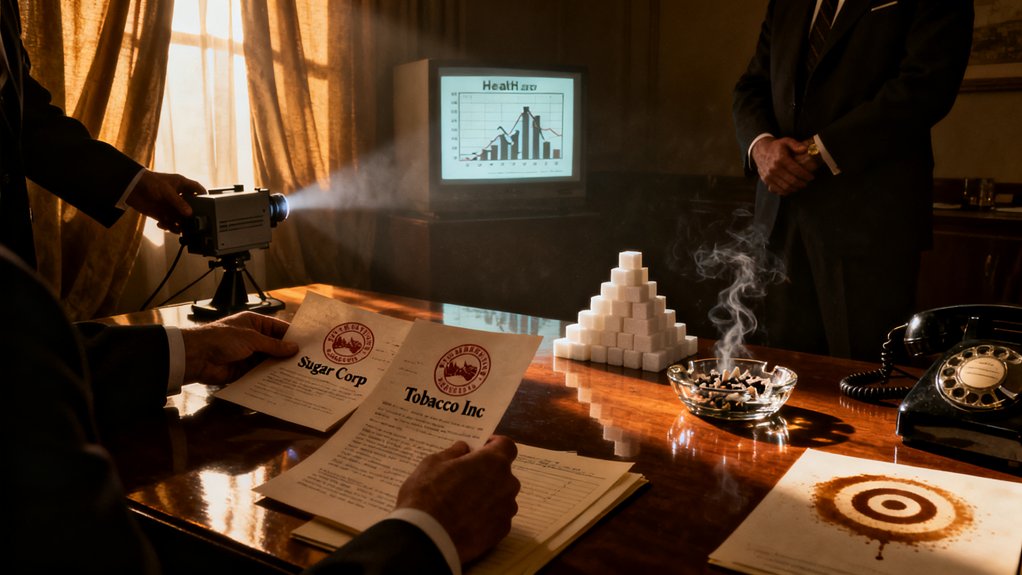
The sugar industry didn’t just defend its product—it reshaped science to shield it. By funding selective research and discrediting links to heart disease, Big Sugar shifted blame to fats, just as tobacco firms once denied nicotine’s dangers. These tactics, echoing the Kehoe playbook, let the industry sweeten public opinion while stalling health warnings for decades.
Sugar Shields Science
What if the blame for America’s heart disease epidemic was misplaced from the start?
The sugar industry shielded its profits by manipulating science, just like Big Tobacco. Decades of dietary confusion stem from coordinated deception:
- Funded a 1967 New England Journal of Medicinereview that shifted blame from sugar to saturated fat
- Paid Harvard scientists $6,500 to exonerate sugar, suppressing links to heart disease and tooth decay
- Controlled research through “Project 226,” handpicking authors and drafting conclusions
- Influenced U.S. dietary guidelines, promoting low-fat, high-carb diets that increased sugar consumption
- Used classic Kehoe tactics: funding biased studies, discrediting independent science, delaying public health action
A 2016 JAMA Internal Medicineinvestigation exposed the lie. The industry didn’t just hide the truth—it rewrote it. People deserve science free from corporate control.
Sweetening Public Opinion
How deep did the sugar industry go to shape what Americans believe about diet and health? Deep enough to pay Harvard scientists $50,000 in today’s dollars to blame fat, not sugar, for heart disease. In 1967, the Sugar Research Foundation got them to publish a review in the New England Journal of Medicine that hid data linking sugar to coronary risks. Just like Big Tobacco, they crafted narratives, buried truths, and influenced decades of dietary guidelines. The industry launched the International Sugar Research Foundation in 1971 to fund doubt, mimicking the Tobacco Institute. Internal memos show executives planned to discredit science threatening sales—exactly how cigarette makers protected profits. They didn’t just lobby; they rewired public belief. This wasn’t oversight. It was manipulation. And for generations, Americans paid the price in health, misled by a sweetened lie corporations refused to correct.
Plastics and the Denial Playbook

Microplastics have been detected in human blood and organs, yet industry-backed groups downplay health risks while lobbying against regulation. Fossil fuel and petrochemical companies have shaped policies to delay restrictions on plastic production, despite growing evidence of environmental and health harms. Their strategy mirrors past tactics—suppressing science, attacking critics, and prioritizing profit as contamination spreads globally. This ongoing refusal to act despite known harm echoes the deliberate withholding of penicillin in the Tuskegee Syphilis Study, where treatment was denied to preserve data over human life.
Microplastics And Health Risks
Why do toxic levels of ultra-short-chain PFAS still flow through public water systems? Because industry downplays the danger while contamination spreads unchecked. Trifluoroacetic acid (TFA), a dominant and highly persistent PFAS, evades standard filtration and floods tap supplies. In Germany, microplastics like TFA appear in 98% of drinking water samples—and in Indiana, TFA makes up 85% of PFAS in taps, with residents’ blood levels surpassing peak national PFOA measures.
- TFA accounts for 90% of all PFAS found in German water
- It slips through carbon filters and accumulates over time
- EPA safety limits are exceeded by orders of magnitude
- Animal studies confirm liver damage and birth defects
- Human health impacts remain understudied despite clear red flags
With over 15,000 lawsuits targeting DuPont, 3M, and others, a reckoning is underway—but millions remain exposed.
Industry Influence On Policy
Even as evidence mounts, the chemical industry continues to shape policy in its favor by shifting the burden of proof onto regulators and the public, just as it did decades ago with leaded gasoline. The Kehoe Rule—lead safe until proven harmful—became a blueprint for delay, now reused to protect PFAS and plastics. DuPont and Ethyl Corporation funded shaky science to muddy the facts, while industry insiders like Nancy Beck slipped into the EPA to gut chemical reviews. The American Chemistry Council pushed the 2016 Toxic Substances Control Act to preempt state bans, not to protect people, but to shield profits. Decades of concealed studies on PFAS toxicity prove the game hasn’t changed. They deny, delay, and dominate—keeping toxic chemicals in circulation while communities pay the price. This isn’t regulation. It’s corporate capture. And it’s still winning—unless we stop it.
How Big Food Spreads Scientific Confusion

Big Food doesn’t deny science— it distorts it. By funding studies that promote conflicting research, companies manufacture scientific doubt and shift blame away from harmful ingredients. This tactic, like those used by tobacco and lead industries, keeps regulators off balance and consumers confused.
Manufactured Scientific Doubt
How do industries make questionable science look like consensus? By manufacturing doubt where evidence is clear. Big Food leverages a decades-old playbook, seeding confusion to protect profits.
- The Kehoe Institute pushed industry-backed studies claiming leaded gas was safe—just as food firms now fund research minimizing sugar’s harms
- Dr. Robert Kehoe denied lead toxicity for over 50 years, echoing today in industry scientists downplaying processed food risks
- His “weight-of-evidence” tactic dismissed independent findings, now used to reject diet-disease links
- Kehoe claimed lead in blood was natural; Big Food claims sugar in diets is normal and safe
- Tobacco and lead industries trained food companies to exploit uncertainty, delaying regulation through sponsored science
They don’t need to win science—they just need to create doubt.
Promoted Conflicting Research
Why did it take decades to recognize the dangers of leaded gasoline, despite clear evidence? The industry didn’t just doubt science—it manufactured conflict. Backed by GM, DuPont, and Standard Oil, Dr. Robert Kehoe pushed the idea that lead was natural in the body, a claim built on research his corporate funders paid for. His work wasn’t independent—it was propaganda dressed as science. The Lead Industries Association, created by the Ethyl Corporation, pumped money into studies that echoed industry lines, drowning out real findings. They didn’t need to win the scientific debate—just create enough confusion to stall action. By demanding impossible proof of harm, they shifted the burden to critics, while hiding the truth: pre-industrial humans had almost no lead in their bodies. Independent researchers like Clair Patterson eventually exposed the lie, but not before decades of delay—delay that protected profits, not people.
Why Corporate Influence Delays Safety Laws
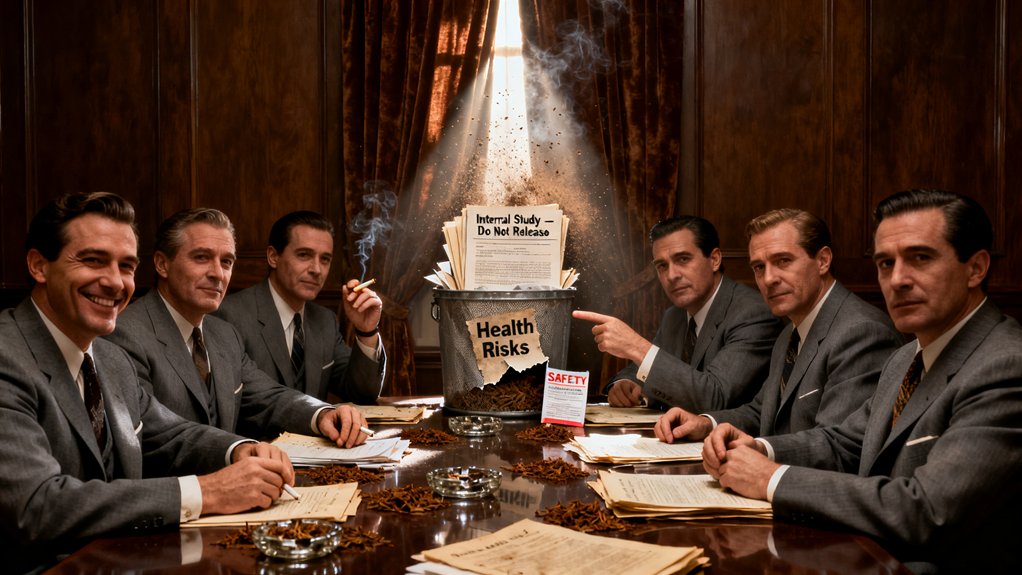
Corporations manufacture doubt to protect profits, funding skewed research and discrediting independent scientists. They suppress evidence of harm, delaying safety reforms that threaten their bottom line. This tactic kept leaded gasoline legal for decades despite known dangers.
Manufacturing Doubt For Profit
While the dangers of leaded gasoline were evident to independent scientists as early as the 1920s, the industry behind it launched a decades-long campaign to obscure the truth.
- Pushed the “Kehoe Rule,” claiming lead was naturally safe until proven harmful—despite evidence of toxicity
- Funded flawed research at the University of Cincinnati to manufacture false consensus on safe exposure levels
- Used Dr. Robert Kehoe as a front, concealing his financial ties to GM, DuPont, and Standard Oil
- Blocked ethanol and other proven antiknock alternatives by falsely claiming no substitutes existed
- Controlled scientific discourse, suppressing independent studies and flooding journals with doubt
Corporations didn’t just deny the risks—they engineered uncertainty to protect profits. For over 70 years, they prioritized shareholder returns over children’s brains, fueling a global health crisis that persists today. This wasn’t ignorance. It was strategy.
Suppressing Science To Delay Reform
A decades-long shield of manipulated science protected the leaded gasoline industry from accountability, with the Kehoe Rule serving as its cornerstone. The rule, named after Dr. Robert Kehoe, forced regulators to prove harm instead of making corporations prove safety—shifting the burden and stalling reform for over 50 years. Funded by GM, DuPont, and Standard Oil, Kehoe’s research dismissed lead as harmless, even as internal data told a different story. His industry-controlled studies suppressed links between lead exposure and children’s brain damage, silencing early warnings. The Ethyl Corporation wielded Kehoe’s authority to block regulation, rejecting independent science and attacking critics. By 1979, 90% of U.S. kids had dangerous blood-lead levels, yet corporate influence delayed action. Junk science and disinformation kept leaded gas running until 1986. It wasn’t ignorance—it was strategy. They knew. They lied. People suffered.
How to Spot and Stop the Denial Playbook
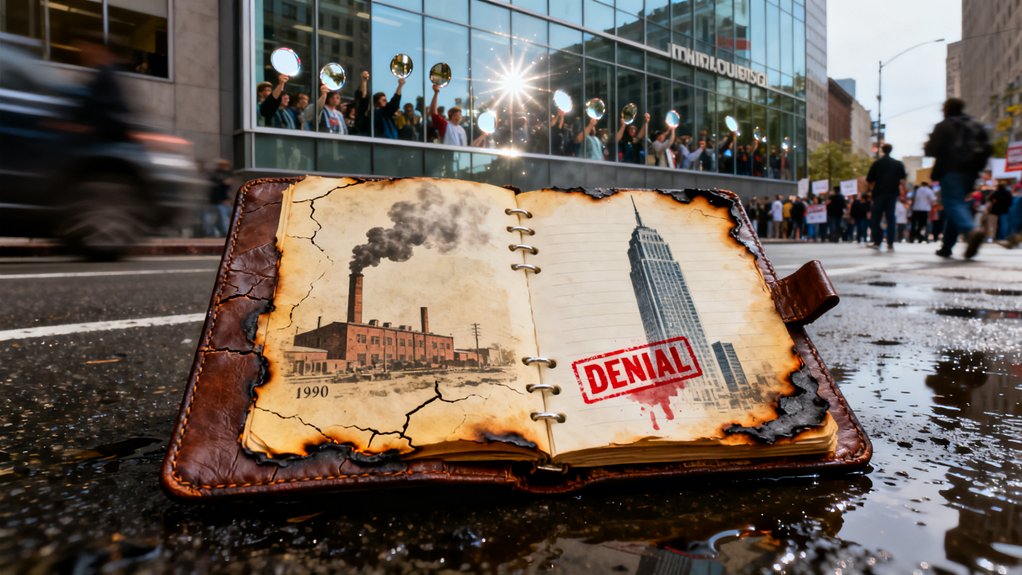
They spot the pattern by identifying false claims of safety, reliance on industry-funded science, and attacks on independent researchers. They demand accountability when corporations ignore internal evidence of harm and suppress safer alternatives. This playbook isn’t history—it’s still in use, and recognizing it is the first step to stopping it.
Spot The Pattern
Because the tactics of corporate denial follow a predictable script, recognizing the pattern starts with identifying who funds the science and who attacks the messengers.
- Corporations like GM, DuPont, and Standard Oil bankrolled biased research to control the narrative on lead toxicity for decades.
- Industry repeatedly discredited independent scientists exposing harm, using defamation and legal threats.
- The same playbook resurfaced in PFAS, where DuPont shielded known risks since the 1950s.
- “Safer” substitutes like GenX replaced PFOA but carry similar toxic profiles—deception disguised as progress.
- Trade groups enabled collusion, as lawsuits reveal, delaying regulation through coordinated disinformation.
This pattern isn’t accidental—it’s strategy. Following the money, spotting coordinated attacks on truth-tellers, and tracing tactics across industries exposes the machinery of denial. Once recognized, it can’t hide.
Demand Accountability
How long must the same story repeat before power answers for its lies? The Kehoe Rule—presume safety until harm is proven—is still used, letting PFAS makers delay regulation despite known risks. Industry insiders like Nancy Beck and Michael Dourson shaped EPA policy from within, blocking safeguards and ignoring water contamination. DuPont hid cancer and birth defect data for decades, just as lead firms once did. Now, over 15,000 lawsuits accuse DuPont, Chemours, and 3M of poisoning communities, with damages likely rivaling asbestos. Whistleblowers faced threats and blacklisting, revealing deep complicity between corporations and local power. This isn’t accidental—it’s a playbook. Accountability means prosecuting fraud, not just settling claims. It means rejecting industry-appointed regulators and centering affected communities. People have the right to know, to speak, and to act. Silence protects profit, not people. Demand transparency. Break the cycle. Justice starts when truth is no longer negotiable.
Frequently Asked Questions
Who Funded Dr. Kehoe’s Research?
Auto and oil companies funded Dr. Kehoe’s research, paying him to defend leaded gasoline. General Motors, DuPont, and Standard Oil backed his work, using it to claim lead was safe. They paid for studies, controlled data, and silenced dissent. His research wasn’t independent—it was propaganda. These corporations relied on his authority to block regulation, protect profits, and keep poisoning the public. The science was rigged from the start.
Did Any Scientists Support Kehoe’s Claims?
Yes, several scientists backed Kehoe’s claims, lending credibility to industry narratives. Funded by auto and oil interests, they echoed his assertions that leaded gasoline posed no public threat. These voices weren’t outliers—they formed a chorus that dismissed emerging evidence, discredited independent researchers, and upheld a scientific façade. Their alignment wasn’t happenstance; it was orchestrated, masking profit-driven motives behind the veil of expertise, delaying justice for communities poisoned by corporate deceit.
How Did Kehoe’s Studies Influence Policy?
Kehoe’s studies shaped policy by positioning industry-backed science as authoritative, blocking regulation for decades. Government agencies relied on his work to justify inaction, treating leaded gasoline as safe. His research—funded by automakers and oil companies—created a false consensus. Policymakers deferred to it, disregarding independent evidence of harm. This delayed lifesaving reforms, protected corporate profits, and cemented a model of manufactured scientific doubt that prioritized power over people.
Was Lead Ever Proven Safe?
No, lead was never proven safe—scientists had evidence of its danger by the 1920s. While industry leaders claimed it was harmless, workers dropped dead in factories and children suffered irreversible damage. Medical studies, buried or dismissed, showed neurological harm even at low levels. Decades of denial delayed action, but truth eventually emerged: lead poisons brains, disrupts development, and lingers in communities. The cost of profit over people? Generations harmed, justice delayed, proof erased—until it couldn’t be.
What Replaced Leaded Gasoline Globally?
Unleaded gasoline replaced leaded fuel globally, with nations adopting cleaner alternatives like ethanol and reformulated blends. Automakers shifted to catalytic converters, which require lead-free fuel, and governments enforced stricter emissions standards. Public pressure and scientific evidence forced the phaseout, completed in 2021 when Algeria stopped using it. The shift liberated communities from decades of toxic exposure, dismantling a major source of environmental harm and advancing global health justice.
Final Thoughts
The Kehoe Playbook didn’t just bury the truth—it weaponized doubt, turning science into a shadow war. For seventy years, corporations danced around poison, shielding profits while children paid the price. Like smoke from a tire fire, the tactic spreads still—hiding in plastic, in food, in policy. The playbook lives, its pages dog-eared by those who profit from delay. But light finds cracks. And truth, once riled, refuses to stay quiet.