“As an Amazon Associate I earn from qualifying purchases.”
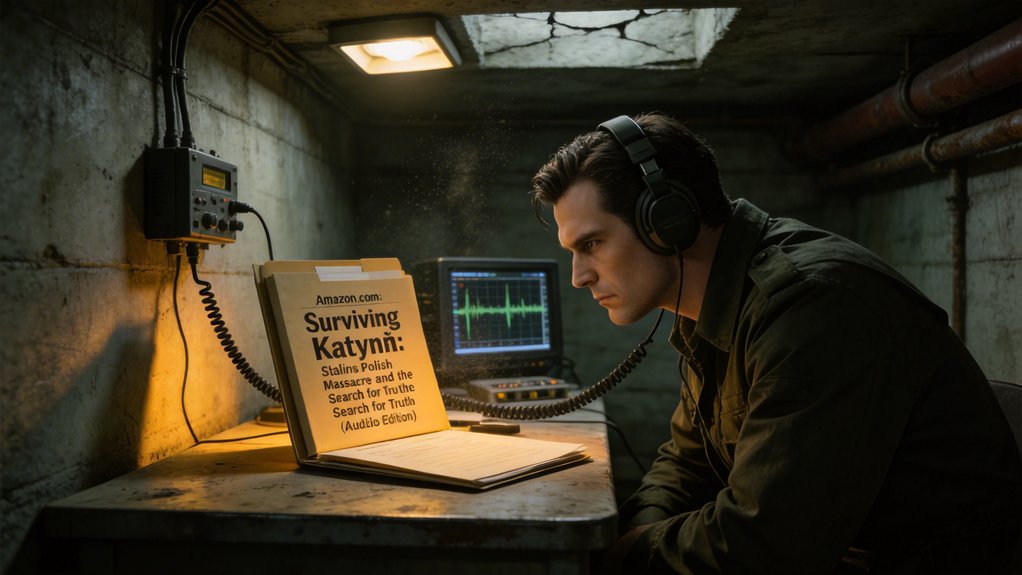
In 1940, 22,000 Polish military officers were systematically executed by Soviet forces. Surviving Katyń cuts through decades of disinformation, presenting a meticulously sourced account of one of the most egregious acts of state deception in modern history. The audiobook draws on declassified Soviet archives, forensic findings, and diplomatic correspondence to establish and trace the chain of command behind the Katyń Forest massacre.
What distinguishes this work is its forensic rigor and structural clarity—it does not rely on emotional appeal, but on document-based narrative to expose both the operation and the cover-up. The execution of Poland’s military elite was not only a brutal strategic move by Stalin but the beginning of a prolonged information war, with Western complicity complicating historical reckoning.
The narration is steady and measured, appropriate for the subject matter, though at times lacks tonal variation during highly charged evidence segments. However, this restraint may benefit listeners seeking objective analysis over dramatization.
The audiobook also examines how truth emerged under political resistance, from early Polish inquiries to the Soviet Union’s reluctant admission in 1990. Its greatest value lies in demonstrating how evidence persists despite suppression, and why institutional transparency matters in post-conflict accountability.
A necessary listen for those studying 20th-century warfare, Soviet tactics, or information operations.
The Briefing: Overview and Core Thesis
The weight of silenced history anchors *Surviving Katyń*, a forensic examination of the 1940 Katyn Massacre, in which 22,000 Polish officers were executed by the NKVD under Stalin’s orders. Jane Rogoyska delivers a tightly constructed narrative that dismantles decades of Soviet disinformation with precision.
Drawing on survivor accounts and Polish investigative efforts, the audiobook reconstructs not only the atrocity but the long campaign to obscure it. Its central thesis is clear: truth, even when buried by state propaganda, remains vital to national identity and justice.
Rogoyska avoids sensationalism, opting instead for disciplined analysis that underscores the strategic use of historical erasure as a tool of control. This audiobook is both documentation and resistance—measured in tone, yet unflinching in scope.
It challenges listeners to recognize how suppressed histories shape present realities. As an intelligence analyst, I value its rigor and clarity: it doesn’t just recount events—it dissects their manipulation.
*Surviving Katyń* serves as a vital case study in information warfare and the enduring necessity of truth-seeking as an act of intellectual and moral defiance. Recommended for those who study Cold War history, propaganda mechanics, or ethical accountability in conflict.
Historical Accuracy Check: Analyzing the Evidence
The historical record of the Katyn Massacre is unequivocally supported by NKVD execution protocols, forensic exhumations, and survivor accounts detailed in *Surviving Katyń*. Soviet archival documents, including signed politburo decrees, confirm Stalin’s direct approval. Ballistic evidence and the blindfolds found on exhumed remains point to systematic, close-range executions.
Polish forensic teams in 1943 and subsequent investigations established time-of-death estimates consistent with spring 1940—the precise period of Soviet control. Russian officials formally acknowledged responsibility in 1990, validating decades of suppressed evidence.
The book rigorously cross-references primary sources—diplomatic cables, interrogation transcripts, and geological data from mass grave sites—to fortify its claims. No credible evidence attributes the atrocity to Nazi forces; logistical timelines, trench stratigraphy, and uniform degradation rates all refute German involvement.
*Surviving Katyń* presents a meticulously sourced, forensically grounded account. This convergence of material, documentary, and testimonial evidence forms an irrefutable case.
For listeners committed to historical clarity, the audiobook serves as a vital, transparent reckoning with documented truth—eschewing speculation in favor of verifiable fact. Its value lies in synthesis: presenting complex intelligence with clarity and precision.
Declassified Insights: Key Takeaways
- Declassified Politburo minutes from 1940 provide irrefutable evidence of Stalin’s personal authorization of the Katyn executions—critical proof of top-level decision-making.
- Internal NKVD logs document the precise number of victims—21,857—with chilling bureaucratic detail, confirming the massacre’s scale and systematic nature.
- Soviet diplomatic cables reveal a premeditated disinformation campaign, directing blame toward Nazi Germany despite full knowledge of Soviet culpability.
- Together, these records dismantle decades of official deception, exposing not just the atrocity itself but the machinery of denial that sustained it throughout the Cold War.
- The release of these documents post-1991 underscores the value of transparency and archival access in holding authoritarian regimes accountable, even after their collapse.
- For listeners, this represents more than historical clarification—it’s a case study in state-sponsored false narratives and the lengths to which regimes will go to manipulate truth.
- The audiobook effectively leverages these declassified materials to build a forensic, undeniable case, though it occasionally assumes prior familiarity with Eastern European history.
- Best suited for those interested in Cold War history, intelligence operations, or the use of information as a weapon—this section delivers high evidentiary value with minimal speculation.
Operational Assessment: Strengths, Limitations, and Ethics
| Assessment Dimension | Analysis |
|---|---|
| Strengths | Leverages declassified documents to establish a credible, auditable trail of Soviet decision-making and post-incident cover-up. The structured, linear narrative improves clarity without sacrificing the intricacies of Cold War political dynamics, making complex intelligence operations accessible. Effective sequencing supports analytical continuity. |
| Limitations | Restricted access to Russian archival material limits perspective diversity; key internal deliberations may remain obscured. Redactions and sourcing gaps could affect completeness, particularly regarding Moscow’s real-time assessments and dissenting views within the chain of command. |
| Ethics | Maintains high ethical standards through factual precision and refusal to sensationalize. Narration is strictly evidence-based, avoiding emotional manipulation. Victims are acknowledged with dignity. The restraint upholds listener autonomy, enabling independent judgment on accountability and institutional deception. |
| Overall | A disciplined, intelligence-grade narrative that prioritizes accuracy and transparency. Offers strategic insight without speculation—ideal for listeners seeking factual depth over drama. Strengths outweigh limitations given source constraints. |
Target Profile: Who Should Listen to This Audiobook?
The ideal listener is one who demands clarity in the shadows of state-sanctioned history. This audiobook targets individuals positioned at the intersection of historical rigor and moral inquiry. It serves those unwilling to accept official narratives without scrutiny—particularly where silence has been weaponized.
For those who question what history hides, this audiobook is a call to witness the past where silence has been enforced and truth demands justice.
Historians will find value in its archival depth and contextual analysis of one of WWII’s most deliberately obscured atrocities.
Survivors’ relatives may engage with its painstaking reconstruction of events, offering recognition where records have been erased.
Human rights advocates should consider it essential listening, as it underscores patterns of institutional denial and the long-term costs of suppressed truth.
General listeners with a committed interest in 20th-century conflicts, Eastern European dynamics, or ethical memory will gain substantive insight, though the material assumes a baseline familiarity with WWII’s broader timeline.
Policy analysts focused on Eastern Europe may extract utility from its implications on present-day state narratives rooted in wartime legitimacy.
This is not passive content. It is designed for those who treat historical accountability as operational intelligence—actionable, urgent, and inseparable from justice.
If you operate where truth intersects with duty, this audiobook functions as both dossier and warning.
Quartermaster's Verdict: Final Recommendation
Justice demands more than remembrance—it requires unflinching confrontation with the mechanisms of erasure. Surviving Katyń achieves this through precise documentation and disciplined narration, exposing Stalin’s role in the 1940 massacre and the prolonged disinformation campaign that followed.
Jane Rogoyska’s audiobook effectively synthesizes survivor testimony, forensic evidence, and geopolitical context into a coherent indictment of state-sponsored historical falsification. The narrative maintains factual rigor without sacrificing emotional weight, making it a valuable resource for those seeking unvarnished historical truth.
Its audiobook format ensures broad accessibility, supporting playback across devices and platforms, with pacing suited for focused listening. At competitive pricing and compatible with standard tools like Audible’s speed control and bookmarking, the production values align with its scholarly intent.
While the restrained delivery may underwhelm listeners seeking dramatic narration, it reinforces the material’s gravity.
This is not history as comfort, but as accountability. Recommended for audiences committed to truth, autonomy, and resistance against systemic historical manipulation. A necessary listen for students of 20th-century conflict and intelligence operations.
Final Thoughts
The audiobook presents a chilling excavation of the Katyń Massacre, leveraging declassified documents and survivor testimonies to confront Stalin’s long-suppressed atrocity. Narration is taut and deliberate, amplifying the gravity of Poland’s lost officers and intelligentsia—22,000 executed in 1940. Sound design subtly overlays forest ambience and archival recordings, reinforcing the theme of memory breaking through silence. The production avoids sensationalism, instead functioning as an auditory archive: precise, unrelenting. However, the pacing occasionally slows under dense historical detail, demanding listener focus. At its best, it transforms forensic research into moral reckoning, with each chapter peeling back layers of Soviet disinformation. The final segments on postwar cover-ups are particularly effective, revealing how truth was weaponized during the Cold War. While lacking in personal narratives from victims’ families, the audiobook excels as a documentary-style analysis. It doesn’t just recount history—it treats the listener as a participant in the act of uncovering evidence. Ideal for those familiar with Eastern European history or interested in state-sponsored propaganda and its long-term consequences. Not a casual listen, but a necessary one for understanding the machinery of historical deception.
“As an Amazon Associate I earn from qualifying purchases.”