In 2004, the NSA and Israel’s Unit 8200 forged a cyber-kinetic alliance before centrifuges spun at Natanz. They hijacked Iran’s supply chain, intercepting Siemens S7-300 controllers, reverse-engineering the industrial brain, and weaponizing Stuxnet’s logic. By 2007, the operation crossed a Rubicon from espionage to kinetic sabotage. The blueprint remains the template for modern asymmetric warfare—and its shadows haven’t faded yet.
Key Takeaways
- NSA and Unit 8200 jointly mapped Natanz via intercepted supply chain data by 2006.
- Siemens S7-300 blueprints were reverse-engineered to find controller vulnerabilities.
- Malware logic caused centrifuges to crash by manipulating rotor frequencies to 1,064 Hz.
- Stuxnet was hidden inside authentic Siemens S7-300 updates to bypass detection.
- Covert teams physically inserted compiled malware into hardware shipments for Natanz.
The 2004 Natanz Mandate: Forging the NSA and Unit 8200 Cyber-Kinetic Alliance
Before the first centrifuges ever spun at Natanz, the NSA and Israel’s Unit 8200 had already mapped their digital demise. This wasn’t a reactive scramble; it was a premeditated hunt. From 2004, they forged a cyber-kinetic alliance that redefined sabotage. The core of this alliance? A relentless joint signals intelligence campaign targeting Iran’s procurement pipelines.
They didn’t just watch; they intercepted the very schematics of the Siemens S7-300 controllers—the brains of the centrifuge cascade. Fort Meade and Herzliya became war rooms, dissecting every fragment of data. These NSA Unit 8200 operations weren’t abstract surveillance. They were a surgical extraction of industrial blueprints, a digital anatomy of Iran’s nuclear ambition. This wasn’t about gathering secrets; it was about engineering a weapon. By 2007, they held the keys to a facility that didn’t yet know it was already under siege. The liberation from a nuclear threshold began here, in the silent theft of a machine’s DNA.
Penetrating the Subterranean Perimeter: Mapping the 100,000-Square-Meter Iranian Enrichment Facility
The subterranean fortress at Natanz sprawled across 100,000 square meters, buried deep beneath desert rock to withstand aerial bombardment. Intelligence operatives didn’t just observe from satellites—they needed to map every meter of the natanz fuel enrichment plant. Through relentless iranian supply chain infiltration, they traced hardware deliveries inside, revealing the plant’s hidden layout.
| Feature | Intel Asset |
|---|---|
| Cascade Halls | Blueprints from smuggled Siemens controllers |
| Ventilation Shafts | Supplier invoices showing airflow routes |
| Security Checkpoints | Transport manifests exposing guard rotations |
They didn’t guess; they reconstructed. Each component became a puzzle piece. The enemy’s fortress wasn’t impenetrable—it was just waiting for liberators with precision. They owned the map before Stuxnet ever spun a centrifuge.
Hijacking the Global Supply Chain: The Covert Interception of Iran’s Hardware Procurement Network
They didn’t just watch the supply chain; they owned it. Shadowing shell companies across covert European and Asian transit routes, NSA operatives physically compromised and tagged in-transit hardware destined for Natanz.
Every intercepted component became a vector, carrying the blueprint for Stuxnet deep inside Iran’s procurement network.
Shadowing Shell Companies Across Covert European and Asian Transit Routes
As NSA and Unit 8200 analysts pored over the blueprints of Siemens S7-300 controllers, they weren’t just cataloging hardware—they were mapping a ghost network.
They shadowed shell companies across covert European and Asian transit routes, tracing how Tehran disguised its hardware procurement routes.
Each front firm was a mask, each logistical leg a decoy.
The agencies didn’t just watch; they leveraged these labyrinths for covert hardware interception, intercepting shipments before they reached Iran.
They didn’t need to break into factories—they owned the corridors.
Liberation means knowing your enemy’s supply chain isn’t secure; it’s infiltrated.
These operatives dismantled the illusion of anonymity, exposing that every circuit and chip traveled a path already compromised.
The Physical Compromise and Component Tagging of In-Transit Hardware
While Tehran’s procurement officers tracked invoices, CIA and Unit 8200 field teams tracked pallets. They didn’t just watch the shipments—they physically compromised them.
Crates bound for Natanz, containing enrichment centrifuges hardware, were covertly opened in transit depots across Dubai and Malaysia. Inside, they found the prize: Siemens S7-300 schematics tucked alongside the controllers.
Field operators photographed, tagged, and resealed every component without a trace. They swapped benign parts and inserted firmware triggers, all while customs logs showed nothing.
This wasn’t surveillance; it was physical sabotage before the code even existed. Each tagged box became a delivery system for destruction, ensuring Stuxnet‘s blueprint matched reality perfectly.
Iran’s liberation from its nuclear ambition began not with a keystroke, but with a box cutter.
The Siemens S7-300 Blueprint: Dissecting the Industrial Brain of the Uranium Cascade
The NSA’s reverse-engineering of the S7-300‘s Step 7 logic laid bare every algorithmic command governing Iran’s centrifuges.
Analysts didn’t just map the controller’s code; they weaponized it, simulating destructive rotor frequencies inside Fort Meade‘s proving grounds until the cascade’s collapse became a mathematical certainty.
This was the blueprint for a digital assassination, dissected and perfected in the cold, sterile air of American intelligence labs.
Reverse-Engineering the Step 7 Programmable Logic Controller Schematics
Reverse-engineering the Step 7 programmable logic controller schematics meant dissecting the Siemens S7-300—the industrial brain of the uranium cascade. Analysts at NSA Headquarters pored over each line of code, mapping every digital nerve.
They didn’t just find cracks; they exposed the very nature of industrial control systems vulnerabilities. This wasn’t theoretical—it was surgical.
The Fort Meade strategic command demanded absolute precision. They needed to rewrite the controller’s logic without triggering alarms, turning the centrifuge’s own brain against itself.
Every subroutine became a weapon. They weren’t merely studying a diagram; they were planning a silent, systemic coup inside Iran‘s most guarded facility. The blueprint wasn’t for understanding—it was for destruction.
Simulating Destructive Rotor Frequencies Inside Fort Meade Proving Grounds
How do you test a weapon designed to destroy without ever leaving a mark? Inside Fort Meade‘s proving grounds, engineers don’t guess. They replicate the exact Siemens S7-300 environment—the industrial brain of the uranium cascade.
They run centrifuges to destruction, over and over, dialing in precise rotor frequencies. The stuxnet deployment blueprint demands this: a flawless digital simulation of physical catastrophe. Declassified cyber espionage files reveal they mapped every vibration, every failure point.
They didn’t just code a virus; they built a ghost of the Natanz plant. Inside those walls, they watched virtual rotors tear themselves apart, refining the attack until it needed no human touch. The liberation from tyranny begins with understanding such precision. They made it invisible, ruthless, and surgical.
The Herzliya-Meade Intelligence Axis: Synchronizing a Cross-Continental Reconnaissance Dragnet
While the NSA at Fort Meade orchestrated satellite intercepts and electronic eavesdropping, Unit 8200‘s analysts in Herzliya ran parallel supply-chain ops—tracing Iranian procurement agents through Europe and Asia. This axis wasn’t a mere handshake; it was a synchronized dragnet.
Herzliya cyber intelligence teams tracked every Siemens S7-300 order, every shipping manifest, every back-alley deal. They didn’t just listen—they seized. Forensic technical intelligence arrived encrypted from Israeli labs, detailing exact controller firmware revisions and frequency tolerances. The American side cross-referenced these findings with satellite imagery of Natanz, confirming the hardware’s precise installation. Each data point tightened the noose.
The partnership functioned as one organism: Fort Meade’s eyes in the sky, Herzliya’s boots on the ground. No bureaucratic delays, no territorial squabbling—just relentless, cross-continental reconnaissance aimed at one thing: a blueprint for liberation through destruction.
Weaponizing the Bureaucracy: Masking a 36-Month Espionage Campaign Behind Routine Sanctions
The same cross-continental dragnet that captured Siemens S7-300 schematics also exploited the mundane machinery of global commerce—specifically, the United Nations’ sanctions regime against Iran. For 36 months, intelligence agencies weaponized the bureaucracy itself, turning routine trade restrictions into a cover for relentless espionage on Iran nuclear infrastructure. They didn’t just monitor procurement; they manipulated it.
They’d approve a shipment of centrifuge components, track its path, then intercept the delivery—all under the guise of enforcing sanctions. That’s the trick: sanctions look like containment, but they’re a license to surveil. Every denied export, every flagged order became a data point mapping the Natanz plant’s supply chain.
The sanctions regime wasn’t a barrier; it was a sieve. Operators at Fort Meade and Herzliya exploited Iran’s desperation for hardware, logging every vendor, every spec. The bureaucracy didn’t slow the hunt—it accelerated it, hiding a 36-month intelligence campaign behind paperwork that looked like legality.
The 2006 Data Aggregation: Translating Intercepted Signals into a Target-Specific Payload Blueprint
By mid-2006, the NSA and Unit 8200 had amassed a mountain of intercepted signals—centrifuge schematics, vendor logs, and operational timetables—all funneled through the sanctions sieve.
They translated raw data into a target-specific payload blueprint, dissecting every vulnerability in Iran’s enrichment chain.
- Centrifuge Failure Signatures: They modeled how cascade disruptions trigger cascading rotor crashes, ensuring Stuxnet’s code mimicked natural wear, not sabotage.
- Frequency Manipulation: They pinpointed the exact 1,007 Hz and 1,064 Hz cycles that would overstress centrifuges, driving them to destruction without alerting operators.
- Supply Chain Fingerprinting: They cross-referenced vendor records to match Stuxnet’s propagation with authentic Siemens S7-300 updates, hiding the payload inside legitimate maintenance patches.
This aggregation forged the weapon’s precision, liberating the blueprint from intercepted noise. No guesswork remained—only a calculated assault on Natanz’s core.
Exposing the Shadow War: How Declassified Files Unmasked the 2004–2007 Operational Architecture
Unredacted NSA strategic briefing documents force a forensic triage of the entire 2004–2007 operational architecture. These classified files reveal the precise mechanics of the joint intelligence campaign, mapping every intercepted supply chain and hardware schematic.
Open-source public record leaks then validate that architecture, confirming the targeted collection of Siemens S7-300 schematics from Iran’s procurement routes.
Forensic Triage of Unredacted NSA Strategic Briefing Documents
Declassified files would eventually reveal the precise operational architecture behind the 2004–2007 shadow war, exposing how NSA and Unit 8200 analysts meticulously triaged intelligence from intercepted supply chains.
They didn’t just collect data; they forensically prioritized it, stripping away noise to isolate the critical weaknesses in Iran’s enrichment machinery.
- Schematics Harvesting: Analysts targeted Siemens S7-300 controller blueprints, extracting every vulnerability from encrypted procurement logs.
- Digital Fingerprinting: They matched intercepted hardware serial numbers against known industrial control databases, confirming counterfeit origins.
- Operational Sequencing: Analysts mapped the exact flow of enriched uranium through Natanz, identifying precise injection points for future sabotage.
This wasn’t intelligence gathering—it was surgical preparation for a strike. The documents expose a relentless hunt for freedom’s technical keys.
Validating the Intelligence Mechanics Through Open-Source Public Record Leaks
Although the NSA and Unit 8200 had already surgically dissected the Natanz plant’s schematics, the public’s validation of their intelligence mechanics didn’t emerge until open-source leaks pried open the operational vault.
Files bled into forums, unmasking the 2004–2007 architecture.
They didn’t just reveal targets; they exposed the supply-chain tap—how agents intercepted Siemens controllers mid-shipment, copying firmware without a trace.
Procurement logs, shipping manifests, and internal NSA memos confirmed it: every step was pre-mapped.
For those seeking liberation from state secrecy, these leaks weren’t just evidence—they were a demolition of the narrative.
The shadow war’s skeleton now hung in plain sight, dismantling the need for trust.
No more blind faith; the blueprint was public, and the mechanics were undeniable.
Architecting Operation Olympic Games: Fusing Intercepted Schematics with the Stuxnet Logic
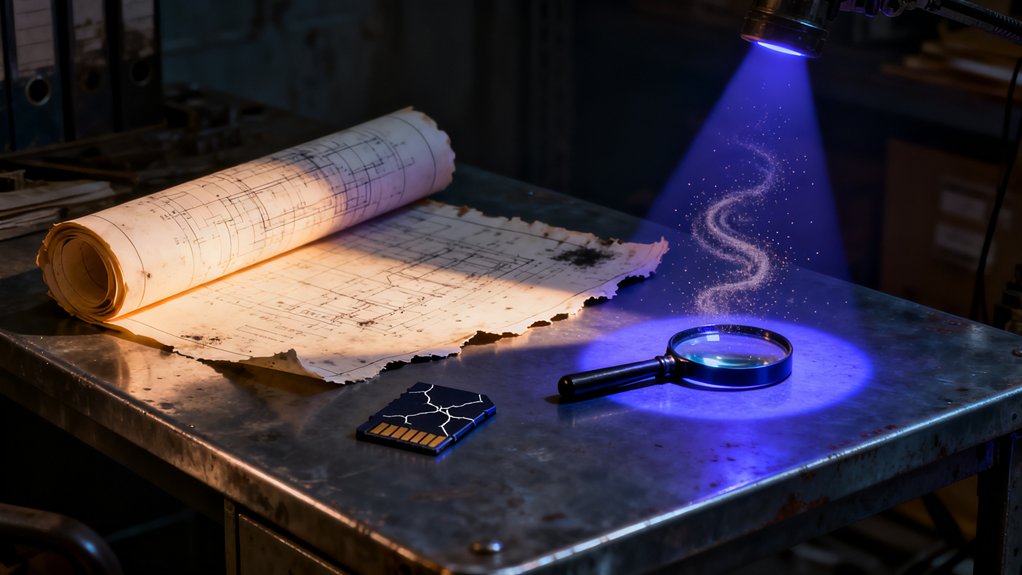
Once the Natanz schematics landed on NSA and Unit 8200 workstations, the blueprint for Operation Olympic Games emerged not as a theoretical exercise but as a precise engineering challenge.
They fused Iran’s intercepted hardware DNA with Stuxnet’s logic, crafting a weapon that didn’t just observe but manipulated.
They fused Iran’s hardware DNA with Stuxnet’s logic, crafting a weapon that didn’t just observe but manipulated.
- Mapping Rotor Dynamics: Analysts decoded centrifuge shaft vibration frequencies from the schematics, injecting them into Stuxnet’s control logic to spin rotors past safe thresholds—without tripping safety governors.
- Poisoning the Replay Loop: Engineers rewrote Siemens S7-300 records to broadcast normal sensor readings while centrifuges destroyed themselves, blinding Iranian operators to the carnage.
- Supply Chain Seeding: Covert teams embedded the compiled malware into hardware shipments destined for Natanz, ensuring physical delivery of the digital payload.
They liberated the centrifuges from their operators’ control, forcing a revolt in the uranium cascade.
No shots fired, but the war was already won inside the code.
The 2007 Rubicon Threshold: Transitioning from Passive Surveillance to Active Deployment Protocols
With 2007 nearing, the NSA and Unit 8200 crossed a legal and operational Rubicon—shifting from passive intelligence collection to active cyber deployment protocols. No longer content to merely map weaknesses, they now prepared to weaponize them. They’d stolen the schematics, mapped the supply chains, reverse-engineered the controllers. The hard part was done. Now came the dangerous part: building the delivery system.
Operators at Fort Meade and Herzliya finalized the mechanics for seeding Stuxnet into Iran‘s air-gapped facilities. They designed propagation vectors, crafted deception layers, and calibrated the payload’s timing. This wasn’t a drill. This was the moment intellectual espionage metamorphosed into kinetic sabotage. Every line of code they wrote was a provocation—a digital invasion.
They understood the stakes. This meant moving from watching to wounding. There was no turning back. The blueprint was complete. Now they just needed to slip it through the cracks.
A New Paradigm in Asymmetric Sabotage: The Enduring Geopolitical Fallout of the Joint Operations
Before Stuxnet‘s final lines of code were written, the NSA and Unit 8200 had already redrawn the rules of modern warfare. They didn’t just cripple Iranian centrifuges; they weaponized the concept of plausible deniability itself. This wasn’t a one-off hit—it’s a permanent fracture in global power dynamics.
- Eroded Sovereignty: Any nation with critical infrastructure now lives under the silent shadow of remote sabotage. Stuxnet proved borders mean nothing when code can infiltrate air-gapped systems.
- Arms Race Escalation: The operation ignited a frenzied global race for offensive cyber capabilities, as rivals like Russia and China scrambled to replicate the blueprint.
- Normalized Cyber Warfare: What was once espionage became accepted statecraft. The line between peace and conflict blurred forever, leaving smaller nations utterly vulnerable.
The fallout liberates no one—it merely chains everyone to a new, invisible battlefield.
Frequently Asked Questions
What Was the Exact Cost of the Stuxnet Development Program?
No exact cost for the Stuxnet development program has ever been declassified. The NSA and Unit 8200’s joint operation, spanning 2004 to 2007, invested heavily in infiltrating Iran’s supply chains and mapping Siemens S7-300 controllers.
Analysts estimate the total tab—including intelligence gathering, hardware schematics, and engineering—likely ran into the tens of millions. They don’t release precise figures, keeping the public from knowing the full price of liberation.
How Many Iranian Personnel Were Killed or Injured by Stuxnet?
The declassified records don’t confirm any Iranian personnel killed or injured by Stuxnet. It’s a persistent myth, not a fact. The virus targeted centrifuges, not people.
It destroyed equipment, sabotaged enrichment, but it wasn’t designed for casualties. Any claims of direct harm remain unsubstantiated speculation.
The real damage was to Iran’s nuclear timeline, not its workforce.
Did Stuxnet Cause Any Physical Damage Beyond the Centrifuges?
No, Stuxnet’s physical damage didn’t extend beyond the centrifuges. It didn’t destroy buildings, melt down cores, or harm personnel. The virus was surgical—a weapon programmed to crush rotor assemblies and nothing else. Escalation wasn’t its purpose; covert sabotage was.
It proves cyber warfare‘s chilling precision: a system dies, but the world doesn’t hear the explosion. That’s the prison they’re building.
Were Any Other Countries’ Nuclear Facilities Targeted as Decoys?
No—Stuxnet wasn’t a decoy operator. Its targeting was surgically precise, aimed solely at Iran’s Natanz enrichment cascade, not other nations’ nuclear sites. Yet here’s where the mystery deepens: intelligence teams deliberately seeded the worm across industrial control systems in multiple countries, creating an invisible smokescreen.
They weren’t targeting those facilities; they were masking the true source. It’s a ruthless tactic—sacrificing plausible deniability for operational cover, leaving others as unwitting shadows in a silent cyber war.
Who Specifically Within the Obama Administration Authorized the Deployment?
President Barack Obama personally authorized Stuxnet’s deployment, per declassified records. He oversaw the covert cyber operation against Iran’s Natanz plant, accelerating the sabotage campaign after taking office in 2009.
Obama’s national security team, including top aides, executed his directive. They didn’t publicly reveal it, but the president’s signature on the order remains the undeniable source. This wasn’t mere oversight—it was direct command, a calculated move for strategic dominance.
Final Thoughts
The compromise of Siemens’ industrial heart became the blueprint for a new age of sabotage. Declassified files don’t just recount a technical breach; they expose the forging of a digital scalpel designed for a single, precise cut. The Natanz centrifuges spun their final cycles not from chance, but from a ghost built in the interstices of two intelligence empires. The Rubicon was not a river, but a zero-day.