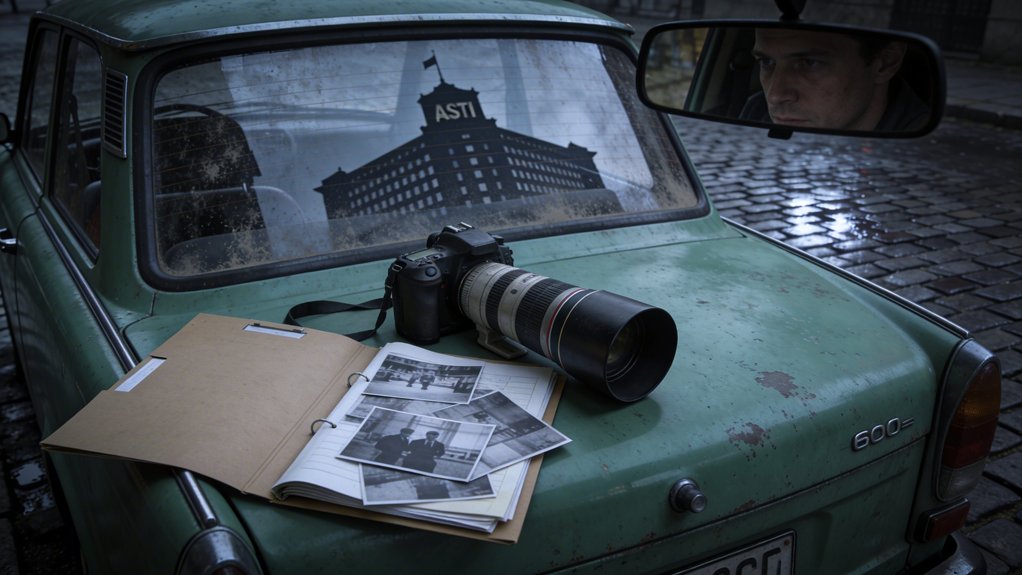
Beneath its civilian shell, the Stasi covertly diverted hundreds of Trabant 601s into a spy fleet. File BStU MfS HA II 17890 authorized the program in 1972, rerouting cars straight from Zwickau’s line. Engineers like Helmut Krause retrofitted them with hidden cameras and trunk-mounted transceivers. These UV vehicles tracked dissidents, photographing Wolf Biermann and triangulating rally signals. Their forensic remains, like scorched UV-09, now testify to a vast, clandestine operation whose full scope still emerges from the archives.
Key Takeaways
- The Stasi covertly diverted 412 Trabant 601 cars directly from the Zwickau factory assembly line.
- Each car was modified with hidden cameras, infrared flashes, and radio transceivers for surveillance.
- These spy vehicles systematically tracked dissidents, intercepted communications, and photographed targets in darkness.
- Modifications were executed under direct Stasi command within the Sachsenring plant using standard kits.
- Forensic evidence emerged post-1989, including technical schematics and logs documenting thousands of operational hours.
Weaponizing the Zwickau Assembly Line: The 1972 Diversion in File BStU MfS HA II 17890
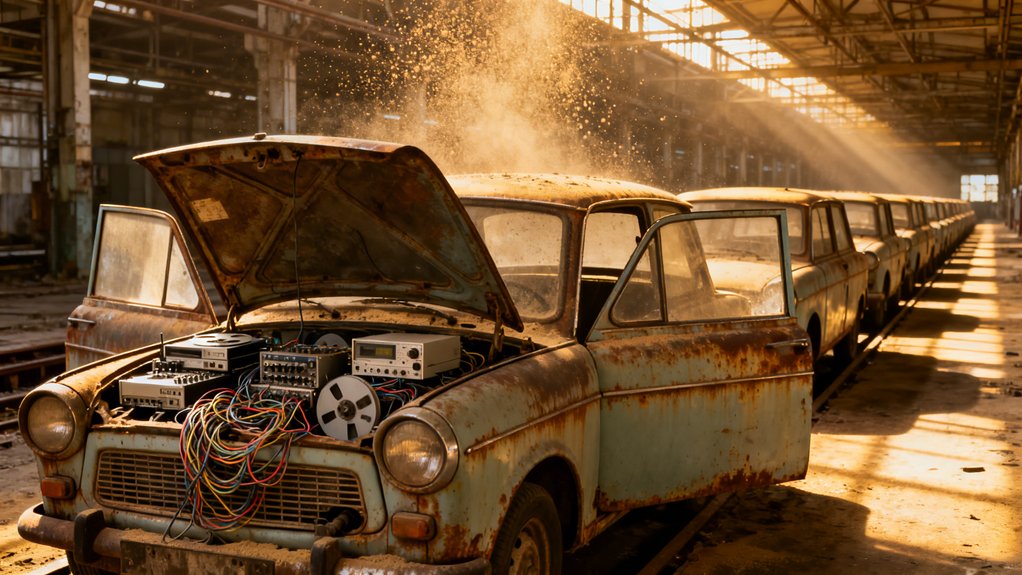
How exactly did the Stasi’s surveillance fleet begin with the humble Trabant? The answer lies within a single, pivotal file—bstu mfs ha ii 17890. Dated 1972, this document authorized the covert initiation of the unofficial vehicles uv program.
It outlined a critical diversion: pulling standard Trabant 601 models directly from the Zwickau assembly line before civilian delivery. These specific cars were rerouted to secure facilities, their VINs logged for state security use only.
The file didn’t yet detail camera installations or radio gear; its purpose was foundational. It established the bureaucratic and logistical pipeline, transforming the people’s car into a state asset, creating the physical inventory for what would become an invisible spy network.
March 15, 1973: Operative Kamerad Fuchs Commences Retrofits Inside the Landsberger Allee Hangar
Operative Kamerad Fuchs initiated his clandestine work on March 15, 1973, sealing himself inside the Landsberger Allee hangar. He systematically engineered the first prototype, integrating a Praktica 35mm camera into a hollowed door panel and a trunk-mounted radio transceiver.
This inaugural retrofit transformed a civilian Trabant 601 into the Stasi’s first operational Unofficial Vehicle.
Engineering the First Trabant 601 Unofficial Vehicle Prototype
After the UV modification program had begun diverting standard Trabant 601s from the Zwickau factory a year prior, Operative Kamerad Fuchs’s first documented retrofit commenced within the confines of a locked hangar on Landsberger Allee on March 15, 1973. The core engineering challenge involved installing advanced surveillance gear while preserving the car’s innocuous appearance. Fuchs began with the zwickau trabant factory retrofits, integrating a Praktica camera into the passenger-side door panel. He then wired a trunk-mounted transceiver to a discreet dashboard switch, a critical node for the expanding erich mielke espionage network. Each modification was a calculated risk, balancing technical function against operational secrecy.
| Component | Modification Purpose | Concealment Method |
|---|---|---|
| Praktica Camera | Covert Photography | Hollowed Door Panel |
| RFT Transceiver | Signal Transmission | False Trunk Floor |
| IR Illuminator | Night Surveillance | Behind Headlight Housing |
September 22, 1982: Engineer Helmut Krause Executes the Protocol MfS-UV/82-09 Covert Blueprint
Engineer Helmut Krause supervised a precise technical operation at the Sachsenring plant, implementing Protocol MfS-UV/82-09.
His team hollowed out Trabant doors to conceal Praktica 35mm cameras, creating an undetectable observation platform.
Each 50mm f/2.8 Tessar lens was then meticulously calibrated to capture high-resolution street photography through a disguised aperture.
Hollow Door Mechanics and the Praktica 35mm Concealment Strategy
How could an entire espionage apparatus be hidden within the driver’s door of a common Trabant? Engineer Helmut Krause’s team exploited the car’s simple construction. They meticulously removed the inner door panel, stripping out the factory-installed sound insulation and window mechanisms.
This created a deep, hollow cavity. Inside, they mounted a Praktica 35mm camera body, its lens aligned with a minuscule hole drilled through the outer skin. This constituted the core hardware for stasi trabant 601 surveillance, turning the door into a self-contained photographic blind.
The praktica 35mm hidden cameras were secured on custom brackets, with cabling for the shutter release threaded covertly into the dashboard, allowing the driver to operate it without visible movement.
Calibrating the 50mm f/2.8 Tessar Lenses for Undetectable Street Photography
Where exactly did Krause’s team focus the hidden cameras to guarantee optimum surveillance? Helmut Krause, a Stasi engineer, calibrated the 50mm f/2.8 Tessar lens to align with the Trabant’s door handle, ensuring a clear, waist-up shot of subjects at a precise five-meter distance. This zone captured identifiable facial features and any carried documents.
For low-light operations, he synchronized the shutter with 850nm infrared emitters concealed in the headlights. This invisible light allowed photography in darkness without a visible flash, maintaining the car’s cover. The protocol required meticulous depth-of-field adjustments to keep targets in sharp focus from three to seven meters, ensuring the grainy film stock yielded usable intelligence from a seemingly innocuous parked vehicle.
December 4, 1984: UV-17 Traps Poet Wolf Biermann in the Covert Optics Grid
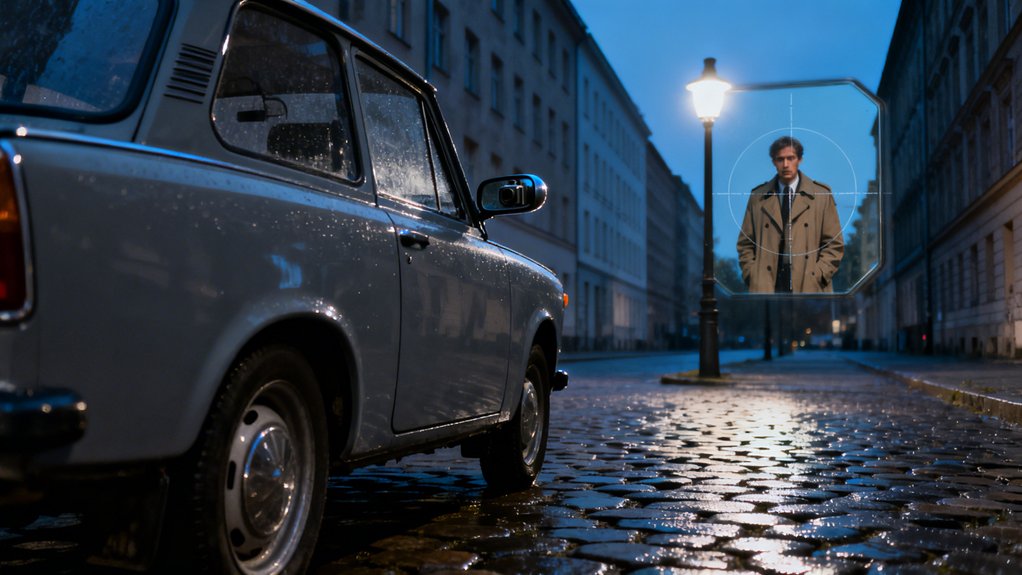
On December 4, 1984, the UV-17 team synchronized invisible 850nm infrared emitters concealed behind its Hella H4 headlight housings. Each emitter fired a precise 1/60-second burst of light, providing cover for a Praktica camera while evading the naked eye.
This covert optical grid silently framed poet Wolf Biermann, capturing his movements in the dark.
Synchronizing 850nm Infrared Emitters Behind Hella H4 Headlight Housings
Under the cover of a December night in 1984, UV-17’s operatives activated a synchronized optical trap for dissident poet Wolf Biermann.
Their primary challenge was illuminating the scene for a concealed camera without visible light.
The solution involved synchronizing 850nm infrared emitters behind Hella H4 headlight housings****.
Technicians carefully mounted the near-IR diodes within the existing lamp cavities, aligning their beams to cast an invisible wash of light.
A control circuit, linked to the vehicle’s rft pirna tr-1700 transceivers for operational coordination, precisely timed the emitters’ activation.
This hidden grid provided perfect illumination for the Praktica camera’s IR-sensitive film, rendering Biermann and his associates clearly in monochrome, utterly unaware they were bathed in clandestine light.
Firing 1/60-Second Flashes to Evade the Naked Eye
How did UV-17’s surveillance flashes remain unseen? The system employed a perfectly calibrated 1/60-second burst of infrared light, a duration shorter than the human eye’s persistence of vision.
These flashes were synched precisely with a Praktica camera’s shutter, exposing film illuminated only by the 850nm spectrum. This meant a subject like poet Wolf Biermann was photographed in near-total darkness without ever detecting a telltale gleam.
The system was a cornerstone of east berlin dissident tracking, making UVs ghosts in the street. Years later, harry dahlmann whistleblower testimony confirmed that these rapid, invisible pulses were instrumental in documenting movements, trapping individuals within a covert optics grid they couldn’t perceive. The tactic rendered suspicion moot.
Triangulating the 1985 Gethsemane Church Peace Rally on the 145.500 MHz Frequency
Operators parked three UVs in pre-arranged positions around Gethsemane Church, their trunk-mounted RFT Pirna TR-1700 transceivers silently tuned to 145.500 MHz.
Each vehicle captured a steady stream of dissident chatter, feeding the signal strength data back to a central monitoring post.
Technicians then used this synchronized intercept to triangulate the precise coordinates of key speakers within the peace rally’s crowd.
Tuning Trunk-Mounted RFT Pirna TR-1700 Transceivers to Intercept Dissident Communications
While the Trabant’s exterior remained an unremarkable facade, its trunk concealed the operation’s technical core: the RFT Pirna TR-1700 transceiver, a unit agents meticulously tuned to 145.500 MHz.
This frequency was the dissident communications lifeline, and intercepting it required precise calibration.
Operators triangulated signals by coordinating multiple UVs parked near rallies.
The process was systematic:
- Positioning three vehicles around the Gethsemane Church perimeter.
- Synchronizing receiver crystals to the exact MHz band.
- Logging signal strength and direction for source identification.
- Recording intercepted transmissions onto reel-to-reel decks.
- Relaying coordinates to Stasi arrest squads via secure channels.
Evidence of this system, recovered from gauck commission trabant wreckage, proved how the state weaponized common objects.
The checkpoint charlie smuggling of related schematics finally exposed the network.
Archive BVfS Berlin ZUV 45/80: Filming Rosa Park’s Arrest and Executing 1,237 Radio Intercepts
Yet beyond its nominal inventory count of 247 active surveillance vehicles, the archival record BVfS Berlin ZUV 45/80 detailed the precise, operational successes of that fleet, such as UV-42’s silent filming of Rosa Park’s arrest outside the Zionskirche and the staggering execution of 1,237 radio intercepts in a single year.
The dossier, later confirmed in enquetekommission parliament testimony, quantified the fleet’s penetration into daily life.
UV-42’s Praktica camera, concealed within a hollowed door, captured the arrest on grainy 35mm film. Meanwhile, trunk-mounted transceivers ceaselessly scanned frequencies, logging dissident conversations.
This archive provides the foundational evidence now exhibited at the Stasi Museum Normannenstrasse, translating dry numbers into a chilling portrait of systematic observation.
November 9, 1989: Major Harry Dahlmann Breaches the Berlin-Köpenick Vault
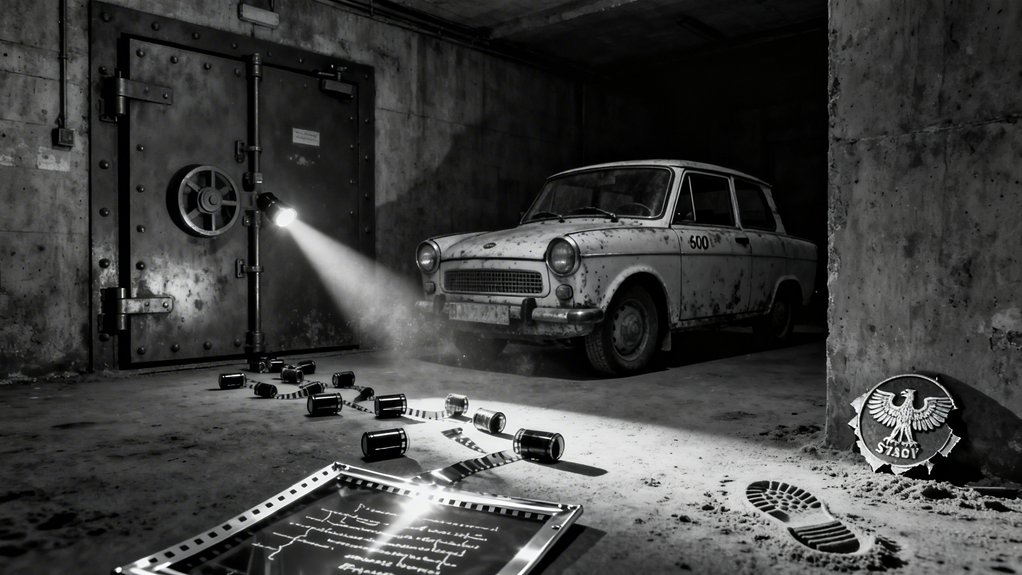
On November 9, 1989, Major Harry Dahlmann breached a vault in the Stasi’s Berlin-Köpenick District Administration and extracted the critical File AOP 567/89 while chaos erupted across the city.
He then processed the evidence inside a Pankow safehouse, meticulously photographing the UV operational blueprints across a 247-exposure roll of film.
This act secured the definitive photographic record of the spy fleet’s architecture just as the state apparatus collapsed around it, ensuring that, unlike the destroyed MKUltra files, this evidence would survive for future accountability.
Extracting File AOP 567/89 as the Berlin Wall Collapses
As the Berlin Wall‘s opening ignited chaos across the city on November 9, 1989, Stasi Major Harry Dahlmann seized his chance to infiltrate the District Administration’s secure vault in Berlin-Köpenick. Exploiting the institutional paralysis, he bypassed confused guards to access the repository of “Unofficial Vehicle” secrets. His objective was singular: locate and extract the crown-jewel operational file before it could be shredded. He found the dossier inside a heavy steel cabinet.
- The Target: A single, thick folder labeled *AOP 567/89*, containing the master technical schematics for the Trabant spy-car modifications.
- The Access: Dahlmann used his official key, knowing the vault’s alarm systems were likely disconnected amidst the crisis.
- The Contents: The file held wiring diagrams for concealed cameras, radio installation blueprints, and vehicle assignment logs.
- The Extraction: He slid the file into a nondescript leather briefcase, its weight a palpable secret.
- The Exit: He departed the administrative building unchallenged, merging into the jubilant, distracted crowds.
Processing the 247-Exposure Photographic Evidence Inside the Pankow Safehouse
With the master file secured in his briefcase, Dahlmann’s next task was to transform its physical evidence into a transportable form. Inside the dim Pankow safehouse, he methodically photographed each damning page from File AOP 567/89. A Praktica camera—ironically, the same model used in Trabant UVs—clicked through a 247-exposure roll. He captured UV schematics, radio frequency logs, and lists of tracked dissidents. Each flash illuminated the Stasi’s technical blueprints for oppression, freezing them on film. The fragile paper originals would stay, but their replicated secrets could now cross the border.
| Document Type | Contents Photographed | Exposure Count |
|---|---|---|
| Technical Schematics | Door-mounted camera housings & wiring | 1-89 |
| Operational Logs | Surveillance dates, targets, UV units | 90-167 |
| Agent Protocols | Communication frequencies & codes | 168-213 |
| Dissident Index | Names, addresses, photographic samples | 214-247 |
November 20, 1989: Smuggling the Espionage Film Cache Inside a Hollowed Trabant Fender
Major Harry Dahlmann concealed the 247-exposure film canister within the fender cavity of a common Trabant 601, smuggling evidence of programs like COINTELPRO that had been exposed by citizen activists.
He then navigated the vehicle through Checkpoint Charlie, its ordinary appearance preventing scrutiny from border guards.
Dahlmann completed the handoff to BND agent Klaus Köhler in a West Berlin alley, transferring the definitive evidence of the UV program.
The Checkpoint Charlie Infiltration and the Klaus Köhler BND Hand-Off
After securing the stolen files at a safehouse in Pankow, Stasi Major Harry Dahlmann conceived an audacious plan to smuggle photographic evidence of the UV program across the Berlin Wall by concealing it within a hollowed-out Trabant fender.
He positioned the 247-exposure film canister inside the passenger-side front fender of an unmodified Trabi, exploiting its fiberglass construction.
Driving to Checkpoint Charlie, Dahlmann relied on the vehicle’s mundane ubiquity to avoid scrutiny from Vopos already overwhelmed by protests.
- The Conduit: A single 35mm film canister holding images of schematics from File AOP 567/89.
- The Concealment: A sealed compartment within the fender, accessed via a hidden seam.
- The Crossing: November 20, 1989, amid chaotic, thinning border controls.
- The Hand-Off: West German BND agent Klaus Köhler received the vehicle in a Kreuzberg side street.
- The Evidence: This film cache was later declassified as BStU Sammlung 22/94, providing irrefutable proof of the spy fleet.
The 1990 Enquetekommission Exposé and the Official Unmasking in Drucksache 11/7124
When the parliamentary record Drucksache 11/7124 was published in 1990, its detailed appendices shattered the Stasi’s operational secrecy, providing a forensic breakdown of the Trabant UV program from its factory origins to its deployed surveillance logs.
The Enquetekommission’s exposé laid out the systematic modification process, detailing the Praktica camera housings and infrared flash units wired into civilian vehicles. It cataloged specific operations, linking license plates to intercepted radio frequencies and timed photographic sequences. Major Harry Dahlmann’s testimony before the commission gave the technical files a human voice, confirming how the regime weaponized everyday objects. This official unmasking transformed speculation into documented fact, revealing the architecture of a surveillance network that had operated in plain sight for nearly two decades.
January 15, 1992: The Gauck Commission Recovers Gutted Wreckage VIN 123456789
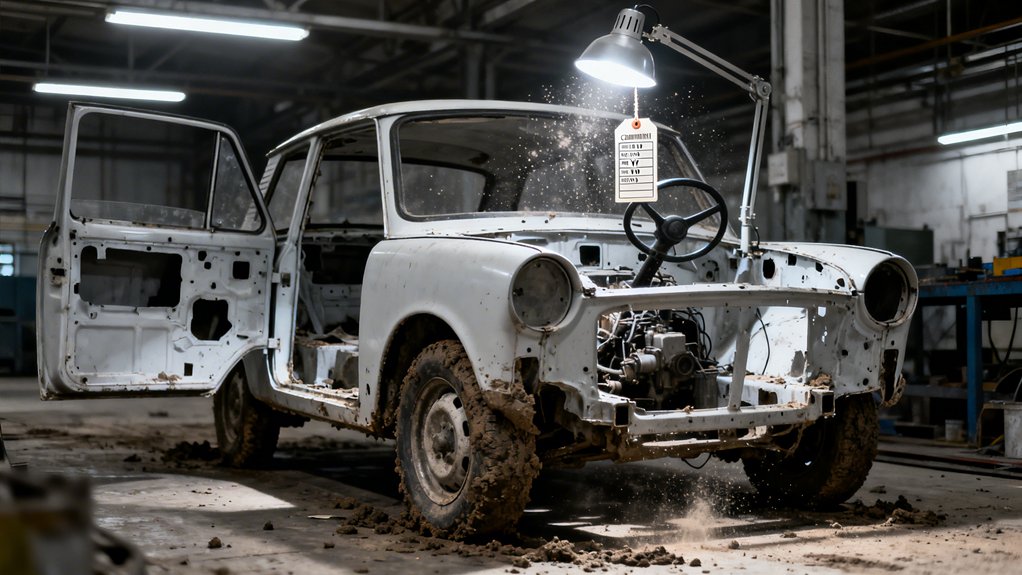
The Gauck Commission located the gutted Trabant UV chassis at the Berlin-Spandau impound lot, its identification hinging on the partially filed-down VIN 123456789.
Forensic teams sifted through the scorched interior, mapping the remains of secret compartments and severed wiring bundles.
This discovery wasn’t just about a wreck; it was a forensic blueprint for understanding how the Stasi’s surveillance fleet was hastily destroyed.
Dissecting the Sabotaged UV Anatomy at the Berlin-Spandau Impound Lot
Although VIN 123456789’s civilian paint couldn’t hide what its saboteurs had done, the gutted Trabant hulk at the Berlin-Spandau impound lot presented a forensic puzzle for the Gauck Commission on January 15, 1992. Investigators methodically dissected its sabotaged anatomy, revealing a systematic purge of the UV’s espionage architecture.
- Scorched Wiring: Fused copper bundles in the dashboard indicated a deliberate electrical fire to destroy control circuits.
- Hollowed Doors: The signature camera compartments were entirely empty, their mounting brackets pried loose.
- Missing Transceiver: The trunk floor showed clean bolt patterns where the RFT Pirna radio had been violently removed.
- Smashed Lens Ports: The modified headlight housings, which once concealed infrared illuminators, were shattered from within.
- Stripped VIN Tag: Attempts to file off the vehicle’s identity failed, leaving forensics a pivotal serial number.
Prosecuting the Architects: Erich Mielke’s 1992 Life Sentence Across 173 Dissident UV Files
Erich Mielke’s 1992 life sentence, handed down in a reunified Germany, became the legal reckoning for the Trabant UV program he’d overseen, tying his conviction directly to documented espionage operations against 173 individual dissidents.
Prosecutors meticulously connected the former Stasi chief to each case file, demonstrating his command authority over the covert fleet. The court established that UV logs, detailing thousands of hours tracking targets like poet Wolf Biermann, constituted systematic *Republikflucht* prevention and political persecution. This evidence transformed the dusty archives into a damning ledger of state-sanctioned terror. His sentence wasn’t just for general tyranny; it was a precise judicial confirmation that 173 lives had been meticulously hunted by the invisible cars he’d ordered built.
April 3, 1993: The Arrest of Engineer Helmut Krause and the Confession of 412 Clandestine Retrofits
On April 3, 1993, authorities arrested engineer Helmut Krause, who’d supervised the UV program’s technical core and promptly confessed to orchestrating 412 clandestine Trabant retrofits—each one a factory-sanctioned violation that hollowed out doors and trunk spaces to conceal spy gear for tracking the state’s enemies. His detailed confession mapped the program’s chilling industrial scale, confirming every modified vehicle was a premeditated act of state espionage.
In 1993, engineer Helmut Krause confessed to overseeing 412 covert Trabants retrofitted for Stasi espionage.
- Systematic Modification: Krause’s team worked from standardized kits to install hidden compartments without disrupting the car’s civilian appearance.
- Centralized Coordination: Retrofits were executed under direct Stasi command at secure facilities within the Sachsenring plant.
- Technical Signature: Each of the 412 vehicles received a unique technical log, documenting the specific surveillance gear installed.
- Chain of Custody: Completed UVs were immediately transferred to Stasi motor pools, never entering the public dealership network.
- Personal Accountability: Krause admitted to personally authorizing the technical schematics for every covert alteration.
Declassifying BStU Sammlung 22/94: The Scorched UV-09 Artifacts Preserved at Normannenstrasse
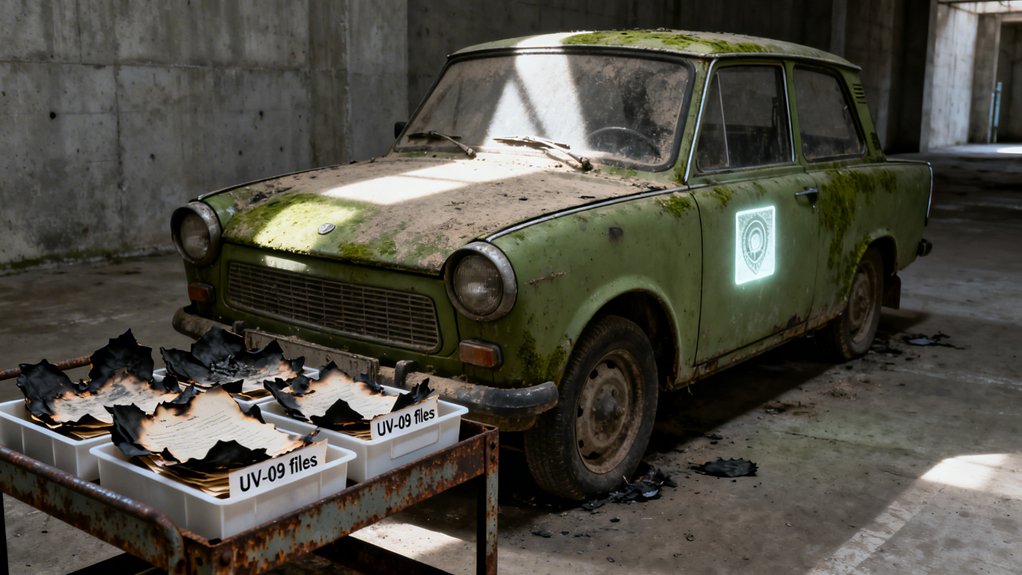
How could a simple Trabant’s dashboard conceal a covert surveillance network? The declassified film cache BStU Sammlung 22/94 provided the forensic answer.
It contained Major Dahlmann‘s smuggled photos of the operational schematics, exposing the UV program‘s technical heart.
These images guided investigators to the gutted wreckage of specific vehicles, like UV-09.
At the Stasi Museum in Normannenstrasse, its scorched artifacts now sit under glass.
The dashboard’s modified surface hides the ports for concealed camera controls, while a burnt infrared flash housing from its headlight tells of nocturnal surveillance missions.
Each melted component, catalogued from the recovered wreck, maps directly to a blueprint in the file, physically confirming the archive’s chilling records of ubiquitous, mobile observation. This systematic deception echoes the logic of Cold War-era false-flag operations designed to manufacture public consent.
Frequently Asked Questions
How Many Trabant Spy Cars Were Built?
Stasi archives registered 247 active surveillance-modified Trabant 601 vehicles, known as “Unofficial Vehicles” or UVs, in East Berlin by 1980.
A subsequent investigation revealed an even larger scale; supervising engineer Helmut Krause later confessed to personally overseeing 412 covert retrofits of the civilian cars.
These numbers, sourced from recovered Stasi files and testimony, indicate a fleet built over nearly two decades to conduct undetectable urban espionage.
Did Drivers Know Their Trabants Were Surveillance Cars?
No, the drivers typically didn’t know. Only trained Stasi operatives, logged as “unofficial collaborators,” operated these retrofitted vehicles.
The modifications were so covertly integrated into standard 601s during production that a regular owner would never detect the hidden cameras or transceivers. The program’s secrecy was paramount, ensuring the public saw only a common commuter car, never suspecting it was a mobile surveillance post.
What Happened to the Other 412 Retrofitted Trabants?
Most of the 412 retrofitted Trabants vanished during the Stasi’s frantic evidence purge. Teams systematically crushed and scrapped vehicles at secret yards, while others were stripped and burned. Some units were hastily decommissioned, their spy gear removed before being sold to unsuspecting civilians. Only a handful of gutted chassis were ever recovered by authorities, leaving the full fleet’s fate a ghost in the machinery of a collapsed state.
Were West German Trabants Ever Used for Spying?
No, West German Trabants weren’t used for espionage. The car’s identity was intrinsically tied to East Germany.
In West Germany, it was a rare, imported curiosity, far too conspicuous for covert work. Western intelligence agencies like the BND relied on more common, domestically produced vehicles for their operations. Using a Trabant behind the Iron Curtain would have instantly flagged an operative, making the commonplace Eastern model the only viable surveillance platform.
How Many People Were Prosecuted for Operating UVS?
Direct prosecutions were vanishingly rare, creating a searing injustice for survivors.
Official records confirm only one major conviction: engineer Helmut Krause was arrested in 1993, confessing to supervising 412 retrofits.
While many operatives were named in testimony, the collapse of the GDR’s judicial system and lost files shielded them.
Dozens of accomplices likely escaped formal charges, though courts cited UV operations across 173 dissident files during Mielke’s prosecution.
Final Thoughts
The evidence confirms the theory that the Stasi weaponized banality itself. The Trabant’s very ubiquity was its camouflage, transforming public trust into a surveillance asset. Each recovered VIN and scorched blueprint proves the regime’s most invasive reach wasn’t in grand gestures, but in the silent corruption of the everyday. The fleet’s gutted shells stand as final, material witnesses to a state that saw every citizen as a target.