
For nearly a decade, KGB illegal Vilyam Fisher ran a silent invasion from a Brooklyn apartment, his cover as photographer Emil Goldfus shielding a sleeper network. He weaponized shortwave radio, hollowed pencils, and dead drops to evade the FBI. The Bureau’s dragnet tightened after a betraying code clerk defected, exposing cipher pads. Fisher’s arrest in 1957 cracked the myth of the invisible operative, but the full story of his dismantled spy apparatus is just beginning.
Key Takeaways
- Fisher operated as deep-cover KGB illegal in Brooklyn from 1948 to 1957.
- FBI triangulated his radio transmissions from the 252 Fulton Street apartment.
- His cover identity was retired photographer Emil Goldfus, embedded in the art community.
- A double agent inside his network betrayed him to the FBI.
- The Bureau seized cipher pads, microfilm, and transmitters from his Fulton Street safehouse.
November 1948: Infiltrating the Hostile Sector and Planting a KGB Phantom
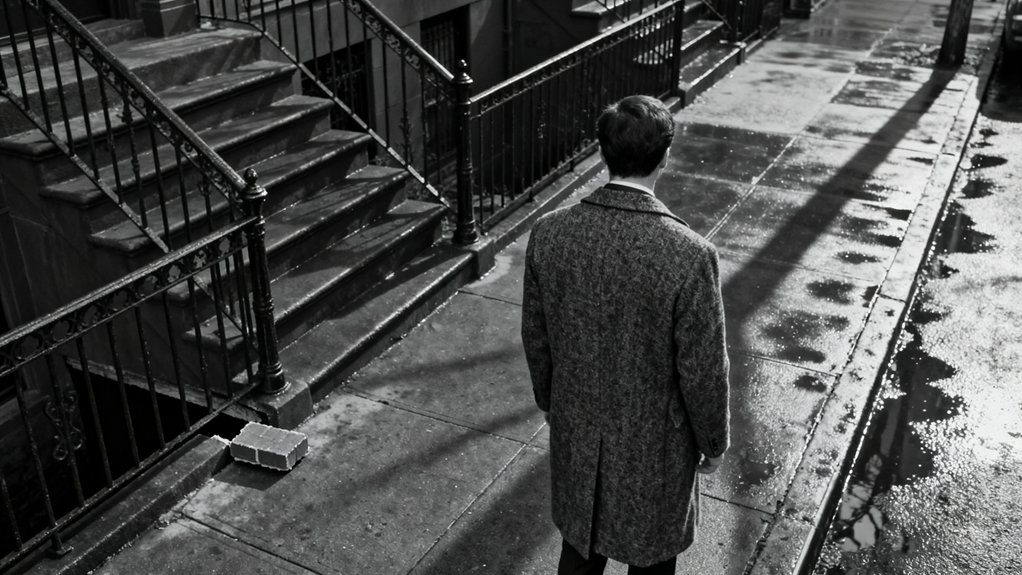
When Vilyam Genrikhovich Fisher stepped off the ship in New York City in November 1948, he wasn’t just another immigrant—he was the KGB’s phantom, a deep-cover illegal carrying orders to burrow into the heart of the hostile sector. The Soviet sleeper agent network demanded patience, and Fisher delivered that in spades. He didn’t simply hide; he became invisible, shedding his old identity like a snake’s skin.
The Bureau wouldn’t know for years that this quiet man had already planted roots, linking him directly to Moscow Center‘s long-term plan. Every step he took in the city built a foundation for others, a silent invasion that craved liberation from surveillance. Fisher’s arrival wasn’t an event—it was the beginning of a quiet occupation.
He moved with purpose, knowing that his real fight wasn’t with bullets but with shadows and secrets. Vilyam Genrikhovich Fisher understood that winning meant never being seen, and he played that game flawlessly.
The Fulton Street Command Center: Architecting a Deep-Cover Node in Brooklyn
Rudolf Abel wasn’t just any tenant at 252 Fulton Street; he was a phantom named Emil Goldfus, a cover so deep it let him vanish into the borough’s fabric.
His apartment wasn’t a home—it was a blueprint of deception, where civilian architecture bent to the needs of a dead drop and a hidden radio.
The FBI‘s watchers would later piece together how a KGB command center operated in plain sight, its walls holding secrets that no average Brooklynite could ever suspect.
Adopting the Emil Goldfus Identity to Evade Counterintelligence
Although deep-cover operatives often rely on forged documents, Rudolf Abel’s Emil Goldfus identity was more than just a passport—it was a meticulously crafted biography. He sculpted a retired photographer, a ghost with a past that the FBI’s best couldn’t crack for nearly a decade. This wasn’t mere disguise; it was liberation from his own history.
- He painted oil canvases, selling them on Fulton Street, embedding his cover into the art community.
- The apartment itself became a character, blending civilian life with signal bursts from a hidden radio.
- FBI watchers logged his routine—groceries, library visits—yet the KGB node remained invisible.
- Only the 1957 espionage arrest cracked the myth; declassified fbi spy files later revealed how close the Bureau came to missing him entirely.
He wielded the ordinary as his weapon.
Blueprint of a Safehouse: Modifying Civilian Architecture for Espionage
The Emil Goldfus cover gave Abel the freedom to move, but it’s the Fulton Street apartment that gave him the power to operate—a civilian space rewired into a secret command post. He didn’t just live there; he weaponized the architecture.
A false wall hid his shortwave transmitter; a hollowed table leg concealed cipher pads. Every room served clandestine communications tradecraft.
The fulton street brooklyn apartment wasn’t a refuge—it was a trapdoor for secrets. He’d slide messages into a dead drop disguised as a loose brick in the alley. Neighbors saw a retired painter; the FBI saw only silence.
But inside those walls, Abel broadcast instructions to Moscow, turning a mundane Brooklyn flat into a fortified node of Soviet intelligence, engineered for liberation through secrecy.
Weaponizing the Airwaves: Clandestine Communications and Covert Radio Tradecraft
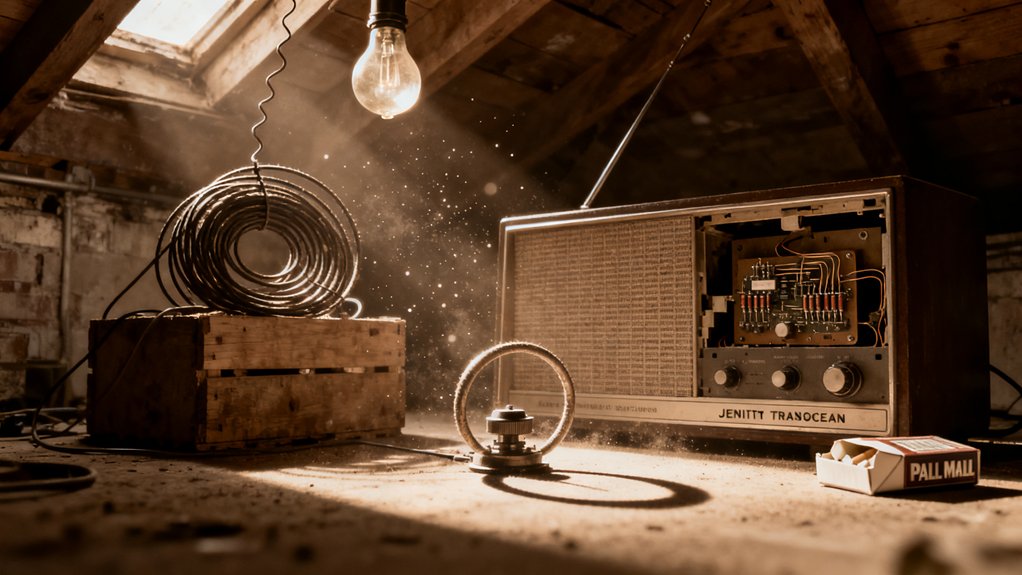
From Abel’s Brooklyn apartment, he didn’t just listen; he weaponized the airwaves, decrypting Moscow’s encrypted shortwave frequencies to pull down his next set of orders. But radio was only half the story—he paired it with microdots, those specks of photographic film no bigger as a pinprick, and concealed dead drops to pass his intelligence. This tradecraft wasn’t theoretical; it was his daily lifeline, keeping the KGB’s sleeper cell humming beneath the FBI’s radar.
Deciphering Moscow’s Encrypted Shortwave Frequencies
While Moscow’s encrypted shortwave frequencies pulsed through the Brooklyn airwaves, Rudolf Abel sat in his Fulton Street apartment decoding them on a modified radio receiver.
This wasn’t random listening—he executed textbook soviet espionage techniques to extract intelligence from the noise. By listening at precise hours and rotating through a schedule of channels, he guaranteed no pattern emerged for FBI triangulation. His methods for handling covert radio transmissions boiled down to four essential practices:
- Frequency hopping to avoid direction-finding.
- One-time pads for uncrackable decryption.
- Scheduled windows to limit exposure.
- Audio fingerprinting to verify Moscow’s signal authenticity.
Each frequency carried liberation from surveillance—a lifeline to the motherland.
The Mechanics of Microdots and Concealed Dead Drops
Microdots reduced entire intelligence reports to specks smaller than a period, and Rudolf Abel tucked them into hollowed coins or behind stamps before depositing them in dead drops across Brooklyn.
This wasn’t just spycraft—it was liberation from surveillance.
As a KGB deep cover illegal, he weaponized the ordinary, turning a park bench or a mailbox into a silent relay point for the clandestine KGB radio network.
Each dead drop, a cipher; each microdot, a whisper from Moscow.
He didn’t need to meet; he needed to vanish.
The FBI later found these drops, but not before Abel transmitted orders from his Fulton Street apartment, keeping his network alive.
For a decade, he proved that true freedom lives in the gaps between what’s seen and what’s hidden.
Operating in Plain Sight: Managing the Soviet Sleeper Syndicate from 1948 to 1957
Between 1948 and 1957, Rudolf Abel ran the Soviet Union‘s most sophisticated sleeper syndicate right out of a nondescript Brooklyn apartment. He didn’t need shadows; he commanded from the light, weaving a web of cold war counterespionage that defied detection for years. His network thrived on ruthless precision, each node unaware of the others, yet bound to his signal.
Abel’s operation hinged on four unbreakable pillars:
- Clandestine Radio: He broadcast coded transmissions from his Fulton Street studio, a direct line to Moscow.
- Microdot Couriers: Agents slipped minuscule film into everyday objects, invisible to any pat-down.
- Dead Drops: He left instructions in hollowed-out coins and park benches, no face-to-face contact needed.
- Identity Cover: He posed as a painter, blending into Brooklyn’s artist colony while commanding a spy ring.
The rudolf abel capture timeline began only when a defector—a bitter code clerk—betrayed his name. By then, Abel had already liberated state secrets for nearly a decade. The FBI‘s surveillance tightened, but Abel’s syndicate didn’t fracture from pressure; it unraveled from within. For those seeking liberation from oppressive systems, Abel’s story is a masterclass in operating unseen—until trust fails.
The Whistleblower Catalyst: Defection Protocols and the Breach of KGB Secrecy

A single defector—a disgruntled KGB code clerk named Reino Häyhänen—shattered Abel’s decade-long invisibility. Häyhänen didn’t just flee; he carried the KGB’s secret blueprint. He revealed the mechanics behind the infamous hollow nickel spy case, a curious artifact that had already tipped off an fbi counterintelligence operation. That nickel, hollowed out for microfilm, was a breadcrumb leading straight to Abel’s Brooklyn lair.
Häyhänen’s defection wasn’t spontaneous—it was a calculated breach of KGB secrecy. He exposed the entire illegal’s tradecraft: cipher pads, dead drops, and the radio transmitter buzzing from Fulton Street. For an audience craving liberation from shadowy tyranny, this betrayal was a crack of light. The state’s oppressive silence shattered because one insider chose freedom over fear. Now, the FBI had a path—and they intended to walk it.
Methodical Shadowing: The FBI’s Exhaustive Counterintelligence Dragnet
Agents traced Abel’s winding paths through the boroughs, mapping each circuitous route he took across New York.
They then correlated those movements against the precise timing of intercepted radio bursts, zeroing in on the source.
All threads led back to a single Brooklyn address, where the spy’s transmissions originated.
Mapping the Target’s Labyrinthine Routes Across New York
As FBI surveillance teams logged his every move, Rudolf Abel‘s routine became the Bureau’s roadmap through Brooklyn’s dense urban labyrinth—each turn, pause, and backtrack calculated to shed a tail, yet meticulously cataloged by the counterintelligence dragnet tightening around him.
They mapped his cunning dance through crowded subways and shadowed alleys, revealing the KGB man‘s method for evading detection while servicing his *brooklyn intelligence node*.
Agents noted four distinct maneuvers he’d repeat:
- Dead drops in public parks, where he’d leave messages under loose bench slats.
- Library meetings, using specific books as signal markers.
- Crowded subway exchanges, where he’d swap trains mid-route.
- Unmarked doorways, pausing to check for watchers before proceeding.
Each route spoke of a man trained to vanish.
The FBI, however, learned the map.
Correlating the Intercepted Broadcasts to the Brooklyn Coordinates
While the FBI shadowed Abel through Brooklyn’s streets, another team traced the ghost signals bleeding from his Fulton Street apartment. They didn’t just listen; they correlated. Each intercepted broadcast’s timestamp and frequency matched tilts in Abel’s daily route. The Bureau built a matrix: his radio’s pulse linked directly to coordinates on a map of the borough.
They weren’t hunting a man; they were triangulating a system. A signal burst at 8:14 PM aligned perfectly with a sketch of a Brooklyn park bench. The coordinates weren’t random—they were a chain binding Abel to his handlers. The sleeper cell’s liberation was a lie; the FBI now held the key to its lock.
June 1957: The Coordinated Federal Raid on the Fulton Street Apartment
By June 1957, the FBI‘s methodical surveillance had drawn a tight cordon around Rudolf Abel’s Fulton Street apartment, setting the stage for a coordinated federal raid. Agents moved with surgical precision, their quarry unaware of the net closing in.
This wasn’t just an arrest—it was a liberation from a decade of deception, a strike against a shadow state operating within American soil.
The raid hinged on four critical elements:
- Silent Approach: Agents converged without sirens, using pre-arranged signals to seal the building’s exits.
- Precision Timing: They struck at 7:00 AM, catching Abel off-guard, still in his sleepwear.
- Controlled Entry: A master key granted immediate access, bypassing the deadbolt Abel relied on.
- Immediate Isolation: The target was separated from any potential accomplices or destruction of evidence.
The intruders flooded the small space, their voices calm but firm. Abel’s legendary composure cracked for a moment—a flicker of recognition that his decade-long game had ended.
The Fulton Street stronghold, once a sanctuary for secrets, became a cage.
Forensic Auditing the Contraband: Seizing Cipher Pads and Shortwave Hardware
When the FBI agents swept through Abel’s Fulton Street apartment that June morning, their eyes weren’t on the man—they were on the tools of his trade. They moved like surgeons, dissecting every crevice for contraband.
In a hollowed-out pencil, they found a microfilm cipher pad, its tiny grids encoding Moscow’s commands. Under floorboards, they unearthed a shortwave transceiver, still warm from its last transmission. Each piece told a story of paranoid precision: the cipher pads, designed for one-time use, guaranteed no message could be decrypted twice; the shortwave hardware, concealed within a fake lamp, allowed Abel to whisper across oceans without wires.
Agents bagged these artifacts with clinical care, knowing each seizure ripped a thread from the KGB’s covert web. The apartment’s quiet betrayed no struggle—only the silent liberation of secrets pulled from shadows into light.
The Interrogation Standoff: Fisher’s Calculated Refusal to Surrender KGB Assets
FBI agents carried the cipher pads and shortwave hardware out of Abel’s apartment, but the real prize—the KGB’s network—remained locked inside his mind.
Throughout the interrogation standoff, Fisher’s calculated refusal to surrender a single asset transformed his silence into a weapon. He understood that betraying his contacts meant erasing his only leverage.
4 key reasons drove his defiant posture:
- Operational Integrity – Every name he protected shielded a sleeper cell still active somewhere in America.
- Personal Survival – Cooperating would expedite his own prosecution and guarantee lifelong imprisonment.
- Psychological Dominance – Silence forced interrogators to question their own evidence and assumptions.
- Strategic Delay – Each withheld detail bought time for the KGB to reorganize and burn compromised assets.
Fisher’s resolve wasn’t stubborn loyalty—it was a calculated gamble for liberation.
He knew that inside those cipher pads lay clues, but inside his head lay the KGB’s future. The FBI couldn’t break what they couldn’t crack.
Prosecuting Rudolf Abel: The Historic 1957 Espionage Trial in Federal Court
Prosecutors methodically dissected the clandestine communications network Abel had operated from his Fulton Street apartment, presenting the radio equipment and coded messages as irrefutable evidence.
The defense, however, mounted a strategic legal fight centered on Abel’s status as a Soviet deep-cover illegal, arguing that his capture had been a diplomatic and procedural anomaly.
This courtroom confrontation would pit the FBI’s exhaustive surveillance against a legal strategy designed to protect a spy who refused to break his cover.
Prosecutorial Dissection of the Clandestine Communications Network
Although the KGB had trained Rudolf Abel to blend seamlessly into the Brooklyn streets, the prosecution’s case dismantled that illusion by targeting the very mechanics of his tradecraft.
They didn’t just prosecute a man—they prosecuted a system.
In court, they laid bare the skeleton of his network, revealing how a seemingly ordinary apartment pulsed with espionage.
The evidence dissected his clandestine communications into clinical components:
- Cipher tools: Microdots and one-time pads, recovered from a hollowed-out pencil.
- Radio setup: A hidden transmitter, beaming messages from Fulton Street.
- Dead drops: Film capsules tucked into park benches, signaling coded exchanges.
- Forged documents: Passports and aliases, each a thread in his cover.
The prosecution argued Abel’s integration wasn’t genius—it was a mechanical illusion, now shattered.
The Strategic Legal Defense of a Soviet Deep-Cover Illegal
The prosecution’s clinical breakdown of Abel’s tradecraft had painted his network as a fragile machine of ciphers and dead drops—but the defense now had to rebuild the man behind the gears.
Attorney James Donovan didn’t deny the spycraft; he reframed it. Abel wasn’t a villain—he was a soldier following orders, a pawn in a cold game. Donovan argued that executing a captured intelligence officer, even a Soviet one, would ignite diplomatic fires the nation couldn’t afford. He drove the court toward a strategic choice: life in prison, not death. This wasn’t mercy—it was leverage. The defense turned Abel’s silence into a bargaining chip, preserving a man who might one day trade for an American’s freedom.
Neutralizing the Sleeper Threat: The Strategic Collapse of Fisher’s Spy Apparatus
Because Fisher’s nine-year sleeper network relied on a single, traceable radio transmitter in his Fulton Street apartment, the M.O.–once cracked–spelled his doom. The FBI didn’t just arrest a man; they dismantled an apparatus built on silence and trust. Here’s how the collapse cascaded:
- Signal intercepts pinpointed the transmitter’s exact location, compressing years of surveillance into weeks.
- A double-agent betrayal inside Fisher’s own network fed the Bureau real-time messages, turning his own tradecraft against him.
- The seizure of cipher materials from his hotel room revealed the encryption keys to past and future operations.
- The arrest itself was surgical—no leaks, no escape routes, no loose ends.
With the transmitter silenced and his contacts severed, Fisher’s spy ring didn’t just fail; it vaporized. For those who believed liberation meant breaking free from shadow control, witnessing a KGB node erased by its own methods felt like watching a cage built around its keeper.
Frequently Asked Questions
How Did Abel’s Family React to His Arrest?
His family didn’t react publicly; they vanished into the shadows he’d built. They’d never known his true identity, only the cover. When the FBI’s net closed, they became collateral—silent, shattered, and left to piece together a life that never existed. Their liberation wasn’t in protest; it was in the desperate, quiet escape from a truth they couldn’t confront.
What Was Abel’s Daily Life Like in Brooklyn?
Who’d suspect the quiet painter on Fulton Street? Abel’s daily life was a masterclass in mundane cover—he’d sip coffee, stroll to his studio, and chat with neighbors, all while his radio crackled with secrets.
He relished the irony of hiding in plain sight, a spy masquerading as an ordinary man.
This routine wasn’t just survival; it was a quiet rebellion, a liberation from the KGB’s leash, yet it couldn’t outrun the FBI’s relentless gaze.
Did Abel Have Any Successful Intelligence Coups?
FBI files never confirmed a single successful intelligence coup by Abel. He’d built a sophisticated radio network in Brooklyn—transmitting from his Fulton Street apartment—but counterintelligence caught him before those signals delivered real damage.
Declassified reports suggest his greatest “accomplishment” was merely surviving undetected for nearly a decade. That’s not a triumph; it’s a proof of how tightly the Bureau’s surveillance eventually squeezed.
How Did Abel Maintain His False Identity for Years?
Like a chameleon blending into urban concrete, Abel maintained his false identity through meticulous discipline. He never slipped, never wavered.
His cover flourished from a mundane Brooklyn life, complete with a painter’s studio and quiet neighbors.
He avoided suspicion by fostering no connections, trusting no one. Every conversation, every gesture, was calculated.
The FBI’s eventual hunt unraveled his artistry, but for years, Abel’s silence and solitude were his ultimate shield—a liberation from detection.
Was There Any Soviet Attempt to Rescue Abel?
No, there wasn’t any Soviet rescue attempt for Abel. Moscow feared a botched mission would expose their broader network and provoke a diplomatic crisis.
Instead, the KGB quietly negotiated his exchange for American pilot Francis Gary Powers in 1962. They sacrificed Abel for a strategic victory, keeping their sleeper apparatus intact elsewhere.
Final Thoughts
By a bizarre twist of fate, Abel’s quiet Brooklyn world unraveled not from a brilliant FBI trap, but a drunken bungle—his courier, Reino Häyhänen, defected after a messy coin-op ticket mishap. That single coincidence, a slip of paper and a misplaced dollar, ignited the chain that shattered the Soviet’s phantom network. In the end, a mundane failure undid an immaculate spy.