“As an Amazon Associate I earn from qualifying purchases.”
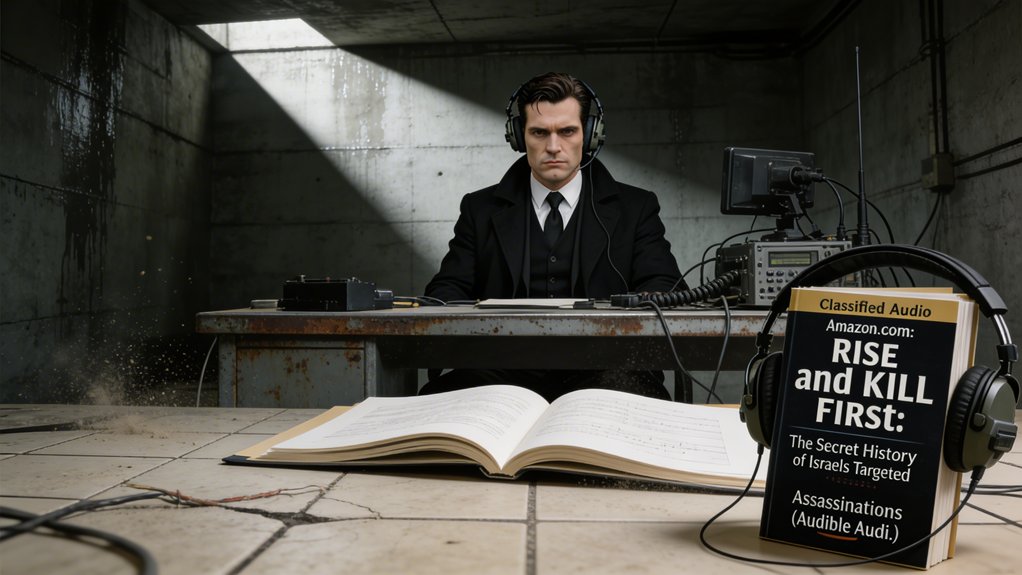
A meticulously researched account of Israel’s targeted killing programs, *Rise and Kill First* delivers a comprehensive view of how assassination has functioned as both tactic and strategy. Drawing on declassified materials and interviews, the audiobook charts operations from Israel’s founding to the modern era, revealing patterns in decision-making, execution, and fallout. The narrative avoids overt moralizing, instead presenting a factual timeline that allows listeners to assess the ethical and strategic implications for themselves. What emerges is a pattern: targeted killings often yield short-term gains but carry long-term strategic costs—escalation, blowback, and moral corrosion. The audiobook excels in exposing the bureaucratic machinery behind covert actions, showing how agencies evolved, adapted, and sometimes overreached. Intelligence failures, operational successes, and political pressures are all weighed with journalistic rigor. For students of military history, counterterrorism, or international relations, this is essential listening—not because it endorses the policy, but because it dissects it with clarity and depth. The production quality supports the material well, with a narrator who maintains pace and gravitas. While dense at times, the audiobook’s structure allows for segmented consumption without loss of coherence. This is less a polemic than a forensic audit of state violence—one that underscores how tactical precision does not always translate into strategic victory.
The Briefing: Overview and Core Thesis
A meticulously researched exposé of Israel’s targeted killing programs, *Rise and Kill First* leverages unprecedented access to classified archives and insider testimony to argue that assassination has been a cornerstone of national security strategy since 1948.
Ronen Bergman documents how Mossad, Shin Bet, and IDF units have operationalized covert elimination as both a tactical necessity and a strategic calculus, shaping regional dynamics through precision violence.
The narrative reveals consistent patterns: preemptive strikes that altered geopolitical trajectories, intelligence failures enabling assassinations gone awry, and long-term blowback fueling cycles of retaliation.
Bergman neither glorifies nor condemns outright but dissects the moral ambiguities and institutional logic behind state-sanctioned killings. He underscores recurring tensions between political oversight and operational autonomy, often exposing a disconnect between decision-makers and field operatives.
While the book’s depth is a strength, its sheer volume of operations may overwhelm casual listeners. As an audiobook, its linear structure benefits from attentive listening to retain complex timelines and interwoven narratives.
Ultimately, *Rise and Kill First* serves as a sobering analysis of how a nation balances survival against ethical boundaries, offering critical insights into the hidden mechanics of modern statecraft. This is essential listening for those examining the intersection of intelligence, policy, and moral consequence.
Historical Accuracy Check: Analyzing the Evidence
Credibility rests on documentation, and *Rise and Kill First* delivers through a robust evidentiary foundation. The author draws extensively from declassified government files, classified records, and more than a thousand interviews with senior officials, operatives, and decision-makers—many speaking publicly for the first time.
These primary sources are cross-verified with archival material and external reporting, reinforcing consistency. Source attribution is transparent, with identities protected only when operational security demands it.
Multiple witness accounts align on key operations, increasing reliability. The narrative avoids speculation, adhering closely to documented events and firsthand testimony.
This disciplined methodology supports the book’s recognition as a rigorously researched historical account. For listeners seeking factual depth without ideological framing, the audiobook offers a valuable, evidence-based perspective on covert operations and national security decision-making.
While dense in detail, its clarity and precision make complex intelligence operations accessible. This is essential listening for those who prioritize accuracy and thoroughness in understanding state-sanctioned actions.
Declassified Insights: Key Takeaways
- Program evolution reflects a deliberate doctrine of preemption, driven by acute threat perception and tech-enabled capabilities.
- Targeted killings were not rogue actions but policy instruments, with final approval centralized at the national command level.
- Operations followed a strategic rhythm: deterrence signaling, calibrated escalation, and, at times, overreach exposing political or tactical miscalculation.
- Intelligence integration across military and civilian agencies delivered high precision—yet unintended outcomes revealed gaps between planning and reality.
- Despite operational successes, long-term efficacy remains debatable; some actions triggered cycles of retaliation, undermining strategic objectives.
- Covert action served as both shield and sword, deeply embedded in Israel’s security identity—but at a recurring cost in legitimacy and regional stability.
- This pattern underscores a core tension: short-term tactical gains versus enduring strategic consequences in asymmetric conflict environments.
- The documented record offers rare transparency into mechanisms of state survival, revealing how one nation wields covert force when conventional deterrence is deemed insufficient.
Operational Assessment: Strengths, Limitations, and Ethics
| Assessment Factor | Key Insight |
|---|---|
| Operational Precision | High accuracy in neutralizing high-value targets, showcasing advanced surveillance and strike capabilities. |
| Civilian Risk | Despite precision, collateral damage persists, undermining public support and increasing regional instability. |
| Strategic Effectiveness | Short-term gains often offset by long-term blowback, including escalated hostilities and radicalization. |
| Intelligence Reliability | Periodic failures highlight systemic vulnerabilities; flawed intelligence has led to wrongful targeting. |
| Legal & Ethical Standing | Actions challenge international legal norms, particularly regarding sovereignty and due process. |
| Accountability Mechanisms | Lack of transparency and independent oversight raises concerns about unchecked executive power. |
| Moral Cost | Persistent use of covert violence risks normalizing extrajudicial measures, eroding democratic principles. |
| Sustainability | Heavy reliance on targeted killings may inhibit development of diplomatic or institutional alternatives. |
This program delivers tactical wins but faces diminishing strategic returns. While it disrupts enemy networks, it simultaneously fuels resentment and operational backlash. Legal ambiguity and minimal oversight compromise institutional integrity. Long-term security requires balancing covert action with ethical constraints, transparent protocols, and measurable accountability. Without such recalibration, the model risks becoming self-undermining—projecting power while weakening foundational values.
Target Profile: Who Should Listen to This Audiobook?
Ideal for listeners who prioritize factual rigor and strategic insight over partisan narratives, this audiobook serves those with a serious interest in intelligence operations and national security policy.
The ideal listener is analytically minded—someone comfortable with moral complexity and willing to confront the covert realities of statecraft.
If you study geopolitical conflict, work in defense or foreign policy, or follow intelligence history with more than casual interest, this audiobook offers concrete value.
It’s particularly well-suited for professionals and independent researchers who rely on primary-source accounts—from operatives, officials, and declassified records—to build informed perspectives.
Avoid if you seek simplified moral framing or dramatic embellishment; this is not a polemic or thriller.
Instead, it delivers a tightly sourced, operationally detailed examination of targeted killing as policy, making it a strategic asset for those committed to understanding how nations execute power in the shadows.
Short on speculation, long on evidence, it rewards careful listening with uncommon clarity on a high-stakes, low-visibility domain of modern warfare.
Quartermaster's Verdict: Final Recommendation
A rare fusion of investigative rigor and historical depth, *Rise and Kill First* delivers a comprehensive examination of Israel’s targeted killing programs through meticulously sourced reporting and insider accounts.
Bergman leverages decades of research, including classified documents and interviews with high-level operatives, to construct a narrative that is both factual and deeply revealing.
The audiobook, narrated by Rob Shapiro, maintains a steady, authoritative tone that complements the material without dramatization.
While the content focuses on operational details and strategic rationale, it does not shy away from the moral ambiguities inherent in covert state actions.
The pacing is deliberate, suited to careful listening, and benefits from the narrator’s clarity.
Some listeners may find the chronological approach dense in sections, but this structure reinforces the book’s analytical strength.
Importantly, the work does not advocate a position but presents evidence for the audience to assess.
For those interested in military strategy, intelligence ethics, or Middle East security dynamics, this audiobook offers unmatched insight.
It demands no ideological alignment—only a readiness to engage with uncomfortable truths.
Recommended without reservation for listeners seeking a disciplined, well-sourced analysis of one of modern warfare’s most consequential practices.
Final Thoughts
A rigorous, source-driven analysis of Israel’s targeted killing campaigns, *Rise and Kill First* combines investigative depth with strategic clarity. Drawing extensively on declassified operations and firsthand accounts, the narrative reconstructs decades of covert action with precision, offering listeners a factual backbone often missing in popular intelligence literature. While the audiobook leans into dramatic pacing—heightening tension like a Cold War thriller—this stylistic choice never fully undermines the gravity of its subject. More impressively, it resists moral simplification, instead presenting assassination as a calculated instrument of national security policy, shaped by legal debates, operational risks, and existential threat perception. The strength lies in its balance: granular detail on surveillance tradecraft and strike execution, paired with reflection on long-term consequences. However, some episodes edge toward sensationalism, particularly in voice performance and sound design, which may distract critical listeners seeking pure analysis. Ultimately, it succeeds as both historical record and strategic case study. Recommended for those familiar with intelligence doctrine or Middle East security dynamics.
Silas Shade
Military Intelligence Analyst
“As an Amazon Associate I earn from qualifying purchases.”