In 1968, the CIA detected K-129’s acoustic death and then drafted Project AZORIAN to pirate its nuclear payload. They forged the Hughes Glomar Explorer as a 1,750-ton claw, weaponizing Howard Hughes’s eccentric persona to fabricate a bogus manganese nodule mining cover. The deception held until a botched burglary exposed the billion-dollar heist. The snapped claw and the Glomar Doctrine’s legal stonewalling buried the truth. There is far more beneath the surface.
Key Takeaways
The CIA used Howard Hughes’s eccentric persona to sell the manganese nodule mining deception. Summa Corporation provided a plausible veneer for the covert submarine recovery operation. Scripted radio chatter and fake dredge logs maintained the mining façade for months. Every contractor and shipyard contract bore Hughes’s imprimatur to mask the true mission. Soviet crews observed through binoculars, aware of the operation’s real nature.
March 1968: The Acoustic Blueprint of K-129’s Pacific Demise
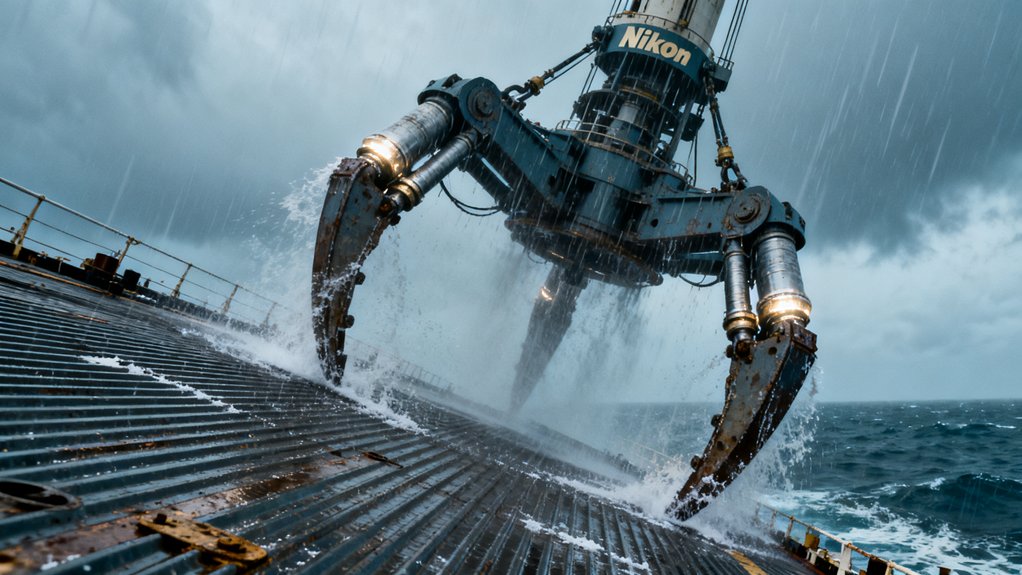
In March 1968, the world remained oblivious as the cold water of the North Pacific already held the acoustic signature of a catastrophic event. This event would soon become the CIA‘s most ambitious salvage project.
Two distinct underwater sounds marked the soviet submarine k-129 wreckage entering its final resting place over 16,000 feet down. U.S. Navy SOSUS arrays captured the implosion, but it took months to pinpoint the debris field. That delay forced a reckoning with pacific ocean salvage logistics at unprecedented depth.
This wasn’t a simple retrieval. It demanded a covert submarine recovery operation masked from Soviet surveillance. The wreck’s location, far from any commercial lanes, made cover plausible, but the engineering hurdles were staggering. Naval espionage engineering now had to solve pressure, corrosion, and secrecy simultaneously.
The goal wasn’t the hull but the deep sea intelligence extraction of nuclear warheads, codebooks, and cryptologic gear. Every contractor lied about the vessel’s true purpose, buying time for a mission that would rewrite underwater espionage.
Drafting Project AZORIAN to Pirate a Submerged Soviet Nuclear Arsenal
By mid-1968, the CIA had already framed the impossible question: how do you steal a 1,750-ton Soviet submarine and its nuclear payload from the bottom of the Pacific without starting a war? The answer demanded a scheme so audacious it would rewrite the rules of covert maritime engineering. This high-risk venture mirrored the FBI’s COINTELPRO program, which similarly operated without warrants, oversight, or congressional authorization from 1956 to 1971.
Drafting Project AZORIAN meant tackling the onerous logistics of a Soviet nuclear submarine extraction, a task requiring a vessel built for secrecy. The agency knew failure wasn’t an option; a botched job could trigger a diplomatic crisis. They insulated the operation with layers of cover, but the fake mining story wouldn’t hold forever. Years later, the Project Jennifer press leak would crack that veneer, exposing the 1974 classified maritime mission to the world. Now, with Project AZORIAN declassified, we can see how the Hughes Glomar Explorer engineering became the centerpiece of this high-stakes heist, designed to plunder a nuclear arsenal from the deep.
Forging the Hughes Glomar Explorer to Execute a 16,000-Foot Extraction
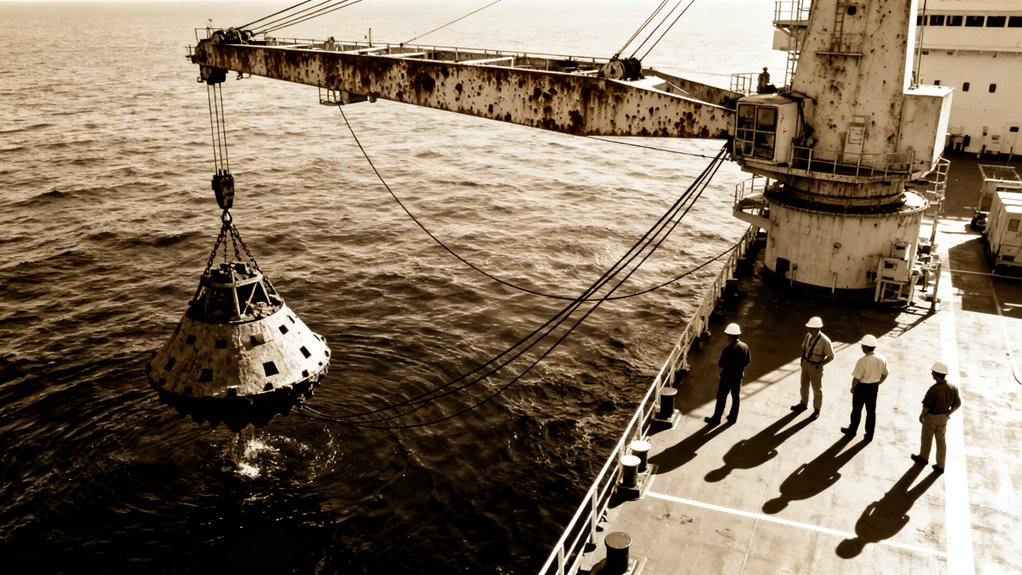
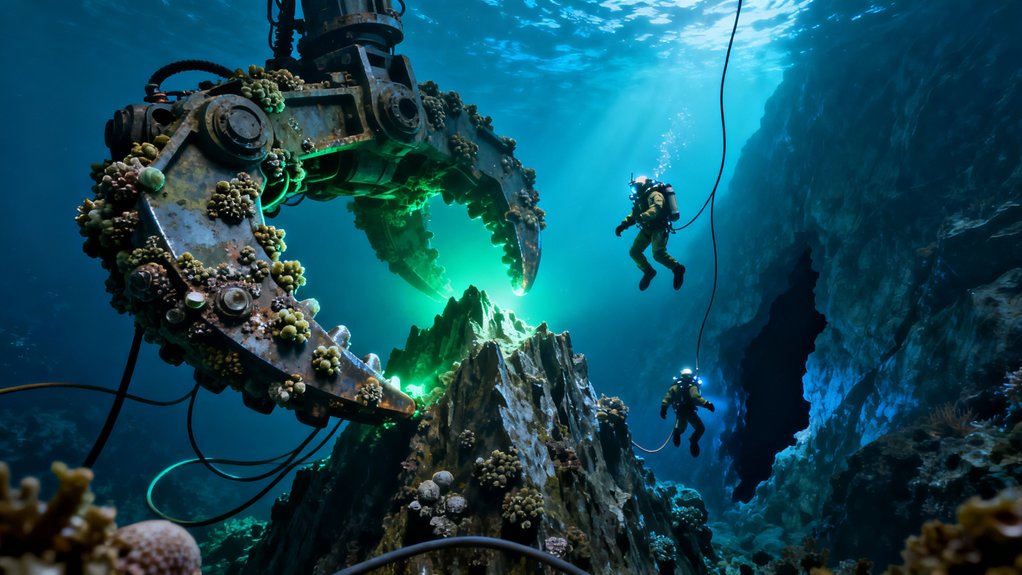
The CIA’s engineers didn’t just build a ship. They forged a 1,750-ton claw, the Clementine capture vehicle, designed for a brutal extraction at 16,000 feet.
To hide this monstrous grappling system, they constructed a massive moon pool within the vessel’s center, a concealment matrix that would keep the real mission invisible.
This mechanical deception, not the ship itself, was the true heart of the operation’s physical capability.
Engineering the Clementine Capture Vehicle and its 1,750-Ton Claw
| Component | Function | Challenge Overcome |
|---|---|---|
| Clementine Capture Vehicle | Submarine retrieval | 16,000-ft depth pressure |
| 1,750-Ton Claw | Grip and secure K-129 | Submarine debris fragility |
| Steel Pipe String | Vehicle deployment | Extreme ocean currents |
| Stabilizing Fins | Underwater control | Salinity corrosion |
| Ballast System | Depth regulation | Precise weight balancing |
This cold war ocean espionage demanded engineering that defied conventional limits. It created a clawed giant that silently descended into the abyss.
Constructing the Massive Center-Vessel Moon Pool Concealment Matrix
How could the CIA possibly conceal an operation involving a massive ship, a 16,000-foot steel pipe string, and the retrieval of an entire submarine? The answer lies in the moon pool, a colossal hidden bay carved directly through the Hughes Glomar Explorer‘s center.
Declassified Azorian documents reveal engineers forged a deceptive matrix of movable panels and false bulkheads, transforming the vessel’s core into a secret berth for the capture vehicle. This wasn’t just a hole; it was a camouflaged lift system.
As the CIA project Azorian declassified files show, the moon pool’s concealment mechanism allowed the 1,750-ton claw to descend on its pipe string without ever exposing its true purpose. Observers saw only a mining vessel; beneath the deck, a covert engineering marvel executed the 16,000-foot extraction.
Weaponizing Howard Hughes to Fabricate the Manganese Nodule Deception
Because the CIA needed a cover story that could withstand scrutiny from Soviets, intelligence agencies, and the global press, they weaponized Howard Hughes’s eccentric persona and business empire to sell the manganese nodule mining deception. They knew critics wouldn’t probe too deeply into a reclusive billionaire’s maritime folly.
By linking the operation to Hughes’s legitimate ocean-mining subsidiary, Summa Corporation, they added a veneer of plausibility. His reputation for bizarre, secretive projects (like the Spruce Goose) made the whole scheme feel disturbingly authentic.
The CIA fed the narrative through Hughes’s trusted lieutenants, ensuring no direct ties to Langley surfaced. Every shipyard contract and fake geologist report bore the Hughes imprimatur. This wasn’t just a cover; it was a masterclass in leveraging a cultural icon‘s peculiar mystique to bury a national intelligence heist in plain sight. The CIA’s ruthless manipulation of dossiers echoed Operation Paperclip’s tactic of using falsified records to bypass official vetting and conceal criminal backgrounds.
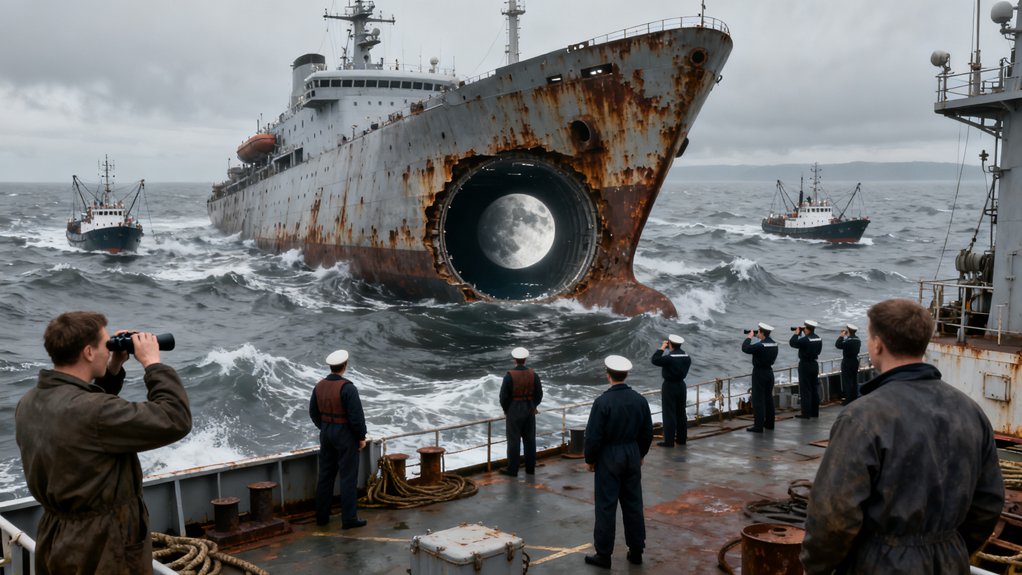
The Surface Game: Operators maintained the mining façade with scripted radio chatter, fake dredge logs, and staged nodule-collection tests. Soviet crews watched through binoculars, knowing the true nature of the operation.
Silent Subsurface War: American attack subs lurked below, ready to intercept any Soviet dive attempt. The *Glomar*’s crew feigned ignorance of the underwater standoff.
Time and Pressure: The Soviets’ presence compressed the operational window. Any mistake, a stray cable or a visible debris piece, would blow the cover and trigger a diplomatic firestorm.
Every man aboard understood: one slip, and this “mining mission” becomes an international confession.
The Critical Winch Sequence: Grappling a Crushed Ballistic Behemoth
The Glomar Explorer’s massive winch system finally hoisted the K-129’s crushed hull, but the critical mid-ascent structural fracture proved catastrophic.
The claw’s grip failed, releasing all but a 38-foot bow section, which now hangs precariously with its torpedoes compromised.
This entire sequence exposes the mission’s lethal gamble.
A single mechanical flaw rewrote the operation’s success.
Analyzing the Catastrophic Mid-Ascent Structural Fracture
As the Hughes Glomar Explorer’s clawed pipe string hauled the mangled K-129 toward the surface, the colossal tension told a grim story. The structure simply couldn’t bear its own rotten history. Investigators later traced the disaster to three specific failures.
- A pre-existing hull fracture from the original sinking, weakened by years of corrosive pressure, acted as a stress riser.
- The winch’s dynamic load profile spiked violently during a wave-induced vessel roll, exceeding the pipe string’s fatigue limit.
- The grappling claw’s uneven grip concentrated force on the bow section’s already compromised frame, triggering a catastrophic tear.
This wasn’t just mechanical breakdown; it was physics punishing engineering hubris. The K-129 didn’t simply snap; it surrendered to accumulated insults from the deep.
Securing the 38-Foot Bow Section and its Compromised Torpedoes
Securing the 38-foot bow section and its compromised torpedoes became the recovery crew’s primary objective after the catastrophic structural failure tore the K-129 apart. The Hughes Glomar Explorer’s claw still gripped a mangled fragment, a 38-foot section that held two compromised torpedoes. Their warheads posed an immediate, ticking hazard. Operators couldn’t risk a standard retrieval; one jarring shift could trigger a nuclear detonation.
They initiated a critical winch sequence, a delicate grapple with a crushed ballistic behemoth. The claw’s hydraulics worked in agonizing inches while sensors screamed pressure warnings. Inside the moon pool, divers reported seawater seeping through breached torpedo casings. The crew had no time for caution; they needed a swift, controlled lift. Securing the bow section wasn’t just salvage. It was a race to disarm a time bomb before the ocean did it for them.
September 1974: The Clandestine Sea Burial of Six Soviet Submariners
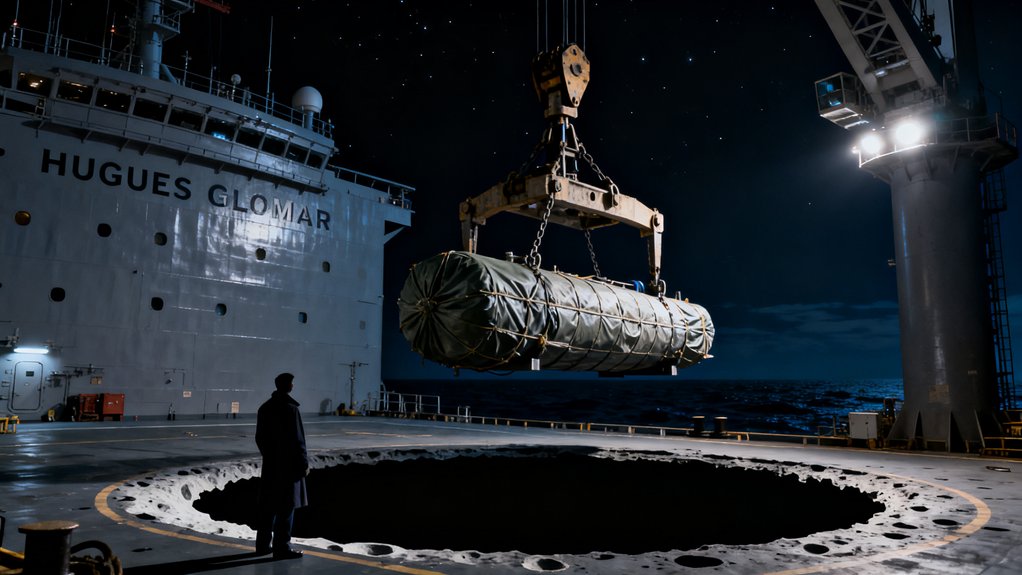
Erasure of evidence, burying the bodies removed any trace of the CIA’s raid, preventing Soviet forensic analysis. Humanity as camouflage, the solemn ceremony mollified the crew’s conscience, reinforcing their loyalty to the cover mission. Strategic ambiguity, keeping the burial secret denied the USSR proof of the theft, leaving them guessing about the submarine’s fate.
The CIA controlled not just the recovery, but the memory of the dead.
The Romaine Street Burglary That Accidentally Pierced the CIA Blackout
A brazen burglary at a Romaine Street office didn’t just steal papers, it stole the CIA’s operational secrecy.
The thieves used the stolen Hughes memoranda to extort the intelligence apparatus, exposing the Glomar Explorer‘s true mission.
Journalist Jack Anderson then leveraged that classified data, broadcasting the details of the maritime operation and shattering the agency’s blackout in 1975.
Extorting the Intelligence Apparatus With Stolen Hughes Memoranda
Although the CIA had successfully buried Project AZORIAN beneath the cover of manganese nodule mining, the agency’s classified blackout shattered in June 1974. The breach came not from a Soviet mole or a leaked memo, but from a bungled burglary on Romaine Street in Los Angeles.
Thieves stole internal Hughes Tool Company memoranda that explicitly referenced the Glomar Explorer‘s true mission. Instead of selling the papers to reporters, they attempted extortion directly against Howard Hughes, unknowingly holding a knife to the CIA’s throat.
- The blackmail demand explicitly named the Glomar Explorer’s classified purpose. This forced Hughes’s team to decide between paying extortionists or risking public exposure.
- Negotiators secured the documents for $12,000. That bargain left the CIA scrambling to contain a breach they’d never anticipated.
- The extortion plot revealed how fragile the agency’s cover really was. It depended not on Soviet counterintelligence failures, but on a simple security lapse at a document shredding service.
Investigating Jack Anderson’s 1975 Broadcast of Classified Maritime Operations
The extortionists’ $12,000 payout bought Hughes’s silence, but it could not plug every leak. By late 1975, syndicated columnist Jack Anderson broadcast the operation’s core truth. The Glomar Explorer was not mining nodules. It was stealing a Soviet submarine. Anderson’s source was a burgled safe at Howard Hughes’s Romaine Street office. Intruders swiped internal memos detailing the true mission.
| Key Player | Leak Vector | Information Exposed |
|---|---|---|
| Jack Anderson | Broadcast journalism | “Mining” cover story |
| Romaine burglars | Stolen memoranda | Glomar’s real objective |
| Hughes’s security | Breached office | K-129 recovery plan |
Anderson’s report shattered the CIA’s blackout. The agency could not deny it. Silence only confirmed the story. This was not a scoop. It was a fire sale of state secrets, one that forced the CIA into damage control for decades.
Inventing the Glomar Doctrine to Legally Stonewall the Free Press
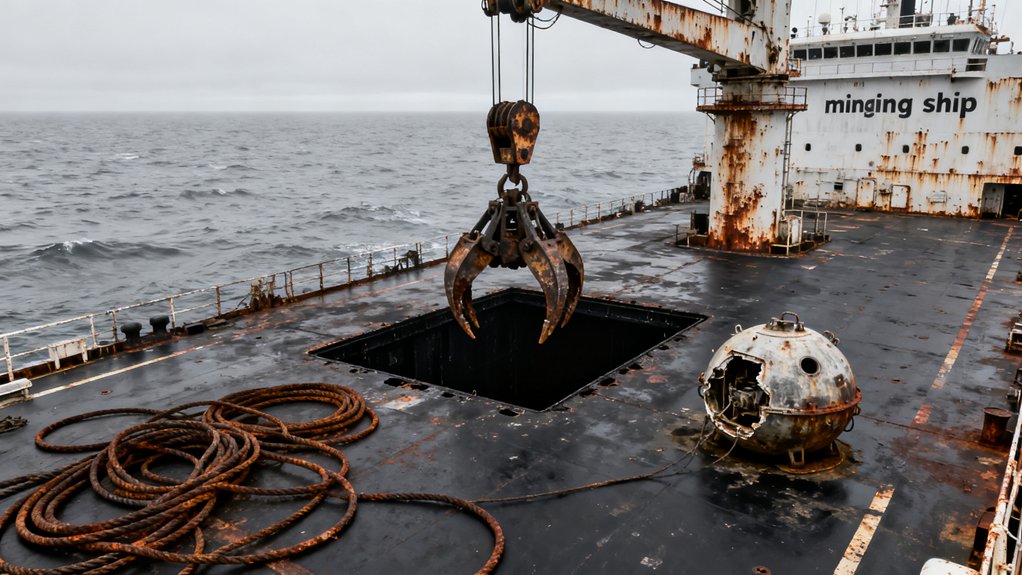
Even as the Hughes Glomar Explorer secretly retrieved the K-129’s remains, the CIA was already confronting an even more persistent adversary: the free press. To legally halt reporters, the agency conjured the Glomar Doctrine, a radical reinterpretation of FOIA that let them neither confirm nor deny any classified operation. This wasn’t just a procedural tactic; it was a constitutional stonewall.
Consider its deeper mechanics.
- Collapsing fact into fiction. The doctrine deliberately conflated the existence of the project with the content of any request. Asking if AZORIAN existed became legally equivalent to asking for its classified details.
- Weaponizing ambiguity. By refusing to verify anything, the CIA forced journalists to either print unconfirmed speculation or capitulate. The burden of proof shifted from the state to the press.
- Creating a legal vacuum. Courts upheld the “neither confirm nor deny” standard, effectively creating a black hole where legitimate public inquiry vanished into nothing.
The Glomar Doctrine didn’t protect secrets. It protected the CIA from having to admit they lied. This tactic mirrored how the Johnson administration used falsified signals intelligence to justify military action in Vietnam.
Auditing the Billion-Dollar Ledger: The True Intelligence Yield of AZORIAN
Before a single dollar of Project AZORIAN’s classified budget was spent, intelligence analysts had already downgraded the expected haul. They didn’t want a submarine, they wanted its codebooks. Yet the operation’s ledger ballooned past a billion. Adjusted for inflation, it’s closer to five. The CIA financed a massive engineering feat to recover K-129’s cryptologic machinery and nuclear torpedoes.
Critics now audit the yield. What did they actually retrieve? Declassified documents reveal the claw broke. It snagged only a 38-foot section of the bow. Analysts secured two nuclear torpedoes, some encryption gear, and a few partial codebooks. They didn’t get the full code-machine they’d prioritized.
Was the expense worth it? The CIA’s own post-mission report calls the intelligence “significant but fragmented.” They never recovered the submarine’s main cipher room. For a project that consumed resources equal to a small navy, AZORIAN’s ledger shows a sobering truth: they bought a fragment of a secret, not the whole vault. Like the Pentagon Papers revelations, the project exposed how government secrecy can conceal deception about an operation’s true cost and justification.
Declassifying the Pacific Theater’s Most Audacious Covert Engineering Feat
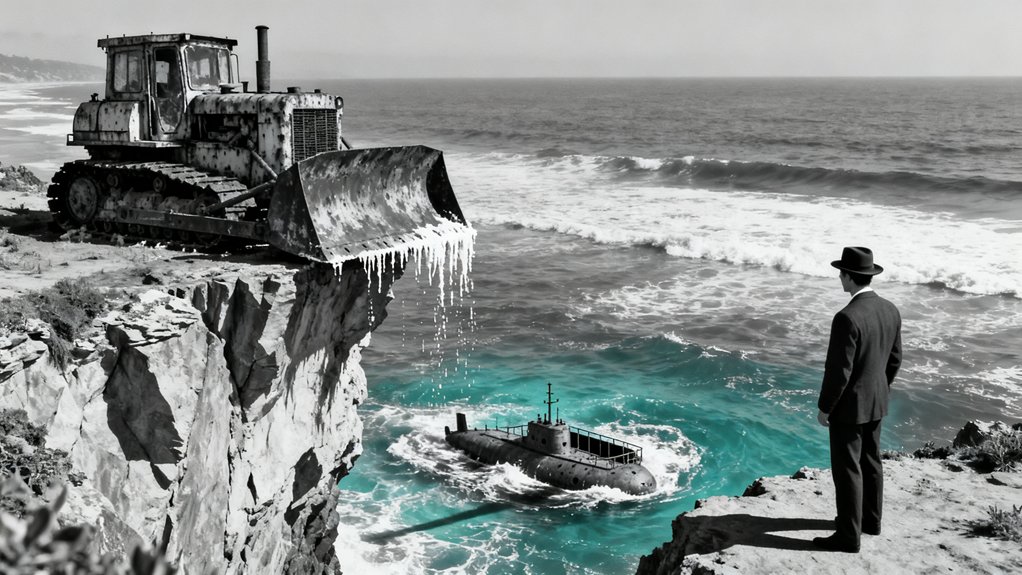
That partial haul, the broken claw and a 38-foot bow section, still stands as one of history’s most ambitious underwater engineering feats. Declassification now reveals the terrifying complexity behind the Hughes Glomar Explorer’s mission. Engineers fabricated an entire mining vessel, then secretly built a 17-story-tall claw, the “Heavy Lift,” capable of grappling a 1,750-ton submarine from 16,000 feet below the surface. The operation’s true audacity lies not in what they grabbed, but in what they conquered. This secrecy echoed earlier Pentagon plans, such as Operation Northwoods, which proposed fabricating attacks on American targets to justify war.
- Deep-Sea Precision: The claw’s mechanical fingers had to snatch the K-129’s broken hull without triggering internal nuclear warheads, a risk only declassified documents now fully admit.
- Operational Secrecy: The entire construction, testing, and recovery happened under constant Soviet surveillance, yet the mining cover held for months.
- Engineered Disintegration: The claw’s failure, one arm snapping, wasn’t random; it stemmed from miscalculated fatigue on a ship designed for lies, not salvage.
This wasn’t just recovery; it was a high-stakes gamble against physics and espionage.
Frequently Asked Questions
Was the Cover Story Ever Believed by the Soviets?
It’s unlikely the Soviets fully believed the Glomar Explorer’s mining cover story.
While they couldn’t publicly prove otherwise without admitting their own surveillance, declassified documents suggest KGB analysts suspected a CIA operation from the start.
They tracked the vessel’s unusual movements and noted its deep-sea capabilities didn’t match commercial mining needs.
Still, without definitive evidence, Moscow couldn’t act, leaving the cover story a fragile, unspoken lie.
How Did the Crew React Upon Finding Human Remains?
The crew’s reaction wasn’t documented as shock but as grim professionalism. They’d discovered a handful of Soviet bones and other remains, a stark, unexpected realization of the mission’s true horror. Most had been told they were digging for a lost submarine’s wreckage, not a tomb.
Some reportedly felt a quiet, deeply unsettling sense of having violated a final resting place. They weren’t prepared for the emotional weight of the salvage.
Did the Operation Recover Any Nuclear Warheads?
No, the operation didn’t recover any nuclear warheads. That’s a common assumption, but declassified records show the Glomar Explorer‘s primary target was the submarine K-129 itself.
The CIA focused on retrieving the hull, codebooks, and cryptological gear. While the Soviets feared loss of their nuclear arsenal, the mission’s fragments (including human remains) revealed no warheads. The cover story kept eyes off the real intelligence prize.
What Happened to the Hughes Glomar Explorer After the Mission?
After the mission, the Hughes Glomar Explorer wasn’t scrapped. Howard Hughes’ company converted it into a true deep-sea mining vessel, leveraging its unique design for commercial seabed operations.
It later served with the U.S. Navy for research. Its classified past didn’t stay buried, however. Its distinctive “lift pipe” system became a tell, forever tying the ship to its covert origin.
The vessel’s later career still sparks debate about what wasn’t recovered.
Why Was the Code Name Specifically “Project Azorian”?
The code name “Project Azorian” wasn’t arbitrary; it’s a cryptic, geographic nod rather than a random label. It draws from the Azores, a crucial Atlantic waypoint for the CIA’s covert logistics, while also echoing the mysterious lost continent of Atlantis.
This choice layers strategic naval reference with mythical secrecy, reflecting the mission’s dual nature as a real salvage operation hidden under a fabricated, impossible cover story. Investigators find its deliberate ambiguity critical to understanding how intelligence agencies obscure truth through language itself.
Final Thoughts
Project AZORIAN’s lie outlasted its mission. The fake mining operation hid a billion-dollar heist, yet ultimately retrieved mostly a twisted hulk and eight sailors’ remains. Was the world’s most expensive covert engineering feat worth its moral and monetary cost? The Glomar Explorer’s true payload remains a ghost, an echo of Cold War ambition, legally buried under its own invented doctrine of silence.