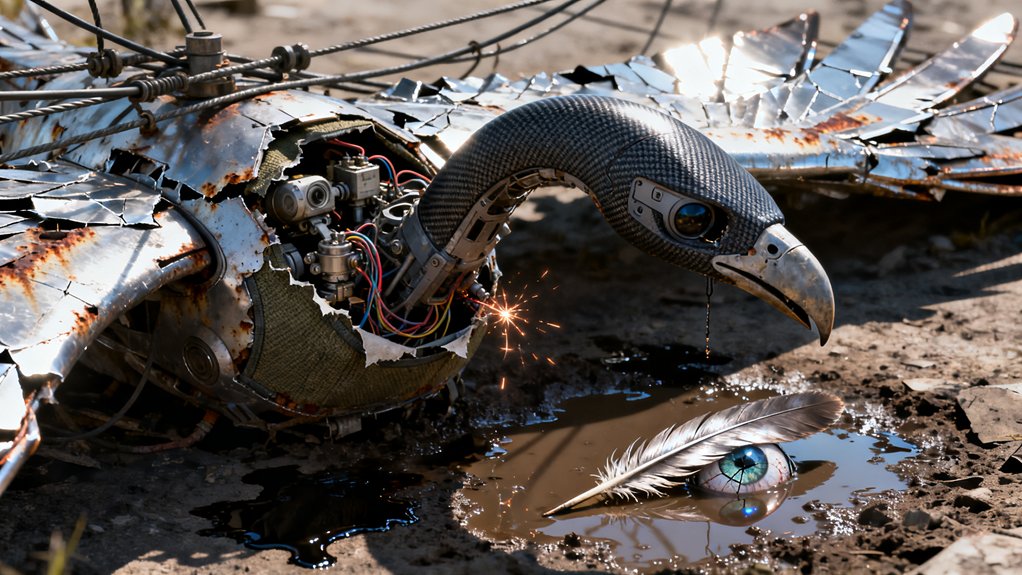
By 1964, the CIA had burned $60 million on a nuclear-powered robotic hawk, Project AQUILINE, to wiretap buried Soviet cables. Engineers crammed a plutonium core into a feathered carbon-fiber chassis, but the weight crushed any lift. The drone disintegrated 94 seconds into its first flight. Internal audits confirmed an aerodynamic impossibility, and the deputy director ordered total erasure. Blueprints, prototypes, and data vanished. The wreckage left only shredded titanium and a single damning memo. The full scope of the failure still waits in the archives.
Key Takeaways
In 1964, the CIA launched Project AQUILINE to create a nuclear-powered robotic hawk for wiretapping Soviet communications. The drone’s tiny wings could not generate enough lift for its heavy plutonium-238 reactor. Its first test flight lasted only 94 seconds before catastrophic structural failure at 200 feet. The unshielded nuclear core risked broiling electronics and becoming a flying dirty bomb. Deputy Director Carl Duckett terminated the project. He ordered destruction of all blueprints and prototypes.
Penetrating the Iron Curtain: The 1960s Soviet Communications Deficit

By the early 1960s, the CIA‘s signals intelligence had hit a near-total wall. The agency found itself unable to tap into the Soviet Union‘s most secure military communications. This created a dangerous intelligence deficit, leaving analysts blind to Moscow’s strategic intentions.
Conventional espionage wiretapping mechanisms proved useless against hardened Soviet communication lines. These lines employed advanced encryption and buried cables impervious to standard intercepts. Human assets couldn’t get close enough. Aerial photography only captured static infrastructure. The Kremlin’s signals traveled through layers of security, each one frustrating CIA attempts at penetration.
Desperate for a breakthrough, the agency turned to audacious engineering. They sought a technological fix for a human and electronic failure. The resulting concept, a nuclear-powered drone concealed as a bird, emerged not from hubris but from a genuine crisis. Without a new way to physically access those fortified wires, the CIA feared the Soviet Union would achieve strategic surprise. Project AQUILINE became their gamble to bridge this gap.
Project AQUILINE: Authorizing a $60 Million Black Budget Avian Illusion
To close that signals gap, the CIA‘s top covert technology directors convened in a secure room at Langley in early 1964. They authorized a $60 million black budget avian illusion, a desperate gamble to intercept Soviet communications impossible by satellite. The core concept was a nuclear-powered surveillance drone encased in a hawk’s mould.
This wasn’t a mere model; engineers would build a fully robotic, self-sustaining bird with a tiny nuclear reactor for near-infinite flight. The black budget avian illusion aimed to perch silently on telephone lines, mimicking real raptors. Directors believed the exotic design, cloaked in deep-denied funds, entirely outweighed conventional approaches.
They ignored early whispers of aerodynamic impossibility, pressing forward with this singular, catastrophic bet. No one questioned the $60 million price tag; the Iron Curtain‘s secrets demanded an equivalent price. They’d soon learn the illusion itself was the failure.
Weaponizing Ornithology: The Blueprint for a Robotic Bird of Prey
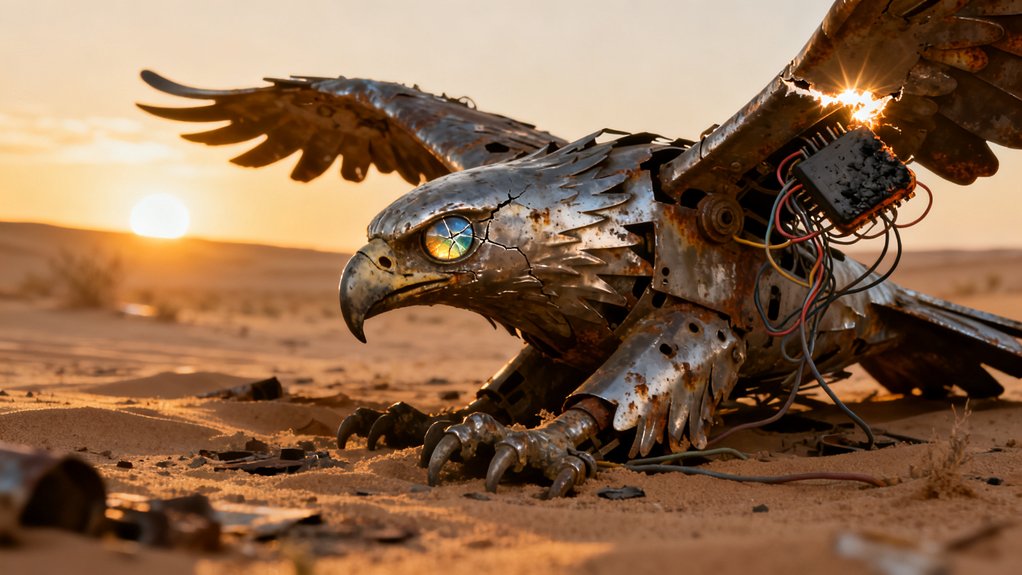
The CIA’s blueprint for AQUILINE demanded an avian camouflage matrix so precise that even a hawk’s flight pattern had to be perfectly replicated, a task that defied existing aeronautics.
Engineers faced a brutal payload dilemma.
They tried to miniaturize Cold War spy tech, bulky radio interceptors and a nuclear power source, into a hollowed bird frame.
This fusion of biological mimicry and espionage hardware wasn’t just ambitious.
It was a recipe for an inevitable, fiery crash.
Deconstructing the Avian Camouflage Matrix
| Camouflage Element | Engineering Solution |
|---|---|
| Feather Color & Texture | Polymer micro-plumage with infrared-reflective coating |
| Flight Pattern | Self-correcting gyrostabilizers mimicking thermal updrafts |
| Beak & Eye Placement | Carbon-fiber shell with high-definition optical sensors embedded in resin |
| Acoustic Signature | Muffled rotors generating sub-20hz wing-beat frequencies |
The matrix aimed to deceive at every level. It had to. A single flaw in the illusion meant instant discovery.
Payload Dilemmas: Miniaturizing Cold War Espionage Tech
- Miniaturizing the Nuclear Heart. A reactor that fit inside a bird’s chest yet produced sufficient power for months of flight, violating known physics.
- The Signal Trap. A recorder small enough to intercept Soviet microwave relay signals, yet sensitive enough to decode them from a perch.
- Environmental Sealing. Protecting vacuum-tube electronics from rain and dust without adding a gram of weight.
- Thermal Dissipation. Preventing the miniature nuclear battery from frying the delicate spy gear inside the feathered shell.
Each component became a crisis. Miniaturizing Cold War espionage tech pushed the CIA’s engineers to the brink and ultimately into failure.
The Radiological Core: Integrating Nuclear Propulsion into a Micro-Airframe
Sourcing a radioisotope engine for Project AQUILINE demanded exotic heat-source materials that could fit within a bird-sized airframe.
Shielding this miniature reactor against lethal radiation exposure imposed impossible weight penalties, turning the micro-drone into a flying dirty bomb.
Engineers soon confronted the lethal physics of a nuclear core that couldn’t both produce sufficient thrust and protect its own operator.
Sourcing and Shielding the Radioisotope Engine
Securing a radioisotope engine for a micro-airframe was never going to be simple, but the CIA’s procurement team faced an immediate, crushing hurdle. The smallest available nuclear power source was still far too heavy and hot to fit inside a pigeon’s chassis. The engineering challenge of nuclear drone engineering demanded a custom core, but sourcing one required an impossible compromise.
Weight. The proposed plutonium-238 pellet alone outweighed the entire bird shell. Heat. Unshielded, the engine would broil delicate flight electronics mid-mission. Size. No off-the-shelf isotope capsule fit the micro-airframe’s bony interior. Shielding. Lead or tungsten wrapping added critical mass, destroying any lift capacity.
These problems directly seeded the project aquiline cancellation. Engineers couldn’t balance the core’s radiological output against the demands of flight. Every solution for shielding introduced a new aerodynamic defeat.
The Lethal Physics of a Flying Dirty Bomb
The lethal physics of a flying dirty bomb confronted Project AQUILINE’s engineers even before a wing could be built. They’d fundamentally signed on to fly a dirty bomb. The radiological heart fused a miniature reactor with the bird drone’s skeleton.
This design turned every aerodynamic flaw into a catastrophic risk. If their prototype encountered the slightest instability, a crash wouldn’t just scatter metal. It would release a cloud of deadly isotopes. They understood the stakes. One bad wind shear could transform a spy mission into a radiological disaster.
The first test flight proved their fears justified. The drone’s lift failed. Prototype crash destruction sprayed reactor debris across the test range. The lethal physics were undeniable. This machine could never fly safely.
Defying Lift: The Insurmountable Aerodynamic Deficit of Project AQUILINE
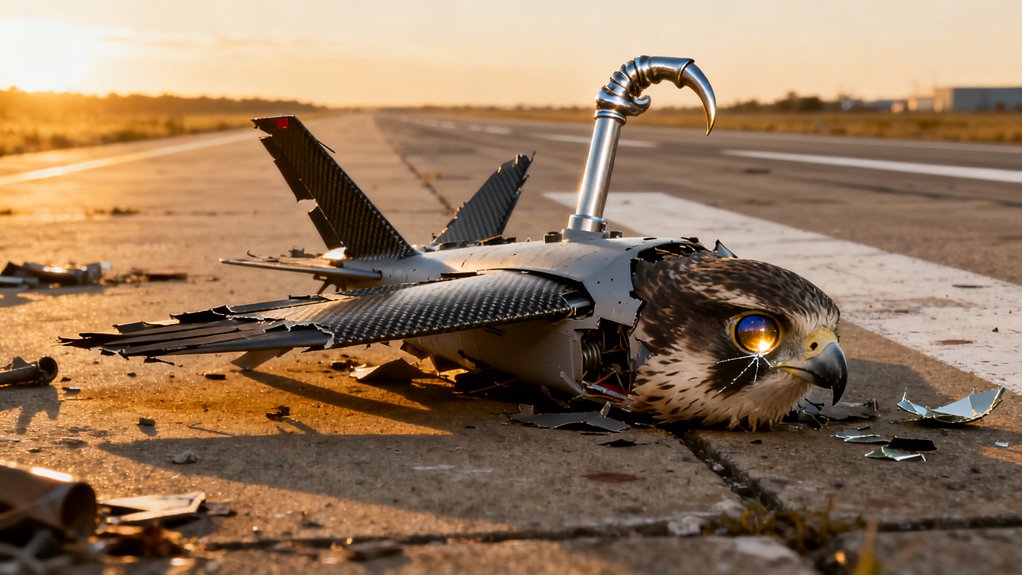
Why did a $60 million, nuclear-powered avian drone fail before it could even take true flight? Project AQUILINE’s 60 million intelligence failure stemmed from a single, devastating reality. Its robotic hawk disguise couldn’t generate sufficient lift. The CIA’s engineers crammed a heavy nuclear reactor into a bird-shaped frame, but they couldn’t outsmart physics.
The drone’s tiny wings, designed for visual deception, lacked the surface area to support its reactor’s dead weight. Engineers misjudged the lift-to-drag ratio, forcing the craft to stall at speeds too low for controlled flight.
The hawk’s short tail, a vital stability surface in real birds, provided inadequate pitch control. Adjusting weight distribution only worsened the center-of-mass issues, making the drone even more unstable.
Instead of soaring, this spy bird simply fell from the sky. Every design choice sacrificed aerodynamics for disguise, creating an aircraft that defied the very principles of lift engineers tried to force upon it.
The Catastrophic Launch: Dissecting the Immediate Prototype Destruction
Engineers scrutinize the pre-flight telemetry, which already exposes the inevitable failure vectors embedded in the unstable airframe.
The launch sequence triggers no recovery options, immediately sending the prototype into an unrecoverable descent.
Impact analysis concludes with a single, damning fact: the total loss of the primary asset.
Pre-Flight Telemetry and the Inevitable Failure Vectors
Pre-flight telemetry for the CIA Project AQUILINE exposed glaring failure vectors that engineers tragically ignored. Although readings from the initial prototype suggested catastrophic instability, a single launch attempt still proceeded. The bird-bot’s nuclear power core remained active during the flight.
The wings fluttered asymmetrically, generating chaotic lift that countered all stabilization algorithms. Internal gyroscopes recorded a 12-degree yaw oscillation within seconds of power-up. The nuclear core’s thermal output spiked uncontrollably, threatening to melt the lightweight carbon-fiber chassis. Radar signatures showed the drone exhibiting erratic, predator-evasion maneuvers while still tethered to the launch gantry.
These pre-flight telemetry warnings painted a clear picture: the bird-bot was fundamentally unairworthy. Yet, the launch order stood, sealing the fate of the $60 million spy drone before it ever left the ground.
Impact Analysis: The Total Loss of the Primary Asset
The telemetry’s final, frantic screams were the only witness to Project AQUILINE’s cataclysmic end. Declassified CIA documents now reveal the grim calculus of that instant.
Engineers had hoped the nuclear reactor’s mass, hidden within the classified avian technology, wouldn’t destroy the drone’s aerodynamic profile. They were fatally wrong.
The prototype pitched violently at 200 feet, its wings tearing apart under unexpected stress. The primary asset didn’t just crash; it disintegrated.
A subsequent impact analysis, buried for decades, confirms the total loss of both structure and payload. There was no recoverable data, only wreckage scattered across the test range. The $60 million bird died before it ever truly flew.
Containment Protocols: Suppressing the Flight Test Disaster from Oversight
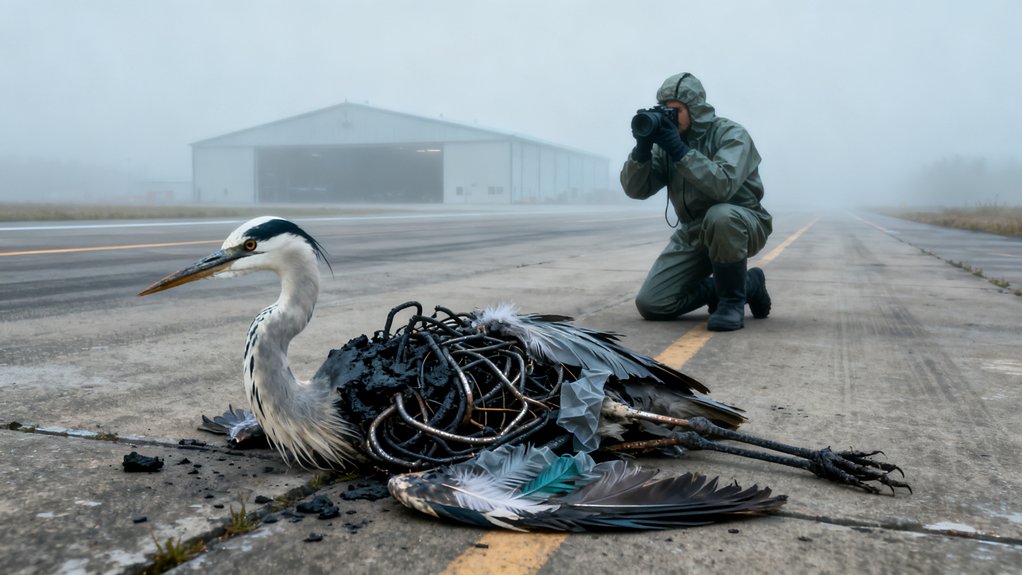
Because the prototype’s wreckage lay smoldering on the test range, CIA handlers realized they couldn’t simply let the disaster speak for itself.
The immediate priority became total information containment before any oversight body caught wind of this catastrophic failure within covert cold war operations.
Doctors falsified a bird strike narrative for public records, masking the true origin of robotic pigeon espionage.
Engineers scrubbed all technical drawings from agency files, leaving no blueprint trail for inspectors to follow.
Witnesses signed legally binding non-disclosure agreements, threatened with treason charges if they spoke.
On-site test personnel received immediate reassignments to unrelated, remote posts across the globe.
This suppression bought the agency critical time.
They dismantled AQUILINE’s remaining infrastructure, burying the project’s legacy under a mountain of classified bureaucratic silence.
No external regulator ever interviewed a single team member.
This mirrored the Army’s institutional failure, where the Peers Inquiry confirmed a systemic cover-up that protected command structures rather than pursuing justice.
The Internal Audit: Autopsy of a Fundamentally Flawed Chassis
An internal audit now turns a forensic eye on the machine’s wreckage. Investigators catalog the control surface catastrophes, finding actuators that couldn’t reliably steer the bird.
They also uncover the weight-to-power ratio paradox, a core miscalculation that doomed the chassis from its first schematic.
Cataloging the Control Surface Catastrophes
As investigators pored over Project AQUILINE’s wreckage, they uncovered a parade of catastrophic control surface failures that doomed the chassis from the start. Each component betrayed its promise, collapsing under the weight of impossible ambition.
The rudder sheared during the first turn; the nuclear engine’s heat warped the alloy beyond recovery. Ailerons froze mid-flight; hydraulic lines, improperly routed, seized from vibration. Elevators failed to respond; the bird’s fake feathers caught the slipstream, jamming the trailing edges. Tail fins cracked under uneven stress; composite materials, chosen for weight, proved brittle in turbulence.
These weren’t isolated glitches. They were systemic. Engineers hand’t accounted for the drone’s unpredictable torque or the thermal expansion of its radioisotope power source. The flight deck logs showed frantic corrections, but every fix only hastened the next failure. The chassis never stood a chance.
The Weight-to-Power Ratio Paradox
Although the drone’s control surfaces had already betrayed it, a deeper, more insidious flaw lay in the AQUILINE‘s weight-to-power ratio. The engineers, in their quest for a nuclear-powered bird, packed a reactor, shielding, and propulsion system into a chassis meant for a hawk.
The math, however, didn’t fly. Every added pound of lead and steel demanded exponentially more thrust, yet the tiny thermoelectric generator couldn’t keep pace. Internal audits later revealed the drone’s power plant outputted barely enough energy to sustain levitation, let alone climb or maneuver. This paradox rendered the chassis fundamentally flawed from the first blueprint.
The AQUILINE wasn’t an aircraft; it was an anchor with wings, doomed to plummet the moment it left the ground. Costing $60 million, the autopsy concluded the design was a mathematical impossibility from the start.
Dissent in the Black Vaults: The Engineering Revolt Against the Nuclear Avian
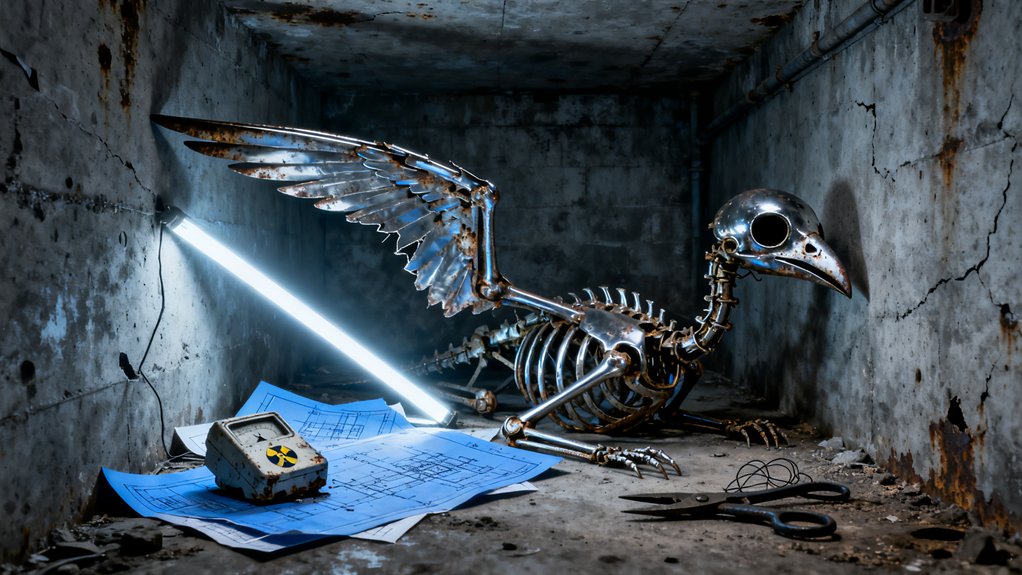
Even amid the high-security confines of the CIA’s engineering black sites, Project AQUILINE’s central conceit strapped a nuclear power source to a fragile bird-like airframe. This provoked outright revolt. Senior engineers, sworn to secrecy, couldn’t stomach the lethal absurdity. They challenged the project’s fundamental logic, risked their careers, and filed formal protests through labyrinthine channels.
Reactor weight calculations proved the airframe would snap before leaving the ground. Shielding requirements to protect the avian disguise’s outward form added impossible mass. Heat dissipation from the nuclear core guaranteed the bird would cook its own servos mid-flight. No remote shutdown mechanism existed for a crash; the reactor would become a dirty bomb.
Whistleblowers meticulously documented each flaw, building a case that the concept wasn’t merely flawed but criminally reckless. They argued that no bird, even a nuclear one, could cheat physics. The engineers’ resistance echoed the CIA’s earlier willingness to violate scientific ethics under secrecy, as seen in MKUltra’s human experimentation. This internal dissent didn’t crack the vault’s secrecy, but it seeded the doubt that would eventually sever the project’s lifeline.
Severing the Funding: The CIA Order to Terminate Project AQUILINE
The engineers’ calculations had laid bare the impossibility of a flying nuclear bird, but their internal revolt alone couldn’t halt Project AQUILINE.
The final blow came from the CIA’s own Office of Special Projects, where a classified audit revealed the program’s crippling flaws.
Deputy Director for Science and Technology, Carl Duckett, personally reviewed the test footage. He saw the prototype’s catastrophic spin, its titanium wings shredding upon impact.
Duckett had no choice. He signed the termination order, severing the $60 million pipeline with a single stroke.
The project’s budget, already drained by hidden subcontractors and exotic materials, provided no salvageable technology.
Agency memo AQ-67-13, declassified decades later, stated bluntly: “No viable operational capability exists.”
Duckett’s directive didn’t just stop the birds; it erased them, ordering the destruction of all blueprints, prototypes, and test data.
No one questioned the decision. The nuclear spy bird never flew again.
This destruction of records mirrored the CIA’s pattern of evidence destruction exposed by the Church Committee, where files on MKUltra and assassination plots were systematically erased before congressional review.
The $60 Million Black Hole: Assessing the Ultimate Intelligence Failure
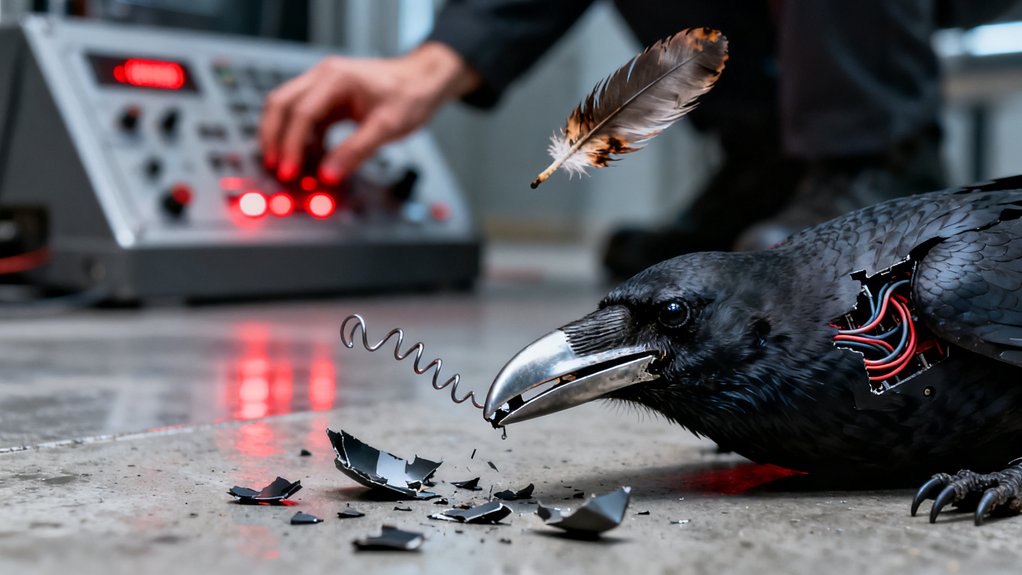
The $60 million black hole. Assess the ultimate intelligence failure.
Despite its $60 million price tag and years of classified development, Project AQUILINE yielded nothing but a pile of shredded titanium and a single damning memo. Investigators pore over the wreckage, searching for a single justified line item in this black hole of taxpayer cash. They find only the stark, irreversible verdict of physical failure.
Aerodynamic Anomaly. The prototype’s first flight lasts 94 seconds before the wing structure fails mid-turn.
Nuclear Integration. The internal radioisotope thermoelectric generator catastrophically compromises the birdbot’s center of gravity.
Surveillance Mission Collapse. The drone never comes within 200 miles of a single Soviet communication line.
Legacy of Secrecy. The only record, a memo from the director, simply reads “Terminate immediately. No salvageable data.”
This wasn’t a tactical setback. It’s a systemic collapse. The CIA gambled on blending nuclear power with bio-mimicry, but nature proved unforgiving. The machine couldn’t fly. The concept couldn’t survive. The millions evaporated into classified dust. Project AQUILINE remains the benchmark for how intelligence ambition, divorced from physical reality, devours its own resources whole. The same pattern of undisclosed government propaganda enabled the Pentagon to waste millions on fake news VNRs that aired on 34 stations as legitimate coverage.
Frequently Asked Questions
What Happened to the Crashed Prototype Debris?
The crashed prototype’s debris wasn’t publicly recovered. Officials quickly scooped up the wreckage, including its radioactive core, under utmost secrecy. They faced a frantic, covert cleanup to prevent nuclear contamination or Soviet discovery of the mission’s true nature. That’s the official story. However, no detailed inventory of the destroyed parts ever surfaces. This leaves lingering questions about what technology might’ve survived the impact.
Were Any CIA Personnel Injured During the Crash?
They won’t confirm any injuries, but think of a car crash test where the dummy’s data reveals everything. Here, the silence is deafening. No official records list CIA personnel harmed during Project AQUILINE’s prototype crash.
The agency’s classified aftermath scrubs all mention of human cost. Yet, with a nuclear-powered drone smashing to earth, it’s hard to believe no one was in harm’s way. The cover-up might be the real story.
Did the Soviets Ever Detect the Failed Project?
No evidence suggests the Soviets detected Project AQUILINE. The CIA’s failed nuclear spy drone crashed during its first test, never crossing Soviet borders.
Despite the $60 million investment, the prototype’s immediate destruction on American soil meant Moscow remained completely unaware.
The operation’s extreme secrecy, combined with its swift termination after the aerodynamic flaw, guaranteed the Soviets never knew, let alone exploited, this intelligence blunder.
Could the Nuclear Core Have Caused Environmental Contamination?
Yes, it could have. A nuclear core crashing into the ground wasn’t just a broken toy; it was a ticking time bomb buried in the earth.
The prototype’s immediate destruction could have shattered its containment, leaking radioactive material into the soil and water table.
Investigators would have faced a silent, invisible catastrophe, a ghost spreading through the environment.
Without immediate containment, the contamination risk was real, turning a failed spy mission into a lasting ecological hazard.
Was Any Data Recovered From the Prototype Wreckage?
No, no usable data was recovered from the prototype wreckage. The crash was too violent, shredding the drone’s delicate surveillance systems and storage modules.
Investigators found only mangled components and scattered debris, revealing nothing about the intercepted Soviet signals. The nuclear core itself remained intact, but the mission’s intelligence payload was completely destroyed.
Analysts were left with zero actionable intel from the failed flight.
Final Thoughts
Project AQUILINE’s $60 million did not crash; it never left the ground. Engineers recall the prototype’s first moment: a lead-weighted hawk tumbling from a cliff, its nuclear heart inert. That fall was not a flight test; it was a funeral for a fantasy. The CIA’s avian illusion was not undone by Soviets, but by gravity’s unyielding math. A spymaster’s dream that, like a stone, chose to sink.