The polygraph’s inaugural test in 1921 logged a 42% error rate. Internal documents show its core function was never scientific detection, but psychological extortion to force confessions. A 2003 National Academy of Sciences study and a 2015 CIA IG report confirm it as an unreliable intimidation prop. Its continued use in security screening represents a costly institutional failure. The full story reveals a century of orchestrated deception.
Key Takeaways
- Its original 1921 test showed a 42% error rate, a flaw present from its inception.
- Declassified CIA reports admit its real function was psychological extortion, not truth detection.
- Internal data showed high pre-test confession rates driven by intimidation, not accuracy.
- A 2003 National Academy of Sciences report condemned its scientific validity for security vetting.
- The machine was used as a coercive interrogation prop to terrify subjects into admissions.
August 8, 1921: John Larson’s Prototype and the Matthew Arnold Embezzlement Illusion
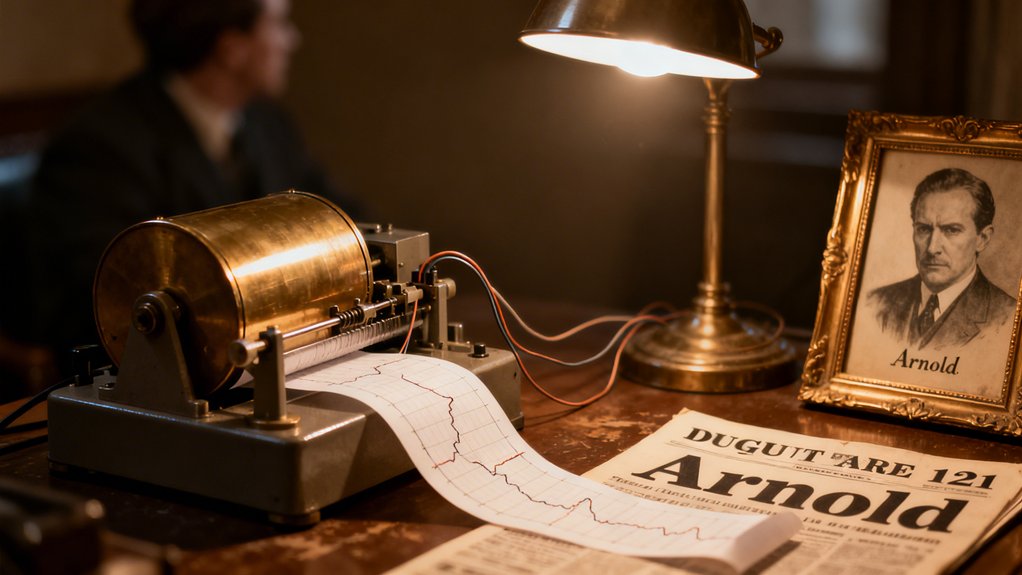
Although the polygraph machine’s inaugural field test on August 8, 1921 appeared decisive, its verdict was a deception of its own design. John Augustus Larson polygraph monitored suspect Matthew Arnold’s blood pressure and breathing during an interrogation on embezzlement charges. The physiological tracings spiked dramatically, seemingly indicating guilt. However, conclusive evidence of forged checks already existed, rendering the machine’s reading superfluous. The device didn’t detect lies; it recorded stress, a fact Larson privately conceded. This foundational flaw mirrors other unsubstantiated scientific claims, where early, dramatic results fail under independent scrutiny. This first application established a critical, enduring pattern: the machine’s intimidating presence as a psychological prop. Its power to induce fear, not its scientific accuracy, would later become the true driver of the high pre-test confession rate agencies sought.
The Keeler Refinement: Marketing a 90 Percent Lie Detection Mirage to J. Edgar Hoover
Keeler’s three-channel design added galvanic skin response, creating a more imposing—though equally invalid—instrumental facade. His 1935 training manual asserted a 90% success rate across 1,200 tests, a statistic fabricated for marketing rather than science. FBI adoption under Hoover codified the polygraph’s primary utility: eliciting pre-test confessions through manufactured dread, not analyzing charts. The CIA’s MKUltra program similarly relied on fabricated data and destroyed records to conceal its true purpose of mind control and unwitting human experimentation.
US Patent 2,115,857: The Scientific Blueprint for a Psychological Interrogation Prop
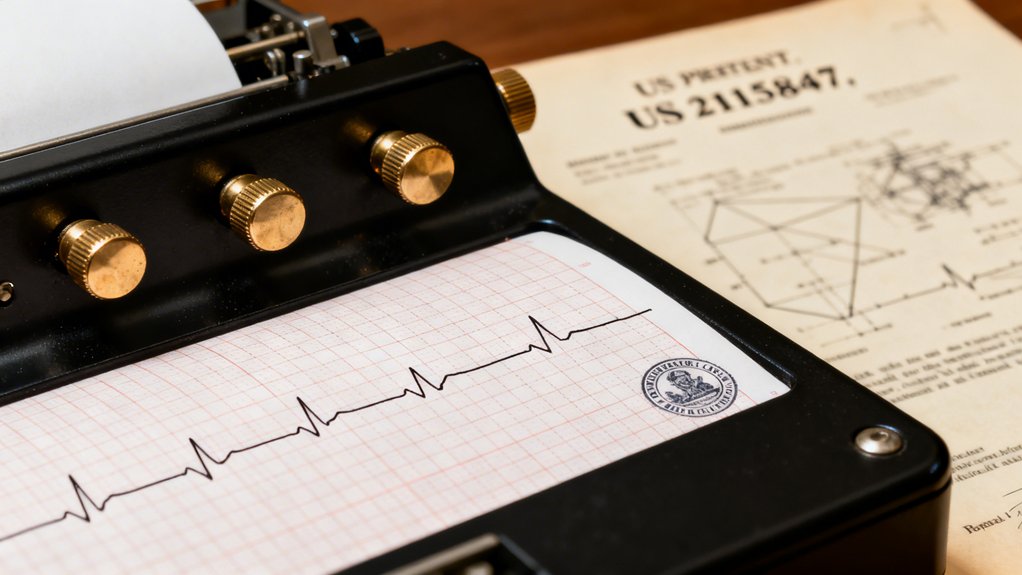
Leonarde Keeler’s 1933 test on Baby Face Nelson had already revealed a critical flaw, as the suspect’s physiological spikes aligned with his terror of the electric chair, not his truthfulness.
This operational reality starkly contrasted the scientific claims in his 1938 patent, which itself only described measuring “emotional excitation.”
Yet an internal 1940 FBI memo from J. Edgar Hoover would expose the device’s true utility, documenting that a staggering 70% of suspects confessed before the test even began, purely from dread of the machine.
The Baby Face Nelson Calibration Failure of 1933
While Leonarde Keeler refined his polygraph into its three-channel form in 1931, a critical test two years later exposed a foundational flaw when the device was used on infamous gangster Baby Face Nelson.
Keeler’s charts recorded intense physiological stress indicators, but the reactions weren’t linked to deception. Instead, Nelson’s panic stemmed from a direct question about the electric chair, proving the machine couldn’t differentiate between a guilty conscience and general terror. This case revealed the device’s true nature as a psychological interrogation prop, capable of measuring arousal but incapable of detecting lies.
- The Setup: Keeler attempted to use his patented device to verify Nelson’s criminal activities during a 1933 interrogation.
- The Flaw: Dramatic chart spikes correlated perfectly with Nelson’s fear of execution, not with factual answers about crimes.
- The Revelation: The failure demonstrated that physiological readings were ambiguous and easily misinterpreted, a core vulnerability.
Hoover’s 1940 Internal Memo Exposing the 70 Percent Pre-Test Confession Rate
Despite Keeler’s public confidence in his machine, J. Edgar Hoover‘s own 1940 internal FBI memo exposed a startling truth.
This fbi memo 1940 hoover documented that suspects confessed seventy percent of the time before the test even began, purely from psychological dread of the device. The document’s existence revealed the polygraph’s true function as a prop for psychological coercion, not scientific verification. Decades later, this same foundational insight into pre-test intimidation would inform modern FBI directors, from james comey onward, about the machine’s core utility. The memo’s statistics framed every subsequent interrogation as a play on fear, proving the process wasn’t about reading physiological charts but about manufacturing enough anxiety to prompt a confession before the needles ever moved.
August 15, 1943: Operation Wedding Ring and the Hans Kammler Baseline Stress Failure
The machine’s needles danced erratically as German POW Hans Kammler sat for his interrogation on August 15, 1943, during the OSS’s Operation Wedding Ring.
The interrogation aimed to extract details on German jet programs, but the examiner misattributed Kammler’s elevated physiological responses—rooted in the trauma of capture and confinement—as deliberate deception.
Interrogators mistook the trauma of capture for deliberate deception during the interrogation.
This critical error, where baseline stress mimicked a lie, foreshadowed future failures like the flawed yuri nosenko interrogation.
The OSS’s reliance on the polygraph nearly derailed the os interrogation, as analysts prioritized the misleading charts over actionable intelligence that was actually sourced from Enigma intercepts.
The experiment’s duration, predicated on such deceptive data collection, mirrored the unethical longitudinal design of events like the Tuskegee syphilis study.
- The examiners recorded deceptive spikes, but these correlated directly with Kammler’s documented malnutrition and sleep deprivation from captivity.
- Valuable intelligence on the Me 262 jet was ultimately verified via signals intelligence, not the unreliable polygraph readings.
- This incident established a persistent pattern where interrogators conflated the stress of the interrogation environment itself with guilt.
MKULTRA Subproject 54 and the CIA’s Orchestrated Self-Deception
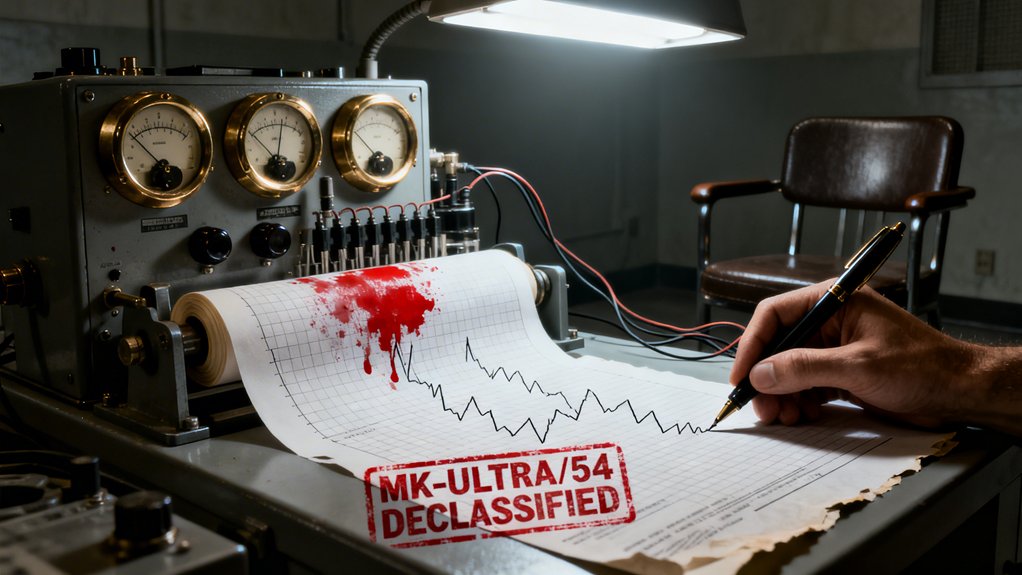
In 1950, CIA scientist William E. Foote observed that LSD-induced physiological arousal consistently triggered false polygraph “deception” readings during MKULTRA Subproject 54 trials.
Agency Director Allen Dulles formalized this operational reality in a 1952 directive to Richard Helms, explicitly prioritizing “psychological leverage” over any scientific accuracy.
The CIA’s leadership therefore orchestrated a system of self-deception, knowingly deploying a flawed instrument as a weapon of intimidation. This mirrored the program’s broader use of unwitting human subjects across its 149 subprojects.
William E. Foote’s 1950 LSD Trials and Hallucinogenic False Positives
What could be learned from deliberately sabotaging the very tool meant to detect deception? In 1950, CIA psychologist William E. Foote ran experiments under MKULTRA Subproject 54, administering LSD to subjects strapped to polygraphs. The hallucinogen induced profound physiological arousal—increased heart rate, sweating, erratic breathing—which the machine’s needles falsely recorded as deception.
This created a perfect “hallucinogenic false positive,” proving the device measured stress, not truth. The findings, which should have invalidated the polygraph, were instead filed away, as the agency prioritized psychological control over scientific integrity. This internal knowledge of the machine’s flaw preceded the pivotal Allen Dulles CIA memo that would soon cement its official, deceptive use.
- The Setup: Foote’s team secretly dosed unwitting subjects with LSD during polygraph examinations, deliberately triggering states of extreme anxiety and altered perception.
- The Result: The polygraph charts showed classic “deceptive” patterns, entirely caused by the drug’s physical effects, not any lies from the subjects.
- The Institutional Truth: This direct evidence of the machine’s fundamental unreability was documented but suppressed, becoming a dark secret within MKULTRA Subproject 54.
Allen Dulles’s 1952 Directive to Richard Helms: Psychological Leverage Over Accuracy
While internal evidence had already exposed the polygraph as unreliable, CIA Director Allen Dulles cemented its official role in 1952 by instructing Richard Helms that “psychological leverage [is] paramount; accuracy secondary.”
This directive, a cornerstone of allen dulles espionage strategy, formalized the machine’s true utility: a fear-inducing prop.
It was a calculated move, directly linking the device to MKULTRA’s mind-control explorations.
The goal was never scientific truth but orchestrated self-deception, exploiting a subject’s dread to trigger pre-test admissions.
Decades later, experts like Dr. Drew Richardson testimony would detail this exact psychological coercion, but Dulles’s memo had already codified the hoax, prioritizing agency control over any genuine diagnostic function.
November 3, 1964: Ignoring the Warren Commission and Botching the Yuri Nosenko Defection
Even though Warren Commission files corroborated Soviet defector Yuri Nosenko‘s claim of no link to Lee Harvey Oswald, CIA polygraph examiners on November 3, 1964 deemed him deceptive based solely on respiration data.
They disregarded external proof, relying on a single, unreliable metric that reflected his understandable stress during intense interrogation. This critical error led to his unjust imprisonment and tortured isolation for years, crippling U.S. understanding of Soviet intelligence.
- The examiners ignored documented evidence, showcasing the polygraph’s role in manufacturing false positives from normal anxiety.
- Nosenko’s ordeal demonstrated how the machine’s “deception” verdicts could override factual intelligence, damaging counterintelligence.
- This failure prefigured later disasters like the Ana Montes espionage case, where the device also provided false assurance.
George Maschke’s Buried 1967 Internal Audit Revealing an 82 Percent Recruit Crack Rate
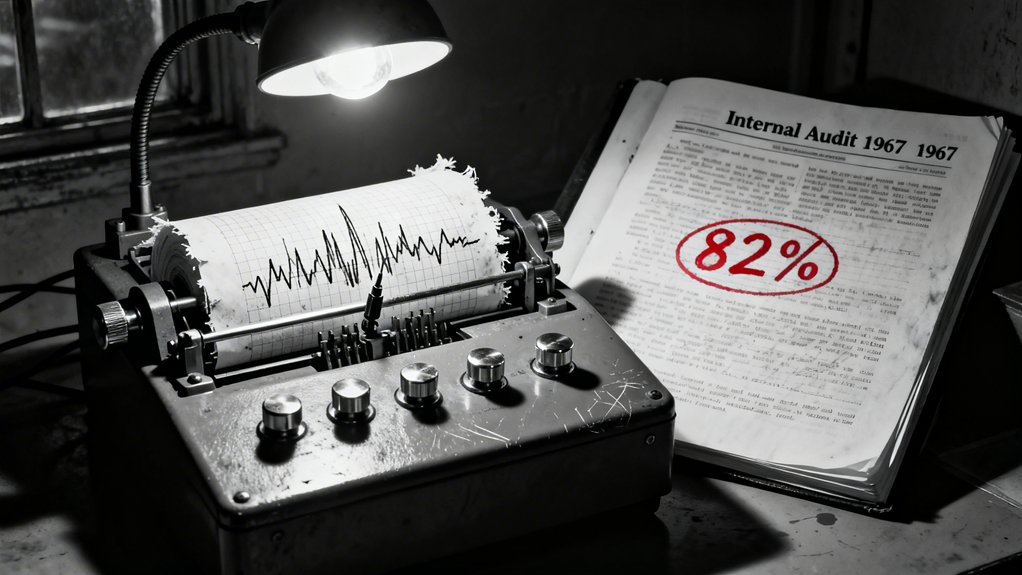
Because internal CIA metrics prioritized coerced admissions over accuracy, George Maschke’s 1967 internal audit exposed an explosive truth: eighty-two percent of recruits ‘cracked’ pre-test during security processing, confessing out of sheer terror of failing the machine rather than from actual guilt. Maschke’s buried report revealed the polygraph’s core function wasn’t detection but intimidation. This systemic flaw in false-positive security screening later proved catastrophic, as actual spies like the aldrich ames kgb mole would pass while innocent personnel faced ruin. The audit quantified the machine’s psychological coercion, showing admissions were driven by the exam’s ominous reputation, not by genuine deception.
| Audit Finding | Implication |
|---|---|
| 82% Pre-test Confession Rate | Admissions were coerced by fear, not evidence of guilt. |
| Machine’s Reputation as Primary Driver | The polygraph operated as a psychological prop, not a detector. |
| High False-Positives on Innocent Recruits | Security screening was flawed, creating risk while missing real threats. |
The July 1983 Capitol Hill Hearings: John F. Sullivan Admits a 60 Percent False Positive
- Sullivan’s testimony revealed that a majority of the “deception” findings were incorrect, branding loyal personnel as potential security risks.
- His admission forced lawmakers to confront the real-world consequences of flawed screenings, which could ruin careers and compromise trust.
- This hearing became a foundational moment for critics, foreshadowing future mandates like the sweeping dod directive 5210.91 that expanded its use despite known flaws.
Weaponizing Incompetence: How Top Espionage Targets Consistently Beat the Box
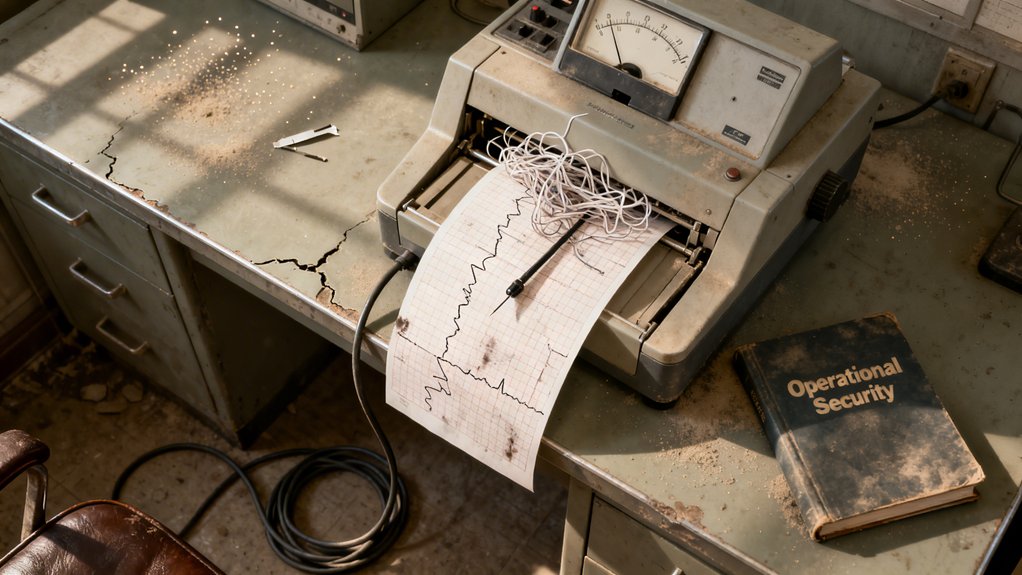
For years, the polygraph’s most embarrassing failures involved high-value spies who consistently passed its screenings.
Counterintelligence officer Aldrich Ames underwent four separate CIA polygraphs while actively funneling secrets to the KGB, each time producing deceptive charts that examiners nonetheless marked as “no deception indicated.”
Similarly, Defense Intelligence Agency analyst Ana Montes faced annual screenings for over a decade without raising alarms, her espionage for Cuba finally halted not by a polygraph but by intercepted signals intelligence.
1986-1992: KGB Mole Aldrich Ames Defeats Four Separate Agency Polygraphs
Why would a CIA counterintelligence officer with a known drinking problem and lavish spending habits repeatedly pass rigorous security polygraphs while actively selling secrets to the KGB? Aldrich Ames exploited the system’s core weaknesses for years, providing a masterclass in subverting the polygraph’s psychological theater.
He calmly disclosed minor transgressions during pre-test interviews to appear cooperative, manipulating his own baseline. His espionage continued undetected until financial anomalies, not the failed machine, triggered his 1994 arrest.
- Controlled Disclosure: Ames strategically admitted to small, real security lapses like occasional drinking, creating a façade of honesty that masked his monumental betrayals.
- Psychological Mastery: He reportedly employed simple countermeasures like controlled breathing and mental detachment to stabilize his physiological readings during critical questions.
- Systemic Failure: The polygraph’s focus on eliciting confessions through fear proved useless against a trained insider who understood its mechanics and remained outwardly composed.
1985-2001: Ana Montes Subverts Annual DIA Screenings Until Signals Intercepts Intervene
While Aldrich Ames’s evasion of the polygraph exposed its flaws within the CIA, the case of Defense Intelligence Agency analyst Ana Montes revealed the same systemic failure in a different agency, as she successfully navigated annual screenings for over sixteen years. She’d been spying for Cuba since 1985, yet her consistent physiological control during exams deflected suspicion. The DIA’s screenings provided a false sense of security, allowing her to pass highly classified information. Her compromise wasn’t discovered by a failed test; signals intelligence intercepts of Cuban communications ultimately identified her. Her case proved that disciplined adversaries could consistently exploit the polygraph’s reliance on stress, not truth.
| Year | Screening Event | DIA Examiner’s Notation |
|---|---|---|
| 1992 | Annual Polygraph | “No Deception Indicated” |
| 1995 | Routine Re-investigation | “Responses Within Normal Parameters” |
| 1998 | Promotion Screening | “Subject Cooperative, Findings Favorable” |
| 2000 | Final Pre-Compromise Test | “Cleared Without Incident” |
| 2001 | Identification Source | Signals Intelligence Intercepts |
The 1997 Senate Judiciary Showdown: Dr. Drew Richardson Exposes a Historical 42 Percent Error Rate
Although the polygraph had been shrouded in bureaucratic deference for decades, its foundational fraud was publicly dismantled before the Senate Judiciary Committee in 1997 when FBI examiner Dr. Drew Richardson delivered a devastating critique. He labeled the technique a “charlatan” tool with zero validity for security screening, introducing John Larson’s original 1921 test logs as evidence.
Richardson’s analysis revealed the device’s error rate wasn’t a modern flaw but a historical constant baked into its operation from the very beginning.
- Original Sin: He presented Larson’s first case files, showing a documented 42% error rate from the instrument’s inaugural 1921 test.
- Expert Testimony: As an FBI forensic examiner himself, Richardson argued the machine measured stress, not lies, making it useless for screening.
- Public Record: His sworn testimony placed the polygraph’s scientific bankruptcy into an official congressional record, challenging decades of institutional myth.
Leaking the 300-Page Playbook: Dark Rooms, Silent Examiners, and the 85 Percent Confession Metric
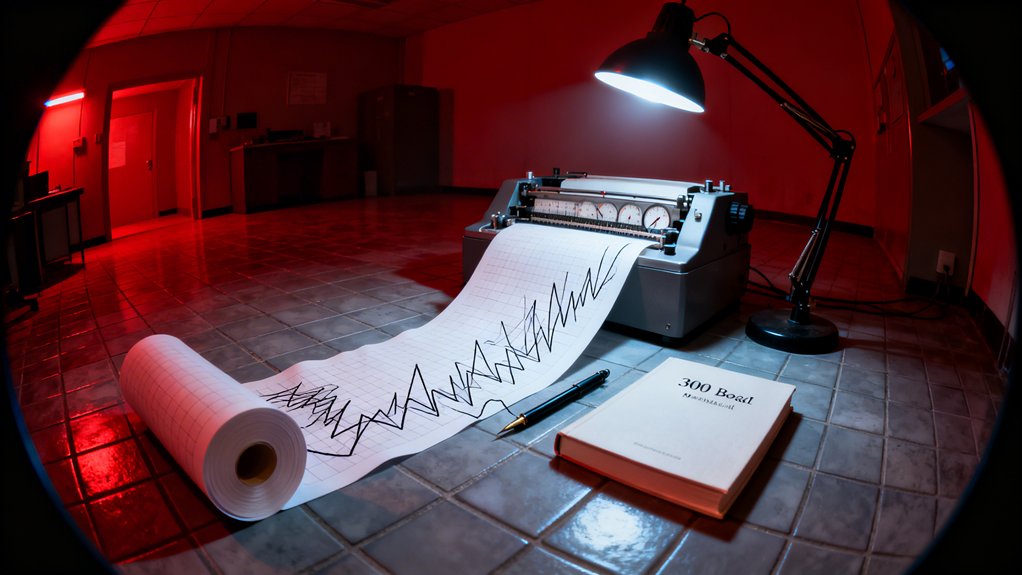
| Psychological Tactic | Stated Purpose & Outcome |
|---|---|
| Pre-Test Interview | Establish examiner authority and machine’s infallibility. |
| Isolated “Dark Room” Setting | Heighten anxiety and sensory deprivation. |
| Silent Examiner Stare | Unnerve the subject, encouraging pre-emptive speech. |
| Reading of Questions | Imply grave consequences for any “deceptive” response. |
| Cumulative Effect | 55-85% pre-test confession/admission rate. |
Richardson’s analysis confirmed the machine served as a theatrical prop, with its ominous wires and charts leveraged to break resolve. The leaked metric showed an 85% confession rate rooted not in truth-seeking but in psychological coercion, mirroring the manufacturing doubt strategy pioneered by industrial polluters to discredit threatening evidence.
The 2003 National Academy of Sciences 422-Page Condemnation of Security Screening Validity
Because the polygraph had persisted for decades as a cornerstone of national security vetting despite mounting internal evidence, its final, authoritative repudiation arrived in 2003 with a 422-page report from the National Academy of Sciences.
For decades, the polygraph persisted in security vetting until a definitive 2003 report repudiated it.
The exhaustive study, commissioned by the Department of Energy after the Aldrich Ames scandal, dismantled the device’s scientific credibility. It concluded polygraph screening was fundamentally incapable of reliably detecting deception, with accuracy rates so low they offered no improvement over chance.
- The report found the polygraph’s theoretical foundation was weak, as physiological responses measured were non-specific to lying.
- It determined the error rate was unacceptably high for security purposes, likely to falsely flag innocent individuals.
- The panel warned that reliance on such an invalid tool could create a dangerous illusion of security while letting actual threats slip through.
DoD Directive 5210.91: Mandating 4.2 Million Clearances and a 300 Million Dollar Annual Boondoggle
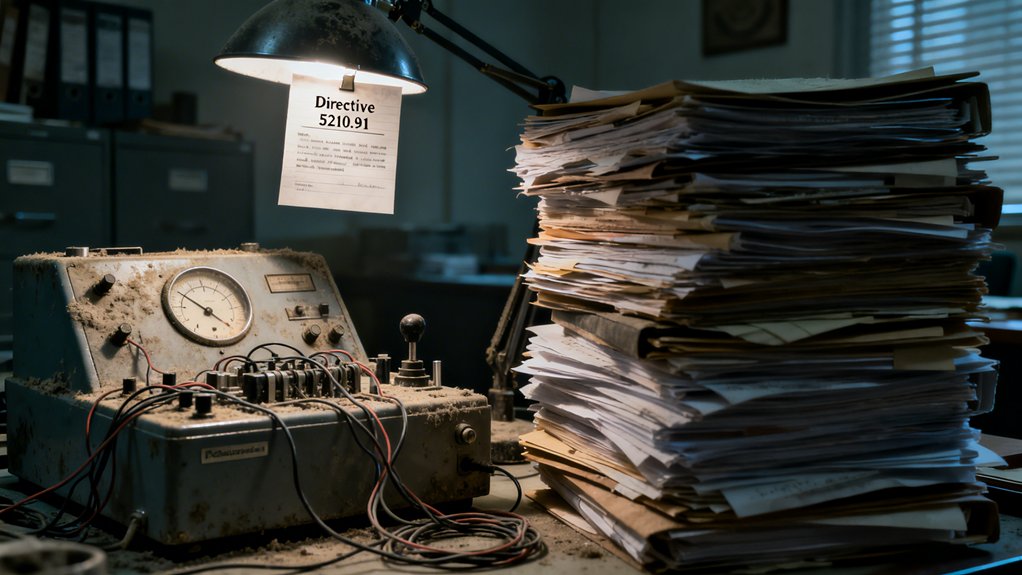
Despite its exhaustive 2003 condemnation by the National Academy of Sciences, the polygraph’s institutional role expanded dramatically when the Department of Defense issued Directive 5210.91 in 2012, mandating its use for millions of personnel. This sweeping policy turned a discredited technology into a cornerstone of national security vetting. It created a massive, costly bureaucracy. Government Accountability Office audits soon revealed a staggering annual price tag of approximately $300 million for screening alone. The directive forced over four million civilian and military personnel holding sensitive positions to undergo the procedure, institutionalizing what critics termed a scientifically bankrupt ritual on an unprecedented scale.
| Directive Mandate | Consequence |
|---|---|
| Issued in 2012 | Codified polygraph use despite known scientific flaws |
| Required Screening for Sensitive Positions | Encompassed ~4.2 million personnel |
| Annual Cost (GAO Audit) | ~$300 million in taxpayer funds |
| Primary Justification | Counterintelligence & insider threat detection |
| Known Efficacy (Per NAS) | No better than chance for security screening |
The 2015 Declassified CIA Inspector General Admission Validating a Century of Psychological Extortion
This institutionalized waste and procedural facade, costing hundreds of millions annually, received its most definitive official corroboration in 2015, when a declassified CIA Inspector General review finally conceded the machine’s real function.
The report stripped the myth of scientific detection away, confirming the apparatus’s century-long utility wasn’t truth-finding but psychological extortion.
It validated the core mechanism insiders had known since the 1920s: the theater of wires and charts existed to terrify subjects into pre-emptive admissions.
The admission served as a bureaucratic tombstone for the polygraph’s legitimacy, formally acknowledging its primary function as a coercive interrogation prop.
- The IG review formally documented the device’s “primary utility in eliciting voluntary disclosures,” a euphemism for confession-by-fear.
- This official admission retroactively validated decades of internal memos prioritizing “psychological leverage” over accuracy.
- It provided the final, authoritative declassification that framed the entire program as an orchestrated psychological operation.
Frequently Asked Questions
Why Can Spies Pass Polygraph Tests?
Spies can pass polygraph tests because the machine measures physiological arousal, not lies. Trained operatives learn to control their breathing and heart rate through countermeasures, remaining calm when deceptive.
The device’s high false-positive rates also mean truthful people fail, while calm liars pass. It relies on the subject’s fear of detection, which a prepared spy doesn’t exhibit, rendering the so-called “lie detector” ineffective against disciplined deception.
Do Polygraphs Detect Lies or Just Stress?
The polygraph doesn’t detect lies, it’s just measuring stress. It acts like a weather vane for nervousness, not truth.
It records physiological arousal like sweating or heart rate, which honest people experience under pressure, while practiced liars may remain calm.
Decades of evidence show its readings correlate with anxiety, not deception, making it unreliable for discerning actual falsehoods.
What Is the Real Polygraph Confession Rate?
Declassified FBI and CIA documents establish a high pre-test confession rate as the polygraph’s primary function. An FBI memo from 1940 noted a 70% confession rate due to the suspect’s fear of the machine.
A 1951 CIA memo recorded an 85% pre-test admission rate, while internal reviews later cited figures between 55% and 85%, confirming the device’s utility as a psychological prop for eliciting statements rather than detecting deception.
Has Any Major Agency Ever Banned Polygraphs?
No major U.S. intelligence or law enforcement agency has instituted a full ban. However, following its devastating 2003 report, the National Academy of Sciences explicitly recommended against polygraph screening.
The Department of Energy faced immense congressional pressure to overhaul its program after the Wen Ho Lee case but opted for stricter protocols instead.
Courts consistently reject polygraph evidence, highlighting its scientific rejection outside security bureaucracies.
What Replaced Polygraphs in Intelligence Agencies?
No single gadget replaced polygraphs, but many agencies enhanced their screening with in-depth background checks and continuous evaluation programs.
They’ve turned to predictive algorithms analyzing financial and behavioral data.
Psychological assessments and structured interviews, far more probing than a machine’s readout, now form the core.
For them, it’s a shift from measuring a subject’s sweat to meticulously constructing a mosaic of their life and loyalties over time.
Final Thoughts
The polygraph stands not as a truth-telling machine, but as a modern-day dragon, a fearsome prop built from state secrets and deliberate myth. For a century, it guarded its treasure—the illusion of infallibility—by breathing manufactured dread. The real hoax wasn’t in the squiggling ink, but in the shadows it cast, where admissions were always the true quarry.