
The Pentagon Papers unmask a 30-year architecture of state deception. Seven thousand pages prove four presidents knowingly trapped America in an unwinnable war. Daniel Ellsberg, once a defense analyst, witnessed inflated body counts, then risked everything to expose the truth. Nixon invoked the Espionage Act, but the Supreme Court rejected prior restraint. Charges collapsed amid government misconduct. Whistleblower protections aren’t secure. The cover-up’s full anatomy extends far beyond that Sunday’s drop.
Key Takeaways
- The Pentagon Papers revealed systemic government deception about the Vietnam War across four presidencies.
- Daniel Ellsberg leaked 7,000 classified pages exposing unwinnable war strategies and inflated body counts.
- Published June 13, 1971, the leak undermined White House authority and turned secrets into liabilities.
- Documents exposed successive administrations’ false optimism and deliberate misinformation targeting the American public.
- The Supreme Court ruled against prior restraint, reinforcing press freedom and limiting government secrecy claims.
The 7,000-Page Anatomy of a Three-Decade Deception
A 7,000-page anatomy of failure—that’s the beast Ellsberg dragged into the light. The pentagon papers leak exposed a systemic government failure spanning four presidencies.
Inside these declassified historical secret files, analysts find a meticulous record of deception. They trace how successive administrations misled Congress and the public, burying grim projections under layers of classification.
Ellsberg didn’t just copy documents; he dismantled a curated narrative. He revealed that the Vietnam strategy wasn’t a series of mistakes but a coordinated pattern of concealment.
Each page shows officials choosing expediency over honesty, expanding a war they privately knew was unwinnable. The evidence doesn’t exonerate anyone; it indicts the entire apparatus.
The leak transformed archive into a public indictment, proving the secret history was a chronicle of lies.
Blood and Bureaucracy: A Defense Analyst Embedded in the Mekong Delta
While Washington’s analysts crunched casualty figures from safe desks, Ellsberg slogged through the Mekong Delta’s flooded paddies, rifle in hand, notebook in the other, documenting a counterinsurgency that was hemorrhaging lives for a strategy he’d later expose as a lie.
He witnessed villages turning hostile, body counts inflated, and pacification failing. Every interview, every ambush, etched a truth that contradicted official reports.
Ellsberg realized the classified defense documents he’d helped produce were instruments of deception. This visceral reality transformed him into the Daniel Ellsberg whistleblower who’d risk everything.
He’d been a participant in the machinery, but now he was its chronicler, gathering evidence that would fuel the Vietnam War cover-up exposé.
The Delta’s blood and mud became his indictment—and the nation’s eventual reckoning.
Commissioning the Encyclopedia of Strategic Failure Under Robert McNamara
In 1967, Robert McNamara commissioned a 47-volume classified dossier, mandating a meticulous documentation of every strategic failure that had turned Vietnam into an unwinnable quagmire.
He didn’t just chronicle the mess; he compartmentalized it, sealing each volume into airtight sections so no single analyst could grasp the full catastrophe.
That deliberate fragmentation, nonetheless, created the very archive whose eventual disclosure would expose the Pentagon’s cover-up.
The 1967 Mandate to Document Unwinnable Quagmires
Though McNamara’s 1967 mandate sought a definitive internal history of the Vietnam conflict, it produced something more damning: an encyclopedia of unwinnable quagmires.
Investigators dissected every military escalation strategy, exposing how each troop surge bred fresh stalemates. McNamara’s analysts compiled raw data that contradicted official optimism.
The report’s eventual unauthorized disclosure fallout would shatter public trust, but the document’s true power lay in its relentless chronicle of deception. For insiders like Daniel Ellsberg, reading these pages triggered a psychological transformation, a moral break from loyalty to a failing system.
The mandate intended to clarify; instead, it armed the conscience. Every page testified to a war that leadership didn’t understand, yet refused to abandon.
That archive became a ticking bomb, waiting for a defector’s hand.
Compartmentalizing the 47-Volume Classified Dossier
Because McNamara demanded the full record, his Vietnam Task Force assembled a 47-volume dossier—then buried it inside compartmentalized clearance structures that kept the whole indictment invisible to nearly everyone.
The OSD Vietnam Task Force didn’t just compile Robert McNamara intelligence; they sliced it into need-to-know fragments. That top secret security clearance system guaranteed no single analyst saw the full catastrophe.
That meant nobody saw the whole picture for over a decade.
- The dossier’s 3,000 pages of analysis.
- Individual volumes restricted to separate offices.
- No cross-referencing allowed between sections.
- Ellsberg’s clearance let him see all—eventually.
Even McNamara’s own deputies couldn’t connect the strategic failures. The compartmentalization protected careers, not secrets.
It created an encyclopedia of failure nobody could read—until one man did.
Weaponizing False Optimism Against the American Electorate
Each page of the Pentagon Papers peeled back another layer of deliberate optimism that successive administrations had weaponized against the American electorate.
They spoon-fed rosy casualty projections and victory timelines while knowing the war’s futility. A Rand Corporation analyst had already quantified the failure, yet policymakers buried those findings.
They didn’t misinform the enemy; they deceived their citizens, manufacturing consent for endless escalation. The leak exposed this machinery, and the government’s response—espionage act charges against the leaker—revealed its priority: protecting the narrative, not the truth.
Americans finally saw the gap between official pronouncements and operational reality. That betrayal wasn’t accidental; it was engineered.
Every optimistic briefing functioned as a weapon, and the electorate stood as target. The papers transformed suspicion into certainty.
The Psychological Fracture of Daniel Ellsberg
The classified intelligence he’d once compartmentalized so neatly collided head-on with the ground-truth casualty reports streaming back from Vietnam, exposing the widening chasm between strategic abstraction and human wreckage.
That collision reached its breaking point at the 1969 Haverford Conference, where Ellsberg’s accumulated dissonance finally erupted into a defining moral rupture.
He left that gathering no longer a McNamara insider but a man resolved to unshackle the truth, regardless of the legal fallout awaiting him.
Colliding Compartmentalized Intelligence with Ground-Truth Casualties
Confronting the raw, mounting body counts from the field against the sanitized strategic assessments he’d pored over in McNamara’s inner circle, Ellsberg couldn’t force the two realities to align.
Each raw casualty report contradicted the Pentagon’s tidy progress charts. He’d watched analysts spin ambiguous data into confident predictions, while deaths accumulated without strategic gain. The compartmentalization wasn’t just bureaucratic—it was a moral labyrinth.
- Field dispatches reported enemy losses that never matched actual troop strength.
- Body counts served as propaganda, not intelligence.
- McNamara’s systems ignored Vietnamese civilian casualties entirely.
- Ellsberg realized the numbers existed to justify escalation, not to measure truth.
These collisions fractured his faith in the entire apparatus. He couldn’t unsee the gap between what headquarters knew and what the ground revealed.
The 1969 Haverford Conference That Triggered the Moral Break
One weekend in August 1969, Daniel Ellsberg sat among peace activists at Haverford College and listened to Randy Kehler announce he’d rather go to prison than fight in Vietnam—a commitment that shattered Ellsberg’s carefully maintained detachment.
In that stark moment, Kehler’s moral clarity exposed his own rationalizations. He couldn’t hide behind McNamara’s charts anymore. Kehler’s sacrifice—willing incarceration over complicity—forced Ellsberg to confront his cowardice.
That weekend, the fracture widened. Returning home, he began photocopying the Pentagon Papers. No longer a detached insider, he’d become a moral defector.
The conference unmade his professional identity, replacing analytic distance with urgent resistance. He’d never unsee it. It became personal. His draft card, later torn, symbolized the break that began in that Quaker meeting room.
Smuggling Top Secret History Out of the RAND Corporation Vaults
Anthony Russo joins Daniel Ellsberg for an eight-month Xerox marathon, methodically reproducing every page of the top-secret history.
The pair strips identifiers from each document, ensuring the copies won’t trace back to RAND’s vaults. Their sanitization shields the covert operational frameworks even as the truth emerges.
Anthony Russo and the Eight-Month Xerox Marathon
For eight months, the Xerox machine inside the RAND Corporation vaults churned out the classified history of the Vietnam War—page by page, night after night.
Anthony Russo, Ellsberg’s former RAND colleague, handled the dirty work. He copied 7,000 pages of the secret study, stuffing them into his briefcase after hours. His fear never disappeared, but he kept going. The eight-month marathon wasn’t just physical labor; it was a psychological grind. Russo’s commitment made the leak possible.
Consider the mechanics:
- He re-entered RAND as a contractor, regaining access.
- He and Ellsberg rented a copier in Los Angeles.
- They worked weekends, when guards patrolled less frequently.
- Russo carried out documents in shopping bags and briefcases.
That relentless routine turned top-secret history into a public truth.
Sanitizing the Documents to Shield Covert Operational Frameworks
As they prepared each batch for the midnight run, Ellsberg and Russo scrubbed the pages with surgical precision—excising field-agent identifiers, covert logistics, and intelligence-source designations that could’ve burned assets still embedded in Southeast Asia.
Removing CIA liaison channels and MACV-SOG insertion points became their first cut. Those covert frameworks, if exposed, could’ve triggered retribution against field operatives.
Ellsberg’s precision wasn’t protecting the Pentagon—it protected lives while exposing systemic lies. He wouldn’t let the truth become secondary to sensational espionage narrative.
Russo monitored each Xerox pass, severing operational links from historical records. They never altered the core deceit; they only stripped mechanisms that might endanger people embedded in the theater.
Sanitized pages still documented the cover-up without fingerprints that could’ve gotten someone killed.
Though Ellsberg had spent eighteen months pressing the full classified study into the hands of congressional gatekeepers, Capitol Hill returned only silence—no hearings, no subpoenas, no public acknowledgment that the documented strategic failures even existed.
That silence wasn’t passive; it actively protected the war’s architects. Every unread page, every deferred question, every staff memo left to gather dust told Ellsberg the system wouldn’t police itself. He’d exhausted lawful channels, and each one had slammed shut.
That silence wasn’t passive; it protected the war’s architects while lawful channels slammed shut.
- No committee chairman read beyond the executive summary.
- Staffers flagged the study’s findings—then buried them.
- Leadership refused to schedule a single closed-door session.
- Whistleblower protections offered no avenue for lawful disclosure.
Congress’s complicity thus left Ellsberg’s unauthorized leak as the only truly functional mechanism for real accountability.
The June 13 Sunday Times Drop That Paralyzed the Executive Branch
When the first installment of the Pentagon Papers hit the Sunday Times’ front page on June 13, 1971, it didn’t just expose the Vietnam cover-up—it detonated a device inside the executive branch’s own command structure.
Within hours, the White House’s narrative collapsed. Officials couldn’t contain the fallout; they’d never seen the full 7,000-page study. The President’s men scrambled to locate copies, but documents already spanned newsrooms.
Senior advisors froze, uncertain who’d leaked or what might surface next. That Sunday, the executive branch’s decision-making machinery ground to a halt—no coordinated response, no legal strategy, just stunned silence.
The leak’s scale paralyzed them. Every later installment promised humiliation. For the first time, the government’s own secrets became its enemy, and no one held the reins.
Richard Nixon’s Prior Restraint and the Federal Injunction of 1971
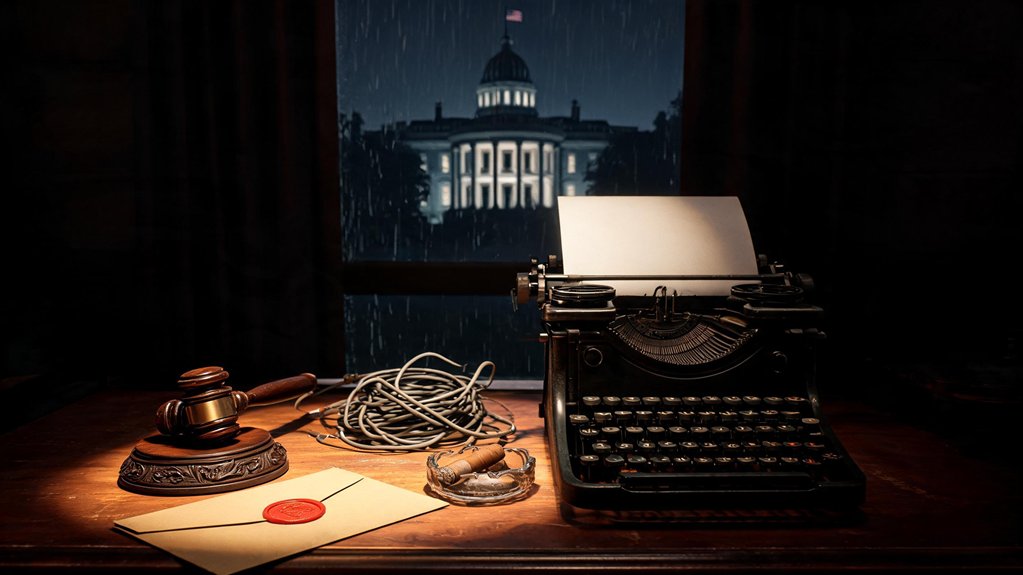
Nixon’s Justice Department invokes the Espionage Act to gag the free press, and the federal injunction of 1971 doesn’t stop the leaks—it ignites them.
The Washington Post mutinies, refusing to stand down, and that’s a defiance that spawns a syndicate leak spreading the documents into every major newsroom.
That’s when prior restraint faces its ultimate test, as the courts scramble to balance national security against a press that won’t back down.
Invoking the Espionage Act to Gag the Free Press
As the Pentagon Papers ripped through the nation’s front pages, the Nixon White House didn’t counter with legal nuance—it moved to strangle the story at its source.
On June 15, 1971, the Justice Department demanded the Times halt publication, then secured a federal injunction—the first prior restraint in American history. The government invoked the Espionage Act, a sweeping relic, to paint disclosure as treason.
- The act criminalized possessing or transmitting “national defense information.”
- Nixon’s lawyers argued publication endangered troops and diplomatic secrets.
- The injunction froze the Times without a single hearing on the documents’ actual contents.
- The White House sought to silence the press, not protect a single secret.
Yet the gag only fueled public fury—the courts quickly moved to strike the order down.
The Washington Post Mutiny and the Syndicate Leak
Though the federal injunction froze the New York Times, the Washington Post didn’t blink. On June 18, 1971, Post reporters obtained the syndicate’s leaked cache—Ellsberg’s archive—and publisher Katharine Graham greenlit publication despite Nixon’s legal onslaught.
The administration retaliated, securing a federal injunction against the Post, invoking prior restraint under the Espionage Act. But Graham’s mutiny held firm; she refused to capitulate. The paper’s lawyers argued the government’s case lacked constitutional grounding, and the D.C. Circuit agreed, refusing to extend the gag.
Meanwhile, the syndicate leak rippled beyond one outlet, as the Times and Post cases merged before the Supreme Court. Nixon’s restraint collapsed under scrutiny. By June 30, the Court ruled 6–3 for the papers, dismantling prior restraint and cementing press freedom.
Activating the White House Plumbers for a Covert Smear Campaign
Nixon’s operatives moved swiftly from courtrooms to criminality.
In September 1971, they broke into Dr. Lewis Fielding’s psychiatry office, hunting for Ellsberg’s file to weaponize against him.
That break-in exposed the Plumbers’ ruthless readiness to destroy a man’s reputation through covert state power.
The September 1971 Break-In at Dr. Lewis Fielding’s Psychiatry Office
Because the Pentagon Papers had stripped away the administration’s credibility, the White House Plumbers broke into Dr. Lewis Fielding’s psychiatry office on September 3, 1971. They sought Ellsberg’s files to paint him as mentally unstable.
After jimmying the door and photographing patient records, they found no bombshell—but the break-in’s fingerprints pointed straight back to the White House.
- Nixon’s team recruited Cubans and ex-CIA operatives for the job.
- They cased the office, picked the lock, and rifled through cabinets.
- The stolen files contained no psychiatric ammunition against Ellsberg.
- The crime later became a template for Watergate’s cover-up.
The Fielding burglary didn’t fail; it transformed Ellsberg into a victim. It exposed the Plumbers’ desperation and sealed their downfall, proving the administration’s smear campaign crossed into criminality.
Decrypting the 6-3 Supreme Court Ruling Against State Secrecy
Six justices delivered the verdict: the government’s bid to enjoin the Pentagon Papers collapsed under a heavy presumption against prior restraint, and the 6-3 ruling didn’t grant the press an absolute license to publish secrets—it simply forced the state to meet an impossibly high bar before muzzling the Times and the Post.
The Court’s splintered per curiam opinion masked deep divisions. Each justice wrote separately, revealing a spectrum from Black’s absolutism to Harlan’s deference.
Yet the controlling judgment was clear: no injunction without proof of direct, immediate harm. The government’s vague claims of diplomatic embarrassment didn’t suffice.
The justices scrutinized the affidavits, found them wanting, and refused to freeze publication. But it didn’t vindicate Ellsberg’s leak; it merely rejected prior restraint as too blunt.
The Collateral Collapse of the 115-Year Espionage Indictment Against Ellsberg

Collapse didn’t arrive through the First Amendment’s shield; it arrived through the government’s own dirty hands.
In May 1973, Judge William Byrne dismissed all charges against Daniel Ellsberg with prejudice. The prosecution’s espionage case disintegrated under the weight of its own corruption. Federal agents had burglarized Ellsberg’s psychiatrist’s office, while the White House plumbers wiretapped him without warrants.
Byrne’s meticulous review uncovered a prosecutorial rot stemming from the highest offices, including perjured testimony and hidden memos. Four violations stood out:
Byrne’s review exposed rot at the top: perjured testimony, hidden memos, four damning violations.
- The break-in at Dr. Fielding’s office.
- Illegal warrantless surveillance.
- Suppressed evidence favoring Ellsberg.
- Overt pressure from Nixon’s aides on the bench.
Byrne’s ruling didn’t sanctify the leak; it condemned the state’s pursuit. The 115-year indictment utterly evaporated, leaving the government’s credibility in its ashes.
Rewiring the Legal Perimeter Between Whistleblowers and National Defense
While the government’s case crumbled, the legal scaffolding around classified leaks stayed dangerously intact. After Ellsberg’s acquittal, prosecutors retreated, but they didn’t dismantle the machinery. Instead, they rewired it, tightening the perimeter between whistleblower protections and national defense.
Courts now demand strict intent tests, narrowing what counts as authorized disclosure. Whistleblowers face steeper burdens: prove malfeasance, exhaust internal channels, accept personal risk. Congress never clarified the statute; it just watched the executive branch expand its reach.
Meanwhile, the Espionage Act remains a blunt instrument, weaponized against leakers, not spies. Ellsberg’s gamble exposed the war’s lies, yet it also etched a chilling precedent—transparency remains a crime unless the state approves it.
The legal perimeter shifted, but now those wires still hum with lethal voltage.
Frequently Asked Questions
How Did Patricia Ellsberg Help Secretly Copy the Documents?
Patricia Ellsberg doesn’t merely support her husband; she becomes an active accomplice.
She operates the copying machine late into the night, methodically duplicating thousands of classified pages. Her hands feed each document, her eyes scan for errors, and her silence protects the operation.
She’s not a bystander—she’s a critical operator, enabling the leak’s physical execution while risking everything alongside Daniel.
What Happened to the Original Copy Ellsberg Personally Annotated?
The annotated original stays with Ellsberg, never handed to reporters. He retains it as his personal record while copies circulate.
When he surrenders, federal agents seize it as evidence, but the case’s collapse forces its return.
The marked pages survive intact, a forensic artifact of his moral transformation and the government’s failed prosecution.
Did the Pentagon Papers Inspire Later Intelligence Community Whistleblowers?
Coincidence? Ellsberg’s leak didn’t just expose secrets; it forged a blueprint.
Later whistleblowers cite his moral break as their catalyst, replicating his logic that public duty trumps classified loyalty.
They’ve studied his psychological shift, his meticulous documentation, his calculated fallout.
His example turned isolated dissent into a tradition, making each subsequent disclosure a deliberate echo of that original, transformative breach.
That lineage runs directly from 1971 to today’s daily headlines.
When Were the Final Withheld Sections of the Report Released?
The final withheld sections saw release in 2011. Analysts finally gained access to the negotiating volumes, documenting secret diplomacy.
They’re the last pieces of a forty-year puzzle. Ellsberg’s original leak left them sealed, but meticulous archival work revealed their contents.
One doesn’t simply shelve history; investigators demand full transparency. The 2011 declassification completed the record, closing a chapter on Vietnam’s hidden machinations.
It wasn’t until then the complete picture emerged.
How Did the Leak Change Ellsberg’s Personal and Family Life?
Before ‘viral’ meant a tweet, the leak blew up his household. He became a target, facing decades in prison. His marriage fractured under FBI surveillance and public scorn.
Patricia, though, stood by him, co-copying the files. The stress aged them; his kids endured taunts. Yet the moral break already redefined his soul.
He’d lost his clearance, his job, and his anonymity, gaining instead a federal indictment and a fractured family.
Final Thoughts
The Pentagon Papers’ release unmasked 30 years of deliberate misrepresentation, yet the most damning figure remains this: Ellsberg photocopied 7,000 pages, but the Nixon administration’s own internal reviews confirmed nearly 90% of the war’s operational failures were never disclosed to Congress. That gap isn’t bureaucratic oversight—it’s calculated deception. Ellsberg’s leak didn’t just expose a cover-up; it proved secrecy’s real purpose wasn’t protecting intelligence, but shielding lies from the public they betrayed.