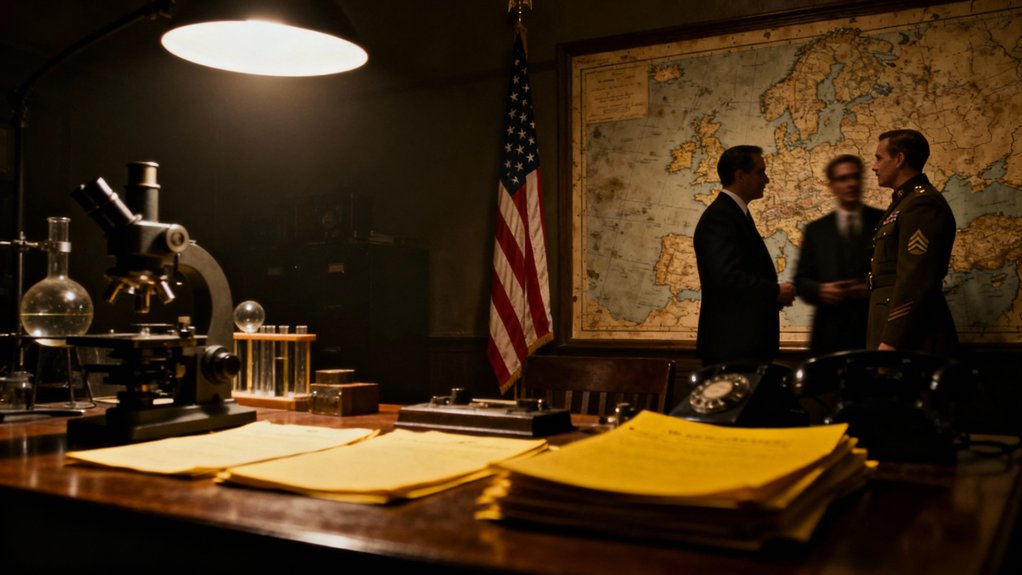
In the ashes of World War II, as Europe lay in ruins, American intelligence operatives combed through bombed-out laboratories and hidden records. They weren’t hunting war criminals—but scientists. Men with bloodstained pasts, once loyal to the Third Reich, now held secrets the U.S. needed. Their recruitment began in silence, no declarations, no oversight. What followed was a covert transfer of minds—and moral compromises—that would shape a new era. The full cost remains buried in classified files.
Key Takeaways
- Operation Paperclip secretly recruited over 1,600 German scientists after WWII, prioritizing Cold War technological gains over ethical concerns.
- The Osenberg List, discovered in 1945, guided U.S. efforts to capture top Nazi scientists and their advanced research.
- Scientists like Wernher von Braun, despite Nazi ties and use of slave labor, were resettled in the U.S. to advance aerospace programs.
- The Joint Intelligence Objectives Agency falsified records to bypass Truman’s ban on ardent Nazis entering the country.
- Many recruits contributed to U.S. rocket, missile, and mind-control programs while avoiding accountability for wartime atrocities.
What Was Operation Paperclip?
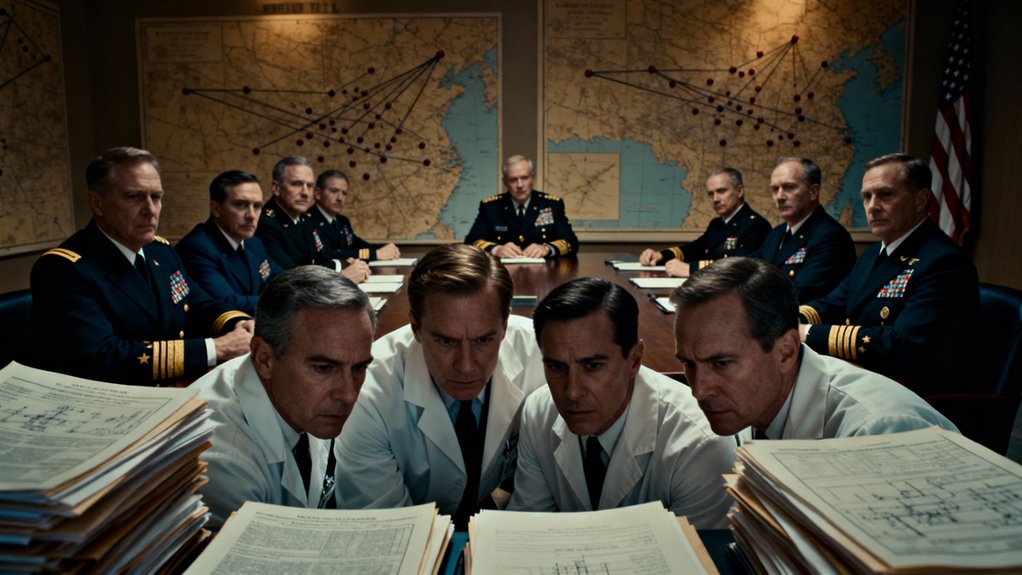
Though cloaked in secrecy and justified by Cold War necessity, Operation Paperclip emerged as a calculated effort by the United States to harness the scientific expertise of Nazi Germany in the aftermath of World War II. Initiated in 1945 as Project Overcast and rebranded in 1946, the program operated until 1959, forming a clandestine alliance with former enemies. Its program timeline spanned pivotal years of technological and ideological struggle, prioritizing rocketry, aerospace, and defense research. Recruitment criteria deliberately bypassed moral boundaries—scientists with Nazi affiliations were vetted not for ethics but utility. The Joint Intelligence Objectives Agency oversaw the selection, fast-tracking over 1,600 German experts and their families to U.S. soil. Despite President Truman’s stipulation against ardent Nazis, loopholes erased red flags. Paperclips literally masked incriminating pasts on personnel files. These engineers, many implicated in slave labor or ideological fervor, were rebranded as assets. Their relocation granted the U.S. a strategic leap, embedding Axis knowledge into American military and scientific institutions—a quiet betrayal traded for supremacy. Soviet Union intelligence efforts prompted urgent U.S. action to secure scientists before they could be captured or recruited by rival powers.
How the Osenberg List Revealed Nazi Scientists?
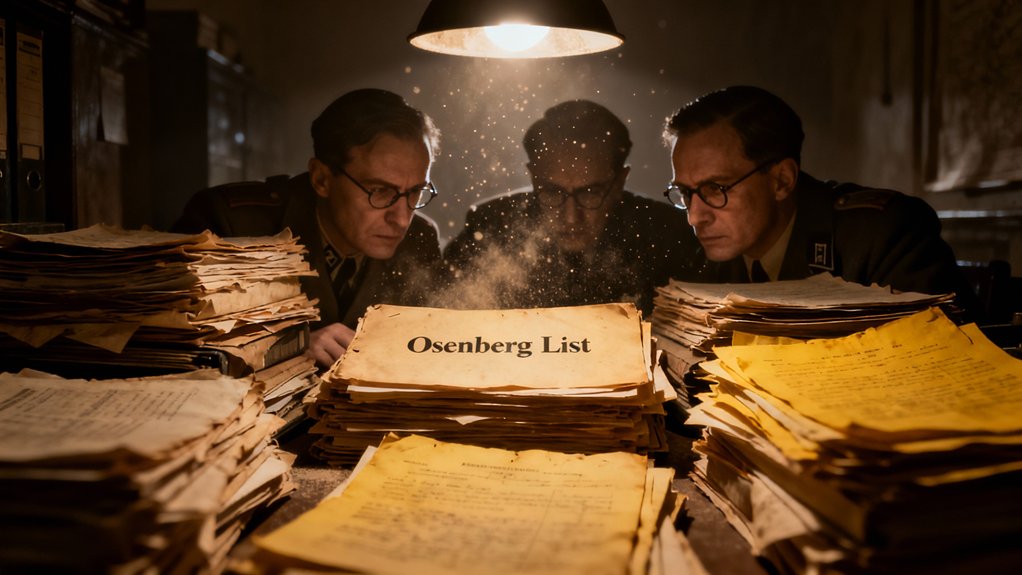
How did a single, crumpled list alter the course of history? Floating in a Bonn University toilet, torn and water-stained, the Osenberg List was salvaged by a Polish technician in March 1945. Its recovery became an act of unintended document preservation, shielding secrets that would reshape global power. Compiled by engineer Werner Osenberg in 1942, it cataloged over 1,600 scientists vetted for Nazi loyalty—rocket pioneers like Wernher von Braun, chemical warfare specialists like Hubertus Strughold, materials experts like Klaus Scheufelen. Passed from British to American intelligence, its list authentication verified targets for Operation Overcast. Maj. Robert B. Staver, Ordnance intelligence in London, used it to draw the Black List, directing urgent captures. Names led to interrogations, revealing nerve gas and plague weapon programs. The list’s arrival triggered a race against Soviet advances, expanding U.S. efforts from a hundred to hundreds more. Evacuation cables flew; scientists were reclassified as War Department Special Employees. Operation Overcast, soon renamed Paperclip, pivoted on this artifact—its fragile pages, once flushed, preserved the blueprint of scientific salvation or subjugation, depending on who held them. Soviet Union also recruited Nazi scientists on a massive scale, relocating thousands to the USSR in a single day during Operation Osoaviakhim.
Why Did the U.S. Recruit Nazi Scientists After WWII?
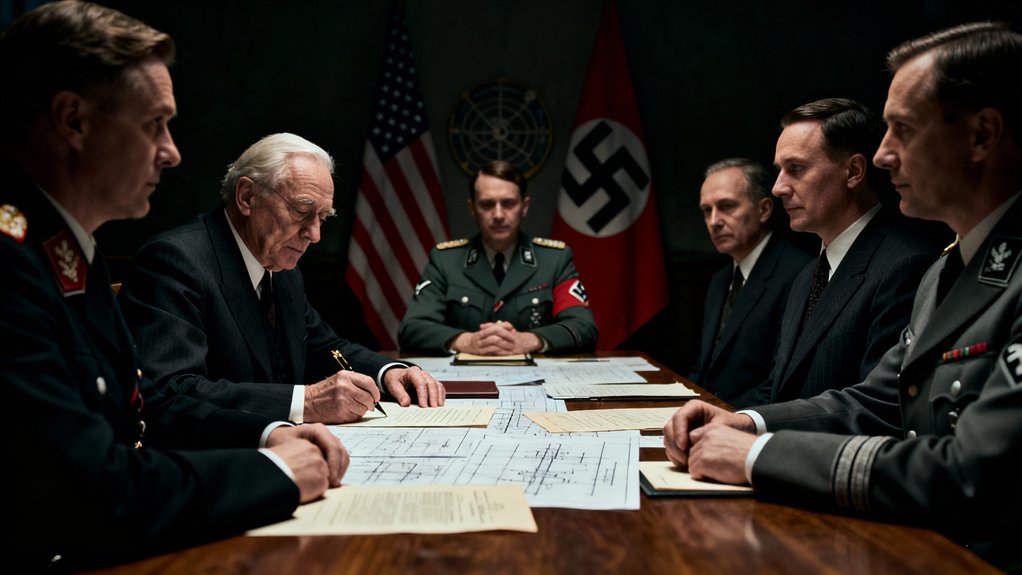
As Soviet forces closed in on German research sites, U.S. intelligence moved swiftly to secure scientists whose knowledge could tip the balance of postwar power. The race for technological dominance converged with national security imperatives, elevating strategic advantage over ethical accountability. Within this calculus, expertise in rocketry and chemical warfare became currency, justifying covert recruitment despite compromised origins. Over 1,500 German scientists and engineers were brought to the U.S. under Operation Paperclip.
Cold War Competition
With the guns of World War II falling silent and the fate of Europe redrawn at Yalta and Potsdam, the United States found itself not in an age of peace, but in the opening phase of a deeper, more calculating struggle—one where scientific brilliance outweighed moral reckoning. Soviet recruitment efforts triggered urgency: Red Army units seized German specialists in rocketry and chemical weapons, enabling critical technology transfer behind the Iron Curtain. In response, Washington escalated Operation Paperclip, weaponizing intelligence sharing with allies while denying expertise to adversaries. Klaus Fuchs’ espionage and the 1949 Soviet atomic test confirmed the stakes. Each superpower recruited over a thousand scientists, racing to outpace the other. Former Nazis, once enemies, became instruments of containment. The Cold War’s unseen frontiers—guided missiles, supersonic flight, nuclear deterrence—were forged not in battlefields, but in classified labs where knowledge, not ideology, dictated allegiance. Operation Paperclip recruited former Nazi scientists to accelerate American technological superiority during the early Cold War.
Scientific Expertise Acquisition
The Pentagon moved swiftly through the ruins of Nazi laboratories, seizing blueprints, weapons, and the minds that had engineered them. American forces uncovered Chemical advancements in nerve agents and biological warfare, including Hitler’s bubonic plague weapon, knowledge absent in U.S. science. The Osenberg List, recovered by the Allies, became a roadmap for capturing elite minds before the Soviets could. Scientists behind Hitler’s rockets, medicines, and weapons were extracted from shattered cities and hidden labs. Their expertise offered immediate access to breakthroughs achieved in secrecy—Medical innovations in trauma, aviation medicine, and toxicology; Chemical advancements in synthetic fuels and warfare agents. The Joint Intelligence Objectives Agency vetted each dossier, prioritizing utility over ideology. In the name of progress and preparedness, the U.S. absorbed these intellects, transferring them from defeated empires to American institutions, where their knowledge would be repurposed, concealed, and deployed in the pursuit of technological liberation. 88 Nazi scientists arrived in the United States on November 16, 1945, marking the beginning of their covert work under Operation Paperclip.
National Security Priorities
Denied access to the full extent of Nazi scientific advancements, American strategists viewed the seizure of German minds as a barrier against catastrophe. With Soviet forces advancing and initiating their own recruitment, threat assessment shifted toward preventing enemy access to expertise in rockets, nerve agents, and biological weapons. Defense priorities demanded preemption: Operation Overcast, later Paperclip, classified and expedited the transport of 1,600 scientists whose value outweighed moral reckoning. Von Braun’s surrender marked a turning point; his team’s rocket knowledge became pivotal. Files marked with paperclips fast-tracked entry, overriding denazification. By 1948, Cold War urgency rendered former loyalties secondary to strategic necessity. Liberation from Soviet dominance justified covert relocation, embedding ex-Nazis in U.S. military labs. National security eclipsed justice—not through oversight, but deliberate calculus. The race for technological supremacy had begun, and the enemy’s gain was deemed an existential risk. 1,600 scientists with families were ultimately resettled in the U.S. under the program.
How Operation Paperclip Evaded Truman’s Immigration Ban?
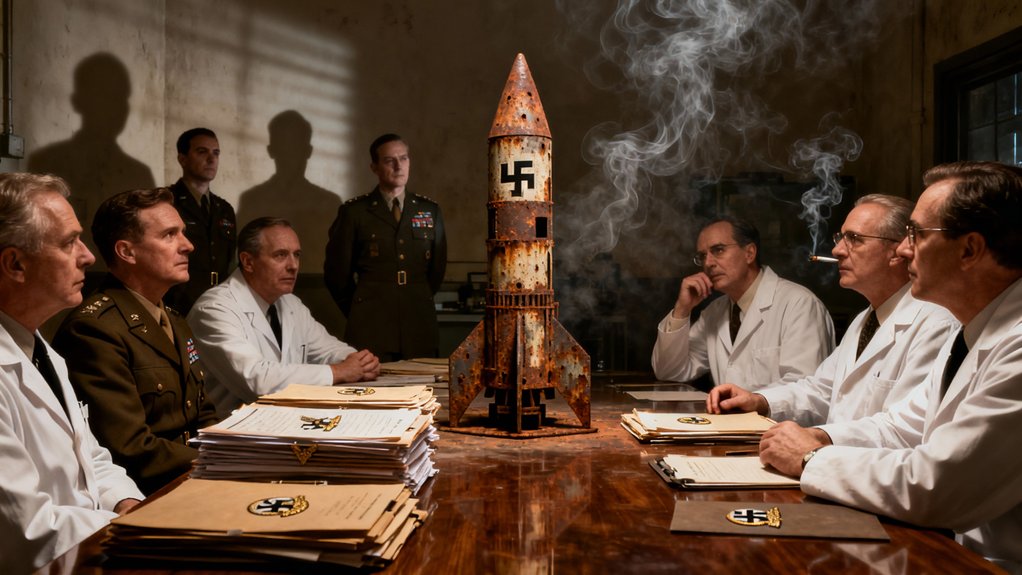
Buried within the rubble of Nazi Germany, the Osenberg List emerged—a meticulously compiled registry of scientists whose expertise transcended moral reckoning. Though Truman’s 1946 directive barred ardent Nazis from entering U.S. service, a silent override took hold: key names on the list were reclassified, their pasts sanitized to fit permissible categories. This administrative alchemy created a loophole wide enough to smuggle in over a thousand scientists under the guise of national necessity. Many of these scientists had direct ties to horrific war crimes, including those who worked on V-2 rocket program.
Osenberg List Discovery
Though hidden in the debris of war, the fate of a forgotten list flushed into a Bonn University toilet would alter the course of American scientific dominance. A Polish technician’s toilet discovery in March 1945 led to the list authentication by British Intelligence, which swiftly reached U.S. hands. Compiled by engineer Werner Osenberg in 1942, the list preserved the identities of Germany’s elite, ideologically vetted scientists—men buried in wartime obscurity but essential to technological supremacy. From Peenemünde’s ashes, their knowledge rose like ash on the wind. The Osenberg List became the blueprint for targeting top scientific minds, enabling Operation Overcast—later Paperclip—to systematically bypass President Truman’s ban on Nazi Party members by overlooking or destroying evidence of their affiliations.
- A crumpled document, discarded, yet indestructible
- Names once hidden, now guiding American boots through rubble
- Science severed from morality, yet pursued relentlessly
- Liberation not of people, but of ideas—stolen, repurposed, deployed
Truman Directive Loophole
Through the back channels of military bureaucracy and the shifting tides of postwar strategy, the Truman Directive’s restrictions on Nazi-affiliated scientists quietly unravelled. Although President Truman mandated exclusion of ardent Nazis and limited entry to “nominal” party members, the Joint Intelligence Objectives Agency exploited ambiguities in the policy. Scientists with SS, SA, or high-ranking Nazi ties were reclassified through systematic documentation falsification, their dossiers revised to omit incriminating records. JIOA bypassed State and Justice Department vetting, fast-tracking approvals under national security pretexts. What began as temporary military custody morphed into permanent residency, subverting civilian oversight. Citizenship procedures were manipulated to integrate scientists deemed strategically valuable, irrespective of ideological history. As Cold War tensions mounted, utility outweighed morality. The loophole was not an accident but a calculated rerouting of justice, where secrecy and expediency rewired immigration law for geopolitical advantage, eroding accountability in the name of progress. Roughly half of the specialists brought in during the early phase of Operation Paperclip had been members of the Nazi Party.
Who Controlled Operation Paperclip? The JIOA’s Secret Role?
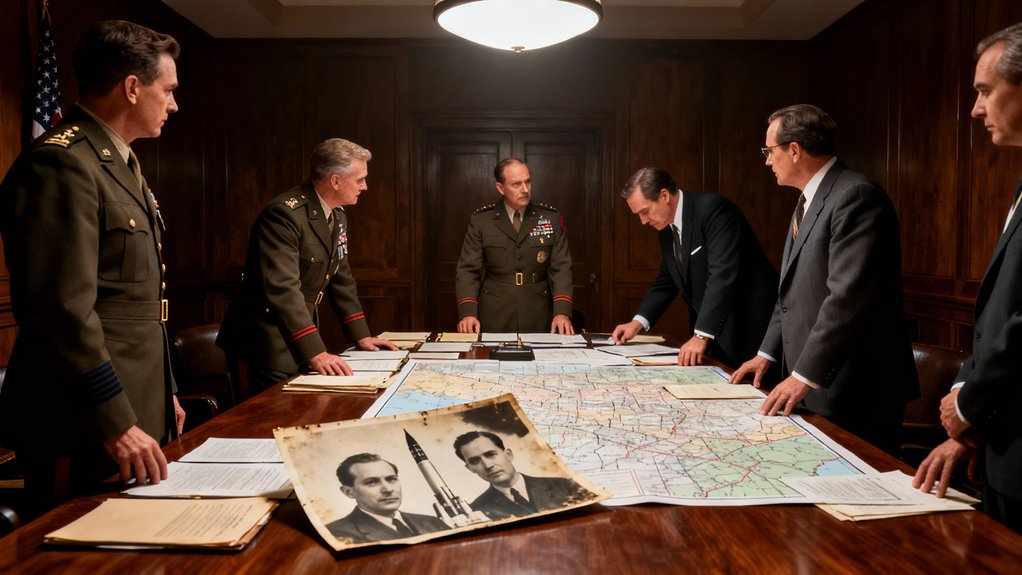
How did a clandestine interagency committee come to wield such decisive control over the fate of Nazi scientists in the immediate aftermath of World War II? The Joint Intelligence Objectives Agency (JIOA) emerged in the summer of 1945, installed by the Joint Chiefs of Staff to enforce JIOA oversight and clandestine recruitment procedures under Operation Overcast—later renamed Paperclip. Operating in shadows, the JIOA centralized power across military and diplomatic branches, engineering a silent coup of moral and scientific authority.
- Compiled black-file dossiers, erasing Nazi pasts with bureaucratic precision.
- Controlled recruitment procedures, selecting minds over morality.
- Centralized intelligence from CIOS, repurposing Nazi research for U.S. dominance.
- Executed JIOA oversight through Army CIC agents, bypassing public and ethical scrutiny.
The JIOA ultimately brought approximately 1,600 specialists to the United States, including many with deep Nazi affiliations. Its composition—army, navy, air force, State—masked its autonomy. A self-sustaining mechanism, it reported upward but answered to no conscience. It operated beyond Truman’s directive, shielded by Cold War imperative. For seventeen years, it dictated which scientists would vanish into American labs, their histories rewritten. The JIOA didn’t just manage Paperclip—it became its silent architect, cloaked in legitimacy, yet building an empire on expediency.
Wernher Von Braun: Nazi Rocket Scientist or American Hero?
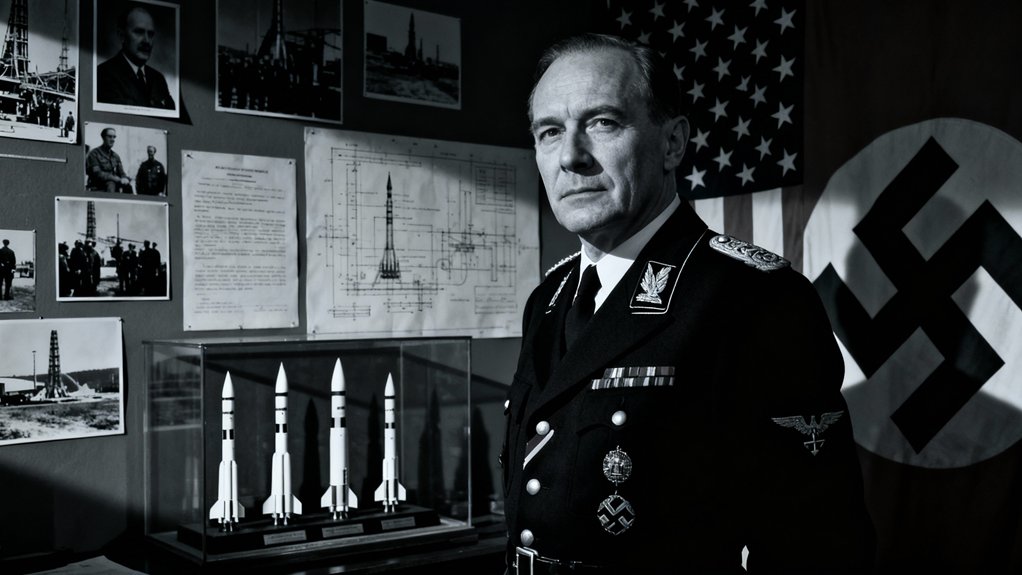
Wernher von Braun stood at the crossroads of destruction and discovery, his hands deep in the mechanics of vengeance as he engineered the V-2 rocket under a Nazi regime that celebrated his work with medals and high access. The same mind that harnessed slave labor in underground factories to build weapons terrorizing London would later orchestrate the Saturn V rocket, the machine that carried astronauts to the Moon. His journey from Peenemünde to NASA frames a legacy split between complicity and redemption, where scientific triumph shadows moral compromise.
Wernher Von Braun’s Nazi Past
Amid the shadowed corridors of Peenemünde’s research complex, where steel and ideology forged the future of warfare, Wernher von Braun ascended as the architect of Nazi Germany’s most advanced rocket program. His childhood influences and fascination with spaceflight shaped a vision soon entwined with militarism. A doctorate in physics from Berlin University solidified his technical authority, while his educational background cloaked ambition in scientific legitimacy. His ascent was paved through complicity:
- Membership in the Nazi Party by 1937 and rank of SS officer
- Leadership over V-2 development using slave labor from concentration camps
- Direct collaboration with Himmler and Hitler, receiving state honors
- Silence on moral accountability, justifying science above conscience
He did not inherit evil—he served it.
From Vengeance Weapon To Space Victory
At Peenemünde, where steel echoed with ideological command and rockets pierced the upper atmosphere for the first time, the A-4’s thunder marked not an end but a beginning. Its liquid-fueled engine roared on advances in propellant chemistry, hurling the V-2—first guided ballistic missile—into history. Though crude in missile accuracy, it soared beyond 50 miles, breaching space. Captured scientists, led by Wernher von Braun, carried these secrets westward. Under Operation Paperclip, they rebuilt in Alabama, refining propulsion and guidance. The Redstone rocket emerged—direct descendant of V-2—launching Explorer 1 in 1958. Jupiter C’s precision signaled mastery over trajectory and flight. At Marshall Space Flight Center, von Braun engineered Saturn’s evolution: Saturn I, then Saturn V. Fueled by relentless innovation in propellant chemistry and missile accuracy, the superbooster lifted Apollo 11 skyward. On July 16, 1969, it tore through atmosphere, bearing the first crew to the Moon—a triumph forged in contradiction, propelled by fire, and claimed in the name of exploration.
Redemption And Controversial Legacy
Though history often remembers him beneath the thunder of Saturn’s ascent, the arc of his legacy bends through darker corridors, where ambition intersected with complicity. Public perception recast Wernher von Braun as a visionary, yet moral accountability remains tethered to silence amid atrocity. His ascent was not isolated, but built upon erasures:
- Membership in the SS and Nazi Party, sealed with Hitler’s honors
- Leadership over V-2 production fed by forced labor and death
- Strategic surrender that prioritized expertise over reckoning
- A narrative reforged in American triumph, obscuring origin
The rockets that lifted humanity beyond Earth were forged in ethical shadows. Liberation demands not condemnation alone, but illumination—of how genius and guilt can coexist, and who gets forgiven in the march toward progress.
How Von Braun’s V-2 Program Used Slave Labor?
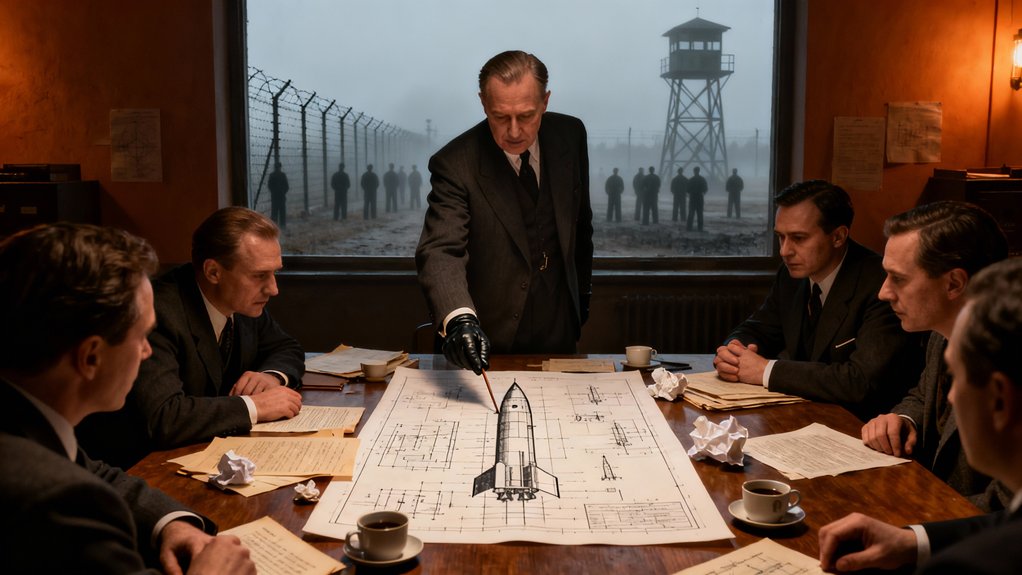
What began as a quest for technological supremacy soon descended into moral abdication. Prisoner selection at Buchenwald funneled skilled labor—electricians, machinists—into the V-2 program, feeding the machinery of war with human flesh. After Allied bombs fractured Peenemünde, the Nazi regime buried its rocket dreams beneath the Harz Mountains, where tunnel conditions defied endurance: damp, suffocating, lit by flickering bulbs, echoing with collapse and screams. At Mittelwerk, beneath Nordhausen, 60,000 prisoners labored in darkness to forge Wernher von Braun‘s A-4 rocket. Over 20,000 died—crushed, hanged, starved—more than twice the number killed by V-2 attacks. Von Braun, visiting frequently to adjust design specs, called the site “repulsive” yet stayed. He denied witnessing hangings, deaths, the emaciated bodies stacked like timber. But engineers did not need to see blood to know its source. The slave workforce was policy, approved by Speer, orchestrated by Kammler, implemented without protest. In those tunnels, science surrendered to atrocity. The rockets flew on the backs of the broken—a monument not to progress, but to silence complicit in genocide.
How Operation Paperclip Jumpstarted U.S. Missile Programs?
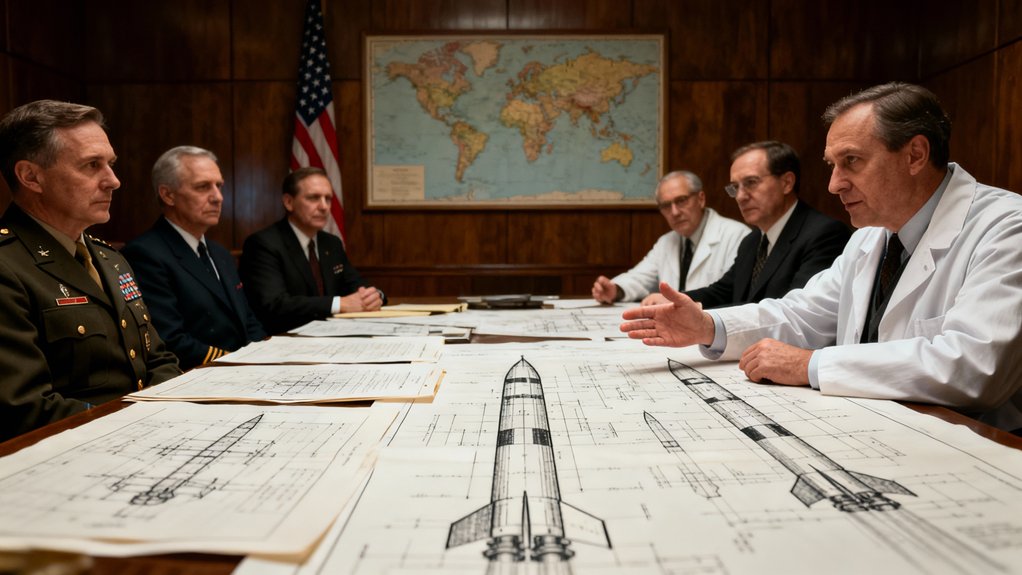
Beneath the scorched plains of White Sands, the echoes of Peenemünde found new life. Captured V-2 engineers, once buried in wartime obscurity, now calibrated guidance systems under American stars. Their hands, once stained by tyranny, now forged the backbone of a nascent missile empire. At Fort Bliss and later Redstone Arsenal, German precision merged with U.S. urgency, accelerating dreams once deemed impossible.
- V-2 launches at White Sands provided irreplaceable data for missile guidance breakthroughs.
- Project Hermes leveraged Nazi-era designs to fast-track Redstone development.
- Army Ordnance bypassed years of research by exploiting proven German propulsion and aerodynamics.
- The relocation of 125 specialists guaranteed continuity from V-2 to ballistic missile innovation.
From the desert’s silence rose thunder—new rockets born of old secrets. The Cold War demanded speed; Operation Paperclip delivered it. These engineers, exiled from Europe’s ruins, became architects of American strategic dominance. Their work did not erase the past, but it reshaped the future—propelling the U.S. toward space and sovereignty through cold calculus and burning fuel.
Arthur Rudolph: NASA’s Nazi Engineer Who Fled Justice?
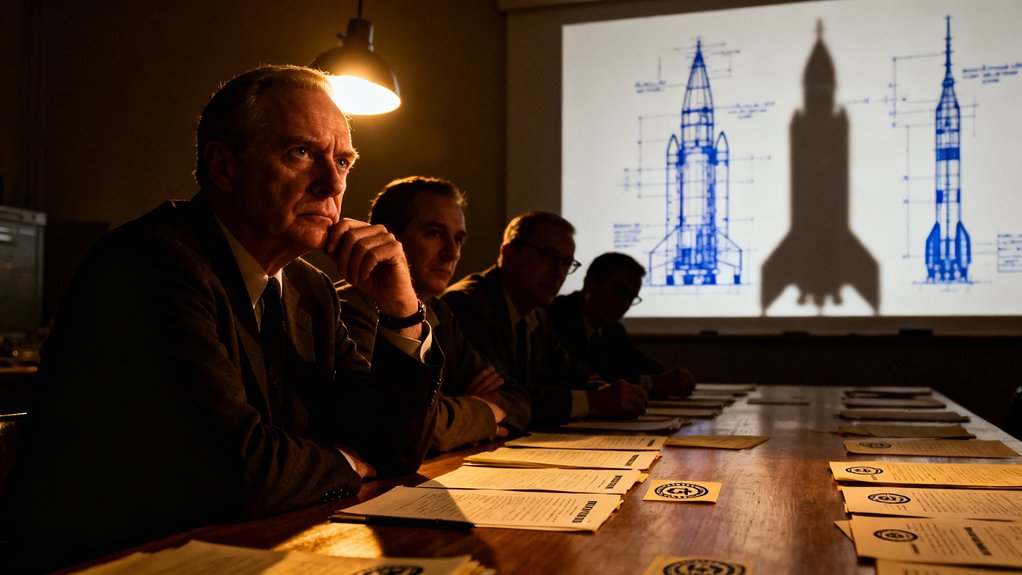
As the V-2 rockets rose from launching pads in wartime Germany, so too did Arthur Rudolph’s influence within the Nazi rocket program, his engineering prowess forged in the crucible of Peenemünde and tempered by the moral compromises of a regime hurtling toward collapse. At Mittelwerk, where slave labor from Dora concentration camp built rockets in underground tunnels, Rudolph managed production with ruthless efficiency. Twenty thousand perished under inhumane conditions, their deaths shadowing every launch. Though branded a “100% Nazi, dangerous type” by U.S. intelligence, he was recruited under Operation Paperclip, his past erased for Cold War gain. He shaped the Saturn V, the moonward vector of American triumph, earning medals and myth. Yet silence cracked in the 1980s when Mittelwerk testimony surfaced, detailed by Dora survivors. Confronted by the Office of Special Investigations, Rudolph renounced U.S. citizenship in 1984 to avoid trial, retreating to West Germany. Justice, deferred and diminished, never reached him. He lived free, pension intact, until 1996—a man absolved by power, unburdened by reckoning.
Operation Paperclip’s Bioweapons Scientists?
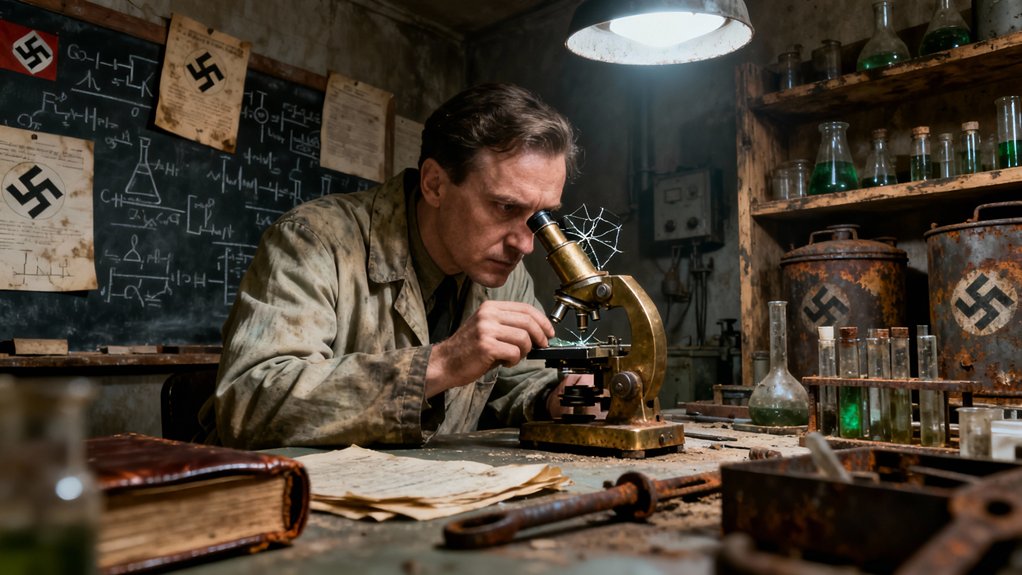
At the captured Geraberg facility in April 1945, U.S. forces unearthed frozen vials of plague cultures and meticulously cataloged records linking Dr. Kurt Blome to Nazi Germany’s clandestine biological warfare program, Blitzableiter. His experiments with aerosolized nerve agents on concentration camp prisoners had been systematic, coldly documented, and seamlessly aligned with America’s emergent chemical and biological weapons agenda. The moral cost of recruiting such figures was acknowledged—then systematically buried beneath Cold War imperatives.
Dr. Kurt Blome’s Role
Though deeply entrenched in the Third Reich’s most clandestine medical atrocities, Kurt Blome reemerged under American patronage, his expertise in biological warfare deemed too valuable to discard. His record bore the stains of plague experimentation and a dubious Nuremberg acquittal, yet U.S. intelligence shielded him, recognizing the strategic weight of his knowledge. At Camp King, he operated beyond public scrutiny, feeding classified research into enhanced interrogation and chemical weapons applications. The past was not absolved—only repurposed.
- A high-ranking Nazi scientist, shielded by geopolitics
- His crimes minimized by Cold War imperatives
- Plague experimentation sanitized into intelligence value
- Nuremberg acquittal not justice, but strategic recalibration
His legacy persists—not in trials, but in the silent continuities of covert science.
Biological Warfare Research
While the smoke of war still hung over Europe, American intelligence moved swiftly to secure what had been hidden in the ruins: a sophisticated biological warfare apparatus cultivated by Nazi scientists. Among the discoveries were advanced programs in bubonic plague weaponization and Anthr, revealing a clandestine capacity far beyond Allied estimates. Facilities once cloaked in Nazi secrecy surrendered data on aerosolized pathogens and mass dissemination techniques. U.S. operatives, recognizing that weapons without expertise were inert, prioritized the extraction of minds over matériel. These scientists, steeped in unethical experimentation, held knowledge deemed crucial. Their research, particularly in Anthr and other biological agents, was methodically cataloged and concealed. The infrastructure of death they built did not die with the Reich—it was relocated, rebranded, and reactivated under new management, its legacy buried beneath layers of classification and necessity.
Ethical Dilemmas Uncovered
- Scientists like von Haagen, who infected prisoners, were recruited despite clear evidence.
- Kurt Blome, acquitted at Nuremberg through withheld evidence, was later hired.
- Hubertus Strughold brokered immunity for Nazi physicians tied to Dachau experiments.
- The Dachau Entomological Institute’s lethal research was quietly absorbed into U.S. programs.
Scientific gain was prioritized over justice, transforming atrocities into classified breakthroughs.
How Paperclip Scientists Enabled CIA Mind-Control Experiments?
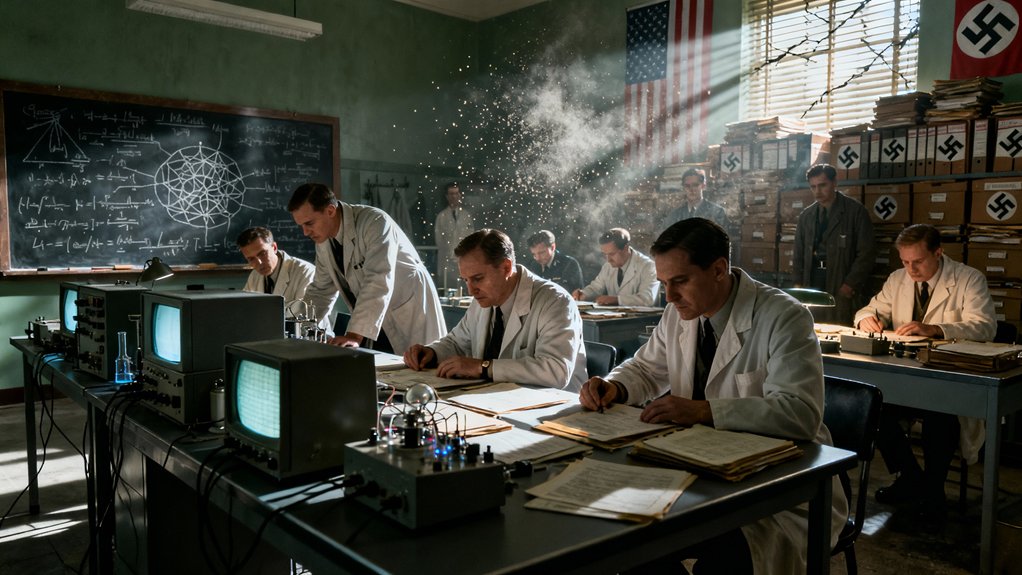
At the heart of the CIA’s early Cold War anxieties lay a clandestine inheritance: the knowledge and expertise of Nazi scientists brought to America through Operation Paperclip. These recruits, many implicated in wartime atrocities, became architects of covert behavioral engineering programs. Their insights into human manipulation fueled fears of Soviet mind control, prompting urgent U.S. countermeasures. By 1949, the CIA initiated mind control experiments under Dr. Willard Machle, testing spies against brainwashing. This effort evolved into Operation Bluebird, a systematic program exploring hypnosis, drugs, and sensory deprivation to reprogram thought and erase memory. Rooted in Nazi and Soviet techniques, Bluebird laid the foundation for ARTICHOKE and later MKULTRA. Scientists who once violated ethical bounds in the Third Reich now operated under U.S. auspices, advancing interrogation science beyond consent. Their work normalized nonconsensual research, embedding exploitation into national security doctrine. These behavioral engineering programs, cloaked in secrecy, expanded across universities, prisons, and hospitals—building an invisible apparatus of control. In chasing the enemy’s shadow, the agency embraced the very horrors it claimed to oppose.
The Dr. Frank Olson Tragedy and Nonconsensual LSD Testing?
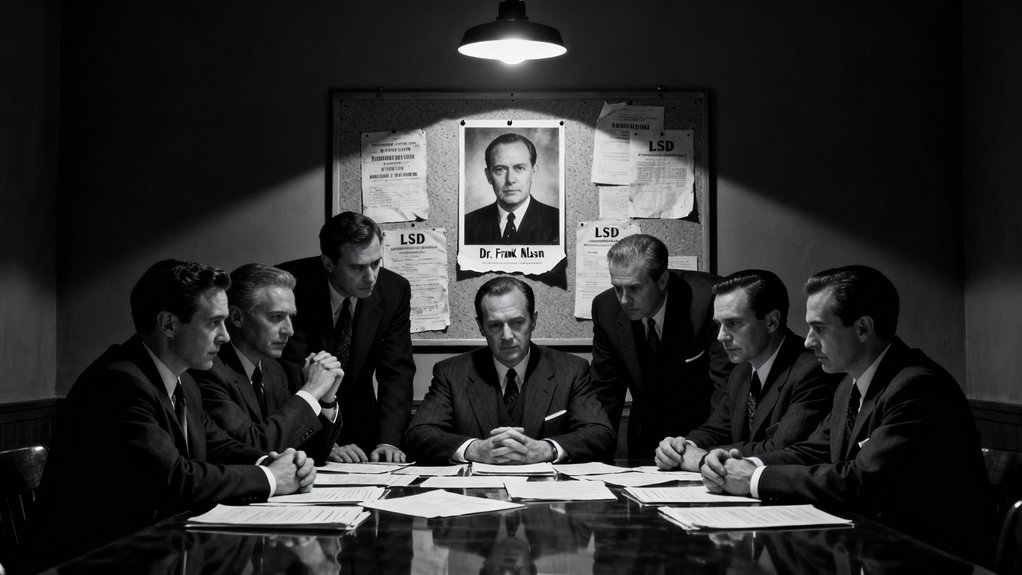
What does it mean to be both a scientist and a subject, a participant and a victim? For Dr. Frank Olson, a bacteriologist at Fort Detrick engaged in covert biological warfare research, the line collapsed on November 19, 1953. Unwittingly dosed with LSD during a retreat at Deep Creek Lodge, his life unraveled in nine days of confusion, dread, and fragmented identity. The CIA’s nonconsensual LSD exposure, part of MK-Ultra’s shadowed pursuit, triggered a cascade of ethical violations.
- A scientist entrusted with national secrets became a test subject without consent.
- His mental disintegration followed the very effects the agency sought to weaponize.
- The state denied agency, then obscured truth for over two decades.
- Liberation demands remembrance—not just of crimes, but of complicity masked as duty.
Olson plunged from the 13th floor of Hotel Statler, his death a cipher in the architecture of control. The 1975 Rockefeller Commission confirmed the deceit. The family received settlement, not justice. His story endures—a warning etched in silence and fall.
How Operation Paperclip Accelerated the Space Race?
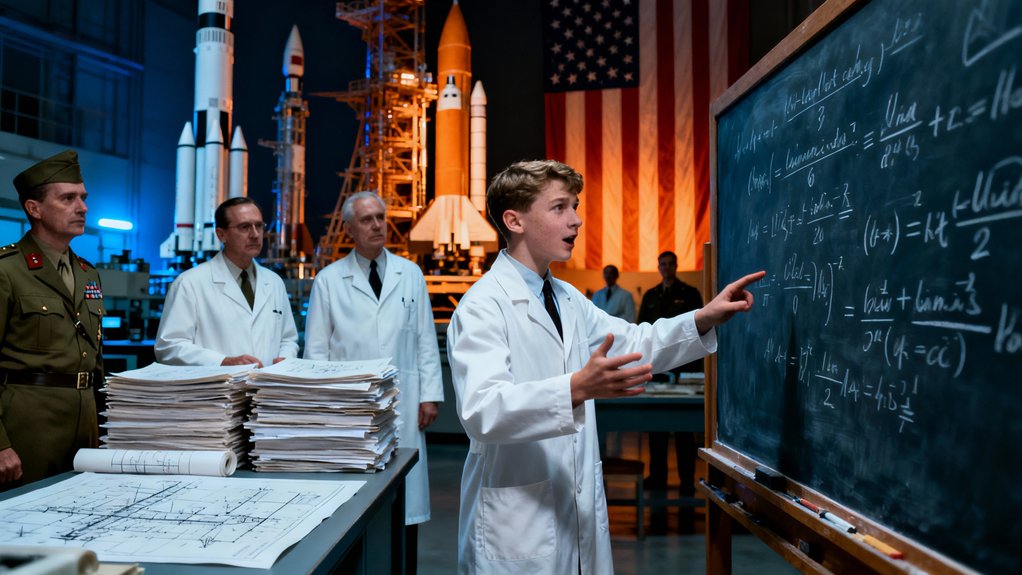
The arc of the V-2 rocket, cutting through the stratosphere in 1944, marked not only a feat of wartime engineering but the beginning of a new era in propulsion—one that would carry far beyond the battlefields of Europe. Seized under Operation Paperclip, Werner von Braun and over 1,500 German scientists brought liquid-fueled rocket innovation to American soil. Their expertise, forged in Peenemünde’s labs, became the backbone of U.S. missile systems and orbital ambitions. Dispursed into military and civilian programs, these minds accelerated advancements critical to Cold War survival. When Sputnik pierced the sky in 1957, it was von Braun’s Jupiter-C—built on captured knowledge—that launched Explorer I, reclaiming momentum. By 1960, his team shifted to NASA, embedding German-led engineering into the heart of America’s space exploration mission. At Huntsville, rocket innovation surged, culminating in the Saturn V—a vehicle born of exiled genius, yet fueled by democratic aspiration. Under its thrust, Apollo soared. The Moon landings were not just acts of national pride but demonstrations of how captured intellect, repurposed, could propel humanity beyond Earth. In that leap, liberation found new meaning—not in origins, but in destination.
Did Any Operation Paperclip Scientists Face Justice?
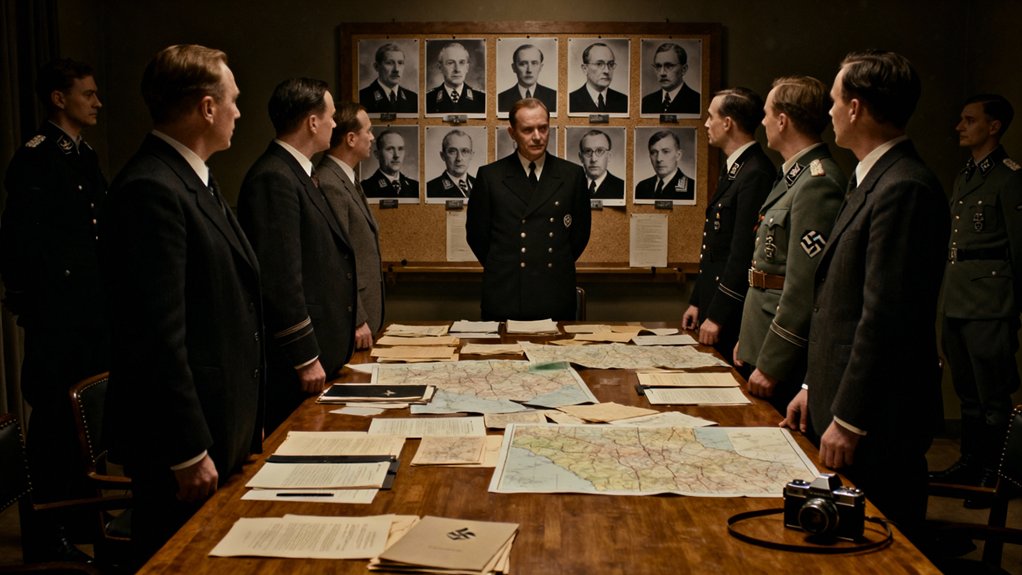
How does a nation reconcile its demand for justice with its hunger for progress? In the shadow of the Cold War, Operation Paperclip made its choice: advancement over atonement. Despite known affiliations, the U.S. granted safe haven to former Nazis, burying records and bypassing moral accountability. Ethical oversight was sacrificed at the altar of technological supremacy.
- Otto Ambros, a convicted war criminal, received U.S. visa waivers despite Nuremberg condemnation.
- Wernher von Braun, SS officer and V-2 architect, later won the National Medal of Science.
- Arthur Rudolph fled the U.S. to evade prosecution, relinquishing citizenship, yet faced no trial.
- Hubertus Strughold, linked to lethal experiments, remained unprosecuted, shielded by state interest.
No Paperclip scientist stood trial in America. The Joint Intelligence Objectives Agency suppressed evidence, whitewashed records, and prioritized innovation over justice. Victims of Nazi atrocities were denied closure. The program’s legacy is a warning: when moral accountability is deferred, liberation remains incomplete. Progress without ethics is complicity in disguise.
Frequently Asked Questions
Did Any Paperclip Scientists Contribute to Private U.S. Tech Companies?
Yes, some Paperclip scientists contributed to private U.S. tech companies, shifting into roles that fueled corporate innovation and aerospace advancements. Embedded in industry through military and governmental channels, these specialists applied wartime expertise to civilian and defense technologies. Their presence, though discreet, accelerated technological progress, shaping major breakthroughs in rocketry and engineering while operating beneath public scrutiny, their pasts obscured in service of national ambition and Cold War imperatives.
How Many Paperclip Families Relocated to the U.S. With the Scientists?
Over 3,600 family members accompanied the scientists in a coordinated effort toward family integration, softening the edges of relocation challenges. Housed initially in military barracks and repurposed estates, they navigated new lives across Texas, Alabama, and New Mexico. Though separated at first, reunification eased shifts. Their quiet assimilation mirrored a broader pattern—displacement given form, stability restored, futures quietly rewritten beneath vast desert skies and pine-covered hills.
Were Any Recruited Scientists Related to Hitler’s Inner Circle?
No recruited scientists held personal connections or direct associations with Hitler’s inner circle. Records confirm absence of ties to figures like Himmler, Goebbels, or Bormann. Selection prioritized technical mastery over political proximity. While some bore Nazi Party or SS links, these were functionally peripheral. The Osenberg List targeted specialists in rocketry and warfare, not regime elites. Von Braun’s SS role, though documented, remained operationally isolated from core leadership, underscoring the program’s focus on expertise, not ideological kinship.
Did the Soviet Union Capture and Use Similar Nazi Experts?
6,500 Nazi scientists were seized in a single night. The Soviet Union did capture and deploy Nazi experts en masse through Operation Osoaviakhim, embedding them in ballistic missile and nuclear programs to accelerate technological parity. These specialists fueled early Cold War competition, their coerced labor building foundations for the R-7 ICBM. As Soviet repatriation began in the 1950s, many returned to a divided Europe, their contributions buried beneath state secrecy and ideological necessity.
What Happened to the Scientists’ Property in Postwar Germany?
Their property in postwar Germany faced systematic confiscation by Allied authorities, with homes, patents, and financial assets seized under denazification mandates. Asset redistribution followed, funneling wealth into state coffers or displaced persons’ restitution. Many scientists lost everything, their names erased from deeds and ledgers. Yet, in a bitter inversion, those selected for extraction escaped the consequences, their buried pasts enabling reinvention—all while the machinery of war they built continued to shape empires.
Final Thoughts
In 1959, Arthur Rudolph stood beneath a rising Redstone rocket, its flame painting the sky—his hands, once guiding V-2s built by slave labor, now launching American dreams into orbit. Operation Paperclip turned moral compromise into technological triumph: 1,600 scientists, their pasts buried, became the unseen architects of a new frontier. Beneath progress’s glow, shadows linger—where victory was measured not in justice, but in altitude.
References
- https://en.wikipedia.org/wiki/Operation_Paperclip
- https://www.britannica.com/topic/Project-Paperclip
- https://www.cia.gov/resources/csi/static/Review-Operation-Paperclip.pdf
- https://worldwithoutgenocide.org/genocides-and-conflicts/holocaust-of-jews/operation-paperclip-nazis-and-the-u-s-space-program
- https://airandspace.si.edu/stories/editorial/project-paperclip-and-american-rocketry-after-world-war-ii
- https://www.coffeeordie.com/article/operation-paperclip
- https://www.jewishvirtuallibrary.org/operation-paperclip
- https://www.airandspaceforces.com/article/our-german-scientists/
- https://everything-everywhere.com/operation-paperclip/
- https://en.wikipedia.org/wiki/List_of_Germans_relocated_to_the_US_via_Operation_Paperclip