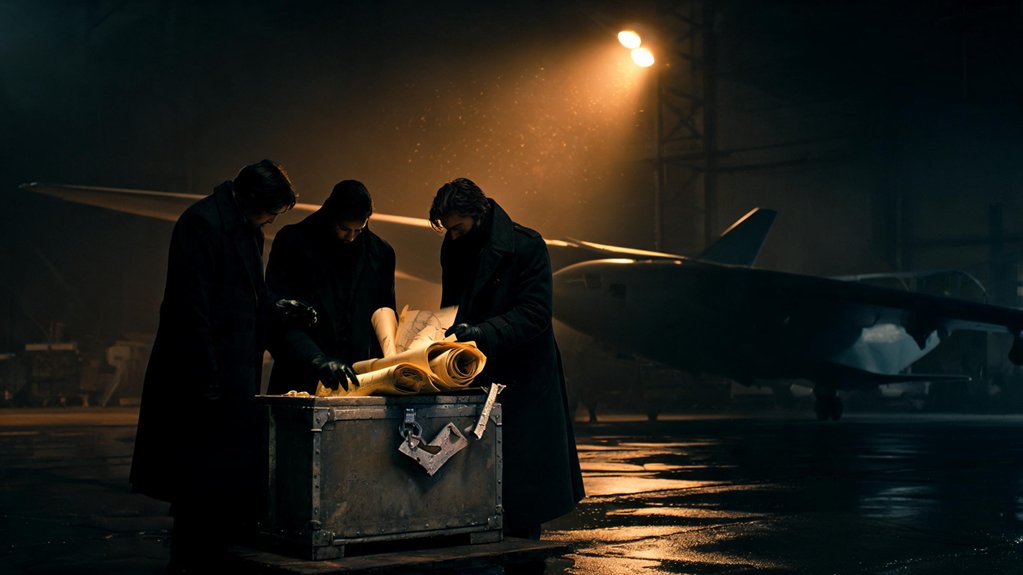
Operation Paperclip wasn’t a rescue mission; it was a calculated procurement of Nazi scientific assets. The Joint Intelligence Objectives Agency orchestrated the extraction, racing Soviets for V-2 tech while whitewashing dossiers and erasing SS memberships. Camp Dora’s 20,000 dead became an entry fee for ballistic trajectories. Dissenters in the State Department faced surveillance and firing. Ultimately, the May 1945 directive built America’s deterrent on a foundation of institutional denial, a pact whose true cost surfaced only later. Unpacking that ledger reveals far more than trajectories.
Key Takeaways
- Declassified records expose a systematic whitewash of SS memberships to expedite visa approvals.
- Extraction prioritized ballistic data and V-2 trajectories over documented atrocities at Camp Dora.
- The Osenberg List guided targeted recruitment, leveraging scientists’ fear of Soviet capture.
- State Department resisters faced surveillance, threats, and firings for opposing the operation.
- Post-war amnesty sheltered war criminals, embedding an ethical toxin in U.S. research culture.
The May 1945 Directive: Scavenging the Ruins of the Third Reich
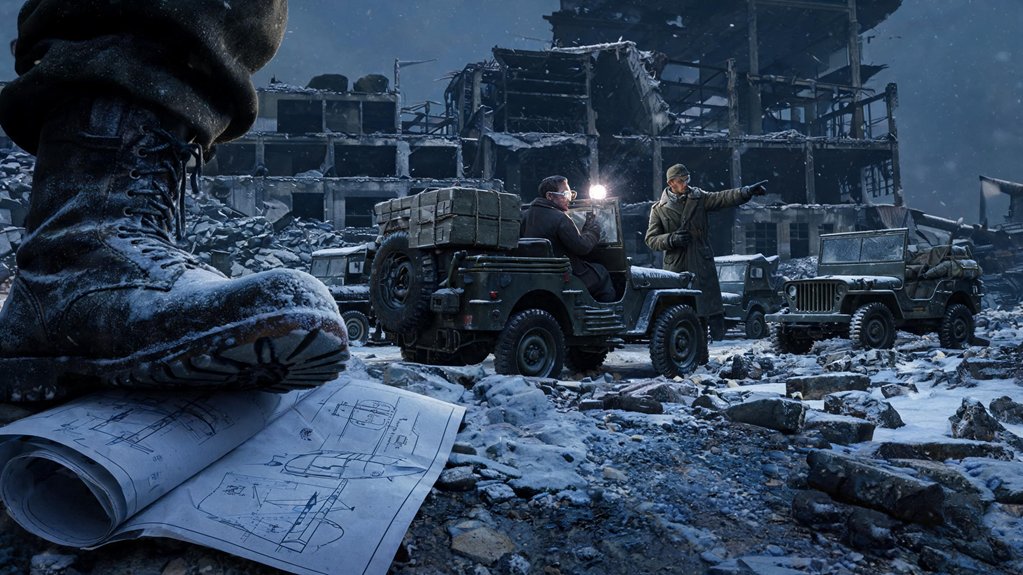
By the time the 12th Army Group’s forward units crossed into the Harz Mountains in April 1945, the Joint Intelligence Objectives Agency had already drafted a shopping list of names, not war criminals, but scientific assets whose work could redefine American power.
That May, the directive crystallized into a ruthless, calculated scavenger hunt. The operation paperclip timeline didn’t begin with noble intentions; it began with a desperate, post-wwii intelligence extraction that prioritized rocket equations over moral reckoning.
Field agents moved through obliterated towns, their priority lists tucked inside map cases, racing the Soviets to each crumbling laboratory and hidden cache.
The psychology of treason became a practical tool. Interrogators didn’t appeal to conscience; they leveraged fear of the Red Army and offered a sterile, comfortable future in the American Southwest.
Scientists didn’t defect for ideology—they defected for survival, calculating that their knowledge bought them immunity. The May directive institutionalized that bargain, transforming former enemies into silent, indispensable assets.
Calculating Surrender: The Pragmatic Defection of Hitler’s Vanguard
The Osenberg List’s meticulously compiled roster of Nazi technical talent effectively became the Pentagon’s shopping list, isolating Wernher von Braun and his ilk as prime extraction targets.
Those same scientists, sitting in Allied internment camps, candidly recounted their calculus: Soviet capture meant the summary execution of engineers who’d built V-2s, whereas American surrender offered a future of funded research with a forgiving victor.
Their defection wasn’t ideology shifting but a survival calculation, transforming Hitler’s vanguard into willing assets for Washington’s coming rivalry.
Decoding the Osenberg List: Identifying the High-Value Targets
Every intelligence operation hinges on a target list, and for Operation Paperclip, that list materialized from a recovered document known as the Osenberg List—a meticulous roster compiled by the Nazi research directorate to recall Germany’s most brilliant scientific minds from the front lines for a last-ditch technological surge.
Analysts cross-referenced its names against declassified interrogation transcripts, separating genuine visionaries from mere administrators. The list’s true value lay in prioritizing strategic asset transfer; it pinpointed rocket engineers, aerodynamics experts, and nuclear physicists whose knowledge could leapfrog American capabilities.
Verified espionage records later confirmed these men’s pre-surrender negotiations, revealing they’d already calculated their defection. Each name represented a calculated gamble—a high-value target whose expertise outweighed their past allegiance, making the list the operation’s foundational blueprint.
The Soviet Terror Calculus: Why Submitting to American Forces Was Strategic Survival
Those names on the Osenberg List represented more than technical value; they represented men who’d already run the numbers on survival. For them, nazi scientist defection wasn’t ideological—it was a cold calculation of Soviet capture avoidance. They’d witnessed the Red Army’s brutality firsthand.
- They knew Soviet interrogations meant Siberian gulags, not debriefing rooms.
- They trusted American POW protocols, which promised eventual citizenship.
- They saw the USSR as a one-way ticket to execution or forced labor.
- They’d read the operation overcast documents, noting the US’s explicit offer of sanctuary.
Surrender to American lines became a strategic hedge—a negotiated exit from a collapsing regime. Their submission wasn’t loyalty; it was the sharpest move in a lethal chess game where the alternative was oblivion.
Operation Overcast: The Tactical Extraction of Technical Assets from the Soviet Zone
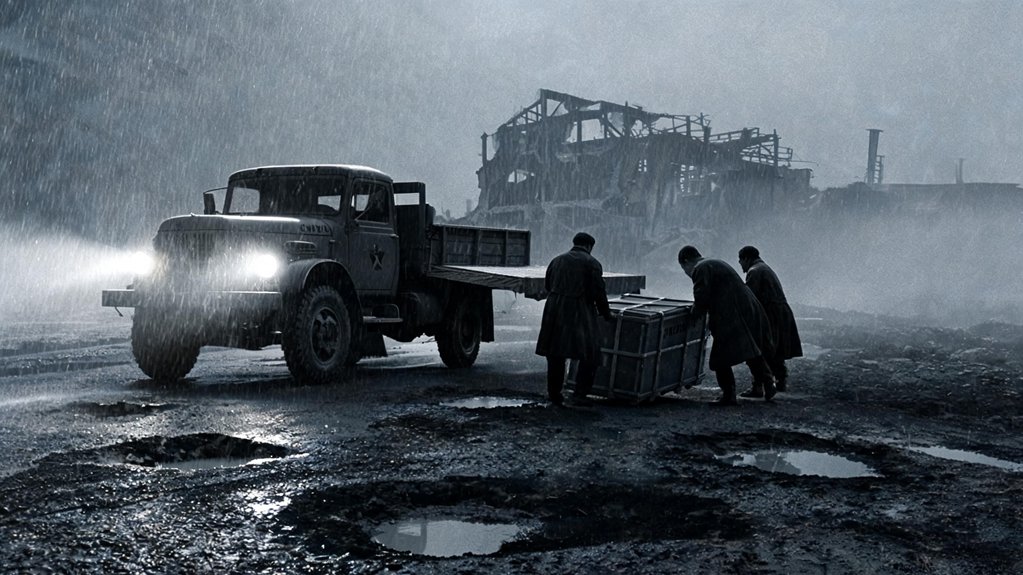
Each extraction hinged on misdirection: scientists swapped identities, hid inside refugee convoys, and crossed demarcation lines at night.
The operation’s raw urgency skewed selection toward immediate utility, leaving ethical vetting for later.
Overcast’s success proved the template—rapid, deniable, and ruthless—that Paperclip would later institutionalize on a grander scale.
Weaponizing the Bureaucracy: The Joint Intelligence Objectives Agency and the Bleached Dossiers
The Joint Intelligence Objectives Agency sidestepped the State Department entirely, exploiting the Truman Directive’s loophole to approve scientists the department had already flagged as security risks.
They didn’t just whitewash records; they actively forged security clearances, swapping incriminating Nazi party files for fabricated “bleached” dossiers that presented ardent National Socialists as apolitical technicians.
This bureaucratic weaponization turned the clearance process into a rubber stamp, converting America’s vetting system into a shield for the very ideology it claimed to have defeated.
Bypassing the State Department: Exploiting the Truman Directive Loophole
Because Truman’s directive demanded that the State Department certify no Nazi affiliations before granting visas, the Joint Intelligence Objectives Agency (JIOA) recognized the red tape as a hurdle to be dismantled, not a boundary to be respected.
They weaponized the loophole by reclassifying scientists as “technical specialists,” bypassing standard consular review entirely. The 1945 German surrender files became raw material for fabrication, not historical record.
- JIOA rewrote employment histories, stripping SS memberships from dossiers before submission.
- They exploited the directive’s vague definition of “Nazi affiliation,” arguing mere party membership didn’t constitute active complicity.
- The US intelligence apparatus pressured military attachés to issue visas without State Department countersignatures.
- Post-war collateral damage emerged as genuine war criminals slipped through, their pasts bleached by bureaucratic expedience.
The loophole wasn’t accidental; it was engineered.
The Paperclip Mechanism: Forging Security Clearances for Ardent National Socialists
JIOA officers didn’t just scrub dossiers; they rebuilt them from the ground up, manufacturing security clearances for men whose loyalty to Hitler was documented in their own personnel files.
They weaponized the bureaucracy, turning the Joint Intelligence Objectives Agency into a forge where Nazi pasts became American futures.
Bleached dossiers replaced arrest records with fabricated civilian histories, while officers stamped approvals without ever vetting the original evidence.
They exploited the Truman Directive’s vague wording, routing each case through a pipeline that prioritized speed over scrutiny.
The result: ardent National Socialists slipped into U.S. labs and defense plants, their ideology conveniently erased, their technical value deemed worth the moral cost.
The mechanism wasn’t a loophole accident—it was a deliberate, systematic erasure of truth.
Boots in the Rubble: The Field Agent’s Ledger of Covert Asset Acquisition
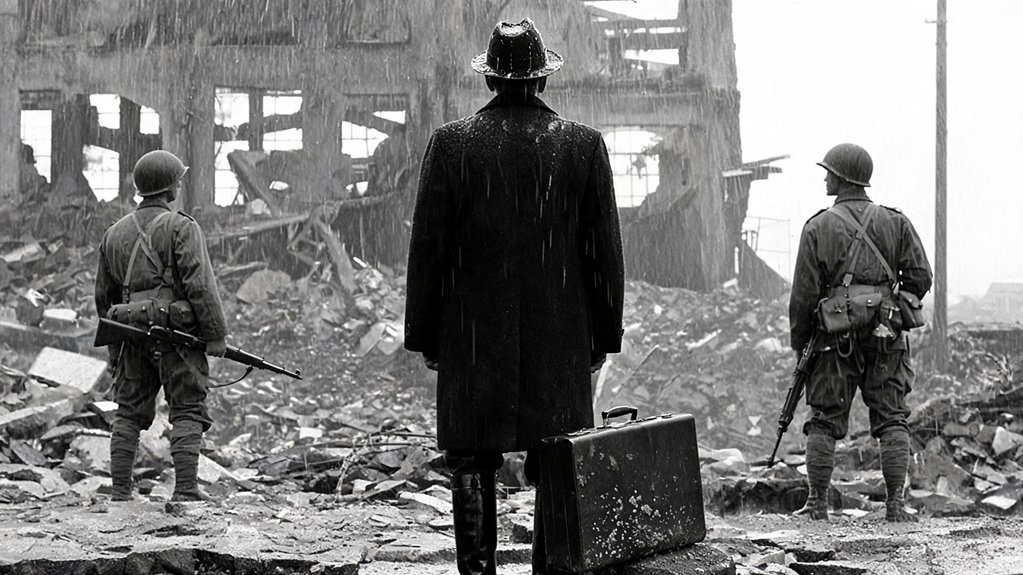
Two dozen names sat on Harmon’s clipboard that damp October morning, each one a German scientist whose future hinged on a single handshake in the rubble of a shattered laboratory. He moved through bombed-out corridors with a practiced neutrality, trading cigarettes and warm meals for signatures that erased biographies.
Every asset acquisition demanded a ledger entry, but the human calculus remained deliberately opaque.
Every asset acquisition demanded a ledger entry, but the human calculus remained deliberately opaque.
- Verification bypassed standard channels, relying instead on whispered references from prior collaborators.
- Signatures extracted under duress were laundered into clean paperwork by week’s end.
- Valuables—pocket chronometers, wedding rings—served as informal collateral in tense negotiations.
- Transport schedules never matched official logs, creating deniable gaps in the trail.
Harmon’s boots crunched over glass as he marked each name complete. He didn’t ask about past affiliations; the ledger only recorded future utility.
Blood in the Tunnels: The Mittelwerk Atrocities and the Calculus of Ignored War Crimes
The Camp Dora ledger records a grim transaction: 20,000 dead traded for the V-2’s ballistic trajectories, a body count etched into the Mittelwerk’s limestone catacombs.
Strategic intelligence didn’t just overlook this sacrifice; it actively sealed the Nordhausen evidence, prioritizing the scientists over the survivors’ testimony.
That calculus—silencing the dead to secure the living—remains the operation’s most damning, untold equation.
The Camp Dora Ledger: 20,000 Casualties Traded for Ballistic Trajectories
Of the roughly 20,000 souls who perished inside the Mittelwerk tunnels, their deaths weren’t collateral damage—they were the entry fee. The Camp Dora ledger quantifies this transaction: enslaved laborers exchanged for V-2 ballistic trajectories. US intelligence officers reviewed these records in 1945, yet they never indexed the atrocity as a war crime; they cataloged only the engineering data.
- Ledger entries correlate prisoner intake with rocket component serial numbers—human lives as line-item inputs.
- Death rates spiked to 200 per week during peak production, yet production quotas remained the sole metric.
- Interrogators logged survivor testimonies about hangings for sabotage, then filed them under “labor efficiency.”
- The final count—20,000—was appended to technical annexes, not prosecution dockets.
Silencing the Survivors: How Strategic Intelligence Buried the Nordhausen Evidence
While US Army medics and intelligence officers documented the rotting corpses and skeletal survivors at Nordhausen in April 1945, their own field reports reveal a deliberate pivot: the photographic evidence of mass graves was filed not as criminal proof but as a logistical footnote to the V-2 salvage operation.
Strategic intelligence, keen for rocket blueprints, systematically buried witness testimonies under classified telegrams.
Survivors who demanded accountability found their stories routed to medical files, then shredded, while interrogators prioritized ballistic trajectory data over atrocity depositions.
The Nuremberg prosecutors never received the Nordhausen dossiers—they sat in army vaults, stamped “Operational Priority.”
The Dustbin Transcripts: Summer 1945 Interrogations and the Anatomy of Collaboration
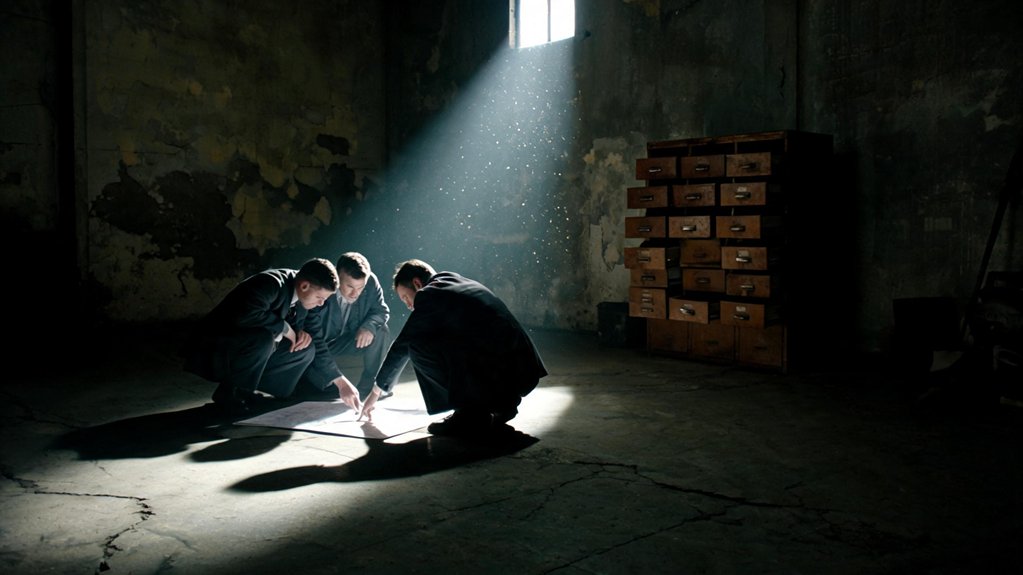
Because summer 1945 marked the uneasy shift from battlefield victory to intelligence-gathering urgency, interrogators at the Dustbin facility in Kransberg Castle faced a unique psychological challenge: extracting technical secrets from men who had, weeks earlier, directed Germany’s most advanced weapons programs.
The transcripts reveal a calculated transactional dance—scientists bartered knowledge for survival guarantees, testing interrogators’ patience and promise credibility. They didn’t confess; they negotiated.
- Interrogators exploited rivalries between Wehrmacht officers and SS-aligned scientists, forcing admissions through institutional distrust.
- Dustbin’s “velvet glove” technique—cigarettes, wine, and polite persistence—unraveled more than harsh methods ever did.
- Transcripts catalog precise “bargaining chips”: rocket telemetry plans, nerve gas formulas, and jet engine blueprints.
- Collaboration’s anatomy hinged on shared anti-Soviet paranoia; scientists framed themselves as defenders of Western civilization.
These sessions produced no tearful repentance, only pragmatic self-preservation.
The castle’s stone walls absorbed whispers of complicity, hardening into a partnership that would outlast the rubble of Berlin.
The Klaus Resistance: State Department Dissenters Against the Military Intelligence Apparatus
Though military intelligence officers treated Operation Paperclip as a fait accompli, a small cadre inside the State Department’s Division of European Affairs refused to rubber-stamp the transfer of Nazi scientists. Led by deputy chief Herbert Cummings, these dissenters—dubbed “the Klaus Resistance” in internal cables—waged a quiet war against the Joint Chiefs’ extraction pipeline, arguing that importing war criminals fatally compromised America’s moral standing.
Their resistance hinged on procedural sabotage, not outright refusal. They stalled visa approvals, leaked dossiers to the press, and demanded full disclosure of Nazi party membership for every recruit. The military’s counterattack was swift: they painted the dissenters as Soviet sympathizers.
| Dissenter | Tactic | Outcome |
|---|---|---|
| Herbert Cummings | Delayed approvals | Reassigned to Manila |
| Eleanor Lansing | Leaked files to journalists | Placed under surveillance |
| John Paton Davies | Demanded full disclosures | Fired in 1954 |
| Samuel Klaus | Drafted legal objections | Received death threats |
| Charles Yost | Flagged war crimes | Dispatched to Syria |
Months later, the military won, and Paperclip proceeded unabated. But the Resistance’s memo trail survives—proof that not everyone inside the machine bought the myth of necessity.
The Moscow Intercepts: Soviet Counter-Espionage and the October 1946 Retaliatory Sweep
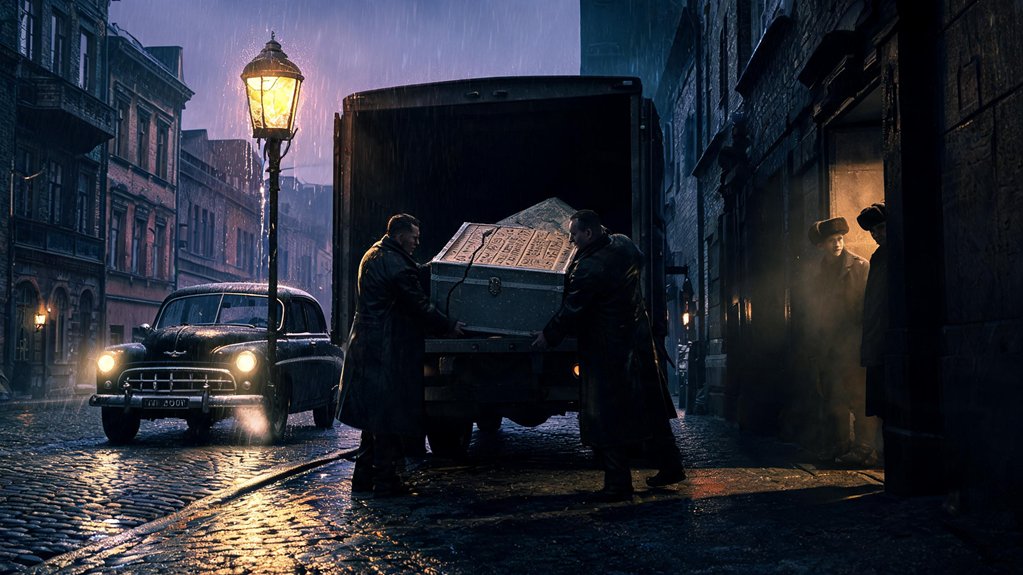
The Moscow Intercepts expose a retaliatory sweep the USSR launched in October 1946, one that mirrored Paperclip’s own ruthlessness but with a sharper edge of paranoia.
Soviet counter-espionage units, tipped by double agents, moved with surgical brutality to purge any German scientist who’d even whispered about defection, snatching them from barracks and research dachas before dawn. Their interrogators sought not just names but the psychological calculus of betrayal, dissecting why a man might choose Houston over the Urals.
The sweep’s ferocity revealed Moscow’s genuine fear: that America’s stolen intellect had already leapfrogged their own.
- Intercepts show the NKVD’s priority ranking—scientists with US contacts were liquidated or vanished within 72 hours.
- The Soviets documented Paperclip’s recruiting patterns, using them to predict future extraction routes.
- Counter-ops planted false defectors, testing loyalty with fabricated American offers.
- October’s sweep codified a standing policy: suspected collaborator meant immediate family reprisal, no trial.
Infiltration by Invitation: Housing the Enemy at Fort Bliss and Wright Field
The shift to Huntsville didn’t merely relocate scientists; it institutionalized their expertise within America’s most guarded domestic corridors.
Fort Bliss offered the first fragile foothold, while Wright Field harnessed their aeronautical knowledge with surgical precision for strategic gain.
Each housing arrangement blurred the line between prisoner and patriot, quietly normalizing the enemy’s presence at the heart of the military-industrial machine.
The Huntsville Transition: Embedding Former Adversaries into the Domestic Military-Industrial Complex
As declassified files confirm, the shift from European extraction to American integration hinged on a calculated domestic relocation strategy: plant the scientists not in isolated research silos, but directly inside the nation’s most sensitive military installations.
The Huntsville conversion formalized this, converting Fort Bliss’s temporary holding pens into a permanent, weaponized intellectual colony. These men didn’t merely advise; they commanded programs.
- Redstone Arsenal became their fiefdom, a closed loop of design, test, and production.
- Civilian contractor status masked military chain-of-command reality.
- Security clearances fast-tracked, bypassing standard loyalty protocols.
- German became the technical lingua franca in guidance and propulsion.
They built the Jupiter and Pershing, embedding adversary DNA into America’s strategic deterrent. It wasn’t assimilation; it was absorption of a hostile ethos.
The Cold War Compromise: Measuring the Toxic Legacy of Classified Amnesty
While most histories close the book on Operation Paperclip the moment the transports touched down, the declassified record reveals a far thornier aftermath—one where the U.S. government’s pact of classified amnesty metastasized into a decades-long institutional toxin.
The CIA and Army files show that these scientists didn’t merely receive sanctuary; they received a structured whitewash that laundered their Nazi pasts into sanitized résumés. This compromise, struck at the apex of Cold War paranoia, didn’t just shelter war criminals—it corrupted the moral framework of American research itself.
The amnesty’s poison seeped into procurement, testing protocols, and even human experimentation, as agencies learned to tolerate ethical rot for technical advantage.
Declassified memos reveal officials actively suppressing evidence of atrocities to protect their assets’ credibility. Consequently, the nation built its missile program on a foundation of silent complicity.
The real cost wasn’t financial; it was the enduring pattern of institutionalized denial, a precedent that still shapes how the government weighs secrets against conscience.
Frequently Asked Questions
Why Were Nazi Scientists Granted Immunity From Prosecution?
They weren’t granted blanket immunity; it was a pragmatic barter. Washington traded legal accountability for technical superiority.
The scientists’ knowledge of rocketry, chemical warfare, and aerospace engineering outweighed their wartime crimes in the eyes of military intelligence. It wasn’t justice; it was a calculated acquisition.
The promise of non-prosecution, often implied or quietly formalized, secured their cooperation. This deal accelerated America’s strategic capabilities, but it deliberately buried moral reckoning beneath expediency, a decision that still raises uncomfortable questions about who defines justice in the wake of war.
How Did the US Hide Scientists’ Nazi Pasts?
The US scrubbed their records, replacing Nazi affiliations with fabricated biographies. Intelligence officers rewrote personnel files, omitting party membership and war crimes, then inserted them into legitimate scientific channels.
They didn’t erase the past; they buried it under expedient paperwork. Surveillance reports show agents actively suppressing investigations, while collaborators’ new identities shielded them from scrutiny.
This wasn’t negligence—it’s a calculated concealment, documented in declassified memos, where silence served national interest over justice.
What Happened to V-2 Rocket Victims?
Victims of the V-2 vanish into a charred, silent crater—thousands of civilians and forced laborers across London, Antwerp, and Mittelwerk tunnels.
They never received justice; their killers’ records got scrubbed by U.S. recruiters.
Survivors’ testimony wound through declassified files, yet no prosecution followed.
These people didn’t become names in a trial—they became statistics buried beneath the rockets’ wreckage, their fates sealed by expedience.
Did Soviet Spies Learn About Operation Paperclip?
Soviet spies did learn about Operation Paperclip, though not its full scope.
Their intelligence networks in occupied Germany detected the sudden disappearance of key Nazi scientists and the US military’s covert transport flights.
Reports reaching Moscow noted the pattern, but the spies lacked precise details on names and destinations.
They confirmed the extraction’s existence, yet the US’s compartmentalized secrecy meant the Soviets only pieced together fragments, not the complete operation’s mechanics.
Were Any Scientists Ever Returned to Germany?
Like buried seeds awaiting spring, a handful of scientists did return. Declassified records show that by the late 1950s, a small fraction, primarily those deemed less strategically crucial or suffering from failing health, were quietly repatriated to West Germany.
Their departures weren’t publicized, but they’re logged in the files. Each return was a calculated release, a rejection of value on the American chessboard, not an act of mercy.
The extraction’s promise was permanent integration—until it wasn’t.
Final Thoughts
Operation Paperclip’s ledger never balanced, but it did tip—Wernher von Braun, once a Hitler loyalist, stood before a Florida launchpad in 1969, blasting Apollo’s crew moonward. That trajectory mirrors a rusty compass: needle pointing north, yet dragging jagged steel through poisoned soil. The bargain held, but the stain didn’t fade; it simply re-aimed, transforming Nazi ambition into American triumph, a meticulous swap of conscience for calculus.