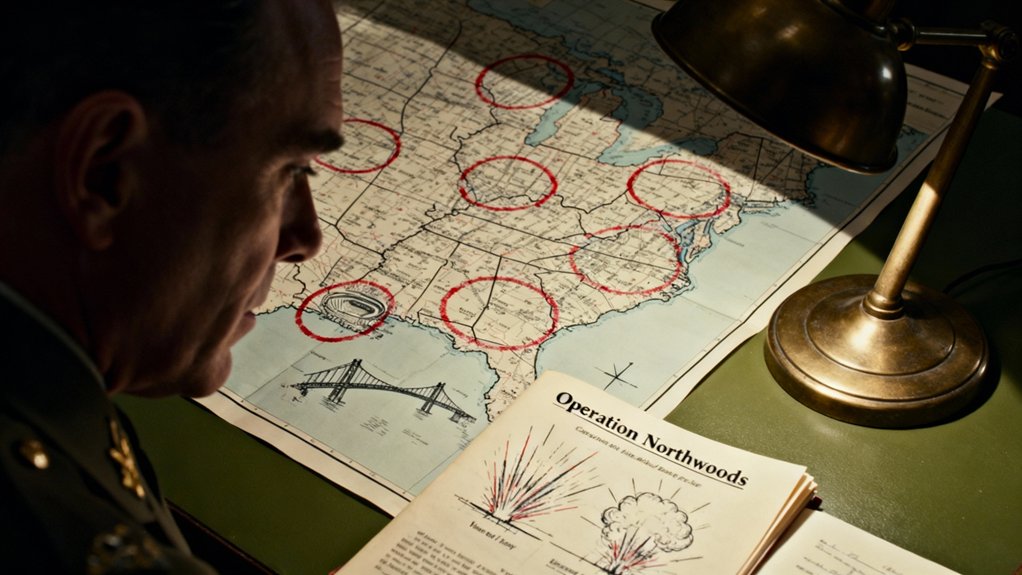
In 1962, high-ranking U.S. military officials drafted a plan to hijack planes, bomb cities, and sink American ships—all while blaming Cuba. They pitched it to President Kennedy with cold precision, expecting approval. The operation wasn’t rogue speculation; it was official policy, stamped and sealed. When the truth emerged decades later, it didn’t just shock the public. It exposed a hidden threshold where loyalty to country could twist into treachery. What else was buried in those files?
Key Takeaways
- The Pentagon’s 1962 Operation Northwoods proposed staging false-flag terrorist attacks on U.S. soil to justify war with Cuba.
- Plans included hijackings, bombings in Miami and Washington, and sinking ships in Guantanamo Bay, all blamed on Castro.
- A drone would mimic a downed passenger plane with fake victims, including real college students listed as dead.
- Joint Chiefs of Staff, led by Lyman Lemnitzer, approved the plan, willing to kill Americans to manipulate public opinion.
- JFK rejected the proposal, but declassified documents in 2001 confirmed its existence, exposing military willingness to terrorize its own people.
What Was Operation Northwoods?
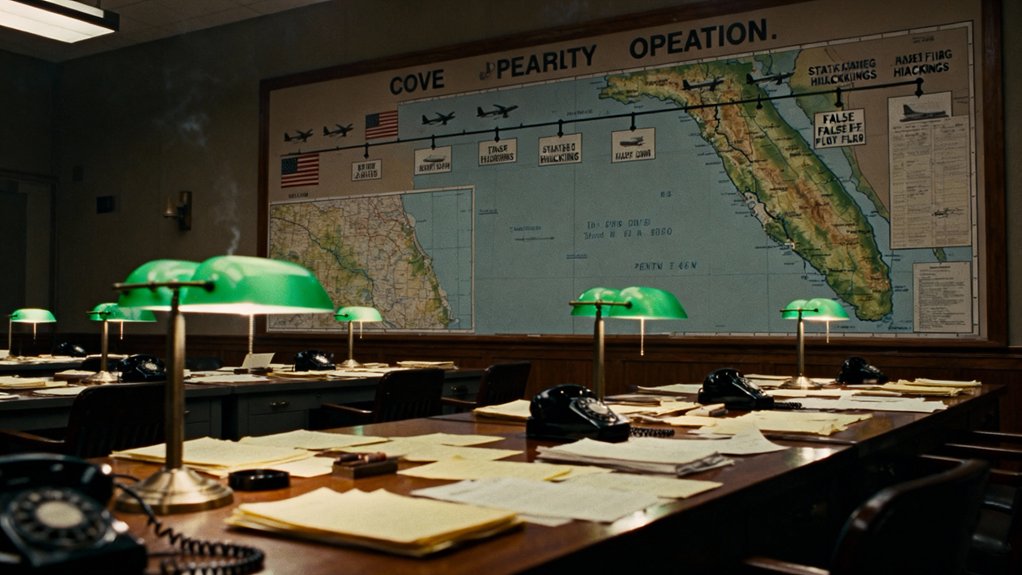
What if the U.S. government staged terrorist attacks on its own soil to justify war? It wasn’t theory—it was policy. Operation Northwoods was a false-flag operation drafted in 1962 by the Joint Chiefs of Staff to provoke public support for war with Cuba. Under this plan, the Pentagon proposed hijackings, bombings in Washington and Miami, and even the sinking of美军 ships in Guantanamo Bay—blamed on Castro. The most chilling element? Down an empty drone plane carrying college students’ names, fake distress signals, real explosions, and full media grief—all fabricated. President Kennedy rejected the proposal, but the fact it reached his desk reveals how deep the appetite for manufactured war ran. Operation Northwoods wasn’t just a document; it was proof the state would weaponize its own people’s suffering. Though buried for decades, its exposure in 1997 ripped open a truth long suppressed: power doesn’t always protect—it engineers crisis. False-flag operation or official lie, the blueprint for deception was real.
Why the U.S. Military Proposed False Flag Attacks
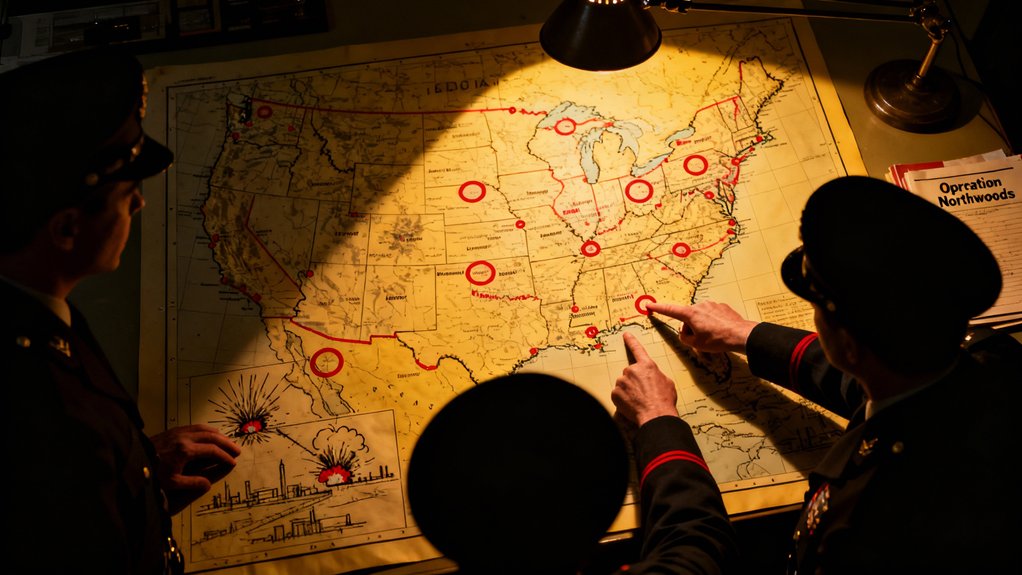
Though President Kennedy had vowed to confront Fidel Castro’s regime, the Joint Chiefs saw restraint as a liability—and decided to take matters into their own hands. Lyman Lemnitzer, then Chairman of the Joint Chiefs, spearheaded Operation Northwoods to provoke war by any means necessary, believing public outrage could be manufactured to justify invasion. The military elite had lost faith in civilian control of the military, seeing elected leaders as indecisive, too cautious to act in what they viewed as America’s interest. They weren’t just planning deception—they were betting on it.
- The Bay of Pigs failure left the Pentagon furious, convinced covert ops weren’t enough.
- Lemnitzer’s team believed only dramatic violence on U.S. soil would galvanize the public.
- They exploited Cold War paranoia, counting on fear to override skepticism.
- Civilian control of the military became a direct obstacle to their ambitions—so they tried to bypass it.
The blueprint was chilling in its precision, and its very existence exposed a rogue mindset at the highest levels.
Operation Northwoods’ Staged Hijackings and Bombings
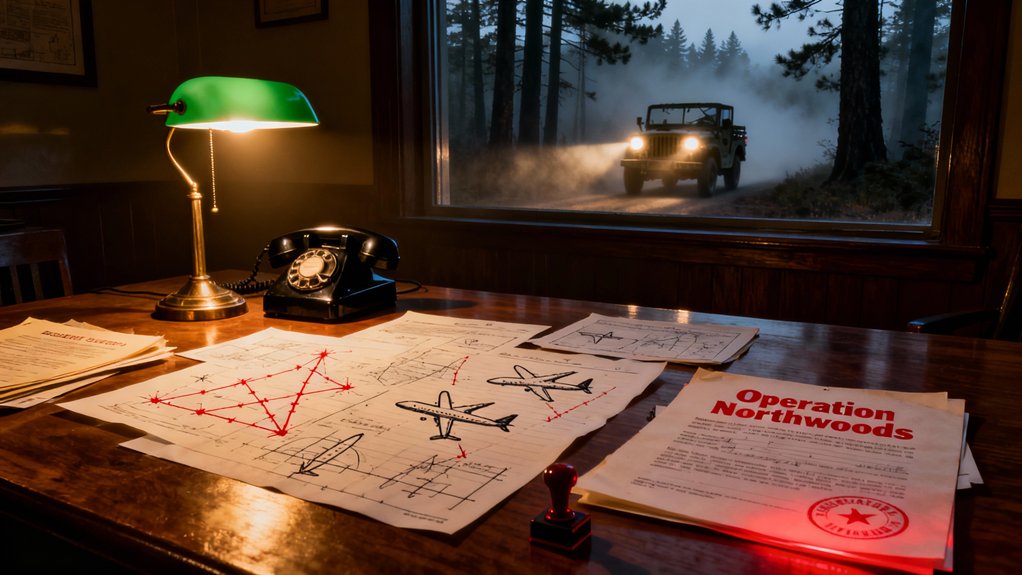
As the Joint Chiefs plotted to fabricate a casus belli, they drafted schemes so audacious they blurred the line between strategy and sacrilege—hijackings of U.S. aircraft, real and simulated, stood central to their deception. They planned to seize civilian planes, reroute them under false pretenses, then vanish them into the Atlantic, making it appear Castro’s regime was behind mass kidnappings. In another twist, they’d simulate hijackings using U.S. military pilots in Cuban uniforms, broadcasting distorted Spanish over radio to sell the lie. Every move aimed to ignite fury. At Guantanamo Bay, they’d blow up a U.S. ship—a calculated u.s.s. maine reenactment—framing Cuba for sinking it. False flag bombings in American cities would follow, detonating chaos ahead of invasion. The military didn’t just prepare for war; they were ready to stage its spark. These weren’t rogue ideas but top-level proposals stamped with official approval. The Joint Chiefs weren’t waiting for an attack. They were designing one. And they were damn close to getting away with it.
How the Plan Framed Cuba for Domestic Attacks
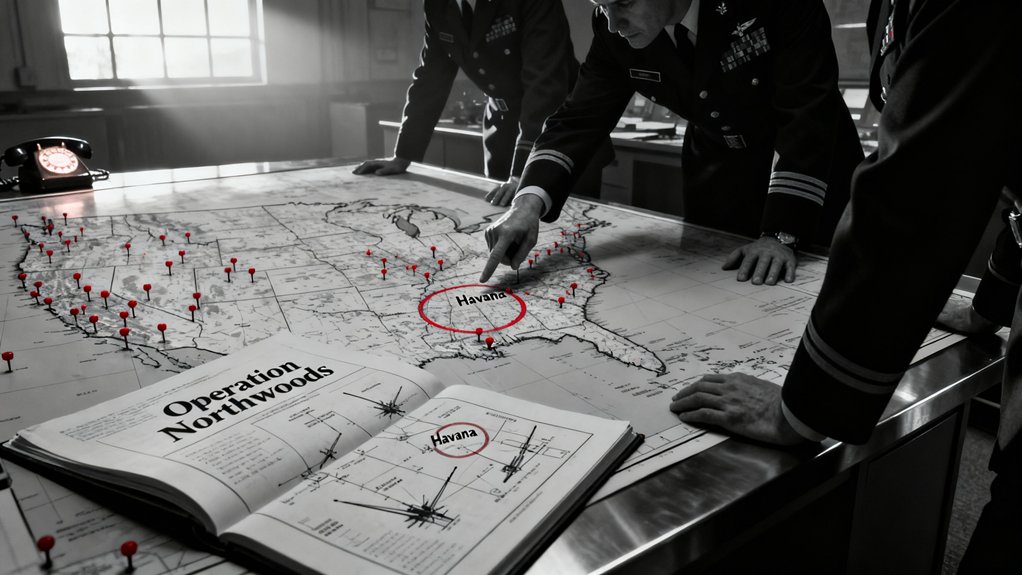
While the American public remained unaware, the Joint Chiefs had already scripted a campaign of violence to implicate Cuba in attacks on U.S. soil. The joint chiefs of staff drafted Operation Northwoods as a deception so deep it would betray the very people they swore to protect. They didn’t just plan violence—they planned lies that would bleed into newspapers and living rooms, all to manipulate a nation into war. Robert McNamara received the proposal with cold analysis, never flinching at the moral abyss. The plan relied on fear, precision, and total deniability. Its architects believed they could control chaos. They were wrong.
They plotted attacks on their own soil, forged casualty lists, and primed the press—all to summon a war from thin air and rule with fear.
- Fake Cuban commandos attacking U.S. military bases
- Bombings in Washington D.C. and Miami blamed on Havana
- A U.S. ship explosion in Guantanamo Bay disguised as a Cuban act of war
- A drone-staged airliner crash with fabricated passenger manifests
Every lie was meant to look like truth. Every victim, a pawn.
The Joint Chiefs’ Memo Authorizing Civilian Sacrifice
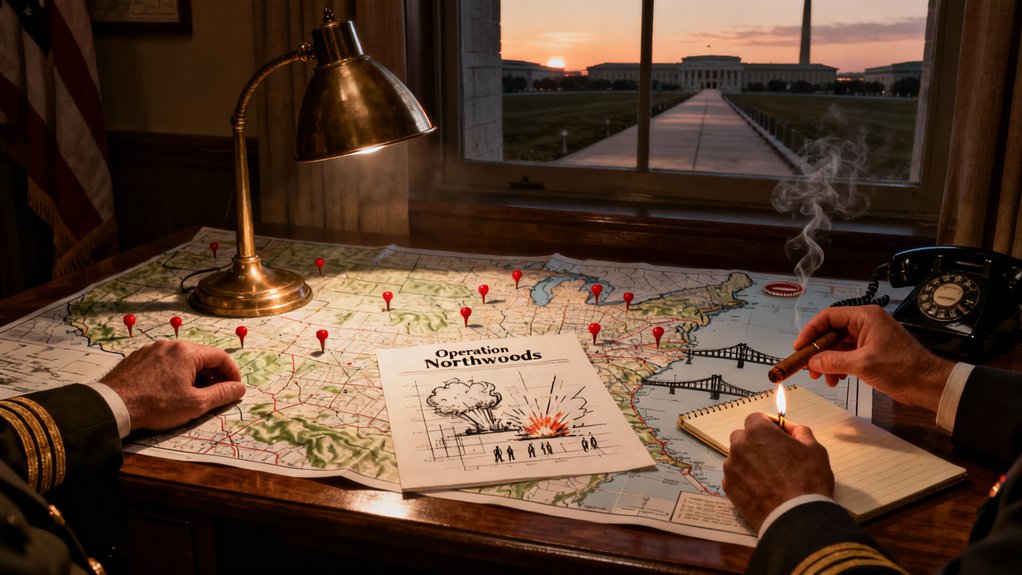
If the Pentagon ever doubted the cost of provoking war, the Northwoods memo erased it—plain language on plain paper authorizing the deliberate murder of American civilians. Drafted by Joint Chiefs Chairman Lyman Lemnitzer, the March 1962 memorandum didn’t obscure its intent; it demanded staged attacks, false flags, and the cold sacrifice of innocent lives to manufacture consent for war. U.S. ships would explode, cities would burn, and a drone would mimic a downed passenger plane—all while real victims were listed as dead. The architects knew exactly what they were doing: manipulating grief into war fever. They didn’t ask for permission; they assumed obedience. The plan stayed buried until the assassination records review board accidentally declassified it in 1997, exposing the military’s willingness to betray the people it swore to protect. Journalist James Bamford later revealed its full horror in Body of Secrets, proving the state had plotted terror against its own. This wasn’t conspiracy—it was policy. The memo stands as a chilling monument to power unchained, a warning etched in deceit and blood.
Why JFK Rejected Operation Northwoods?
How does a president respond when his generals demand he sacrifice innocent lives to justify a war? JFK did not flinch. After the failure of the cia-backed bay of pigs, the Joint Chiefs doubled down with Operation Northwoods—a grotesque proposal to terrorize Americans and blame Cuba. Kennedy said no. He saw it for what it was: a betrayal of everything the nation claimed to stand for.
- A plan to sink a U.S. ship in Guantanamo and blame Havana—echoing the Maine scandal.
- False-flag bombings in American cities to制造 public demand for war.
- The cold orchestration of a fake plane crash, using students as cover.
- The chilling ease with which top brass proposed mass deception and murder.
He rejected it outright, not just as reckless, but as evil. His refusal marked a turning point—a line drawn between power and principle. Later revealed in James Bamford’s *Body of Secrets*, Northwoods exposed a shadow war the military was willing to wage against its own people. JFK chose truth over control, sovereignty over spectacle.
Operation Northwoods’ 2001 Declassification
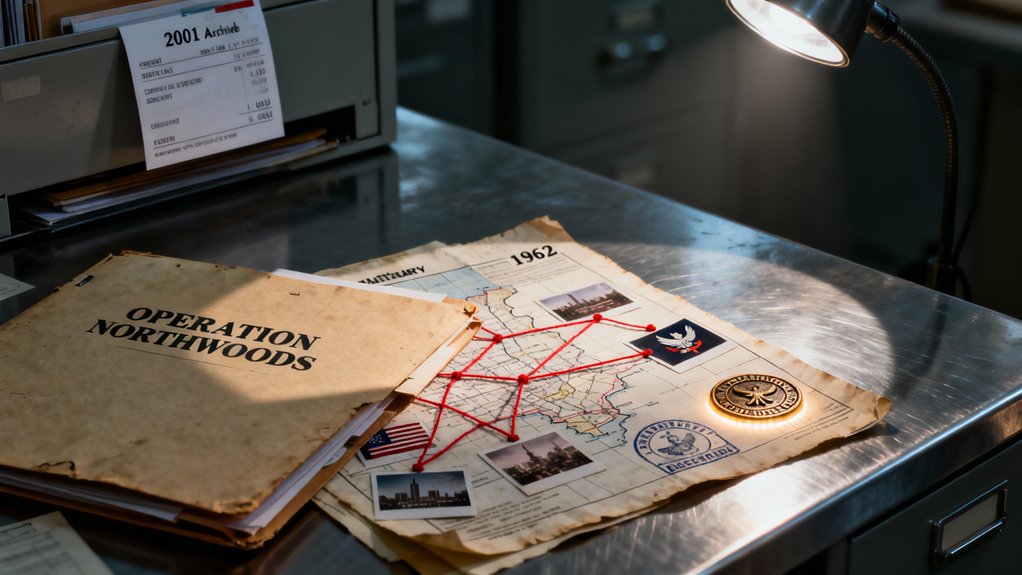
In 1997, buried among thousands of pages released by the Assassination Records Review Board, the truth about Operation Northwoods slipped into public view—uncovered not by a whistleblower or investigative raid, but by accident. For thirty-five years, the Pentagon’s plan to bomb U.S. cities and fake terrorist attacks had stayed locked in silence. Then, in 2001, the Department of Defense officially declassified the documents, confirming what many had dismissed as conspiracy. The release didn’t spark outrage—it dropped like a stone in still water. But the truth was now undeniable: America’s own generals had plotted mass deception, even mass murder, to manipulate public fear. Names of students on that fake doomed flight could’ve been read on national news. Cities braced for attacks that would’ve come from within. The government hadn’t just imagined war—it had planned to lie its way into one. Now, with the files open, citizens could finally see how deep the betrayal ran. The cover-up lasted decades. The revelation changed everything. And the question remained: if they did it once, what else are they hiding?
How Northwoods Exposed Military Overreach
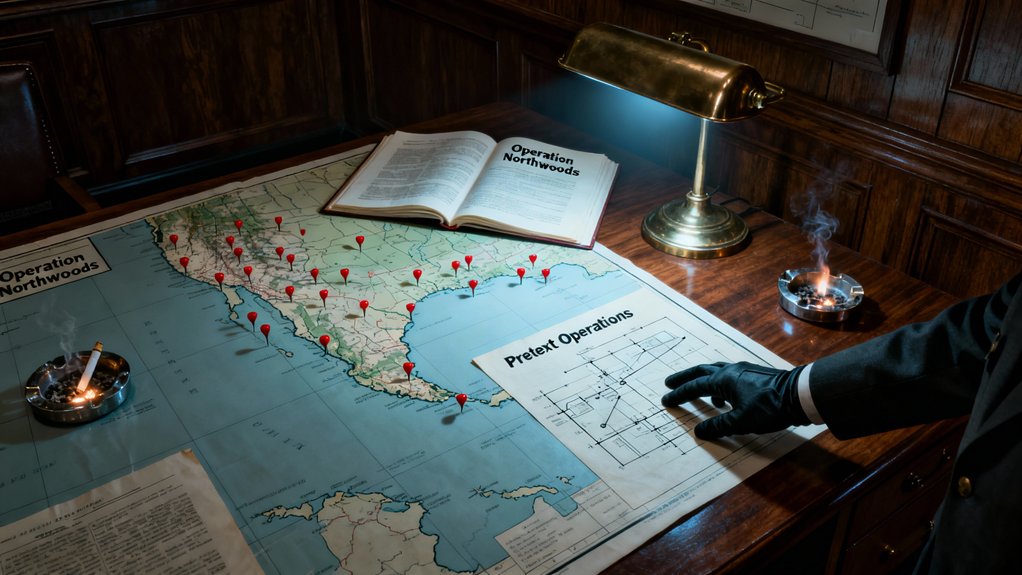
Though buried for decades, Operation Northwoods roared back to life with the 1997 leak, tearing open a wound few knew existed. The military’s own plan laid bare a chilling truth: senior leaders weren’t just preparing for war—they were plotting to deceive and terrorize their own people to start one. This wasn’t speculation. It was typed, signed, and stamped with full Joint Chiefs approval. The blueprint exposed how far the Pentagon was willing to go when unchecked:
- Fabricate Cuban attacks on U.S. soil using American bombs and American blood.
- Sabotage U.S. ships and blame Havana, mimicking the false flags that sparked past wars.
- Shoot down a drone disguised as a civilian airliner, filling newspapers with fake martyr lists.
- Manipulate public rage into demand for invasion, all while hiding the strings behind the curtain.
Northwoods didn’t just reveal a plan—it exposed a pattern. When institutions believe they know better than democracy, they don’t serve the people. They control them. And the most dangerous threat isn’t from outside the gates. It’s from within the command center.
Operation Northwoods and Public Distrust in Government
Even decades after the fact, the truth about Operation Northwoods cuts like a blade through the nation’s trust in its leaders. The moment citizens learned top military officials plotted to bomb U.S. cities and fake a plane crash—using real students as pawns—they saw a government willing to betray its own people. This wasn’t conspiracy theory; it was a signed memo from the Joint Chiefs. When the document surfaced in 1997, it didn’t just expose a rogue plan—it revealed a system where power could operate in shadows, inventing enemies and manufacturing wars. The lie wasn’t only in the proposed attacks, but in the belief that leaders always protect. Operation Northwoods proved they might also endanger. Every false flag they schemed, every life they treated as expendable, chipped away at the people’s faith. Now, that distrust spreads—not as paranoia, but as survival. Knowing this history arms citizens. They see the patterns, question the official stories, and demand transparency. The blueprint was denied, but the betrayal stuck. And in that truth, people find resolve: to watch, resist, and never again surrender their trust blindly.
Could a False Flag Plot Like Northwoods Happen Today?
While the Cold War bred secrets in shadowed corridors, the question lingers: could a scheme as brazen as Northwoods emerge in today’s light? Modern surveillance, digital leaks, and watchdog journalism make large-scale deception harder—but not impossible. Power still seeks cover in crisis, and fear remains a weapon. The machinery of control adapts; it doesn’t vanish.
- Information Control: Governments now weaponize narratives through algorithms and state-aligned media.
- Plausible Deniability: Covert actions are outsourced to shadowy contractors and proxy forces.
- Crisis Exploitation: Attacks—real or staged—still pivot public opinion toward war and repression.
- Institutional Obedience: Chains of command rarely question orders, even when ethics scream dissent.
Technology exposes lies faster, yet disinformation floods the zone, muddying truth. Whistleblowers face prison, not praise. The public’s trust is fragile, eroded by decades of hidden agendas. Northwoods wasn’t an anomaly—it was a blueprint tested and shelved, not abandoned. The conditions for false flags still thrive, camouflaged in patriotic rhetoric and national emergency. Vigilance isn’t paranoia. It’s survival.
Frequently Asked Questions
Was JFK Aware of Other False Flag Plots Beyond Northwoods?
Yes, JFK was aware of other false flag plots beyond Northwoods. He faced multiple proposals from military and intelligence factions pushing for provocations to justify war. His administration uncovered plans involving fabricated attacks, sabotage, and psychological operations targeting U.S. cities. Fearing unchecked escalation, he resisted, recognizing the danger of rogue elements manipulating national policy through deception, which ultimately intensified tensions between him and the national security establishment determined to overthrow Castro at any cost.
Did Any Military Officials Face Consequences for Proposing Northwoods?
No Pentagon official faced prosecution over Northwoods—career consequences were quiet, not corrective. Lemnitzer lost his Joint Chiefs role, quietly reassigned to NATO command, a demotion masked as promotion. Others involved simply faded into bureaucratic shadows. In today’s terms, it’d be called accountability theater: smoke and mirrors to pacify dissent. Power protected its own, while truth slept in classified vaults—until the 1990s internet age cracked the door open.
How Did the Public React Immediately After Northwoods Was Declassified?
They were stunned, then furious—outrage spread like wildfire once Northwoods surfaced. People saw it not as a relic but a revelation, proof the military had plotted to betray them. Protests flared, trust eroded, and the public demanded answers. The government’s silence only fueled suspicion. Citizens refused to look away, insisting the truth be heard, holding power to account in real time—no cover-up deep enough to bury what they’d uncovered.
Were Journalists Targeted for Investigating Operation Northwoods in the 1990S?
No journalist faced documented retaliation for probing Operation Northwoods in the 1990s—truth slipped through the cracks like smoke from a buried fire. James Bamford and others chased declassified trails with press passes and persistence, unshielded but unscathed. The system didn’t silence them; it blinked, exposed. In that rare moment, the veil lifted, and the public saw the Pentagon’s ghostly hand still trembling on the lever of deception.
Is There Evidence Northwoods Inspired Later Covert Operations?
Yes, it left fingerprints. Analysts trace its ghost in false-flag ops where governments exploited chaos to justify wars. Elements reappear in 21st-century attacks used to silence dissent and push military agendas. Though never replicated wholesale, its DNA thrives—embedded in deception, sold as security. Whistleblowers whisper its name in corridors of power, where shadows still draft plans no one admits. The blueprint didn’t die; it evolved, unseen but felt.
Final Thoughts
Shadows lengthen across the Pentagon’s marble halls, where ink once bled into blueprints for bloodless lies. Operation Northwoods died on paper, but its ghost lingers—in every whispered doubt, every flicker of distrust. The flag still waves, yet beneath its stars, something watches. Not Cuba. Not enemies abroad. But the cold calculus of power, cloaked in secrecy, waiting for the next match to strike.