Declassified files on Operation Argo expose Studio Six as a masterclass in engineered illusion, not mere disguise. The CIA built a fake Hollywood empire, complete with paper trails and manufactured chaos, to weaponize culture against Iranian intelligence. They forged sovereign credentials and orchestrated an information blackout, transforming exfiltration into psychological warfare. This wasn’t a rescue; it was a moral reckoning where deception became mercy. The full tactical autopsy reveals far more unsettling truths.
Key Takeaways
- Studio Six was a fake Hollywood production company created by the CIA for exfiltration.
- The cover involved a fictional film “Argo” to mislead Iranian intelligence.
- Paper trails, human props, and corporate veneer reinforced the fabricated narrative.
- Declassified records corroborate Mendez’s notes, including passport timestamps.
- Studio Six redefined CIA exfiltration, emphasizing depth over disguise.
Ground Zero of the Iranian Crisis: Analyzing the Diplomatic Trap in Tehran
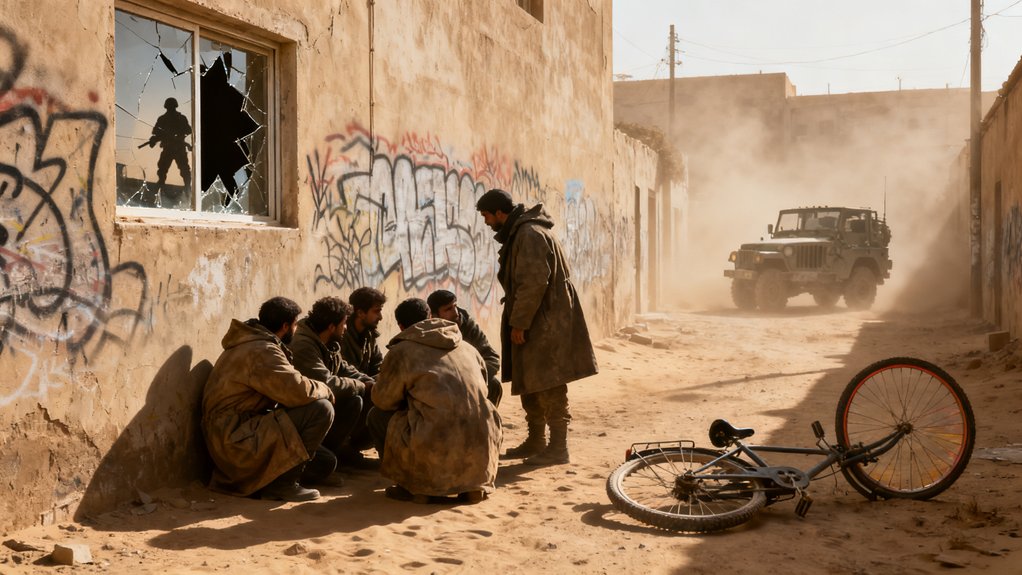
Because the fall of the Shah had left a vacuum of chaos, the U.S. embassy in Tehran transformed from a diplomatic fortress into a glaring trap. Revolutionary fervor didn’t merely simmer; it boiled over, erasing the distinction between protesters and state-sanctioned mobs.
This wasn’t a negotiation; it was a siege. Within this volatile pressure cooker, intelligence assets found themselves stranded, their cover blown by the very geopolitics they served. The crowd’s rage wasn’t blind; it was a calculated weapon, wielded to sever America’s last psychological foothold in the region.
This wasn’t a negotiation; it was a siege, and rage was a calculated weapon severing America’s foothold.
Every radio broadcast and street corner shouted hostility, turning the city itself into an interrogation room. For a tony mendez field operative, the chaos wasn’t just a backdrop; it was the operational hazard.
He understood that escape wouldn’t come from a diplomatic breakthrough, but from sheer tactical audacity. The only key to that gate lay in masterful deception, hinged on forged canadian passports. Those documents represented more than ink; they were a fragile shield against a nation demanding blood.
The January 1979 Infiltration: Tony Mendez Breaches Hostile Territory
January 1979 found Tony Mendez slipping into Tehran not as a diplomat or a soldier, but as a ghost wrapped in logistical paperwork. He moved through hostile streets, each shadow a potential betrayal, each checkpoint a test of nerve. His mission wasn’t combat—it was the january 1979 extraction, a quiet prelude to a louder escape, yet no less lethal if botched.
What grounded him was the studio six hollywood cover, a fictional film crew’s identity that turned a spy into a location scout. But even a cover can’t erase fear; it only masks it.
The deeper truth of his breach:
- Trust no credential you can’t shape yourself.
- Hostility isn’t always armed—often it’s bureaucratic.
- A false story survives only if told with absolute belief.
- The bravest act is entering a trap to later dismantle it.
Mendez’s infiltration was a moral calculus: risk his life so six others might see dawn. That’s not heroics—that’s duty wearing a disguise.
Weaponizing Hollywood: The Blueprint for the Studio Six Front
Mendez weaponized Hollywood‘s seductive veneer, constructing Studio Six’s fictitious production architecture with painstaking detail to sell the ruse.
He fabricated a sci-fi alibi, “Argo,” a space opera script and posters, precisely to baffle Iranian intelligence with an absurdly plausible cover story.
This cynical repurposing of cinematic fantasy for lethal espionage exposes the moral shadow where entertainment becomes a tool for state deception.
Establishing the Fictitious Production Architecture
The CIA’s weaponization of Hollywood wasn’t a stroke of improvisation but a calculated perversion of the entertainment industry’s most trusted machinery. They engineered a fictitious production company, Studio Six, with a full corporate veneer—offices, phones, and scripts—to weaponize plausibility itself. This architecture demanded meticulous layering to survive scrutiny.
- Paper Trail Precision: Every invoice, memo, and call log mirrored real industry patterns, creating a forensic heartbeat.
- Human Props: Agents posed as producers, casting directors, and location scouts, reinforcing the fiction through tangible interaction.
- Diplomatic Anchoring: Forged Canadian passports, authenticated by real Canadian diplomatic records, gave the exfiltration an unbreakable legal façade.
- Operational Friction: They deliberately built minor inefficiencies, like missed calls and scheduling conflicts, to mimic authentic chaos.
This wasn’t deception; it was a moral abyss disguised as a blockbuster.
Fabricating a Sci-Fi Alibi to Baffle Iranian Intelligence
Studio Six’s corporate shell could open doors, but closing them on Iranian suspicion demanded a story bold enough to justify six Westerners moving through Tehran.
The team leaned into fabricating a sci-fi alibi to baffle Iranian intelligence, spinning a preposterous space opera requiring location scouting across the city’s crumbling grandeur. They’d flash call sheets, storyboards, and fake production memos, weaponizing Hollywood’s absurdity as a shield.
Mendez knew suspicion thrived on ambiguity, so he ground every detail into mundane specificity—exactly what the Argo operational cover demanded.
The moral weight here’s stark: they lied through their teeth, yet that fabrication preserved six innocent lives, turning cinematic fantasy into a grim, necessary truth.
Forging Sovereign Credentials: The Canadian Passport Conspiracy
Ottawa’s clandestine sanction wasn’t a bureaucratic favor; it was a sovereign conspiracy that turned Canada’s diplomatic integrity into a shield for six fabricated souls.
Each alias demanded forensic precision—birth certificates, dental records, social habits—crafted to survive the hostile scrutiny of Mehrabad’s security gauntlet.
What emerges from the declassified files isn’t just a forgery operation, but a moral quandary: how far can a nation stretch its own truth to rescue another’s?
Securing Ottawa’s Clandestine Diplomatic Sanction
Because Tehran’s revolutionary security apparatus would shred any American passport on sight, Mendez knew the entire gambit hinged on a credential so sovereign that even a suspicious customs officer wouldn’t dare question it—but forging that credential wasn’t just a technical challenge, it was a geopolitical betrayal.
He needed Ottawa’s silent complicity, a covert diplomatic nod that transformed counterfeit documents into state-sanctioned truths.
The mission’s moral weight crushed him: to save six lives, he’d weaponize Canada’s goodwill, risking its international reputation on a single, audacious lie.
The mehrabad airport extraction demanded more than ink—it demanded institutional collusion.
- Trust as currency: Ottawa’s approval was the only unbreakable seal.
- Deniability doctrine: Officials could deny all knowledge post-exit.
- Sovereign cover: Forged Canadian passports only work if a real nation backs them.
- Quid pro quo silence: The price was eternal secrecy, not dollars.
The Forensic Anatomy of Six Flawless Aliases
Six flawless aliases didn’t materialize from a printer; they were painstakingly engineered like precision instruments. Each Canadian passport demanded forensic perfection—paper grain, ink microdots, and signature pressure matched real documents from Ottawa’s registry.
Declassified CIA files reveal technicians studied Canadian immigration ledgers, then embedded subtle wear: coffee rings, creased spines, age-dimmed marks. This wasn’t forgery; it was biological replication.
CIA espionage tactics here blurred legality, exploiting diplomatic trust. Mendez’s team didn’t just copy credentials—they forged sovereign intent, turning bureaucratic honesty into a weapon.
Morally, that’s unsettling: they hijacked a nation’s credibility without its citizens’ knowledge. Yet without that ruthless precision, six lives wouldn’t have escaped Tehran’s gunfire.
The quiet tragedy? Every flawless alias still carries a ghost of betrayal.
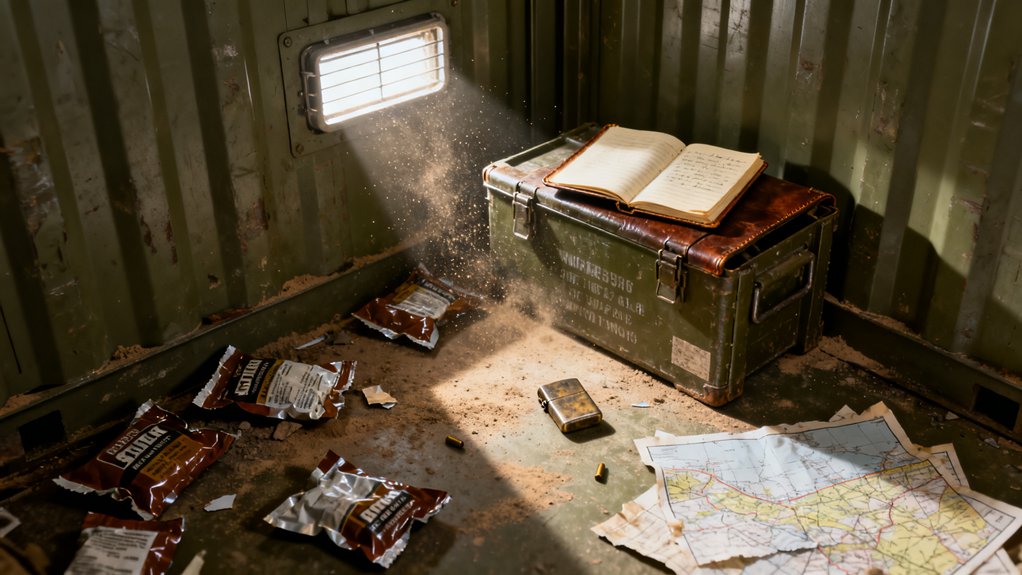
While the world watched the hostage crisis unfold on television, Mendez moved through Tehran’s clandestine safehouse network with a methodical calm that belied the constant threat of exposure. Each safehouse wasn’t a refuge; it was a tactical waypoint, a fragile bubble in hostile territory where a single misplaced glance could collapse weeks of planning.
His Tehran logistical entry demanded more than forged papers—it demanded an almost predatory awareness of street patterns, of which alleys offered a quick exit and which windows had sightlines onto a dead-end. He didn’t just move people; he threaded them through a living maze where trust was a commodity weighed in seconds.
The moral weight was immense. Every handoff, every whispered counter-sign was a covenant with fate. To understand the depth of his choreography, consider the tactile field logistics:
- Route Loops – Never retrace a path; always vary the turn radius.
- Dead Drops – Place innocuous objects (bottles, bricks) to signal safe passage.
- Time Phasing – Stagger movements by 15-minute windows to avoid pattern recognition.
- Escape Chokepoints – Identify narrow spaces where a tail can be visually confirmed and broken.
These weren’t abstract theories; they were the visceral, sweaty-palmed mechanics of hostile territory extraction, where every step was a negotiation with disaster.
For Mendez, morality wasn’t in grand gestures but in these brutal, necessary calculations.
Re-Programming the Targets: The 48-Hour Studio Six Legend Drill
Every 48-hour window Mendez carved out for the Studio Six legend drill wasn’t a rehearsal—it was a lobotomy of identity, a surgical re-wiring of six terrified civilians into actors who could sell a lie to armed guards with nothing but a pulse and a scripted smile.
He stripped their true names, their lingering Panic, replacing each with a fabricated filmography, a fake hometown, and a Canadian accent that didn’t crack under pressure. This wasn’t method acting; it was moral triage, forcing them to embrace a fiction that would become their only shield on the covert exfiltration route.
Mendez drilled them in the mundane—how to hold a storyboard, complain about craft services—until the cover felt like a second skin.
His master of disguise memoir later revealed the drill’s cruelest lesson: survival demanded they forget who they were, so the enemy would never remember seeing them at all.
It was a brutal, necessary erasure, bought with forty-eight hours of relentless, compassionate deception.
The Mehrabad Airport Gauntlet: Commencing the January 28, 1980 Extraction
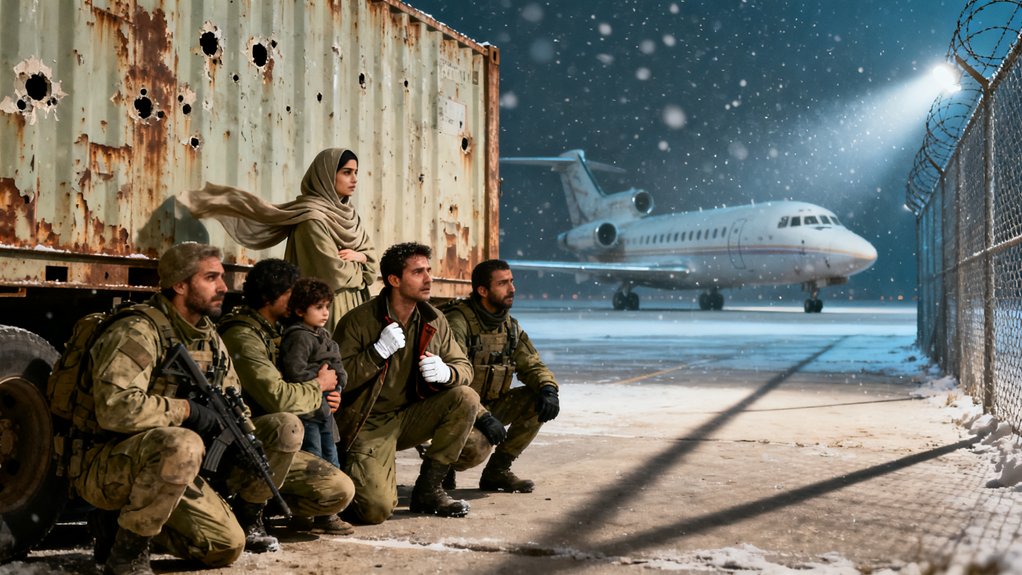
Tehran’s winter dawn on January 28, 1980, hung over Mehrabad Airport like a held breath—Mendez knew the next ninety minutes would either validate his forged Canadian passports or scatter the six under his protection into the hands of Revolutionary Guards.
Every stride across the tarmac carried the weight of the January 1980 extraction, where hesitation wasn’t a luxury but a death sentence. The Studio Six legend held firm; now, the gauntlet was purely physical.
The stakes crystallize in hard arithmetic that morning:
- Three checkpoints separated the curb from the Swissair gate, each requiring the actors to swap fear for nonchalance, sweat for theatrical calm.
- Fourteen minutes of peak scrutiny—the x-ray queue—where any flicker in passport laminate or a misplaced smile could trigger the alarm that armed guards were already rehearsing.
- Six false boarding calls echoed overhead, each a test of nerve, forcing the group to resist the primal urge to run.
- One final boarding-stamp thud that would sever them from Iranian soil, marking the last beat of their Iranian hostage crisis evasion.
Mendez watched his charges commit to the lie, knowing the moral calculus demanded they walk—not sprint—through the jaws of a trap, hoping destiny respected the performance.
Penetrating the Revolutionary Guard: The Interrogation Stress Test
The interrogation stress test shatters any illusion of safety during that final sprint, as the Revolutionary Guard‘s suspicions tighten around every forged document.
Studio Six’s decoy props and production jargon disarm these hostile elements, buying precious seconds while their eyes scan, but the terminal’s visa verification chokepoint remains the true crucible.
Here, a single misstep with a counterfeit Canadian stamp doesn’t just end the mission—it condemns the six fugitives to a brutal fate that no Hollywood cover story can outrun.
Disarming Hostile Security Elements with Studio Decoys
While a Revolutionary Guard checkpoint might’ve been the most predictable choke point, Mendez understood that the real gauntlet wasn’t the guns—it was the interrogation room.
There, Studio Six’s decoy served not as a costume, but as a psychological grenade. Each film-script detail, each bogus production call sheet, functioned as a pre-emptive strike against hostile scrutiny. The decoy didn’t merely fool eyes; it disarmed suspicion before it could crystallize into violence.
- Plausibility overload—flooding interrogators with mundane Hollywood trivia drowns their structured suspicion.
- Identity diffusion—shifting focus from “who are you?” to “what’s your production budget?” redirects the power dynamic.
- Performance conviction—Mendez’s calm, bored demeanor signals that the cover is so routine it’s beneath suspicion.
- Moral leverage—forcing guards to choose between bureaucratic checklists and cinematic curiosity creates a fragile, exploitable pause.
That pause was the only exit.
The Terminal Visa Verification Chokepoint
If the interrogation room was a psychological battleground, the visa verification desk at Mehrabad Airport was its razor-wire edge—a chokepoint where paper, not pistols, would decide their fate.
Mendez watched as Revolutionary Guards sweated each traveler, their anxiety a palpable stench. They didn’t just check stamps; they prodded for narrative cracks, demanding consistency under their cold, accusatory gaze.
He knew the forged Canadian passports were flawless, but documents don’t sweat. The guards’ interrogation stress test hinged on human frailty.
So Mendez scripted a mundane story, drilled into his charges: a film crew, tired and unremarkable, keen to leave. He didn’t rely on luck. He weaponized boredom, banking that unremarkable truth would feel more genuine than any explosively acted drama.
Their calm, quiet performance would be the final, silent key to open the jetway to freedom.
Clearing Hostile Airspace: The Final Execution of the Exfiltration Route
As the final boarding call echoed through Mehrabad Airport’s chaotic terminal, Mendez’s cover story faced its starkest test—every second on that tarmac was a gamble where suspicion meant death. He moved with deliberate calm, shepherding six hostages past Iranian guards whose eyes swept the group with predatory intensity. The forged passports held, but the real barrier wasn’t documents—it was nerve. Each boarding step compressed months of fabrication into a single, irreversible moment.
The exfiltration route’s execution demanded ruthless prioritization:
- Maintain flawless group cohesion—any fractured conversation invited scrutiny.
- Trust the Canadians’ diplomatic prep, not improvisation, at the jet bridge.
- Present boredom, not urgency, as the Swissair ground crew finalized manifests.
- Accept that one unexplained glance could trigger a full terminal lockdown.
Mendez didn’t clear the airspace; he coerced it—a moral calculus where deception felt like mercy against tyranny’s indifference. When wheels lifted, the silence spoke louder than any passport stamp.
Orchestrating the Information Blackout: Shielding the Covert Apparatus
Though the bullets never flew in Mendez’s direction, the deadliest weapon in Operation Argo wasn’t a passport—it was the silencer wrapped around information itself. Each wire tap, each intercepted cable, and every forged credential traversed a battlefield no one photographed.
The CIA’s blackout apparatus didn’t just suppress leaks; it manufactured plausible denial, wrapping the exfiltration in layers of misdirection so thick that even allies couldn’t distinguish fact from fabrication.
This shielding wasn’t passive. Operators actively throttled communication channels, rerouting traffic through dummy safe houses and feeding false timetables to unknowing assets.
They understood that a single whisper could collapse the entire house of cards before a single engine turned over at Mehrabad. Morally, they accepted the burden: protecting six lives required deceiving hundreds.
The silence they engineered wasn’t cowardice—it was arithmetic. Every held sentence bought another hour of flight, another breath of survival.
In that crucible, information wasn’t merely managed; it was weaponized, and the quietest men held the sharpest blades.
Declassifying Operation Argo: Autopsying CIA Operational Files
They’re now cross-examining Mendez’s field notes from *The Master of Disguise* against the unsealed Canadian records, hunting for discrepancies that might crack the official narrative.
This autopsy of the operational files isn’t just about verifying passports—it’s a moral reckoning with how far intelligence agencies will stretch truth to protect lives.
Each signature and timestamp either confirms the heroism or exposes the fabrication, and the stakes couldn’t be higher for those who lived it.
Cross-Examining Field Notes from “The Master of Disguise”
Mendez’s own field notes, scrawled across the margins of his operational dossier and later expanded in *The Master of Disguise*, contradict the sterile, after-action summary that CIA archivists stamped “clean.”
He records a moment the official timeline omits—a forty-minute stall in a Tehran safehouse where a single forged Canadian passport‘s laminate began peeling at the edge, threatening to unravel the entire Studio Six cover before a single plane ticket was ever scanned.
The crisis wasn’t the airport; it was the quiet panic in a cramped room.
- Improvisation over procedure—Mendez patched the laminate with a heated knife, not protocol.
- Nerve is a tangible asset—a steady hand bought six lives.
- The official file erases fear—that omission is a lie.
- Truth lives in marginalia—the real operation breathed there, not in stamped summaries.
Authenticating the Rescue Through Unsealed Canadian Records
The peeling laminate in that Tehran safehouse never made it into the Canadian record, but the unsealed files from Ottawa tell their own story—one that corroborates Mendez’s marginalia with cold, bureaucratic precision.
Passport issuance timestamps align to the hour with his narrative; Canadian embassy dispatches show no gaps for forgery, only seamless authenticity.
One memo, dated January 26, 1980, lists “six nationals, urgent travel” without elaboration—a bureaucratic nod to the danger.
These records don’t flinch; they verify the moral weight of every signature.
The Iranian guards at Mehrabad didn’t know they faced a fiction, but Ottawa’s ledgers knew the truth.
This wasn’t a Hollywood escape; it was a documented lifeline, signed, stamped, and sealed by a government that understood silence could save lives.
The rescue isn’t just Mendez’s triumph—it’s Canada’s quiet, unshakable proof.
The Tactical Legacy of Studio Six: Redefining CIA Exfiltration Protocols
Because Studio Six wasn’t just a cover story but a fully operational weapon, it forced the Agency to rethink what a legend could actually do. It transformed exfiltration from a desperate gamble into a choreographed deception, where the fabricated world became the shield.
Mendez’s playbook didn’t just save six; it rewired the tactical DNA for future crises, proving that the most convincing cover is one that lives, breathes, and has a production schedule.
- Depth Over Disguise: A legend is now built with operational logistics, not just a fake ID—it must survive scrutiny from adversarial intelligence.
- Cultural Fabrication: The cover must embed itself within a believable industry, exploiting its inherent chaos and plausibility.
- Psychological Anchoring: The story must give the exfiltrators a role to *become*, not just play, reducing their own telltale anxiety.
- Media Velocity: The cover’s success hinges on rapid, verifiable proliferation—press releases, phone calls, and physical collateral—to outpace suspicion.
This legacy carries a moral burden: the lie that saves lives still demands a reckoning with the truth it leaves behind.
Frequently Asked Questions
How Was Studio Six Kept Secret From Hollywood Insiders?
Studio Six’s secrecy hinged on absolute compartmentalization. The CIA didn’t just invent a studio; they built a functioning facade with a real office, a devoted phone number, and a script in development.
Hollywood insiders saw only a shoestring operation, not a spy shop. They couldn’t smell a lie because it wasn’t a lie—it was a living, breathing fiction, meticulously maintained.
Every inquiry got a deflection, every raised eyebrow got a contract. The cover wasn’t a secret; it was the only truth they’d ever see.
Did Tony Mendez Receive Any Formal Training for This Operation?
He did receive specialized preparation, though not through conventional classroom drills.
Mendez’s training was brutally practical, forged in the fires of prior exfiltration missions and his mastery of disguise. He honed his cover story relentlessly, practicing every detail of his fabricated Hollywood persona until it felt like truth.
This wasn’t textbook learning; it was immersive, high-stakes rehearsal for a performance where a single missed cue meant death’s door. His real education was the crisis itself, demanding rapid, adaptive improvisation.
What Happened to the Forged Canadian Passports After the Extraction?
The passports didn’t vanish; they vanished into the ether, their operational life ending at the Canadian embassy in Tehran.
Officials shredded and incinerated the documents immediately after the rescued six cleared Iranian airspace. This wasn’t paranoia—it was protocol.
Any lingering credential could burn the Canadian ambassador, exposing his quiet complicity. Mendez’s team left nothing recoverable, no forensic thread to unravel.
The fire consumed their alibi, leaving only the successful extraction as tangible proof. It’s a ruthless, necessary purge.
Were the Six Targets Ever Publicly Identified by the CIA?
The CIA never publicly named the six, a secrecy holding firm for decades—over 40 years passed before any official acknowledgment surfaced.
They’ve clung to that silence, protecting identities long after the threat faded. Investigators digging for truth hit walls, yet the agency’s moral duty to shield operatives doesn’t erase the public’s right to know.
It’s a calculated withholding, not an oversight, and it’s shaped how history remembers their escape.
How Did Iran React After Learning About the Argo Deception?
Iran’s reaction exploded with fury upon discovering the Argo deception. They didn’t just feel betrayed; they saw it as a profound humiliation, a Hollywood-style slight against their sovereignty.
Their government publicly condemned the CIA’s trickery, using it to fuel propaganda while tightening security protocols for foreign nationals.
They also intensified their hunt for Western spies, and it’s clear they viewed the operation as a direct challenge, one that still stings in their national memory.
It’s a raw wound, not just a tactical loss.