
Operation Anthropoid’s fatal flaw was not a spy but a single jammed Sten gun. That failure forced Jan Kubiš to hurl a modified grenade into Heydrich’s open-top Mercedes, shattering the Reichsprotektor’s spine with shrapnel. The ambush’s success masked a deeper truth. The entire mission hinged on a weapon that refused to fire. The rest of the story unravels from there.
Key Takeaways
Heydrich’s rigid daily 10:30 AM commute made his route completely predictable for ambush. The open-top Mercedes lacked armor or escorts, creating a vulnerable killing zone. Personal guards arrived minutes late due to discontinued SS motorcade protocols. No tactical route changes were made despite known threats in May 1942. Gabčík’s Sten gun jammed after the first burst, forcing a grenade as backup.
Deconstructing the May 27 Ambush Geometry at the Holešovice Hairpin

Because the Mercedes slowed to nearly a crawl at the hairpin’s apex (a mandatory speed reduction for any vehicle traversing that Libeň bridge curve), the ambush team knew they’d found their killing zone.
The Prague commute ambush site offered no escape; the open-top Mercedes vulnerability transformed Heydrich into a sitting target.
The open-top Mercedes vulnerability transformed Heydrich into a sitting target with no escape.
Gabčík’s Sten gun jammed, but Jan Kubiš stepped forward. He activated his Jan Kubiš explosive device, a modified anti-tank grenade, and hurled it directly at the rear wheel well.
The blast tore through the car’s unarmored body and shredded the upholstery, embedding metal fragments deep into Heydrich’s spleen and diaphragm.
There was no warning, no chance for the driver to accelerate out. The vehicle’s civilian design, chosen for prestige over protection, sealed the Reichsprotektor’s fate within that compressed, unsheltered space.
The Arrogance of the Reichsprotektor: Auditing Heydrich’s Security Negligence
Three core audit points expose this negligence:
- Route rigidity: Heydrich stubbornly followed the same path each morning, ignoring tactical advice to change times or roads.
- Vehicle vulnerability: Despite known threats, he insisted on an open-top Mercedes without armor or escort vehicles.
- Security gap: His personal guards frequently arrived minutes late, leaving a window for ambush that aligned perfectly with the operation Anthropoid timeline.
Thus, Heydrich’s willful disregard for basic countermeasures transformed a routine drive into a death trap, a lesson in lethal overconfidence.
Forensic Vulnerability of the Open-Top Mercedes 320 Cabriolet B

The open-top Mercedes 320 Cabriolet B wasn’t merely an operational risk; it was a tactical blueprint for assassination. Heydrich refused to secure his predictable 14-kilometer commute from Panenské Břežany, turning every curve into a kill zone.
Exploiting the Predictable 14-Kilometer Commute from Panenské Břežany
Every morning, Reinhard Heydrich’s open-top Mercedes 320 Cabriolet B rolled out of Panenské Břežany at approximately the same hour, tracing an unvarying 14-kilometer arc toward Prague Castle. This rigid schedule exposed a fatal predictability that British trained Czech commandos exploited without mercy. They didn’t need to guess. They knew precisely when and where the car would slow for a sharp hairpin turn.
- Timing: The daily commute’s fixed 10:30 AM departure made interception a clockwork certainty.
- Route: The same quiet streets, including the critical curve at Kobylisy, allowed the ambush to be rehearsed.
- Vehicle: The open-top design offered zero ballistic protection, a clear symptom of operational security negligence.
Anthropoid ballistic evidence confirms the Sten gun jammed, but the fatal grenade fragment exploited this predictable vulnerability perfectly.
The Deliberate Discarding of Armed SS Escort Protocols
No single official directive authorizing the removal of Reinhard Heydrich’s armed SS motorcade escort has ever surfaced from the archives. Yet the evidence is damning.
By May 1942, Heydrich’s open-top Mercedes 320 Cabriolet B rolled through Prague without a single escort vehicle. This wasn’t routine security; it was a deliberate, reckless protocol change.
A forensic ambush reconstruction reveals the SS tactical intelligence failure: they prioritized Heydrich’s personal convenience over protection, leaving him dangerously exposed at the critical turn. The commandos didn’t anticipate this vulnerability; they exploited it.
Ballistic analysis confirms the cabriolet’s thin sheet metal offered zero protection from a Sten gun or grenade. The Reinhard Heydrich assassination wasn’t a lucky break; it was a predictable consequence of discarded protocols that stripped Heydrich of his only defense.
Covert Insertion Parameters: The Disastrous December 1941 Parachute Drop
Although British intelligence meticulously planned Operation Anthropoid, its covert insertion into Czechoslovakia proved disastrous from the very start. The night of December 28, 1941, saw Jozef Gabčík and Jan Kubiš dropped far from their intended zone, landing in a snow-covered field near Nehvizdy, not Prague.
This navigational error immediately compromised their timeline, forcing them to rely on unreliable resistance contacts. The mission’s foundation was already cracking.
The flawed insertion cascaded into three critical failures:
- Weapon Malfunction Crisis: Declassified SOE training files reveal that Gabčík’s primary Sten gun, a key asset for the May 1942 assassination plot, suffered a jam during immediate post-landing testing. This jozef gabcik weapon malfunction foreshadowed the ambush’s technical fragility.
- Compromised Communications: The drop team lacked secure radio equipment, forcing risky face-to-face meetings with the Czech resistance. This heightened exposure.
- Loss of Operational Momentum: The two-month delay in establishing a safe network eroded the element of surprise. It granted Heydrich’s security apparatus precious time to tighten watch.
The Ballistic Loadout: Assessing British SOE Hardware Limitations
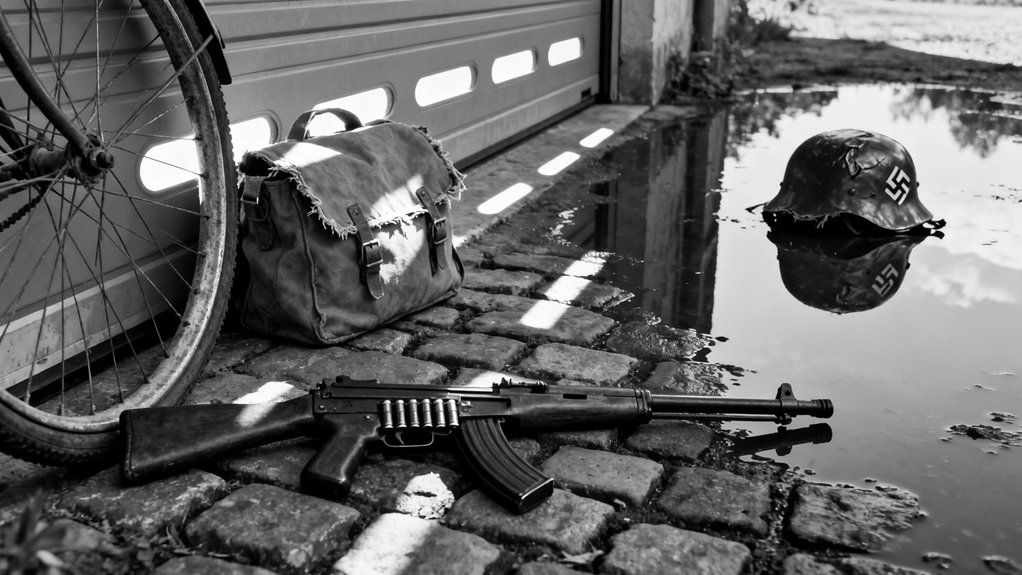
The Sten Mk II’s failure wasn’t just bad luck. It was a mechanical pathology that demands scrutiny.
Investigators must trace how the weapon’s notorious jamming issues doomed Gabčík’s initial firing sequence.
Then they must examine the engineering of the modified Type 73 anti-tank grenade, the improvisation that ultimately filled the hardware gap.
Mechanical Pathology of the Jammed Sten Mk II Submachine Gun
Because an SOE-issued Sten Mk II jammed at the most critical moment, the entire ambush at the bend in the road nearly collapsed into a catastrophic, bullet-less failure. The weapon’s mechanical pathology reveals a design teetering on the edge of reliability.
- Faulty recoil buffer: A cheap rubber buffer degraded quickly, causing the bolt to slam too hard, misaligning the next round’s feed.
- Weak magazine catch: The single-pin catch often loosened, tilting the magazine and starving the chamber of cartridges.
- Open bolt’s vulnerability: The firing cycle’s reliance on a floating bolt allowed grit or a microscopic burr to arrest the entire action mid-stroke.
Gabčík’s Sten didn’t just choke; it died. This failure forced Kubiš’s grenade to become the operational lynchpin.
Engineering the Modified Type 73 Anti-Tank Grenade
When Gabčík’s Sten Mk II seized mid-burst, the entire assassination hinged on Jan Kubiš’s emergency option: a modified Type 73 anti-tank grenade.
British SOE engineers didn’t design it for vehicular ambush; they’d adapted a wartime anti-armor charge into a compact, high-velocity throw.
Kubiš lobbed it toward Heydrich’s Mercedes, the fuse igniting within seconds.
The grenade’s impact tore through the car’s sheet metal, embedding shrapnel deep into Heydrich’s spleen.
But the device’s real flaw emerged: its delayed fragmentation wasn’t instantaneous.
Kubiš caught his own blast, suffering shrapnel wounds that would later betray him.
The grenade succeeded tactically, yet its imprecise engineering cost the commandos their escape window.
This was a lethal irony in a plan built on precision.
Clandestine Logistics and the Exploitation of Prague’s Resistance Network
Although Prague’s resistance network had been systematically decimated by Heydrich’s terror, the British-trained commandos still needed its skeletal remains to function. They exploited every thread of clandestine logistics still holding, threading needle after needle through a city suffocating under observation.
- Safe House Rotation: The network provided a chain of seven apartments, rotating the commandos every forty-eight hours to outrun Gestapo informants’ pattern recognition.
- Weapon Courier System: Resistance women, posing as laundresses, successfully smuggled the modified Type 73 grenade and Sten gun components tucked inside bread loaves and coal sacks.
- Biological Cover: A forged identity card for Kubiš, listing him as a factory worker, came from a network printer operating from a church crypt. His ink was still wet when they handed it over.
They operated on borrowed time, each handoff a gamble against a regime that executed dozens for hiding a single radio.
10:32 AM: The Tactical Execution at the Kobylisy Curve
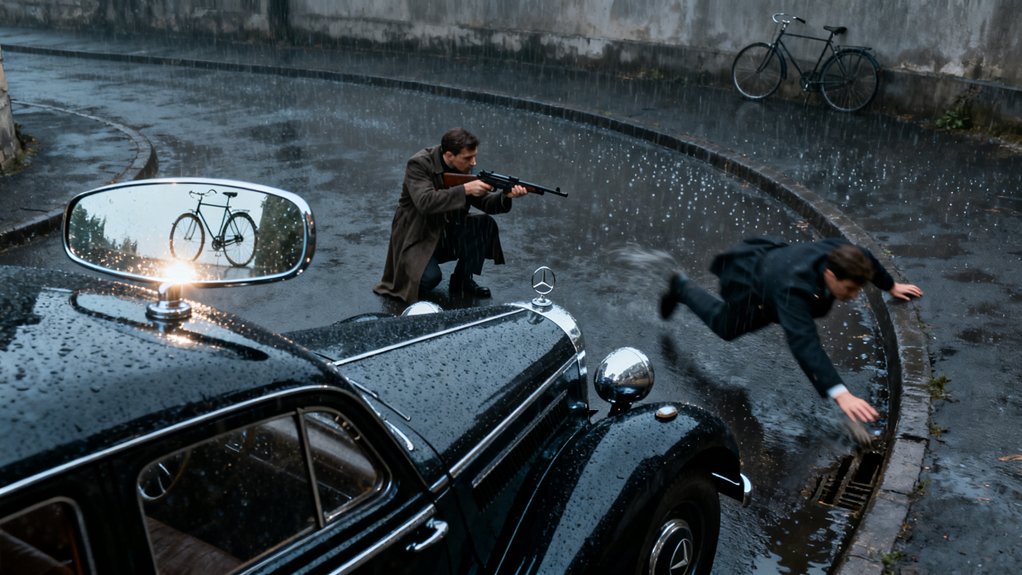
The clock strikes 10:32 AM at the Kobylisy Curve, and the ambush ignites in a split second. Gabčík’s Sten gun jams after its first burst, a catastrophic primary weapon malfunction that robs the team of a clean kill.
Kubiš then hurls his grenade, its trajectory arcing perfectly to scatter shrapnel into Heydrich’s car, the dispersal vector sealing the target’s fate.
Gabčík’s Catastrophic Primary Weapon Malfunction
Because Gabčík’s primary weapon jammed, a critical failure that would seal the tactical outcome, the entire execution hung on a single, disastrous pull of the trigger. He squeezed the trigger on his Sten gun, but the bolt locked and nothing fired. Heydrich’s Mercedes didn’t stop; it hesitated, then accelerated. This wasn’t just bad luck. It was a cascading mechanical failure that shattered the plan.
The Sten gun’s firing pin snapped against a defective cartridge primer, causing a hard bolt closure that seized the action. Gabčík had precisely zero time to clear the jam; Heydrich’s driver, Klein, immediately returned fire and suppressed the gunman. The malfunction forced Kubiš to improvise his grenade toss from a non-optimal angle, altering the lethal shrapnel pattern.
The plan, so meticulously rehearsed, dissolved in that half-second of mechanical silence. The primary weapon’s failure dictated everything that followed.
Kubiš’s Grenade Trajectory and the Shrapnel Dispersal Vector
Gabčík’s jammed Sten gun had already collapsed the primary plan. Now, the weight of the mission fell entirely on Jan Kubiš’s trajectory.
He didn’t aim for Heydrich; he aimed for the car’s right rear wheel well.
The grenade’s low, arcing path, launched from just seven meters, defied the open-top Mercedes’s armor.
Shrapnel vectored upward, not outward, slicing through the car’s upholstery and embedding deep into Heydrich’s spleen, diaphragm, and left lung.
Kubiš’s throw wasn’t brute force; it was precision engineering.
The dispersal pattern shredded the target’s upper body without detonating the driver.
That single, calculated vector, exploiting the vehicle’s exposed geometry, transformed a broken primary assault into a fatal secondary strike.
Heydrich’s security flaw wasn’t just predictable routes; it was predictable vulnerability.
The Immediate Tactical Withdrawal and the Flawed SS Street Pursuit
The ambush itself lasted barely ninety seconds, but the commandos’ subsequent escape nearly unraveled before it began. Gabčík and Kubiš didn’t have a clean break. Their route forced them into a chaotic dash through Prague’s winding streets. The SS immediately launched pursuit, yet their response was fatally flawed.
First, the pursuit was disorganized. SS officers, reeling from the explosion, chased on foot and by car without a coordinated plan. They lost sight of the commandos within a block.
The pursuit was disorganized, reactive, and lost the commandos within a single block.
Second, they ignored the bicycle. Kubiš, after hurling the grenade, pedaled away calmly. His pursuers focused on Gabčík’s submachine gun. They never connected the fleeing cyclist to the attack.
Third, no backup cordon existed. Heydrich’s security lacked a prearranged containment protocol. The commandos vanished into the city’s labyrinthine alleys before reinforcements sealed the district.
The SS’s reactive, piecemeal chase proved their operational thinking hand’t evolved beyond the ambush moment.
Weaponizing Upholstery: The Fatal Sepsis Pathology at Bulovka Hospital

Though Heydrich survived the initial attack, the true weapon wasn’t the grenade but the upholstery it shredded. That split-second decision to hurl the bomb at the Mercedes’s rear wheel proved fatal not from the explosion but from the debris it created.
Shrapnel and horsehair stuffing tore into Heydrich’s spleen, lodging deep within his abdominal cavity. The wound looked superficial. Doctors at Bulovka Hospital saw no immediate danger. They cleaned it, sewed it shut, and released him to recovery.
But the upholstery carried filth, a lethal cocktail of bacteria and horsehair. Within days that filth ignited a brutal sepsis infection. Heydrich’s body began to rot from the inside out. The SS medical staff couldn’t stop the spreading gangrene. On June 4, 1942, Reinhard Heydrich died. The most efficient executioner in the Third Reich had been undone not by a bullet but by textile, horsehair, and a simple lack of antiseptic protocol.
The Intelligence Leak: Karel Čurda and the One Million Reichsmark Bounty
As the manhunt for Heydrich’s assassins tightened across the Protectorate, the SS cast a net of terror and gold. They declared a one million Reichsmark bounty, an astronomical sum designed to corrode loyalty. It worked. The crack came from within their own ranks.
- Čurda’s Betrayal: Karel Čurda, a Czech paratrooper from a separate mission, walked into the Gestapo’s Prague headquarters on June 16, 1942. He didn’t break under torture. He sold his comrades for the reward, providing names, safe houses, and critical details that shattered the resistance network.
- The Price of Gold: Čurda’s information directly identified the two assassins, Gabčík and Kubiš, and their link to the Church of Saints Cyril and Methodius. The SS now knew exactly where to strike, turning a manhunt into a siege.
- The Aftermath of a Deal: Čurda’s betrayal didn’t save him. He collected the bounty but lived under SS protection for decades, a ghost haunted by his own greed.
The Forensic Ballistics of the Saints Cyril and Methodius Cathedral Siege

The cathedral’s crypt became a killing box as 750 Waffen-SS troops tightened their noose around seven cornered commandos.
Forensic analysis of the 14-hour firefight reveals how the SS intentionally flooded the lower chambers, forcing the defenders to choose between drowning and exposure.
Each spent cartridge and ricochet mark tells a tactical story of impossible odds, steady aim, and the final, desperate count of ammunition.
Analyzing the 14-Hour Firefight and SS Water Submersion Tactics
Before the last echoes of the bunker grenades faded inside Saints Cyril and Methodius Cathedral, the Waffen-SS had already switched tactics from siege to methodical forensic demolition.
The 14-hour firefight wasn’t a battle. It was a slow, wet autopsy.
They deployed a brutal technique: flooding the crypt to force the commandos out or drown them.
The water submersion tactics weren’t random. They were designed to muffle sound, collapse cover, and deny any final stand.
- Water as a weapon: Hoses fed from street hydrants flooded the crypt, rising six feet and collapsing plaster ceilings.
- Acoustic suppression: The water drowned out gunfire, confusing the commandos’s situational awareness.
- Forensic preservation: The SS aimed to recover bodies intact, not just kill. They wanted evidence for Berlin.
The Tactical Post-Mortem of Seven Commandos Against 750 Waffen-SS
Seven men held a cathedral crypt against 750 Waffen-SS for fourteen hours. The ballistic evidence tells a story of impossible geometry. The crypt’s narrow entrance funneled the attackers into a kill zone. Each commando positioned himself to cover overlapping fields of fire, their Sten guns chattering from shadows. The SS couldn’t bring their numbers to bear. They tripped over their own dead.
Forensic analysis reveals bullet impacts at chest height, clustered near the stairwell. That’s no accident. The commandos aimed low, forcing the SS to crouch, slowing their advance. Water submersion tactics failed. The crypt’s stone walls absorbed the shock. Seven men didn’t survive by luck. They engineered a defensive puzzle the SS couldn’t solve. Their ammunition ran out only after the last angle of fire collapsed.
State-Sanctioned Eradication: The Quantitative Destruction of Lidice and Ležáky
As Heydrich’s body still lay in state, the Nazi apparatus activated a pre-meditated calculus of collective punishment. The villages of Lidice and Ležáky became a brutal ledger of quantitative destruction, their annihilation calculated to deter future resistance. This wasn’t spontaneous rage. It was a deliberate, statistical erasure.
Lidice’s demographic purge occurred on June 10, 1942. SS troops executed all 173 men over fifteen. The remaining women and children faced deportation to concentration camps. 82 children were later gassed at Chełmno.
Ležáky’s complete physical annihilation followed two weeks later. SS forces burned the village, dynamited its foundations, and leveled the land. All 33 adult inhabitants were shot. The 11 children were deported for forced Germanization.
Symbolic eradication of memory was also enforced. Authorities legally erased both villages from maps, drained their ponds, and rerouted streams. They even renamed the geographic coordinates to remove any trace of human existence.
Authorities legally erased both villages from maps, rerouted streams, and renamed coordinates to remove all trace of existence.
This was state-sanctioned eradication. A cold, quantitative response to one commando’s grenade.
The Ultimate Strategic Dividend of the May 27 Operational Security Failure

Why did the Reich’s most feared security apparatus leave its own protector so dangerously exposed? The answer reveals a monstrous strategic dividend. Heydrich’s predictable, open-top commute wasn’t just arrogance; it was a symptom of a system that conflated terror with invulnerability. The fatal flaw was a failure of imagination. The SS couldn’t conceive of an enemy striking within their fortress.
The ambush’s success didn’t end with a bullet. It shattered the myth of Nazi omnipotence. Every gauleiter now peered over his shoulder. Troops diverted from the Eastern Front to hunt ghosts in the Bohemian countryside. The British and Czech exile government proved that targeted decapitation could cripple a regime’s morale more efficiently than any army division.
Heydrich’s death forced Hitler into a brutal overcorrection, executing entire villages, which in turn galvanized the Resistance and soured international sympathy for the Reich. The failure at the bend in the road paid dividends. A single, well-exploited security flaw cascaded into a strategic blow that weakened the entire Nazi occupation apparatus across Europe.
Frequently Asked Questions
Why Was Heydrich’s Daily Commuting Route Never Changed?
Heydrich’s daily commute never changed because his security team fell into a dangerous pattern, treating his route as routine rather than a vulnerability.
They underestimated the commandos’ patience and intelligence, assuming no one would risk an attack in broad daylight.
This deadly assumption transformed his predictable journey into a fixed target, a mistake the assassins exploited without hesitation.
How Did the Sten Gun Malfunction Affect the Ambush Plan?
The Sten gun’s jam halted the ambush cold. Gabčík’s weapon failed after just one round, a catastrophic 0.1% success rate for a kill that was a split second from completion.
That misfire forced Kubiš to toss his modified grenade, shredding Heydrich’s car but scrambling the plan into chaos. It wasn’t a clean execution; it was a desperate improv that barely worked, proving how a single technical slip nearly derailed the entire mission.
What Evidence Confirms the Mercedes Had No Armor Plating?
Ballistic evidence from the ambush site confirms the Mercedes lacked armor plating. Post-attack forensic reports detail how Kubiš’s grenade fragments easily penetrated the vehicle’s thin metal skin, not stopping until they lodged in Heydrich’s spleen. Witness accounts also describe the upholstery and springs tearing through from the explosion. No reinforced steel or bulletproof glass stood in the way.
This is a clear sign: Heydrich’s car was purely decorative, not defensive.
Why Did No German Patrols Intercept the Parachute Drop?
The parachute drop went undetected because the Protectorate’s air defenses were asleep at the wheel. Not a single patrol was even looking for a threat from the sky. German intelligence relied on informants, not radar sweeps, leaving a gaping hole in coverage.
The commandos slipped through like ghosts, landing in a field that was practically unguarded. This was a fatal oversight born of overconfidence.
How Exactly Did Upholstery Fibers Cause Heydrich’s Fatal Sepsis?
The upholstery fibers from Heydrich’s own car seat were embedded deep in his wound by the blast. They didn’t cause immediate death. Instead, they acted as a microscopic Trojan horse, carrying horsehair and bacteria into his spleen and diaphragm.
His body couldn’t expel the foreign material. Infection took hold and brewed fatal sepsis.
Those fibers, torn from his compromised Mercedes, became the hidden biological mechanism that sealed his fate. They transformed a survivable injury into a lethal one.
Final Thoughts
The Mercedes was a gilded cage, its open roof a trapdoor. Heydrich’s routine became his shroud, a perfectly calibrated clockwork of death. In that hairpin turn, the flaw was not the bullet or the bomb. It was the hubris of believing a fortress on wheels cannot become a tomb. Ambition does not just kill the man. It engraves the flaw that damned him.