Operation Algeciras was Argentina’s covert plan to strike Britain’s Gibraltar naval base during the Falklands War. Facing conventional losses, its planners recruited former Montonero insurgents for their European expertise. The mission aimed to plant limpet mines on Royal Navy ships, exploiting Gibraltar’s crowded harbor and neutral Spanish soil to cripple British logistics. British intelligence discovered the plot, however, and quietly had the cell deported. The full story reveals a desperate gambit that nearly expanded the war into Europe.
Key Takeaways
- Argentine commandos covertly planned to sabotage Royal Navy ships in Gibraltar.
- It was a high-risk gambit to attack British morale and logistics far from the Falklands.
- The operation recruited former Montonero insurgents for their European clandestine expertise.
- Operatives aimed to plant limpet mines to sink vessels in the neutral port.
- The plot sought to create a second front and alter the war’s momentum.
The Genesis of Operation Algeciras: Argentina’s Audacious Strategy Beyond the South Atlantic Combat Zone

When Argentina’s conventional forces faced mounting losses in the South Atlantic during the Falklands War, its military planners conceived a daring covert strike far from the main theater, targeting the British Royal Navy in its Gibraltar sanctuary. This initiative, dubbed Operation Algeciras, represented a strategic pivot.
They’d realized that attacking British logistics and morale directly in Europe could offset their deteriorating battlefield position. The Argentine Special Forces Gibraltar unit was tasked with executing this audacious Argentine Sabotage Plot Gibraltar.
Its core objective was to infiltrate the British naval base and deploy limpet mines to sink or damage vessels, aiming to disrupt supply lines and create a second front of chaos. This plan was among the most extreme of the Falklands War Secret Missions, a high-risk gambit that expanded the Covert Operations Falklands War into a neutral European territory, far from the isolated islands.
Forging an Unlikely Alliance: Argentine Special Forces Recruit Former Montonero Insurgents for Covert Sabotage
Though the Argentine military had long considered the left-wing Montoneros a subversive enemy, the urgency of the Falklands War necessitated a pragmatic and secretive alliance.
In April 1982, the Argentine special forces identified a critical need: operatives with European experience, false documents, and the ability to blend in for a clandestine sabotage mission.
This secret Falklands war history reveals they turned to former Montonero insurgents, men they’d once hunted, offering clemency in exchange for their unique skills.
These recruits, now part of the argentine commandos in spain 1982, possessed invaluable knowledge of the continent.
The mission, military history operation algeciras, would rely on these unlikely argentine frogmen gibraltar to infiltrate and mine British ships.
This desperate recruitment forged a temporary, and deeply covert, partnership born from national crisis.
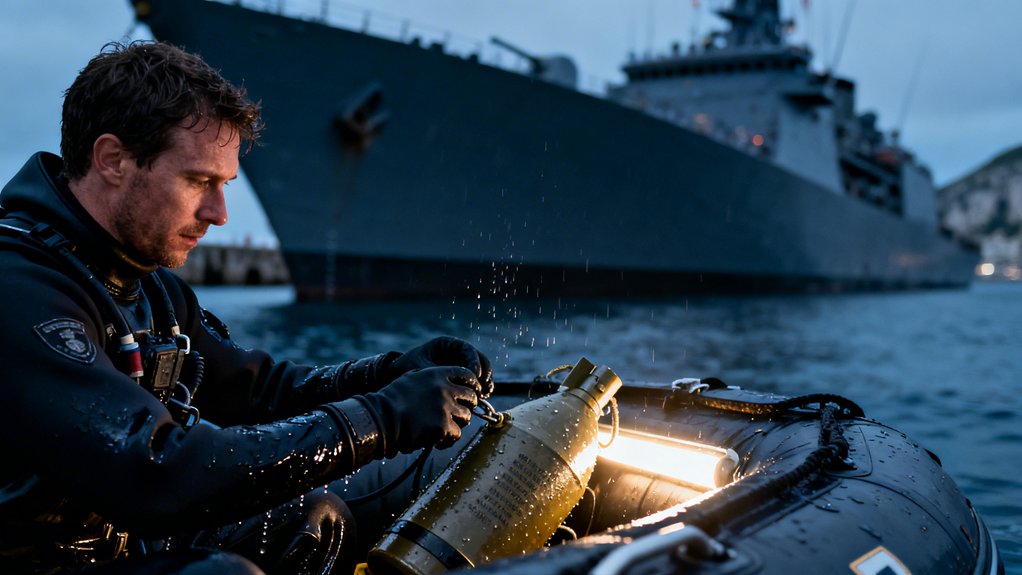
Why would Argentine planners, thousands of miles from the Falklands, target the iconic Rock of Gibraltar? The answer was coldly strategic. Gibraltar served as a crucial naval chokepoint and a critical logistical hub for the Royal Navy’s South Atlantic task force.
A successful british royal navy gibraltar sabotage there would cripple key vessels far from the war zone, delivering a devastating psychological and military blow. By planting limpet mines gibraltar 1982 on hulls, operatives aimed to sink or severely damage warships in a single, deniable stroke.
This planned thwarted attack on royal navy ships sought to alter the war’s momentum. While falklands war spanish involvement was officially neutral, Gibraltar’s geography made it the ideal, if audacious, target for operation algeciras declassified. Its crowded anchorage offered both camouflage for saboteurs and a high-value concentration of enemy assets.
Weaponizing Diplomatic Immunity to Smuggle High-Explosive Limpet Mines Into Western Europe
Argentine operatives exploited diplomatic immunity, smuggling their limpet mines through Spanish customs undetected inside official embassy pouches.
These high-explosive components were then covertly assembled into functional, subaquatic detonators within rented apartments across neutral Spanish towns.
The entire lethal inventory was thereby prepared for use while embedded within unsuspecting civilian communities.
Bypassing Spanish Customs Protocols via Argentine Embassy Diplomatic Pouches
To bypass Spanish customs and smuggle limpet mines into Gibraltar, the operation weaponized diplomatic immunity, exploiting the inviolability of Argentine embassy diplomatic pouches to transport high explosives covertly into Western Europe.
This core logistics channel defined what was operation algeciras**: a brazen sabotage plot hatched during the Falklands War**.
The mines, destined for British warships, moved securely under diplomatic seal directly to operatives in Spain.
This audacious smuggling method is a primary reason why was operation algeciras covered up by British and Spanish officials; exposing it would have revealed a severe breach of European security.
These operation algeciras documentary facts, concerning falklands war cover ups, underscore the lengths taken to conceal a state-sponsored attack on neutral soil.
The Clandestine Logistics of Assembling Subaquatic Detonators in Neutral Civilian Zones
While preparing their high-explosive ordnance for the planned raid, the Argentine operatives took a significant risk by assembling the waterproof firing devices for their limpet mines inside a rented apartment in Algeciras—a neutral Spanish port city full of civilian tourists and residents.
They meticulously pieced together the pressure-sensitive, delayed-action timers that would allow their frogmen to escape after attaching the mines to British hulls. This phase revealed the operation’s dangerous proximity to civilian life and its reliance on audacious secrecy. The clandestine workshop’s location underscored the mission’s core paradoxes:
- A Tourist Haven as a Weapons Factory: The benign facade of a holiday rental concealed a high-stakes bomb assembly line.
- The Illusion of Normalcy: Operatives maintained cover stories while handling components that could sink a warship.
- The Fragility of Security: A single slip—a noise, a curious neighbor—could collapse the entire plot in a densely populated neutral zone.
Establishing the Forward Operating Base in the Coastal Spanish Enclave of Algeciras
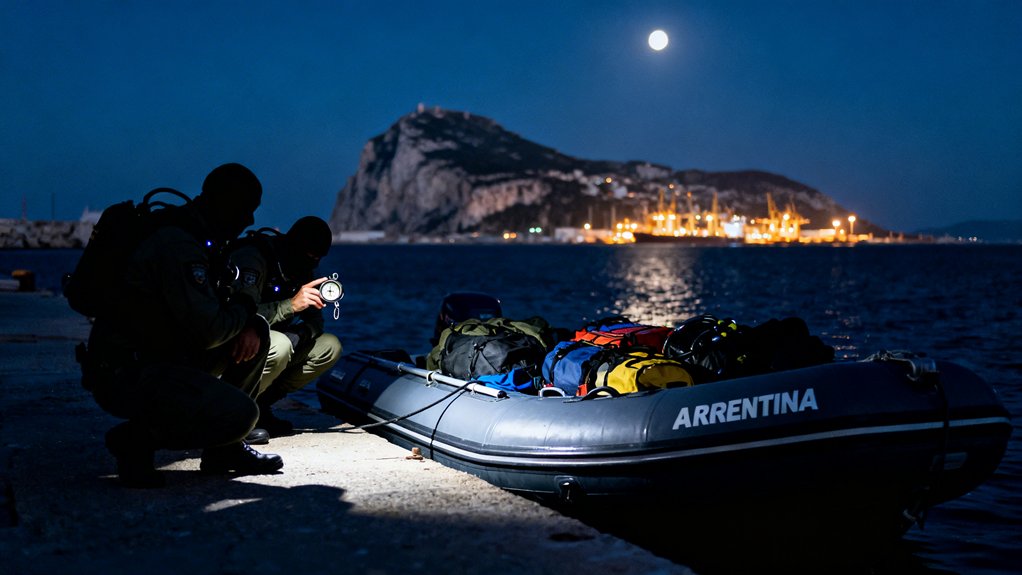
After infiltrating Europe with their ordnance intact, the sabotage team’s immediate task was to secure a clandestine vantage point from which to stage their attack. They established their forward operating base in Algeciras, Spain, a bustling port city offering both anonymity and a direct line of sight across the bay to the British naval base at Gibraltar.
The operatives rented a discreet apartment, likely using false documentation. This location served as an essential hub for command, control, and concealment of their specialized equipment, including diving gear and the smuggled limpet mines. From this urban hideout, they could monitor maritime traffic and finalize their assault plans while blending into the civilian environment, their presence masked by the routine comings and goings of a neutral coastal enclave.
Clandestine Reconnaissance and Frogman Assault Preparations Across the Bay of Gibraltar
From their vantage point in La Línea, the commandos meticulously monitored the Royal Navy‘s patrol and refueling cycles.
They studied the anti-diver nets and sonar sweeps around the vessels, calculating precise launch windows and underwater navigation routes.
Their planning focused on executing a swift infiltration in the bay’s notoriously murky, low-visibility waters.
Commandeering a rental apartment in the Spanish coastal town of La Línea, the Argentine commandos maintained a relentless watch on the British warships anchored across the Bay in Gibraltar.
Armed with high-powered binoculars and cameras, they documented every routine, tracking patrol boat schedules and noting vessel comings and goings.
Their surveillance focused on identifying vulnerabilities, particularly by meticulously observing the Royal Navy’s anti-frogman defenses.
They logged the deployment patterns of surface nets, the watch rotations of sentries, and the operational timing of underwater detection systems.
This intelligence was critical for planning a covert insertion.
- Patrol Patterns: Timing the exact intervals of harbor security boats to find gaps in coverage.
- Physical Barriers: Charting the placement and retrieval of anti-submarine/anti-diver nets around high-value targets.
- Human Element: Recording the vigilance levels and shift changes of dockyard guards and watchstanders.
Tactical Calculations for the Zero-Visibility Subaquatic Sabotage Infiltration
While the commandos’ surveillance from La Línea provided a surface-level picture, planning the actual underwater assault demanded precise tactical calculations for a high-stakes infiltration in the bay’s notoriously murky waters.
They’d to chart currents, tidal timings, and exact distances from their chosen launch point to the anchored targets.
Each diver’s approach path needed to avoid both naval patrols and the underwater anti-saboteur nets protecting the ships’ hulls.
The operatives studied water visibility reports, knowing they’d be navigating by touch and compass alone once submerged.
They rehearsed attaching the limpet mines in darkness, calculating the magnetic hold-time required before a timed detonation would allow them a safe escape.
Every minute of the submerged operation was pre-planned to mitigate the extreme risks.
The Eleventh-Hour Interception: Spanish Police Dismantle the Assault Cell in May 1982
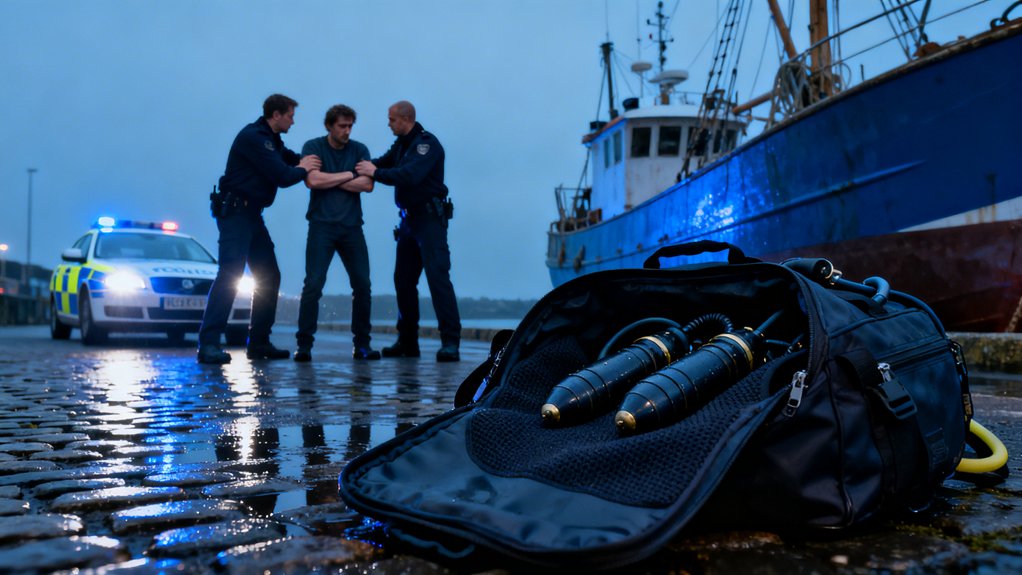
Spanish police attention was triggered when the Argentine operatives rented cars using false documentation in a suspicious pattern.
This breach of local protocol activated a surveillance operation that culminated in the commandos’ tense arrest.
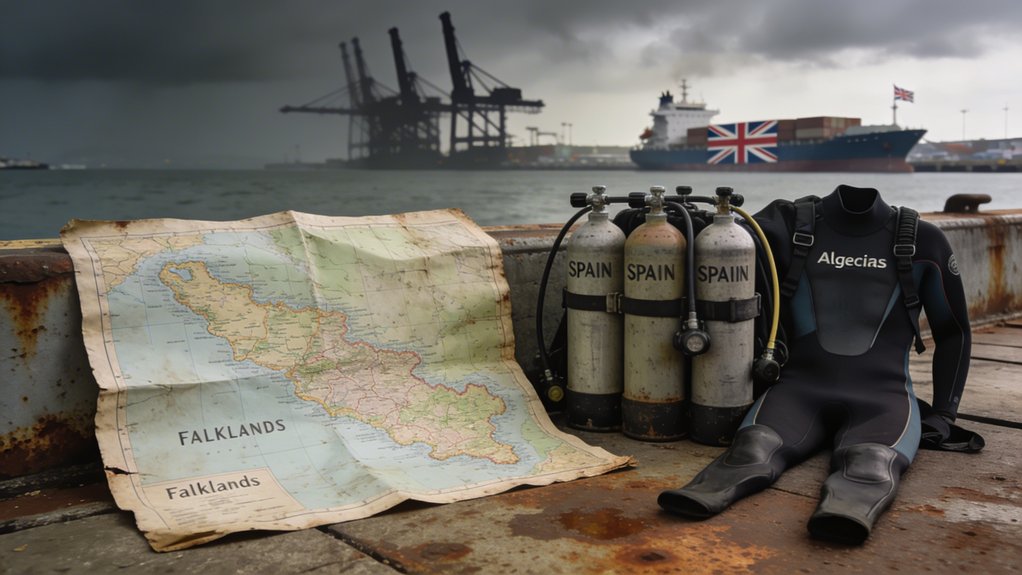
Authorities then immediately confiscated a cache of limpet mines and specialized diving gear, dismantling the strike arsenal.
Suspicious Vehicle Rentals and the Accidental Triggering of Local Law Enforcement Surveillance
Because they’d rented a series of vehicles in quick succession using cash, the Argentine assault cell inadvertently drew the attention of Spanish police in the Algeciras area. This operational security lapse triggered a low-key but persistent surveillance operation.
Observant officers noted the men’s patterns, which didn’t align with typical tourist behavior. Their investigation revealed a sequence of telltale actions:
- Rapid Vehicle Turnover: Frequently switching cars, a classic tradecraft technique, paradoxically created a conspicuous paper trail of cash transactions devoid of legitimate identification.
- Fixed Surveillance Points: Repeated visits to specific waterfront locations provided police with predictable patterns to monitor, linking the men geographically to potential maritime targets.
- Operational Inertia: The cell’s focus on their mission blinded them to the basic civilian protocols they were violating, making their covert activities transparent to local law enforcement.
The Tense Arrest and Immediate Confiscation of the Argentine Commando Strike Arsenal
Following weeks of surveillance, Spanish police officers moved decisively to arrest the Argentine operatives and confiscate their arsenal, finding eight limpet mines, two waterproof bags containing magnetic attachments, and multiple detonators assembled in a rented apartment overlooking Gibraltar’s harbor.
Their apprehension unfolded in late May 1982, marking the operation’s abrupt end. The team hadn’t anticipated the Spanish counter-intelligence net tightening around their safe house. Upon entry, authorities secured the explosives, which were fully prepared for immediate deployment via an underwater swimmer.
The discovery confirmed the mission’s lethal intent: to cripple British naval vessels anchored nearby. This eleventh-hour seizure prevented a potentially catastrophic attack and turned the operatives from saboteurs into detainees in a neutral country.
Diplomatic Expediency in Madrid: Suppressing Evidence of Covert Military Infiltration on Spanish Soil
While the operatives’ capture averted the immediate threat, what unfolded next revealed a calculated political maneuver, as both London and Madrid moved swiftly to bury the evidence.
The capture was merely the prelude to a swift, joint operation in political damage control.
Spanish authorities, under intense diplomatic pressure, opted for a quiet expulsion instead of a public trial.
They meticulously suppressed the facts of the military infiltration, ensuring no official records detailed the planned attack from their neutral soil.
This hushed deportation served a mutual interest: averting a scandal that would’ve exposed Spain’s compromised neutrality and Britain’s profound vulnerability in Gibraltar.
The deeper mechanics of this cover-up involved:
- Immediate Evidence Control: Police reports were sanitized, and the seized limpet mines and diving gear were hidden from public inventories.
- Legal Maneuvering: Charges were limited to minor immigration offenses, bypassing more serious laws regarding espionage or terrorism on Spanish territory.
- Narrative Sealing: Both governments enforced a strict public silence, effectively erasing the incident from contemporary political discourse to maintain diplomatic appearances.
The tactic mirrored the FBI’s use of covert operations to manage political crises without public accountability.
Whitehall’s Calculated Silence: The British Strategy to Conceal the Vulnerability of Gibraltar
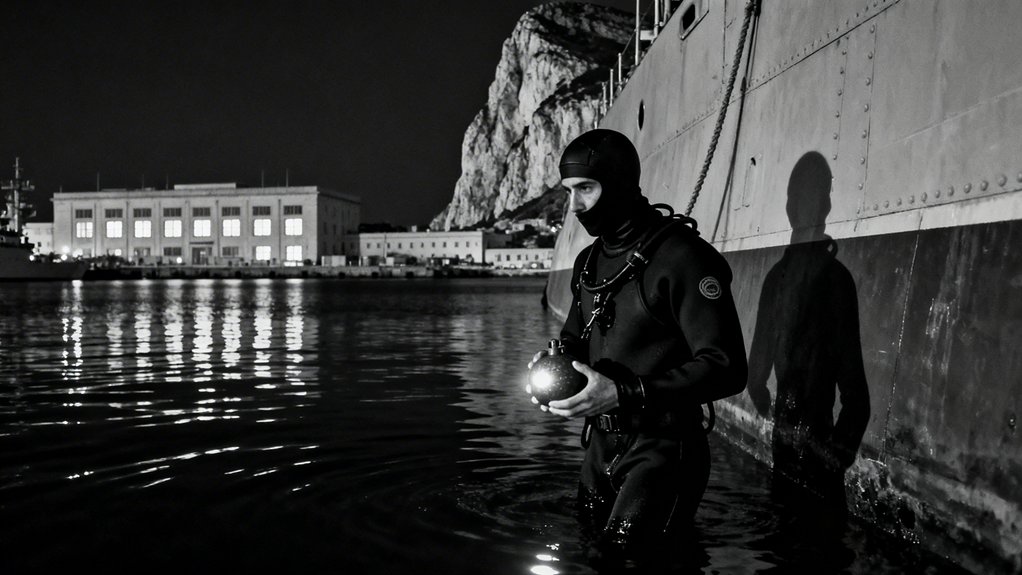
As the Spanish cover-up unfolded, Whitehall was simultaneously executing its own strategy of suppression to obscure how deeply Argentine commandos had penetrated Gibraltar’s defenses.
British officials immediately grasped the operational intelligence’s sensitivity: a successful naval sabotage in a fortress port would’ve been a catastrophic intelligence and military failure. They couldn’t admit their key naval base was surveilled and targeted with impunity.
Consequently, London actively collaborated with Madrid to guarantee the incident vanished from public view. Whitehall issued strict gag orders, classified all related documents, and directed a media blackout, utilizing tactics reminiscent of the wartime Press Bureau censorship.
This calculated silence aimed to prevent revealing Gibraltar’s vulnerabilities, avoid public panic, and maintain an image of inviolable security during a war. The priority was protecting strategic reputation over exposing a narrowly-averted disaster.
The Clandestine Deportation of the Saboteur Cell to Buenos Aires to Avoid a Public Extradition Trial
British authorities, having secured Spain’s cooperation in suppressing the incident, now focused on eliminating the physical evidence: the arrested Argentine commandos themselves. A swift, clandestine deportation was arranged to Buenos Aires, deliberately bypassing the standard judicial process.
This covert transfer guaranteed there wouldn’t be a public extradition trial that could expose the operation’s details or provoke a diplomatic crisis. The move was a joint, pre-emptive strike to erase the incident from public scrutiny.
- It prevented a court from examining the seized limpet mines and diplomatic pouch smuggling routes.
- It avoided forcing Spain to officially acknowledge a hostile military operation on its soil.
- It allowed both governments to treat the failed sabotage as a mere “immigration violation,” burying its true nature as a wartime attack.
Post-War Investigations: How Declassified Intelligence Exposed the Thwarted Operation Algeciras Strike
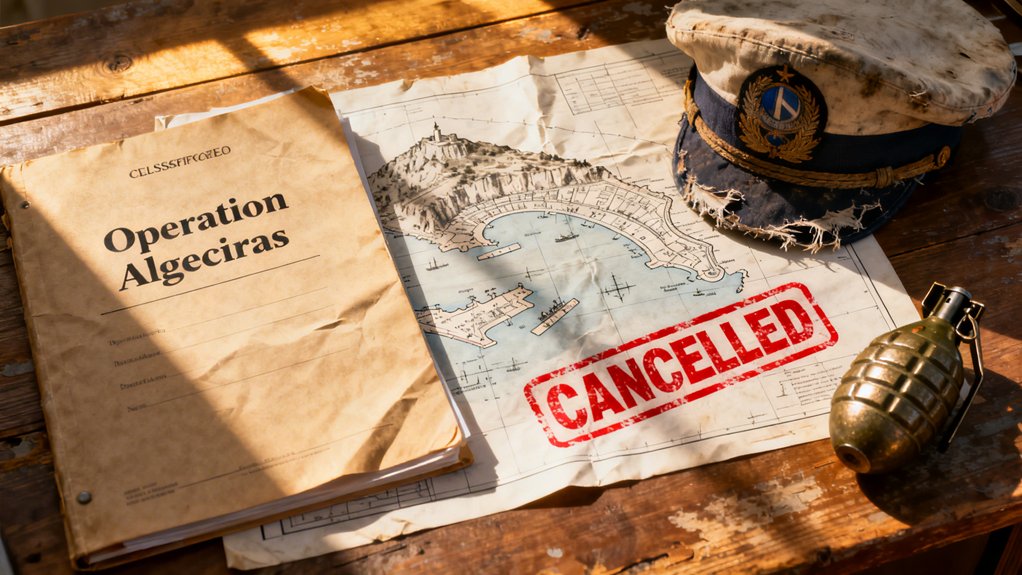
Post-war investigators pored over suppressed documents that revealed a systematic effort to manipulate arrest records.
They found that the original police reports had been altered to conceal the operatives’ true military identities and the nature of their seized equipment.
This bureaucratic cover-up, exposed through declassified intelligence, finally detailed the full scope of the thwarted Gibraltar strike.
Analyzing Suppressed Government Documents and the Systematic Manipulation of Arrest Records
Although authorities initially dismissed reports of sabotage, declassified intelligence documents later revealed a meticulous effort to manipulate arrest records and conceal the extent of Operation Algeciras.
Investigators found the official Spanish police files had been sanitized; charges were downgraded from terrorism-related offenses to minor immigration violations.
This systematic alteration served a clear diplomatic purpose, facilitating the operatives’ quiet deportation to Argentina and preventing a public trial that would have exposed the breach of Spanish neutrality.
The evidence points to a coordinated cover-up.
- Altered Charges: Documents show terrorism indictments were replaced with trivial administrative breaches.
- Expunged Evidence: Reports detailing the seized limpet mines and reconnaissance photos vanished from the official record.
- Coordinated Narrative: Both British and Spanish files presented a unified, misleading story of a minor police incident.
The Enduring Legacy of Operation Algeciras at the Intersection of Covert Warfare and Diplomatic Secrecy
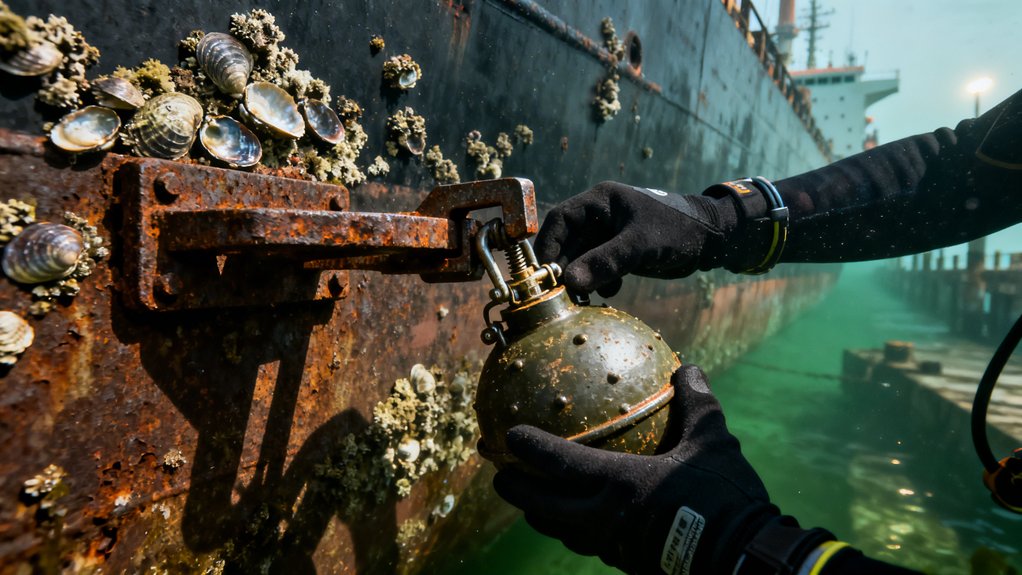
Since a covert Argentine mission in Gibraltar was dismantled by Spanish police and then deliberately buried by allied governments, its true legacy lies in the stark precedent it set. It demonstrated that the rules of covert warfare could be flagrantly stretched to target assets in a neutral European port, leveraging diplomatic channels to smuggle weapons. This aligns with a well-documented history where sensitive operations are hidden from public oversight through the deliberate destruction of evidence. Yet the legacy is equally defined by the subsequent cover-up, where British and Spanish authorities chose expediency over exposure. They quietly deported the saboteurs, manipulated records, and suppressed the incident to avoid political scandal.
This created a blueprint for how states can manage the fallout of rogue military operations intersecting with civilian sanctuaries. It reveals a persistent tension: successful counter-intelligence often necessitates a diplomatic secrecy that obscures history itself, leaving the public record incomplete.
Frequently Asked Questions
Was Any British or Spanish Official Punished?
No British or Spanish officials faced punishment. Investigators found the cover-up was a deliberate, high-level policy choice, not a failure of individual duty.
Both governments prioritized geopolitical stability over public accountability. They coordinated the suppression of evidence and the quiet deportation of the Argentine commandos specifically to avoid a scandal.
The operation’s exposure came decades later through declassified files, long after any officials involved could be held responsible.
Why Wasn’t Argentina Sanctioned for the Plot?
No specific sanctions targeted Argentina for Operation Algeciras, partly because the plot’s failure—a zero-success statistic—left no tangible damage.
Investigating further reveals that British and Spanish authorities actively concealed the incident to avoid escalating the war into neutral Europe.
They prioritized diplomatic expediency over public condemnation, quietly deporting the operatives.
This covert resolution prevented an open crisis that might’ve required formal sanctions against Argentina.
Did the Operatives Face Trial in Argentina?
The operatives didn’t face trial in Argentina. After their deportation from Spain, Argentina treated them as returning heroes.
The government, having authorized the covert mission, wouldn’t prosecute its own special forces commandos. This lack of judicial consequences reflected Argentina’s view of the operation as a legitimate, albeit thwarted, wartime action against Britain, further underscored by the plot’s secretive nature and the diplomatic cover-up that ensued.
Were Any Other European Ports Targeted?
Argentine plans didn’t involve other European ports for active sabotage missions. Gibraltar was the sole target due to its strategic Royal Navy presence.
The operation’s singular focus stemmed from Gibraltar’s role as a critical naval hub supporting British forces in the Falklands.
Commandos concentrated all their reconnaissance and logistical efforts there, using Spain as a launch point for this specific, high-risk amphibious attack on vessels in that harbor.
How Did Argentina React to the Cover-Up?
Some suggest Argentina quietly accepted the cover-up. Official records show no formal protest, implying tacit approval to avoid exposing their covert aggression on neutral soil.
Investigative accounts reveal Argentina likely preferred the quiet deportation, as a public trial would’ve embarrassed its government and confirmed its violation of Spanish neutrality.
This allowed both nations to sidestep a diplomatic crisis, prioritizing political expediency over a full, public accounting of the failed sabotage mission.
Final Thoughts
The thwarted plot, like a ghost in the naval archives, haunted post-war relations. Its full exposure came only through persistent declassified inquiries, which peeled back the layers of an intentional diplomatic silence. The operation’s legacy endures as a stark case study where covert action collided with realpolitik, revealing how states sometimes choose secrecy over confrontation, quietly burying a brazen act of war to preserve fragile alliances.