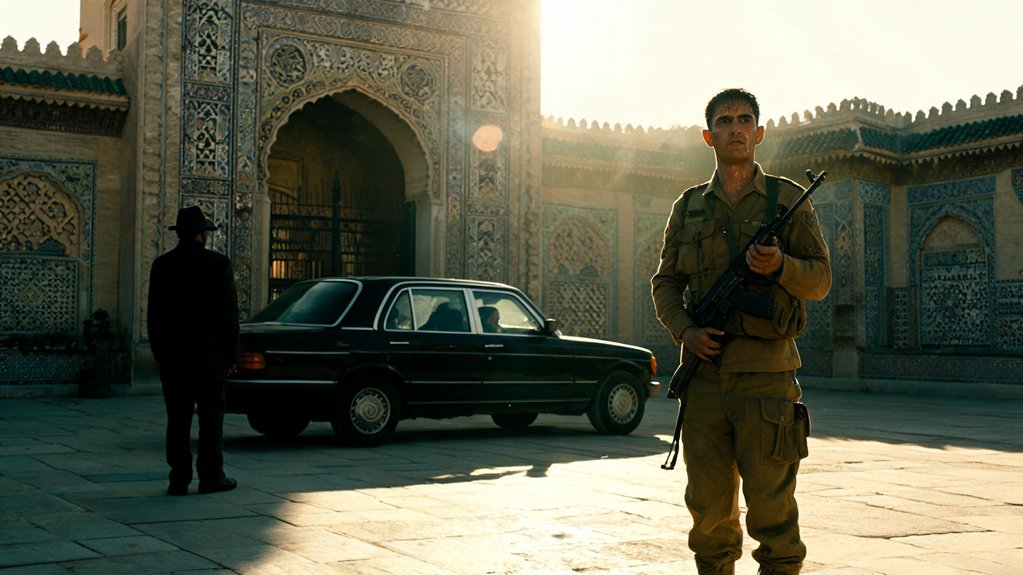
Declassified files expose Operation Ajax as a meticulously engineered coup toppling Iran’s Mossadegh. CIA operatives funneled untraceable cash, bribed journalists, weaponized General Zahedi’s ambition. The botched August 15 attempt panicked the Shah, but Kermit Roosevelt’s 96-hour scramble secured Tehran. Mossadegh’s show trial sealed his fate; Washington purged loyalists, installed a repressive Shah. That betrayal bred decades of rage, culminating in 1979’s revolution—but the sordid blueprint didn’t surface until 2013. Unraveling the archive reveals their reach.
Key Takeaways
- Operation Ajax was a 1953 CIA-led coup that overthrew Iranian Prime Minister Mohammad Mossadegh.
- The coup restored Shah Mohammad Reza Pahlavi to power, securing Western oil interests.
- Declassified 2013 report detailed bribery, propaganda, and a $100,000 monthly covert budget.
- The operation included a failed August 15 attempt before a successful August 19 offensive.
- Ajax fueled long-term Iranian resentment, contributing to the 1979 Islamic Revolution.
The Abadan Refinery Blockade and the 1951 Geopolitical Hit on Mohammad Mossadegh
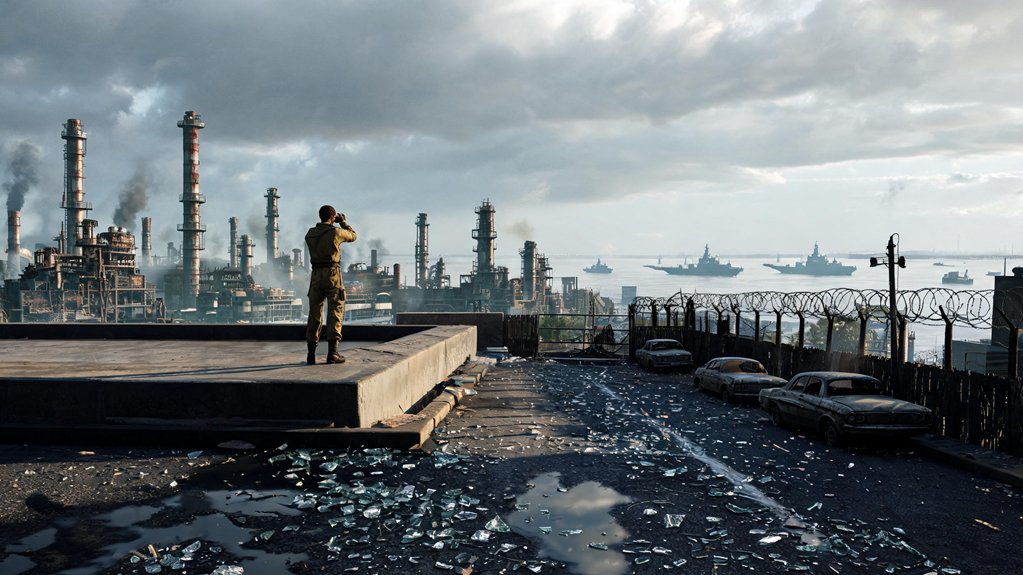
Though Operation Ajax would ultimately deliver the fatal blow in 1953, the first coordinated assault on Mohammad Mossadegh’s premiership came two years earlier, when British naval forces clamped a blockade on the Abadan refinery—a strategic stranglehold engineered to break the prime minister’s oil nationalization and, with it, his political will.
That blockade wasn’t just economic pressure; it aimed to starve Mossadegh’s political base. By freezing exports, London hoped the resulting chaos would force his resignation. Instead, the crisis hardened into a diplomatic standoff, convincing American observers that only covert action could settle the matter.
The blockade aimed to starve Mossadegh’s base, but the standoff hardened, convincing Americans that only covert action could end it.
When reviewing the 1953 Iran coup timeline, this blockade clearly foreshadows the prime minister Mossadegh’s overthrow. It demonstrated how covert intelligence mechanics could use economic leverage as a weapon.
When the CIA later adopted CIA regime change tactics, they applied those lessons directly, though the Abadan refinery blockade remained the pivotal opening strike.
Architecting Operation Ajax Inside the CIA’s Near East and Africa Division
The Near East and Africa Division blueprints the London-Washington sabotage campaign, wiring funds and orders across two capitals.
It weaponizes Iranian domestic media through covert bribes, turning newspaper editors into silent assets.
That’s the opening move—before the street mobs, the division already owns the story.
Blueprinting the London-Washington Sabotage Campaign
While the blueprint for regime change took shape across London and Washington, CIA operatives inside the Near East and Africa Division worked alongside British intelligence to draft a sabotage campaign built around General Zahedi’s rationalized treason—a psychological calculation they’d later verify through his own memoirs and intercepted communications.
These operation ajax declassified files show cia coup orchestration leaning on general fazlollah zahedi memoirs. They’d found his psychological rationalization—a man convincing himself he’s saving Iran.
The mossadegh displacement operation demanded that story. London and Washington synchronized their sabotage plans, targeting army loyalties and street chaos. They’d twist his ambition into a patriotic mask.
Every intercepted cable confirmed his readiness. The blueprint wasn’t just tactical; it was personal. It marked the point of no return.
Weaponizing Iranian Domestic Media Through Covert Bribes
Once the blueprint went live, operatives inside the Near East and Africa Division flooded Tehran’s newsrooms with covert cash, bribing editors and radio hosts to push a narrative that didn’t need to be true—only loud: Mossadegh’s downfall as Iran’s salvation—so the domestic media weaponized itself before a single tank appeared.
These foreign intelligence operatives didn’t stop at headlines; they synced their propaganda with Zahedi secret communications, amplifying the whispers of Iranian military treason.
Every broadcast hinted at a looming Tehran coup execution, preparing the public for what domestic military conspirators would enact.
The bribes bought silence about the other side, drowning out Mossadegh’s voice while painting Zahedi as the nation’s savior.
It wasn’t persuasion—it was purchase, turning newsrooms into silent partners of the coup.
The Asset in the Shadows: Psychological Profiling of General Fazlollah Zahedi
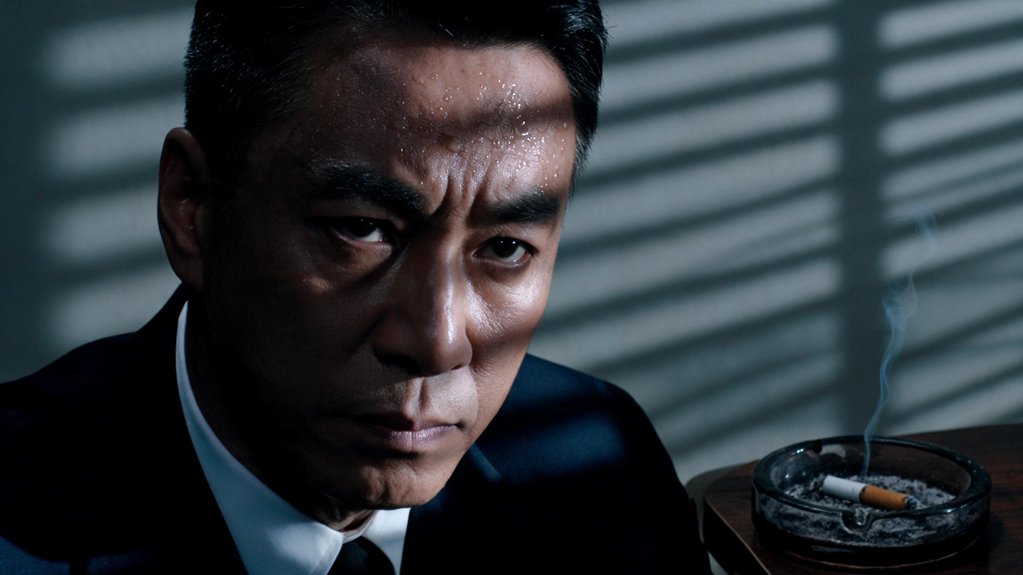
Because his memoirs and private communications reveal a meticulous self-justification, General Fazlollah Zahedi doesn’t emerge from the declassified record as a reluctant conspirator but as an ambitious asset who rationalized betrayal as patriotic duty.
His letters to CIA handlers paint a portrait of a man aching for validation. Zahedi bristled at British disdain, resented Mossadegh’s popularity, and saw himself as Iran’s true guardian. He courted power with calculated charm, dismissing his countrymen as naive.
The general’s ambition wasn’t veiled; he positioned himself as the strong hand Iran needed. Interviews with his cohort reveal a pattern: Zahedi measured loyalty by utility. He admired strength, disdained compromise, and viewed the coup as destiny, not conspiracy.
His psychological profile shows a narcissistic streak tempered by pragmatic patience—he waited decades for this moment. The archives capture a telling vulnerability. Zahedi craved acknowledgment from his handlers, demanding reassurances that history would vindicate him.
The Anatomy of Betrayal: Rationalizing Treason Through Classified Dispatches
Zahedi’s classified dispatches expose a mind recasting foreign collusion as patriotic necessity, each justification carefully scripted for posterity.
He frames the coup not as treason but as salvation, painting Mossadegh’s ouster as the only path to shield Iran from chaos.
Those private memoirs don’t hide the betrayal—they rationalize it into a doctrine of national redemption.
Deciphering Zahedi’s Private Memoirs and Operational Justifications
Hidden inside Zahedi’s private memoirs, a carefully constructed ledger of justifications takes shape, each entry recasting cooperation with foreign intelligence as patriotic duty rather than treason.
He doesn’t deny the meetings. Instead, he frames them as rescue missions. The CIA’s cash, he scribbles, wasn’t a bribe; it was operational funding to save Iran from chaos.
His dispatches portray Mossadegh as a destabilizing force, not a legitimate leader. Zahedi positions himself as the necessary surgeon, the foreign hand holding the scalpel.
He meticulously documents each contact, transforming espionage into administrative procedure. The tone stays clinical, detached, as if he’s recording logistics.
His justification emerges between the lines: a conviction that only he could restore order, making each secret deal a calculated salvation, not a sellout.
The Patriotism Paradox: Framing Foreign Collusion as Domestic Salvation
As the classified dispatches surface layer by layer, a paradox snaps into focus: the very men plotting with foreign intelligence insisted, in writing, that they were saving the nation.
General Zahedi’s own cables don’t frame CIA cash as payment; they recast it as patriotic fuel. He calls Mossadegh’s government a foreign-backed disease, then casts his own coup as the cure—never acknowledging the irony that his cure arrives via Langley’s couriers.
The dispatches reveal a psychological sleight of hand: every dollar, every rendezvous with Kermit Roosevelt, becomes a tool for “rescuing” Iran from imagined external puppetry. They scribble salvation in one hand while shaking the CIA’s other.
The dispatches don’t hide the collusion; they sanctify it, draping treason in a flag they never owned.
The Botched August 15 Midnight Decree and the Shah’s Panicked Flight to Rome
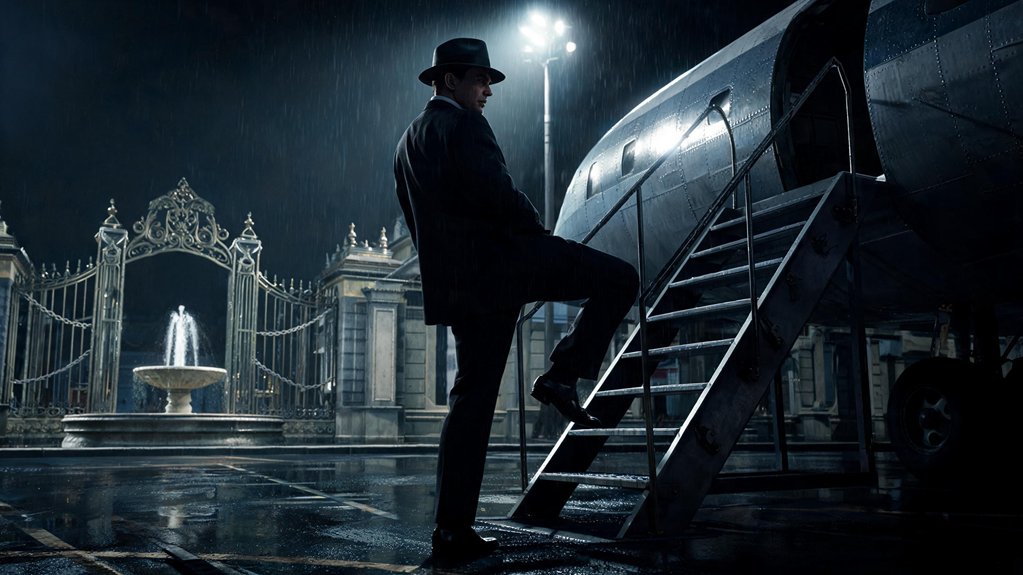
Though the midnight decree was signed and ready, the coup didn’t just stumble—it disintegrated within hours when Colonel Nematollah Nassiri knocked on Mossadegh’s door and ended up in handcuffs instead.
The prime minister’s loyalists had already sniffed out the conspiracy, and Nassiri’s arrest exposed the entire plot. Tehran’s streets remained quiet, but whispers of the Shah’s betrayal rippled through the barracks.
By dawn, the palace’s nerves frayed completely. The Shah, hearing his army had refused to move and that Zahedi had gone into hiding, panicked. He didn’t wait for a counter-coup; he grabbed Empress Soraya and fled.
His plane lifted off from Mehrabad Airport, bound for Baghdad, then Rome. In Rome, he’d check into the Excelsior Hotel, dazed and calculating his next move.
He’d leave Mossadegh in power, believing the game was over. From his exile, he’d watch Tehran’s radio crackle with defiance—every broadcast wounding his own throne.
Kermit Roosevelt’s 96-Hour Window to Salvage the Crumbling Tehran Offensive
Roosevelt’s 96-hour window opens with desperate improvisation as the Tehran offensive crumbles around him.
He’s funneling untraceable cash to southern Tehran’s rent-a-mobs, igniting street-level chaos to mask the operation’s earlier failures.
Simultaneously, he’s locking pro-Shah military units into synchronized formation for the decisive August 19 push.
Funneling Untraceable Dollars to Rent-a-Mobs in Southern Tehran
Kermit Roosevelt emptied a fortune in untraceable dollars into the slums of southern Tehran, buying rent-a-mobs to salvage a coup that was crumbling before his eyes. He couldn’t write checks; that left a trail.
Agents distributed crumpled bills in alleys, paying thugs, wrestlers, and street toughs to flood the bazaar. They weren’t patriots. They were mercenaries for chaos, paid to chant, riot, and smash Mossadegh’s statues.
Roosevelt’s men moved quickly, stuffing cash into enthusiastic palms, promising more for louder protests. Each dollar greased the gears of a machine to destabilize the capital.
Synchronizing Pro-Shah Military Units for the Final August 19 Push
Scrambling to salvage the crumbling offensive, the field chief had a razor-thin 96-hour window to synchronize pro-Shah military units for the final August 19 push—and he couldn’t afford a single loyalist officer balking.
He’d watched the first wave falter—mobs melting into alleyways, tanks idling without orders. Now Roosevelt’s coded cables crisscrossed Tehran, each carrying a separate piece of the puzzle: a garrison commander here, a police chief there.
He didn’t need mass enthusiasm, just precise compliance. By August 17, he’d mapped every regiment’s loyalty, flagging the hesitant colonels, buying wavering captains with rank. The plan hinged on simultaneity: too early would tip Mossadegh’s loyalists, too late meant annihilation.
The August 19 Artillery Siege on Kakh Palace and the Surrender of the Premier
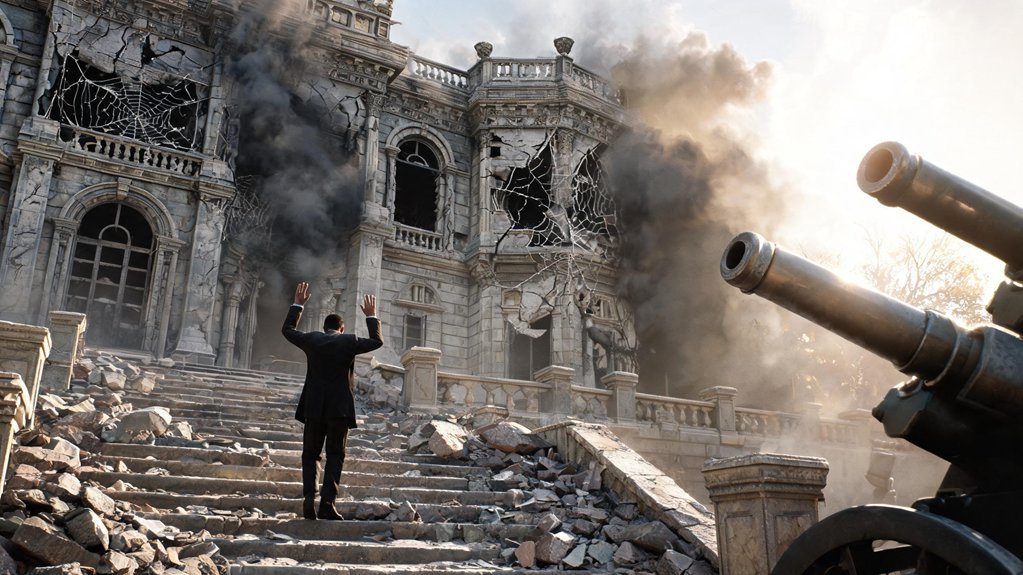
Artillery shells tore into Kakh Palace on August 19, turning Mossadegh’s compound into a war zone as pro-shah army units closed in from three sides.
Tank fire ripped through the garden walls while loyalist troops inside the compound returned sporadic rifle fire, their resistance crumbling against the overwhelming barrage.
From a rooftop, a key Zahedi operative directed the assault, coordinating each volley with precise radio calls while crowds scattered in panic.
Inside the palace, Mossadegh’s advisers urged him to flee, but the premier refused, reportedly muttering that he’d rather die than abandon his post.
Yet by mid-afternoon, the artillery had silenced the defenders. A white flag appeared from a shattered window.
By mid-afternoon, the artillery had silenced the defenders; a white flag rose from a shattered window.
Mossadegh emerged, his face streaked with dust, and surrendered quietly to army officers who’d once sworn him loyalty.
They quickly dragged him into an armored car, and the siege ended—but the real reckoning loomed in the chaos.
Silencing the Target: The Military Show Trial of Prime Minister Mossadegh
Though the guns fell silent over Kakh Palace, the army’s victory couldn’t yet silence the deposed premier, so they hauled him before a military tribunal built to finish the job.
The courtroom reeked of stagecraft. Charges branded him a traitor, though the room’s real audience was history itself. Mossadegh, frail but unbroken, turned the spectacle into a platform. He dismantled prosecutors’ claims with precision, exposing the coup’s foreign fingerprints and the generals’ lies. His hoarse voice carried: he’d acted within law, and the court became the coup’s last battlefield.
Each session revealed more than it concealed. Witnesses contradicted themselves; prosecutors refused documents. The verdict was predetermined — the tribunal couldn’t risk acquitting him.
Still, Mossadegh’s defense stripped the military’s charade bare. They sentenced him to death, then commuted it to three years — not from mercy, but because executing him would’ve made a martyr of a man they couldn’t silence.
Consolidating the Coup: General Zahedi’s Ascension to the Premiership

With Mossadegh’s prison cell sealed, the coup’s architects moved to install their chosen successor.
General Zahedi didn’t wait for formalities. He seized the prime minister’s office, issuing decrees as if his mandate came from the Shah himself—though the Shah hesitated in Rome, awaiting clearer signals.
Zahedi seized the premiership, issuing decrees while the Shah hesitated in Rome.
The CIA’s field operatives pressed urgency, knowing a power vacuum could reignite loyalist resistance. They fed Zahedi lists of army officers to purge, ensuring the military’s command structure bent to the new reality.
Tehran’s streets, still scarred from the coup’s violence, fell quiet under his curfews. Zahedi’s premiership wasn’t a restoration; it was a consolidation. He dismantled Mossadegh’s nationalization apparatus, reinstating the old guard who’d fled the chaos.
Within days, his cabinet took shape, stocked with men who’d cooperated during the plotting. The coup’s success hinged on his ruthless efficiency. He didn’t govern—he enforced the coup’s outcome.
Breaching the TPAJAX Archive: The 2013 Declassification of Langley’s Master Plan
The 2013 declassification cracks open the TPAJAX archive, and Donald Wilber’s 1954 report reads like a signed confession—every operational detail a forensic admission of guilt.
But the archive’s gaps scream louder than its pages, because CIA leadership deliberately torched the most damning operations files before historians could touch them.
Tracing that destruction becomes the real investigation, exposing how the Agency’s own handiwork nearly erased the evidence of its coup.
Dissecting the 1954 Donald Wilber Report for Forensic Admissions of Guilt
Cracked open in 2013, the 1954 Wilber report laid bare Langley’s master plan, a self-authored confession buried in the archives.
Wilber’s own words damn the agency, admitting to bribery, propaganda, and the enlistment of Iranian agents to destabilize Mossadegh’s government. He spares no detail, turning the report into a step-by-step blueprint of subversion.
- Wilber details the $100,000 monthly budget for covert manipulation.
- He names the CIA officers directing Zahedi’s coup cells.
- He documents the fabricated religious riots that ignited Tehran’s streets.
These admissions read like a forensic audit of guilt.
Wilber’s timeline exposes the exact days the CIA paid off clerics and army generals, proving the coup wasn’t a spontaneous uprising but a calculated, contract killing of democracy.
The report doesn’t speculate; it confesses.
Tracing the Intentional Destruction of Operations Files by CIA Leadership
Although Wilber’s confession survived in the archives, CIA leadership waged a quieter war against the rest of the TPAJAX record, intentionally destroying operations files that named agents, paid clerics, and bribe-takers. They sanitized history, knowing full well that names equal evidence. Top brass stuffed burn bags before Washington’s oversight committees could blink.
| Target | What Went Missing |
|---|---|
| Agent networks | Codenames, meeting schedules, dead-drop routes |
| Cleric payroll | Cash transfer logs, mosque contact records |
Investigators who cracked the 2013 release found gaps that weren’t accidental; they were surgical. The destruction wasn’t bureaucratic sloppiness—it was calculated silence, rendering the master plan half-readable. The missing records don’t just obscure facts; they erase the identities of middlemen who made the coup possible. Decades later, shredders still guarded their secrets.
A Quarter-Century of Geopolitical Blowback: How the 1953 Subversion Ignited the 1979 Crisis
When the CIA’s 1953 coup toppled Mossadegh, it planted a seed of resentment that would take a quarter-century to bloom.
The Shah’s return marked the start of a repressive dependency, and Washington’s unwavering support calcified Iranian rage into revolution.
- Washington ignored Mossadegh’s democratic legitimacy, and the Shah’s secret police tortured dissidents.
- The CIA trained SAVAK, making the U.S. complicit in every atrocity.
- The West’s thirst for oil guided policy, not Iran’s welfare.
Frequently Asked Questions
Who Funded the Cia’s Operation Ajax?
The U.S. government’s covert budget bankrolled Operation Ajax, funneling millions through the CIA’s clandestine accounts.
They didn’t rely on foreign money; British intelligence offered cooperation, not cash.
Washington’s dollars financed the propaganda, the bribes to Iranian military officers like Zahedi, and the operational logistics that toppled Mossadegh.
This wasn’t a private venture—it was taxpayer-funded regime change, executed with silent checks and hidden ledgers.
The cash flowed from American taxpayers’ pockets.
What Role Did British MI6 Play in the Coup?
MI6 didn’t merely assist; it co-architected the coup.
British intelligence funneled essential funding, logistics, and propaganda, exploiting its deep regional contacts.
It coordinated directly with CIA handlers and Iranian officers like Zahedi, exchanging intelligence and amplifying psychological pressure against Mossadegh.
Without MI6’s extensive groundwork and network, Ajax couldn’t have succeeded.
Its role proved indispensable, a hidden hand operating alongside America’s.
How Did Mossadegh React to His Overthrow?
Mossadegh doesn’t surrender quietly. He barricades himself, rallies loyalists, and fights until overwhelming military force ends the standoff.
Arrested, he turns his trial into a defiant platform, declaring the coup illegal and condemning foreign interference. He refuses to plead for mercy, framing his overthrow as a betrayal of Iranian sovereignty.
In prison, he continues resistance through legal appeals and public statements. He accepts imprisonment, never renouncing his democratic mandate.
Did the Shah Know About the Coup Beforehand?
He knew beforehand. Whispers of the plot reached the Shah before the coup ignited.
Though he hesitated, fear gnawing at his resolve, he signed the royal decrees authorizing it. Foreign agents pressured him, but the final decision was his.
He understood the political stakes, accepted the calculated gamble, and chose to reclaim power. He wasn’t surprised; he was a reluctant but fully informed participant.
His final choice sealed Mossadegh’s fate.
What Happened to Kermit Roosevelt After the Coup?
After the coup, Kermit Roosevelt basks in quiet glory, receiving the National Security Medal from Eisenhower.
He expects more, but Allen Dulles keeps him at arm’s length. He’s frustrated, so he resigns from the CIA in 1958.
He then works for Northrop, writes his memoir “Countercoup,” which doesn’t see publication until 1979.
He quietly lives out his final days as a consultant and author, never escaping the shadow of Ajax.
Final Thoughts
This archive doesn’t just recount a coup; it unearths the CIA’s psychological blueprint. They leveraged Zahedi’s ambition, turning loyalty into treason and toppling Mossadegh. Yet that covert victory left a festering wound. Each declassified memo reads as a confession, showing how foreign powers exploit internal fractures to stage regime change. History’s blowback has made that wound permanent—Iran’s 1979 crisis, a direct consequence of 1953’s subversion, still bleeds in geopolitical memory.