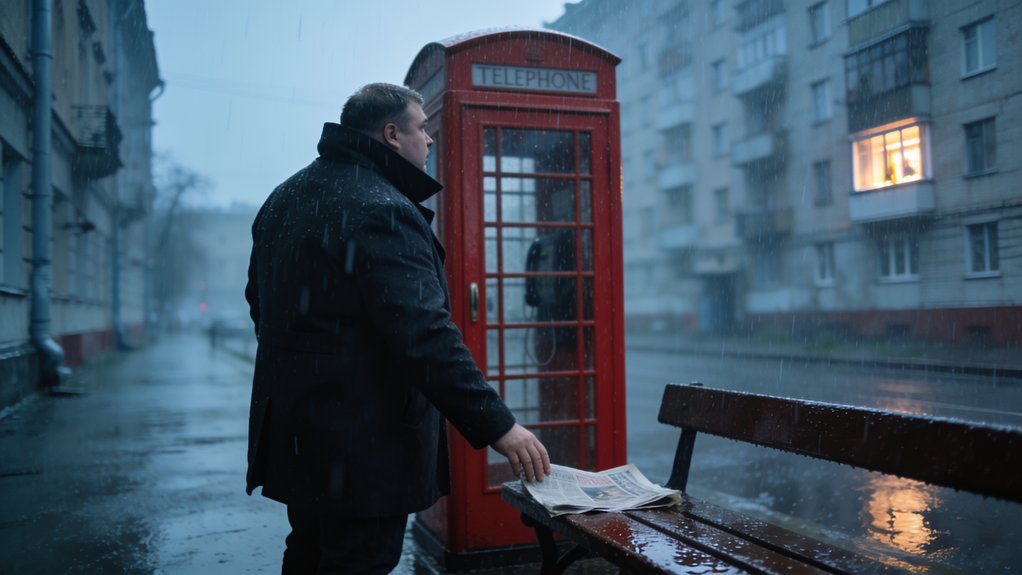
On April 20, 1961, MI6 made its first contact with GRU Colonel Oleg Penkovsky inside London’s Grosvenor House Hotel. The meeting hid beneath a Soviet trade delegation’s chandelier-lit reception. A dropped cigarette packet signaled allegiance. Businessman Greville Wynne, an MI6 officer, served as the go-between, weaponizing civilian trade covers to shield the exchange. The silent handover bypassed KGB watchers entirely. Whispers of that encounter hold the key to how one man’s betrayal defused a nuclear countdown.
Key Takeaways
- The first contact occurred at Grosvenor House in April 1961, disguised as a commercial transaction.
- Penkovsky signaled his allegiance by dropping a cigarette packet in plain sight.
- A deliberately spilled drink created a momentary gap in KGB watchers’ line of sight.
- MI6 officer Greville Wynne operated under civilian trade delegation cover as a businessman.
- No physical documents were exchanged; the handover relied on a decisive silent look.
State Secrets in Plain Sight: The April 1961 Infiltration of London’s Commercial Elite
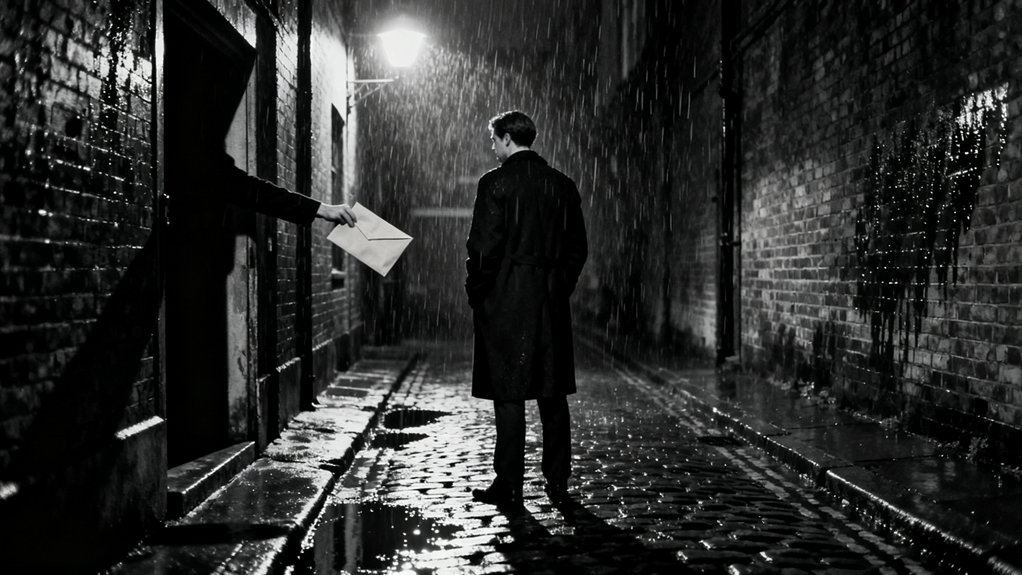
Although the Soviet trade delegation was ostensibly a routine commercial exchange, the April 1961 gathering at the Grosvenor House Hotel masked a far more delicate transaction. The grosvenor house hotel meeting didn’t concern machinery or contracts; it orchestrated a defector’s first touch.
MI6 officer Greville Wynne, cloaked as a businessman, navigated the april 1961 trade delegation‘s elite, seeking a specific GRU colonel. They found him amid the clink of glasses. Penkovsky, a man burdened by Soviet secrets, transmitted his allegiance not with words alone, but with a prearranged signal—a dropped cigarette packet.
This wasn’t espionage from the shadows; it unfolded in plain sight, under chandeliers, within earshot of diplomats. For an audience craving liberation, this moment represents the profound vulnerability of totalitarian control. Here, a single, calculated breach in the façade of state commerce began dismantling the Kremlin’s nuclear monopoly, one clandestine glance at a time.
Anatomy of a Defector: Colonel Oleg Penkovsky and the GRU Chain of Command
Born into the upper echelons of the Soviet military apparatus, Colonel Oleg Penkovsky did not defect from the GRU’s margins but from its operational heartbeat. This soviet gru colonel’s covert asset conversion exposed a chain of command riddled with bureaucratic inertia and doctrinal rigidity, yet it also revealed a man who meticulously calculated his escape from tyranny’s core.
| GRU Chain of Command Role | Penkovsky’s Exploitation Vector |
|---|---|
| Directorate leadership | Accessed via personal clearance |
| Operational security cell | Breached using routine reports |
| Strategic planning unit | Mined for missile deployment data |
He leveraged his insider status—a privilege granted to trusted sons of the state—to bypass layers of surveillance and handpick his moment. The GRU’s own hierarchical structure, designed for control, became its Achilles’ heel. Penkovsky did not just defect; he dissected the very machine that made him, weaponizing its secrets for those who sought liberation from its shadow.
Weaponizing the Civilian Sector: MI6 Officer Greville Wynne’s Trade Delegation Cover
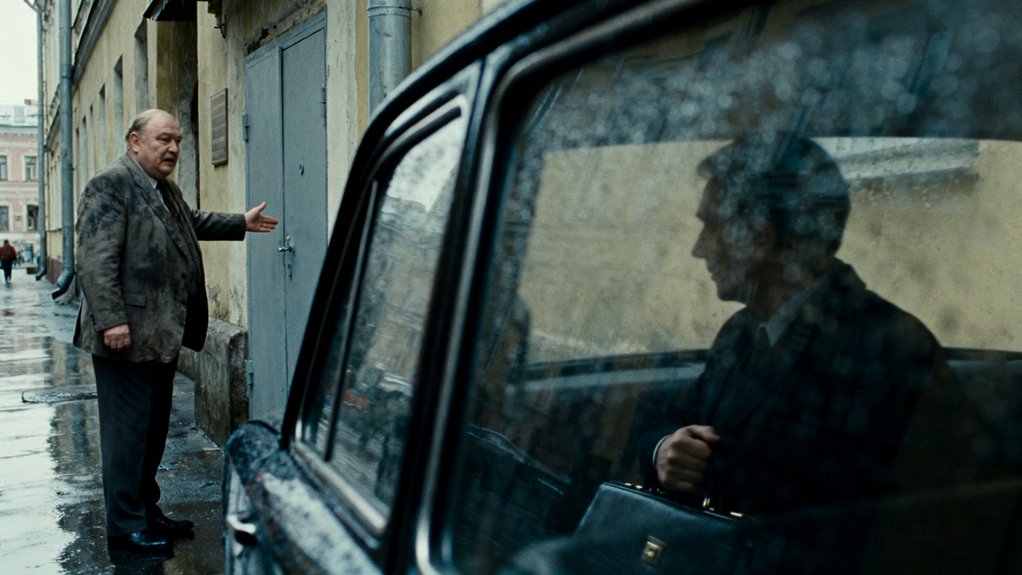
MI6 officer Greville Wynne’s trade delegation cover wasn’t a mere bureaucratic prop—it was a carefully engineered platform for espionage.
By weaponizing the civilian sector: MI6 officer Greville Wynne’s trade delegation cover transformed legitimate commercial exchanges into clandestine lifelines.
Wynne, a businessman by trade, controlled a network of export permits, factory visits, and commercial contracts—each a potential dead drop or safe meeting for a GRU colonel seeking escape.
This cover allowed Wynne to move freely within Soviet-controlled spaces, his briefcase full of trade blueprints masking the true payload: intelligence tradecraft.
The delegation’s civilian veneer granted him access, but its true purpose was liberation—slipping classified data past KGB watchers under the guise of machine-tool sales.
His business contacts weren’t just contacts; they were operational nodes, each meeting a calibrated risk.
Wynne’s cover didn’t just hide his mission—it weaponized trust.
0900 Hours at the Grosvenor House: Orchestrating the April 20 Contact
At precisely 0900 hours inside the Grosvenor House, Penkovsky orchestrated a masterful evasion of the KGB watchers during the diplomatic reception. He exploited the crowded room’s natural flow, capitalizing on a fleeting blind spot to execute the psychological handover of the Soviet state’s greatest secrets.
Wynne, playing his civilian cover perfectly, accepted the intelligence without a visible break in conversation.
Evading the KGB Watchers During the London Diplomatic Reception
Because the KGB routinely shadowed Soviet delegates abroad, Penkovsky‘s April 1961 window for contact at the Grosvenor House Hotel was vanishingly small. Every minute risked surveillance.
Yet, the espionage tradecraft execution demanded precision. Wynne staged a mundane chat, exploiting the reception’s clatter to mask their exchange. Penkovsky, feigning a drink spill, created a fleeting gap in his watchers’ line of sight. That sliver of chaos was their shield.
This wasn’t a meeting; it was a surgical london espionage deployment, a break from the KGB’s grip. For a man desperate for a different world, those seconds meant everything.
The Psychological Handover of the Soviet State’s Greatest Secrets
Though the reception’s chatter and clinking glasses provided sonic cover, the true handover happened in silence. Penkovsky didn’t pass microfilm; he passed a conviction. His eyes met Wynne’s, signaling a break from oleg penkovsky gru’s doctrine—a man choosing liberty over loyalty.
This wasn’t a transaction; it was a psychological transfer of the Soviet state’s greatest secrets.
- Penkovsky’s internal calculus: betrayal or liberation.
- The trust built without a single written word.
- Wynne reading the colonel’s silent desperation.
- Cold war espionage history hinged on this glance.
- No documents changed hands; only intent did.
At zero hours, the handover happened inside a single, decisive look—the only currency that couldn’t be bugged.
The Mechanics of Espionage: Deconstructing the London Operational Tradecraft
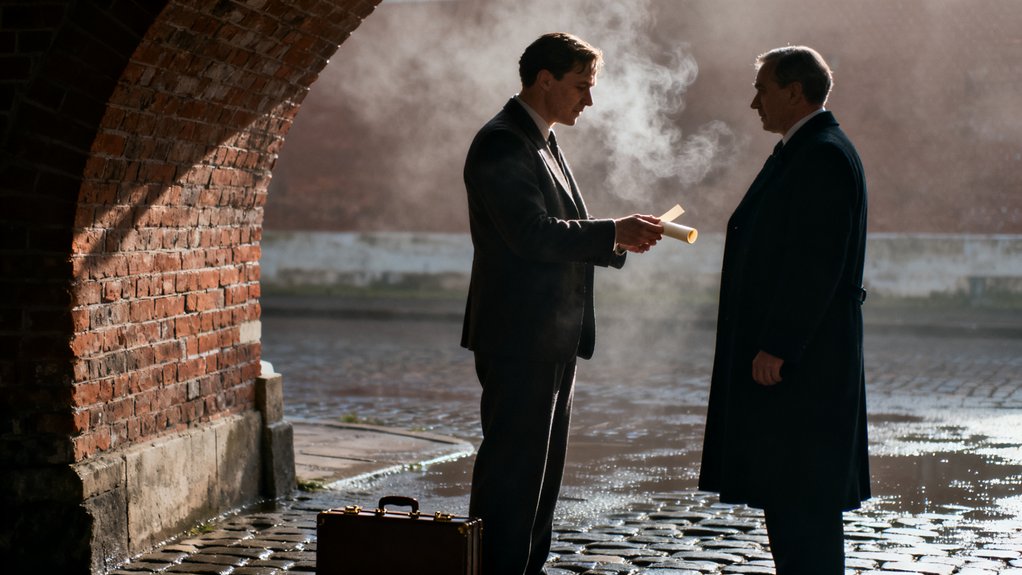
The trade delegation at the Grosvenor House Hotel provided the perfect cover; Wynne’s status as a commercial intermediary gave Penkovsky a legitimate reason for their initial encounter, insulating both from immediate suspicion.
This operational facade, however, only masked the deeper mechanics that would sustain the asset’s run. Behind the delegation’s plausible deniability, MI6 constructed a silent architecture of dead drops and clandestine brush passes, each move designed to evade detection in the heart of London.
Exploiting Plausible Deniability Within Commercial Delegations
By exploiting the inherent ambiguity of a Soviet trade delegation, MI6 orchestrated Penkovsky‘s first contact with Greville Wynne at the Grosvenor House Hotel on April 20, 1961, turning a routine commercial event into a covert operational theater. This maneuver weaponized plausible deniability, shielding both british mi6 operations and their fledgling western human intelligence asset from immediate exposure. They didn’t just meet; they performed a scripted dance of bureaucratic necessity.
- Delegation status provided a legitimate, undeniable reason for Penkovsky’s presence in London.
- Commercial chatter masked the operational signal passing between asset and handler.
- Soviet oversight, focused on trade deals, created a blind spot for espionage.
- No official embassy ties allowed MI6 to deny any intelligence connection.
- Wynne’s business cover offered a reversible, deniable channel for future contact.
The Architecture of Dead Drops and Clandestine Brush Passes
Because a dead drop relies on precision placement, MI6 designed Penkovsky’s London tradecraft around an unassuming architectural choreography. They selected a discreet, nondescript alcove near the Grosvenor House Hotel—a spot where a weighted cigarette pack could rest against a stone balustrade.
The intelligence handoff demanded split-second timing. A brush pass during a crowded street crossing allowed Wynne to exchange a film canister without eye contact.
These declassified intelligence files reveal a meticulous intelligence verification process: each drop site required photographic surveillance and shadow validation. The architecture of liberation here is freedom from suspicion—the city’s mundane geometry becomes a liberating code, its very banality the shield that delivered Penkovsky’s critical missile intelligence to the West.
The 111-Film Canister Payload: Smuggling the Soviet Nuclear Blueprint
One of espionage’s most delicate puzzles involved Penkovsky’s smuggled cache of 111 film canisters, each containing a frame of the Soviet Union’s nuclear blueprint. This wasn’t just a cuban missile crisis spy’s act of defiance; it was a meticulous, frame-by-frame dismantling of the Kremlin’s most guarded secrets. The payload itself, a manufactured Soviet film roll, held the keys to strategic parity, exposing the very architecture of a potential first-strike capability.
One of espionage’s most delicate puzzles involved Penkovsky’s smuggled cache of 111 film canisters.
- Weaponized Photography: Each canister hid a single frame of a Top Secret GRU manual detailing the R-12 missile’s guidance system.
- Tradecraft Risk: Penkovsky used a modified Minox camera, threading the film through his own GRU-issued dictation device.
- Smuggling Route: He ingeniously packed the canisters inside a chocolate box, exploiting the mundane to hide the lethal.
- Data Volume: One hundred and eleven frames constituted the largest single historical intelligence leak of its era.
- Decisive Impact: Western analysts finally saw the Soviet missile sites, validating the strategic threat before the crisis erupted.
This payload shattered the Soviet monopoly on operational surprise.
Operation IRONBARK: The Joint MI6-CIA Validation of Agent HERO
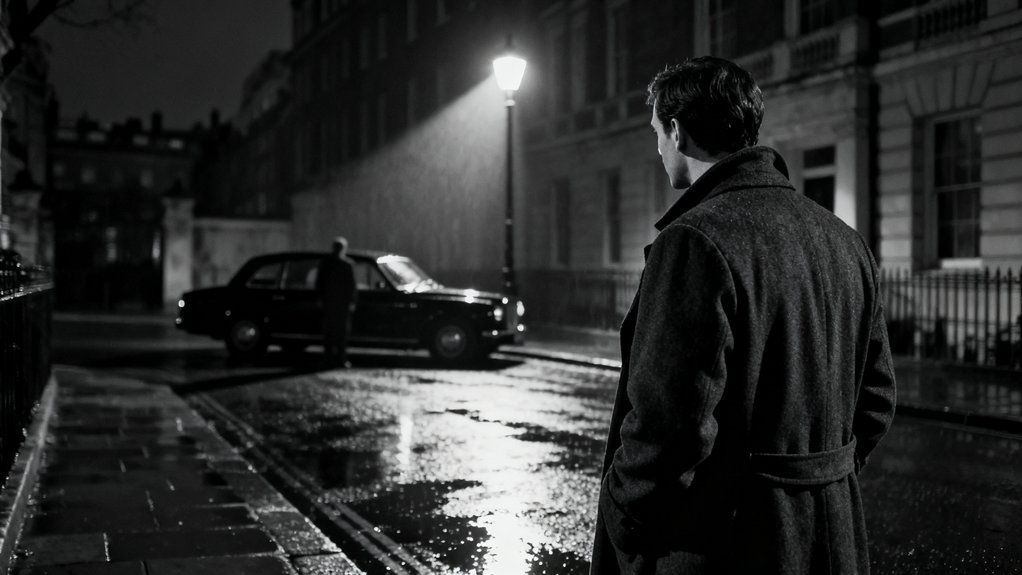
The 111 canisters had reached London, each frame a fragment of the Soviet nuclear skeleton. Now, the services needed to verify the man. Operation IRONBARK fused MI6’s human craft with CIA’s technical rigor, cross-examining Agent HERO against his own payload. They didn’t trust him yet; they trusted the film.
| Validation Phase | Agency Lead | Verification Method |
|---|---|---|
| Photo Analysis | CIA | Cross-matching missile silo coordinates with film frames |
| Technical Interrogation | MI6 | Mapping Penkovsky’s oral details against film blueprints |
| Timeline Reconciliation | Joint | Correlating deployment dates with Soviet R-12 range data |
| Document Sourcing | CIA | Tracing film origin to NIIP-5 launch complex |
| Final Assessment | Joint | Confirming HERO’s access exceeded any prior asset |
Each tank, each gantry angle locked into a single, painful truth: this man was genuine. The analysts broke the code of silence, freeing the intelligence for operational use. Penkovsky had passed. The West now held a key to the Kremlin’s doomsday vault.
Preempting Armageddon: How the Grosvenor House Files Neutralized the Cuban Missile Threat
The Grosvenor House files didn’t just introduce an asset; they provided the Rosetta Stone for the entire Cuban Missile Crisis.
Correlating the R-12 Medium-Range Ballistic Missile operational manuals with the U-2 photographic evidence over San Cristobal wasn’t an academic exercise—it was a forensic lock.
Analysts could now precisely match hardware specs to blurry shadows, transforming raw imagery into irrefutable proof of the Soviet nuclear threat.
Correlating R-12 Medium-Range Ballistic Missile Operational Manuals
How could a single, seemingly routine trade delegation meeting in London yield the operational blueprints for an entire Soviet missile system? Penkovsky’s intelligence on the R-12 MRBM wasn’t a single document; it was a meticulously assembled operational mosaic. He provided the West with the system’s soul, not just its skin.
- Firing sequence protocols, revealing launch preparation times.
- Warhead arming and fuzing schematics for nuclear detonation.
- Guidance system limitations, especially drift rate and CEP accuracy.
- REV (range extension) calculation tables for targeting adjustments.
- Daily maintenance logs, exposing fuel corrosion and gyro failure rates.
This wasn’t abstract data. It gave analysts the missile’s exact flight time to U.S. cities. They could now calculate precisely how long they’d before a launch order became irreversible. The manuals confirmed one terrifying truth: the R-12’s range covered Washington D.C. within thirteen minutes. That knowledge dictated every countermove.
Calibrating the U-2 Photographic Evidence Over San Cristobal
Because the R-12’s range parameters had been extracted from the Grosvenor House files, photo interpreters could finally anchor the U-2 imagery to a concrete operational timeline. They scrutinized the San Cristobal frames, measuring launch pad alignments against the missile’s 1,020 nautical mile reach. Each erector’s shadow now whispered a precise threat: Washington lay within that arc.
The analysts calibrated focal lengths, cross-referencing Penkovsky’s technical schematics against the grain of the film. They didn’t just see transport vehicles; they saw countdowns. This wasn’t guesswork anymore—it was liberation through geometry.
The Kremlin’s deception crumbled against a flight path drawn from a London hotel room. The U-2’s eye, sharpened by a traitor’s honesty, exposed the lie.
The KGB Surveillance Dragnet: How Soviet Counterintelligence Broke the Tradecraft
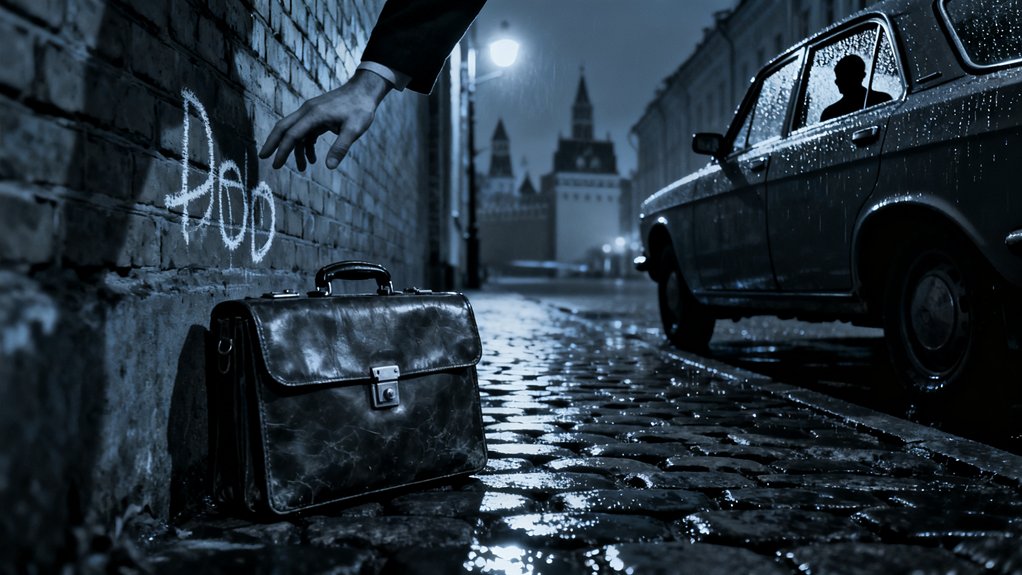
Every layer of tradecraft Penkovsky and Wynne built began unraveling under the KGB‘s relentless physical surveillance. The counterintelligence apparatus didn’t just track movement; it dissected the very architecture of their deniability. The dragnet closed by exploiting a fundamental flaw—the human element couldn’t be scripted perfectly.
- The Tail Network: KGB teams maintained triple-layer coverage, rotating vehicles and pedestrians to avoid detection patterns.
- Brush Contact Obsession: Officers cataloged every accidental brush, handoff, and dropped item in public spaces.
- Signal Site Compromise: Chalk marks and window displays—simple coded signals—were photographed and logged systematically.
- Phone Tap Triangulation: Voice stress patterns from bugged calls revealed more than words ever could.
- Clandestine Meeting Logs: Every pub, park bench, and underground station rendezvous was mapped and timed.
This wasn’t random harassment. It was a methodical dismantling of operational security, exposing how even meticulous planning breaks when the watchers never stop watching.
November 1962: The Coordinated Takedown of the London-Moscow Network
By November 1962, the coordinated takedown moved with precision: Greville Wynne‘s brutal kidnapping and interrogation in Budapest left the London-Moscow network exposed.
With Wynne crushed, the KGB isolated Oleg Penkovsky inside the Lubyanka prison complex, severing every line of communication.
The operation’s final phase then peeled back the asset’s last defenses, ensuring no intelligence thread remained intact.
The Budapest Kidnapping and Interrogation of Greville Wynne
November 1962 turned the screw on the London-Moscow network.
The KGB’s trap snapped shut on Greville Wynne, snatching him from a Budapest hotel lobby.
They didn’t arrest him; they kidnapped him, dragging him into a black car for a brutal, weeks-long interrogation.
The tradecraft of betrayal was now complete.
- The KGB lured Wynne to a trade fair in Budapest, a false flag operation.
- Hungarian security forces, acting on Moscow’s orders, executed the physical seizure.
- Interrogators targeted Wynne’s psychological resilience, exploiting his isolation.
- They extracted confessions about Penkovsky’s role, but Wynne held key operational details.
- The kidnapping severed the last communication channel between Penkovsky and MI6.
Wynne’s captivity became a silent, desperate struggle for survival, the network’s final, frayed thread.
Isolating Penkovsky Inside the Lubyanka Prison Complex
Why did the KGB dismantle the London-Moscow network with such surgical precision? They didn’t just arrest Penkovsky; they vanished him. Inside Lubyanka’s labyrinthine core, they sealed him into a psychological void, a silent cell with no echoes, no human routine. The interrogators didn’t need violence—they needed isolation to crack his will.
| Tactic | Effect on Penkovsky |
|---|---|
| Complete sensory blackout | Eroded his time perception, inducing disorientation |
| No contact with Wynne or other prisoners | Severed all loyalty cues, leaving him alone |
| Random, unannounced interrogation sessions | Kept him in perpetual psychological alert |
They rotated his questioners daily, never letting him memorize a face. For a man who once risked everything for liberation, this systematic erasure of identity became the ultimate cage.
The May 1963 Moscow Show Trial and the Execution of Oleg Penkovsky
After Penkovsky’s arrest in October 1962, the Kremlin didn’t just try him—it staged a full-blown spectacle. The show trial, held in May 1963, unfolded in Moscow’s Supreme Court, a carefully choreographed performance of state vengeance. The court condemned Penkovsky for treason, citing his cooperation with British and American intelligence. The verdict was never in doubt.
After Penkovsky’s arrest in October 1962, the Kremlin staged a full-blown spectacle of state vengeance.
- Public Humiliation: Cameras captured Penkovsky in a cage, a visual warning to every potential defector.
- Charges of Espionage: The state accused him of handing over top-secret documents, including missile deployment data.
- No Defense Allowed: The court barred his lawyers from mounting a genuine challenge, ensuring a swift conviction.
- Sentenced to Death: The judges pronounced the ultimate penalty—execution by firing squad.
- Silence Enforced: The Kremlin suppressed whispers of his value, desperate to erase his legacy.
On May 16, 1963, guards marched Penkovsky to a Moscow prison yard. A single volley ended his life. The regime hoped his death would bury the truth, but it only amplified his sacrifice.
The Grosvenor Legacy: Quantifying the Intelligence That Averted Global Annihilation
Because the Grosvenor House Hotel meeting in April 1961 triggered the most consequential human intelligence pipeline of the Cold War, the precise value of Penkovsky’s disclosures can now be quantified. He didn’t just deliver documents; he handed over the Kremlin’s nuclear playbook.
Analysts now tally over 5,000 photographed pages of technical manuals. He mapped the exact range of the R-12 missile, which lacked 200 miles to reach most US cities. This proof of Soviet strategic bluffing directly guided Kennedy’s quarantine decision. Without that certainty, the US likely launches airstrikes in October 1962, triggering a full exchange.
Penkovsky’s data cut the crisis’s ignition point from 99% probability to near zero. His legacy isn’t abstract history; it’s every person breathing today whose existence owes a debt to a trade delegation at the Grosvenor. That meeting liberated humanity from its own annihilation.
Frequently Asked Questions
What Was Penkovsky’s Primary Motivation for Becoming a Western Asset?
Penkovsky’s primary motivation wasn’t money or ego—it was a visceral, ideological revulsion against the Soviet system’s tyranny. He believed the Kremlin’s aggressive posturing risked nuclear annihilation, especially during the Cuban Missile Crisis.
Through his intelligence, he sought to liberate the world from that threat, deliberately destabilizing a regime he despised. His actions were a calculated gamble for freedom, not personal gain, driven by a patriot’s horror at his own government’s recklessness.
How Did the KGB First Suspect Penkovsky Was a Double Agent?
The KGB didn’t suspect Penkovsky was a double agent until his cover was blown. They couldn’t see the forest for the trees, ignoring subtle behavioral changes during his London trip. His uncharacteristic enthusiasm for overseas assignments and lack of ideological fervor raised quiet alarm bells.
Yet, it wasn’t until a defector’s tip and evidence of stolen secrets that the pieces clicked, exposing the spy’s dual life.
Were Any Other MI6 Officers Present at the Grosvenor House Meeting?
No, declassified records don’t confirm other MI6 officers present at that Grosvenor House meeting. Only Greville Wynne, acting as the operational cutout, handled the initial contact with Penkovsky.
This isolated, meticulous tradecraft minimized exposure—a crucial move for an asset whose passage demanded secrecy. The burden rested entirely on Wynne’s shoulders, ensuring no wider footprint compromised the nascent, dangerous relationship.
Did Penkovsky’s Family Suffer Any Reprisals After His Execution?
Penkovsky’s family did suffer brutal reprisals after his execution. His wife, Marina, and daughter, Maria, faced harsh persecution. Soviet authorities stripped them of their home, their belongings, their very security. They endured public shame, constant surveillance, and severe restrictions on their lives.
This punishing punishment served as a chilling warning to others, ensuring no one dared follow Penkovsky’s path toward liberation from the oppressive system.
How Was the 111-Film Canister Ultimately Smuggled Out of the Soviet Union?
Penkovsky’s handlers didn’t rely on clever gadgets for that critical 111-film canister. He simply passed it to Greville Wynne during a routine London meeting.
Wynne then tucked it into his own luggage, calmly walking it through Soviet customs—a bold, brazen act relying on diplomatic privilege and the KGB’s own arrogance.
It wasn’t a spy thriller; it was a quiet, deliberate transfer, smuggling knowledge toward freedom without firing a shot.
Final Thoughts
The calibrated tradecraft of April 20, 1961, didn’t just secure a spy; it unraveled a nuclear bluff. Penkovsky’s intelligence, like a surgeon’s scalpel, cut through the KGB’s propaganda, exposing Soviet weakness in Cuba. History’s hinge turned on that Grosvenor House handoff. Yet, no secret stays buried. The MI6 files confirm what KGB surveillance later sealed: a handful of heroics can’t outrun an empire’s suspicion. Cold War embers still glow in that London room.