
Nikolai Vavilov, a famed botanist, collected over 250,000 seeds to safeguard global food supplies. His work was condemned when Stalin endorsed Trofim Lysenko’s pseudoscience, which rejected genetics. Vavilov was arrested for defending real science, subjected to brutal interrogations, and imprisoned. He died in 1943 from starvation in a Saratov cell, a victim of state-enforced fraud. His seed bank endured, and his scientific legacy was later vindicated. The full story reveals a profound battle for truth.
Key Takeaways
- Vavilov, a pioneering geneticist, was persecuted for opposing the state-approved fake science of Trofim Lysenko.
- He was imprisoned and subjected to torture and a systematic starvation diet.
- Vavilov’s death from malnutrition in prison was a calculated silencing of a scientific rival.
- Lysenko’s fraudulent theories replaced genetics to align with Stalin’s ideological and agricultural goals.
- This pseudoscience was enforced by purges, criminalizing genetics and devastating Soviet agriculture.
The 1930s Soviet Ideological Shift Against Mendelian Genetics in Favor of Political Pseudoscience
As Stalin consolidated power in the 1930s, Soviet science underwent a brutal ideological purge, where Mendelian genetics was declared a bourgeois heresy and replaced by a state-approved pseudoscience. The regime’s radical push for rapid agricultural transformation found its champion in Trofim Lysenko, who rejected the idea of fixed genes. He instead promised that acquired traits—like cold-hardiness “trained” into wheat—could be inherited, an idea that perfectly aligned with Soviet ideology. This doctrine, known as Lysenkoism, wasn’t merely a competing theory; it became a political weapon. This mirrored the manufacturing doubt tactic used by industries to suppress inconvenient science.
The state enforced the soviet ban on genetics with devastating force. Scientific journals were shuttered, and genetics courses vanished from universities. Researchers faced a stark choice: renounce modern biology or risk persecution. This ideological shift transformed a scientific field into a dangerous ideological battleground.
Nikolai Vavilov and the Five-Continent Expedition to Amass the Ultimate Agricultural Seed Collection
Vavilov undertook ambitious expeditions across five continents, meticulously cataloging crop diversity in some of the world’s most remote terrains.
He identified key geographic centers of origin for the planet’s most crucial food plants, believing this genetic treasury held the solution to preventing global famine.
His collection grew into a living library of over 250,000 seeds, each specimen a potential key to agricultural resilience.
Cataloging Crop Diversity Across Remote Terrains to Prevent Global Famine
| Expedition Region | Key Specimens Collected |
|---|---|
| Central Asia | Wild apples, drought-resistant wheat |
| The Andes | Hardy, frost-tolerant potatoes |
| Mediterranean | Ancestral strains of barley and lentils |
Establishing the World’s First Seed Bank at the Leningrad Institute of Plant Industry
While ideological battles were brewing, the world’s first seed bank was quietly established at the Leningrad Institute of Plant Industry, a visionary project born from Nikolai Vavilov‘s global expeditions to secure humanity’s agricultural future.
This Leningrad seed bank wasn’t a mere storage facility; it was a living library.
Nikolai Vavilov systematically organized the hundreds of thousands of collected seeds, tubers, and fruits by their geographical origin, creating a scientific catalog of global biodiversity.
He understood that these genetic resources were irreplaceable keys to breeding resilient crops against disease and climate.
The vaults were meticulously climate-controlled to preserve viability.
This centralized repository represented a monumental shift—turning scattered botanical finds into a strategic, accessible resource for plant breeders, aiming to inoculate the world’s food supply against future catastrophe.
Trofim Lysenko and the Dangerous Ascent of the Fraudulent Barefoot Scientist
Trofim Lysenko first gained notoriety by inventing “vernalization,” a pseudoscientific claim that soaking and chilling spring wheat could force it to become winter-hardy.
He then strategically recast this biological fiction as a triumph of Marxist-Leninist practice, securing Joseph Stalin’s vital endorsement.
This alignment of lies with state dogma gave Lysenko immense power and directly threatened the legitimate genetics research of Vavilov.
Inventing Vernalization Pseudoscience to Force Winter-Hardiness in Spring Wheat
Having convinced Stalin that he’d mastered turning spring wheat into winter-hardy crops, Trofim Lysenko launched his fraudulent “vernalization” pseudoscience, which claimed plants could be trained through environmental conditioning to ignore seasonal cycles. His core process involved soaking and chilling spring wheat seeds before planting them in autumn. He then declared these conditioned plants had acquired inherited winter-hardiness, a biological impossibility according to Mendelian genetics.
Trofim Lysenko wasn’t just inventing vernalization pseudoscience to force winter-hardiness in spring wheat; he was fabricating a complete alternative theory of heredity. He dismissed genes as a bourgeois fiction, insisting that environmental shocks alone could permanently alter a plant’s nature for future generations, a claim that promised miraculous agricultural yields.
Securing Joseph Stalin’s Endorsement by Aligning Lies with Marxist-Leninist Dogma
Because his pseudoscientific claims dovetailed perfectly with the state’s ideological demands, Trofim Lysenko secured Joseph Stalin’s personal endorsement by framing genetics as a reactionary capitalist fiction. He argued that the concept of inherited genes contradicted Marxist-Leninist principles of malleable human nature and rapid societal transformation. Lysenko presented his own pseudoscience as a proletarian truth, adaptable through will and effort, which explained why did Stalin ban genetics. This alignment provided the ideological cover for the state’s suppression of real science, a pivotal chapter in Soviet pseudoscience history. Stalin, seeking immediate agricultural miracles to legitimize his rule, embraced Lysenko’s lies, granting him absolute authority and triggering a purge against genuine scientists like Vavilov.
The Systematic Purge of Legitimate Botanists and the Official Criminalization of Genetics
State propaganda soon reframed the established biological sciences as Western bourgeois sabotage, labeling their practitioners enemies of the people.
This ideological campaign systematically targeted and removed legitimate botanists from their positions, replacing them with political loyalists.
The state then moved to officially criminalize the study of genetics itself, making Mendel’s laws a subversive act.
Framing Traditional Biological Sciences as Western Bourgeois Sabotage
Though genetics was a legitimate field of scientific inquiry, the Soviet state under Stalin systematically recast it as Western bourgeois sabotage.
The ideological war of vavilov vs lysenko wasn’t merely academic; it was a political purge. Authorities branded Vavilov’s Mendelian genetics a capitalist tool, while Lysenko’s false theories of environmentally acquired inheritance were heralded as proletarian science.
This framing justified dismantling research institutes and arresting geneticists.
By criminalizing mainstream biology, the state directly engineered the lysenko agricultural disaster, as his unscientific mandates ruined crop yields.
The purge guaranteed that anyone adhering to traditional biological sciences was treated not as a scholar, but as an enemy of the state, sabotaging the Soviet future.
The August 1940 NKVD Arrest of Nikolai Vavilov During a Botanical Expedition in Ukraine
While gathering specimens in western Ukraine’s Carpathian Mountains, Nikolai Vavilov was seized by NKVD agents in August 1940, abruptly ending his final field expedition. The arrest targeted who was Nikolai Vavilov: a pioneering botanist whose global expeditions had built an immense seed collection to safeguard the world’s food supply.
His Nikolai Vavilov biography**** details a career dedicated to ending famine through science. Agents intercepted his team’s vehicles, meticulously cataloging his research notes and plant samples as evidence.
The charges stemmed from his unwavering defense of genetics, now condemned as “bourgeois sabotage.” Transported to Moscow, he was imprisoned in the Lubyanka. This operation wasn’t a random detention; it was the calculated silencing of a prominent intellectual rival by the state-sponsored pseudoscience of Trofim Lysenko.
The September 1941 Siege of Leningrad and the Nazi Threat to the Institute’s Vaults
With the Nazi siege of Leningrad tightening in September 1941, the world’s first seed bank faced a dual assault: enemy bombardment aimed to capture the city, while starvation stalked the scientists guarding Vavilov’s priceless collection. What was the Vavilov seed bank—a trove of over 250,000 edible-plant specimens gathered from five continents—now became a strategic target, as Germany’s military sought to seize the institute’s genetic vaults to control global food supplies. The leningrad seed bank true story reveals a calculated Nazi strategy to capture, not destroy, this biological repository. Investigators later confirmed that specialized military units, aware of the collection’s value, were prepared to secure it. For the siege of leningrad botanists, their mission shifted from research to a desperate defense.
| Threat | Strategic Nazi Objective | Impact on the Institute |
|---|---|---|
| Military Encirclement | Capture the city and its scientific assets | Direct path to the seed vaults breached |
| Aerial Bombardment | Cripple infrastructure and morale | Laboratories and storage facilities damaged |
| Specialized Units | Confiscate the collection for German agroscience | Scientists knew they were a specific target |
The Agonizing Sacrifice of the Scientists Guarding the Leningrad Seed Bank
As Nazi forces encircled Leningrad, Vavilov’s colleagues barricaded the vaults containing hundreds of thousands of rare specimens. These scientists endured the city’s starvation siege, surrounded by massive collections of edible rice, wheat, and potatoes. They didn’t touch the crucial seeds, knowing each specimen held future solutions to global hunger.
Barricading the Vaults to Protect Hundreds of Thousands of Rare Specimens
To protect Vavilov’s irreplaceable collection, his staff in Leningrad barricaded themselves inside the seed bank’s vaults. They were safeguarding the very history of the first seed bank from the physical destruction of the 28-month Nazi siege and the ideological purge of Trofim Lysenko’s fake science back in Moscow. Investigators later pieced together a grim scene of their defiant operation.
- Securing the Perimeter: Scientists used shelves, cabinets, and desks to seal off vault entries, creating a fortified inner sanctum against looters and shelling.
- Maintaining the Climate: They took shifts to monitor temperature, manually maintaining conditions to prevent mold or sprouting in the specimens.
- Protecting the Records: They concealed vital catalogues and research, ensuring the collection’s scientific value wouldn’t be lost even if the building fell.
Dying of Starvation While Surrounded by Edible Rice, Wheat, and Potato Collections
Although surrounded by hundreds of thousands of edible seeds, the scientists guarding the Leningrad seed bank chose to starve. The institute, barricaded against looters, became a trap of moral principle. Their leader’s own fate—Vavilov starvation in prison—echoed in their sacrifice; they protected the genetic heritage he’d gathered. Men like Georgy Kriyer and Dmitry Ivanov perished at their posts, starving to death while surrounded by edible rice, wheat, and potato collections, knowing those seeds were humanity’s future. Their slow demise wasn’t mere hunger; it was a deliberate, agonizing exchange.
| Scientist | Role | Recorded Fate |
|---|---|---|
| Georgy Kriyer | Rice Collection Curator | Died at his desk, guarding samples |
| Dmitry Ivanov | Head of Grain Collection | Perished from hunger, preserving seeds |
| Alexander Stchukin | Specialist in Peanuts | Succumbed, having eaten only glue paste |
Vavilov’s Brutal NKVD Interrogations and Exile to the Saratov Prison Dungeon

- Interrogation Tactics: Investigators employed sleep deprivation and psychological torture over 400 interrogation sessions, attempting to fabricate a narrative of wrecking Soviet agriculture. This mirrors the systemic deception used to enroll subjects in unethical studies elsewhere.
- The Forced Confession: Under extreme duress, Vavilov signed a false confession admitting to leading a “counter-revolutionary” organization, a document used to justify his sentence.
- Conditions in Saratov: He was confined to a dank, solitary basement cell, completely isolated, which began his physical deterioration even before systematic starvation.
The Tragic 1943 Death of the World’s Greatest Agronomist by Extreme Malnutrition
After enduring months of psychological torture and confinement in Saratov’s solitary cell, Vavilov’s final torment was a systematic and fatal deprivation of food. His already weakened body received a starvation diet, its rations deliberately insufficient for survival.
Prison records indicate he developed severe dystrophy. Guards would’ve seen a once-vigorous scientist, now skeletal, slowly succumbing.
Confined in unheated, filthy conditions, his system couldn’t fight off disease. The man who’d traversed continents to secure humanity’s food supply died from extreme malnutrition on January 26, 1943.
His official death certificate listed cardiac arrest, but the autopsy report, later examined, told the true story: complete physical exhaustion from starvation. The state erased him, burying Vavilov in a common prison grave.
The Catastrophic Soviet Crop Failures Triggered by State-Mandated Lysenkoism
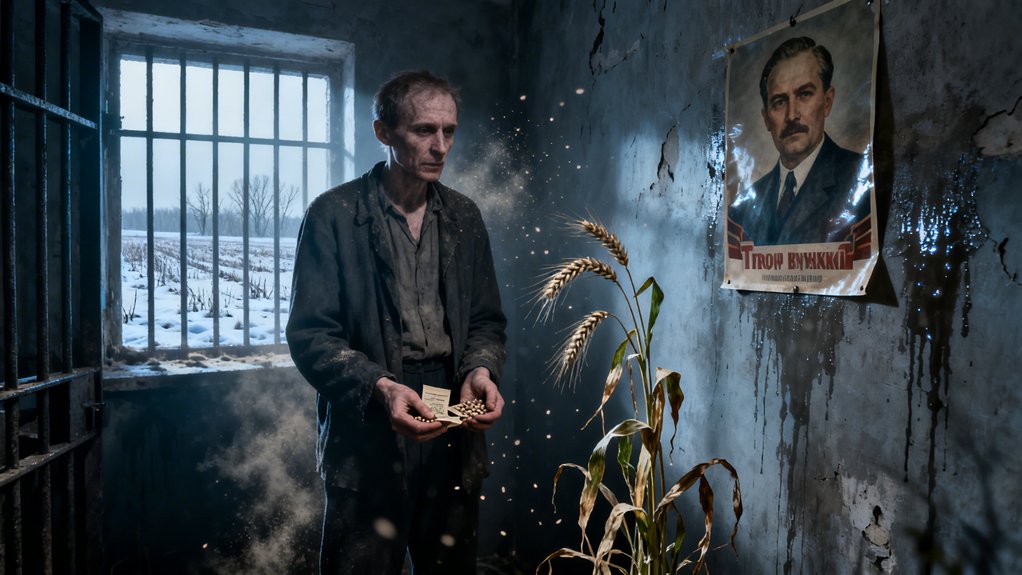
The Soviet state’s enforcement of Lysenko’s theories institutionalized agricultural fraud across the collective farm system. This mandate directly exacerbated catastrophic crop failures, as farmers were forced to adopt pseudoscientific practices like vernalization that ignored basic genetic principles.
Consequently, these state-ordered failures deepened the nation’s famines, turning ideological adherence into a recipe for mass starvation.
Institutionalizing Agricultural Fraud and Exacerbating the Soviet Famines
Because Lysenko’s fraud was elevated into official doctrine, Soviet agriculture underwent a systematic and devastating transformation.
The state didn’t just endorse his ideas; it enforced them with brutal authority, dismantling genetic research and purging dissenting scientists. This institutionalization of pseudoscience directly exacerbated the nation’s famines by mandating practices that guaranteed crop failure.
- Mandated Vernalization: Authorities forced peasants to soak and freeze wheat seeds, a labor-intensive, useless process based on Lysenko’s claim it could “train” crops for harsh climates.
- Destruction of Crop Rotation: Lysenkoism rejected established agronomy, leading to the plowing-under of essential legume crops that naturally replenished soil nitrogen.
- Eradication of Fallow Fields: The doctrine denounced leaving land fallow, insisting every acre be sown continuously, which rapidly depleted soils and collapsed yields.
The Posthumous Vindication of Nikolai Vavilov and the Enduring Survival of the Leningrad Vaults
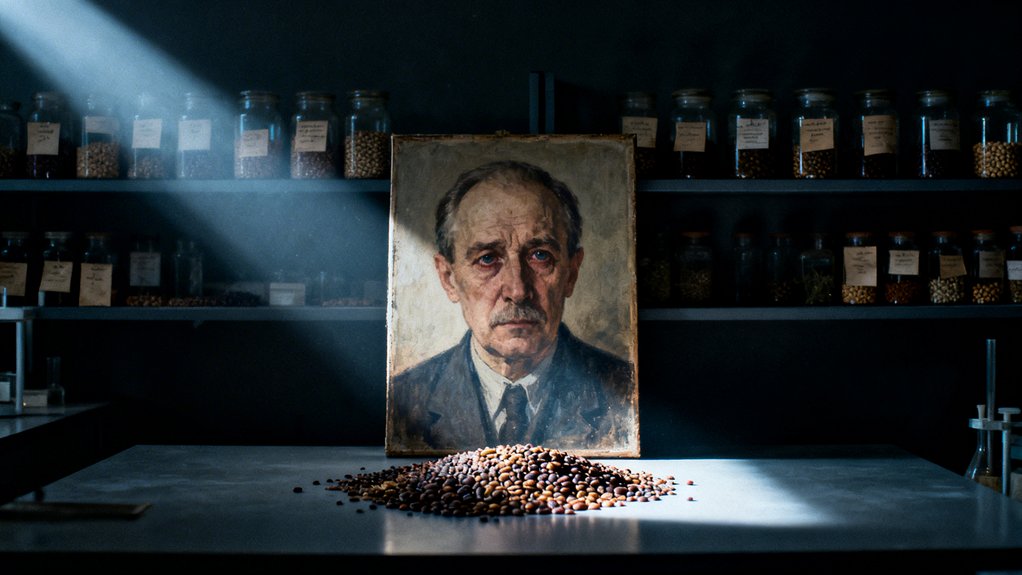
Even though Vavilov starved in a prison cell, his scientific legacy wasn’t extinguished; his colleagues in Leningrad defiantly guarded the seed vaults, and decades later, modern genetics would fully vindicate his work.
Vavilov’s legacy endured as his colleagues guarded the seeds, his science later fully vindicated.
During the brutal Siege of Leningrad, nine of his scientists chose to starve to death rather than consume the priceless seeds they protected. This sacrifice preserved his collection, which survived the war and the enduring reign of Lysenkoism.
After Stalin’s death, the political climate slowly shifted. By the 1960s, molecular biology had conclusively proven Vavilov’s theories on plant heredity and centers of origin, exposing Lysenko’s doctrines as fraudulent.
The Leningrad seed bank endured, evolving into the Vavilov Institute and serving as a vital genetic reservoir for global crop diversity, fulfilling his original, humanitarian vision.
Frequently Asked Questions
What Exactly Is Lysenkoism in Simple Terms?
Lysenkoism was a bizarre, state-enforced agricultural dogma that rejected mainstream genetics.
It claimed plants could inherit acquired traits—like a wheat “learning” to love winter—through sheer force of will and proper “Soviet training.”
Championed by Trofim Lysenko, it wasn’t science but political fiction masquerading as biology, promising miraculous harvests to please Stalin.
Its enforcement caused famine, ruined crops, and purged real geneticists, cementing its legacy as a catastrophic fusion of ideology and pseudoscience.
Did Vavilov’s Seed Collection Survive World War II?
Yes, Vavilov’s seed collection survived World War II. During the brutal siege of Leningrad, his dedicated colleagues guarded the world’s first seed bank. They protected hundreds of thousands of unique plant specimens from looting, cold, and starvation.
Tragically, several scientists died while protecting the collection, refusing to eat the edible seeds that represented future agricultural solutions. Their immense sacrifice preserved this irreplaceable genetic library for postwar science.
Were Any Lysenkoist Scientists Punished After Stalin Died?
The ideological tide receded after Stalin’s death. Lysenkoism, that scientific phantom, clung to influence for a decade but faced a growing chorus of legitimate geneticists.
Are Any Crops We Eat Today From Vavilov’s Seeds?
Yes, many modern crops trace their lineage to Vavilov’s seed collections. His expeditions gathered over 250,000 specimens. These provided essential genetic diversity for global breeding programs.
For instance, his work with wheat, potatoes, and legumes directly contributed to developing disease-resistant and higher-yielding varieties that now feed millions. The preserved seeds from his Leningrad bank continue to serve as a critical genetic resource for agricultural science worldwide.
How Is the Vavilov Seed Bank Used in Modern Science?
The Vavilov seed bank provides modern scientists with a unique genetic library for crop improvement. Researchers use its historic specimens to identify traits like disease resistance or drought tolerance.
This germplasm can be crossbred into current varieties, enhancing food security. It serves as a vital baseline for studying genetic diversity and plant evolution, helping agronomists develop resilient crops for a changing climate.
Final Thoughts
In a dungeon, the great botanist starved. His colleagues died guarding the seed bank, refusing to eat their work. The state’s enforced pseudoscience then triggered catastrophic famine. How can a truth so essential—the key to feeding nations—be outlawed and its defenders destroyed? Vavilov’s legacy survived in those preserved vaults, a proof of real science prevailing over political dogma.