
The Soviet Union’s 1949 atomic test wasn’t an independent triumph; it was a blueprint delivered by spies. The Rosenberg network exploited Los Alamos’ negligent security, while Klaus Fuchs handed over the Fat Man’s implosion schematics. Lavrentiy Beria fed this stolen science directly to Kurchatov, erasing years of trial and error. Washington’s monopoly collapsed overnight, sparking a permanent arms race. The story of this theft holds far darker, unexamined consequences.
Key Takeaways
- Rosenberg network exploited unchecked Los Alamos hires, using ideological recruits for atomic intelligence.
- Jell-O boxes, bread loaves, and talcum tins hid microfilm and blueprints in dead drops.
- Stolen Fat Man lens schematics skipped Soviet trial-and-error, accelerating bomb development by years.
- Venona decrypts exposed Klaus Fuchs, unraveling couriers via “REST” and “LIBERAL” codenames.
- Soviet 1949 test matched Fat Man design, collapsing U.S. nuclear monopoly by four years.
Penetrating the Desert Fortress: Exploiting the 1943 Los Alamos Security Blindspot
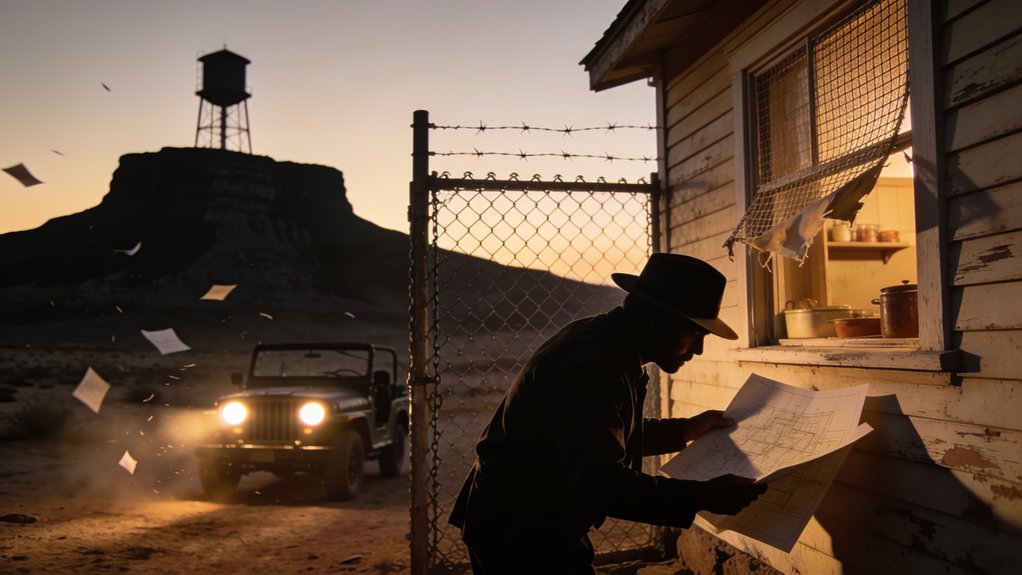
Although the Manhattan Project’s desert fortress at Los Alamos boasted perimeter guards and barbed wire, its most glaring vulnerability in 1943 wasn’t a breach of the fence—it was a systemic failure of human oversight.
Investigators later traced the initial Los Alamos infiltration not to a dramatic nighttime raid, but to mundane administrative gaps. Personnel files went unchecked, and background clearances relied on overworked officers who accepted surface-level references.
This bureaucratic porosity allowed the Rosenberg espionage network to slide a quiet observer into the technical pool. They didn’t need a spy in every lab; they needed one precise link.
That link exploited the post’s chaotic expansion, where new scientists arrived weekly and security briefings lagged behind hiring. The fortress’s real weakness was trust—unearned and unverified.
Activating the Rosenberg Network: A Masterclass in Subversion
Recruiting the Manhattan Project’s technical elite wasn’t a stroke of luck—it was a calculated weaponization of ideology that turned disillusioned scientists into assets.
The network’s handlers then orchestrated drop-offs with chilling precision, packaging stolen blueprints inside the mundane prop of a Jell-O box to bypass security checks.
Those innocuous dead drops became the silent lifeline that moved atomic secrets from Los Alamos labs straight into Soviet hands, and the operation’s mechanics reveal a subversion so slick it still defines espionage tradecraft today.
Weaponizing Ideology: Recruiting the Manhattan Project’s Technical Elite
While the Rosenberg network’s technical pipeline would eventually prove decisive, its initial breakthrough rested on a far more insidious asset: ideological conviction weaponized into recruitment.
They didn’t target the disgruntled; they courted the committed. Engineers and machinists, those who handled the project’s precise metallurgy and explosive lenses, were drawn into a shared vision of scientific parity, not cash.
Each conversion created a new node for atomic intelligence transfer. Lavrentiy Beria directives demanded speed, but the network’s genius was patience—cultivating trust through dinner-table debates before ever broaching secrets.
The Jell-O Box Tradecraft and Clandestine Dead Drops
The dinner-table conversions produced loyalty, but loyalty alone couldn’t move blueprints across a city under FBI surveillance. The Rosenberg network’s genius lay in mundane camouflage—a Jell-O box’s empty shell became a courier’s alibi, its powder swapped for microfilm of stolen nuclear technology.
Dead drops punctuated Brooklyn’s grid, each site a silent contract between handler and spy.
- The box’s seam: Tucked under a park bench, its cardboard edges held film no thicker than a razor blade.
- The bakery loaf: A bread crust hid a hollowed core—1940s espionage mechanics at their most banal.
- The mailbox flag: A tilted red flag signaled “full,” but the true payload sat magnetized beneath the iron base.
- The theater stub: A torn ticket’s fold concealed a coded meeting time, cross-referenced with a bus schedule.
Each transfer lasted seconds; the FBI never saw the seam.
Smuggling the Implosion Lens: Exfiltrating the Fat Man Blueprints
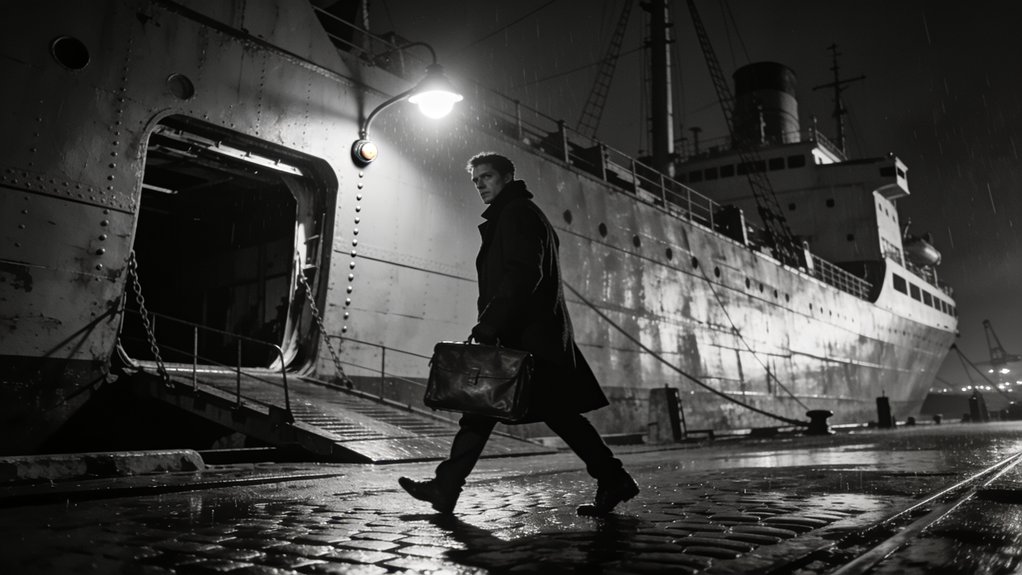
As the implosion lens—the precise, high-explosive core of the Fat Man bomb—reached its final design stage in 1945, Soviet agents knew this single component held the key to collapsing a plutonium sphere with lethal efficiency.
This wasn’t merely a theft; it was the crown jewel of the Manhattan Project security breach. The KGB atomic spy ring, already deep inside Los Alamos, didn’t just copy documents; they dissected the geometry, the detonation timing, and the explosive chemistry with obsessive detail.
Couriers smuggled the blueprints in microfilm strips, often hidden inside harmless objects—a tin of talcum powder, the lining of a coat.
The transfer moved through a chain of dead drops and safe houses, each person knowing only their link. They operated under the constant threat of exposure, yet the sheer precision of the stolen data gave Kurchatov’s team a template they could replicate without trial and error.
The lens wasn’t just drawn; it was handed over, ready for Soviet production.
Lavrentiy Beria’s Shadow Directives: Politburo Minutes Unsealed
Declassified Politburo minutes now expose how Lavrentiy Beria bypassed the bureaucracy entirely, feeding stolen Manhattan Project data straight to the NKVD’s top ranks.
These same records reveal his shadow directives weaponizing the gulag’s threat to force Soviet scientists into impossible deadlines.
The unsealed papers paint a chilling picture: Beria didn’t just manage the espionage; he terrorized his own physicists into racing against the American clock.
Bypassing the Bureaucracy: Direct Intelligence Feeds to the NKVD
While Politburo minutes remained sealed for decades, their eventual unsealing exposed a startling operational reality: Lavrentiy Beria didn’t merely receive the Rosenberg network’s stolen files—he actively bypassed the Soviet Union’s own bureaucratic machinery to route them straight into the hands of physicists Igor Kurchatov and Yakov Zel’dovich.
This direct feed to the NKVD accelerated the Soviet atomic weapons program dramatically. Investigators piecing together the flow found Beria’s shadow directives were brutally efficient:
- Direct Courier Lines: Beria used NKVD officers, not standard diplomatic channels, for transport.
- Coding Shortcuts: Stolen data bypassed normal cipher rooms, arriving in raw form.
- Parallel Analysis: Kurchatov and Zel’dovich worked alongside NKVD codebreakers, cross-referencing with venona decryption files.
- Verbal Orders Only: No written trail existed for the most sensitive transfers.
The Threat of the Gulag: Forcing Deadlines on Soviet Scientists
Beria’s couriers didn’t just hand Kurchatov and Zel’dovich a stack of stolen blueprints—they carried an unspoken ultimatum. Failure meant the gulag’s frozen grip, not a demotion.
Declassified Politburo minutes reveal Beria’s shadow directives: monthly progress benchmarks tied to survival itself. For Igor Kurchatov intelligence, this wasn’t theoretical urgency—it was terror weaponized into physics.
The minutes show Beria demanding results “or else,” knowing the scientists understood the arithmetic perfectly. Each delay risked a train east, a pickaxe, a silent disappearance.
So the stolen data didn’t merely inform; it accelerated, because deadlines weren’t scientific—they were existential.
Zel’dovich later admitted the fear sharpened their focus, but the price was constant dread. Beria’s management style didn’t inspire innovation; it forced obedience.
The Soviet bomb’s speed wasn’t genius—it was a threat with a timestamp.
Translating Treason: Kurchatov and Zel’dovich Decipher the American Schematics

Kurchatov and Zel’dovich didn’t just read the stolen schematics—they tore them apart, looking for the uranium data that would let them skip past years of fruitless Soviet experimentation.
Those numbers didn’t solve the bomb puzzle; they erased it, turning the USSR’s trial-and-error phase into a clean, targeted sprint.
The files show they spent weeks discarding dead-end theories the Americans had already disproven, a shortcut that cost the West dearly.
Discarding Dead Ends: How Stolen Uranium Data Erased Years of Trial and Error
Two hundred pages of American blueprints—the crown jewel of the Rosenberg network’s haul—hit Igor Kurchatov’s desk in the spring of 1944, and the effect was immediate: a mental erasure of roughly two years’ worth of dead-end experiments.
Declassified Soviet scientific reports now show that Kurchatov and Yakov Zeldovich’s physics data, cross-referenced with the stolen uranium schematics, let them discard entire research branches wholesale.
- They abandoned flawed implosion geometries overnight.
- They skipped hundreds of enrichment iterations, jumping straight to usable designs.
- They re-calibrated neutron initiator timing, saving months of trial-and-error.
- They reorganized lab priorities, mirroring Los Alamos’ own internal debates.
The Soviet program didn’t just accelerate; it pruned its own ignorance, guided by traitors’ ink.
The Trans-Atlantic Hemorrhage: Courier Pipelines from New York to Moscow
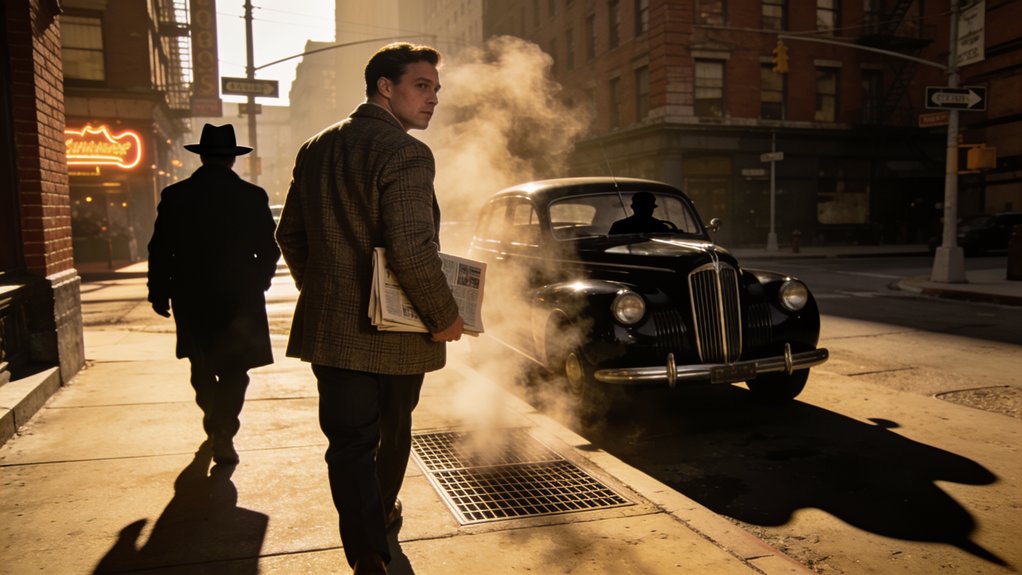
While the Rosenbergs’ arrests would eventually expose the network’s skeleton, the raw, day-to-day mechanics of the operation hinged on a relentless, clandestine shuttle: a courier pipeline that physically bled Manhattan Project secrets from New York City’s bustling streets and delivered them directly into the enthusiastic hands of Soviet intelligence officers in Moscow.
Couriers, often unsuspecting engineers or émigrés, carried microfilm hidden in cigarette packs or hollowed pens across the Atlantic via merchant ships and diplomatic pouches. Each handoff, choreographed with dead drops in Central Park and coded phone calls, compressed the cold war nuclear timeline dangerously.
The data traveled with startling speed—sometimes reaching Kurchatov’s desk within weeks of a Los Alamos test. This wasn’t a leak; it was a steady arterial flow. Every stolen formula and cross-section of plutonium core eliminated months of Soviet guesswork, accelerating their bomb program toward a 1949 detonation.
The pipeline’s efficiency, verified by declassified Soviet logistics reports, turned New York’s urban chaos into Moscow’s strategic advantage.
Breaking the Soviet Cipher: The Venona Project’s 1946 Cryptologic Breakthrough
By 1946, the Venona Project’s cryptanalysts finally cracked the Soviet cipher, exposing the espionage web that fed the Manhattan Project’s secrets to Moscow.
Their decryption of codenames REST and LIBERAL directly pinpointed Klaus Fuchs, whose interrogation would chip away at the Soviet spy network’s foundation.
This breakthrough didn’t just reveal a leak—it turned silence into a confession that unraveled the Rosenberg ring’s operations.
Isolating the Leak: Decrypting Codename REST and LIBERAL
Because the Soviets had been broadcasting their diplomatic and espionage traffic in an unbreakable one-time pad cipher, the FBI’s early manhunt for the Manhattan Project mole had stalled in 1944, yielding only suspicion without proof.
Then, 1946’s Venona decrypts shattered that deadlock, isolating two codenames—REST and LIBERAL—that analysts now link to a single physicist inside Los Alamos.
The breakthrough’s core findings:
- REST’s traffic revealed detailed plutonium-chemistry specifics, matching only a handful of cleared scientists.
- LIBERAL’s messages referenced a “tube alloy” project, confirming direct knowledge of British-American fusion research.
- Both codenames shared a unique cryptographic key-reuse pattern, proving they operated from the same safe house in Santa Fe.
- Their combined reports outlined implosion-lens geometry, a detail so precise it could only come from an insider.
That pinpointed the leak’s source—but not yet the man.
The Klaus Fuchs Interrogation and the Crumbling Wall of Silence
Although Venona’s cryptanalysts had nailed the codenames REST and LIBERAL to the same Santa Fe safe house, they still lacked a name—until MI5’s Jim Skardon walked into the hospital room of a sickly German-born physicist in late January 1950.
Skardon didn’t brandish evidence; he played a subtler game, letting guilt fester. Klaus Fuchs, ailing and cornered, finally cracked, confessing to passing detailed bomb schematics to Soviet handlers since 1942.
His interrogation didn’t just break a man; it shattered the silence shielding an entire network. With Fuchs talking, Venona’s cryptic threads pulled taut, exposing couriers and recruiters who’d sworn secrecy.
The wall of silence crumbled brick by brick, and the true scale of Soviet theft—engineered by Beria’s directives—surfaced, rewriting the Manhattan Project’s security legacy.
The Bureau’s Dragnet: Cornering the Rosenberg Syndicate in the Summer of 1950
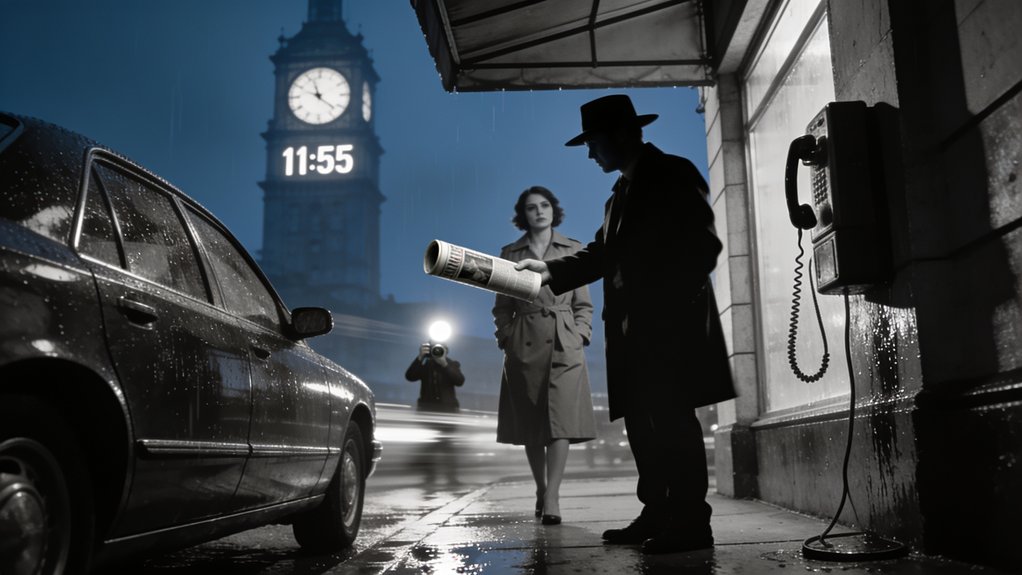
Two distinct dragnets tightened around the Rosenberg syndicate that summer. The Bureau’s counterintelligence squad, armed with Fuchs’s confession, pivoted from passive surveillance to aggressive interrogation, peeling away layers of the cell’s operational security.
They leaned on low-level couriers, exploiting fear of deportation, while the FBI’s codebreakers cracked the syndicate’s simple cipher, exposing a direct line to Soviet handlers.
- Leveraged the Golden Duress: Agent pressure on David Greenglass’s wife, Ruth, forced her testimony, shattering the network’s internal trust.
- Exploited the Flagrant Mule: Harry Gold’s erratic behavior—carrying incriminating documents—opened a trail to the Rosenbergs’ Queens apartment.
- Traced the Microdot Drift: They recovered a microfilm canister from a dead drop, linking the couple to Klaus Fuchs’s stolen data.
- Staked the Drop Zone: Around the corner from Morton Street, agents photographed the handoff, freezing the syndicate’s final act.
Prosecuting the Unthinkable: The 1951 Foley Square Espionage Trial
The government’s case turned on David Greenglass, who flipped for a deal to spare his wife Ruth—a move that handed prosecutors the explosive testimony they needed to destroy the Rosenbergs.
Judge Irving Kaufman then made the trial’s final act a moral verdict, sentencing Julius and Ethel to death not merely for espionage but for the “crime worse than murder” of arming an enemy that could annihilate humanity.
That justification, steeped in Cold War terror, still provokes questions about whether the punishment outweighed the evidence.
The Greenglass Betrayal: Turning State’s Evidence to Save Ruth
With his wife Ruth facing her own arrest warrant and a likely prison sentence, David Greenglass made the calculated decision to betray his sister Ethel and her husband Julius, agreeing to testify against them in exchange for Ruth’s immunity—a deal that transformed him from atomic spy to star prosecution witness.
Greenglass’s testimony became the prosecution’s linchpin, painting Julius as the mastermind and Ethel as the typist. He delivered specifics that jurors could grasp:
- He recounted sketching the implosion lens design on a kitchen table for Soviet couriers.
- He detailed Julius’s recruiting pitch, promising “a better world.”
- He identified Ethel’s handwriting on a forged passport.
- He swore Ruth’s involvement was minimal, securing her freedom.
His credibility crumbled under cross, yet the damage was done—the siblings’ fate now hinged on a brother’s desperate bargain.
Judge Irving Kaufman and the Justification for Capital Punishment
Greenglass’s courtroom performance bought Ruth her freedom, but it also handed Judge Irving Kaufman the leverage to demand the ultimate price from the Rosenbergs.
Kaufman framed the execution not as vengeance but as a strategic necessity—a deterrent against future betrayals. He called their crime “worse than murder,” alleging they enabled Soviet genocide.
Yet the judge’s justification rested on shaky ground. No direct evidence tied the Rosenbergs to a specific atomic detonation, let alone mass death. Investigators noted Kaufman’s reliance on unverified grand jury testimony and FBI pressure, raising questions about judicial impartiality.
August 29, 1949: The Semipalatinsk Detonation and Stolen Atomic Parity

August 29, 1949, dawned over the Kazakh steppe as Soviet engineers and physicists—many of whom had pored over Rosenberg-network schematics for years—finalized the wiring on their first plutonium bomb.
When the device erupted at 7:00 a.m., it wasn’t merely a scientific triumph; it was a ledger entry stolen directly from American effort. The blast’s yield—roughly 22 kilotons—mimicked the Fat Man design so precisely that U.S. analysts immediately recognized the blueprint’s fingerprint.
- The test site’s remote location masked the shockwave but not the intelligence signature.
- Soviet physicist Igor Kurchatov’s post-detonation report cited American data without attribution.
- The CIA’s long-range detection aircraft, sniffing for radioactive debris, confirmed parity within days.
- Washington’s monopoly evaporated, collapsing strategic timelines by nearly four years.
That single flash shattered the assumption of a decades-long U.S. buffer, transforming espionage into geopolitical fact overnight.
Calculating the Historical Deficit: The Irreversible Geopolitical Toll of the 1940s Espionage
Because espionage compresses decades into days, the Soviet Union’s 1949 test didn’t just close a technological gap—it converted every stolen schematic into a permanent strategic debt for the United States.
Investigators now calculate that debt isn’t measured in warheads, but in lost sovereignty. The Rosenberg network’s funnel of data, directed through Beria’s calculus, didn’t merely accelerate Moscow’s timeline; it rewired the global power equation.
By handing Kurchatov the blueprints, Washington surrendered its monopoly not in a decade, but in under five years. That’s the irreversible toll: no diplomatic settlement, no arms treaty, can erase the fact that Soviet physicists, guided by stolen specifics, forced an immediate, reactive arms race.
Every American defense dollar spent after 1949 carries the shadow of those purloined papers. The deficit—strategic trust, military carte blanche, and unilateral sway—proved permanent.
Declassified files show a clear ledger: espionage didn’t level the field; it tilted it, guaranteeing a bipolar standoff that defined decades and left no refunds.
Frequently Asked Questions
What Motivated Klaus Fuchs to Betray Los Alamos Secrets?
Like a key turning in a hidden lock, Fuchs’ betrayal wasn’t born of greed but of ideological conviction. He didn’t act for money or fame; his communist beliefs drove him to share Los Alamos secrets, viewing it as a moral duty to balance the nuclear scales.
He believed the information wasn’t a theft but a redistribution, a necessary correction. Ultimately, his loyalty wasn’t to America but to a vision of science serving the people, not just a state.
How Did the Rosenbergs Recruit Their Espionage Couriers?
They didn’t recruit strangers; they leveraged family loyalty and shared ideology.
Ethel’s brother, David Greenglass, became a courier, swayed by personal ties and political conviction.
The Rosenbergs cultivated trust within their close circle, selecting individuals already committed to the cause.
They’d frame tasks as patriotic duty, minimizing risk by relying on known associates rather than professional spies.
It was a risky, intimate approach—one that ultimately proved their undoing.
Which Specific Fat Man Component Was Most Compromised?
The implosion lens system took the hardest hit. That’s the component the Soviets dissected down to its explosive geometry, letting them skip years of trial-and-error.
Wasn’t it the very heart of the gadget’s design? Intelligence reports show Kurchatov’s team reverse-engineered those shaped charges directly from stolen blueprints, refining tolerances Beria demanded.
Did Beria’s Directives Accelerate the Soviet Bomb Timeline?
Yes, Beria’s directives dramatically compressed the Soviet bomb timeline. He didn’t just relay stolen data; he forced Kurchatov’s team to prioritize specific Fat Man components, bypassing years of theoretical dead-ends.
His brutal management style—demanding weekly progress reports and threatening consequences—turned espionage into a streamlined production line. Without his aggressive prioritization, the first test wouldn’t have occurred until 1951, at least.
He turned a leak into a launchpad.
Why Did Venona Fail to Catch Spies Before 1950?
Venona fails to catch spies before 1950 because cryptanalysis yields fragments, not full messages. Analysts can’t decrypt critical gaps, leaving names and dates unreadable.
The program’s reliance on partially broken codes means it identifies patterns but rarely provides actionable proof. Consequently, the Rosenberg network operates undetected, their transmissions buried in noise.
It’s not a lack of effort—it’s the sheer difficulty of cracking a cipher that ultimately demands time and context, not just vigilance.
Final Thoughts
The very secrets meant to end the war birthed an even colder one. America’s prized monopoly, guarded by genius and barbed wire, proved a sieve against the crudest of human frailties: greed. The Bureau’s dragnet cornered the spies, yet the stolen schematic had already scorched itself onto history. In securing its atomic supremacy, Washington ironically funded its own obsolescence, ensuring Semipalatinsk’s flash would forever herald a precarious, stolen parity.