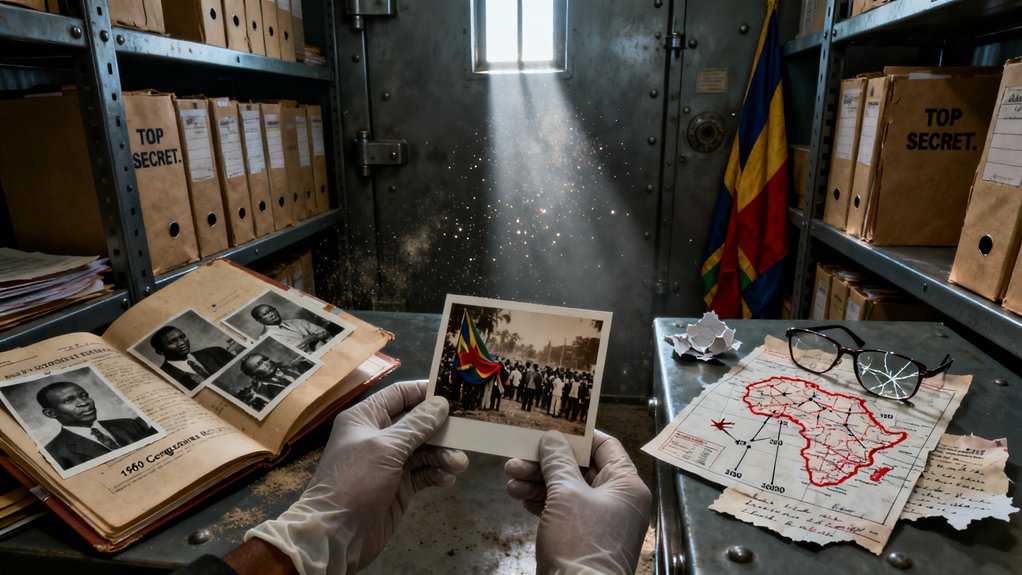
They called it peace, but the shadows were already moving. The CIA and Belgian intelligence fastened their grip on Congo’s fate as Patrice Lumumba’s voice rose for true independence. His defiance threatened vast mineral interests and Cold War calculations. Covert ops unfolded—poison plots, bribes, secret detentions. When the world stopped watching, they handed him to his enemies. What happened next wasn’t just murder. It was a blueprint.
Key Takeaways
- Declassified CIA files confirm direct involvement in plots to assassinate Patrice Lumumba using poisoned toothpaste.
- Belgian government cables reveal official orders for Lumumba’s “permanent disposal” by Katangan authorities.
- The CIA’s Sidney Gottlieb delivered toxins to Congo under diplomatic cover shortly after independence.
- MI6 ran disinformation campaigns to isolate Lumumba and undermine his legitimacy across Africa.
- Union Minière funded secessionists and supplied chemicals used to dissolve Lumumba’s body.
Why Was Patrice Lumumba Targeted?
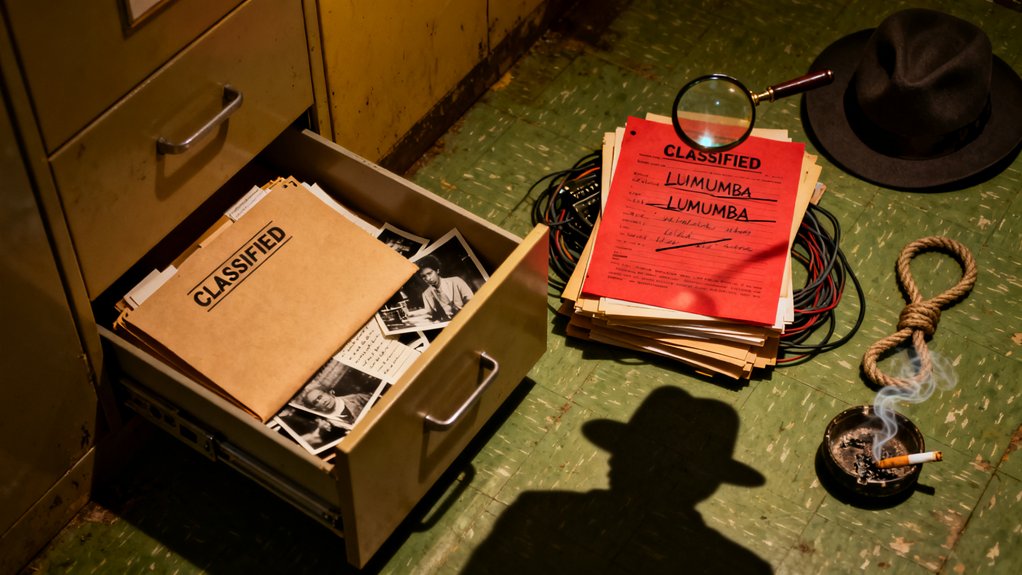
Though he was a democratically elected leader, Patrice Lumumba was seen as a threat because he fiercely defended Congo’s sovereignty and refused to let foreign powers control its vast mineral wealth. His vision of true independence challenged colonial and corporate interests, especially Belgium’s grip on Katanga’s copper and uranium. The cia viewed him as a dangerous nationalist who might align with the Soviet Union, despite his appeals for Western aid. Under Eisenhower’s orders, the cia authorized a plot to eliminate him, fearing his influence would spread across Africa. Belgian officials, mining executives, and Congolese allies conspired to depose and detain him. Patrice Lumumba’s unwavering stance made him a marked man. His assassination was not an accident of history—it was a calculated act of political and economic suppression, orchestrated by imperial powers determined to maintain control long after independence.
How Congo’s Independence Threatened Global Powers
Congo’s independence detonated alarm bells across Western capitals, not because of chaos, but because its resources were too valuable to risk losing control. The U.S., Belgium, and corporate powers feared Patrice Lumumba’s resolve to reclaim sovereignty over rich mineral lands, especially in katanga. Union minière, the Belgian mining giant, had dominated Katanga’s copper and uranium for decades, fueling colonial wealth while Congolese suffered in poverty. An independent Congo under Lumumba meant nationalization, profit loss, and precedent—liberation movements across Africa might follow. Katanga’s secession, backed by Belgium and funded through union minière’s covert transfers, wasn’t about regional pride; it was a strategic move to cripple Congo’s economy and remove Lumumba. Western powers didn’t fear disorder—they feared justice, redistribution, and a continent waking up. Control had to be maintained, by force if necessary. The stage was set not for peace, but for intervention.
The CIA’s First Moves to Remove Patrice Lumumba
After Lumumba’s fiery speech at the independence ceremony rattled colonial sensibilities, the CIA wasted no time launching covert operations to neutralize him. President Eisenhower didn’t mince words—his “extremely strong feelings” at a National Security Council meeting were taken as a direct order. Sidney Gottlieb, the CIA’s chemist, was dispatched to Congo with毒 agents, ready to act. The mission was clear: eliminate the threat of a truly independent Congo.
A fiery speech ignited a covert war—Lumumba’s vision for Congo would not stand, and the CIA moved swiftly to crush it with poison and precision.
- Gottlieb’s poison plot was authorized within weeks of independence
- President Eisenhower’s directive was interpreted as a green light for assassination
- Deadly toxins were transported under diplomatic cover
- Sidney Gottlieb personally oversaw the operation’s early phase
This wasn’t espionage—it was political warfare against liberation itself.
Gottlieb’s involvement linked the operation directly to the MKUltra program, where he had previously spearheaded the CIA’s most extreme mind control research.
The CIA’s WIROGUE Operation: Silent Sabotage in the Congo
While direct assassination plots were being considered, the CIA launched Operation WIROGUE to destabilize Lumumba through covert propaganda and political subversion. Operating under the WIROGUE cryptonym, the agency deployed assets to fracture Lumumba’s support among African leaders and amplify ethnic tensions within the Congo. These agents were tasked with organizing surveillance, funding opposition factions, and even attempting to recruit “execution squads” to isolate him. Larry Devlin, the CIA’s station chief, coordinated these efforts through backchannel communications to ensure Lumumba’s government was weakened from within. Though less overt than the poison plots, the CIA’s silent sabotage via WIROGUE crippled Congo’s first democratically elected leader at a critical moment in his fight for sovereignty. The WIROGUE files—buried for decades in CIA archives—remain a stark record of how the agency weaponized disinformation and paramilitary assets against African self-rule.
Belgium’s Covert Role in the Assassination Plot
Belgium didn’t wait for chaos to unfold—it shaped the outcome from the start.
- Belgian Minister d’aspremont lynden pushed for Lumumba’s “permanent disposal,” wiring classified orders days before the execution.
- Union Minière supplied sulfuric acid and funneled $175,000 to Katangan forces—corporate murder with state backing.
- Belgian officers directed the firing squad, oversaw the body’s dissolution, and destroyed evidence in embassy furnaces.
- Key proofs remain locked in sealed belgian archives, hiding names, orders, and accountability to this day.
From plot to cover-up, Belgium’s government ran the operation with cold precision. Assassination wasn’t a rogue act—it was policy. Officials like d’aspremont lynden didn’t just endorse murder; they demanded it. Yet decades later, justice stays buried. The truth isn’t lost. It’s being withheld. Until the sealed belgian archives open fully, liberation remains unfinished. They killed a leader, but not the fight.
What Declassified Files Reveal About Foreign Involvement
How deep did foreign complicity in Lumumba’s murder go? Declassified files expose a web of state and corporate collusion. The U.S. CIA greenlit assassination after Eisenhower’s order, while Belgium’s ministers demanded “physical elimination.” Union Minière funneled $175,000 in covert fund transfers to Katangan forces. Sulfuric acid—supplied by the mining giant—dissolved the bodies. The Church Committee unearthed but didn’t halt the cover-up; the CIA reclassified key files as TOP SECRET.
| Date | Action | Perpetrator |
|---|---|---|
| Jan 17, 1961 | Execution by firing squad | Belgian & Katangan forces |
| Jan 18, 1961 | Bodies dissolved in acid | Commissioner Soete |
| 1975 | Files buried post-investigation | CIA (church committee) |
| Ongoing | 50,000 pages still sealed | Belgian state archives |
Justice remains buried.
How Disinformation Fueled the Plot Against Lumumba
Patrice Lumumba’s fate was sealed not only by bullets and acid but by a relentless campaign of lies that painted him as a communist pawn and existential threat. Western powers weaponized propaganda to justify his eradication, twisting his anti-colonial stance into a Cold War specter.
Lumumba was not felled by bullets alone, but by a web of lies crafted to paint liberation as menace and justify murder as necessity.
- The CIA and Belgian intelligence spread false intelligence linking Lumumba to Moscow, despite no evidence of direct allegiance.
- Media outlets echoed state narratives, branding him a “chaotic radical” to undermine his legitimacy.
- UN diplomat Conor Cruise O’Brienrelayed misleading reports that fed the smear machine.
- Even after death, the truth was buried—Gérard Soetes grim confessions revealed how disinformation shielded perpetrators.
These lies didn’t just precede the assassination—they enabled it, silencing dissent and sanctifying murder under the guise of global security. The same fog that cloaked Lumumba’s killers still lingers in sealed archives and unanswered questions, a barrier to justice and liberation.
The Betrayal: Capturing Lumumba and Handing Him Over
Though he had evaded capture for months, Lumumba’s movements were no secret to those determined to end his leadership. Betrayed by allies and tracked by Western intelligence, he was seized in December 1960 by Mobutu’s forces and transferred to Thysville, then flown to elisabethville—into the hands of secessionist Katangan authorities. Belgian officers, including colonel marlière, directed every phase of the handover, ensuring Lumumba would not survive imprisonment. U.S. and Belgian officials had long deemed him a threat; now, they had their chance. At elisabethville’s Brouwez House, guarded by Belgian troops, Lumumba was denied legal status, tortured, and kept for execution. Coordination between colonial agents, corporate enforcers, and local collaborators sealed his fate. The transfer wasn’t a capture—it was a delivery. Power, empire, and racism converged to hand a free man over to his killers. There would be no escape.
The Night Patrice Lumumba Was Executed

Where was the world when Patrice Lumumba died?
In the dark hours of January 17, 1961, colonial hands pulled the trigger on Congo’s freedom. Belgian officers and Katangan forces carried out the physical elimination of Lumumba, Maurice Mpolo, and Joseph Okito at a remote farmhouse near Elisabethville.
- A Belgian command oversaw the execution, treating liberation leaders like disposable threats.
- Sulfuric acid, supplied by Union Minière, dissolved their bodies to erase all traces.
- Belgian police commissioner Gérard Soete led the gruesome work, keeping a gold tooth as a trophy.
- The Belgian government cabled “mission accomplished” before shredding evidence.
They thought silence would last. But the truth won’t stay buried. This was no accident—it was a calculated strike against African self-determination.
Why the Truth Was Hidden for Decades
How do secrets survive fifty years? Through silence bought with corporate vouchers, archives burned at 3 a.m., and cables buried in private drawers. The truth about Lumumba’s murder was strangled at birth by Belgian ministers, Union Minière, and the CIA. After the firing squad killed Lumumba and Maurice Mpolo, bodies were dissolved—sulfuric acid from mining ledgers erased flesh, but not evidence. One officer kept lumumba’s gold tooth, a grotesque trophy. Officials shredded records; the CIA reclassified files as “TOP SECRET SENSITIVE” to block Church Committee eyes. Belgium admitted guilt in 2002, yet prosecutions never came. Fifty thousand pages of archives remain sealed today. They didn’t just kill a leader—they tried to kill memory. But teeth, confessions, and paper trails don’t stay buried. Liberation starts when silence breaks.
What Declassified Files Mean for Justice Today
What does justice look like when the evidence has been dissolved in acid but the orders to buy it still exist on corporate forms? Declassified files prove the assassination of Patrice Lumumba—and the murders of Maurice Mpolo and Joseph Okito—were not accidents of history but calculated crimes. Today, those documents demand accountability:
- They expose Belgium’s state role and Union Minière’s direct complicity in the killings.
- They confirm Joseph Okito was targeted as a political leader, not collateral.
- They reveal operational chains linking colonial officials to execution orders.
- They prove the cover-up was immediate, systematic, and ongoing.
Though bodies vanished, paper trails didn’t. The files force open sealed archives and demand prosecutions. Justice now means refusing silence, honoring Okito’s legacy, and treating declassification not as closure—but as a tool for liberation. The truth isn’t buried; it’s being withheld.
Frequently Asked Questions
Who Paid the Assassins and How Much?
They were paid by Belgian authorities using $175,000 funneled through Union Minière to Katangan security forces. Records show vouchers from the Belgian Foreign Ministry covered the costs, including payments to men like Police Commissioner Soete. This wasn’t rogue action—it was state-orchestrated murder, funded covertly, then buried under decades of classified cables, sealed archives, and deliberate silence. Justice remains blocked.
What Happened to Lumumba’s Personal Belongings?
They seized Lumumba’s belongings after his execution. His gold tooth was pried from his jaw and kept by Belgian Commissioner Soete as a trophy. Other personal items—his briefcase, clothing, papers—were either burned in the embassy furnace or lost in classified transfers. Belgium never returned the tooth; it resurfaced decades later through Soete’s family. No official inventory was ever released. Looters, officials, and silence erased what remained.
Are There Living Witnesses to the Execution?
Yes, there were living witnesses to the execution. Belgian officers, Katangan guards, and local officials saw it happen. Some participated directly; others received orders or cleaned up after. A few later spoke—like Gérard Soete, who admitted dismembering the bodies. Others stayed silent. Their testimonies, scattered across archives and confessions, confirm it was no accident but a planned murder. Truth survived, though justice hasn’t.
Did UN Officials Know About the Assassination Plan?
Yes, UN officials had advance knowledge of the assassination plot. Conor Cruise O’Brien, a senior UN aide in Congo, intercepted Belgian cables warning of Lumumba’s “permanent disposal” and informed UN leadership. Secretary-General Dag Hammarskjöld received direct warnings but took no public action. Other UN personnel witnessed suspicious movements of Belgian forces yet were ordered not to intervene, confirming complicity through silence. Their inaction let the execution proceed.
Will Belgium Ever Release All Classified Documents?
Of course Belgium will release all classified documents—just as soon as the sun rises in the west. Officials still guard the files like relics, hiding 50,000 pages behind bureaucracy and silence. Despite 2002’s hollow admission, no trials followed, no archives fully opened. The truth remains buried because liberation terrifies those who profit from lies. But the world remembers. They won’t forget. The demand won’t die.
Final Thoughts
Shadows long cloaked the truth, but declassified files tear through the veil like dawn’s first light. Lumumba’s murder wasn’t chaos—it was calculation, a symphony of spies, states, and silenced screams. His bones may have dissolved, but his legacy refuses to erode. The records prove it: empires conspired, corporations complied, and justice waited decades in the wings. Now, the stage is set not for vengeance—but for reckoning.