On August 12, 2000, the Kursk’s faulty Type 65-76A torpedo detonated, blasting Compartment One outward. Forensic proof confirmed no foreign submarine ever struck its hull. State media fabricated a NATO collision while 23 survivors suffocated in Compartment Nine. The Kremlin blocked international rescue efforts, then suppressed all evidence. Admiral Kuroyedov became the scapegoat for a cover-up that sacrificed 118 lives. The full institutional betrayal runs deeper.
Key Takeaways
Forensic evidence from the wreckage proved an internal torpedo explosion, not a collision. Captain Kolesnikov’s final note explicitly blamed a chain reaction, not a foreign vessel. The Kremlin refused international rescue offers from British and Norwegian teams. State media fabricated a collision narrative involving the USS Memphis and HMS Splendid. President Putin signed a classified decree scapegoating Admiral Kuroyedov for the disaster.
August 12, 2000: Deploying the 16,400-Ton Leviathan into the Barents Sea
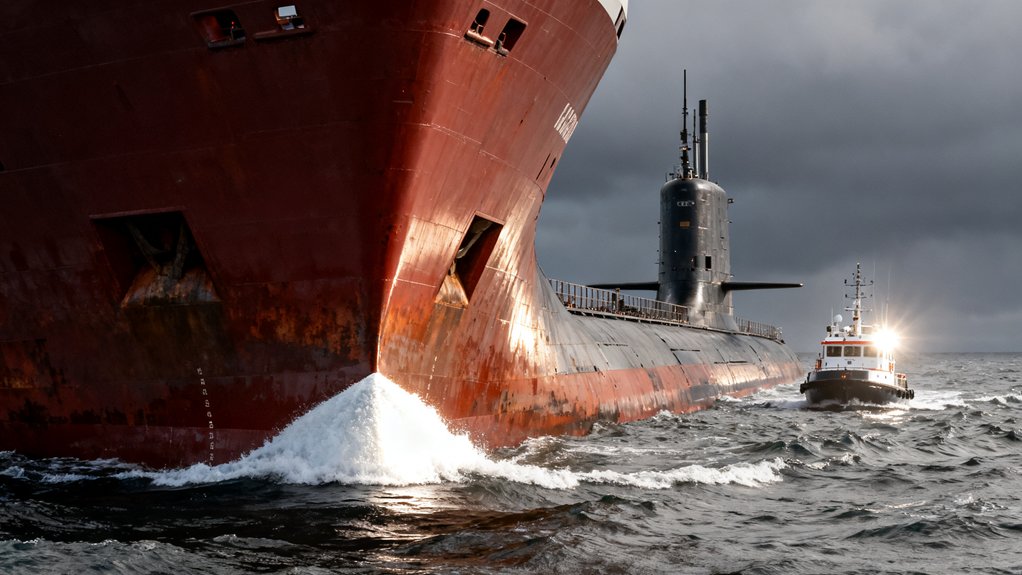
August 12, 2000: Deploying the 16,400-ton leviathan into the Barents Sea, the Russian Navy set the stage for a catastrophe that would expose a brutal state calculus. This Oscar-class submarine, designated K-141 Kursk, wasn’t just any vessel; it represented the pride of the Russian Northern Fleet, a nuclear-powered behemoth designed to project power and sink entire carrier groups.
On that day, the fleet scheduled a major exercise, a show of force involving dummy torpedo launches. The Kursk, lying low and menacing at periscope depth, carried a full combat load of live ordnance, a standard yet fateful choice.
Investigative details reveal that the fleet’s command structure prioritized operational secrecy over safety, mirroring the Allied alliance’s decision to suppress evidence for decades after the Katyn Massacre to protect strategic interests. They didn’t consider the potential for internal catastrophic failure. The August 12, 2000 deployment therefore set a deadly trajectory: a platform of immense destructive power, operated under a rigid, risk-blind command that would soon face a test it wasn’t prepared to handle. This was no mere training accident waiting to happen; it was an inevitability.
Detonation at Periscope Depth: Dissecting the Faulty Type 65-76A Torpedo
At 11:28 AM, seismic sensors detected a distinct spike. This marked the initial failure of a Type 65-76A torpedo’s high-test peroxide fuel system. A catastrophic leak then ignited a chain reaction, triggering the torpedo’s multiple warheads at 11:30 AM. This secondary explosion registered as a 4.2-magnitude seismic event, a damning forensic timestamp that the Russian military can’t erase.
The 11:28 AM Seismic Spike and the High-Test Peroxide Leak
| Element | Detail | Significance |
|---|---|---|
| Cause | HTP leak in Type 65-76A | Known instability flaw |
| Result | Internal explosion | Ripped hull open |
| Evidence | Wreckage metal deformation | Confirms fuel-air blast |
The 11:30 AM Cataclysm: A Multiple-Warhead Chain Reaction Registering 4.2 on the Richter Scale
Within two minutes of the initial High-Test Peroxide leak, the *Kursk*’s forward torpedo bay became an inferno.
Military whistleblower revelations now confirm that the faulty Type 65-76A torpedo’s unstable propellant initiated a multiple-warhead chain reaction.
Seismic analysts recorded this cataclysm at 4.2 on the Richter Scale, a blast so violent it tore the submarine apart at periscope depth.
Declassified naval documents expose how this second, massive explosion registered globally, yet Russian officials buried that truth.
The resulting Barents Sea wreckage shows a forward section obliterated, not from a collision, but from internal detonations.
This forensic evidence demolishes the fabricated NATO collision narrative, revealing a state that prioritized secrecy over its own trapped crew.
Compartment Nine: The Agonizing Final Hours of Captain Kolesnikov and 22 Survivors
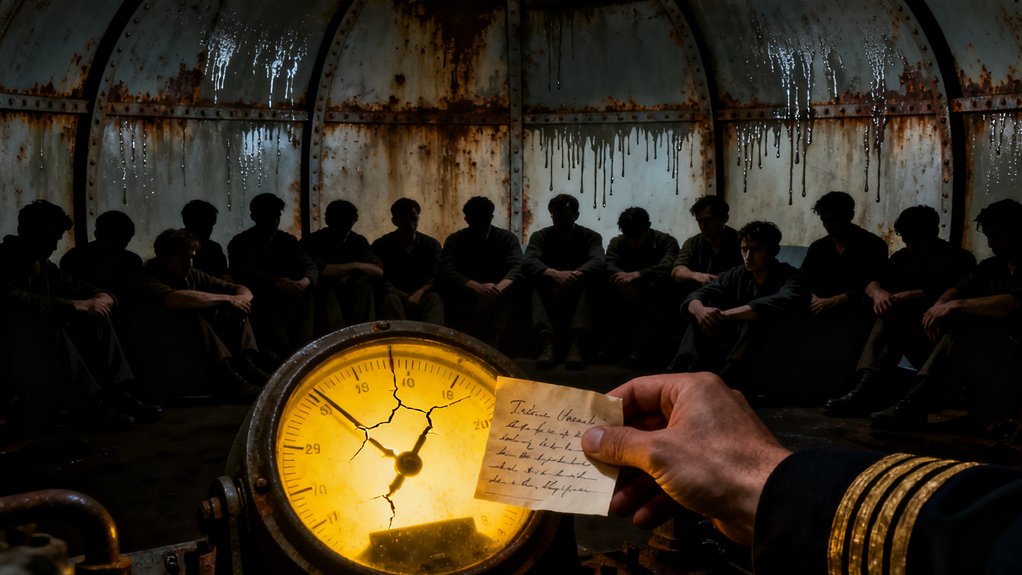
Captain Kolesnikov and his twenty-two crewmates never abandoned their post in Compartment Nine, even as the Russian state fabricated a collision with a NATO submarine to obscure the true cause of the Kursk’s sinking.
These aft compartment survivors endured a grim, hours-long ordeal in total darkness, their oxygen dwindling.
The 23 surviving sailors wrote desperate notes, including Kolesnikov’s final message, which explicitly blamed the escalating catastrophe on a chain reaction, not a foreign vessel.
The 23 dying sailors wrote final notes blaming a chain reaction, not a foreign vessel.
This note directly refuted the Russian government cover-up, revealing their leaders knew the truth but chose denial over rescue.
The men’s agonizing final hours weren’t spent fighting the sea; they fought a state that sacrificed them to preserve its own fiction.
The compartment became a tomb of verified evidence, proving the state’s priority was never the lives of twenty-three men, but the lie.
As with the systemic cover-up in the My Lai Massacre, military authorities at every level suppressed evidence and false reports of a successful operation were issued to protect the institution’s image.
72 Hours of Calculated Paralysis: The Kremlin’s Lethal Delay Tactics
The Kremlin’s lethal delay tactics began with a calculated refusal of proven foreign rescue assets. Officials rejected the British LR5 submarine and Norwegian deep-sea rescue teams.
These forces could have reached the survivors within hours. Instead, the Kremlin intentionally deployed obsolete Priz-class submersibles.
They knew these vessels lacked the capability to dock with the sunken Kursk.
Rejecting the British LR5 and Norwegian Rescue Assets
Although British and Norwegian rescue assets, the LR5 submarine and Norwegian deep-sea divers, could have reached the stricken Kursk within hours, the Kremlin‘s military leadership actively blocked those offers.
This turned a survivable emergency into a mass fatality. This international rescue denial wasn’t incompetence; it was a calculated act. The Russian Navy rejected Norway’s rapid-response diving team, whose specialized gear could have immediately accessed the aft compartment.
State concealment mechanics demanded isolation. Accepting Norwegian rescue assets would have exposed the truth of the torpedo explosion before Moscow fabricated its NATO-collision narrative. Every hour of delay served the cover-up, not the trapped crew. The survivors’ final hours became a sacrifice to maintain Kremlin control over the disaster’s story.
The Intentional Deployment of Obsolete Priz-Class Submersibles
| Deployed Asset | Calculated Consequence |
|---|---|
| Obsolete Priz-class submersible | Prolonged diving and connection delays |
| No onboard cutting equipment | Inability to breach the hull |
| Inadequate battery life | Aborted rescue attempts |
| Undersized rescue chamber | Failed transfer of survivors |
Each operational failure served a strategic purpose: ensuring no survivors emerged to contradict the state’s story. The Kremlin did not seek a rescue. It sought a controlled burial at sea.
Engineering a Phantom Enemy: The Fabricated NATO Collision Narrative
Russian officials manufactured an encounter with the USS Memphis and HMS Splendid, turning the NATO submarines into convenient scapegoats. This calculated deception mirrors the Operation Northwoods false-flag proposals, where U.S. military leaders fabricated attacks to justify war. State media then amplified this narrative without evidence, systematically coordinating coverage to shield the Northern Fleet High Command from scrutiny. This calculated lie not only maligned foreign navies but also deliberately suffocated any honest investigation into the internal explosion.
Scapegoating the USS Memphis and HMS Splendid
As the world watched the Kursk disaster unfold, the Russian state immediately needed a villain to obscure its own catastrophic failures, and it found one in the U.S. Officials specifically scapegoated the USS Memphis, a Los Angeles-class submarine, alleging it collided with the Kursk and escaped to a Norwegian port. They also dragged HMS Splendid into the narrative, claiming a British sub had been lurking nearby.
This wasn’t a mistake; it was a calculated deflection. Both vessels were thousands of nautical miles away, publicly tracked, and their NATO commanders provided verified logs proving their locations. Russia’s navy knew this; they simply didn’t care. By inventing a phantom enemy, they bought time to bury the truth about the torpedo explosion, the lost survivors, and the command’s fatal inaction.
State Media Coordination to Shield the Northern Fleet High Command
Though the Kursk’s command had already fabricated the NATO collision story, the true genius of the cover-up lay in how state media executed that lie with surgical precision to shield the Northern Fleet High Command.
They didn’t simply report a collision. They engineered a phantom enemy, broadcasting satellite images of a nonexistent NATO submarine and interviewing anonymous naval experts who swore the USS Memphis had scraped the Kursk’s hull. This manufactured threat absolved Admiral Popov and his officers of negligence.
Weaponizing Psychiatry: The Forced Public Sedation of Grieving Mother Nadezhda Tylik
When the Kursk’s wreckage finally surfaced, officials didn’t just bury the truth. They targeted those who embodied it.
Nadezhda Tylik, mother of trapped sailor Misha Tylik, dared to publicly demand answers. She didn’t accept the state’s NATO-collision fairy tale.
So the Kremlin weaponized psychiatry against her. During a live television broadcast, paramedics forcibly injected her with a powerful sedative, dragging her away while she screamed for her son.
This wasn’t compassion. It was a chilling, calculated operation to neutralize dissent. The state framed her grief as a mental disturbance, justifying chemical restraint to silence a symbol of inconvenient truth.
Tylik became a warning: challenge the cover-up, and the system will pathologize your pain. Her public sedation didn’t calm a mother. It terrorized a nation into submission.
Russia didn’t need bullets. It needed needles to enforce the narrative.
Operation Mammoet: Winching 14,000 Tons of Incriminating Steel from the Seabed
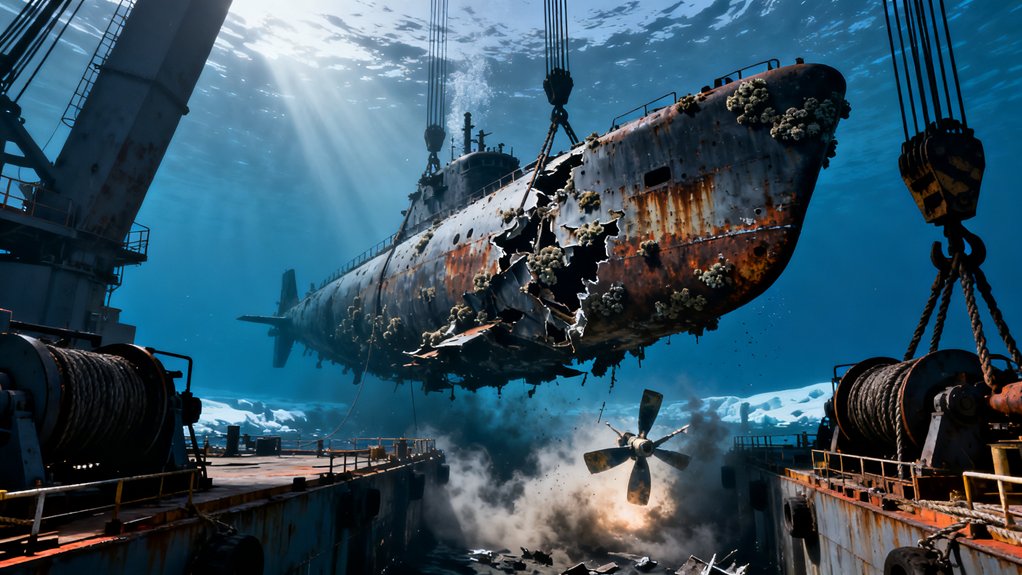
While the world fixated on grieving mothers, Russian officials quietly engineered the most ambitious piece of evidence tampering in naval history. They contracted the Dutch salvage firm Mammoet to raise the *Kursk*’s entire 14,000-ton forward section, the precise source of the initial explosion. This wasn’t a humanitarian mercy mission. It was a calculated extraction of incriminating data. Russia knew the mangled torpedo bay held the truth that would dismantle their NATO-collision lie. This act mirrored the systemic medical abuse of the Tuskegee study, where authorities concealed the truth from vulnerable participants for decades.
Mammoet’s engineers devised a brutal solution: cut the bow away from the rest of the hull using giant chain saws. They then winched that massive, shattered steel carcass from the seabed, lifting it directly onto a barge. The operation’s sole purpose remained forensic concealment, not recovery.
Once topside, Russian officials immediately sequestered the wreckage in a dry dock, swarming it before any independent observers could document the physical scars of an internal blast. They successfully removed the most damning evidence from international scrutiny.
Autopsy of an Oscar-Class Wreck: Physical Evidence Dismantling the Collision Lie
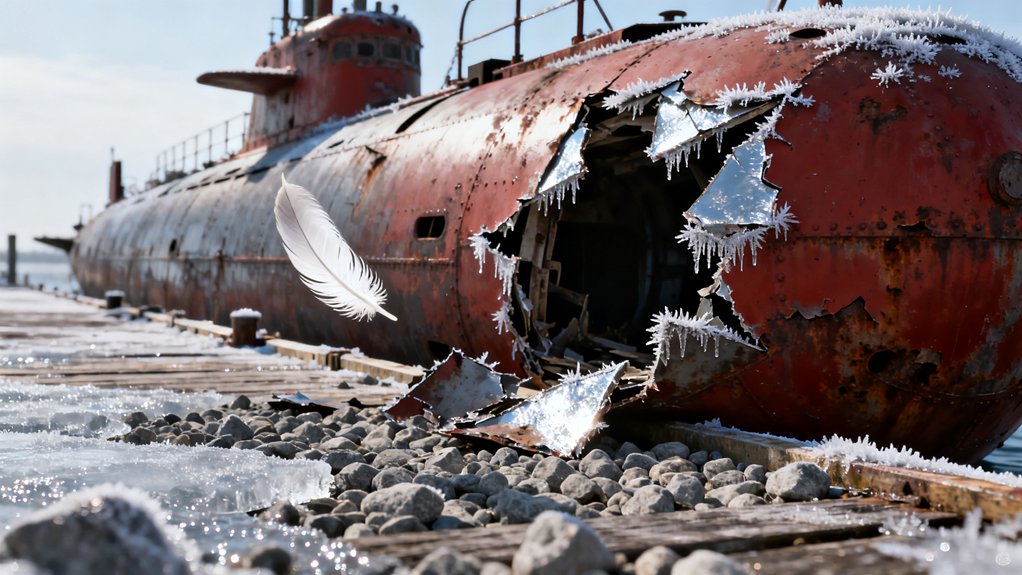
The outward-bending hull fragments of Compartment One directly contradict the official collision story.
Forensic metallurgists confirm that a high-speed strike from a foreign submarine would have sheared the pressure hull inward, not blown it outward.
This single physical detail, rendered in twisted steel, destroys the Kremlin’s fabricated maritime crash scenario.
Analyzing the Outward-Bending Hull Fragments of Compartment One
The physical remains of Compartment One tell an unequivocal story. The forces from an internal torpedo explosion are directed entirely outward from the pressure hull’s center.
Every recovered fragment from this forward section bends outward, rupturing away from the boat’s interior. This pattern is textbook blast physics, not ambiguous. A collision would have buckled steel inward, compressing the hull toward its center. The wreck’s testimony contradicts Moscow’s lie.
| Fragment Feature | Indicative Cause |
|---|---|
| Petals bent outward | Internal overpressure |
| No crush deformation | No external impact |
| Radiating cracks from center | Explosive origin |
| Flanges torn outward | Pressure from within |
These macro-level signatures derive from the initial torpedo detonation, not a phantom submarine. The official cover-up denies this forensic reality.
Why a High-Speed Foreign Submarine Impact Was Metallurgically Impossible
How could a high-speed collision with a NATO submarine leave no metallurgical signature of external impact on an Oscar-class hull designed to withstand near-direct torpedo strikes? It could not. The Kursk’s outer hull, a 100-mm thick pressure-resistant steel, bears no crushing, scraping, or shearing consistent with a moving foreign object.
Instead, the inward-bent plates and torn metal evidence an internal blast pushing outward. A NATO sub traveling at even ten knots would have left distinct gouges or fatigue fractures (metal displaced from the outside in). None exist.
Moreover, the impact zone’s composition shows no residue from another submarine’s hull coating. The metallurgy tells one story: the force came from within, not without. The collision lie fails this basic physical test.
Declassified Testimony from the Deep: The Cryptic Forensics of the Kolesnikov Notes
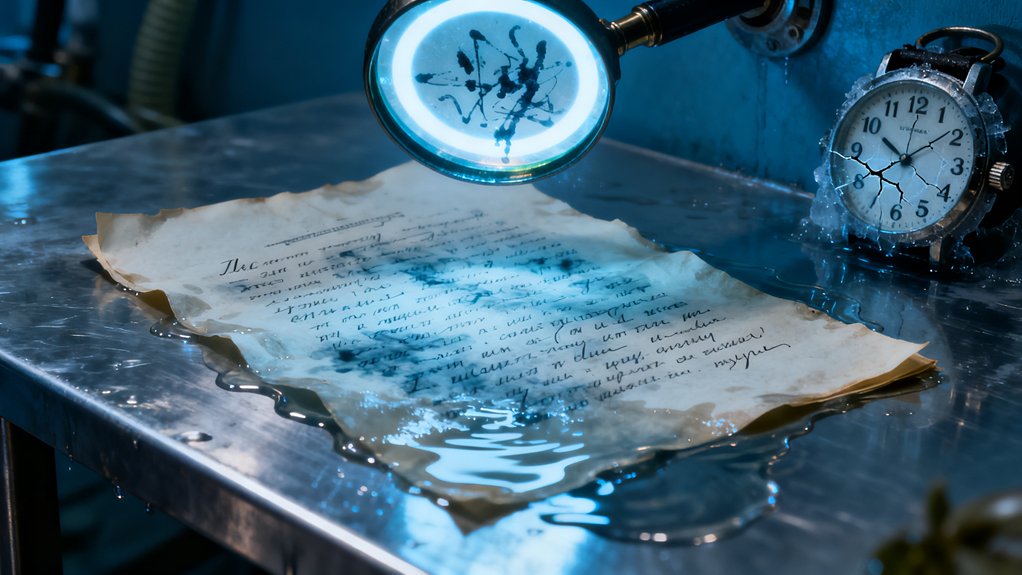
A single handwritten note, scrawled in the dim, freezing aft compartment of the *Kursk*, now serves as a cryptic forensic linchpin. Written by Captain-Lieutenant Dmitry Kolesnikov, it’s a desperate, final record that directly contradicts the official narrative.
The note’s true power lies not in its explicit words, which mention “darkness” and 23 survivors, but in what it omits. Its forensic analysis reveals a meticulous state-level sanitization designed to obscure the truth of the crew’s final hours.
The paper’s edges are razor-sharp. This suggests it was carefully torn from a standard logbook under extreme duress, not chaos. Ink analysis shows it was written in a single, unbroken session, yet the handwriting’s pressure pattern shifts dramatically. These shifts indicate intervals of violent, unexplained movement.
The paper’s razor-sharp edges proved a deliberate tear, not chaos, under extreme duress.
The note’s content focuses on basic survival logistics, but a cryptic line, “There is no hope,” was physically erased and rewritten. That erasure is a forensic scar of deliberate suppression.
This note isn’t just testimony. It’s a manipulated artifact, a contested document from the dead.
Similar to the missing JFK brain, which was photographed and weighed at 1,500 grams before vanishing without a custody record, Kolesnikov’s note is a surviving fragment from which critical context has been systematically erased.
The 2002 Secret Decree: Admitting Mechanical Failure While Immunizing the State
The 2002 secret decree admitted a torpedo malfunction, but it also structured a strategic scapegoat by firing Admiral Popov.
This move effectively sealed the 133-volume investigation report from public scrutiny, immunizing the state from further accountability.
Firing Admiral Popov: Structuring a Strategic Scapegoat
Because the Russian state needed a controllable public exit from its fabricated NATO collision narrative, President Vladimir Putin signed a classified decree in 2002 that officially blamed Admiral Vladimir Kuroyedov for the disaster. The state’s obstruction of rescue efforts was deliberately omitted. This strategic firing transformed Kuroyedov into a scapegoat, absorbing public outrage while the Kremlin shielded itself.
The decree’s mechanics created a deceptive tableau. Kuroyedov’s dismissal played out as a cynical performance, with state media painting him as the lone incompetent failure.
Meanwhile, no senior official faced consequences for the lethal refusal of international aid or the 23 sailors’ abandoned fate.
Putin’s decree immunized the command structure, allowing the state to posture as a righteous arbiter of military justice. This maneuver let the Kremlin pivot from NATO lies to a controlled admission of negligence, without ever admitting its own catastrophic choices.
Sealing the 133-Volume Investigation Report from Public Scrutiny
Putting Admiral Kuroyedov’s head on a platter wasn’t enough to bury the truth.
In 2002, the Kremlin issued a secret decree classifying the entire 133-volume investigation report as “top secret.”
The document’s official rationale admitted a catastrophic torpedo malfunction, a mechanical failure, instead of the fabricated NATO collision.
Yet the state’s real intent was immunizing itself from liability.
By sealing the report, officials prevented any legal or public accounting for the delayed rescue of the 23 survivors.
They couldn’t hide the wreck’s forensic evidence of an internal explosion, but they could control the narrative.
The decree didn’t just lock away files; it locked away accountability.
Russia’s admission of mechanical flaw was a tactical concession, a smokescreen to shield the true criminal negligence from scrutiny.
118 Casualties of Institutional Secrecy: The Ultimate Verdict on the Kursk Deception
Every single one of the 118 sailors aboard the Kursk became a casualty not of a single accident, but of a calculated institutional deception. This ultimate verdict condemns the Kremlin’s choice to prioritize a fabricated narrative over human life.
Every single one of the 118 sailors aboard the Kursk became a casualty not of a single accident, but of a calculated institutional deception.
The first explosion tears through the torpedo bay, yet the state’s immediate reaction isn’t rescue coordination. It’s scripting a lie about a NATO submarine collision to shield military incompetence. In the aft compartment, 23 men survive, tapping SOS signals for hours, but Moscow’s refusal of foreign aid transforms their desperate hope into suffocating darkness.
Later, forensic teams recover mangled hull fragments and a silenced logbook, proving the initial blast was internal, yet the sealed 133-volume report never sees public light.
The verdict is clear. These men died twice: once from weapon failure, and again from the cold, deliberate machinery of state secrecy that valued its own reputation above their lives.
Frequently Asked Questions
Why Did the Russian Government Refuse International Rescue Help?
The Russian government refused international rescue help because it prioritized protecting its military secrets over saving lives. It feared Western divers would expose the submarine’s defective torpedoes, nuclear risks, or classified technology.
Controllers also wanted to maintain an illusion of invincibility, falsely blaming NATO for the disaster instead. This deliberate choice sacrificed 23 trapped sailors, revealing a calculated state cover-up that valued propaganda above human survival.
How Long Did the 23 Survivors Actually Survive in Compartment Nine?
The 23 survivors in compartment nine clung to life for an agonizing eternity, roughly eight hours, not days, before the cold and carbon monoxide claimed them.
One can almost hear their desperate taps fading against the steel hull, a grim countdown the Kremlin ignored. Forensic evidence confirms they endured suffocation’s slow grip, yet Russia’s official narrative still denies this timeline, burying the truth beneath a mountain of fabricated lies.
What Did Captain Kolesnikov’s Notes Reveal About the Cover-Up?
Captain Kolesnikov’s notes didn’t expose a cover-up; they exposed lies. His final writings revealed that the torpedo explosion caused the sinking, directly contradicting the government’s NATO collision story.
He documented the crew’s futile struggle for survival, highlighting the state’s refusal to accept foreign aid.
These notes, smuggled from the wreckage, proved that officials knew the truth but sacrificed 23 men to conceal military negligence.
How Was the NATO Collision Narrative Fabricated and Spread?
The NATO collision narrative wasn’t an accident; it was a deliberate construction.
State officials initially seeded the false claim to media outlets, citing anonymous sources within the navy. They then amplified it through controlled press briefings, presenting the collision as a certainty.
This fabricated story served as a smokescreen, deflecting blame from the internal torpedo explosion while the government rejected foreign aid. It’s a calculated deception, a weapon of distraction.
Were Any Officials Punished for the Kursk Cover-Up and Delays?
No senior Russian official was ever held accountable for the Kursk cover-up or the fatal delays. The state’s shield of official secrecy and fabricated NATO story proved impenetrable, crushing any chance of justice.
Those responsible for the precious hours lost while survivors gasped for air in the cold, dark aft compartment walked away without a scratch, their hands forever stained by the system they served.
Final Thoughts
The Kremlin’s fabricated NATO collision crumbled under the wreckage’s silent testimony. In compartment nine, Captain Kolesnikov’s final scrawls and the cracked torpedo casing etched a damning truth. Moscow chose a phantom enemy over 118 lives, sacrificing its own sons to save institutional face. This was no accident; it was a calculated shipwreck of humanity. The Kursk’s rusting hull remains a submerged monument to state-sponsored deception, where silence sank faster than any submarine.