The declassified record exposes the CIA’s pre-war case as a construct, built on Curveball’s unvetted fabrications. Analysts stripped critical caveats, transforming a defector’s lies into certainty for the White House. Field officers’ warnings dissolved into silence, while verification standards collapsed under political pressure. The March 2003 invasion followed phantom stockpiles, but ground truth revealed empty warehouses instead. This single-source contamination engineered a narrative that armed an invasion, and its systemic failures demand closer examination.
Key Takeaways
- Curveball’s unvetted fabrications became core CIA pre-war evidence, bypassing polygraphs.
- Analysts stripped sourcing caveats in reports, replacing rigorous verification with confirmation bias.
- Colin Powell’s 2003 UN speech turned conditional claims into declarative absolutes about WMDs.
- Iraq Survey Group found no weapons; Duelfer’s report traced the failure directly to Curveball.
- Single-source desperation and urgency prioritized narrative confirmation over intelligence truth.
Shadows in Erbil: The 2001 CIA Field Operations and the Hunt for Saddam’s Arsenal
As 2001 ground on, the CIA’s hunt for Saddam’s arsenal had narrowed to a single, gritty Kurdish city—Erbil—where a single field officer’s notes would soon poison the entire intelligence bloodstream.
The officer’s task—cia humint operations—aimed to crack the regime’s secrecy, yet the erbil intelligence gathering yielded only fragments: whispers of trucks, guarded warehouses, nothing forensic.
Desperate for traction against a silent target, the station leaned heavily on a single asset, the future curveball informant, whose unverified tales of mobile labs filled the void.
This raw, ambient dread—not hard proof—fed directly into cables bound for Washington, bypassing rigorous analysts.
By prioritizing volume over validation, the field team enabled intelligence stream contamination, setting the stage for a monumental iraq wmd intelligence failure.
The hunt’s urgency had bred a fatal credulity, where rumor masqueraded as certainty, and the ground truth of Erbil dissolved into a self-fulfilling prophecy.
Projecting the Phantom: Rafid Ahmed Alwan al-Janabi and the Curveball Dilemma
The BND’s initial interrogations of Rafid Ahmed Alwan al-Janabi in 1999 birthed the mobile biolab fabrication, yet his raw claims bypassed standard polygraph protocols entirely.
Curveball’s deception wasn’t just a lie—it was a pipeline of unvetted fantasy that fed directly into the CIA’s pre-war narrative.
This is the smoking gun: the system didn’t fail to catch him; it actively refused to test him.
The BND Interrogations and the Genesis of the Mobile Biolab Theory
Once the BND’s Karlsruhe interrogators sat down with Rafid Ahmed Alwan al-Janabi in early 2000, they didn’t just reveal a single secret—they triggered a chain of assertions that would metastasize into the mobile biolab theory. His fabricated WMD claims, rooted in unverified human intelligence, painted a chilling picture: trailers allegedly brewing anthrax. Yet, those narratives collided with reality.
| Claim | Source Veracity | BND Action |
|---|---|---|
| Mobile labs for bioweapons | Unverified human intelligence | Accepted with skepticism |
| Production capacity details | Fabricated WMD claims | Lacked technical validation |
| Locations across Iraq | Vague, inconsistent | No ground checks |
| Operational testing | Contradictory timeline | Never reconciled |
CIA field officer reports echoed his words, embedding the pre-war intelligence narrative before any hard proof surfaced. The moral urgency cut deep—the phantom solidified, shaping a war’s justification.
Translating Deception: How Raw Fabrications Bypassed Standard Polygraph Protocols
Despite Curveball’s fabrications carrying the weight of a nation’s war machine, neither the BND nor the CIA ever subjected him to a formal polygraph examination—a protocol gap that would prove catastrophic.
The Baghdad espionage mechanics relied on a translated narrative, filtered through handlers who never pressured him to confront contradictions. Declassified CIA files reveal how his fluency and confident detail distracted analysts from missing checks.
Consequently, his phantom mobile labs became the 2003 invasion justification, surviving WMD analytical vetting purely on narrative coherence. Operation Iraqi Freedom intel therefore consumed lies as gospel.
We can’t ignore this: the absence of even one standard test transformed a refugee’s tall tale into a second Gulf War’s trigger. That systemic negligence wasn’t accidental; it was a willful blind spot, prioritizing urgency over truth, and we all paid its price.
Weaponizing Unvetted HUMINT: The Systematic Breakdown of CIA Verification Standards
As the CIA field officer’s reports from northern Iraq traveled up the chain, they weren’t just flawed—they were fuel for a predetermined fire, and that’s where the system’s rot set in.
Verification standards didn’t merely slip; they were actively dismantled. Analysts, starved for certainty, laundered raw informant claims into finished national estimates, stripping away sourcing caveats.
Verification standards were dismantled, and raw claims were laundered into certainty, stripped of caveats.
Dissemination protocols broke down when senior policymakers demanded “actionable” intelligence, forcing junior officers to push unvetted material through expedited channels.
The result: a feedback loop where confirmation bias replaced tradecraft, and dissenters faced bureaucratic isolation.
Every layer that should have added rigor instead added urgency, converting speculation into apparent consensus.
This wasn’t negligence—it was institutionalized capitulation to political pressure, weaponizing uncertainty as fact.
The system didn’t fail despite its protocols; it failed because those protocols were consciously overridden for expediency.
That breakdown didn’t just misinform—it sentenced the intelligence community’s credibility to death before a single bomb fell.
The View From Northern Iraq: A Field Officer’s Futile Warnings Against Contaminated Data
From his post in Erbil, the field officer watched his raw reports—fragmentary, secondhand, and riddled with gaps—get laundered into Washington’s certainty, and he knew the warnings he appended were vanishing like footprints in the desert.
He flagged every cable with caveats: “source unvetted,” “timeline unconfirmed,” “exposure risk high.” Yet his superiors, starved for actionable intel, stripped those cautions before forwarding the files upward.
He’d spent months in Kurdish safe houses, tracking a single asset whose claims shifted like sand—sometimes mobile labs, sometimes buried munitions. Each contradiction, he documented. Each dead end, he logged.
Nobody asked. The analysts in Langley wanted a story, not a fog. His protests became tedious noise, misfiled and ignored.
Bleeding into the Executive Stream: How Ambiguous Field Reports Became Presidential Talking Points
Compartmentalization at Langley effectively muzzled the skeptical analysts whose warnings might’ve stopped the bleed, while the October 2002 National Intelligence Estimate codified those ambiguous field reports into a strategic mirage.
That document didn’t just summarize flawed data—it transformed rumor into official consensus, handing the White House a weaponized narrative it could wield without qualifiers.
The president’s talking points weren’t born from evidence; they were the inevitable echo of an intelligence stream already poisoned upstream.
Compartmentalization and the Silencing of Skeptical Analysts at Langley
Although the flawed Curveball reporting has dominated post-war scrutiny, the structural mechanism that guaranteed its survival inside the Agency’s own walls was a rigid compartmentalization that weaponized secrecy against internal dissent.
At Langley, analysts voicing doubts about the informant’s sketchy claims found themselves locked out of the raw traffic that might’ve proven them right. They couldn’t see the contradictions; they couldn’t challenge the sourcing.
Compartmentalization didn’t just hide secrets—it hid the absence of evidence. Skeptics became isolated, their warnings reduced to footnotes in a stream already flowing toward war.
This wasn’t bureaucratic accident; it was institutional design. By shielding flawed reporting from scrutiny, the Agency silenced its own brakes, letting ambiguous field reports accelerate unchecked into the executive’s certainty.
The failure wasn’t just bad intel; it was a system engineered to protect a lie.
The October 2002 National Intelligence Estimate: Codifying a Strategic Mirage
The October 2002 National Intelligence Estimate didn’t just summarize the chaos—it sanctified it, folding Curveball’s shaky tales into a single, ominous document that read like a verdict rather than a hypothesis.
That NIE didn’t weigh ambiguity; it erased it, converting field-level rumors into definitive “facts” for the executive branch. Analysts’ caveats vanished from the final draft, replaced by certainty where none existed.
Every presidential talking point that followed traced back to this codified mirage, laundering disinformation into state policy. The Estimate’s authors didn’t revise the intelligence; they redacted doubt, handing policymakers a clean narrative built on rotten sourcing.
That document didn’t just mislead—it armed an invasion, proving the system’s real failure wasn’t bad intel, but the relentless pressure to manufacture consensus over truth.
The Baghdad Blind Spot: Projecting Western Operational Biases Onto Empty Facilities
Once the analysts in Langley superimposed a Western template of industrial-scale weapons production onto the scattered clues from Erbil, the physical emptiness of Baghdad’s suspected facilities stopped reading as evidence of innocence.
Instead, that void became a sinister cipher. They’d expected cavernous bunkers, conveyor belts, and chemical drums—Western-scale infrastructure. Finding none, they didn’t question their map; they questioned their eyes. Clean rooms read as *sanitized*; missing equipment, *relocated*. The absence of a signature became a signature itself.
The void became a cipher; clean rooms read as sanitized, absence itself a phantom signature.
This projection wasn’t malicious, but it was fatal. It inverted logic, transforming the strongest exculpatory data—bare floors and dead air—into confirmation of a phantom. The field officer’s reports from the north, already compromised, now fused with this hallucinated template, producing a coherent mirage.
Baghdad’s true condition—dilapidated and harmless—never survived contact with that preconceived grid. The blind spot wasn’t in Iraq; it was the rigidity of a worldview that refused to recognize its own fiction.
The February 5 Point of No Return: Secretary Powell and the 76-Minute UN Deception
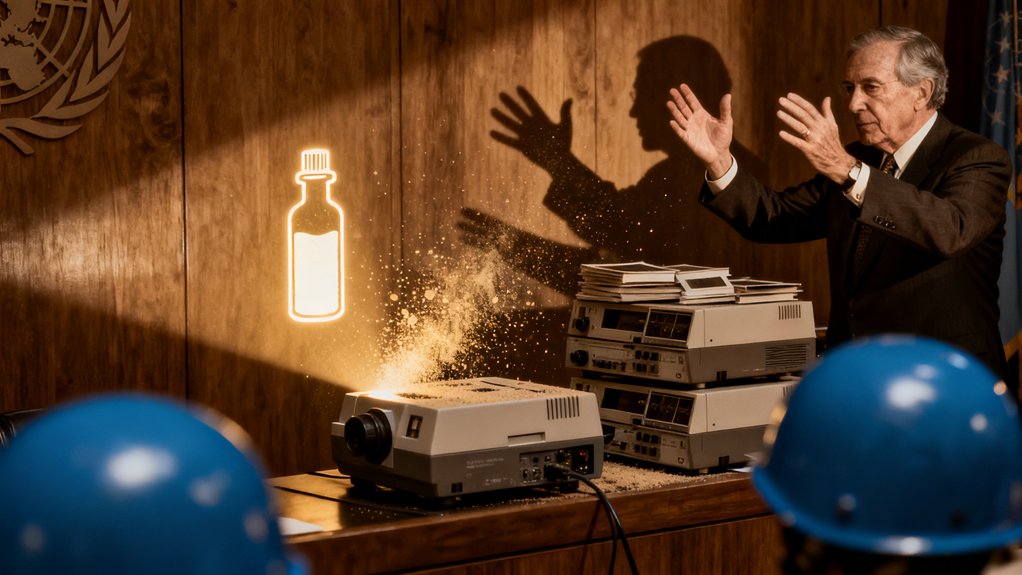
Secretary Powell’s address to the UN on February 5, 2003, becomes the chilling apotheosis of a fabricated certainty, as his drafting team systematically strips every caveat from Curveball’s raw claims, leaving only a veneer of unimpeachable confidence.
The 76-minute performance weaponizes satellite schematics, transforming inert images of non-existent chemical trains into visual proof that persuades a global audience and seals the invasion’s moral urgency.
This calculated theater doesn’t just mislead—it converts intelligence failure into an irrevocable point of no return, where the world’s single most credible voice becomes the final, deceptive authority on war.
Drafting the Address: Stripping Caveats and Amplifying Fabricated Certainty
Even as the now-infamous February 5, 2003, address approached, Powell’s own analysts had already flagged the raw Curveball reporting as too thin to support a single claim. Yet the drafting process consciously inverted that caution.
The team stripped every qualifier, every “unverified” caveat, replacing them with definitive phrasing that manufactured a certainty no intelligence file ever contained. They transformed conditional assessments into declarative absolutes, amplifying Curveball’s fabrications into cornerstones of the presentation.
This wasn’t a mistake—it was a deliberate sleight of hand, executed under pressure to justify an invasion. Powell’s subordinates knew the sourcing collapsed under scrutiny, but they buried that truth in margins, letting the polished fiction dominate the world stage.
That address didn’t expose intelligence; it weaponized a lie. The Secretary delivered it, but the hand that drafted it already knew the well was dry.
The Visual Propaganda: Satellite Schematics of Non-Existent Chemical Trains
As Powell’s pointer traced the schematic’s clean lines across the UN Security Council’s screens on February 5, 2003, the satellite imagery promised something the intelligence community never possessed: a mobile chemical weapons train winding through the Iraqi desert, a tangible threat that existed only in the distorted echo of Curveball’s fabrications.
That visual spectacle clinched the deception. Analysts watched, stunned, as stylized arrows and annotated boxes morphed raw guesswork into cinematic proof.
But the schematics weren’t evidence—they were propaganda’s apex. The CIA lacked a single photograph of that train. They’d Curveball’s fevered tale, repackaged with false precision.
Powell’s 76-minute performance sealed the point of no return, moving a skeptical world toward war on a phantom locomotive. That night, the lies weren’t whispered; they were broadcast, immaculate and lethal.
Crossing the Berm: The March 2003 Invasion and the Evaporating Casus Belli
While the intelligence community’s flawed WMD assessments had already calcified into public dogma by the winter of 2003, the true test of that failure didn’t occur in a briefing room—it happened on the ground.
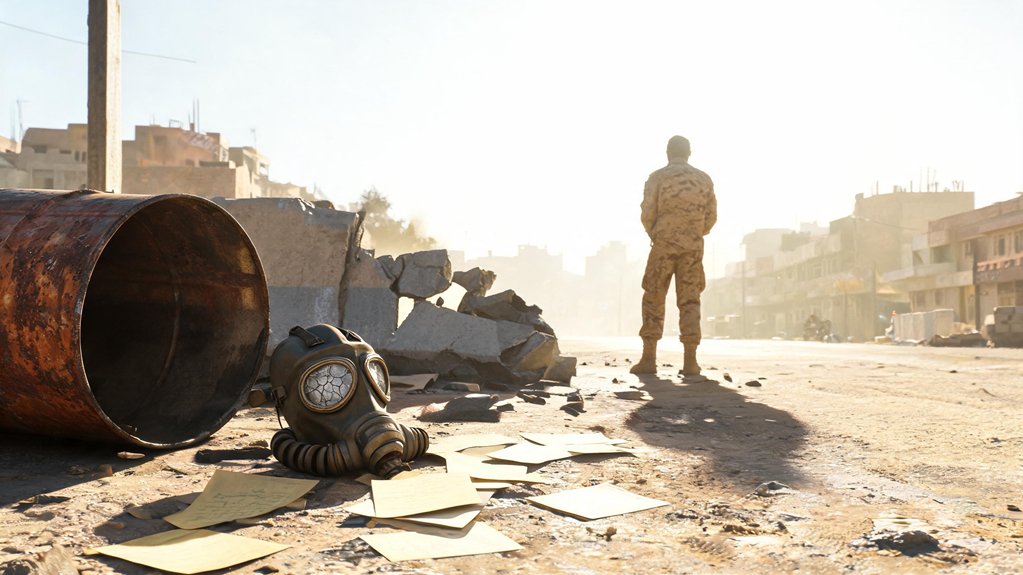
As coalition forces breached the berm on March 20, they carried a casus belli welded to phantom stockpiles. Troops swept through Iraqi facilities expecting laboratories and chemical rounds; they found empty warehouses and sterile documentation.
The invasion’s momentum clashed with an evaporating justification. Every unearthed bunker, every sealed container opened to reveal rust or nothing, stripped another layer from the administration’s narrative.
Soldiers radioed for hazmat teams that never deployed; analysts listened for rocket launches that never came. The war proceeded, but its moral scaffolding collapsed in real time.
What remained wasn’t a threat—just the echo of Curveball’s fabricated tales and a mission launched on faith rather than fact.
Ground Truth and the Iraq Survey Group: Dismantling the Curveball Mythology
The 1,200-man Iraq Survey Group swept through empty warehouses at Taji and beyond, finding nothing but dust where mobile labs were supposed to exist.
Charles Duelfer’s thorough report didn’t just autopsy the intelligence failure—it traced the lies directly back to Curveball, exposing how a single fabricated source hijacked a nation’s war machine.
That ground truth shatters the mythology: no weapons, no program, no justification—only the husk of a ruinous decision built on a con man’s tale.
The 1,200-Man Search Initiative and the Empty Warehouses of Taji
By early 2004, a 1,200-man coalition search initiative descended on Iraq’s sprawling Taji complex—a military-industrial city north of Baghdad—only to find echoing warehouses stripped of everything except dust and illusion.
They swept every bunker, every rail spur, every sealed chamber. Nothing. No chemical precursors, no biological agents, no hidden munitions. The ground truth contradicted the intelligence that had justified invasion.
The Iraq Survey Group’s subsequent forensic work exposed the rot: Curveball’s fabrications had metastasized through the CIA’s bloodstream, unchecked.
Taji’s emptiness wasn’t a failure of search—it was a failure of nerve. Analysts had preferred a compelling lie over an inconvenient absence.
The warehouses didn’t hide WMDs; they hid the uncomfortable reality that the entire pre-war case rested on a ghost.
Charles Duelfer and the Comprehensive Report Autopsying the Intelligence Failure
Taji’s hollow warehouses demanded an answer, and Charles Duelfer—head of the Iraq Survey Group—delivered it in September 2004 with a 1,500-page extensive report that sliced through the Curveball mythology like a scalpel.
Duelfer’s team didn’t hunt for hidden stockpiles; they autopsied the analytical corpse. He traced every contaminated stream back to its source, exposing how Curveball’s fabrications—never vetted, never challenged—became gospel.
The report’s stark conclusion: Saddam had destroyed his WMD programs years prior, but the intelligence machinery preferred a convenient lie over inconvenient truth.
Duelfer didn’t just dismantle the myth; he documented its birth, its unchecked spread, and its deadly consequence. His ground truth wasn’t a defense—it was a confession, forcing policymakers to confront how they’d traded evidence for assertion, and paid in blood.
The Erbil Post-Mortem: Why Tactical Espionage Mechanics Failed the Ultimate Stress Test
Because intelligence is only as sound as the system that vets it, the Erbil station’s tactical collapse wasn’t a failure of collection but a catastrophic breakdown in adjudication—a process where raw field reports, like those from Curveball, leapfrogged the analytical checks designed to catch them.
The station’s handlers fed urgent, ambiguous chatter straight to Washington, bypassing the skeptical review that might’ve stalled the march to war. The stress test exposed three fatal mechanics:
- Source validation was superficial—handlers accepted unverifiable claims as credible because they fit a preconceived threat matrix.
- Analytical isolation—field officers worked in silos, never cross-examining contradictory regional data that could’ve flagged Curveball’s fabrication.
- Urgency over accuracy—the pressure to deliver actionable intel prioritized speed, letting conjecture masquerade as certainty.
Erbil’s post-mortem reveals a system that rewarded narrative confirmation, not truth.
What’s left is a stark lesson: espionage mechanics are only sound if they resist the very urgency that drives them.
A Legacy of Contamination: How a Single Defector Engineered the Pre-War Narrative
Though the postwar investigations would eventually map every bureaucratic misstep, the true origin of the pre-war narrative traces back to a single, unchecked source: Rafid Ahmed Alwan al-Janabi, a defector whose fabrications didn’t just leak into the intelligence stream—they became the stream.
Operating from Erbil, this source fed CIA officers raw claims of mobile bioweapons labs and chemical production. The analysts, starved for concrete proof, embraced his narrative without resolution—no corroboration, no technical validation. They transformed rumor into certainty.
His contamination wasn’t accidental; it was structural. The Bureau of Intelligence and Research repeatedly flagged his unreliability, yet the CIA’s operational momentum overrode skepticism.
By mid-2003, his falsehoods anchored Colin Powell’s United Nations presentation, cementing a deception that triggered invasion.
The legacy isn’t merely a misread—it’s a blueprint of how single-source desperation hijacks institutional rigor. Once emitted, Curveball’s lies required no further verification; they demanded only acceptance.
The stream carried them straight into war.
Frequently Asked Questions
What Specific CIA Protocols Were Bypassed for Curveball’s Reports?
Curveball’s reports bypassed standard validation protocols, including redundant source vetting and polygraph screening.
The CIA’s Directorate of Operations skipped corroboration checks and direct handler access, allowing raw, unverified claims to flow straight into national estimates.
They ignored the “two-source rule” and technical review boards, prioritizing speed over rigor.
That’s how a single, questionable asset’s story became gospel—a shortcut that warped the entire pre-war intelligence picture.
Were Any Dissenting Intelligence Analysts Disciplined After the Iraq Invasion?
Did Congress demand accountability for fabricated intelligence?
Dissenting analysts faced no public discipline post-invasion—official probes like the Senate Select Committee’s 2004 report blamed systemic failures, not individuals.
Careers quietly stalled, but no analyst was fired or demoted for challenging Curveball’s claims.
The intelligence community’s silence protected process over truth, leaving culpability diffuse—a moral stain that still haunts institutional credibility.
How Did Curveball’s Handlers Verify His Access to WMD Sites?
Curveball’s handlers didn’t truly verify his access—they trusted his story.
They relied on his claimed proximity to mobile labs, yet never tested his knowledge against satellite imagery or other collectors. His reports bypassed rigorous checks, sliding straight into classified streams because they fit the desired conclusion.
Analysts pushed back late, but by then, the damage was done—acceptance outpaced proof, and the narrative hardened around a lie they couldn’t catch in time.
What Role Did Iraqi Exile Groups Play in Elevating Curveball’s Credibility?
Iraqi exile groups didn’t just amplify Curveball’s tale; they gave it a shield of legitimacy. Their political interests, keen to topple Saddam, transformed his dubious claims into unchallenged “truth.”
They vouched for his access, pushing aside verification. This isn’t a footnote—it’s a moral breach. They weaponized their credibility, letting a liar’s fiction drive a nation to war.
The exiles’ silence on his flaws wasn’t oversight; it was complicity, and they own a piece of that catastrophe.
Did the CIA Ever Formally Debrief Curveball Face-To-Face Before 2003?
No—the CIA never formally debriefed Curveball face-to-face before 2003.
They relied entirely on indirect reporting from foreign liaisons, never verifying his identity or credibility directly.
This gap proved catastrophic; his unvetted claims flowed straight into intelligence streams, shaping a narrative that justified war.
You can’t escape the moral weight: a single unchecked source, never confronted or questioned, steered history’s deadliest miscalculation.