On February 12, 2003, the HMAS *Dechaineux* nearly sank when a flawed seawater hose ruptured during an in-depth test. This wasn’t an accident; it was a foretold failure. The Australian Submarine Corporation had buried engineers’ warnings to protect its multi-billion-dollar program. A subsequent cover-up labeled it a minor issue, but whistleblowers and journalists exposed the truth, forcing a fleet-wide redesign. The full story reveals how budgets were prioritized over sailors’ lives.
Key Takeaways
- A faulty seawater hose fitting violently ruptured during a 2003 maximum depth test, flooding the submarine and nearly causing its loss.
- The design flaw was a known vulnerability, but internal warnings were systematically downgraded or suppressed to protect the defense program.
- Critical procurement and engineering failures, including the use of unapproved materials, created the pre-existing weaknesses that led to the rupture.
- Following the emergency surfacing, the submarine’s return and damage were concealed using security cordons and restricted access to avoid scrutiny.
- Initial reports were edited to reclassify the near-catastrophe as a minor issue, obscuring the true cause and systemic cover-up.
The Multi-Billion-Dollar Collins-Class Submarine Procurement Gamble
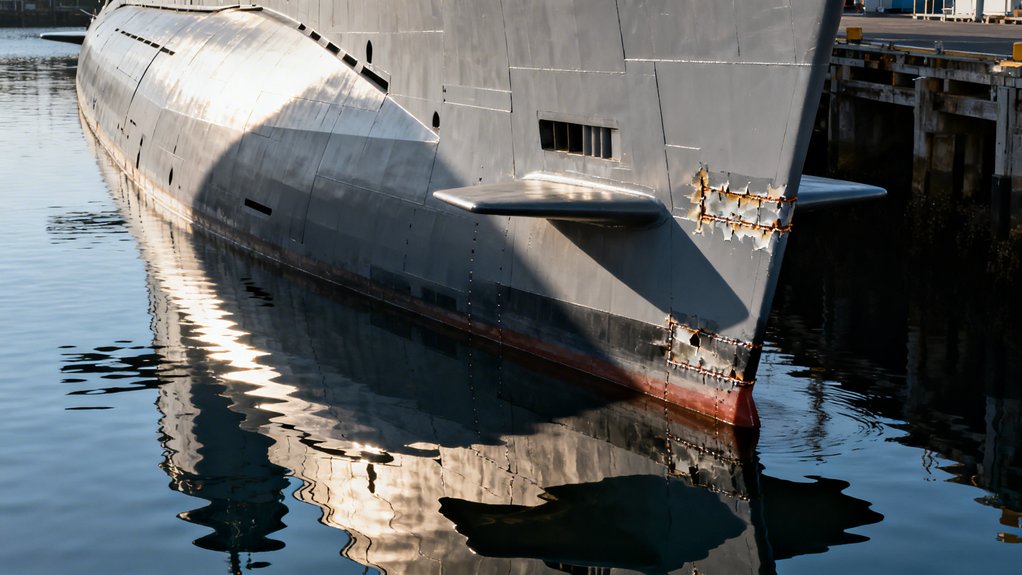
How could a state-of-the-art submarine program, conceived as a cornerstone of national defense, become a vessel of lethal compromise from its very inception? The gamble began with the politically-charged decision to launch a domestic multi-billion-dollar defense procurement program for the Collins-class. This wasn’t just a build; it was a high-stakes national endeavor.
However, the foundational Collins-class submarine problems were woven into its design from the start. Technical warnings about critical systems were disregarded in the rush to advance the project, setting the stage for the broader Australian submarine crisis. This foundational misstep was the first act in the Australian defense procurement scandal, where program momentum and contractual obligations began to overshadow fundamental engineering and safety, foreshadowing the later defense contractor scandals Australia would confront.
Suppressing the Blueprints of Disaster at the Australian Submarine Corporation
The Australian Submarine Corporation didn’t just ignore early engineering warnings; it actively buried assessments that flagged catastrophic structural vulnerabilities.
This suppression prioritized protecting the colossal defense budget over the most fundamental duty: ensuring Royal Australian Navy personnel weren’t sent to sea in a flawed vessel.
Consequently, the very blueprints of disaster were concealed, setting the stage for the near-tragedy aboard HMAS Dechaineux.
Burying the Initial Engineering Assessments of Structural Vulnerabilities
Even as the first Collins-Class hulls were laid down, engineers inside the Australian Submarine Corporation were sounding alarms over fundamental design flaws, but their critical assessments detailing brittle materials and faulty seals were quickly classified and buried by management to shield the lucrative program from scrutiny.
This deliberate suppression created a ticking time bomb, directly enabling the later HMAS Dechaineux incident. The buried warnings specifically highlighted:
- Substandard piping alloys prone to stress corrosion.
- Inadequate pressure testing protocols for critical systems.
- Faulty weld specifications on seawater fittings.
- A systemic culture of dismissing internal safety concerns.
This Australian military cover-up, later exposed by a military whistleblower submarine insider, meant the Royal Australian Navy sailed with vessels harboring known Collins-Class design flaws, prioritizing program continuity over fundamental safety.
Because billions in defense funds were at stake, executives at the Australian Submarine Corporation actively suppressed the catastrophic blueprints documenting the flawed seawater systems, choosing fiscal preservation over the lives of Royal Australian Navy personnel.
This deliberate act explains a core reason why are collins-class submarines bad, prioritizing financial and political interests over fundamental safety.
The suppressed documents specifically detailed the risk of a submarine seawater hose rupture, the very failure that nearly sank HMAS Dechaineux.
This cynical calculus became a dark thread in collins-class submarine history, showcasing how naval disaster cover-ups are orchestrated.
The scandal ultimately reveals a brutal hierarchy: protecting the defense budget over royal australian navy personnel safety was the unspoken policy, gambling sailors’ lives to shield a program’s fiscal viability.
February 12, 2003: HMAS Dechaineux Descends to Maximum Test Depth Off Western Australia
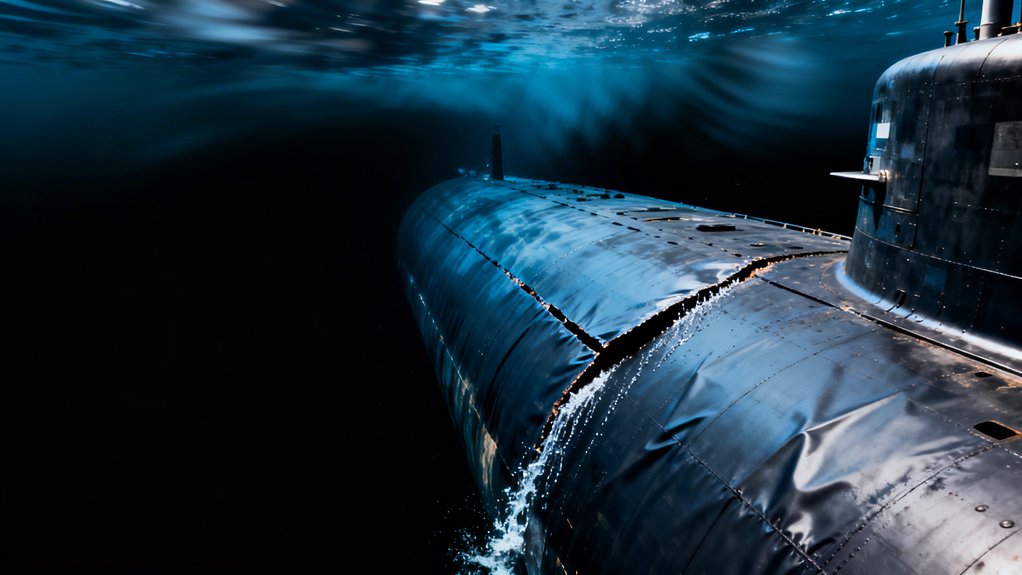
How did a routine test plunge become a crisis for Australia’s navy? On February 12, 2003, HMAS Dechaineux, a Collins-class submarine, commenced a standard thorough analysis off Western Australia to verify its operational envelope. This procedure was meant to confirm the vessel’s structural integrity at its maximum test depth.
However, the descent would directly lead to what happened to HMAS Dechaineux**: the near sinking of HMAS Dechaineux**. As pressure increased, a critical flaw awaited its moment. The crew, unaware of any imminent danger, was conducting a normal evaluation in an environment where any failure carries catastrophic consequences.
The specific conditions of this dive were critical precursors to the disaster:
- The test pushed the submarine to the extreme limits of its designed depth.
- This environment exerted immense hydrostatic pressure on every component.
- Any pre-existing weakness in the submarine’s systems would be catastrophically exposed.
- The HMAS Dechaineux flooding incident wasn’t an accident but a failure triggered by this planned stress test.
The Catastrophic Rupture of the Engine Room Flexible Seawater Hose
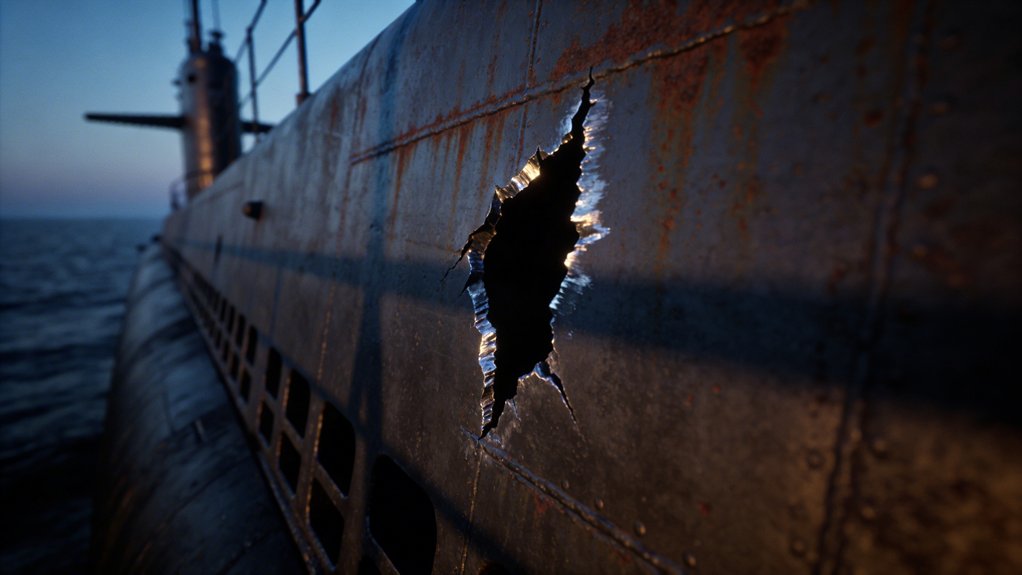
The flexible seawater hose violently ruptured at its coupling, blasting a torrent of high-pressure seawater into the claustrophobic lower engine room.
Crewmen faced a catastrophic ingress that immediately threatened the vessel’s stability and buoyancy.
Each second of flooding brought the submarine’s total weight dangerously closer to exceeding its calculated crush depth.
A Violent Ingress of High-Pressure Seawater Inside the Claustrophobic Lower Deck
When an aging flexible seawater hose suddenly split wide open deep beneath the ocean’s surface, it released a torrent of freezing, high-pressure seawater into the cramped confines of Dechaineux’s engine room. The ingress wasn’t a leak but a catastrophic, full-bore rupture. The sea roared through the breach with such force that it instantly filled the space with a deafening spray, blinding crewmen and soaking critical electrical systems.
This violent event transformed the engineering compartment into a treacherous, flooding chamber where every second counted.
The investigation into the rupture’s severity revealed:
- The hose failure occurred at a critical depth where external water pressure was extreme.
- The flooding rate immediately threatened stability and electrical integrity.
- Crew access to the rupture site was obstructed by the torrent and confined space.
- Standard emergency procedures were overwhelmed by the scale and speed of the ingress.
The Imminent Mathematical Threat of Exceeding Submarine Crush Depth
Yet could this single ruptured hose push the entire submarine past its calculated limits? The mathematics were brutally unforgiving.
Each gallon of flooding seawater directly increased the boat’s displacement and overall weight. As that mass accumulated, the vessel’s buoyancy diminished, causing it to sink deeper into the water column. At these profound depths, the external water pressure increased exponentially with every foot of descent.
The crew wasn’t just battling a leak; they were fighting a runaway equation where the floodwater’s weight could accelerate the dive, pushing the hull closer to its ultimate crush depth—the point where oceanic forces would catastrophically implode the pressure hull. Every second of unchecked flow tightened the mathematical vise.
The HMAS Dechaineux Crew’s Chaotic and High-Risk Fight to Halt the Flooding
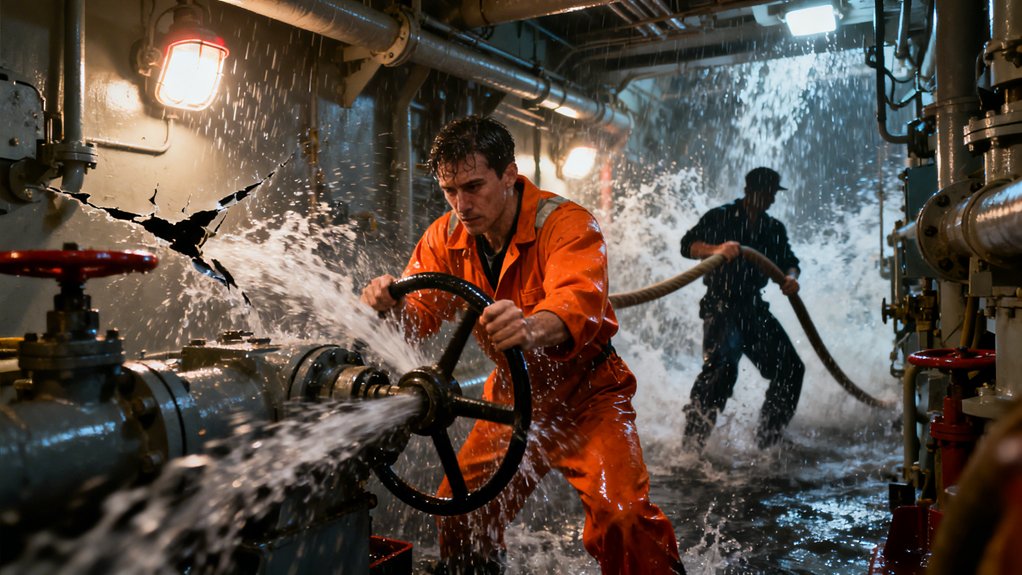
Faced with a violent, high-pressure torrent flooding their engine room at maximum depth, the crew of HMAS Dechaineux initiated a desperate and chaotic struggle for survival. Their actions weren’t a practiced drill but a frenzied, high-stakes reaction to an imminent catastrophe.
Engineers wrestled with bucking hoses while electricians fought to keep critical pumps online, all within a space rapidly filling with icy seawater. Every second weighed the vessel’s fate against the crew’s stamina and ingenuity. This chaotic response exposed the gap between theoretical safety protocols and the brutal reality of a full-scale engineering failure at sea.
- The flooding’s force overwhelmed standard containment procedures immediately.
- Crew actions shifted from procedure to improvisation under extreme stress.
- The fight depended more on individual grit than on pre-designed solutions.
- The event’s chaos revealed a critical lack of realistic, high-pressure flooding training.
Executing the Emergency Blow Procedure to Ascend Before Total Vessel Loss
How could a submarine ascend from the brink of the abyss? With the engine room critically flooded and the vessel losing buoyancy, the commanding officer had one final option: execute an emergency main ballast tank blow. This procedure forced high-pressure air into the tanks, violently displacing seawater to regain positive buoyancy.
It was an act of pure desperation; a failure would mean an irreversible descent. The crew initiated the sequence, hearing the roar of compressed air fighting against the ocean’s immense pressure.
The submarine’s ascent wasn’t graceful—it was a violent, angled climb toward the surface. Every system groaned under the strain, but the blow worked, arresting their fatal dive and beginning a precarious journey upward. This maneuver prevented the total loss of the vessel and all hands.
The Immediate Aftermath and Quiet Docking of the Crippled Submarine
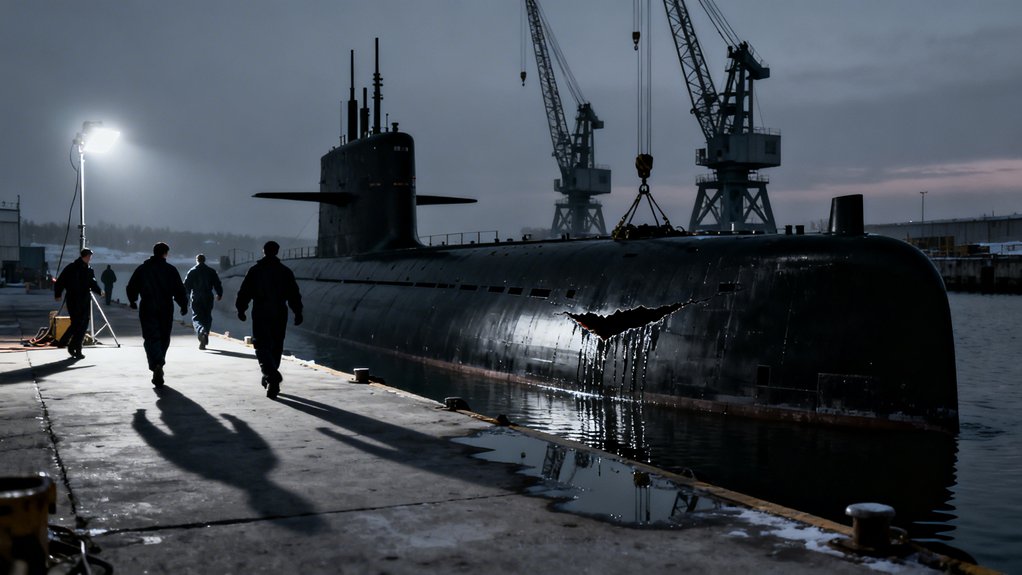
With its integrity compromised but its crew intact, HMAS Dechaineux returned to port under a veil of operational secrecy that masked the severity of its condition. The vessel’s stealthy docking at Stirling Naval Base wasn’t a triumphant return; it was a controlled concealment.
A compromised vessel’s stealthy, controlled return masked its true condition under operational secrecy.
No public fanfare greeted the crew. Instead, a tight cordon of security personnel isolated the submarine, preventing external observation. The rapid, quiet offloading of the traumatized sailors aimed to disperse witnesses before any detailed accounts could coalesce. The crippled submarine, now a silent evidence to systemic failure, was immediately sequestered for a closed-door damage assessment, its true state hidden from all but a select few.
- The arrival was orchestrated to avoid any public or media scrutiny.
- A security cordon physically isolated the vessel from the base’s normal operations.
- Crew members were rapidly disembarked and dispersed to limit collective testimony.
- The submarine was taken directly into a secured, restricted-access maintenance facility.
Orchestrating the Post-Incident Cover-Up Between Defense Contractors and Parliament
Following the near-sinking, key figures within the defense department and contracting firms aggressively manipulated the initial damage reports, purging any mention of the seawater hose’s catastrophic failure as a systemic flaw. These falsified dossiers mirrored the methods of Operation Paperclip, where incriminating records were systematically altered to protect strategic assets.
They then coordinated a quiet but intense campaign to silence internal whistleblowers who threatened to expose the truth, using reassignments and legal threats to shield the procurement program.
This clandestine partnership effectively buried the lethal vulnerabilities, ensuring Parliament and the public remained unaware of the grave risks still present across the entire Collins-Class fleet.
Manipulating Initial Damage Reports to Downplay the Lethal Collins-Class Flaws
Even as the crippled HMAS Dechaineux was being hauled back to port, a parallel operation began in Canberra and corporate offices to sanitize the official narrative.
Defense contractors and parliamentary figures worked to reclassify the near-catastrophe as a minor “engineering issue,” not a systemic failure. They edited the initial damage reports to obscure the fact that a faulty seawater hose fitting—a known, documented vulnerability—had caused the massive flooding. This deliberate manipulation aimed to deflect scrutiny from the Collins-class’s lethal flaws and protect the procurement program.
The sanitized reports systematically:
- Changed the incident’s cause from “catastrophic design flaw” to “isolated component failure.”
- Removed all references to prior warnings about the hose assemblies.
- Downgraded the severity from “near-loss of vessel” to “contained flooding event.”
- Omitted the fact that identical fittings existed across the entire submarine fleet, creating a universal risk.
Shielding the Procurement Program From Internal Defense Whistleblowers
As whistleblowers within the Royal Australian Navy began preparing damning testimony about the Collins-class flaws, defense contractors and key parliamentarians coordinated to isolate and silence them. They launched a multi-pronged campaign, labeling the concerned personnel as disloyal or incompetent to destroy their credibility.
Parliamentary committees, influenced by vested interests, blocked attempts to formally hear their evidence. Internal memos were classified to prevent disclosure, while loyal officers were instructed to marginalize the whistleblowers through transfers and poor performance reviews. This orchestrated suppression guaranteed that critical warnings about the submarine’s propulsion system and hull integrity never reached a public forum, successfully shielding the multi-billion-dollar procurement program from scandal and accountability for years.
Internal Whistleblower Leaks Shatter the Coordinated Bureaucratic Silence
Because the coordinated silence had maintained the illusion of safety, internal whistleblower leaks began methodically dismantling it.
These weren’t random disclosures but targeted acts of conscience from within the defense establishment itself.
Insiders, horrified by the suppressed engineering warnings and the near-catastrophe, started funneling classified documents and internal memos to trusted channels.
Their actions pierced the bureaucratic veil, revealing a deliberate pattern of obfuscation that mirrored the Kehoe Rule, demanding impossible proof of catastrophic failure before acting on systemic risks.
The leaks provided the first tangible proof that the HMAS Dechaineux’s hose rupture wasn’t an isolated failure, but a symptom of known, systemic flaws.
The leaked materials vitally exposed:
- Internal risk assessments that flagged the seawater system as critically vulnerable years before the incident.
- Deliberate edits to technical reports that softened language regarding component failure probabilities.
- Direct orders to withhold certain damning findings from broader circulation within the Navy.
- Documentation showing contractor concerns about the hose specifications were overruled for cost and schedule reasons.
Relentless Investigative Journalism Forces the Withheld Hose Rupture Evidence Into Public Light
While the bureaucracy had attempted to bury the truth, a dogged pursuit by journalists finally dragged the evidence of the flawed seawater hose into public view. Investigative reporters, armed with whistleblower accounts, bypassed official channels and pieced together the suppressed technical facts. They revealed the hose wasn’t a simple component failure, but a symptom of a disregarded design flaw. Their persistent FOI requests and cross-referencing of declassified snippets forced the navy’s hand, compelling an official acknowledgment that contradicted years of muted statements.
| Journalistic Action | Evidence Uncovered | Impact on Narrative |
|---|---|---|
| Forensic FOI Requests | Internal memos on hose material specifications | Exposed prior knowledge of substandard parts |
| Corroborating Sources | Engineer testimonies on pressure test failures | Shattered the “isolated incident” claim |
| Analyzing Leaked Photos | Images of the ruptured fitting’s corrosion | Visually proved systemic maintenance neglect |
This journalistic pressure created an undeniable public record, making continued obfuscation politically untenable and setting the stage for official inquiries.
Declassified Engineering Assessments Expose the Systemic Concealment of Design Failures
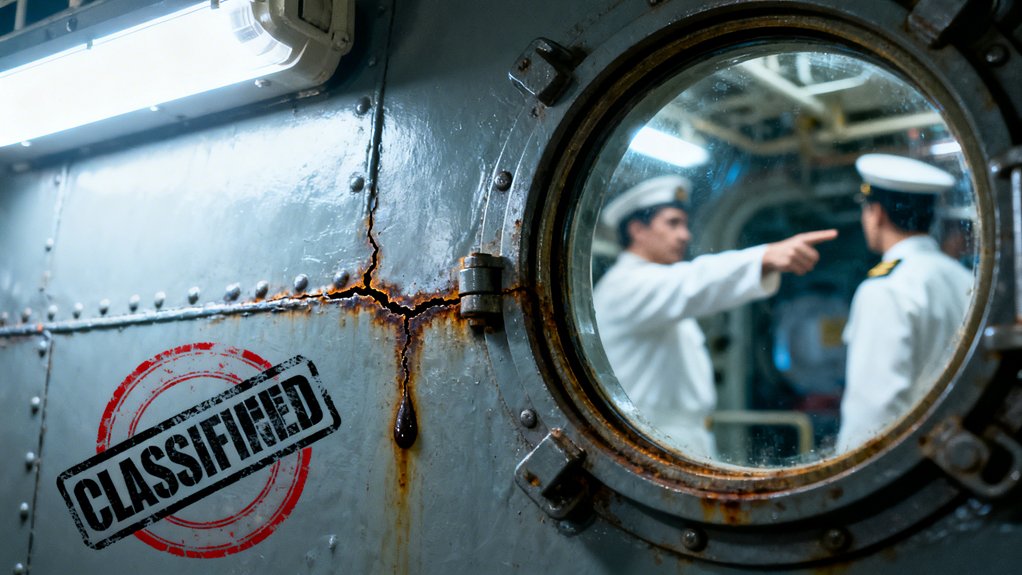
Beyond the journalists’ revelations, the government’s own declassified engineering assessments laid bare the scope of the concealment.
These internal documents confirmed a deliberate, systemic effort to bury catastrophic design flaws within the Collins-class program.
They exposed how initial warnings about the submarine’s seawater systems were systematically downgraded or omitted from official safety records.
The assessments proved the hose failure wasn’t a random accident but a predictable result of compromised engineering that multiple internal reviews had identified years prior.
The declassified files revealed a pattern of calculated obfuscation:
- Critical Design Non-Compliance: Original contractor specifications for high-pressure hoses and fittings weren’t met, using inferior, unapproved materials.
- Suppressed Failure Analysis: Early fatigue testing predicted the exact rupture mode, but these reports were sealed.
- Altered Risk Classifications: Known vulnerabilities in the cooling system were deliberately categorized as “minor” to avoid mandatory fixes.
- Circumvented Certification: Systems were signed off as operational despite engineers’ formal, written objections about their integrity under deep-dive pressures.
- Unsubstantiated Claims: This culture of concealment mirrors the promotion of medical devices based on unreproducible results rather than validated engineering.
Political Inquiries and the Formal Fallout of Systemic Bureaucratic Hubris
Political inquiries began demanding contractor accountability during combative defense committee hearings.
These hearings forced mandatory, safety-critical redesigns of the Collins-Class cooling infrastructure.
The formal fallout exposed systemic bureaucratic hubris as legislators confronted those responsible.
Demanding Contractor Accountability During Combative Defense Committee Hearings
Evidence mounts in combative committee hearings, as military brass and civilian contractors come face-to-face with lawmakers demanding accountability for the Dechaineux disaster. The inquiry’s spotlight burns on the contractors who supplied the failed seawater system.
Lawmakers grill them on ignored warnings, cost-cutting pressures, and flawed quality assurance that led to the near-catastrophe. Every evasive answer deepens the scandal, revealing a partnership where safety became secondary to schedule and profit.
The hearings dissect a chain of failed oversight:
- Internal audit reports that flagged substandard hose fittings were dismissed.
- Pressure to maintain delivery timelines overrode critical engineering reviews.
- Contractual ambiguity diffused responsibility for component certification.
- A culture of commercial confidentiality obstructed the flow of crucial defect data to the Navy.
Mandated Safety Redesigns of the Collins-Class Cooling Infrastructure
As the political inquiries into the Dechaineux disaster concluded, their formal findings mandated a complete and urgent redesign of the Collins-Class submarines’ flawed cooling infrastructure, forcing a billion-dollar reckoning upon the program’s hubris.
Engineers replaced the entire network of critical seawater hoses, whose material fatigue had caused the rupture.
They abandoned the original, failure-prone couplings for a forged, high-integrity design.
The retrofit program, codenamed SEA 1439, didn’t just swap parts; it reconfigured the entire engine-room piping layout to eliminate stress points and install redundant shut-off systems accessible during a flood.
This wasn’t a simple fix; it was an admission that the original design’s latent defects had nearly sent a boat and its crew to the ocean floor.
The Lasting Legacy of the HMAS Dechaineux Near-Sinking on Australian Military Procurement
Although its crew miraculously survived, the near-catastrophic flooding of HMAS Dechaineux permanently altered Australia’s military procurement arena by forcing a reckoning with the deadly costs of concealed engineering failures.
The incident shattered the culture of secrecy, mandating unprecedented transparency and rigorous, independent validation of critical systems before acceptance.
It created a powerful institutional memory, ensuring the Dechaineux serves as a constant, non-negotiable benchmark for safety in all future naval projects.
This legacy directly shaped the demanding oversight protocols for subsequent programs, including the AWD destroyers and the Attack-class submarine project, embedding a doctrine that prioritizes operational integrity over political or industrial expediency.
- Mandated Independent Verification: All critical system designs now require certification from independent, third-party engineering authorities.
- Enhanced Whistleblower Protections: New frameworks were established to protect personnel reporting safety defects without fear of reprisal.
- Public Accountability Measures: Major defense projects are subject to more frequent and detailed public reporting to Parliament.
- Cultural Shift in Risk Assessment: A “safety-first” culture replaced one where schedule and cost could override fundamental engineering concerns.
Frequently Asked Questions
How Many Crew Were Aboard During the Incident?
There were 55 crew members aboard HMAS Dechaineux during the near-catastrophic flooding incident in 2003. Each faced a harrowing fight for survival as high-pressure seawater violently breached the hull.
The claustrophobic chaos and shared danger bind their experience, highlighting the immense human risk concealed by bureaucratic failures. This specific number underscores the scale of the potential tragedy had their desperate damage-control efforts failed.
Did Anyone Face Criminal Charges for the Cover-Up?
No criminal charges ever pierced the cover-up’s armor. Inquiries produced scalding reports, not prosecutions, as responsibility dissolved in a bureaucratic fog. The official probes acted like spotlights, exposing negligence and manipulation, yet the legal system lacked the teeth for a criminal case.
Ultimately, no individual or corporation faced a courtroom for suppressing the lethal flaws; accountability became a phantom, lost between flawed procurement and institutional self-preservation.
What Were the Specific Flaws in the Hose Design?
The hose’s specific flaws included a critical failure in its crimping design, which compromised the bond between the hose lining and its fittings. This design weakness, combined with the use of non-standard, inferior materials that couldn’t withstand sustained high pressure, created a lethal vulnerability.
The flawed crimp allowed the hose to catastrophically separate at depth, leading to the massive, high-pressure seawater flooding that nearly sank the submarine.
How Much Extra Did Fixing All the Submarines Cost?
The required fix across the entire Collins-Class fleet cost approximately AU$100 million. This retrofitting expense, primarily for redesigned and reinforced seawater systems, directly addressed the catastrophic hose failures.
It represented a massive financial overrun that was quietly absorbed into the defense budget, a direct consequence of the initial suppression of the design flaws and the ensuing emergency remediation program forced by the Dechaineux incident.
Are Any of the Flawed Hoses Still in Service Today?
No official confirmation states flawed hoses remain in service. Investigations mandated a full system audit and replacement program across the Collins-class fleet after the Dechaineux incident.
While replacement programs were implemented, the exact completion status and any residual risk from older components aren’t publicly documented.
The secrecy surrounding the initial cover-up means complete public transparency regarding current hose integrity isn’t guaranteed.
Final Thoughts
Her investigations revealed one shocking statistic: a single, suppressed engineering report had detailed the risk years earlier. They’d concealed it to shield a $5 billion program. This deliberate act nearly sent 55 crew and a submarine to the ocean floor. The Dechaineux cover-up exposed how bureaucratic and corporate interests weaponized secrecy, leaving sailors to battle a catastrophic flaw they were never meant to face.