
The theory that Roberto Calvi took his own life doesn’t hold up—his body, found hanging beneath Blackfriars Bridge with bricks in his pockets and cash in multiple currencies, showed no signs of water in the lungs, and his clothes were dry. Someone went to great lengths to stage the scene. Powerful interests had reason to silence him, and evidence points to a cover-up reaching into the highest levels of finance, crime, and the Vatican.
Key Takeaways
- Roberto Calvi, known as “God’s Banker,” was found dead under London’s Blackfriars Bridge in 1982, officially ruled a suicide but widely believed to be murder.
- Forensic evidence, including neck trauma and dry clothing, proved Calvi was murdered, not suicidal, and his body was staged to resemble a hanging.
- Calvi’s ties to the Vatican Bank and the secret P2 lodge linked him to a vast network of financial crime, corruption, and organized crime.
- The Vatican Bank used its sovereign status to facilitate money laundering for the Mafia and hide illicit flows through offshore shell companies.
- Despite strong suspicions of Mafia involvement and a high-level cover-up, all suspects were acquitted due to lack of evidence, leaving the murder unsolved.
Who Was Roberto Calvi?
Roberto Calvi didn’t just run Italy’s second-largest bank—he moved billions tied to the Vatican Bank, earning him the name “God’s Banker.” His dealings hid behind offshore shells, and his sudden death followed a trail of missing funds and silenced witnesses. Now, the truth about his double life and the Church’s role may finally be catching up with the facts.
The Vatican Bank Connection
Though tied to the highest levels of financial and religious power, Roberto Calvi wasn’t just a banker—he was the chairman of Banco Ambrosiano, Italy’s second-largest bank, and the central figure in a web of secret dealings with the Vatican Bank, officially known as the Institute for Religious Works (IOR). The vatican bank held significant influence over Ambrosiano, using it to shift billions through shell companies and dodge Italian financial laws. The Institute for Religious Works approved opaque loans and backed risky transactions, deepening the scandal. When Ambrosiano collapsed in 1982, owing up to $1.5 billion, the IOR denied criminal ties but admitted moral responsibility, paying $224 million in 1984. Archbishop Paul Marcinkus, head of the IOR, maintained close links to Calvi. Documents later revealed Calvi had safeguarded Vatican funds worldwide—secrets that may have sealed his fate. He was found dead under Blackfriars Bridge, silenced before he could expose more.
A Life Of Secrets
Long entwined with power and secrecy, Roberto Calvi built a career that spanned decades of financial intrigue in Italy. As chairman of Banco Ambrosiano, he moved vast sums through shadow networks tied to the Vatican and global elites. His life unfolded behind closed doors, guarded by loyalty oaths and hidden alliances.
- Roberto Calvi rose through Banco Ambrosiano, becoming chairman in 1975, steering it into international dealings with offshore fronts
- He was convicted in 1981 for smuggling $27 million abroad, a crime linked to Banco Ambrosiano’s collapse and its Vatican Bank ties
- A member of the secret P2 lodge, Calvi consorted with Mafia figures, politicians, and spies, shielding corrupt financial flows
His death was no accident—it was a message. Roberto Calvi knew too much, and his silence was bought with bricks and Blackfriars fog.
The Vatican Bank’s Role in Calvi’s Empire
The Vatican Bank wasn’t just a financial player in Calvi’s empire—it was central to its operations, holding significant stakes and enabling offshore flows. Leveraging its sovereign status, the Holy See shielded transactions from Italian regulators, allowing billions to move through shell companies with no oversight. With Archbishop Marcinkus at the helm, the IOR maintained secrecy while building a network that linked the highest levels of Church finance to Calvi’s collapsing bank.
Vatican Bank Ties
A web of clandestine financial ties bound the Vatican Bank to Roberto Calvi’s collapsing empire, with the Institute for Religious Works (IOR) serving as a key enabler of Banco Ambrosiano’s unchecked expansion. Vatican Bank ties ran deep through offshore shells and secret accounts, all under the watch of Archbishop Paul Marcinkus, who shielded Calvi’s maneuvers from regulators. The IOR funneled billions in untraceable funds, exploiting its sovereign status to bypass oversight.
- The IOR was Banco Ambrosiano’s main shareholder, enabling massive, undocumented transfers
- Archbishop Paul Marcinkus oversaw nominee accounts that hid true ownership of Vatican-linked capital
- Offshore fronts in Luxembourg and the Caribbean concealed money from Italian auditors
After the 1982 collapse left $1.3 billion in debt, the Vatican admitted “moral responsibility” and paid $224 million—without accepting legal liability—a move that silenced creditors but not the truth seekers.
Holy See Finances
Holy See finances funneled billions through the Institute for Religious Works (IOR), which acted as both patron and protector of Roberto Calvi’s Banco Ambrosiano. The Vatican Bank exploited its tax-free, unregulated status to enable covert financial ties with Calvi, moving vast sums through offshore shells. Archbishop Paul Marcinkus led the IOR as it held nominee accounts for fictitious firms tied to Calvi’s empire—accounts used to launder money, though the Holy See denied legal culpability. After the bank’s 1982 collapse, the Vatican admitted moral responsibility and paid $224 million to creditors, a gesture of accountability without legal consequence. Despite subpoenas revealing systemic opacity, no direct evidence proved the Holy See authorized crimes—only that it provided the infrastructure.
| Entity | Role | Financial Link |
|---|---|---|
| IOR (Vatican Bank) | Financial conduit | Held nominee accounts |
| Banco Ambrosiano | Shell hub | $1.5B in hidden debts |
| Marcinkus | IOR Director | Oversaw Calvi’s transfers |
| Holy See | Sovereign authority | Shielded by diplomatic status |
How Banco Ambrosiano Collapsed Under Fraud
Banco Ambrosiano collapsed in 1982 after a web of fraudulent loans and fake credit lines funneled billions through offshore fronts tied to the Vatican Bank. The IOR wasn’t just a silent partner—it backed shell companies that moved over $1.5 billion in illicit transfers. When the scheme unraveled, the bank’s fall exposed a criminal network linking Rome’s financial elite to organized crime and secret Vatican accounts.
The Vatican Connection
Though the Vatican never admitted legal guilt, its financial entanglement with Banco Ambrosiano fueled the bank’s dramatic collapse in June 1982, when $27 million in illegal transfers triggered a crisis that exposed a web of offshore shell companies and secret accounts. The Vatican Bank—formally the Institute for Religious Works—was central to the scheme, moving billions in unregulated transactions. Archbishop Paul Marcinkus enabled Roberto Calvi’s web of fraud, using the IOR’s secrecy to bypass oversight.
- Vatican Bank acted as main shareholder and conduit for illicit cross-border fund flows
- Institute for Religious Works shielded $1.5 billion in missing funds tied to South American loans and covert operations
- IOR accepted moral responsibility in 1984, paid $224 million to creditors, but claimed legal immunity
Power protected silence. The truth, though buried, isn’t gone.
Financial Web Unravels
Roberto Calvi’s empire began to crumble as investigators uncovered layers of deception beneath Banco Ambrosiano’s operations. The bank’s collapse in June 1982 exposed debts up to $1.5 billion, fueled by illegal transactions masked as legitimate loans. Bancо Ambrosіanos relied on shell companies in Luxembourg and Latin America to dodge Italian financial laws and move money undetected. As early as 1978, the Bank of Italy flagged billions in illicit capital flight, but no decisive action followed. The Vatican’s Institute for Religious Works, the bank’s main shareholder, facilitated secretive transfers and shielded offshore dealings. When the fraud unraveled, the scale of corruption stunned regulators. Though the Vatican later admitted moral responsibility and paid $224 million to creditors, full accountability never came. The truth stayed buried—proof that when power and finance collide, the system protects its own.
How the Mafia Used Calvi’s Banking Network
The Mafia turned Calvi’s bank into a money laundering machine, routing drug profits through a web of offshore shells in Latin America and Luxembourg. His ties to the Vatican Bank let them move cash undetected, bypassing Italian regulators with ease. These illicit flows formed a hidden financial network that sustained organized crime—until the collapse threatened to expose it all.
Money Laundering Machine
How did Mafia fortunes flow undetected through Europe’s financial arteries? The Italian banker Roberto Calvi turned Banco Ambrosiano into a global money laundering machine, moving over $1.5 billion through shell companies in Panama and Luxembourg. With help from the Vatican Bank—officially the Institute for Religious Works (IOR)—billions in drug profits passed as legitimate finance. Calvi forged letters of credit and faked loans, including $27 million diverted to crime-linked South American ventures. The system thrived on secrecy, exploiting offshore loopholes and religious immunity. When the bank collapsed, the Mafia lost millions—and the truth risked exposure.
- Banco Ambrosiano moved illicit funds via Panama and Luxembourg shells
- The Vatican Bank processed dirty money with no oversight
- Fake loans and forged credits disguised narco-cash as capital
Liberation begins with following the money—where power hides, crimes fester.
Mafia Financial Network
Banco Ambrosiano didn’t just move money—it became the Mafia’s financial bloodstream, channeling drug profits and embezzled millions through a maze of offshore shells. The mafia exploited Calvi’s network to hide illegal transactions, funneling cash through the Vatican Bank and phantom firms in Luxembourg and the Bahamas. These maneuvers masked dirty money as legitimate, bypassing Italian oversight and inflating false balances. When losses mounted and exposure loomed, mafia bosses like Pippo Calò and Licio Gelli saw Calvi as a liability. He no longer protected their wealth—instead, he threatened it. With $1.5 billion vanished and ties to the P2 lodge at risk of exposure, silence became essential. The mafia didn’t tolerate loose ends. Calvi’s 1982 murder at Blackfriars Bridge wasn’t random—it was ordered, precise, a message wrapped in bricks and river water. His death sealed lips, buried truths, and preserved a system built on corruption, secrecy, and illegal transactions that still haunt global finance.
Secret Masonic Ties: The P2 Lodge Exposed
The P2 lodge wasn’t just a secret society—it was a shadow government with tentacles in finance, politics, and crime. When police raided a villa in 1981, they found a list of 962 members, exposing a network that included top bankers, generals, and even future Prime Minister Silvio Berlusconi. Calvi’s role in P2 and his nickname “man of Providence” pointed directly to a brotherhood that operated above the law.
The P2 Lodge Uncovered
Though buried in secrecy, the Propaganda Due (P2) Lodge emerged into the light in 1981 when police raided Licio Gelli’s estate and uncovered a membership list implicating 962 influential figures. The propaganda due, led by Licio Gelli, operated as a clandestine power network embedded in Italy’s highest institutions. Gelli’s “black friars” swore loyalty not to the state, but to him—effectively creating a shadow government.
- P2 infiltrated military, political, and financial elites, including future PM Silvio Berlusconi
- Roberto Calvi, a top P2 member, funneled Vatican and Mafia-linked money through Banco Ambrosiano
- The lodge was dissolved in 1982 after being exposed as a subversive force behind Italy’s political and financial crises
This exposure didn’t bring justice—it revealed how deep the rot went. The public deserved answers, not cover-ups. Power had operated in the dark long enough.
Masonic Networks Exposed
While police never formally tied the murder to the lodge, Calvi’s deep ties to Propaganda Due (P2) thrust its secret Masonic network into the spotlight—exposing a covert web of power that stretched from high finance to the Vatican. Led by licio gelli, P2 operated as a state within a state, with over 900 members including bankers, officials, and spies. They called themselves “frati neri,” their black robes mirroring the shadows they wielded. The 1981 discovery of the membership list at gelli’s villa confirmed what many suspected: propaganda due manipulated Italy’s institutions for decades. Calvi funneled money for the Vatican Bank and Mafia-tied interests, all under P2’s guidance. Licio gelli was later investigated for ordering Calvi’s silencing. The location—beneath Blackfriars Bridge—was no coincidence. It was a message. These secret rites, financial crimes, and elite impunity had built a system built on control. Now, it was cracking open.
What Happened on Blackfriars Bridge?
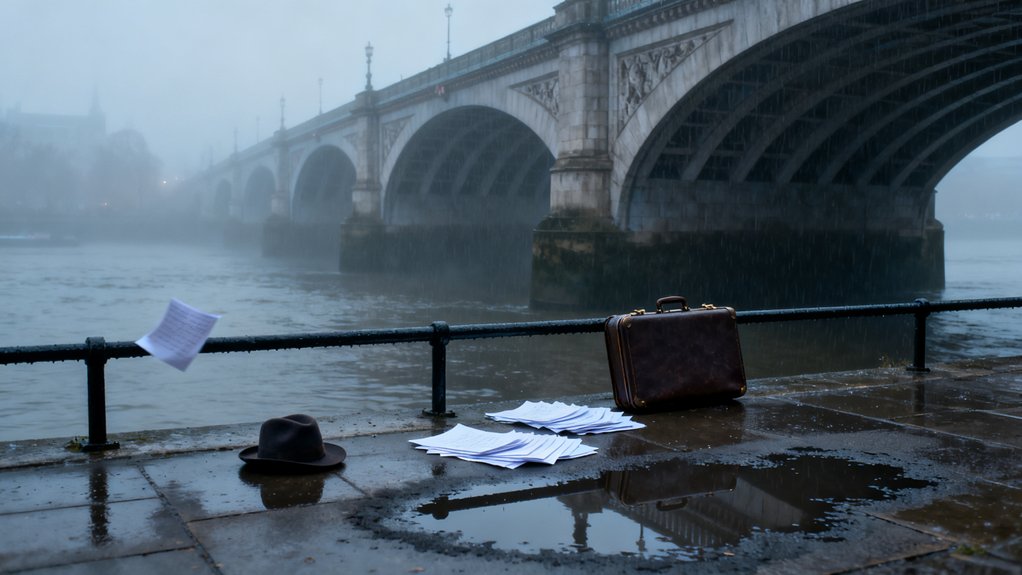
Roberto Calvi’s body was found hanging beneath Blackfriars Bridge on June 18, 1982, weighted with bricks and carrying cash, a fake passport, and multiple watches. The scene showed signs of staging—tide damage didn’t match the body’s position, and paint on his shoes didn’t come from the bridge’s scaffolding. Authorities later concluded he didn’t kill himself, and evidence points to murder.
Body Found Under Bridge
How did a man with bricks in his pockets and a false passport end up hanging beneath Blackfriars Bridge? Roberto Calvi’s body was found under Blackfriars Bridge on 18 June 1982, weighted with five bricks and clutching $14,000 in three currencies. Dressed in a dark suit, he carried a fake passport under the name Gian Roberto Calvini with a valid Brazilian visa—evidence hinting at escape.
- Body discovered hanging from scaffolding, bricks in pockets, cash on person
- Initial inquest ruled suicide; 1983 jury returned open verdict due to inconsistencies
- Calvi wore multiple watches and carried identification suggesting flight plans
His position, clothing, and the tidal evidence raised immediate doubts. A 1998 exhumation confirmed neck trauma inconsistent with hanging. The scene under Blackfriars Bridge didn’t add up—Calvi wasn’t fleeing. He was silenced.
Evidence Pointing To Murder
Something wasn’t right at Blackfriars Bridge. Roberto Calvi’s body, found hanging with five bricks in his pockets, showed signs far from suicide. Forensic review in 2003 revealed neck injuries inconsistent with hanging; no brick residue was on his hands, proving he didn’t place them there. The tidal and paint evidence confirmed green fragments on his shoes didn’t match the bridge’s scaffolding—his body had been moved, likely by boat. Calvi, who suffered from vertigo and poor physical health, couldn’t have climbed the narrow, steep structure alone. His missing briefcase—with sensitive financial documents—points to a deliberate cover-up. Uneven soaking on his clothes suggests the body was staged. Whoever placed him at Blackfriars Bridge wanted it to look like suicide. But the facts scream otherwise. Roberto Calvi was silenced—his death a message buried under layers of lies.
Was Calvi’s Death Suicide or Murder?
The official suicide ruling quickly drew skepticism as evidence emerged that didn’t add up. Calvi’s body showed signs of manipulation, and forensic tests later proved he couldn’t have placed the bricks in his own pockets. With tampered documents, foreign mud on his shoes, and a neck injury incompatible with hanging, investigators began treating his death as murder. Just as with the Lavon Affair forgeries, fabricated records were used to obscure the truth and shield powerful figures from accountability.
Suicide Ruling Under Scrutiny
Why would a man commit suicide and carry bricks, cash in foreign currencies, and a fake passport? The suicide ruling never added up. Calvi’s death sparked immediate doubts, with forensic tests exposing fatal flaws in the official narrative. Evidence pointed away from self-inflicted death and toward a staged scene designed to mislead.
- The 1983 inquest returned an open verdict after inconsistencies undermined the suicide theory
- Forensic tests in 2003 revealed neck injuries incompatible with hanging and no signs of climbing
- Experiments confirmed Calvi, who had vertigo, couldn’t have scaled the narrow scaffolding alone
Authorities ignored red flags linking Calvi’s death to powerful forces. The suicide ruling collapsed under scrutiny, exposing a cover-up. Forensic tests ultimately proved he was murdered—truth buried, then unearthed. Justice delayed, but not erased.
Evidence Pointing To Murder
Though official reports first labeled it suicide, mounting forensic evidence quickly undermined that claim, revealing a scene staged to mislead. Roberto Calvi’s body showed no rope burns on his hands, and neck injuries contradicted hanging, pointing instead to murder. Tidal patterns and dry clothes proved he didn’t enter the river alive. The bricks in his pockets—weighing 12 pounds—were meant to sink him, not mimic suicide. His shoes had no wear from the foreshore or ladder, and green paint fragments didn’t match Blackfriars’ scaffolding. Calvi suffered from vertigo and was physically unfit to scale the structure. A 2003 review by Italian experts confirmed he couldn’t have hanged himself. Documents went missing, and a fake passport, extra watches, and cash were found—signs of a setup. The evidence doesn’t lie: Roberto Calvi was murdered, not by despair, but by those who silenced him.
The Significance of the Bricks in His Pockets
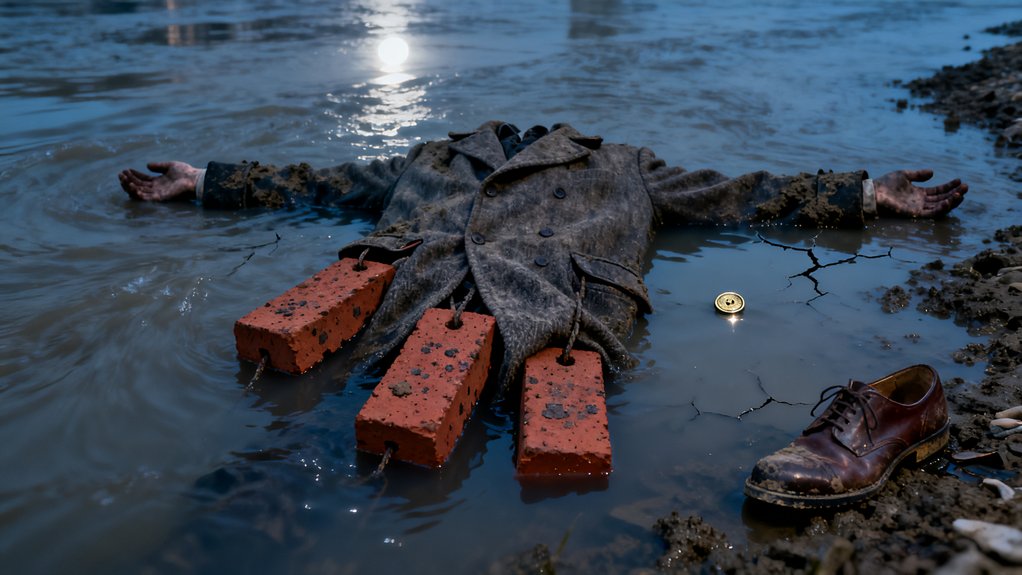
The five bricks in Calvi’s pockets weren’t just ballast—they were a message. Their placement suggests a ritualistic signature, possibly tied to Mafia or secret society symbolism. Whoever staged the scene used the weight not only to sink the body but to send a warning.
Bricks As a Signature
Bricks spoke louder than words in the silent aftermath beneath Blackfriars Bridge. The five bricks in Roberto Calvi’s pockets weren’t just ballast—they were a message. Placed with precision, they defied suicide logic and pointed to a calculated staging. Forensic evidence showed the body had been moved; dirt on his clothes didn’t match the scene. The bricks, likely inserted post-mortem, revealed a killer’s intent to mislead. Calvi’s poor health made climbing with such weight nearly impossible, undermining the official narrative.
- Bricks used to sink the body, suggesting a staged escape gone wrong
- Placement mirrored Masonic punishment rituals, implicating secret societies
- Post-mortem insertion confirmed by reinvestigation, exposing flaws in initial verdict
The bricks at Blackfriars Bridge weren’t random—they were a signature, left by those who operate in shadow.
Symbolism of the Weights
Five bricks in Roberto Calvi’s pockets screamed more than they sank. Weighing five and a half kilos, the bricks weren’t just ballast—they carried symbolism. Placed deliberately, they guaranteed his body stayed hidden beneath the Thames, a message submerged with the man. Forensic evidence showed no scuff marks on his shoes, meaning he didn’t climb down alone. Someone else put him there. The bricks, crude and common, echoed Mafia codes—construction materials turned tools of burial. In underworld parlance, bricks build empires or seal coffins. Here, the symbolism pointed to silencing. Calvi knew too much: Vatican finances, Mafia cash, Cold War deceits. His death wasn’t just murder; it was a warning. The bricks weren’t an afterthought—they were a signature. Those weights weren’t meant to sink a man, but a truth. Liberation begins when symbols are read correctly.
Who Was Convicted in Calvi’s Murder Trial?
Five suspects stood trial in Rome for Calvi’s murder, but the court acquitted all in 2007 due to lack of evidence. Though judges agreed he was murdered, they couldn’t prove who was responsible. The verdict left the case unresolved, with no one ever convicted for the killing at Blackfriars Bridge.
Trial Verdict Unresolved
Who pulled the strings behind Calvi’s death? Despite a trial involving five people—Calò, Carboni, Kleinszig, Diotallevi, and Vittor—the truth remains buried. In 2007, an Italian court acquitted all due to lack of evidence, even as forensic signs pointed to murder. The appeals process upheld the verdicts by 2011, sealing the case’s unresolved fate.
- The prosecution failed to prove direct links between the accused and the killing
- Licio Gelli was dropped from charges in 2009, also due to lack of evidence
- No convictions have ever been secured, leaving power brokers unexposed
Though institutions shielded suspects, the public demands answers. Justice wasn’t served—just delayed, denied, and dismissed. Calvi’s killers walk free because the system protects its own. The truth isn’t lost; it’s hidden.
Acquitted By Italian Court
Why did the trial deliver no justice? In 2007, an Italian court acquitted all five defendants in Roberto Calvi’s murder—Giuseppe Calò, Flavio Carboni, Manuela Kleinszig, Ernesto Diotallevi, and Silvano Vittor—despite evidence pointing to murder. Prosecutors argued Calvi was silenced to protect powerful secret networks linking the Mafia, Vatican Bank, and P2 lodge. Giuseppe Calò, a Mafia insider, and Flavio Carboni, a financier with shadowy ties, were central figures, yet doubts about proof led to acquittal. In 2009, charges against P2 master Licio Gelli were dropped. The Court of Cassation upheld the verdict in 2011, ending legal pursuit. No one has been convicted. The outcome fuels suspicion that elite cover-ups blocked accountability. Truth remains buried under institutional walls. Calvi’s family and truth-seekers refuse to accept silence. The bridge holds secrets. The powerful still do not answer.
Who Killed God’s Banker: And Why?
Someone killed Roberto Calvi because he knew too much about the Mafia’s money and the Vatican’s secrets. His ties to both the Sicilian mob and the P2 lodge put him at the center of a financial web that powerful figures needed to silence. The truth likely lies where organized crime meets institutional power—and someone there pulled the trigger.
The Vatican Connection
How deep did the Vatican’s involvement run in the final days of Roberto Calvi? The Vatican Bank, under Archbishop Marcinkus, was deeply entangled in Banco Ambrosiano’s collapse, moving $1.5 billion through shadowy channels. Calvi, its architect, had shielded the institution’s secrets—so much so that he wrote to Pope John Paul II pleading for help, claiming he’d borne the Church’s financial sins alone. Though no direct legal guilt was proven, the Vatican Bank’s immunity and financial opacity enabled a system ripe for abuse.
- Vatican Bank was Banco Ambrosiano’s main shareholder, exploiting offshore shells
- $406 million paid to creditors in 1984 after acknowledging “moral responsibility”
- Calvi’s letter to Pope John Paul II revealed his belief he’d protected the Church’s global interests
Powerful institutions stayed untouched—Calvi didn’t.
Mafia Money Trail
Roberto Calvi didn’t die by suicide—he was silenced. He knew too much about how mafia money flowed through Banco Ambrosiano, propped up by Vatican Bank collusion. When hundreds of millions vanished, Cosa Nostra demanded answers. Sicilian boss Giuseppe Calò ordered Calvi’s execution to protect the network. Mafia pentito Francesco Marino Mannoia confirmed the hit was retaliation for the lost funds. Alleged killers Sergio Vaccari and Vincenzo Casillo, tied to Rome’s Della Magliana gang and Cosa Nostra, carried it out. Calvi’s body, found under Blackfriars Bridge with bricks in his pockets, showed signs of a staged suicide—ligature marks inconsistent, clothing disturbed post-mortem. Licio Gelli and the P2 lodge conspired to bury the truth. Though five suspects faced trial by 2007, lack of direct evidence led to acquittals. The mafia money trail went cold, but the cover-up proved louder than the crime.
How Calvi’s Death Revealed a Vatican Cover-Up
Calvi’s death cracked open the Vatican’s secret financial web, exposing how billions vanished through its bank with no oversight. Authorities stayed silent, but the evidence pointed to high-level collusion and a coordinated effort to hide illegal transfers tied to the Mafia and P2. The Swiss, gatekeepers of global finance, said nothing — their silence only deepened the cover-up.
Vatican Finances Exposed
What really happened to the billions funneled through the Vatican’s shadowy financial network? The collapse of banco ambrosiano in 1982 exposed how the vatican bank (IOR) moved $1.5 billion through offshore shells, dodging oversight and fueling global corruption. Archbishop Paul Marcinkus ran the IOR like a sovereign bank, using Vatican immunity to evade Italian laws.
- Vatican Bank held secret shares in Banco Ambrosiano, enabling massive money laundering
- Untraceable funds flowed to Mafia, P2 lodge, and anti-communist operations
- After Calvi’s murder, the Vatican admitted “moral responsibility,” paid $224M, but blocked legal accountability
Calvi’s silence was bought with bricks and blood. The truth? The Vatican Bank wasn’t just complicit—it was central. Financial sovereignty became a license to lie, hide, and kill. This wasn’t scandal. It was systemic. And the people never got their reckoning.
Silence Of The Swiss
Though the tide washed over Blackfriars Bridge, it couldn’t erase the traces of what had been done. Roberto Calvi’s death exposed a web linking the Mafia, the P2 lodge, and the Vatican Bank. Swiss banks shielded the flow of billions, funneling Banco Ambrosiano’s collapse through offshore accounts with total impunity. The Vatican Bank owned shares and wired funds globally, dodging Italian oversight, protected by secrecy. Though it paid $406 million in “moral responsibility,” it avoided legal blame. Swiss financial laws blocked investigators, refusing access to accounts tied to Archbishop Marcinkus. Key documents vanished; cooperation never came. Forensic proof confirmed murder, not suicide, yet Swiss silence preserved the cover-up. With Vatican Bank hidden behind sovereignty and Swiss discretion, truth was buried. The architects walked free. Power protected its own. The people never got justice—just another lesson in who really controls money, and silence.
Frequently Asked Questions
Was the Vatican Banker Found Under Blackfriars Bridge?
Yes, the Vatican banker was found under Blackfriars Bridge. Roberto Calvi, known for ties to the Vatican Bank, appeared beneath the structure in London in 1982, hanging from scaffolding. Authorities discovered bricks in his pockets, cash in various currencies, and a fake passport. Though first ruled a suicide, investigators later uncovered evidence of foul play, including signs the body had been moved after death. The case pointed to high-level cover-ups.
What Happened to Banco Ambrosiano?
Banco Ambrosiano collapsed in a financial earthquake, wiping out billions. It had illegally funneled money through shell companies, propped up by Vatican Bank funds. After Calvi’s 1981 conviction, the bank imploded in 1982, owing up to $1.5 billion. The Vatican admitted moral responsibility, paid creditors, but escaped legal consequences. Documents vanished, records were destroyed—truth buried beneath layers of power, secrecy, and a system designed to protect the untouchable.
Did the Vatican Ever Compensate Banco Ambrosiano Creditors?
Yes, the Vatican compensated some Banco Ambrosiano creditors. In 1984, the Vatican Bank admitted moral responsibility and paid $224 million to 120 creditors after the bank’s collapse. The funds had moved through the Institute for Religious Works using fake names and shell companies. Though it denied legal liability, the payout was a strategic move to contain fallout. No reparations went to Italian tax authorities, leaving many debts unresolved and deepening suspicions of systemic cover-up.
What Is the Movie About Roberto Calvi?
The movie portrays Roberto Calvi’s downfall as a banker entangled with the Vatican and a secret Masonic lodge. It shows his flight from Italy with cash and a fake passport, leading to his body found under Blackfriars Bridge. Evidence like paint on his shoes and tidal inconsistencies point to murder. Despite trials, no one’s convicted. The film highlights corruption, financial deceit, and a cover-up spanning powerful institutions—revealing how truth gets buried by those in control.
Final Thoughts
Calvi’s death exposed a rot that reached the highest levels. Like the 1992 assassinations of Italian prosecutors Falcone and Borsellino—also tied to Mafia and state collusion—his murder wasn’t just a silencing, but a message. The bricks, the staging, the lost evidence—all pointed to power protecting itself. No matter the trial, the real verdict was in the cover-up: impunity for those who pull the strings.