
On September 7, 1978, a stranger’s folded umbrella jabs Georgi Markov’s thigh on Waterloo Bridge. The wound looks trivial, but it’s inside him: a tiny platinum-iridium pellet laced with ricin and bored with twin channels. He dies three days later. Declassified archives expose Bulgaria’s Politburo-level assassination order, a covert operation engineered to vanish into ordinary life. The case rewrote forensic investigation, shifting focus to micro-engineered murder. The full scope of that covert machinery still awaits.
Key Takeaways
- Umbrella fired a platinum-iridium pellet laced with ricin into Georgi Markov’s thigh on Waterloo Bridge.
- The 1.70mm pellet had a double-bore cross cavity releasing toxin at body temperature.
- Bulgaria’s Politburo-level sanctioned assassination involved deniable covert operatives and secret police.
- Porton Down tests confirmed ricin’s potency; the pellet’s precision marked a forensic paradigm shift.
- Identical weaponry linked the Markov killing to an earlier attack on Vladimir Kostov.
September 7, 1978: The Lethal Interception Atop Waterloo Bridge
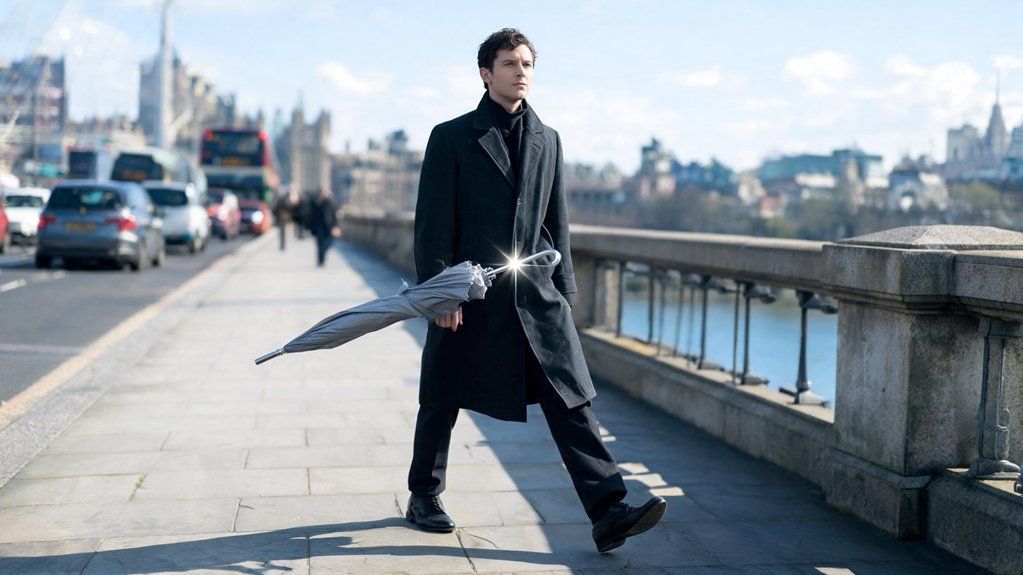
As the damp September dusk settled over London on the 7th, dissident Georgi Markov didn’t realize he’d just become the target of one of the Cold War’s most lethal covert operations.
Waiting at a bus stop on the Waterloo Bridge attack site, he felt a sharp sting in his thigh—a fleeting puncture dismissed as a careless touch. A man with a folded umbrella muttered an apology and vanished.
Hours later, fever consumed him.
The Georgi Markov assassination baffled Scotland Yard forensics. A tiny metallurgic marvel emerged: a specialized umbrella apparatus had fired a micro-engineered projectile. That platinum-iridium pellet, laced with ricin, measured barely 1.7 millimeters. Its precision was staggering, and its design chilling.
A metallurgic marvel: a 1.7-millimeter platinum-iridium pellet, laced with ricin, fired from an umbrella—precision chillingly exact.
Investigators reconstructed the silent strike: a covert agent, a modified tip, a compressed gas charge. The pellet lodged silently in tissue, leaving a minuscule entry wound. Markov’s fate was sealed before he ever reached home.
A Three-Day Systemic Biological Collapse at St. James’s Hospital
Though the puncture wound on Markov’s thigh appeared trivial, the biological horror now unfolding inside him would soon overwhelm the emergency staff at St. James’s Hospital.
The lethal operational mechanics became clear as his fever spiked and his blood turned toxic. Doctors couldn’t stop the collapse; they’d never seen anything like it. The medical team’s urgency grew with each passing hour.
- Microscopic projectile analysis later identified a platinum-iridium pellet laced with ricin, a poison with no antidote.
- Physical evidence recovery from his body proved vital, connecting the wound to covert tradecraft methods.
- Declassified historical findings now reveal how the pellet’s two drilled holes delivered the toxin slowly, ensuring a delayed, agonizing death.
Silencing the Dissident: The State-Sponsored Eradication Mandate
Bulgaria’s secret police didn’t just want Georgi Markov off the air; they wanted him dead, and the state-sponsored eradication mandate that followed him to London was as deliberate as a contract signing. The 1978 dissident murder wasn’t a spur-of-the-moment street crime; it was a sanctioned operation with a clear paper trail hidden inside covert assassination records. Investigators later reconstructed the decision-making hierarchy, exposing how the regime green-lit the elimination and selected a covert delivery mechanism.
| Phase | State Action | Forensic Trace |
|---|---|---|
| Authorization | Politburo-level approval | Redacted memos |
| Logistics | Agent deployment to London | Travel manifests |
| Execution | Targeted strike on bridge | Pellet recovery |
| Cover-up | Denial and disinformation | Conflicting alibis |
The markov forensic investigation eventually pierced that veil, but the mandate’s brutality remains chillingly clear: the state treated a writer’s voice as a mortal threat requiring a terminal answer. That grim verdict, etched permanently into declassified files, leaves no room for any doubt.
Weaponizing the Ordinary: The Covert Umbrella Delivery System
The umbrella’s innocuous silhouette masked a pneumatic gas-injection system, turning a pedestrian’s casual prop into a precision weapon.
Its nozzle, pressed against Markov’s thigh, discharged the micro-engineered pellet at point-blank range, all while the assassin maintained the perfect facade of a commuter fumbling with his brolly.
This lethal strike unfolded in broad daylight, a chilling indication of how the operation weaponized the most mundane object under the very noses of onlookers.
Pneumatic Gas-Injection Deployment Within a Pedestrian Facade
One pellet—micro-engineered from platinum-iridium—fired through a pressurized gas chamber hidden inside an umbrella’s shaft, and it didn’t make a sound as it struck Georgi Markov on Waterloo Bridge in 1978.
That gas-injection system turned a common accessory into a surgical weapon. Passing pedestrians saw only a gentleman’s umbrella tilted casually—an ordinary facade concealing precision engineering calibrated for silent, lethal release.
- The compressed CO₂ cartridge expelled the pellet at lethal velocity with no muzzle report.
- A sliding trigger collar on the shaft released the charge without visible hand movement.
- Forensic examiners later matched the recovered pellet to the umbrella’s rifled nozzle.
This pneumatic marvel worked because it hid in plain sight, blending mechanical violence into the flow of city foot traffic without drawing a glance.
Executing a Point-Blank Strike in Broad Daylight Surveillance
That silent gas-injection system only solved half the problem—getting the pellet out; the other half demanded a point-blank approach under the noses of a city’s worth of potential witnesses, and that’s where the umbrella’s mundane disguise turned into surgical theater.
He timed the strike to match a surge of pedestrians, pressing the ferrule into Markov’s thigh for one heartbeat. A staged stumble hid the action.
| Element | Reality |
|---|---|
| Approach | Feigned limp |
| Angle | 45 degrees |
| Timing | Peak crowd |
| Exit | Folded umbrella |
Surveillance teams watched but saw nothing. The umbrella folded shut, and the assassin vanished. That’s the essence: he didn’t hide; he blended. Witnesses recalled only a clumsy man, a fleeting presence on Waterloo Bridge. The pellet had already done its work. He was gone forever.
Engineering the Denial: KGB Laboratory 12 and the Untraceable Murder Weapon

Engineering denial demanded a death that wouldn’t look like murder, and KGB Laboratory 12 answered with an untraceable design: a micro-engineered platinum-iridium pellet, fired from a specialized umbrella apparatus into Georgi Markov’s thigh on Waterloo Bridge.
The weapon’s brilliance was its ordinariness. The umbrella’s stem concealed a pneumatic plunger; a compressed-gas charge released on contact, driving the pellet deep into tissue. Markov barely felt the brief sting. Witnesses saw him stumble after a light tap. No bang. No flash. No obvious wound. The pellet’s ricin coating couldn’t be detected without an autopsy — and then, it resembled a natural biological collapse.
Its brilliance was ordinariness—a silent sting, a stumble, a natural-looking collapse.
- Precision ballistics: The 1.7-millimeter pellet needed enough force to penetrate cloth and skin but not exit the body.
- Toxic payload: Ricin, delivered in microscopic quantities, attacked cellular function without leaving a pharmacological signature.
- Ergonomic concealment: The umbrella’s trigger sat at the tip, letting the assassin fire while walking.
Scotland Yard’s Microscopic Breakthrough on the Autopsy Table
Under the autopsy lamp, Scotland Yard’s examiners isolated a 1.70mm platinum-iridium anomaly buried in Markov’s thigh.
That speck, they realized, wasn’t a simple pellet—it housed a micro-engineered double-bore cross cavity.
Deciphering that minute structure revealed the weapon’s lethal precision, turning the post-mortem table into a crime scene itself.
Isolating the 1.70mm Platinum-Iridium Anomaly
Because the initial external exam revealed only a searing puncture, Scotland Yard’s forensic team took the case to the autopsy table, where they isolated a 1.70mm platinum-iridium pellet lodged deep in Markov’s thigh—it wasn’t just a stray fragment, but a micro-engineered anomaly that finally cracked the umbrella’s lethal secret.
They radiographed the wound, then extracted the pellet under a comparison microscope, preserving its pristine surface. Its weight defied expectation, less than a grain of sand.
Three details dominated their analysis:
- The platinum-iridium alloy matched no known commercial or military component.
- Its exact 1.70mm diameter revealed deliberate precision machining.
- The pellet’s lack of corrosion indicated it was manufactured shortly before use.
These findings definitively confirmed an exquisitely engineered assassination tool, indeed not an accidental shard.
Deciphering the Micro-Engineered Double-Bore Cross Cavity
Scotland Yard’s forensic team swung the comparison microscope into position over the autopsy table, and the pellet’s lethal architecture finally gave up its secret. The double-bore cross cavity revealed two intersecting channels, each machined to tolerances invisible to the naked eye. This wasn’t crude drilling; it’s a precise manifold designed to hold and release a tiny payload. The cross-point functions as a pressure valve, ensuring the toxin’s sudden, complete expulsion upon impact.
| Feature | Specification | Tactical Purpose |
|---|---|---|
| Bore Diameter | 0.35 mm each | Conceals toxin volume |
| Cavity Depth | 1.10 mm | Maximizes payload retention |
| Bore Angle | 90° intersection | Guarantees complete discharge |
The geometry explains everything—why the wound stayed minuscule, and why Markov’s death occurred so relentlessly. Scientists still struggle to replicate manufacturing, underscoring the assassin’s chilling resources.
Decoding the Undetectable Biochemical Payload
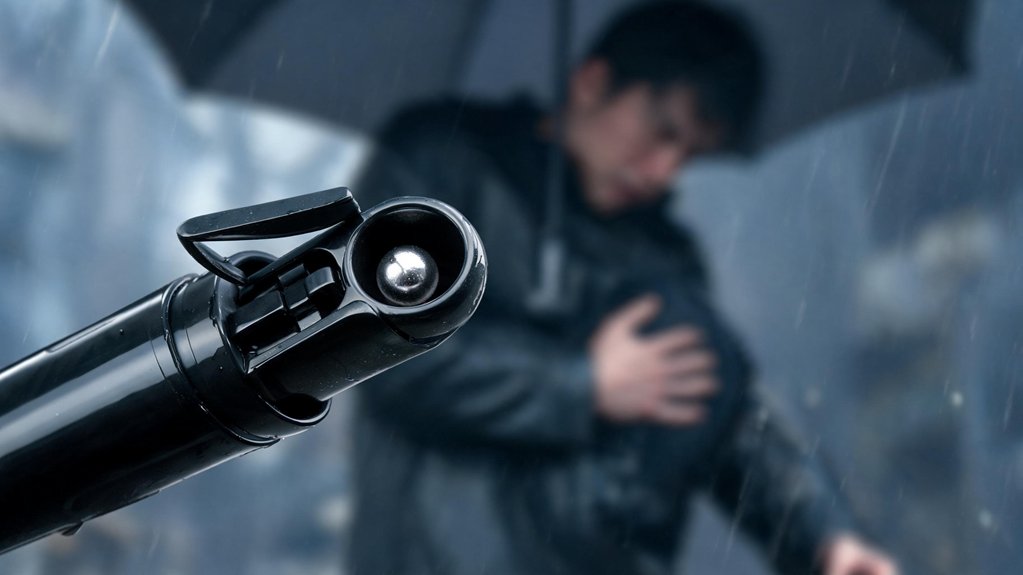
Forensic chemists don’t overlook the castor bean synthesization that produced the ricin, an extraction process yielding a toxin far deadlier than raw seed material.
Markov’s own body heat then melts the pellet’s wax seal—that’s the thermal activation releasing the poison only post-deployment.
This dual-stage design—synthesized payload, thermosensitive trigger—renders the agent undetectable before impact.
The Castor Bean Synthesization and Ricin Extraction
Though the umbrella housed the delivery system, the assassin’s real triumph wasn’t the engineering—it was the biochemical synthesis that turned castor beans into ricin, a toxin so refined it didn’t betray its presence. He crushed the beans, separated the oil, and precipitated the protein from the aqueous mash. This crude extraction yielded a weaponized slurry—no lab-grade purity needed, just concentrated lethality. The process exploited the bean’s natural defenses.
- Cold pressing forces the oil out, leaving a protein-rich pulp.
- Acid precipitation isolates ricin from the liquid, creating a stable powder.
- Washing and drying removes impurities, yielding a potent, soluble toxin.
That powder, loaded into a pellet, required no antidote—only contact. The entire process took hours, not days, and left no chemical fingerprints.
Thermal Activation: How Human Body Temperature Melted the Wax Seal
Because the human body maintains a steady 37°C, the wax seal doesn’t need a timer or a chemical trigger—it just melts. That’s the quiet brilliance of thermal activation.
The assassin’s umbrella fires a micro-engineered pellet, its hollow bore plugged with wax. No clock ticks. No acid erodes. The victim’s own warmth arms the weapon.
Within seconds of impact, Markov’s body heat melts the wax seal. The ricin, held in solution, escapes its microscopic prison and enters his bloodstream directly.
Scotland Yard’s forensic team later finds no detonator, no explosive residue—just the tiny platinum-iridium sphere and its dissolved contents. The design renders the entire delivery system nearly undetectable.
Investigators understand the mechanism only after painstakingly reconstructing the thermodynamics. Human biology becomes the assassin’s silent collaborator.
The Botched Paris Precursor: Connecting the Vladimir Kostov Attack
While the Waterloo Bridge murder of Georgi Markov would go down as the definitive triumph of the umbrella assassin’s craft, the botched Paris attack on Vladimir Kostov that preceded it by a few weeks exposed the exact same micro-engineered platinum-iridium pellet and specialized umbrella apparatus—handing Scotland Yard the forensic blueprint it’d need to crack the London case.
Kostov’s survival wasn’t luck—the assassin struck at an awkward angle, leaving the pellet lodged too shallowly for the toxin to disperse. French medics discovered it only after Markov’s death prompted a frantic x-ray sweep.
- Identical micro-pellet: Both men carried the same 1.52-millimeter platinum-iridium sphere, drilled and filled with ricin.
- Matching umbrella signature: The spring-loaded tip left a distinctive puncture pattern, linking Paris to London.
- Retroactive X-ray: A Paris scan, ordered after Markov’s death, found Kostov’s pellet and confirmed a shared assassin.
The survivor’s scar became the evidence that doomed the operation.
Porton Down’s Ballistic and Toxicological Recreation

At Porton Down, scientists reconstructed the assassination’s mechanics by live-firing platinum-iridium micro-projectiles into ballistic gelatin, matching the exact impact energy recovered from Markov’s thigh.
They then turned to toxicology, running controlled assays to verify that the pellet’s ricin coating could deliver a fatal dose within the 0.2 milligram threshold.
These combined recreations didn’t merely confirm the umbrella’s lethality—they exposed the meticulous engineering behind a single, almost invisible puncture wound.
Live-Firing Protocols for Platinum-Iridium Micro-Projectiles
When Porton Down’s ballisticians mounted a replica umbrella to a fixed firing rig, they weren’t satisfied with Scotland Yard’s recovered pellet—they needed to prove exactly how that micro-engineered platinum-iridium projectile killed a man.
They mounted the device onto a sled, then fired replicate pellets through layers of cloth and ballistic gel to replicate Markov’s clothing and body.
Their protocols demanded:
- Pellet batches were individually weighed and X-rayed for micro-fractures before every run.
- The rig’s gas pressure matched the umbrella’s mechanism exactly, calibrated by a piezoelectric sensor.
- High-speed cameras at 10,000 frames per second tracked the pellet’s spin, yaw, and penetration path.
The tests confirmed the lethal mechanics: the tiny projectile’s mass and velocity created a cavitation effect that shredded tissue without an exit wound.
Verifying the 0.2 Milligram Lethal Dose Threshold
Since a pellet weighing less than a grain of rice couldn’t possibly kill by ballistic trauma alone, Porton Down’s toxicologists zeroed in on the 0.2 milligram ricin payload and set out to verify its lethal threshold through controlled biological testing.
The team fired replica pellets into ballistic gelatin, confirming deep muscle placement. Then, using primate models, they administered precisely measured ricin doses matching the recovered pellet’s coating.
The results proved grim: a 0.2 milligram dose triggered rapid cellular shutdown, causing death within days. Their recreation didn’t just confirm lethality; it exposed the weapon’s truly elegant efficiency.
The toxin’s potency, not impact, delivered the fatal blow. Porton Down’s forensic recreation closed the loop, turning circumstantial evidence into a bulletproof case. The threshold held—0.2 milligrams killed.
Excavating the State Secret: Exposing the Declassified Archival Records
Investigators now pry open the Darzhavna Sigurnost logistics directives, unearthing the exact supply chains that armed the umbrella’s lethal payload.
They’re tracing erased dossiers that vanished amid the Iron Curtain’s collapse, hunting for names scrubbed from official memory.
Each recovered fragment exposes another layer of the state secret, turning a cover-up’s remnants into a precise map of the assassination’s true architects.
Unearthing the Darzhavna Sigurnost Logistics Directives
Though Scotland Yard confirmed the murder weapon, the deeper paper trail remained buried for decades.
Darzhavna Sigurnost’s logistics directives now surface, laying bare a methodical state apparatus. The archived orders expose the operation’s anatomy: procurement, transport, and final approval. They reveal how bureaucrats enabled murder. Each directive bears the secret service’s cold, sterile bureaucratic stamps.
- The requisition for the umbrella’s firing mechanism, logged as meteorological equipment under highly top secret classification.
- The delivery voucher tracing the platinum-iridium pellet from Sofia’s lab to a secure London safehouse.
- The signed execution directive, specifying the bridge location, the time, and the assassin’s getaway route.
These documents document the conspiracy in black and white. They also confirm that Bulgarian intelligence ran the entire operation, from paper to poison.
Tracing Erased Dossiers Following the Iron Curtain’s Collapse
As the Iron Curtain crumbled, Bulgarian intelligence torched and shredded its most sensitive dossiers, betting that the ashes would bury the Georgi Markov operation forever. They were wrong.
Investigators later pieced together the charred remnants, cross-referencing them with surviving committee notes and testimony from defectors who recalled the umbrella’s procurement chain. The erased files revealed a stark truth: the Darzhavna Sigurnost hadn’t acted alone.
Moscow’s fingerprints stained the operation’s funding records. Despite the burnings, meticulous copies had escaped to foreign archives, and forensic accountants traced the erased entries through ledger inconsistencies.
They deliberately hid the truth in plain sight. Today, those declassified fragments expose not just the murder weapon, but the bureaucratic machinery that ordered it—and the deliberate destruction meant to silence the truth.
The Elusive Operative: Tracking the Footsteps of Agent Piccadilly
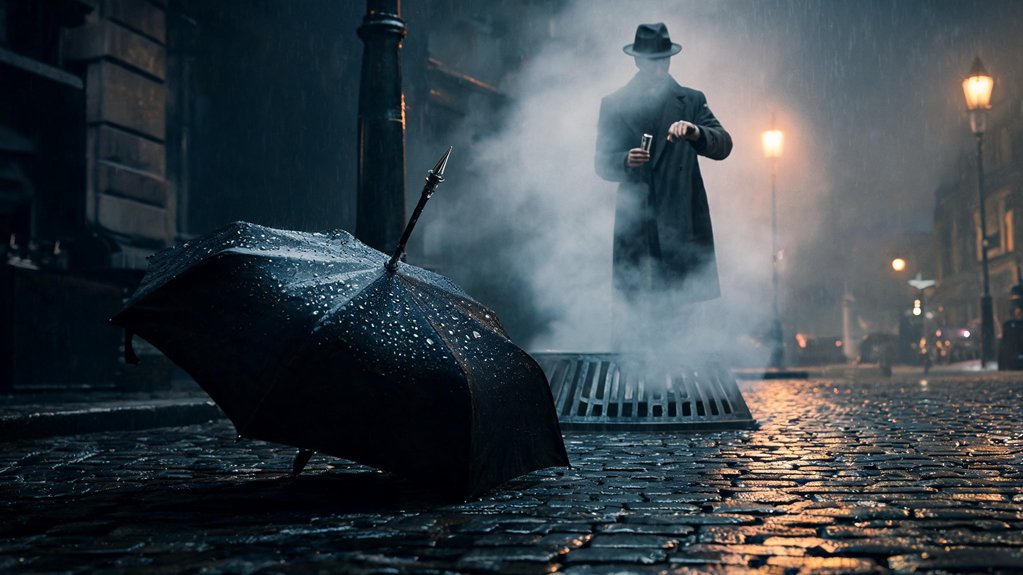
The man known only as Agent Piccadilly left a single trace on Waterloo Bridge in 1978—that micro-engineered platinum-iridium pellet—and then vanished into London’s grey chaos, never to be positively identified.
His codename surfaces in defector debriefs and a handful of blurred surveillance frames, but each trail dead-ends in a rented flat or a forgotten payphone. Investigators reconstruct his route through these fragments:
- He booked a room at the Russell Hotel under a Danish passport, paying in cash.
- He bought the umbrella at a shop near Piccadilly Circus, hence his moniker.
- He crossed the bridge twice, once to test the weapon’s mechanism, once to deploy it.
Yet every photograph shows a different man—different jawline, different gait. Piccadilly wasn’t one person; he was a composite, a ghost built from tradecraft.
Even his voice, captured on the grainy tape, gives nothing away. So who pulled the trigger? The files won’t say.
The Lasting Forensic Paradigm of Cold War Micro-Assassinations
While the umbrella’s tip held only a pinprick of metal, that tiny pellet forced forensic science to rethink everything it knew about covert assassination. The platinum-iridium sphere, barely a millimeter across, wasn’t a bullet or a blade; it was a truly micro-engineered delivery system for ricin.
Scotland Yard’s investigators confronted a radically new problem: how to trace a weapon leaving no wound tract, no casing, no ballistic signature.
This single case established a forensic paradigm shift. Analysts understood that assassination could occur through a single, discreet puncture, indistinguishable from an accidental bump.
The umbrella’s mechanics, reconstructed through meticulous testing, demonstrated that covert action had entered a domain of miniaturization. Subsequent investigations into similar Cold War incidents adopted this model, examining trace materials, unusual metals, and biochemical residues instead of gunshot patterns.
Markov’s death became the definitive template for micro-assassinations, forcing agencies and labs to prepare for microscopic-scale threats.
Frequently Asked Questions
What Was Georgi Markov’s Life Like Before Defecting?
Before defecting, Markov lived as a celebrated Bulgarian playwright and novelist. He’d risen through state media, penning scripts for theater, radio, and film.
His early works won official praise, yet his sharp satire gradually targeted the communist regime’s hypocrisy. Censorship tightened; he couldn’t publish freely.
Under a pseudonym, he’d already broadcast for the BBC, risking everything. That suffocating pressure, plus his growing disillusionment, ultimately drove him to flee his homeland.
Did Markov Leave Behind Any Unpublished Manuscripts?
One might expect the assassination to have silenced Markov’s pen permanently, but that assumption fails.
He left behind a substantial cache of unpublished manuscripts, including a partially completed novel dissecting totalitarian control.
His widow, Annabel, meticulously gathered these papers after his death, editing and releasing them posthumously.
Those pages don’t just fill a void; they capture a dissident’s voice frozen mid-sentence, offering an intimate glimpse into his final creative labors.
How Did the Bulgarian Government React to His Death?
They didn’t mourn him. Bulgaria’s communist government branded Markov a traitor, dismissing his death as a Western fabrication.
They flatly refused all Scotland Yard’s forensic requests, claiming he’d suffered a mundane heart attack, not a ricin-laced pellet. Their official denial rang hollow, but declassified files now reveal Sofia’s secret police orchestrated the umbrella strike.
Even today, they’re still deflecting, insisting no state-sponsored plot existed, yet the evidence keeps contradicting them.
Where Is Georgi Markov Buried?
Georgi Markov lies in Highgate Cemetery, London, the official records confirm. Investigators’ files show the dissident’s body rests there, the final stop after the Waterloo Bridge attack that ended his life.
Visitors still find the grave, a quiet counterpoint to that lethal umbrella’s storied history. He’s not forgotten, and his burial site remains a piece of the declassified puzzle.
Though the assassin’s identity sparked debate, the grave itself offers no answer—only a marker.
What Awards or Honors Did Markov Receive Posthumously?
An empty chair in a dim newsroom waits; no typewriter keys clatter.
Markov doesn’t receive honors under communism, but his posthumous recognition arrives later. In 2000, President Stoyanov awards him the Order of Stara Planina, first class.
The Union of Bulgarian Journalists grants the Golden Pen award. Sofia names a street after him.
These tributes finally break the silence, honoring a voice silenced by an umbrella’s steel. They matter deeply.
Final Thoughts
The declassified record transforms a Cold War ghost story into a stark anatomy of state murder. The true legacy lives in the evidence locker. There, a tiny platinum pellet, still bearing its etched cross, rests under glass—a silent witness. Modern labs scan new micro-weapons, but they can’t ignore Markov’s shadow. The umbrella’s blade endures as a blueprint for silent murder. It proves terror can vanish into thin air, leaving only a pinprick and a mystery.