
The Kriegsmarine’s Enigma machine boasted 159 quintillion possible key combinations, a cryptographic fortress. Yet Bletchley Park’s Hut 8 cracked it wide open. German operators routinely signed morning weather reports with the fixed phrase “Heil Hitler,” providing fatal cribs. Turing and his team weaponized this predictable human habit, turning a mathematical impossibility into a solvable pattern. That fatal flaw broke the Atlantic stranglehold. The full story of this elegant, decisive attack awaits.
Key Takeaways
German radiomen routinely signed morning weather reports with “Heil Hitler,” providing known plaintext. These fixed phrases, or “cribs,” allowed Bletchley Park to deduce Enigma rotor positions. The cribs enabled the electromechanical Bombe to test possibilities rapidly against known text. German operator predictability was exploited instead of attacking Enigma’s mathematical complexity. The “Heil Hitler” flaw turned a routine signature into a fatal cryptographic vulnerability.
The 1939 Atlantic Stranglehold and the 159-Quintillion Combinatorial Barrier
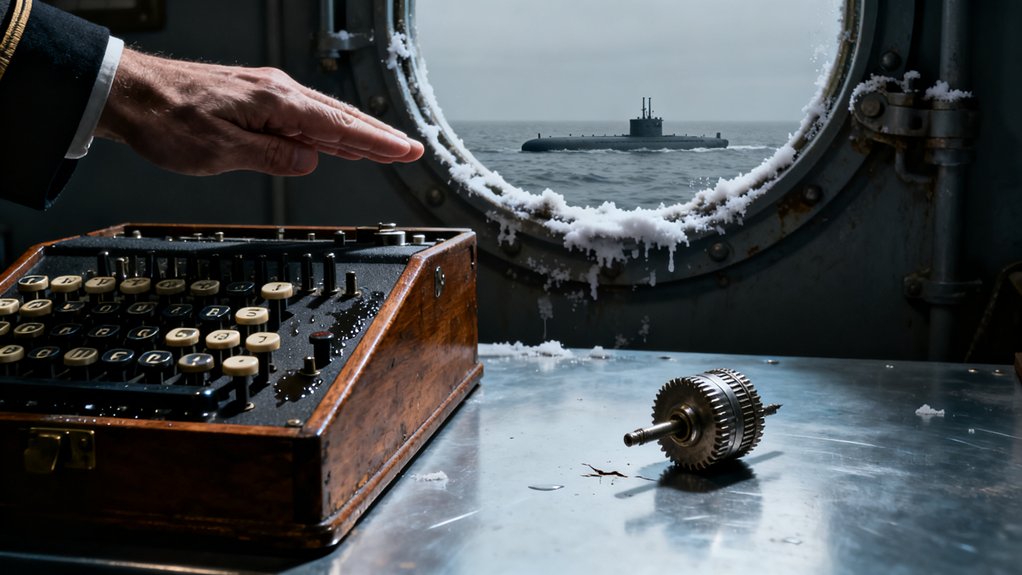
By 1939, the Kriegsmarine’s U-boats had clamped an iron stranglehold on Britain‘s Atlantic lifelines, sinking merchant ships faster than they could be built. This relentless campaign relied on the German Enigma cipher, a cryptographic puzzle that presented an almost insurmountable barrier: 159 quintillion possible key combinations.
Each message originated with specific Enigma rotor settings, a daily-changing secret that transformed plaintext into seemingly random gibberish. For British codebreakers, the sheer scale of this combinatorial explosion rendered manual decryption utterly impossible. Without a systematic attack, the Atlantic convoys faced annihilation.
This desperate urgency birthed the need for a machine that could think mechanically, a device capable of testing and discarding thousands of Enigma rotor settings each second. The solution was the electromechanical Bombe device, Turing‘s weapon against the mathematical fortress. It wouldn’t brute-force the impossible; it would intelligently exploit predictable human flaws to narrow the search space, turning an impenetrable wall into a manageable door.
Anatomy of the German Cryptographic Shield: Inside the Scherbius Rotor System
The Scherbius rotor system hid its secrets behind the Steckerbrett plugboard, which scrambled the alphabet before encryption even began.
Every midnight at 0000 hours, the entire configuration reset, turning each day’s intercepts into an isolated mathematical puzzle.
This daily key change rendered brute-force interception impossible, locking the Allies out of a 159-quintillion combination maze.
The Steckerbrett Plugboard and the 0000 Hours Daily Key Reset
Although the Enigma’s rotor wiring created a mathematical labyrinth of staggering complexity, its true strength as an uncrackable cipher stemmed from the Steckerbrett plugboard. This front-panel device scrambled letters before they ever reached the rotors, multiplying the possible daily key settings astronomically.
At 0000 hours each day, German operators reset this entire configuration. This rigid, predictable schedule became the fatal crack for Alan Turing and Bletchley Park‘s team. They didn’t chase billions of combinations randomly; they weaponized crib-based decryption methods. By knowing the enemy’s daily reset point, they could isolate the plugboard’s effect using known plaintexts from routine messages. The Steckerbrett’s theoretical strength dissolved when its daily key reset became a prisoner of operational habit.
The Mathematical Impossibility of Brute-Force Interception
Facing an Enigma machine wasn’t like confronting a simple code. It was staring down a mathematical fortress designed to defy brute force.
The Scherbius rotor system didn’t just scramble letters. It multiplied possibilities into a dizzying wall of cryptographic combinations.
With three rotors, each spinning at different rates, the machine created 17,576 distinct wiring positions before factoring in the plugboard’s additional 150 million pairings. This wasn’t a puzzle; it was a locked universe of near-infinite variation.
Mathematicians quickly grasped the mathematical impossibility of brute-force interception. Checking every setting manually would take centuries, not hours. The Germans believed this shielded their secrets perfectly. They didn’t realize that Turing’s team wouldn’t try to outpace the numbers. They’d simply sidestep them by exploiting a fatal human flaw.
Mobilizing the Intelligence Vanguard Inside Bletchley Park’s Hut 8

How could a single, predictable phrase, *Heil Hitler*, unravel the mathematical fortress of the Enigma cipher? Inside Bletchley Park’s Hut 8, the answer emerged from a tight-knit group of codebreakers.
The hut 8 decryption team didn’t just face the German enigma cipher. They ruthlessly dissected how operators used it. They knew the Enigma’s billions of possible daily settings made brute force a dead end. So they shifted focus to human sloppiness.
German radiomen routinely signed morning weather reports with *Heil Hitler*, a fixed phrase. This weakness gave the team a “crib” (a known plaintext guess).
They’d feed this into the Bombe, the electromechanical beast Turing designed, which rapidly tested rotor positions. The Bombe didn’t solve the entire cipher; it narrowed down possibilities from astronomical numbers to a handful.
In Hut 8, the vanguard didn’t fight machines. They exploited the operators’ predictable habits.
Turing’s Methodological Pivot from the Polish Biuro Szyfrów Bomba
While the Poles’ Bomba had cracked early Enigma variants, Turing saw its critical limitation. It relied on the Enigma’s double-stepping rotor mechanism, a feature the Germans soon eliminated.
He pivoted, forging a more flexible weapon. Turing’s genius redefined the attack. Instead of chasing mechanical quirks, he’d hunt human operational flaws. Every German operator, through routine, left a signature. Predictable patterns, like the repetitive “Heil Hitler” sign-offs in morning reports.
This shift transformed the problem into a logical, solvable maze. The declassified ultra intelligence reveals Turing’s Bombe didn’t guess. It eliminated impossibilities, using those human slip-ups as its blade.
He built a machine that could test countless rotor positions, but only against a crib, a known plaintext drawn from operator carelessness. It wasn’t the cipher’s complexity that doomed the Germans. It was their own sloppy habits. Turing turned their predictable errors into a fatal vulnerability.
Investigating Predictable Failures in the 0600 Kriegsmarine Weather Broadcasts
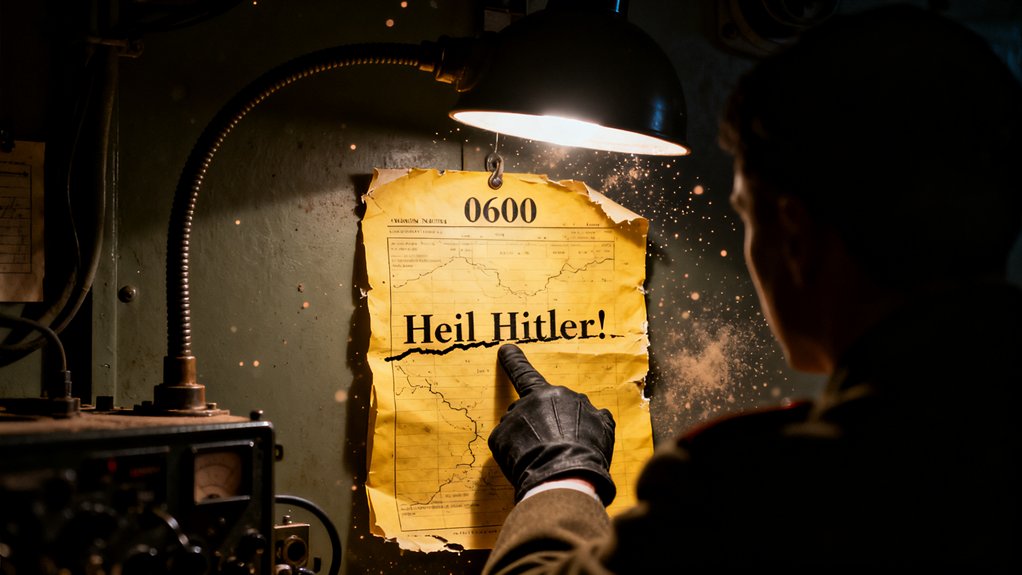
Because German operators transmitted the 0600 Kriegsmarine weather report with near-clockwork precision, they handed Turing’s team a predictable, exploitable flaw. Every day, at the same hour, morning weather report intercepts flooded Bletchley Park‘s listening posts. Analysts noticed something vital. These intercepted enemy transmissions always began with the same rigid format, grid coordinates, wind speeds, and sea states. No variation. No deviation.
Turing’s cryptanalysts didn’t just read the weather. They dissected the language’s predictable structure. They realized that a cipher’s weakness often lay in its operator’s habits, not its mathematics. The 0600 broadcast‘s repeated phrasing gave them a reliable “crib”, a known plaintext segment. This reduced the Enigma’s massive key space to a manageable hunt. Operators followed procedure so blindly that they never considered altering even a single word. They handed their adversaries a fatal, daily consistency. Turing’s team didn’t need genius luck. They needed German routine. And every morning, they got it.
The “Heil Hitler” Vulnerability: Weaponizing Enemy Hubris into Linguistic Cribs
| Operator Error | Exploited Pattern | Result for Bombe |
|---|---|---|
| Routine sign-off | “Heil Hitler” at end | Provided known crib |
| Fixed weather format | “Weather for 0600” | Established start point |
| Repeated call signs | Identical station codes | Reduced rotor possibilities |
| Predictable time stamps | Daily schedule | Narrowed key space |
Each repetition fed the Bombe’s logic. The Germans’ ceremonial obedience, their insistence on that fatal salute, did not just waste time. It handed Turing’s team a master key. Hubris, not mathematics, broke Enigma.
Engineering the Counter-Measure: Turing’s Electromechanical Bombe Blueprint
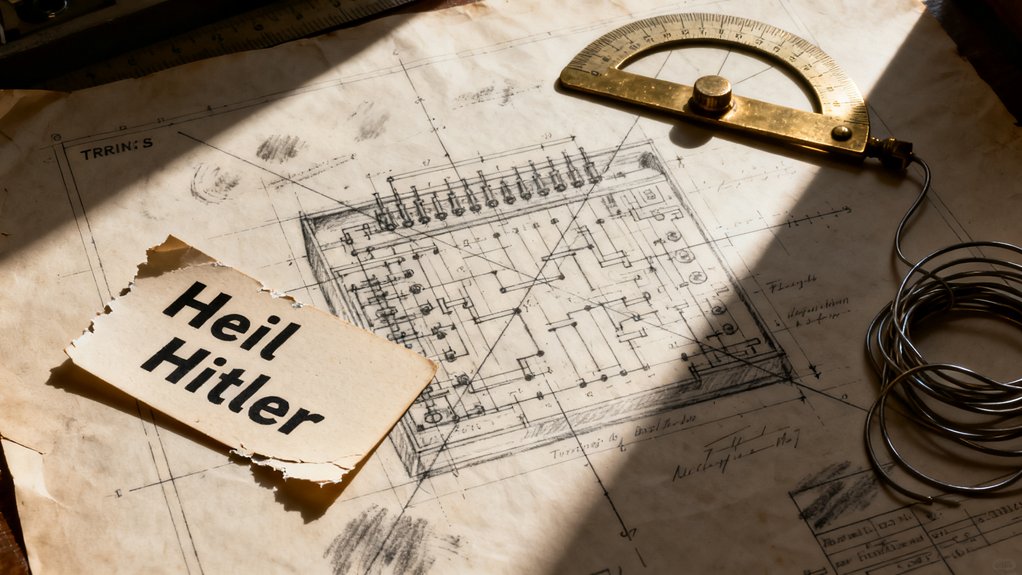
Turing’s blueprint commanded the Bombe to execute the equivalent of 36 Enigmas simultaneously. Its cascading bronze rotors spun in relentless parallel to test every cribbed hypothesis. Gordon Welchman’s diagonal board matrix then sliced through the resulting noise, instantly eliminating false positives with a mechanical elegance that outran human error. Together, these innovations transformed the fragile “Heil Hitler” crib into a devastating weapon, short-circuiting the cipher’s billions of possibilities in hours.
Cascading Bronze Rotors and the Simultaneous Execution of 36 Enigmas
While the Bombe’s logical framework targeted human error, its physical form was a marvel of brute-force engineering. It was a cascading assembly of bronze rotors that basically ran 36 simulated Enigma machines simultaneously. Each stack of rotors spun with relentless precision, mimicking the German cipher’s three-wheeled drum.
But Turing didn’t stop there. He integrated Gordon Welchman’s diagonal board, a pivotal innovation in WWII cryptographic history that connected all 36 machine simulations into a unified search. This board let the Bombe eliminate thousands of false solutions per second, forcing the Enigma’s secrets out of each rotor’s grinding turn. Without Welchman’s addition, the brute-force approach would have stalled against the cipher’s staggering complexity.
Gordon Welchman’s Diagonal Board Matrix for Eliminating False Positives
Three pivotal innovations transformed Turing’s Bombe from a promising concept into a practical codebreaking weapon, and Gordon Welchman’s diagonal board was the most ingenious of them all.
It isn’t enough to merely spin rotors; false positives would drown the operator. The diagonal board created a matrix of all possible rotor pair connections, allowing the Bombe to detect contradictions instantly as it tested menu circuits. If one rotor position suggested impossible letter pairings elsewhere in the matrix, Welchman’s board rejected the entire setting without wasted verification. This eliminated thousands of false leads per hour. Without it, the Bombe would have choked on its own data stream. Welchman didn’t just speed things up; he engineered the logic that made brute force feasible.
The March 1940 “Victory” Activation and the Initial Penetration of Luftwaffe Traffic
The March 1940 “Victory” activation marked the initial penetration of Luftwaffe traffic. Although the Bombe had been theorized for months, it wasn’t until March 1940 that Turing’s team switched on the machine and watched it roar to life. This electromechanical victory cracked open the first hole in Germany’s armor. That morning, the team targeted Luftwaffe traffic, specifically routine weather reports. Every Luftwaffe message began with coded coordinates and ended with an operator signing off with a predictable “Heil Hitler.” Turing’s team didn’t need to break every rotor cycle; they needed only that one fatal flaw.
Inside Hut 8, the Bombe’s drums spun, hunting for a match. When a rotor stopped, it signaled a potential key setting. They didn’t celebrate yet. First, they tested it on a real intercept. The decrypted words came through: flight paths, troop movements, fuel levels. For the first time, British intelligence heard the Luftwaffe’s daily orders before they were executed. This wasn’t just a test; it was the start of a silent war fought inside a machine.

The May 1941 seizure of U-110 hands investigators the keys to the naval Enigma’s deepest chamber.
Captured Kurzsignale codebooks don’t just reveal the enemy’s shorthand. They expose the procedural scaffolding for the four-rotor Shark cipher. This captured trove transforms a cryptographic wall into a forensic map, peeling back the Atlantic U-boat fleet’s veil of secrecy.
The May 1941 U-110 Raid and the Subjugation of Captured Kurzsignale Codebooks
Inside the U-boat’s radio room, they found more than codebooks. They discovered the *Kurzsignale* manual. This compact signal book condensed entire messages into short, encoded bursts. Without it, Bletchley Park‘s analysts struggled against the newly introduced, four-rotor Shark cipher, flooding the Atlantic with unbreakable traffic.
The capture provided the literal key to the cipher’s inner workings. Decrypting those rapid signals became a forensic exercise, not a guessing game. The U-110‘s secrets didn’t just crack Shark; they exposed the entire naval communications chain.
Scaling the Intelligence Apparatus Across the Stanmore and Eastcote Outstations
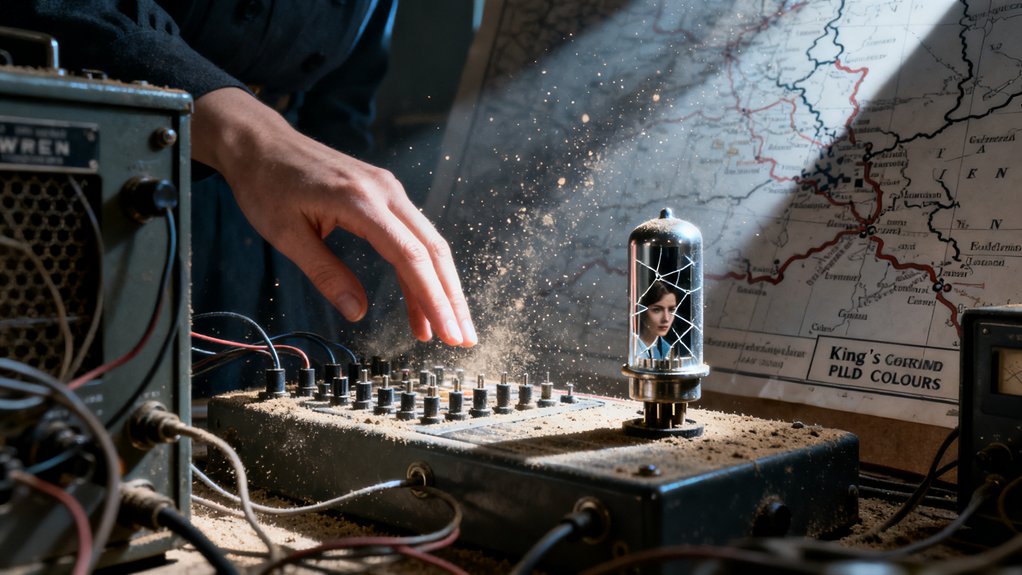
As Bletchley Park’s Bombe proved its worth against routine Heil Hitler sign-offs, the operation’s success demanded rapid expansion beyond its original cramped huts. Turing’s team couldn’t sustain the volume alone. They needed industrial scale decryption. So the intelligence apparatus stretched outward, seeding two essential outstations: Stanmore and Eastcote.
These sites weren’t mere annexes. They were purpose built cryptanalytic factories. At Stanmore, engineers assembled rows of new Bombes, each one a whirring, clicking beast that chewed through Enigma’s daily settings. Eastcote mirrored this effort, housing dozens of machines that ran in shifts, consuming intercepted signals day and night. Operators, mostly Wrens, worked in stifling silence, swapping rotors and resetting drums with military precision.
The expansion transformed codebreaking from a cottage industry into a systematic assault. Stanmore and Eastcote didn’t just relieve pressure. They multiplied the throughput, ensuring no Heil Hitler slip up went unearthed. This was logistics in service of logic, scaling a razor’s edge advantage into a weapon.
Systematically Severing Admiral Dönitz’s Wolfpacks to Secure the Atlantic Lifeline
Stanmore and Eastcote’s whirring Bombes had turned routine Heil Hitler sign-offs into a flood of decrypted U-boat command signals. Now, the Admiralty wielded this intelligence as a precise scalpel. They didn’t just track wolfpacks. They systematically severed their supply lines. Every decrypted signal revealed Dönitz’s refueling schedules and rendezvous points, allowing escort groups to ambush thirsty U-boats mid-ocean.
The Atlantic lifeline, Britain’s jugular, tightened dangerously under U-boat pressure. But Bombe intelligence shifted the odds. Convoys received real-time rerouting, dodging submerged ambushes. Hunter-killer groups, guided by decrypted coordinates, stalked individual boats, sinking them before they could coordinate an attack. The wolfpacks, once a coordinated terror, fragmented into isolated targets.
Dönitz never understood how his invisible fleet became so visible. He blamed Allied sensors, never suspecting his own men’s fatal greeting.
The 30-Year Institutional Silence: Operation Ultra’s Embargo on Bletchley’s Architects
Although Bletchley’s Bombes had silenced the Atlantic wolfpacks, a different kind of silence soon swallowed their creators. For thirty years, the British government imposed a draconian embargo on Operation Ultra‘s secrets. The architects, Turing, Welchman, and their team, couldn’t whisper a word about their triumph. They vanished behind a wall of official secrecy, their contributions erased from public memory.
Turing’s conviction for gross indecency in 1952 sealed his fate. His cryptographic genius remained classified, denying him the recognition that might’ve mitigated his persecution. The silence wasn’t accidental. It was institutional, designed to protect the illusion that Britain’s wartime superiority stemmed from sheer intelligence, not groundbreaking mathematics.
This forced muteness warped history. By the 1970s, when the embargo finally lifted, Turing was dead, and his architects had aged into obscurity. The world learned of their victory decades late, robbed of their rightful place in the narrative. The silence protected a secret, but it also buried the very minds who saved the Atlantic.
Frequently Asked Questions
Was Turing Ever Captured by German Forces During the War?
No, Turing was never captured by German forces. He remained at Bletchley Park throughout the war, safe from enemy hands while his Bombe machines ceaselessly exploited routine human errors in Enigma transmissions.
The team’s success hinged on analyzing intercepted messages, not on dangerous field operations. Turing’s work was classified, keeping him hidden from the enemy’s radar. His life wasn’t at risk from capture, even though his breakthroughs were pivotal in turning the tide.
How Long Did It Take to Build the First Bombe Prototype?
It took roughly six months to build the first Bombe prototype. Construction began in early 1939, with the machine operational by March 1940. Turing’s team didn’t start from scratch; they adapted earlier Polish designs, but the electromechanical complexity demanded intense refinement.
That prototype wasn’t a polished weapon. It was a clunky, experimental beast that proved the concept, shaving years off what manual decryption would have required. Without that rapid build, cracking Enigma might’ve come too late.
Did the Enigma Code Ever Get Cracked Without Human Errors?
No, the Enigma code never fell without human error. Even the brilliant Bombe couldn’t brute-force its billions of combinations.
It relied on predictable operator mistakes: routine weather reports, repeated phrases, that fatal “Heil Hitler” sign-off. Without these slip-ups, the cipher’s staggering complexity remained impenetrable.
Human fallibility, not math alone, cracked the unbreakable.
What Happened to the Original Bombe Machines After the War?
After the war, most original Bombe machines were dismantled and destroyed by British authorities. They weren’t preserved.
Their parts were scrapped for security, silencing these silent saviors.
All but a few surviving blueprints were systematically eliminated, ensuring the devices’ detailed design didn’t fall into wrong hands.
It’s a stark fate for a machine that saved millions, yet it’s an understandable end for a wartime secret.
Were Any Bletchley Park Operatives Executed for Leaking Secrets?
No Bletchley Park operatives were executed for leaking secrets. The British government enforced strict secrecy under the Official Secrets Act, but punishments typically involved imprisonment, not execution. Investigators uncovered no proven cases of treasonous leaks from the codebreaking team. They executed spies elsewhere during the war, but Bletchley’s core remained secure. That silence, maintained for decades, proves the loyalty and discipline Turing’s unit carried to their graves.
Final Thoughts
Silence settled like dust over Bletchley’s rusting Bombe racks. Hut 8’s chalkboards went blank. Yet the ghost of that 0600 weather broadcast still hums. A heel-click, a signature, a fatal crack in the Scherbius rotors’ shimmering wall. Declassified logs prove it was not brute force but one rigid German habit, repeated into history’s hinge, that turned 159 quintillion combinations into a single, snapped cipher chain.