
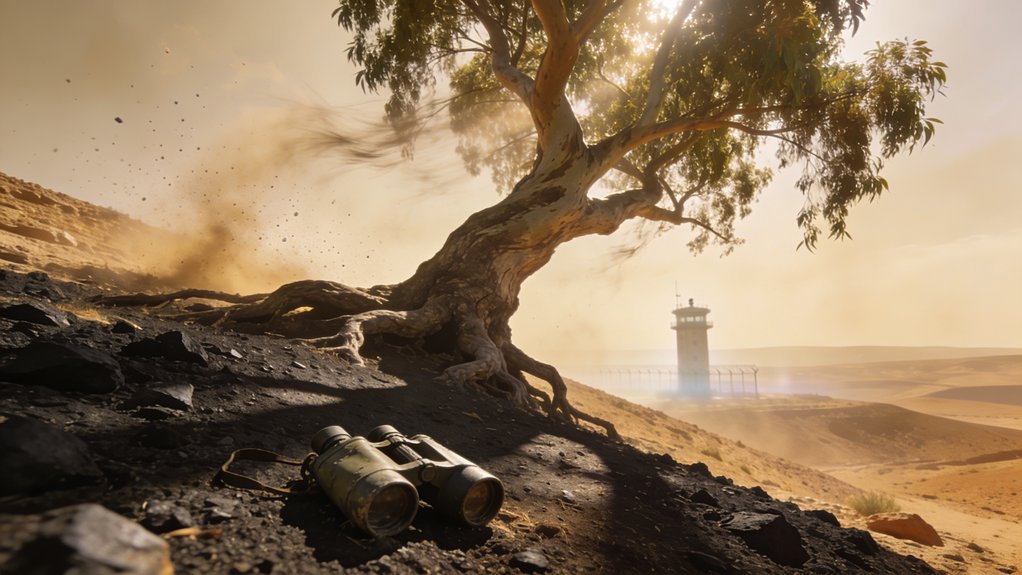
In 1961, Mossad agent Eli Cohen infiltrated Damascus as wealthy Syrian businessman Kamal Amin Ta’abet. He planted hundreds of eucalyptus trees as a humanitarian project across the Golan Heights. They became fixed coordinates for the Israeli Air Force. Cohen transmitted precise bunker depths and troop patterns from his apartment radio. After his 1965 execution, the trees endured. On June 9, 1967, pilots used the canopy markers to decimate Syrian defenses in under ten hours, permanently seizing the high ground. The unseen grid still dictates the terrain’s strategic reality.
Key Takeaways
- Eli Cohen planted eucalyptus trees as covert landmarks for Israeli targeting.
- Trees provided fixed, unambiguous coordinates immune to enemy countermeasures.
- Groves covered Syrian bunkers and artillery positions on the Golan Heights.
- Blueprint relied on trees’ visibility from air to guide bomber pilots.
- Botanical sabotage continued functioning as targeting grid even after Cohen’s capture.
Constructing Kamal Amin Ta’abet: The 1961 Infiltration of Damascus
By early 1961, Israeli intelligence had fully assembled the legend of Kamal Amin Ta’abet, a wealthy Syrian-born businessman who’d spent years abroad in Argentina. This wasn’t merely a backstory; it was a meticulously constructed kamal amin ta’abet alias, forged to withstand intense scrutiny. The operation targeted high-value damascus government infiltration, requiring an identity so flawless it could open doors to Syria’s power corridors.
Mossad agents in Buenos Aires had cultivated real Syrian contacts, embedding Eli Cohen—the real man behind Ta’abet—into a network of influential expatriates. They planted false documents, fabricated business records, and rehearsed his biography until it felt lived-in. Cohen then departed for Syria, carrying a legend thicker than a passport. His arrival in Damascus wasn’t a gamble; it was the calculated insertion of a Trojan horse.
The alias didn’t just disguise him—it weaponized his persona, granting access to politicians and officers who believed they were welcoming a wealthy patriot. They never realized they were inviting a mole.
Infiltrating the Ba’athist Elite: Bypassing Syrian Counterintelligence
Cohen’s cover didn’t start in Damascus; it was meticulously forged in Buenos Aires, where he cultivated the persona of a wealthy, connected Syrian expatriate.
This Argentine origin story provided the perfect camouflage, allowing him to weaponize lavish hospitality as his primary tool for influence.
Syrian counterintelligence never suspected that the generous, charismatic host buying access to their highest ranks was actually an Israeli operative.
The Buenos Aires Genesis: Crafting the Wealthy Expatriate Cover Story
Before he could compromise Syria’s military hierarchy, Eli Cohen first had to become someone else entirely.
In Buenos Aires, Israeli handlers meticulously forged a new man—a wealthy, flamboyant Syrian expatriate businessman. This wasn’t just acting; it was the bedrock of his *covert intelligence gathering*. They constructed a life so convincing it would survive Syrian counterintelligence scrutiny.
- Fabricated History: They invented a childhood in Syria and a business career in Argentina, complete with forged documents.
- Financial Backing: Mossad funded a lavish lifestyle—apartments, parties, and a trading company—to project authenticity.
- Network Cultivation: Cohen actively befriended Syrian expatriate elites, gaining their trust through charm and generosity.
- Dry Run Operation: His Buenos Aires social circle became his first successful infiltration, proving his cover held.
Every detail perfected there enabled his *eli cohen espionage* to proceed undetected into Syria’s heart.
Weaponizing Hospitality: Buying Influence Within the Syrian High Command
Once he’d been accepted into the Syrian capital’s social orbit, Eli Cohen shifted from simply being a guest to becoming the host—a strategic pivot that let him bypass military protocols entirely. He threw lavish parties, using his wealth to secure a steady flow of intelligence.
Buying influence within the Syrian high command wasn’t just about bribes; it was about creating debt. Key officers, including future president Amin al-Hafiz, became regulars at his table.
Cohen weaponized this hospitality, learning state secrets during late-night conversations that no counterintelligence officer could monitor. He didn’t just gather data; he directed Syrian paranoia against their own, feeding rumors that kept them hunting imaginary traitors.
This was the core of the Mosad intelligence operation: not a single tap, but a corrupting social conquest. By the time Damascus looked for the mole, they’d already drunk his whiskey.
Penetrating the Restricted Zone: Cohen’s Unprecedented Access to the Golan Defenses
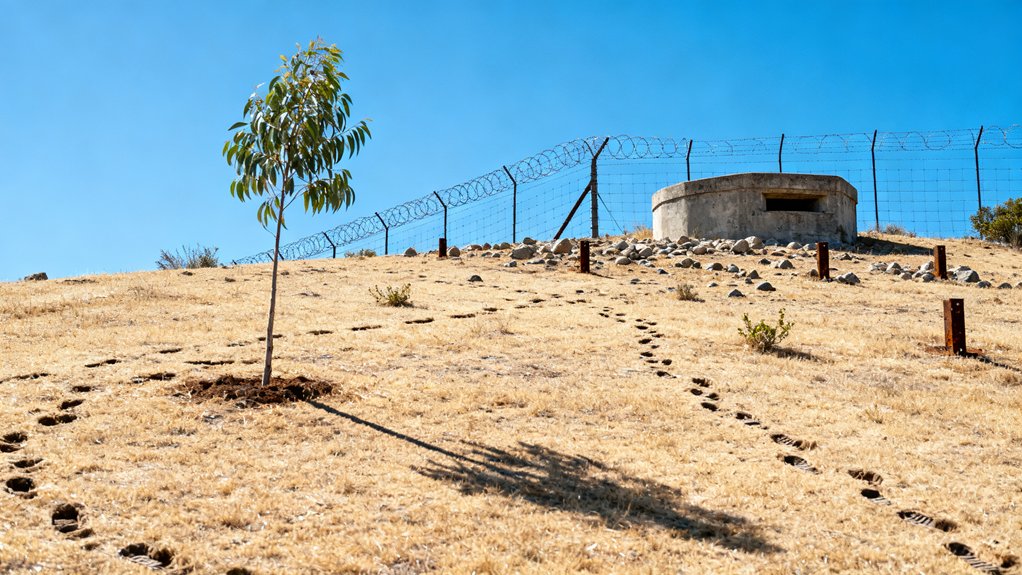
Although the Golan Heights remained a heavily fortified and restricted military zone, Eli Cohen‘s fabricated persona as a wealthy, philanthropic businessman granted him unparalleled access to its most sensitive defenses. His cover shattered every barrier.
He didn’t just observe the golan heights fortifications—he walked among them, photographing deep bunkers and mapping artillery positions with impunity. His access wasn’t accidental; it was engineered.
He didn’t just observe the Golan fortifications—he walked among them, mapping their deepest secrets with impunity.
- Classified bunker locations: Cohen documented hidden command centers carved into the rock, unreachable by any other spy.
- Troop rotation patterns: He noted when guards shifted, revealing the weakest points in the perimeter.
- Reinforced concrete thickness: Measurements he took later guided IAF bomb fusing.
- Underground fuel and ammo depots: He pinpointed supply caches that, if destroyed, would cripple Syrian logistics.
In just weeks, Cohen’s drive gave Israeli planners a complete, target-rich map of the region’s most secret defenses. Every detail he extracted deepened the deception yet to come.
The Eucalyptus Deception: Architecting a Trojan Horse Disguised as Humanitarian Relief
Cohen expertly exploited empathy, framing the eucalyptus plantation as humanitarian relief for sun-scorched Syrian troops. He selected the species for its rapid growth and high aerial visibility, ensuring the trees would become indelible landmarks.
This seemingly benevolent gesture architecting a botanical blueprint that would seal the fate of the Golan’s hidden fortifications.
Exploiting Empathy: Selling the Illusion of Shade for Exhausted Troops
- Cohen directly addressed the soldiers’ suffering, building trust with a tangible solution.
- He framed the trees as a morale boost, not a strategic asset.
- Syrian commanders approved the planting without vetting the long-term intelligence risks.
- The troops planted their own betrayers, unknowingly marking their hidden positions.
Each tree became a fixed, visible signpost for Israeli reconnaissance.
Cohen didn’t just offer shade; he sold a lie wrapped in compassion, turning a scene of exhaustion into a precisely mapped battlefield.
The empathy was the weapon, and the soldiers became unwitting tools of their own destruction.
The Botanical Blueprint: Selecting Eucalyptus for Rapid Growth and High Aerial Visibility
Because eucalyptus grows faster than nearly any other tree in the region, its selection was no botanical accident—it was a calculated choice for speed and visibility. These trees rocket skyward, creating unmistakable eucalyptus tree markers within months, not years.
Cohen didn’t just recommend any tree; he engineered a living grid. From a pilot’s cockpit, these tall, distinct silhouettes scream location against the Golan’s barren slopes. This transforms humanitarian shade into a precision weapon for aerial target identification. Each planted sapling becomes a fixed coordinate, guiding bombs directly onto Syria’s hidden bunkers. The species’ rapid growth seals the deception before anyone can question it. By the time Syrian officers appreciate the shade, they’ve already surrendered their strongest secret—their own defensive positions, now perfectly mapped from the sky.
Broadcasting the Blind Spots: Transmitting Classified Fortification Coordinates to Tel Aviv
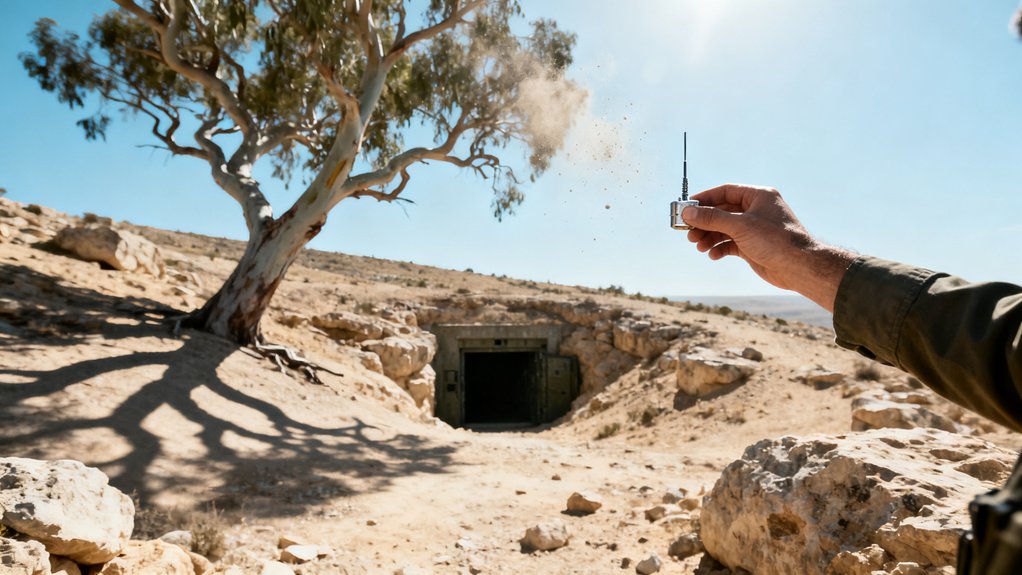
Once a simple agricultural gesture had been approved—planting eucalyptus trees as shade for Syrian troops—Eli Cohen now pivoted to his most dangerous act yet: transmitting the precise coordinates of those newly marked fortifications back to Tel Aviv. Using a concealed shortwave radio hidden in his Damascus apartment, he encoded and relayed grid data, confirming each tree’s location relative to the concealed Syrian defenses. This intelligence would become the blueprint for future Israeli air force strikes.
- Cohen mapped every tree as a fixed coordinate point, not a natural landmark.
- He used a high-frequency transmitter to bypass Syrian signal detection.
- His transmissions included elevation data, exposing bunker depths beneath the trees.
- Cohen verified coordinates via night-time visual checks against his own planted markers.
This data flowed directly to Israeli military intelligence, transforming a forest into a targeting grid. Each eucalyptus now held a death sentence, its position memorized by pilots who’d soon turn shade into destruction.
The January 1965 Intercept: Soviet Tracking Tech and the Fall of Agent 88
Soviet tracking technology finally cornered Agent 88‘s transmissions in January 1965, but not without a critical anomaly.
A persistent radio interference from the Indian Embassy paradoxically masked the beacon’s true origin, forcing KGB specialists to triangulate the signal through a complex urban scape.
They ultimately pinpointed the clandestine broadcasts to a specific apartment in the Abu Rummaneh Quarter, sealing Cohen’s fate.
The Indian Embassy Paradox: Radio Interference Betraying the Transmission Source
How could a professional intelligence officer vanish from the airwaves so completely that his own handlers couldn’t locate him? Cohen’s transmissions, seemingly secure, were betrayed by a flaw no one anticipated: the powerful antenna of the Indian Embassy, located near his safe house, created unexpected radio interference.
This peculiar signal signature—a distinct buzzing pattern—drew Soviet direction-finding teams directly to his door. It wasn’t just bad luck; it was a precise, technical gamble that failed.
- The Indian Embassy’s high-gain antenna distorted Cohen’s signal footprint.
- Soviet technicians isolated this anomaly from standard civilian chatter.
- The interference directly correlated with Cohen’s transmission times.
- This paradox turned a quiet neighborhood into a traceable beacon.
Without this intercept, Cohen’s intelligence on Syrian military bunkers might’ve reshaped 1967 six-day war tactics. Instead, the technical handshake sealed his fate.
The KGB Intervention: Pinpointing the Signal in the Abu Rummaneh Quarter
The Indian Embassy’s rogue signal signature was only the opening act. Now, the KGB stepped in, deploying its sophisticated tracking tech across Damascus.
In January 1965, a specialized Soviet intercept van roamed the Abu Rummaneh Quarter, hunting the precise source of a clandestine transmission. They didn’t just find a signal; they pinpointed Agent 88’s apartment.
This wasn’t a simple radio intercept—it was a technical ambush. The KGB’s direction-finding gear locked onto the frequency used by Eli Cohen, ending the Mossad intelligence operation that had penetrated Syria’s highest circles.
The game was over, and the trap had snapped shut, all thanks to a Soviet signal trace that left no room for escape.
The Marjeh Square Execution: Syrian Retaliation and the May 1965 Public Hanging
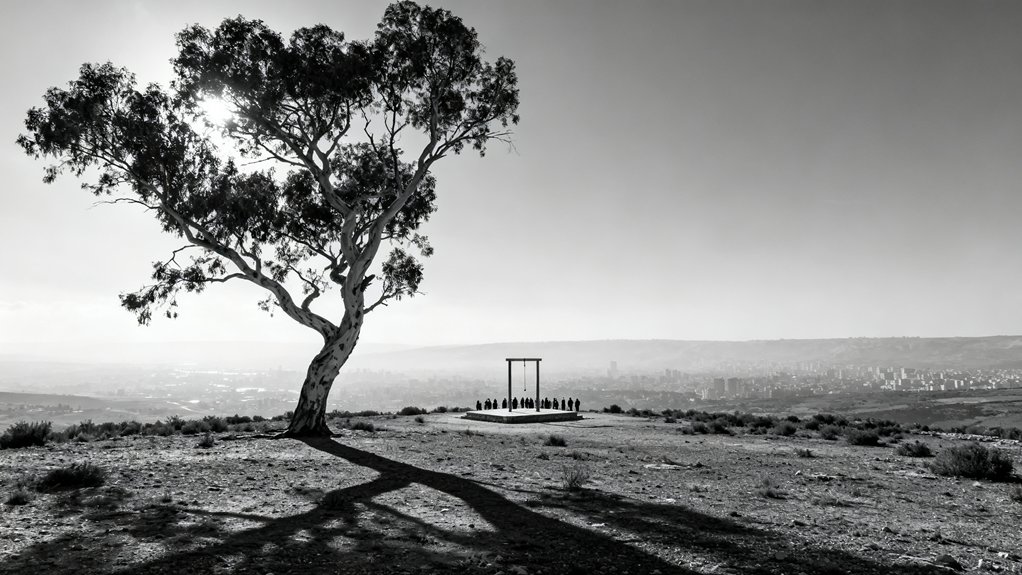
Because Syrian intelligence had finally closed in on him, Eli Cohen’s espionage career ended not with a quiet extraction, but with a brutal public spectacle. On May 18, 1965, Syrian authorities hanged him in Marjeh Square, Damascus, before a jeering crowd. They choreographed this execution as a message—a warning to all foreign spies.
- Solemn Procession: They marched Cohen through the streets in chains, stopping at the scaffold for photographs.
- Public Denunciation: A Syrian officer read a lengthy indictment, accusing Cohen of delivering Syrian military secrets to Israel.
- Final Moments: Cohen refused a blindfold, facing the crowd with unwavering composure.
- Posthumous Display: They left his body hanging for 12 hours, a grotesque trophy of Syrian retaliation.
This execution didn’t erase Cohen’s work. It cemented his legend. The eucalyptus trees he planted still stood, markers for a future strike. But in May 1965, Syria believed they’d won. They hadn’t—they’d only delayed the inevitable reckoning.
June 9, 1967: The Israeli Air Force Activates Cohen’s Posthumous Target Grid
On June 9, 1967, Israeli pilots didn’t just see trees—they zeroed in on Cohen’s deliberate canopy markers, translating isolated foliage into precision aerial waypoints.
The grid he left behind turned the Syrian bunkers from impenetrable fortresses into exposed targets, their coordinates etched into the terrain by his eucalyptus deception.
In just ten hours, the Israeli Air Force decimated positions the Syrian military had boasted were unbreakable, proving Cohen’s posthumous blueprint had already won the battle.
Zeroing the Canopies: Translating Isolated Foliage into Precision Aerial Waypoints
How exactly does a grove of eucalyptus trees—planted years earlier at a spy’s suggestion—become the Israeli Air Force‘s most precise target grid on the Golan Heights? The answer lies in the canopy’s translation into a tactical coordinate system.
To pilots, these weren’t scattered trees; they were indelible, isolated waypoints etched into the terrain.
This transformation wasn’t accidental—it required deliberate intelligence engineering:
- Fixed Prominence: Eucalyptus canopies remain evergreen, creating year-round contrast against the brown Golan terrain.
- Spatial Isolation: Each grove stood alone, eliminating misidentification with forests or orchards.
- One-to-One Mapping: A single tree cluster directly signified a single bunker entrance.
- Recognition Geometry: Spacing between clusters formed unique patterns, verifiable from high-speed passes.
Pilots simply zeroed crosshairs on the canopy center. No ground lasers, no spotter calls—just foliage transformed into a kill-box.
The 10-Hour Decimation: Dismantling the Supposedly Impenetrable Syrian Bunkers
The eucalyptus canopies had already become fixed points on the Israeli Air Force’s mental maps. On June 9, 1967, they activated Cohen’s posthumous target grid. Pilots didn’t hunt for Syrian bunkers; they simply flew toward the trees. Each canopy marked a concrete tomb. The Syrian fortifications, engineered to withstand heavy artillery, were never designed to be spotted from above. Now, they were exposed.
The assault wasn’t a grinding siege. It was a surgical execution. For ten relentless hours, bombs fell through the Syrian defenses’ blind spot. Explosions collapsed bunkers one by one. The survivors emerged with their hands up. The supposedly impenetrable line crumbled without ever firing a shot. Cohen’s leafy markers made the impossible decimation a matter of simple navigation.

While Cohen’s eucalyptus trees painted clear aerial targets from above, they cast a different kind of problem on the ground below—one the Golani Brigade had to solve in the heat of battle.
Those same markers, visible to pilots, also acted as homing beacons for Syrian gunners. The brigade didn’t just assault bunkers; they’d to dismantle the entire kill-zone architecture that surrounded them.
- Shadow Mapping: They learned to read the long shadows of the eucalyptus trees, using them not as targets but as cover to move between overlapping machine-gun arcs.
- Silent Link-Ups: Unit leaders used the trees’ positions to coordinate rendezvous without radio chatter, trusting the physical markers over encrypted signals.
- Reverse Seeding: They dismantled Syrian mortar pits first—precisely those positions the trees were planted to obscure from the air, flipping Cohen’s logic against its creators.
- Visual Dead Zones: Scouts identified the exact blind spots created by the tree lines, feeding those coordinates directly to advancing assault squads.
Each step bypassed the prepared defenses. The trees became their roadmap, not their trap.
Redrawing the Geopolitical Map: The Swift Conquest of the Golan Heights
With the kill zones bypassed and the bunkers silenced, the brigade’s advance didn’t just break Syrian lines—it shattered the territorial status quo. The terrain literally fell into Israeli hands in under 24 hours.
From the summit of Mount Hermon, the troops watched a strategic domino effect realign the entire region. The Golan Heights, a Syrian artillery perch for two decades, now belonged to Israel.
This wasn’t just a military victory; it was a geostrategic transformation. The swift conquest meant the Galilee settlements below would no longer live under shellfire. Control over the headwaters of the Jordan River shifted, giving Israel a critical hydrological buffer.
The Syrian army, caught flat-footed, lost its high-ground advantage permanently. The eucalyptus markers had done their clandestine work. The map of the Middle East was being redrawn in real-time, with every captured bunker and seized trench confirming Cohen’s long-game design had succeeded beyond any conventional assault’s reach.
The Enduring Root System: Analyzing the Tactical Supremacy of Botanical Sabotage

Because Eli Cohen’s eucalyptus trees didn’t just mark targets—they became an enduring weapon system, their tactical supremacy lies in how they weaponized nature itself against Syrian operational security.
This botanic sabotage delivered an undefeatable advantage, rooting deception deep into Syrian territory long before the first bomb fell.
- Indelible markers: Trees can’t be moved or camouflaged overnight, offering Israeli pilots fixed, unambiguous coordinates immune to countermeasures.
- Invisible intelligence: Each eucalyptus grove shouted “attack here” without a single radio transmission, masking espionage in plain sight.
- Strategic permanence: Once planted, the markers required zero maintenance—no agents, no signals, no risk of betrayal after Cohen’s capture.
- Psychological reach: The trees became silent saboteurs, growing in plain view while Syria’s generals didn’t realize their own shade was their undoing.
Yet this botanical deception mirrors how the U-2’s silver fuselage reflected sunlight to create star-like lights that defied known aircraft behavior, turning a secret human operation into an enduring myth.
Frequently Asked Questions
How Did Eli Cohen Initially Finance His Wealthy Businessman Cover?
Mossad practically handed Eli Cohen a bottomless suitcase. They fully bankrolled his extravagant lifestyle, transforming a nobody into a Damascus magnate overnight.
This wasn’t mere funding; it was a masterpiece of investment. His supposed construction empire, complete with lavish parties and tailored suits, was nothing but an elaborate fiction, bought and paid for by Israeli intelligence.
Every single lira spent on his “successful” cover was a calculated down payment on Syrian secrets.
What Precise Method Did Cohen Use to Transmit the Fortification Coordinates?
Cohen didn’t transmit coordinates through codes or radios. He planted the intelligence in plain sight, convincing Syrian commanders to mark their own bunkers with eucalyptus trees.
He whispered humanitarian necessity while crafting visible targets from the sky. Israel’s pilots didn’t need maps; they followed the tree line.
It wasn’t espionage in the shadows—it was deception so brazen, it grew roots before the war even started.
Why Did Syrian Intelligence Not Suspect the Eucalyptus Trees Before 1967?
Nearly 1,200 trees were planted, all meticulously placed with military precision. Syrian intelligence didn’t suspect them because Cohen’s cover was impeccable—he’d already gained their trust as a wealthy benefactor.
The trees looked innocent, providing genuine shade. They weren’t just markers; they were a facade of benevolence. The deception’s brilliance lay in its normalcy, hiding lethal intent in plain sight. No one questions a gesture of goodwill until it’s too late.
Were Any Other Spies Involved in Planting the Eucalyptus Trees On-Site?
No, no other spies were involved in planting the eucalyptus trees on-site. Cohen exclusively orchestrated the deception, persuading Syrian officials to plant them.
He didn’t need accomplices; his deep cover as a wealthy businessman granted him direct access. Syrian soldiers performed the actual planting, unaware of their role in marking bunkers.
Cohen’s lone operation guaranteed secrecy, avoiding any risk of leaks through a network. This isolation made his intelligence coup uniquely his own.
How Long Did the Eucalyptus Trees Survive After the 1967 War Ended?
Most of the eucalyptus trees didn’t survive long after the 1967 war. Israeli airstrikes had already targeted the groves as markers, blasting many to splinters.
The surviving trees, now on Israeli-occupied territory, weren’t maintained; they were relics of a deception. Within a decade, military construction and neglect felled nearly all of them.
Today, only a few scattered remnants exist, standing as silent witnesses to Cohen’s deadly trickery.
Final Thoughts
Decades before a single bomb fell, Cohen’s eucalyptus trees rooted themselves into Syria’s defenses. On June 9, 1967, an Israeli pilot spotter doesn’t scan for guns—he follows the canopy. Every grove marks a bunker’s mouth. It’s not a coincidence. It’s a harvest. The Syrian army built their own tombstone, watered by deception, shaded by folly. Six years of cultivation paid out in thirty-six hours of fire.