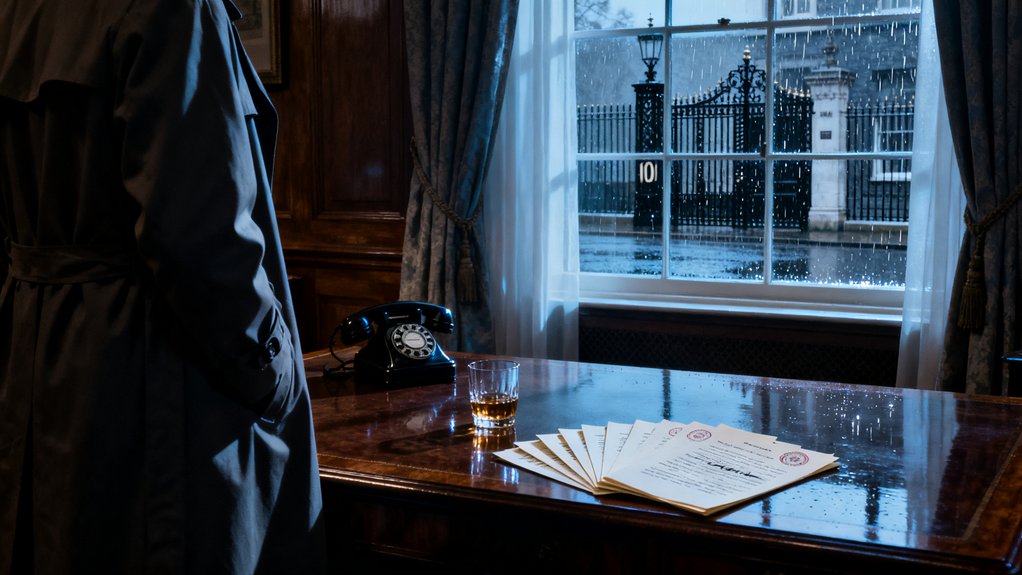
A yellowing document slips through the cracks of history, its contents a quiet detonation. The Downing Street Memo exposes a secret meeting where top UK officials revealed the U.S. had already committed to war in Iraq by mid-2002—months before the public case was made. Intelligence was being “fixed” around the policy, not guiding it. What follows unravels the official story of the war’s justification.
Key Takeaways
- The Downing Street Memo revealed that the U.S. had already decided on war with Iraq by July 2002, despite public claims of pursuing peace.
- Intelligence was “fixed around the policy” of regime change, with Sir Richard Dearlove reporting that facts were shaped to fit predetermined war plans.
- The U.S. and UK manipulated WMD intelligence, ignoring minimal British assessments to exaggerate Iraq’s chemical weapons threat.
- Legal concerns were bypassed, as UK and US leaders pursued war despite lacking international legal justification for regime change.
- The memo’s 2005 leak exposed deception, eroding public trust and revealing that war plans were set months before the invasion.
What Was the Downing Street Memo?
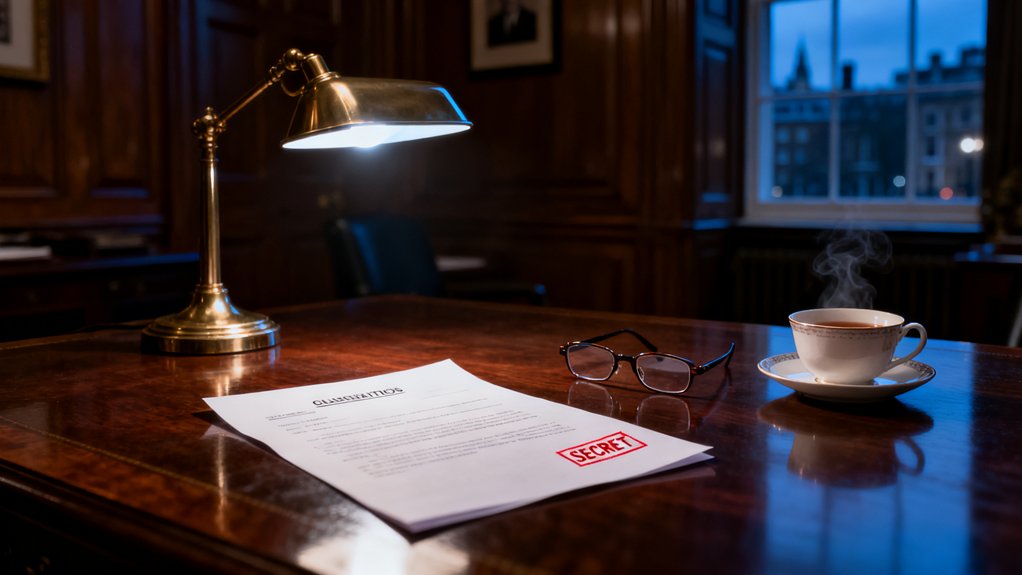
The Downing Street Memo originated from a classified July 23, 2002 meeting of British senior officials, including Prime Minister Tony Blair, where they discussed U.S. plans for regime change in Iraq. It revealed that the U.S. had already decided on war, with intelligence being “fixed around the policy” to justify the invasion. The document exposed a critical gap between private planning and public claims that war remained a last resort. This manipulation of intelligence echoes the Pentagon’s contemplation of false-flag attacks in Operation Northwoods to justify military action.
Origins Of The Memo
- Classified “Strictly Personal – UK Eyes Only,” the memo captured candid assessments of American intent
- Sir Richard Dearlove reported that Bush had already decided on war, with military action seen as “inevitable”
- U.S. intelligence was being shaped to fit the policy, not guide it—facts were “fixed” around the plan
Key Revelations Exposed
Though secret at the time, the Downing Street Memo laid bare the inner workings of a war already decided. Dated 23 July 2002, it recorded a meeting where intelligence chief Sir Richard Dearlove reported the U.S. had fixed on military action to remove Saddam Hussein. Most striking was the admission that *intelligence and facts were being fixed* around the policy, not guiding it. Attendees agreed military action was “inevitable,” despite legal concerns from Attorney-General Lord Goldsmith. Foreign Secretary Jack Straw called the case for war “thin,” noting Iraq’s WMDs paled next to those of Libya, Iran, or North Korea. President Bush was set on regime change, and *Prime Minister Tony Blair* had aligned with him months before public justification. The memo, marked “secret” and “UK eyes only,” exposed a truth long hidden: the war wasn’t a last resort—it was preordained.
How the Downing Street Memo Was Leaked
Someone within the UK government leaked the Downing Street Memo to *The Sunday Times* journalist Michael Smith, who published it on 1 May 2005. The memo, marked “UK Eyes Only,” had been distributed to just 13 senior officials, making the source’s access clear but never officially confirmed. Smith’s report followed online exposure by U.S. bloggers who highlighted the document’s explosive claim: intelligence was being fixed around the policy of war. Like the Pentagon Papers leak, this disclosure revealed how top-level government decisions were shaped by predetermined war objectives rather than objective intelligence.
Source Of The Leak
- Only 13 senior officials received the “Secret, UK Eyes Only” memo.
- Attendees raised no objections, confirming its accuracy.
- Michael Smith’s source acted beyond the reach of state control, triggering global scrutiny.
That leak shattered official narratives and empowered citizens demanding accountability.
Media Breaks The Story
Michael Smith broke the story of the Downing Street Memo on 1 May 2005, publishing it in *The Sunday Times* during a heated UK general election campaign. The classified memo, titled “Secret and Strictly Personal – UK Eyes Only,” was written by Foreign Office aide Matthew Rycroft after a 23 July 2002 meeting of top British officials. It revealed the U.S. had already decided to invade Iraq, with intelligence being “fixed around the policy.” Though major U.S. outlets ignored it, progressive blogs like Daily Kos and MYDD circulated the document on 30 April, forcing mainstream attention. The *Sunday Times* exposure gave credibility to the leaked classified memos, unraveling official narratives. Tony Blair confirmed the memo’s authenticity days later, dismissing its significance. Yet its release proved pivotal—exposing how leaders concealed war plans from the public. The story’s emergence, driven by independent journalism and digital activism, illuminated truth buried beneath state secrecy, empowering citizens with facts long withheld.
The Most Damning Quote: ‘Intelligence Was Being Fixed
Sir Richard Dearlove wrote that “intelligence and facts were being fixed around the policy” after his July 2002 talks with U.S. intelligence officials, including CIA Director George Tenet. This phrase captured how the Bush administration was shaping evidence to fit a predecided war plan, not responding to new threats. The memo made clear that policy was driving intelligence, not the other way around.
Intelligence Was Being Fixed
Although policymakers publicly maintained that war with Iraq remained a last resort, internal British documents from July 2002 reveal that U.S. intelligence was already being shaped to justify a decision that had effectively been made. MI6 chief Sir Richard Dearlove reported after high-level talks in Washington that “intelligence and facts were being fixed around the policy,” showing intelligence was being fixed to fit the march to war. This manipulation occurred despite public claims that no final decision had been made.
- Dearlove delivered this assessment directly to Tony Blair’s war cabinet after meeting CIA Director George Tenet.
- The phrase “fixed around the policy” implied intelligence and facts were bent to serve preordained regime change.
- The “Secret—UK Eyes Only” memo was never disputed by any of the 13 senior officials who received it.
Policy Driving Evidence
Even as public statements emphasized caution and the need for further evidence, internal discussions among British officials in July 2002 exposed a stark reality: the U.S. had already committed to war, and intelligence was being shaped to fit that decision. The Downing Street Memo recorded that “intelligence and facts were being fixed around the policy,” a conclusion drawn by MI6 chief Sir Richard Dearlove after high-level U.S. talks. This deliberate reversal of process meant policy drove evidence, not the other way around. Facts were being fixed to justify regime change, while WMD claims swelled despite thin proof. The CIA’s inflated estimates contradicted British assessments, revealing systemic bias. Public diplomacy, including UN efforts, became a cover for a war long decided. Intelligence and facts, once safeguards of truth, were repurposed as tools of justification—undermining democracy, deceiving the public, and paving the war’s path with lies.
Bush’s Public Justification for War
Bush publicly framed the Iraq War as a response to imminent threats, insisting Saddam Hussein possessed active WMD programs and had ties to al-Qaeda. He emphasized intelligence showing Iraq had stockpiled chemical and biological weapons, even as internal estimates—like the British JIC’s 1.5 tons of VX—were far smaller and more uncertain. His administration also pushed the idea that Saddam supported terrorism, despite no credible evidence linking him to 9/11 or operational cooperation with al-Qaeda.
WMDs As Primary Justification
Nearly every public justification for the Iraq War centered on the claim that Saddam Hussein was amassing weapons of mass destruction, yet internal documents reveal this rationale was built on distorted intelligence. By July 2002, the U.S. had already decided on invasion, and intelligence was being “fixed around the policy” to fit the narrative. Despite minimal evidence, the administration insisted Iraq possessed active WMD programs, contradicting internal assessments.
- The CIA’s October 2002 estimate exaggerated Iraq’s chemical stockpiles by hundreds of tons compared to British evaluations.
- MI6 reported the U.S. was reshaping intelligence to justify regime change, not responding to imminent WMD threats.
- Jack Straw acknowledged Iraq’s capabilities were weaker than those of Libya, Iran, or North Korea—yet the public was told otherwise.
The war’s primary public justification collapsed under scrutiny, exposing how facts were bent to serve a predetermined war.
Terrorism Links Emphasized Publicly
Why did the administration stress Saddam Hussein’s ties to terrorism when internal records show those links were dubious at best? The Downing Street Memo reveals that by July 2002, bush and top officials had already decided on war, even though public justification hinged on unproven claims. Despite knowing Iraq posed no immediate threat and wasn’t aiding global terrorism, the U.S. framed the invasion around these fears. Intelligence was “fixed around the policy,” with bush citing terrorist connections in speeches to rally support. In March 2003, he claimed the war would disrupt terror networks, though internal assessments contradicted this. British officials, including Jack Straw, admitted the case was “thin.” The emphasis on terrorism served not truth, but momentum—exploiting 9/11 anxieties to sell a war already set in motion. Liberation rhetoric masked predetermined aggression.
UK Officials Feared War Was Inevitable
By July 2002, senior UK officials recognized that the U.S. had already set course for war, leaving Blair little room to alter Bush’s trajectory. Sir Richard Dearlove’s report confirmed that intelligence was being shaped to fit the policy, not drive it, exposing a war decision made behind closed doors. With regime change legally unjustifiable and public justification still lacking, British leaders grappled with a reality they couldn’t control.
War Decision Already Made
Though British ministers publicly maintained that war with Iraq remained a last resort, internal deliberations as early as July 2002 revealed they saw U.S. military action as inevitable. By then, President Bush had decided on regime change, and British officials knew it. Intelligence and facts were being fixed around the policy, not guiding it. Sir Richard Dearlove confirmed this after talks in Washington, noting the intelligence process was shaped to fit a predetermined war. Jack Straw acknowledged the case for war was thin, with Iraq’s WMD threat weaker than Iran’s or North Korea’s.
- President Bush had decided on war before the public justification existed
- Intelligence and facts were being fixed to support the invasion plan
- The UK anticipated using UN inspections as a pretext, even after Iraq accepted strict terms
Blair Caught In Bush Agenda
How could diplomatic efforts credibly unfold when the path to war had already been charted? By July 2002, top UK officials knew President Bush wanted to remove Saddam Hussein by force, with war deemed inevitable. The Downing Street Memo records MI6 chief Richard Dearlove stating intelligence was being “fixed” around U.S. policy. Prime Minister Blair, though publicly reserving judgment, had already aligned with Bush’s agenda. British officials, including Foreign Secretary Jack Straw, acknowledged the justification for war was thin, weaker than cases against Libya or North Korea. Yet Blair’s team helped craft a strategy for an ultimatum on weapons inspectors—knowing non-compliance could be used to justify invasion. Internal records, authored by Blair’s aide Matthew Rycroft, show no dissent. The memo proves UK leaders were not steering policy but following Bush’s chosen course, undermining claims of peaceful intent.
What ‘Fixed Intelligence’ Actually Meant
The phrase “fixed intelligence” referred to the deliberate shaping of evidence to justify an already decided war policy. U.S. officials aligned intelligence assessments with the goal of invasion, prioritizing political objectives over accurate analysis. This meant gathering and presenting data selectively, ensuring public and diplomatic narratives supported immediate action, not open inquiry.
Intelligence Tailored To Fit War
While the Bush administration insisted publicly that war with Iraq remained a last resort, internal intelligence was already being reshaped to justify an invasion set in motion months earlier. The term “fixed intelligence” wasn’t speculation—it was a deliberate manipulation of facts to serve policy. MI6 chief Richard Dearlove reported that U.S. intelligence was being rigged like a predetermined outcome, with assessments molded to fit the drive for war.
- The CIA claimed Iraq had up to 500 tons of chemical weapons; British analysts, relying on real data, estimated just 1.5 tons of VX.
- U.S. officials dismissed post-invasion planning, focused instead on crafting a casus belli.
- Facts weren’t guiding decisions—intelligence was fixed, then presented as proof.
Policy Driving Evidence Gathering
Sir Richard Dearlove’s July 2002 report from Washington exposed the reality behind the rhetoric: U.S. intelligence wasn’t guiding policy—it was being reshaped to fit it. The Bush administration had already committed to war, and intelligence was adjusted to justify that choice. Facts no longer drove decisions; policy dictated how intelligence was framed. Dearlove found U.S. officials, including CIA Director George Tenet, aligning assessments with the goal of removing Saddam Hussein. While the British JIC estimated minimal chemical weapons, the U.S. NIE claimed up to 500 tons—a vast exaggeration. Officials noted the U.S. dismissed genuine inspections, preferring a failing ultimatum to manufacture casus belli. By July 23, military action was “inevitable” in British eyes, though publicly, war remained a last resort. This inversion—policy driving evidence gathering—turned intelligence into spectacle, facts into tools. The memo revealed not inquiry, but confirmation.
WMDs and the Downing Street Memo’s Warning
The Downing Street Memo revealed that U.S. and British officials were shaping WMD intelligence to support a war already decided upon. Despite weak evidence—like the disputed claim of 1.5 tons of VX nerve gas—public statements exaggerated Iraq’s chemical arsenal as large and imminent. This gap between known facts and official narratives showed how intelligence was manipulated to justify regime change.
WMDs As Justification
A secret consensus among top British officials in July 2002 exposed the growing gap between public justification and private intent. Though the U.S. had already committed to war, weapons of mass destruction were being pushed as the primary justification—even as evidence crumbled. British intelligence assessed Iraq’s WMD capability as minimal, far below nations like North Korea, yet the public narrative amplified exaggerated threats.
- U.S. claims of 500 tons of chemical weapons starkly contradicted Britain’s estimate of just 1.5 tons of possible VX nerve agent
- Jack Straw called the WMD case “thin,” knowing regime change—not weapons—was Washington’s true aim
- Officials drafted ultimatums rigged to fail, turning inspections into a pretext rather than a peace measure
The WMD justification collapsed under scrutiny, revealing a war built not on facts, but manufactured consent.
Intelligence Was Manipulated
How could intelligence so sharply diverge from policy if not shaped to fit a predetermined course? In July 2002, British intelligence chief Richard Dearlove reported that facts were being fixed around the U.S. policy to invade Iraq. The Downing Street Memo revealed that intelligence was manipulated to align with a war decision already made. Despite thin evidence, officials claimed Saddam Hussein had active WMD programs. Yet British assessments showed Iraq’s capabilities lagged behind Libya, North Korea, and Iran. The U.S. National Intelligence Estimate inflated chemical stockpiles to 500 tons—vastly overstating 1.5 tons suggested by outdated UN data. Legal advisors like Lord Goldsmith warned regime change lacked international legitimacy. Still, leaders forged ahead, distorting intelligence to manufacture consent. The public was misled; debates were staged, not genuine. Facts were buried, not honored. WMDs became a narrative tool—convenient, false, and wielded to justify a war decided months before.
Timeline: Memo Leak to Iraq Invasion
The Downing Street Memo, written on 23 July 2002, confirmed that the U.S. had already set course for war while public justification centered on WMDs and terrorism. It wasn’t until 1 May 2005 that the memo surfaced, igniting global reaction and scrutiny over the timing and honesty of the Iraq invasion. The leak exposed a stark contrast between private planning and official narratives, fueling demands for accountability in both the UK and the U.S.
Planned Invasion, Public Justification
Though public statements emphasized diplomacy and containment as viable alternatives, behind closed doors the path to war was already set by July 2002, as revealed in the Downing Street Memo. Senior British officials knew military action was inevitable, even as the U.S. and UK governments insisted war was a last resort. Intelligence was being “fixed around the policy,” ensuring facts would serve the pre-determined push for invasion. Legal justification remained shaky—regime change lacked support under international law—but the U.S. and UK pushed forward, crafting a narrative centered on WMDs. An ultimatum for readmitting UN inspectors was designed to strengthen that case, regardless of the outcome.
- Military action was locked in before public debate began
- Intelligence was shaped to fit the policy, not guide it
- Legal justification was retrofitted to mask a fixed decision
Memo Leak, Global Reaction
Journalists and lawmakers began scrutinizing the lead-up to the Iraq War anew when *The Sunday Times* published the Downing Street Memo on 1 May 2005, exposing internal British discussions from July 2002 that confirmed U.S. war plans were already in motion while public statements maintained diplomacy was ongoing. The memo leak revealed that intelligence was being “fixed around the policy,” sparking a global reaction as media from Chile’s *La Segunda* to Colombia’s *El Tiempo* condemned the deception. U.S. bloggers amplified the story days before official publication, pushing Rep. John Conyers to demand answers. Though mainstream coverage lagged, the outcry fueled a June 2005 hearing featuring Joseph Wilson and Cindy Sheehan, challenging the narrative of last-resort war. Evidence of premeditated invasion shattered official justifications, empowering citizens to question authority and demand transparency in governance.
Media Reaction and Public Backlash
The leak of the Downing Street Memo triggered a sharp shift in media coverage, as blogs pushed the story into the mainstream despite early silence from major U.S. outlets. When *The New York Times* and others finally reported it, the delayed response fueled public perception of a cover-up, eroding trust in official narratives. Editorial boards and readers alike began accusing the Bush administration of distorting intelligence, marking a turning point in war accountability discourse.
Media Coverage Shifts
Why did it take U.S. mainstream media over two weeks to report on a document that undermined the official narrative for the Iraq War? The British memo, leaked in early May 2005, revealed war planning predated public justification, yet major outlets ignored it. Progressive blogs broke the story in the U.S., forcing the issue into view.
- *Daily Kos* and *MYDD* exposed the memo days before mainstream media mentioned it
- *Los Angeles Times* and *Washington Post* finally assigned reporters on May 12–13
- *Christian Science Monitor* slammed the press delay, calling it a failure of duty
Public pressure mounted. *The New York Times* admitted readers pushed them into action. The mainstream media had failed to challenge power—but could no longer look away.
Public Trust Erodes
Even as the Downing Street Memo exposed how intelligence was being shaped to fit a predetermined war policy, the delayed response from major U.S. news outlets fueled public outrage, turning a political revelation into a crisis of trust. The leak, first amplified by progressive blogs, revealed that british prime minister tony Blair’s government knew the U.S. had already decided on war months before the invasion, while public statements claimed diplomacy was ongoing. When major papers like the *Los Angeles Times* and *Washington Post* ignored the story for nearly two weeks, public trust eroded further. Over 540,000 people signed a petition demanding accountability by June 13, 2005. The “Awaken the Mainstream Media” campaign erupted, condemning corporate media silence. Editorials, like the *Star Tribune*’s Memorial Day piece, accused Bush and aides of deception. People realized they’d been misled—not just by officials, but by the press meant to check them.
Did the Downing Street Memo Reveal a Conspiracy?
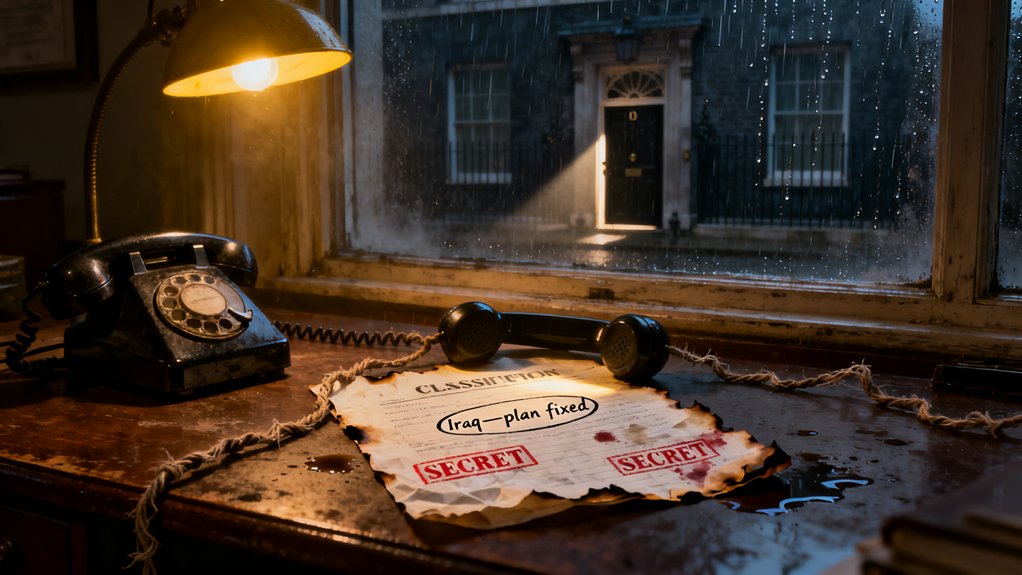
By July 2002, top U.S. and British officials had already committed to removing Saddam Hussein, even as public statements insisted war remained a last resort. The Downing Street Memo reveals that intelligence was being shaped to fit the policy, not guide it, with MI6 chief Richard Dearlove confirming facts were “being fixed” around the decision for war. With military action deemed “inevitable” months before the invasion, planning proceeded despite weak evidence on WMDs and unresolved legal concerns.
War Decided Beforehand
Although public statements portrayed the Iraq War as a last resort, the Downing Street Memo exposed a secret reality: by July 2002, top U.S. and British officials had already accepted military action as inevitable. President Bush had decided to remove Saddam long before the invasion, with planning underway as early as March 2002. The U.S.-UK coordination was classified, and regime change was the clear objective—regardless of WMD evidence or diplomatic efforts.
- By July 2002, U.S. military action was deemed “inevitable”
- Bush had already decided to remove Saddam eight months before the invasion
- British officials acknowledged the war case was “thin” and WMD claims weak
This behind-closed-doors commitment to war shattered the illusion of choice, revealing a path paved not for peace, but for conquest cloaked in false urgency.
Intelligence Manipulated for War
The July 2002 meeting at Downing Street laid bare not just the certainty of war, but the mechanism to justify it. British officials recorded that US intelligence had already committed to regime change, with facts being *fixed* around that policy. MI6 chief Richard Dearlove reported that intelligence and evidence were adjusted to fit the war plan, not guide it. Officials discussed engineering a diplomatic pretext—pushing Iraq to reject weapons inspections—knowing refusal could be used to legitimize invasion. Even as the UK’s Joint Intelligence Committee estimated only minimal WMD stockpiles, the CIA claimed Iraq possessed 500 tons of chemical weapons. The memo showed leaders ignored legal warnings and inflated threats, manipulating *intelligence* to sell the war. The result was not discovery, but deception—a war built on *fixed* narratives, not facts. Truth was sacrificed to power.
The Lasting Impact of the Downing Street Memo
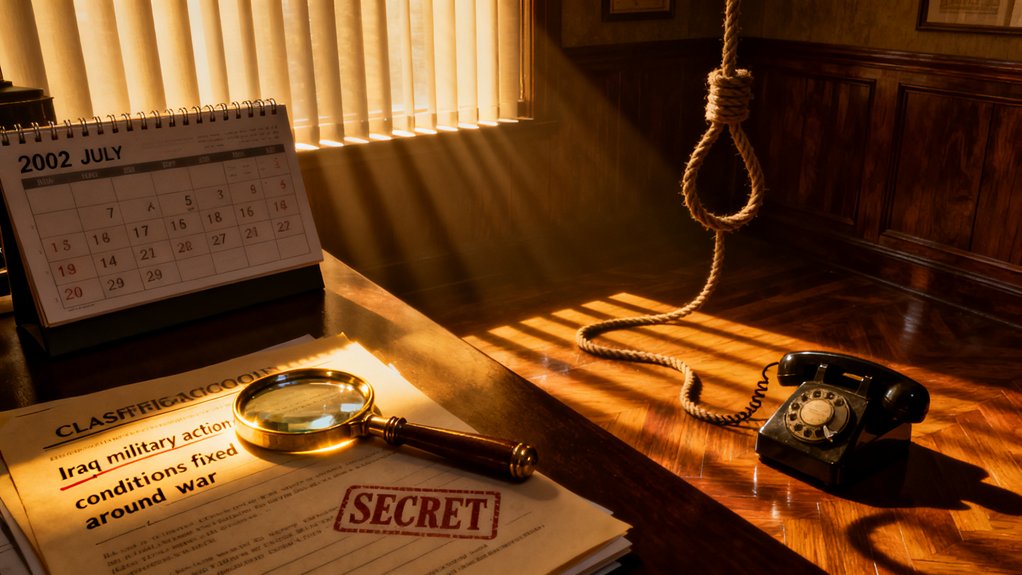
The Downing Street Memo sharpened scrutiny of government credibility, as it revealed senior officials had planned for war months before public justifications were offered. It exposed how intelligence was shaped to fit a predecided policy, fueling widespread skepticism about the honesty of both U.S. and U.K. leadership. That loss of trust reshaped foreign policy debates, making future military initiatives face greater public and legislative resistance.
Erosion Of Public Trust
Doubt began to take root in May 2005, when the public saw what British officials had known since July 2002: war with Iraq was already set, no matter the evidence. The leak of the Downing Street Memo shattered the official narrative, exposing how intelligence was shaped to justify a predetermined invasion. Public trust eroded as citizens realized leaders like Blair had committed to war while publicly insisting diplomacy remained priority. The memo revealed a path paved with deception, fueling global skepticism.
- The U.S. had fixed intelligence around policy—facts bent to fit a war plan.
- UK lawyers warned regime change lacked UN backing, yet leaders pushed forward.
- Blair’s honesty rating plunged to 30%, a clear collapse in public trust.
Downing’s shadow stretched across democracies, reminding people: truth matters.
Legacy In Foreign Policy
Intelligence shaped to fit a war plan, once hidden, now cast long shadows over how nations justify conflict. The Downing Street Memo revealed in 2005 that by July 2002, U.S. and UK leaders deemed war with Iraq “inevitable,” even as they publicly exhausted diplomacy. Intelligence was “fixed around the policy,” British chief Richard Dearlove reported, exposing a rift between private decisions and public narratives. This revelation reshaped foreign policy discourse, becoming a benchmark for scrutinizing government transparency. Media worldwide cited it years later as proof of deceptive justifications for war. Though U.S. outlets lagged, the memo fueled congressional hearings and sustained demands for accountability. Its legacy endures in debates over military intervention, where citizens now question official claims with sharper skepticism. The memo’s truth remains a tool for those demanding honest, ethical governance.
Frequently Asked Questions
Was the Downing Street Memo Authentic?
Yes, the Downing Street memo is authentic. British officials confirmed its legitimacy, and it matches official records. Dated July 23, 2002, it captures a high-level meeting where intelligence was described as being “fixed around the policy.” Journalists and investigators verified its contents through multiple sources. No credible evidence has disproven it. The document remains a key piece of evidence showing early war planning preceded public justifications.
Did Tony Blair Lie to Parliament?
He did not lie outright, but he misled Parliament. Tony Blair presented intelligence with certainty it didn’t warrant, omitted doubts about Iraq’s WMDs, and framed war as last resort while backing regime change early. His government exaggerated threats, dismissed alternatives, and downplayed risks. Though he believed Saddam was dangerous, his selective truths distorted reality. Parliament and public were denied full context—choices were shaped by omission, not outright falsehoods.
Why Did the U.S. Ignore the Memo’s Warnings?
They didn’t ignore the warnings—they already shared the goal. U.S. leaders had committed to regime change long before the memo surfaced, coordinating closely with Britain. Intelligence was shaped to fit the plan, not guide it. The public rationale emerged later, wrapped in urgency about WMDs and terror. Dissent was sidelined, questions suppressed. Power moved deliberately, bypassing scrutiny, ensuring momentum toward war no memo could halt.
Were Any Officials Punished for Fixing Intelligence?
No officials faced punishment for fixing intelligence. Despite clear evidence of manipulation, accountability never materialized. Those in power protected their own, shielding decision-makers from consequences. The public grew skeptical, yet institutions upheld silence. Careers advanced while truths remained buried. Whistleblowers risked everything, but reprisals fell on them, not the architects. Justice stalled, eroding trust. The system, designed to serve truth, instead preserved power, leaving dissenters to carry the cost.
Did the Memo Influence Later U.S. Wars?
No, the memo didn’t stop later U.S. wars, but it did shadow them. Whispers of deception spread, fueling skepticism. When leaders called for new interventions, people remembered—eyes narrowed, voices rose. Distrust took root. Protests grew louder, scrutiny deeper. Each military push faced sharper questions. The ghost of fixed intelligence haunted decisions. Truth became a weapon the people wielded, refusing to be misled without a fight.
Final Thoughts
The Downing Street Memo exposed a war machine already in motion, its gears oiled with predetermined outcomes and polished intelligence. Leaders spoke of diplomacy while paving the road to Baghdad. Like a trial where the verdict comes before the evidence, the invasion of Iraq was a foregone conclusion—truth twisted to fit a narrative, not the other way around. Trust broke quietly, one fixed fact at a time.