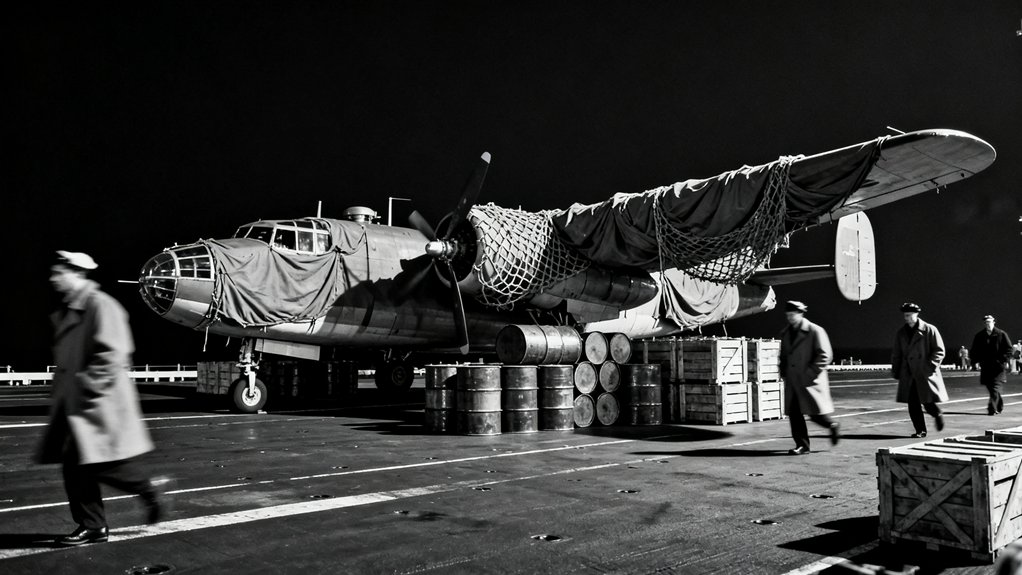
In a frozen Minnesota hangar, engineers stripped B-25s of armor and guns, replacing a classified bombsight with a broomstick to deceive spies. They loaded extra fuel for a one-way strike from the USS *Hornet*. Task Force 16 sailed under radio silence, its crew ignorant of the target. When the *Nitto Maru* exposed them, gale-force winds forced a premature launch. Pilots dropped to wave-top level, exploiting a 50-foot radar blind spot over Tokyo. The raid’s concealment tactics shattered Japan’s invulnerability myth, but the real secret lay in the aftermath. A chain of panic and retaliation followed.
Key Takeaways
The B-25s were disguised as cargo aircraft, with Norden bombsights swapped for broomsticks. Crew ignorance prevented loose lips; no one knew the target before launch. Radio silence created a psychological void, masking Task Force 16’s location. A fake base was fabricated to mislead Japanese intelligence about the carrier’s origin. The B-25s flew at wave-top level to evade Japanese radar’s 50-foot minimum detection altitude.
The Sub-Zero Genesis: Engineering a 16-Bomber Retaliation in January 1942
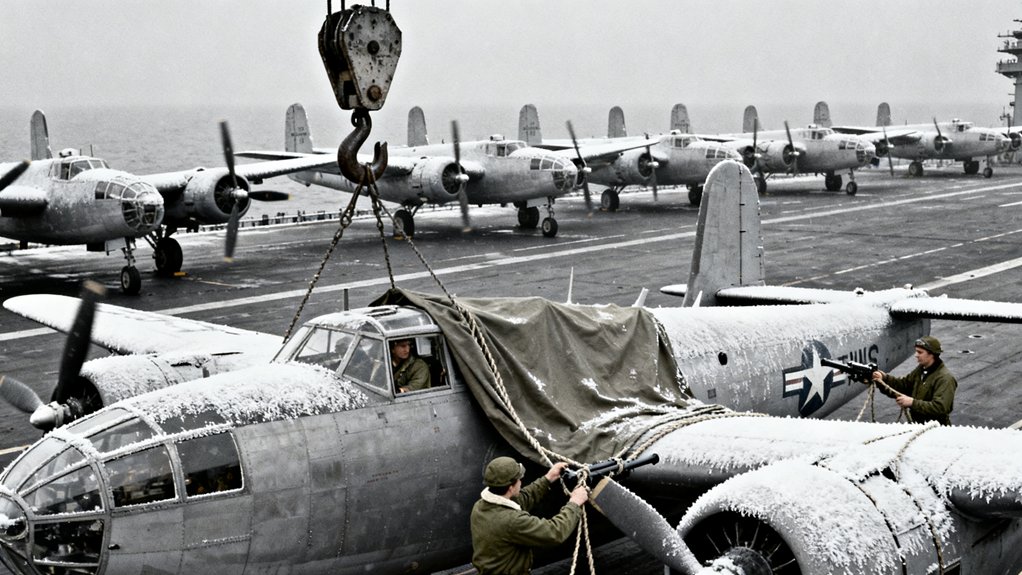
Although the Japanese military command considered a mainland attack impossible in early 1942, a team of American planners was already defying that logic in sub-zero temperatures. They forged a desperate, clandestine scheme, the first special aviation project, conceived in the frozen isolation of a Minnesota airfield.
The core requirement was brutally simple: launch 16 B-25 bombers from a Navy aircraft carrier, a feat no one had attempted. This meant stripping every unnecessary pound from the aircraft. Engineers performed forensic B-25 Mitchell payload modifications, removing the lower turret, armor, and even the tail gun to pack extra fuel tanks.
They weren’t building bombers; they were building fuel trucks with wings. Each Mitchell became a calculated gamble, a single-use weapon designed for a one-way mission. The team worked in secrecy, their breath misting in the cold, knowing that every rivet removed increased their slim chance of reaching Japan. This was the raw, human genesis of retaliation.
Stripping the Mitchells: The Forensic Modification of Land-Based B-25s for Carrier Operations
Ground crews stripped the B-25s of their secret Norden bombsights, replacing them with crude broomsticks to mislead Japanese spies.
They then calculated every pound of weight saved against the critical fuel load, targeting a precise 1,141-gallon capacity for the extended flight.
This forensic modification of a land-based bomber for a carrier deck wasn’t just engineering. It was a calculated gamble on survival.
Eradicating the Norden Bombsight and Weaponizing Broomsticks
The “Mark Twain” sight preserved combat functionality, but it also erased a classified asset from Japanese hands. This act transformed a precision instrument into a spy’s liability.
It prioritized mission security over technological advantage. The broomstick symbolized a raw, humanistic pivot. Desperate men turned a cleaning tool into a weapon of war.
The 1,141-Gallon Fuel Mathematics Imperative
The mission demanded every possible gallon. Ground crews stripped the B-25s down to their bones, removing the bottom turret, the Norden bombsight, even the radio, just to fit an extra 1,141 gallons of fuel into the cramped fuselage. This was not guesswork. It was cold mathematics. USAAAF declassified strike reports reveal the exact tank placements, each welded into place after a forensic raid timeline calculation showed the bombers needed that precise capacity to reach China after hitting Japan. The crewmen did not just load fuel. They redefined the aircraft’s very purpose. That single number, 1,141, shattered Japanese domestic invulnerability before a single bomb fell.
| Modification | Fuel Gained (Gallons) |
|---|---|
| Forward bomb bay tank | 835 |
| Crawlway tank (aft fuselage) | 265 |
| Wing leak-proofing + aux tanks | 41 |
Task Force 16 Enters the Void: The Strict Concealment Mechanics Aboard the USS Hornet
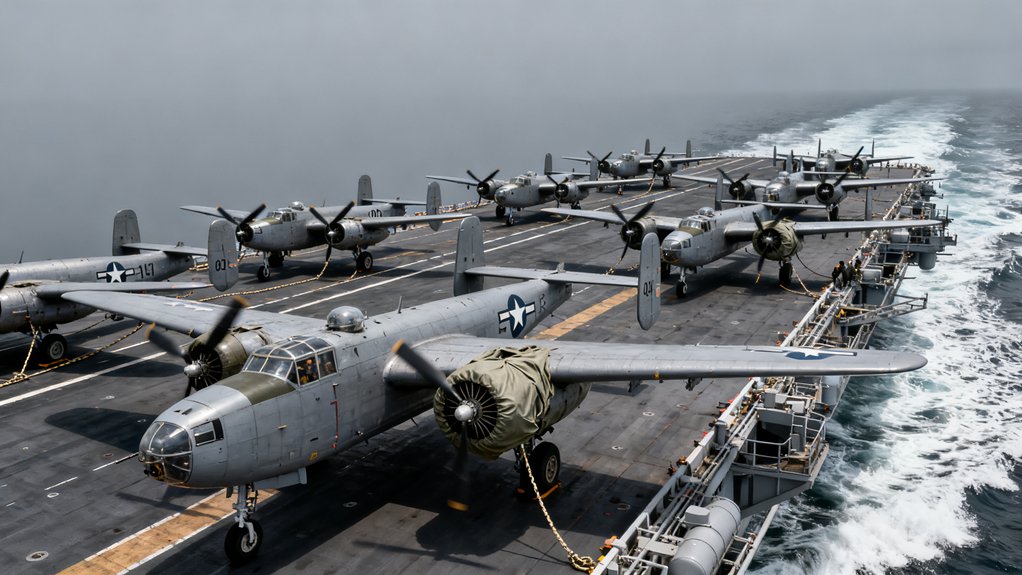
The Crew’s Ignorance: Their innocence wasn’t merely a security measure. It served as a human shield, protecting the plan from loose lips and casual chatter.
The Bombers as Props: The heavily loaded B-25s, parked on the flight deck, appeared as innocuous cargo. They masked the violent strategic military reallocation they’d soon execute.
The Void Itself: Task Force 16 sailed into radio silence, a psychological void where no one knew the mission’s actual target. This forced trust in leadership’s hidden hand.
The 0744 Whistleblower: How the Nitto Maru Picket Boat Compromised the Pacific Infiltration
Admiral Halsey’s 400-mile miscalculation forced a premature launch order when the Nitto Maru picket boat spotted Task Force 16 at 0744, shattering the operation’s fragile concealment. The crew knew their Pacific infiltration had failed; now they raced against the clock and the elements.
Admiral Halsey’s 400-Mile Miscalculation and the Premature Launch Order
Admiral Halsey’s miscalculation risked the bombers running out of fuel before any Tokyo target damage assessment could occur, turning precision into prayer.
The premature launch guaranteed the Hornet’s deck became a frantic, human-centered stage of mechanics and will, not sterile protocol.
That single 0744 alert made the entire operation a gamble on morale rather than logistics, changing the war’s human narrative forever.
The 0820 Gale-Force Deck Mechanics of the B-25 Departures
The premature launch at 0744 threw the operation into chaos before a single bomber left the deck.
By 0820, the Hornet’s deck crew faced a nightmare: gale-force winds and mountainous seas, a brutal test of human endurance. These weren’t just mechanics. They were men wrestling 31,000-pound bombers on a pitching, oil-slicked tin can.
They chocked wheels, strained against wind, and fought to align each B-25 for its impossibly short takeoff. Two hundred feet felt like two yards against a heaving deck.
The Nitto Maru’s discovery had already blown their covert infiltration, so speed wasn’t a preference; it was survival. Every shouted command or soaked glove gripping a tie-down carried the weight of desperation.
The crew knew failure meant losing the fleet to Japanese guns.
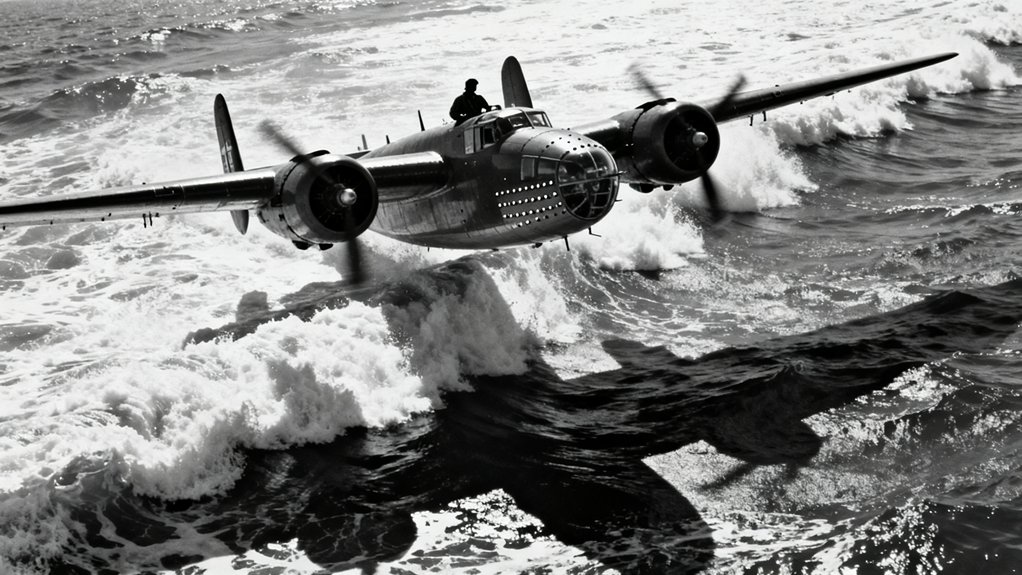
Because Japanese coastal radar had a minimum detection altitude of roughly 50 feet, the 16 B-25s of the Doolittle Raid exploited this precise blind spot by dropping to wave-top level for the final approach.
This wasn’t just a technical maneuver; it was a high-stakes gamble where the ocean became a shield. Pilots flew so low they could taste salt spray, their propellers churning a fine mist off the waves. They navigated by instinct, using compass bearings and the horizon’s faint line, knowing one downdraft meant a watery grave. The Japanese defenders, expecting a high-altitude threat, never saw them coming.
The 50-foot barrier wasn’t a limitation. It was a psychological weapon. It forced every pilot to trust his gut over instruments, flying blind to stay invisible. Wave-top flight erased the margin for error. A single swell, a gust of wind, and the mission and the man would vanish without a trace. This wasn’t stealth technology. It was raw human nerve. They turned a radar flaw into a tactical masterpiece, proving courage could outsmart early-warning systems.
The 1215 Payload Delivery: Shattering the Psychological Myth of Tokyo’s Domestic Invulnerability
As the first B-25s roared over Tokyo at precisely 12:15 PM, their bomb bay doors swung open over a city still wrapped in the complacency of war. Schoolchildren played in courtyards, workers returned to factories, and no sirens warned of the sky’s betrayal. That single moment didn’t just drop ordnance. It cracked an unspoken national myth. For months, Japanese propaganda had assured citizens that their home islands were immune, that enemy planes could never reach them. The raid’s payload fell not into factories but into a psychological fortress. Eyewitnesses later described stunned faces staring upward, unable to process the impossible. Bombs hit military targets, but their real destruction was abstract. This attack shattered a myth of invulnerability similar to how, decades later, the My Lai Massacre would shatter the myth of American moral superiority in Vietnam. The empire’s aura of invulnerability evaporated in smoke. After April 18, 1942, no Japanese civilian could trust the sky again. The emperor’s inner circle understood instantly. Their people now knew the war could come home. That knowledge reshaped strategy, forcing commanders to recall forces for homeland defense from distant fronts.
Roosevelt’s Shangri-La Deception: The Oval Office Embargo on Operational Strike Details
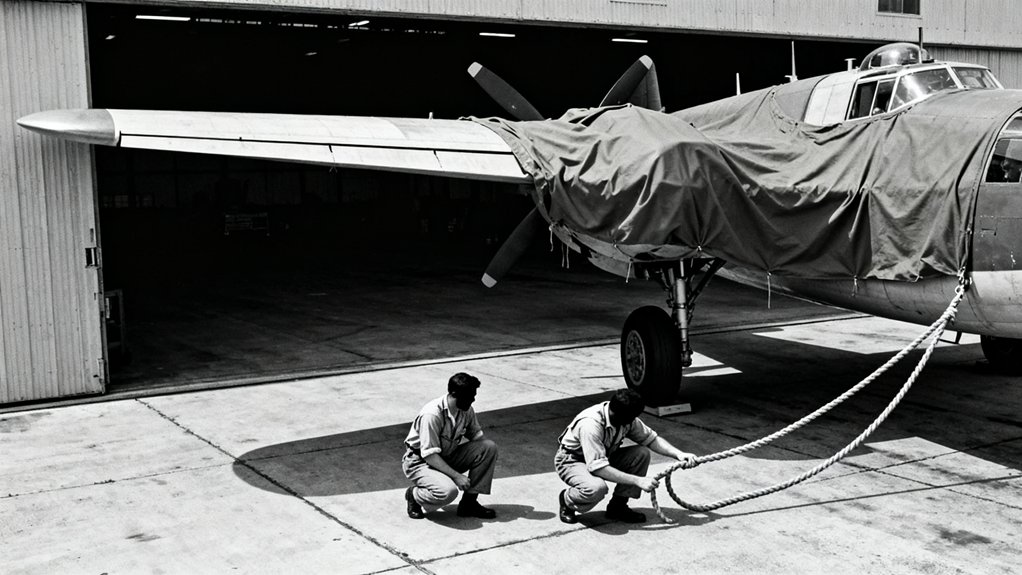
Protecting the Carrier. Roosevelt’s fiction kept the *Hornet*’s existence in the Pacific a secret. This prevented Japan from deducing the carrier’s launch point or its vulnerability to counterattack.
National Morale Management. The lie transformed the raid into a romantic, nearly supernatural feat. It boosted American spirits without conceding any dangerous operational intelligence.
Strategic Misdirection. By creating a fake base, Roosevelt forced Japan’s intelligence services to chase a phantom. This diverted their attention from the real Navy and Army Air Forces.
The Mathematics of Starvation: 15 Bombers Heading Blind Toward the Chinese Coast
Although the Doolittle Raid‘s bombers had just struck Japan, the most harrowing chapter, the escape, had only begun. Fifteen B-25s now fled toward the Chinese coast, their fuel gauges ticking down like a death sentence.
Launched prematurely from the *Hornet*, they’d burned precious gasoline on a 170 mile head start. The 200 gallons remaining couldn’t cover the 1,200 nautical miles to safety.
Doolittle’s crews faced a brutal equation: ditch at sea, crash into the mountains, or bail out blindly over enemy occupied China. None of them had charts for this. They navigated by dead reckoning, the moon their only star.
The math was merciless. At low altitude, even a headwind could starve an engine. These men weren’t just flying; they were gambling against empty tanks, knowing that survival meant pushing deeper into the unknown, one gallon at a time.
The 2200 Nighttime Bailouts: A Forensic Mapping of the April 18 Wreckage Sites
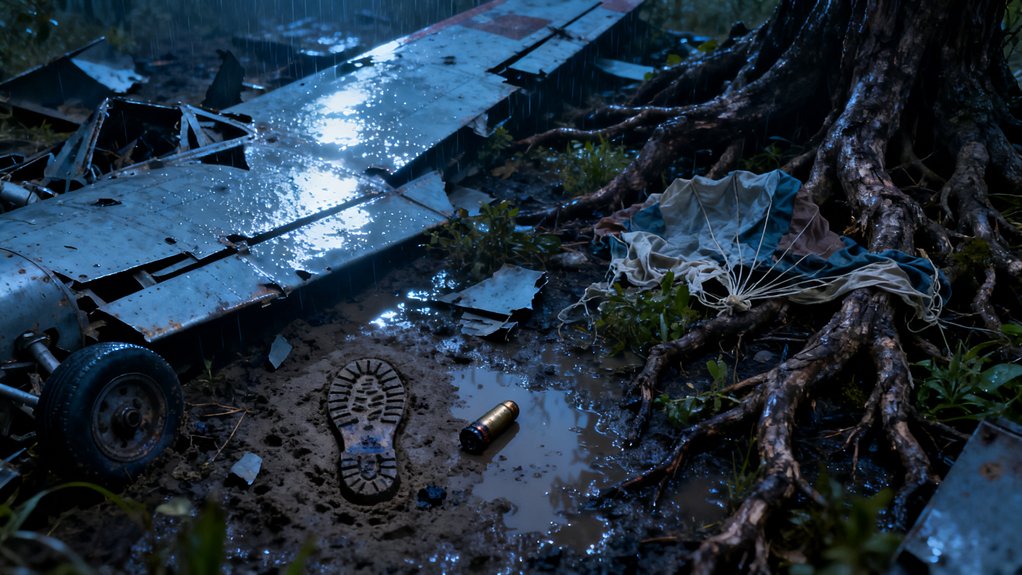
One bomber didn’t follow the rest. Aircraft 40-2242 defected east, landing intact in Vladivostok, a solitary Russian chapter in the Raid’s story.
The other fifteen crews faced a darker fate; their parachutes dragged men down onto the razor-sharp ridges of the Zhejiang Province mountains.
Mapping each wreckage site now reveals the brutal geography that determined who survived the night and who did not.
Aircraft 40-2242: The Solitary Russian Defection to Vladivostok
Of the sixteen B-25s launched on April 18, 1942, only one, Aircraft 40-2242 piloted by Captain Edward York, broke from the planned flight path and defected to the neutral Soviet Union, landing at Vladivostok roughly six hours after the strike. The choice wasn’t born from cowardice; it came from fuel gauges reading empty. York faced a brutal binary: ditch in the hostile Sea of Japan or gamble on Stalin‘s hospitality.
Fuel as a moral compass. York’s decision reveals how resource scarcity, not strategy, often drives escape. Neutrality’s hollow promise. The Soviets promptly interned the crew for thirteen months, proving no haven exists in war’s gray zones. A solitary story of survival. Unlike the other fifteen crews who bailed over China, York’s men landed intact, a human counterpoint to the raid’s scattered wreckage.
Tracing the Parachute Casualties Across the Zhejiang Province Mountains
On the night of April 18, 1942, fifteen B-25 crews vanished over Zhejiang Province. They didn’t simply disappear. They bailed out over jagged, rain-soaked mountains. The 2,200-foot nighttime bailouts left a forensic puzzle across a vast, hostile terrain. Investigators now map each wreckage site, tracing the precise coordinates where parachutes opened and aircraft exploded.
One crew splintered on a ridge near Shangrao. Another smashed into a bamboo grove two miles west. The human cost is brutal: broken bones, shattered spines, and desperate local farmers pulling American airmen from wreckage. This isn’t just a map of destruction. It’s a narrative of survival. Men clung to trees, hid from Japanese patrols, and trusted strangers in the dark. Each crash site holds a story of courage, chance, and the terrible geography of war.
Interrogating the Invaders: Japan’s Brutal Post-Strike Investigation into the Carrier Secret
Although the Doolittle Raid inflicted no major structural damage, its aftermath exposed a deeper wound. The Japanese military frantically and brutally sought to uncover how the Americans had achieved the impossible. Captured airmen faced relentless interrogations. Their captors were desperate to extract the carrier’s secret, a mystery that threatened Japan’s entire defense doctrine. These sessions weren’t mere questioning. They were systematic campaigns of psychological and physical violence, designed to break men who knew little themselves.
Crushing the Truth: Japan’s interrogators couldn’t accept that their homeland had been violated by a fleeting, improvised strike. They tortured for a leaked plan that didn’t exist.
Japan’s interrogators tortured for a leaked plan that never existed—unable to accept a fleeting, improvised strike.
Fragile Pride: The empire’s obsession with the carrier secret revealed its own vulnerability. It was a fear that any American success proved Japanese intelligence could be fatally outmaneuvered.
Human Cost: Airmen like Hallmark and Farrow endured unspeakable cruelty. It wasn’t for actionable intel but to satisfy a regime’s shattered delusion of invincibility.
In this frenzy, the Japanese military never grasped the raid’s true weapon. It wasn’t the bombers but the hope the raid ignited.
The Shanghai Show Trials: Prosecuting the Eight Captured Doolittle Raiders
By August 1942, the show trials in Shanghai had run their course, handing down execution sentences for Farrow, Haller, and Spatz. Those three men weren’t just condemned by a court. They were marked for death in a system that had already weaponized starvation.
The Japanese military prison camps weren’t just holding cells. They were mechanisms designed to break men long before any formal punishment could be applied.
The August 1942 Execution Sentences for Farrow, Haller, and Spatz
Because the captured Doolittle Raiders had already endured months of brutal captivity and starvation, the Japanese military tribunal wasted no time in cementing its predetermined verdict. On August 28, 1942, the court sentenced Lieutenants Dean Hallmark, William Farrow, and Harold Spatz to death by firing squad.
The men never received a genuine defense, only a swift ritual of condemnation. The tribunal refused to allow any witness testimony that contradicted its narrative, silencing the Raiders’ pleas for fairness.
A single interpreter distorted every defense argument, ensuring the Japanese prosecution controlled all legal proceedings. The execution orders arrived from Tokyo before the trial even concluded, proving the verdict was a foregone conclusion.
The three aviators died on October 15, 1942, their final words lost to a hostile silence.
The Starvation Mechanisms of the Japanese Military Prison Camps
While the Shanghai Show Trials performed a grotesque parody of justice, the real mechanism of punishment operated through starvation well before the gavels fell. Captured raiders entered a world where hunger became a weapon, meticulously calibrated to break them. Their captors did not just withhold food; they weaponized it, turning caloric deprivation into a slow, deliberate execution.
| Ration Per Day | Physical Outcome |
|---|---|
| 500–800 calories | Severe muscle wasting and organ failure begins |
| Rice porridge (thin) | Chronic diarrhea and beriberi sets in |
| No protein source | Edema and weakened immune response |
This was not neglect; it was policy. Guards routinely stole shipments meant for prisoners, while officers justified the brutality as necessary for discipline. By the time the trials staged their verdicts, malnutrition had already claimed more victims than any firing squad. The courtroom drama masked a quieter, more insidious genocide.
Operation Sei-Go: The 250,000-Casualty Retaliation Sweep Against the Chinese Underground
Why did Japan’s military unchain a 250,000-casualty sweep across China just weeks after the Doolittle Raid? The answer lies in rage and desperation. Humiliated by American bombers striking their sacred homeland, Imperial commanders demanded a visible, brutal reassertion of control. Operation Sei-Go targeted the Zhejiang-Jiangxi region, where Chinese farmers and villagers had sheltered the downed Doolittle crews. Japanese forces didn’t just search; they systematically annihilated entire communities, using biological warfare and scorched-earth tactics to erase any trace of aid. Civilians, old men, women, and children, suffered the weight of Tokyo’s fury. This wasn’t a military necessity; it was retribution. The Japanese military executed Operation Sei-Go specifically to punish Chinese civilians for helping Doolittle’s airmen escape capture. Troops deliberately destroyed crops, poisoned wells, and spread cholera, creating a man-made famine that killed more than bullets did. This mirrored the dehumanizing methods of Unit 731’s human experiments, which weaponized plague and anthrax against captives in occupied Manchuria. The sweep’s true purpose was psychological: to terrorize any region that might defy Japan’s occupation, proving dissent meant collective death.
The Yamamoto Panic: How the April 18 Psychological Breach Forced the Strategic Midway Disaster
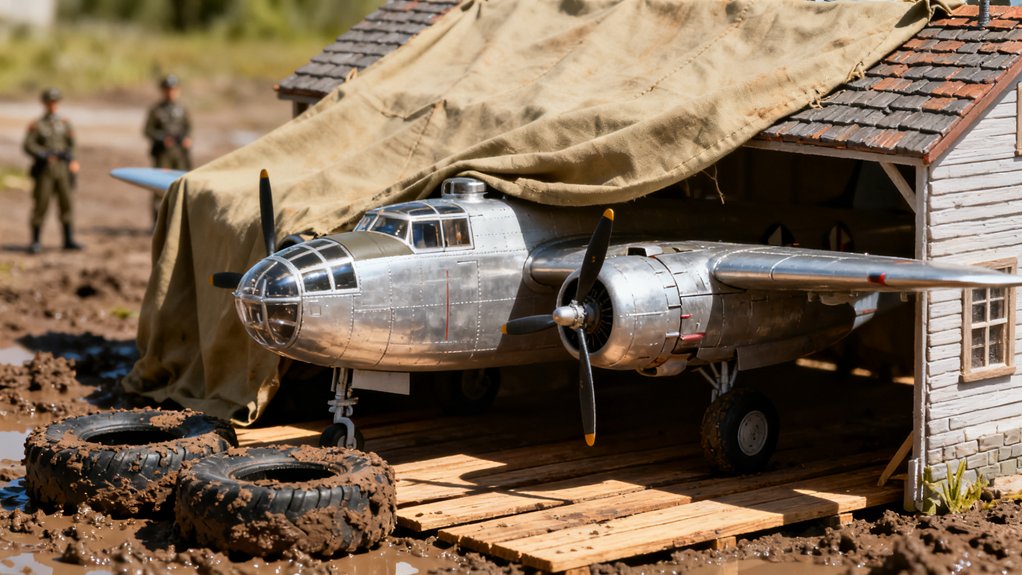
When the B-25s roared over Tokyo on April 18, 1942, Admiral Isoroku Yamamoto didn’t just lose face. He lost control of Japan’s strategic clock. The psychological breach set off a frantic scramble. Yamamoto, humiliated by the emperor’s exposure to enemy bombs, demanded an immediate, decisive blow. He couldn’t afford another embarrassing surprise.
This panicked haste hijacked Japan’s war plan. The Midway operation, originally a cautious trap, became a rushed gamble. Yamamoto forced a compressed timetable, splitting his massive fleet into poorly coordinated groups. He ignored his own intelligence officers’ warnings, desperate to restore prestige. The meticulous deception of the raid’s concealment had worked too well. It shattered Japanese confidence so thoroughly that Yamamoto abandoned strategic patience.
That April morning didn’t just prove Japan was vulnerable. It directly engineered the catastrophic carrier losses at Midway. The concealment tactics that shielded the raid’s departure inadvertently revealed Yamamoto’s psychological fragility, luring him into a battle he couldn’t win.
Frequently Asked Questions
Why Did the Doolittle Raid Use B-25 Bombers Specifically?
The Doolittle Raid used B-25 bombers because their design met the mission’s demanding specifications.
These twin-engine aircraft had a wingspan that fit within the limited space of the *Hornet*’s flight deck.
This wasn’t a coincidence. Planners needed a bomber that could take off from a carrier, something never done before, while also having enough range to strike Japan and escape. Their adaptability proved essential for this risky, one-way operation.
How Did They Modify B-25s to Launch From an Aircraft Carrier?
They stripped the B-25s of unnecessary weight: removing the lower turret, heavy radio gear, and de-icing equipment, while adding extra fuel tanks in the bomb bay. This wasn’t about comfort; it was about distance.
The modifications allowed the bombers to lift off from the *Hornet*’s short deck, but the true gamble lay in the fact that no one knew if a fully loaded B-25 could ever fly that far.
What Was the Nitto Maru’s Exact Role in Compromising the Raid?
The Nitto Maru’s exact role was as a picket ship, spotting the task force far earlier than expected.
Its radio warning directly compromised the raid’s concealment, forcing an emergency launch 170 miles farther out than planned.
That early detection didn’t abort the mission, but it shattered the element of surprise.
It scattered the B-25s and cost fuel, time, and lives in the chaotic aftermath.
How Did the 50-Foot Altitude Evade Japanese Radar Exactly?
Flying at just 50 feet, the bombers exploited a critical gap in Japanese radar technology. The curvature of the earth and atmospheric clutter masked their low-altitude approach, creating a blind spot that standard detection systems couldn’t penetrate.
This wasn’t luck; it was a calculated exploitation of physics and radar limitations. The planes’ small size and wooden construction further reduced their radar signature, letting them slip through undetected until it was too late for any defensive reaction.
Did Roosevelt’s Shangri-La Claim Delay the Japanese Discovery of the Carrier?
Roosevelt’s Shangri-La claim didn’t delay Japan’s discovery of the carrier. By then it was already gone, and you can’t lock a barn door after the horse has bolted.
The Japanese command pieced together forensic clues from the raid and focused on the bombers’ origins. They concluded a carrier launched them, yet the Hornet had vanished into the vast Pacific. Roosevelt’s cryptic reference, meant to obscure, merely amplified their frustration, not their search.
Final Thoughts
The Doolittle Raiders’ triumph was not in the bombs they dropped. It was in the fear they seeded. It could be contended that the strike’s physical damage was negligible, a mere pinprick. Yet that psychological breach forced Japan’s hand, recalling forces and setting Midway’s trap. Those 80 men did not just fly. They rewrote the Pacific’s brutal calculus, a whispered promise that no empire’s home was truly safe.