For twenty-five years, General Dmitri Polyakov fed the CIA Moscow’s most guarded secrets. He acted not for money but out of a corrosive disgust for the rot devouring his own military. He handed over GRU cipher codes, revealed Chinese troop movements, and let the FBI commission his fury. Robert Hanssen ultimately betrayed him. In 1988, a single Makarov bullet ended the man who rewrote Cold War history. There is far more buried in his silence, though.
Key Takeaways
Dmitri Polyakov betrayed the GRU for 25 years due to ideological disgust, not financial gain. He operated as FBI asset “TOPHAT,” passing microfilm and cipher codes from New York. His tradecraft included burst transmitters, varied dead drops, and appearing boring as cover. Robert Hanssen, an FBI mole, exposed Polyakov’s identity and handler details to the KGB. Interrogators failed to break him; he traded silence for assurance of his family’s safety.
Ideological Revulsion: The 1961 Decision to Sabotage the GRU from Within
What drove a decorated Soviet general to risk everything? The answer lies not in greed, but in a slow, corrosive disgust. General Dmitri Polyakov witnessed a rot within the Soviet military corruption that sickened him. He saw generals profiteering while soldiers starved, a system devouring its own idealism.
This was no sudden epiphany; it was a creeping, ideological revulsion born from years of quiet observation. He couldn’t ignore the grotesque gap between state propaganda and the daily reality of theft and cronyism.
His choice crystallized in 1961. Polyakov decided his true duty involved sabotage from within. He’d weaponize his access, not for money, but to hasten the collapse he deemed inevitable. This wasn’t betrayal of a nation; it was, in his mind, loyalty to an idea the system had already betrayed.
His revulsion became a secret engine, powering a twenty-five-year campaign to hand the West the tools to expose the lie he could no longer stomach. He risked everything because, for him, the system’s corruption had already taken everything worth believing in.
Establishing Asset “TOPHAT”: Commissioning the FBI’s Apex Informant in Manhattan
From the quiet corrosion of his conscience in Moscow, Polyakov’s revulsion found its most potent expression in New York City. There, under the FBI’s watchful eye, he became Asset “TOPHAT”. He was a high-ranking intelligence mole who’d step into the shadows of Manhattan’s consulate meetings. He’d already mastered intelligence concealment methods in Moscow. Now he’d weaponize them for the FBI. The bureau didn’t recruit him. They commissioned his fury.
He would walk past Soviet officials, slipping microfilm into dead drops near Central Park benches, his face betraying nothing. The FBI never knew his real name at first, just “TOPHAT”, a ghost inside the Soviet GRU intelligence apparatus. He’d hand over GRU cipher codes, rewriting the Kremlin’s playbook for counterintelligence. Every meeting, he’d remind his handlers: I’m not doing this for you. His Manhattan commission felt like a war declaration, a strike against the system that corrupted his soul. The FBI’s operations were part of a broader system that, like COINTELPRO, had previously targeted domestic political movements using warrantless burglaries and illegal wiretaps.
Polyakov’s new identity didn’t erase his past. It amplified his vengeance.
A Quarter-Century of Phantoms: Engineering the 25-Year Intelligence Pipeline
Polyakov didn’t simply hand over secrets; he weaponized burst transmitters that fired encoded data in fractions of a second, making interception nearly impossible.
He then paired those electronic pulses with the oldest trick in the book: concealed dead drops hidden in plain sight, far from his Moscow routine.
This lethal combination of high-tech bursts and low-tech drops let him dance right past the KGB’s Second Chief Directorate for a quarter-century, leaving no trace of his phantom pipeline.
During the same era, the CIA ran mind control experiments on unwitting subjects without consent through Project MKUltra.
Weaponizing Burst Transmitters and Concealed Dead Drops
How could a spy sustain a clandestine pipeline of secrets for twenty-five years without detection? Polyakov weaponized burst transmitters, compressing weeks of intelligence into split-second radio pulses. No operator could pinpoint their origin before they vanished. He paired this with concealed dead drops across Moscow’s frozen parks, exploiting mundane objects. A hollowed brick or a loose drainpipe shielded film and documents.
The Moscow espionage network thrived on such Cold War clandestine operations, where patience was the ultimate weapon.
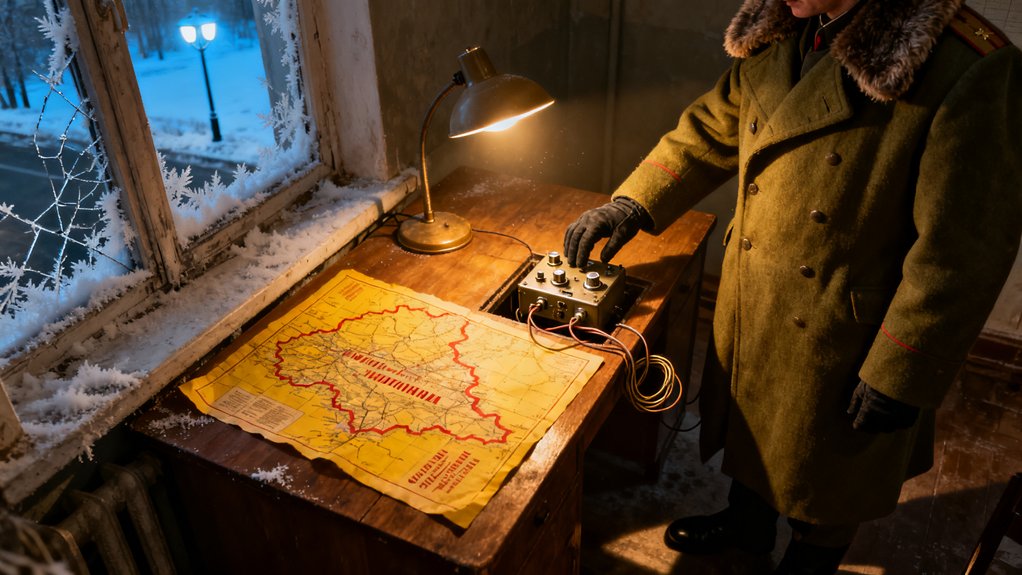
Burst transmitters reduced transmission time to under three seconds, evading triangulation. Dead drops used natural decay: rusted bolts and shifting soil disguised recent disturbances. Polyakov varied drop sites weekly, never repeating a pattern. He embedded signals (chalk marks or bent twigs) that only handlers could read. The espionage tradecraft mechanics relied on Soviet predictability; KGB patrol routes became his clock.
Bypassing the KGB’s Second Chief Directorate Counter-Surveillance
Although the KGB‘s Second Chief Directorate tracked every foreign contact with obsessive precision, Polyakov slipped through their net for decades.
He didn’t just avoid surveillance, he weaponized bureaucratic predictability.
He’d visit a ministry, then casually walk a pre-planned route, using split-second timing to exchange film canisters with dead drops in plain sight.
Declassified CIA files reveal how he’d signal readiness by leaving a scuff mark on a particular lamppost.
That detail was too mundane for any watcher to note.
American counterintelligence marveled at his patience.
He never rushed a meeting, never acted nervous.
His unauthorized geopolitical disclosures, transmitted via bursts lasting milliseconds, arrived at Langley before Moscow even knew he’d left his apartment.
Polyakov understood that the best cover wasn’t invisibility, it was being boring.
Fracturing the Communist Bloc: Declassifying the Sino-Soviet Border Militarization
Polyakov’s photos showed Chinese troops massing under bridge camouflage. Documents detailed Soviet emergency responses, including pre-authorized launch codes.
Satellite imagery cross-verified his hand-written field notes from border outposts. Nixon received these briefings in secret Oval Office sessions without Kissinger’s full knowledge.
The KGB never suspected a general would betray their most guarded border secrets.
The Oval Office Proxy: How a Soviet General Engineered Nixon’s 1972 China Pivot
Polyakov’s raw GRU intercepts didn’t simply sit in a file; they became the backbone of Henry Kissinger’s secret strategy.
These cables, detailing Moscow’s paranoid fears of Beijing, gave Washington a precise map of the rift’s depths.
Translating Raw GRU Intercepts into Actionable Kissinger Strategy
How did raw Soviet military intelligence, traffic meant only for the Kremlin’s eyes, find its way onto Henry Kissinger’s desk and shape the most dramatic diplomatic pivot of the 20th century? Polyakov didn’t just hand over decrypted cables. He translated the GRU’s paranoid calculus into a map of opportunity, allowing Kissinger to weaponize Moscow’s own anxieties.
The National Security Advisor didn’t need to interpret; Polyakov’s analysis directly revealed the Sino-Soviet rift’s depth, confirming that a U.S. China opening wouldn’t trigger war. This wasn’t passive collection. It was a targeted, high-stakes translation of a spy’s raw disgust into a lever for presidential strategy.
The devastating Robert Hanssen betrayal later sealed Polyakov’s fate, but not before his intelligence had already rewritten history.
- Traffic Triangulation: Polyakov’s reports pinpointed Soviet fears of a two-front war, validating Nixon’s diplomatic gamble.
- Kissinger’s Silent Partner: The Soviet general effectively became an unelected advisor, parsing Kremlin thinking without ever meeting Kissinger.
- Decoding Disgust: Polyakov’s personal revulsion at corruption lent his intelligence an unexpected, credible edge.
- Risk Calibration: He showed Washington exactly how far they could push before Moscow reacted.
- Legacy of Leakage: The intelligence chain remained unbroken until Hanssen’s betrayal exposed the source.
The Geopolitical Calculus of Arming Washington with Moscow’s Paranoia
Kissinger’s hands were now full of Polyakov’s most incendiary product: Moscow’s deepest fears, served up as a diplomatic blueprint. He didn’t just read intelligence. He weaponized it.
Polyakov’s dispatches exposed a Kremlin terrified of encirclement, especially by a resurgent China. So Kissinger calculated: use Moscow’s paranoia to pry open Beijing. He’d dangle détente as bait, letting the Soviets believe Washington was their ally against the Chinese.
In truth, he was building Nixon’s bridge to Mao. The calculus was ruthless. Fuel Soviet insecurity to engineer a Sino-American pivot. Polyakov’s secret intel became the lever, and Kissinger pulled it without Moscow ever realizing they’d been played by their own general.
Outliving the Handlers: The Unprecedented Operational Lifespan of a Cold War Ghost
Why did it take twenty-five years for the sun to set on Dmitri Polyakov? He became a ghost who outlived his handlers. He didn’t just disappear; he performed a vanishing act that required perfect, absolute stillness. No American agent met Polyakov; they visited him in a carefully constructed silent world. He rejected radio transmissions, refused dead drops, and demanded face-to-face meetings only when absolutely necessary. Polyakov’s tradecraft wasn’t just good; it was revolutionary.
He operated without a single operational meeting for years, burying intelligence in empty cigarette packs. Polyakov passed “cabinets” of material disguised as harmless personal documents during official military functions. He never took a single dollar, eliminating any trace of financial motive that Soviet counterintelligence could exploit. Polyakov forced handlers to memorize his face, demanding photographs of him never exist in any file. He maintained a secret radio schedule that changed weekly, based on a code in chess tournament results.
The Directorate K Blind Spot: Soviet Suspicion and the Blind Decades-Long Mole Hunt
Where did the Kremlin’s counterintelligence machine go wrong for twenty-five years? The answer lies in a self-inflicted blind spot inside Directorate K, the Soviet unit hunting moles. They couldn’t conceive that a general, a man of Polyakov’s rank, privilege, and access, would betray them.
Their paranoia fixated on disgruntled clerks, low-level technicians, or ideological deviants. Polyakov, however, played the perfect patriot. He didn’t defect. He stayed, reported real intelligence, and never touched a rumor.
While their paranoia hunted clerks, a general moved silently through the hollow spaces of their assumptions.
His disgust with corruption fueled a calm performance that Directorate K’s interrogators couldn’t crack. They’d suspect, arrest, and even execute innocents, but Polyakov remained invisible because he didn’t fit their profile.
The machinery of Soviet suspicion became a sledgehammer seeking a nail, while the real threat, a high-ranking idealist, moved silently through the hollow spaces of their own assumptions, decade after decade.
The 1985 Hanssen Catastrophe: Anatomy of the FBI’s Most Lethal Insider Betrayal
Hanssen didn’t stumble onto Polyakov; he hunted him. Using the FBI’s own Automated Case Support systems, he pinpointed the CIA’s prized asset, code-named TOPHAT. Then, with a single, lethal transmission, Hanssen handed the Kremlin the identity of a spy who’d shaped a president’s foreign policy. This betrayal mirrored the CIA’s own historical pattern of institutional concealment that kept even congressional investigations from uncovering the full scope of its illegal domestic surveillance and assassination plots.
Exploiting Automated Case Support Systems to Unmask Asset “TOPHAT”
Although Polyakov’s cover held for a quarter-century, it took Robert Hanssen just a few minutes inside the FBI‘s Automated Case Support (ACS) system to rip it apart. Hanssen, a trained counterintelligence agent, knew exactly where to look. He exploited lax access controls, querying the database for the file codenamed “TOPHAT”—Polyakov’s operational alias. No subtle hacking, no complex tradecraft; just a trusted insider abusing his credentials.
Weak access protocols allowed Hanssen to search sensitive files without triggering alarms. A single query sufficed to reveal Polyakov’s true name, handlers, and debriefing records. Digital fingerprints were never checked; the FBI lacked real-time audit logs for ACS. Human oversight failed; supervisors didn’t monitor anomalous file access after-hours. Systemic arrogance assumed no FBI agent would betray the Bureau’s own assets.
The betrayal was chillingly simple: one man, one terminal, one fatal click.
The Lethal Transmission: Handing the CIA’s Crown Jewel to the KGB
How did one FBI agent hand the CIA‘s crown jewel to the KGB with almost no one noticing? Robert Hanssen didn’t need a weapon, he needed a password. For years, he quietly pilfered files from his own bureau’s Automated Case Support System. Inside, he found Dmitri Polyakov, the CIA’s most prized Soviet asset.
Hanssen packaged the general’s identity, methods, and location into a single, devastating report. He left it in a dead drop for the KGB, no face-to-face meeting required. The transmission felt routine. No alarms sounded.
But with that single act, he didn’t just betray a man. He condemned a quarter-century of intelligence. Hanssen handed over the crown jewel, and Polyakov’s fate became a silent, lethal certainty.
The 1986 Ambush in Moscow: The Sudden Disappearance of General Polyakov

Because Polyakov had never missed a scheduled meeting in twenty-five years, his absence from a routine 1986 dead drop in Moscow sent immediate, chilling shockwaves through his CIA handlers. They knew instantly that the unthinkable had happened. Their crown jewel had been plucked from the shadows.
The KGB didn’t take him in a gunfight. They ambushed him silently, vanishing him from a city street with surgical precision, leaving no trace for neighbors or family. His wife reported him missing to authorities, unknowingly initiating a cover story that would label him a sudden, mysterious defector to the West. The CIA’s emergency signals never activated. Polyakov had no chance to trigger his abort protocols. Soviet counterintelligence moved with terrifying speed, sealing his Moscow apartment and erasing any paper trail within hours. His handlers could only watch, helpless, as Moscow’s intelligence machinery swallowed their general whole.
In that single missed meeting, twenty-five years of indispensable intelligence simply ceased to exist.
The Lefortovo Interrogations: Dismantling the Highest-Ranking Traitor in Soviet History
Inside the interrogation chambers at Lefortovo Prison, the KGB systematically dismantled Polyakov. They employed psychological coercion that targeted his deepest loyalty, his family’s survival. They didn’t break him for the secrets he’d already given. They broke him to force a complete confession, using the calculated threat of his wife and son’s fates as leverage.
The final KGB damage assessment would quantify 25 years of hemorrhaged state secrets. It was a staggering loss that left Soviet intelligence reeling.
Psychological Coercion and the Calculated Preservation of Polyakov’s Family
Although the Soviet state had long suspected a high-level leak, the full scale of General Dmitri Polyakov’s betrayal didn’t dawn on its interrogators until they sat him down in Lefortovo Prison.
They wielded a precise tool, psychological coercion.
They dangled a singular, awful leverage, his family’s fate.
They believed he’d crack if they threatened his wife and sons.
But Polyakov’s calculation proved deeper than theirs.
He demanded a single, non-negotiable assurance.
The state must never harm his children.
This wasn’t cowardice.
It was a cold, strategic trade of his silence for their lives.
The interrogators saw coercion failing.
A broken man yields nothing intact.
Instead, they offered a grim preservation contract.
Cooperation for familial survival.
Every session became a tense negotiation, not a confession.
The Final KGB Damage Assessment: Quantifying 25 Years of Hemorrhaged State Secrets
How could the KGB even begin to tally the damage from a man who spent twenty-five years handing America its deepest secrets?
Inside Lefortovo Prison, interrogators didn’t just ask; they calculated. They mapped each compromised operation against Polyakov’s timeline. They found years of lost intelligence, broken networks, and foreign negotiations preempted by Washington.
He didn’t just leak; he systematically gutted Soviet military planning. The KGB’s final report estimated Polyakov’s treachery cost the USSR more than a decade of strategic parity.
Some secrets he sold outright. Others, like the Sino-Soviet rift, he gave away for ideology alone. In the end, they couldn’t quantify a number; only the ruin of trust itself.
A Bullet in the Lubyanka: The March 1988 Execution That Erased the General
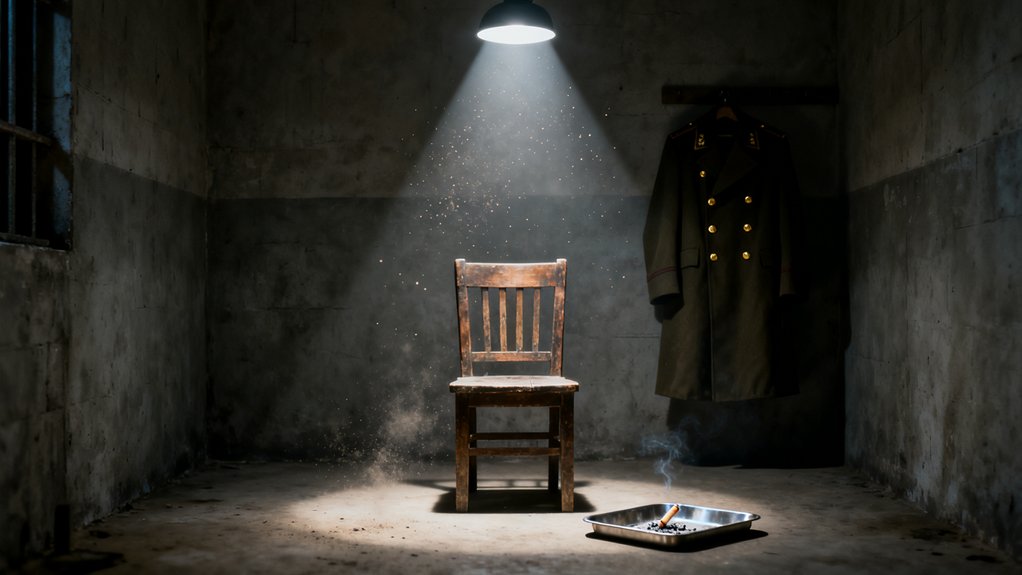
Why did the Kremlin wait nearly two years to pull the trigger? The answer lies in the slow, methodical autopsies of betrayal.
The Kremlin waited two years, conducting slow, methodical autopsies of betrayal before pulling the trigger.
After Hanssen‘s tip, the KGB didn’t just arrest Polyakov, they spent months deconstructing his decades of treason, extracting every confession, every shred of evidence for the record. They needed a clean, irrefutable case before they could silence a general who knew too much.
- The Verdict’s Weight: A closed military tribunal handed down the death sentence in 1986, but executioners delayed, maximizing his debriefing.
- Solitary Vigil: Polyakov languished in Lubyanka’s basement cells, his only companions the dank walls and rusted pipes.
- The Final March: On March 15, 1988, guards marched him to a soundproofed execution chamber in the same building he once served.
- A Single Bullet: The shot came from a Makarov pistol, a quiet end for a man who whispered Kremlin secrets for a quarter century.
- Unmarked Grave: They buried him in a nameless plot, erasing any trace of the general who shaped Nixon’s détente.
The Post-Mortem Geopolitical Shockwave: Measuring the True Cost of Hanssen’s Treason
Because Hanssen’s betrayal didn’t just end Polyakov’s life, it ripped open a wound in U.S. intelligence that would bleed for decades. The immediate cost was staggering.
Moscow systematically rolled up dozens of Polyakov’s network, executing assets who’d trusted Washington.
But the true shockwave hit deeper. Polyakov’s intelligence had shaped Nixon’s détente with China, a geopolitical pivot that exploited the Sino-Soviet rift. Hanssen’s treason poisoned that well.
The Kremlin now knew exactly which cards America held, forcing a strategic reset. They hardened their borders, purged compromised officials, and rebuilt intelligence from scratch.
For the U.S., lost access meant blind spots across Asia for years. Every future defector’s risk skyrocketed; trust became a luxury the CIA couldn’t afford. This breakdown mirrored the corrosive effect of the Pentagon Papers leak, which proved that unchecked governmental secrecy enabled endless war and deepened public skepticism of official narratives.
Hanssen’s betrayal wasn’t just a leak. It was a cataclysm that redrew the operational map, costing Washington its deepest Cold War advantage overnight.
Frequently Asked Questions
What Happened to Polyakov’s Family After His Execution?
The full story remains unknown, and that’s the point. History records Polyakov’s execution but buries his family’s fate.
What’s known is chilling. Soviet retaliation didn’t stop with him. His wife and son likely faced severe state persecution, including imprisonment, internal exile, or worse, for his treason. The KGB wouldn’t leave witnesses to his legacy.
Their lives were systematically erased, a final brutal act of retribution that remains a classified, ghostly footnote to his decades of sacrifice.
Did the FBI Ever Suspect Polyakov Was a Double Agent?
Yes, the FBI did suspect Polyakov might be a double agent. They questioned his motives given his high rank and access. Yet they couldn’t find solid proof of deception.
His intelligence on the Sino-Soviet rift was too valuable and too consistent. They ultimately trusted the source, believing his disgust with corruption was genuine, and let the operation continue.
It was a gamble that paid off until Hanssen’s betrayal.
How Did Hanssen Access Polyakov’s File Undetected?
How could the FBI’s own walls be so porous? Hanssen accessed Polyakov’s file undetected by exploiting a lethal combination.
His counterintelligence position granted him automatic clearance, while he meticulously avoided leaving a paper trail.
He’d memorize documents rather than copy them, and he used FBI computers to search for Polyakov’s existence without formal authorization.
This intimate knowledge of the Bureau’s own blind spots, its trust in its top insiders, allowed him to move through its most sensitive secrets unseen.
Was the CIA Ever Aware of Polyakov Before Hanssen’s Betrayal?
Yes, the CIA knew Polyakov well before Hanssen‘s betrayal. They’d run him as a prized asset for two decades, relying on his insider intelligence to decode the Sino-Soviet rift.
His reports directly shaped Nixon‘s foreign policy moves. The agency didn’t suspect him of being compromised. They trusted his cover implicitly.
That trust made Hanssen’s exposure all the more devastating. It wasn’t a discovery but a confirmation of a catastrophic leak they’d never seen coming.
Did Polyakov Regret His Decision to Spy for the US?
He didn’t express regret. Picture a man, hands stained from a decade of betrayal, yet he remains unwavering.
Polyakov’s own writings, seized after his arrest, reveal a clear conscience. He called his treason a “crusade” against the Soviet rot he despised. No second-guessing surfaces in those pages; only disgust for the system he fled from, not the country he aided. His choice felt like a moral necessity, not a mistake.
Final Thoughts
General Polyakov was not just a spy. He was a ghost with a briefcase who dragged the entire Sino-Soviet alliance into the light for a quarter century. Nixon’s entire China pivot was Polyakov’s handiwork, sold for pocket change. Then Hanssen, that smug Judas, sold him for a few thousand bucks. One bullet at Lubyanka erased the leak. The damage had already reshaped the whole damn world.