

The CIA burned $20 million chasing Soviet telepaths, convinced Moscow held a “spectral” edge. They locked housewives in dark rooms, forcing them to squint at mental static and sketch wobbly blobs as “intel.” Generals cheered these gray smudges, ignoring that results matched random guessing. It was fear dressed as strategy, a psychic embarrassment funded by paranoia. Two decades later, audits revealed zero verifiable magic, just expensive wishful thinking. The files hint that the real story behind those blurry lines is far stranger than the sketches suggest.
Key Takeaways
- Project Stargate was a $20 million CIA program driven by Cold War fears of Soviet psychic warfare.
- The agency recruited civilians to remotely view secret Soviet sites using sensory deprivation and mental projection.
- Participants produced vague sketches that analysts often misinterpreted as actionable military intelligence through confirmation bias.
- Controlled testing consistently demonstrated that remote viewing results were no better than random guessing.
- Post-Cold War audits confirmed the program yielded zero verifiable intelligence, marking it as an expensive institutional failure.
Silas Shade Presents Truth Has A Backstory: Uncovering the CIA Project Stargate Files

Silas Shade doesn't just dust off old files; he drags the CIA's two-decade, $20 million psychic embarrassment into the light, revealing how Cold War paranoia convinced generals that vague sketches from dark rooms were actually actionable intel on Soviet subs.
It's almost funny, really, watching hardened military men nod seriously at crayon drawings of underwater metal tubes. Shade peels back layers of bureaucratic denial, showing how fear funded fantasy for years. He isn't selling magic; he's exposing a very human tendency to grasp at straws when terrified.
The archives smell like stale coffee and desperation. silas shade truth has a backstory, and this tale reeks of wasted tax dollars.
He walks readers through the dimly lit rooms where “viewers” squinted at blank paper, convinced they saw enemies. No lasers fired, no subs sank, yet the checks kept clearing.
Shade's narrative cuts through the fog, proving that sometimes the scariest monsters aren't foreign spies, but our own desperate imaginations running wild inside secure facilities. While Stargate chased ghosts, the agency was simultaneously destroying MKUltra files to erase evidence of real human experimentation and mind control programs that left actual victims in their wake.
The Cold War Catalyst: Soviet Psychic Warfare and Washington Institutional Paranoia

That stale coffee smell of desperation didn't just linger; it curdled into full-blown panic when Washington heard rumors that the Soviets were already winning the mind war. Officials imagined red psychics peering into Pentagon briefings, a terrifying thought that ignored basic logic but fueled budgets anyway.
It wasn't just paranoia; it was a bureaucratic fever dream where every shadow hid a telepath. They desperately needed an edge, so they embraced cold war psychic espionage with the fervor of a gambler chasing losses.
A bureaucratic fever dream where every shadow hid a telepath, fueling psychic espionage like a gambler chasing losses.
Stories circulated about Moscow training mind-readers to sabotage American missiles, tales likely born from bad vodka and worse intelligence. Yet, Washington listened, nodding gravely while signing checks for nonsense. The fear felt real enough to justify wasting millions on hunches rather than hard data.
Everyone pretended this madness made sense because admitting ignorance seemed riskier than funding ghosts. Ultimately, institutional terror drove the train right off the tracks, leaving taxpayers footing the bill for a spectral arms race that existed only in frightened minds. This same institutional willingness to bypass ethics for strategic advantage was starkly evident when military leaders drafted plans for false-flag attacks to manufacture consent for war against Cuba.
Recruiting Remote Viewers to Counter Perceived Intelligence Advantages
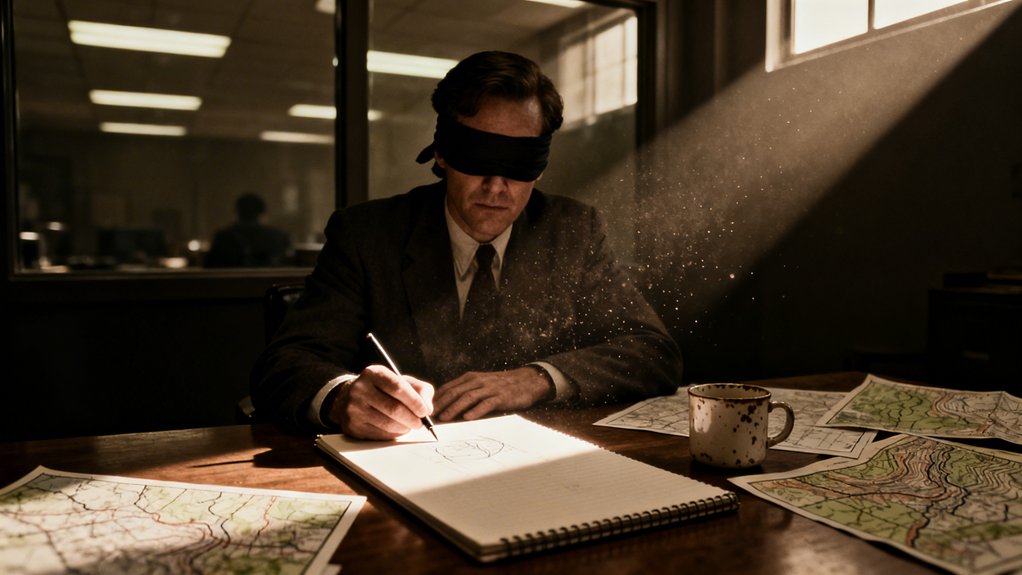
A handful of self-proclaimed seers suddenly found themselves on the government payroll, tasked with mentally poking around Soviet missile silos while sitting in windowless rooms. It sounds absurd, doesn't it? Yet, Washington genuinely believed these folks could outsmart Kremlin spies without leaving their chairs.
The CIA psychic program wasn't just a fringe experiment; it became a desperate, funded reality. Recruits claimed they'd sketch hidden submarines or describe secret meetings happening thousands of miles away. Officers took notes seriously, hoping for an edge.
Sometimes, the viewers guessed right, mostly by luck or vague prompting. Other times, they described barns instead of bunkers. Nobody seemed to mind the inconsistencies much.
Paranoia fueled the budget, not results. They hired artists, housewives, and oddballs alike, promising them purpose. Everyone wanted to believe magic could stop missiles.
Ultimately, this recruitment drive proved that fear makes people buy almost anything, even tickets to a show where nobody actually performs. This same institutional willingness to violate scientific ethics under the guise of national security had previously driven the CIA to fund non-consensual mind control experiments like MKUltra.
Sensory Deprivation and Dark Room Operations: The Mechanics of Mental Projection
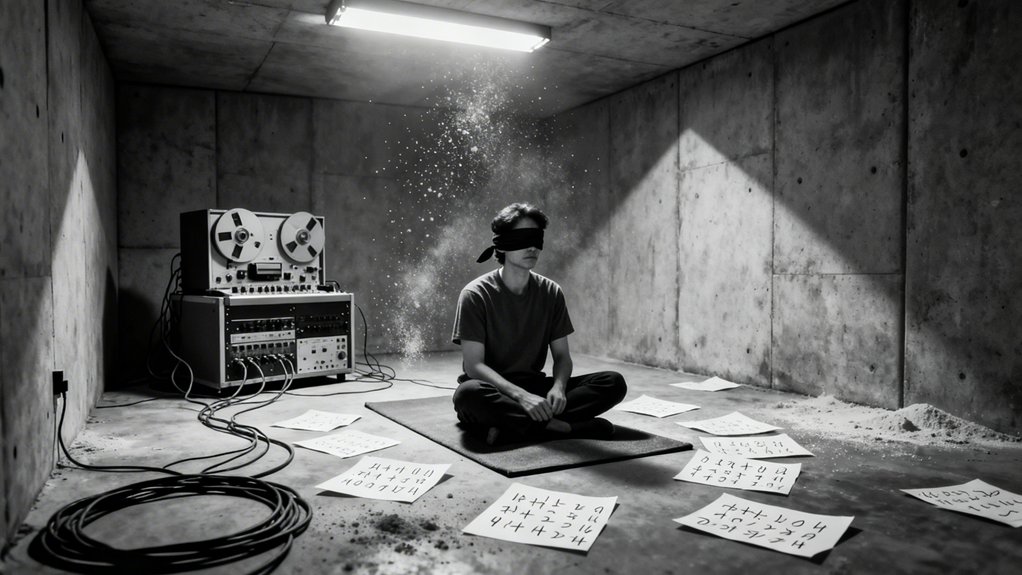
They locked the viewers in pitch-black rooms, convinced that stripping away sight would somehow sharpen the mind's eye. What emerged from those dark sessions were mostly vague, wobbly sketches that generals somehow treated as top-secret intel. It's a funny thing how a blurry drawing of a Soviet silo could get folks salivating over actionable strategy. This same reliance on sanitized realities later allowed the Pentagon to distribute combat footage that omitted civilian death counts while mimicking independent journalism.
Generating Vague Sketches from Global Parapsychological Espionage
Though the lights were killed to force a mental voyage, the remote viewers mostly just sat in dark rooms scribbling vague sketches that generals later swore contained actionable intel. This project stargate remote viewing experiment often felt less like espionage and more like an expensive art therapy session gone rogue. Viewers claimed their minds traveled globally, yet their pencils only captured ambiguous blobs.
| Claimed Target | Actual Sketch |
|---|---|
| Soviet Silo | Gray smudge |
| Submarine Base | Wavy line |
| Missile Launch | Random dot |
They'd stare into the void, hoping for clarity, but usually just produced abstract messes. The process relied heavily on guesswork disguised as psychic projection. Critics noted the drawings matched nothing specific until analysts retroactively forced connections. It was a strange dance where imagination met bureaucracy, resulting in piles of paper that supposedly held secrets. Ultimately, the darkness didn't reveal truths; it just hid the lack thereof quite effectively from keen commanders. Much like how official public explanations for U-2 flights were routinely dismissed as misperceptions to conceal classified operations, these vague psychic outputs were retroactively validated to maintain the illusion of success.
Elevating Ambiguous Drawings to the Status of Actionable Military Intelligence
Darkness became the ultimate security clearance, a velvet curtain where generals mistook sensory deprivation for strategic advantage. Inside those soundproof booths, remote viewers squinted at mental static, convinced they'd spotted russian submarines lurking in the Arctic ice.
Their scribbles—blobs resembling potatoes or angry clouds—somehow transformed into classified briefings overnight. It's almost charming how bureaucracy inflates nonsense into necessity.
- Analysts stretched vague curves into precise sonar contacts.
- Commanders ignored missed targets while celebrating lucky guesses.
- Budgets swelled as ambiguity masqueraded as breakthrough intelligence.
Nobody really asked why a psychic's doodle required top-secret clearance. They just nodded solemnly, filed the “intel,” and waited for the next vision.
The whole operation felt like a high-stakes game of telephone played in the dark, where everyone pretended to understand the message. Ultimately, these dark room operations proved that fear writes better checks than facts ever could, turning childish drawings into dangerous policy. Just as intelligence was distorted to create consensus and justify escalation in Vietnam, these psychic projections were elevated to actionable military intelligence to satisfy the insatiable demand for secret advantages.
Targeting the Eastern Bloc: Mentally Projecting to Locate Russian Submarines and Nuclear Silos
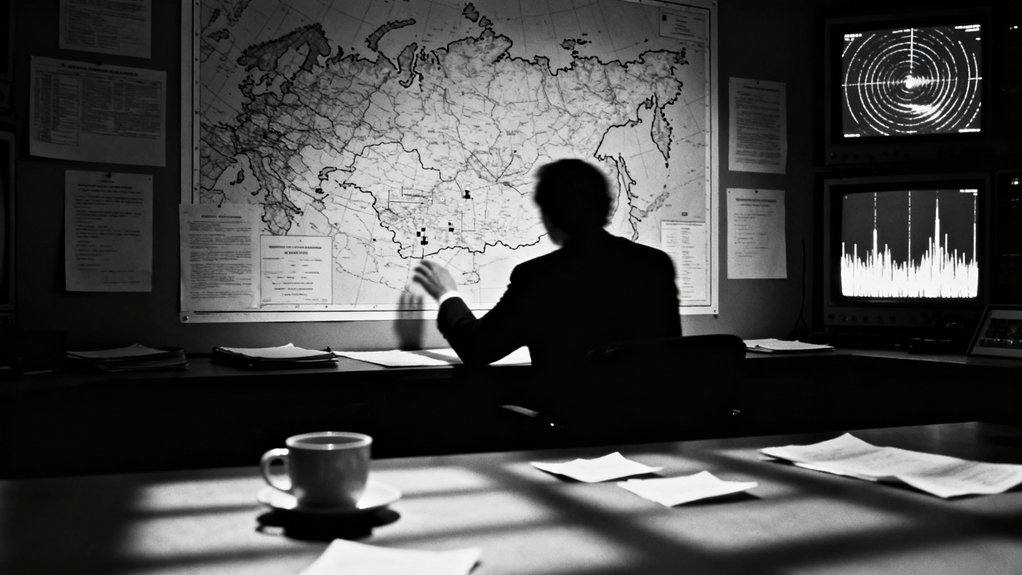
While the Pentagon fretted over Soviet subs lurking in the deep, remote viewers sat in pitch-black rooms, convinced they could mentally ping those hulls right off the ocean floor. It sounds absurd today, doesn't it?
Yet, during those tense decades, the CIA remote viewing program treated these mental excursions as serious reconnaissance. Viewers would sketch blurry shapes, claiming they'd found hidden nuclear silos in Siberia or tracked Red Fleet movements beneath the ice.
Sometimes they'd describe a periscope; other times, just vague gray smudges that analysts desperately tried to match with satellite photos. The whole operation felt like a cosmic game of telephone where the message got lost somewhere between the subconscious and the Situation Room.
They weren't just guessing; they believed they were projecting consciousness across the Iron Curtain. Sadly, most “hits” were lucky guesses or retroactive fits.
The Eastern Bloc remained largely opaque to these psychic probes, proving that no amount of mental focusing could truly pierce the fog of war or substitute for actual spies on the ground.
Financing the Psychic Arms Race: A Breakdown of the Twenty-Million-Dollar Budget
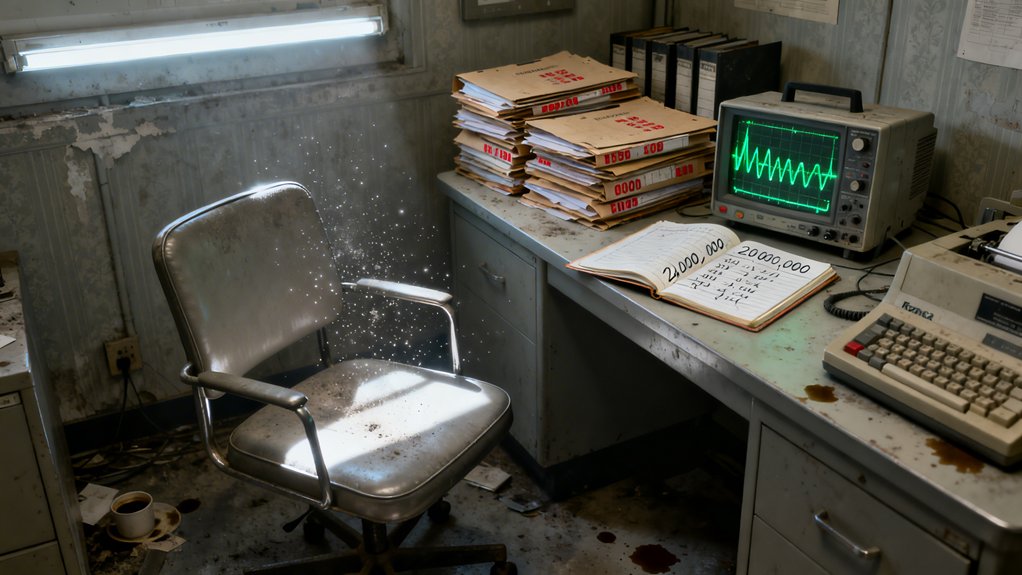
The CIA kept writing checks for twenty years because nobody wanted to admit they'd funded a room full of people guessing at maps.
That twenty-million-dollar line item mostly covered the cost of bureaucrats sweating over Soviet rumors rather than any actual psychic breakthroughs.
It's funny how fear pays the bills even when the “intelligence” looks like a child's doodle of a submarine.
This strategy of manufacturing uncertainty to secure funding mirrors how the tobacco industry used manufactured doubt to delay health regulations and protect corporate profits.
How Bureaucratic Fear Sustained Covert Intelligence Funding for Two Decades
Because nobody in Washington wanted to be the bureaucrat who skipped the psychic budget and then watched a Soviet submarine surface in the Potomac, the CIA kept the cash flowing for twenty years. It wasn't belief, really; it was career insurance wrapped in manila folders. They'd rather waste millions than risk looking soft on mysticism.
The logic twisted itself into knots:
- Funding vague sketches felt safer than admitting the Russians might actually win the mind-war.
- Auditors ignored glaring failures because questioning the program invited suspicion of being a sympathizer.
- Later, cia declassified paranormal documents revealed everyone just nodded along while taxpayers footed the bill for daydreams.
Nobody stopped the madness because stopping required admitting the whole thing was absurd. So, the checks kept clearing, buying nothing but anxiety and bad art until the Berlin Wall fell, rendering the ghosts obsolete anyway. This prioritization of strategic advantage over moral accountability mirrors the U.S. cover-up of Unit 731, where intelligence value justified shielding war criminals from justice.
The Epistemology of Failure: Confirmation Bias within the CIA Command Structure
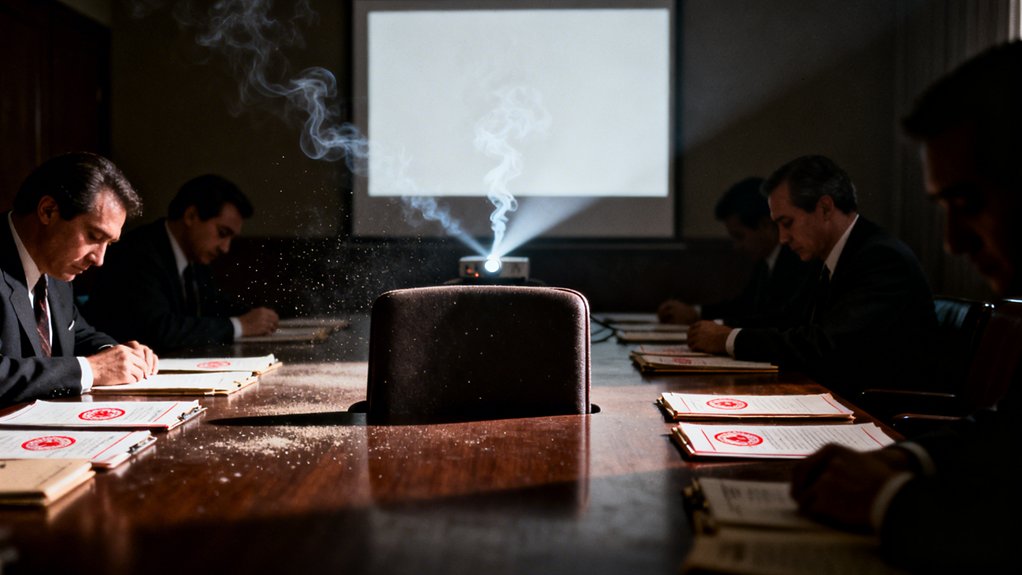
Though the generals demanded concrete coordinates, they'd often settle for vague charcoal sketches that somehow confirmed their own worst fears. It's a classic case of seeing ghosts in the static because you're terrified someone else built the radio.
Analysts would squint at blurry lines depicting a “large metallic structure” and immediately nod, convinced it was a Soviet silo rather than, say, a water tower in Ohio. This selective vision fueled the entire cia psychic experiment failure, transforming guesswork into gospel through sheer administrative will.
They weren't gathering intelligence; they were mirror-gazing with a security clearance. Every missed target got filed away as “interference,” while every lucky guess became proof of concept. It's funny how bureaucracy loves a mystery it can't solve, mostly because solving it might end the budget.
The command structure didn't want truth; they wanted validation for their paranoia, wrapping cold war anxiety in mystical packaging and calling it strategy. This same institutional drive to manufacture certainty later justified the dossier manipulation used to erase Nazi affiliations and fast-track German scientists into U.S. programs.
Post-Cold War Scrutiny: The Internal Audits That Dismantled the Remote Viewing Program
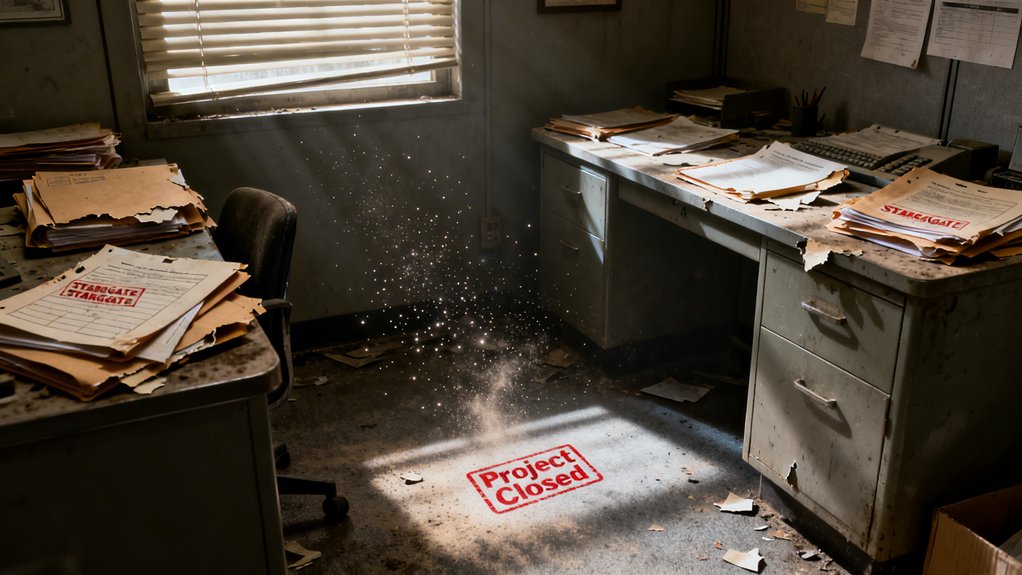
Once the Cold War thawed, bored auditors finally cracked open Stargate's files and found nothing but vague sketches and wasted cash.
They quickly realized the agency hadn't been hunting Soviet subs so much as chasing its own paranoid tail for twenty years.
In the end, the review proved that while the budget was very real, the supposed superpowers were just a bureaucratic fever dream, mirroring how intelligence oversight was virtually nonexistent before reforms exposed decades of unconstitutional surveillance.
Declassifying the Project Stargate Operational Reviews
Following the Cold War's final curtain call, bureaucrats finally dragged Project Stargate‘s files into the light, discovering that twenty years and $20 million had bought nothing but vague sketches and institutional embarrassment.
Reviewers sifted through dusty project stargate cia documents, chuckling at the sheer absurdity of it all. They found:
- Generals praising blurry drawings as precise military intel.
- Viewers missing obvious targets while nailing trivial details.
- Auditors realizing fear, not psi, drove the funding.
It's funny, really, how panic makes smart people fund nonsense.
The reviewers didn't just close a file; they exposed a collective delusion wrapped in top-secret stamps. Nobody possessed magic; they just possessed really good job security. The whole operation collapsed under its own weight once the Soviet boogeyman vanished.
Ultimately, the declassified reviews proved that spending millions on hunches isn't strategy; it's just expensive wishful thinking dressed up in government suits.
Debunking the Existence of Verifiable Superpowers in Cold War Recruits
When the auditors finally dragged the Stargate files into the fluorescent glare of post-Cold War scrutiny, they didn't find a cache of superpowers; they found a twenty-year receipt for institutional paranoia.
The reviewers chuckled over vague sketches of Soviet silos that looked more like abstract art than military intel. Generals had once hailed these scribbles as gospel, yet the data simply crumbled under actual math. Nobody could consistently hit a target, proving the whole psychic espionage gig was just expensive wishful thinking.
The burning question everyone asked afterward was simple: was remote viewing real? The answer landed with a dull thud. It wasn't magic; it was bureaucracy feeding on its own fears.
They'd spent millions chasing ghosts while ignoring the mundane truth staring them right in the face. Ultimately, the only thing they successfully projected was their own collective anxiety onto blank paper.
Analyzing the Complete Absence of Verifiable Phenomena Over a Twenty-Year Duration

Although two decades passed and twenty million dollars vanished into the ether, not a single verifiable psychic event ever materialized to justify the expense.
It's almost charming, really, how bureaucrats chased phantoms while ignoring the glaring truth behind project stargate: nobody actually saw anything useful. They'd sit in dim rooms, sketching blurry blobs they claimed were Soviet subs, yet never once nailed a coordinate without prior intel.
Bureaucrats chased phantoms in dim rooms, sketching blurry blobs while ignoring that nobody ever saw anything useful.
The whole operation felt like an expensive magic trick where the rabbit never shows up.
- Viewers consistently missed obvious targets unless handlers accidentally leaked clues beforehand.
- Vague descriptions passed as “hits” only because analysts stretched interpretations wildly.
- Repeated controlled tests showed results matching random guessing every single time.
It's funny how fear fuels bad science. Generals wanted an edge, so they bought into stories about mind travelers.
But when you strip away the paranoia and classified stamps, you just find people drawing squiggles and hoping for the best. The absence of real phenomena wasn't subtle; it was deafening, echoing through twenty wasted years of taxpayer cash.
The Historical Audit Conclusion: Why Military Generals Championed the Psychic Espionage Fallacy
That deafening silence of zero results didn't stop the brass from clapping; it just made them clap louder. Generals, terrified of falling behind imaginary Soviet mind-readers, championed vague sketches as strategic gold.
They'd squint at a blob drawn by some guy in a dark room and declare, “That's definitely a submarine!” It wasn't science; it was bureaucratic theater fueled by paranoia.
When auditors finally dragged the files into the light, they found a rich repository of cold war intelligence failures disguised as breakthroughs. The generals weren't stupid, exactly; they were just desperate.
They'd rather fund magic than admit they couldn't see the enemy. So, they kept writing checks, ignoring the obvious truth that psychics couldn't find a barn in a field, let alone a hidden silo.
This institutional blindness turned a wild goose chase into official policy, proving that fear makes even smart people believe in fairy tales when the stakes feel high enough to justify the absurdity.
A Twenty-Million-Dollar Legacy of Institutional Failure and Misguided Government Intelligence
The twenty-million-dollar tab for Project Stargate didn't buy secrets; it bought a masterclass in how bureaucracy can monetize its own blindness. Officials chased phantoms while ignoring reality, convinced that us military psychic warfare offered a silver bullet against Soviet spies.
They burned cash on vague sketches instead of solid data, creating a legacy where failure felt like progress. It's almost funny, really, how serious men nodded at nonsense just to keep the funding flowing.
- Generals mistook lucky guesses for strategic brilliance, ignoring the sheer absurdity of remote viewing.
- Auditors later found confirmation bias drove every “success,” proving the system was rigged to fail upward.
- Taxpayers funded a two-decade delusion where imagination replaced intelligence, leaving nothing but expensive paperwork.
Ultimately, the program proved that fear makes poor policy. When institutions prioritize paranoia over proof, they don't just waste money; they erode trust.
Fear breeds poor policy; prioritizing paranoia over proof wastes money and erodes trust.
The real secret wasn't out there in some Russian silo; it was right here, hidden in plain sight within the budget sheets. We paid dearly to learn that you can't psychic your way out of bad judgment.
Frequently Asked Questions
Did Any Remote Viewer Ever Correctly Locate a Specific Soviet Target?
No, they never truly nailed a specific Soviet target.
Sure, viewers drew squiggles that generals *claimed* matched submarines, but it was mostly lucky guessing or vague enough to fit anything later. They'd sketch a blurry shape, and someone desperate for intel would shout, “That's the silo!”
It wasn't psychic power; it was just bureaucracy desperately wanting magic to work during those paranoid Cold War years.
Which Specific CIA Officials Authorized the Initial Funding for This Program?
Specific names remain buried in redacted files, though senior intelligence brass like Stansfield Turner likely signed the checks.
They didn't want psychics; they wanted an edge against Soviet “psychotronics.”
Bureaucrats funded vague hunches because admitting fear cost less than ignoring it.
Were There Any Documented Mental Health Issues Among the Recruited Remote Viewers?
Records suggest the viewers suffered merely from “operational fatigue,” a polite euphemism for unraveling minds.
While no formal psychiatric diagnoses were publicly filed, anecdotal accounts describe recruits spiraling into paranoia and dissociation after staring into the psychic void.
They didn't just see Russian submarines; they often lost their grip on reality entirely.
The agency quietly dismissed these breakdowns as collateral damage, preferring to fund the delusion rather than address the crumbling psyches of their so-called seers.
How Exactly Were the Vague Sketches Interpreted as Actionable Military Intelligence?
Generals squinted at blurry crayon scribbles, deciding a wobbly circle definitely meant a Soviet submarine hatch.
They'd ignore the artist's note about “maybe a potato” and insist it matched a specific coordinate.
It's like playing cosmic Pin the Tail on the Donkey, then launching missiles because someone guessed right once.
They desperately needed hope, so they twisted vague doodles into concrete targets, convincing themselves the nonsense actually made strategic sense.
Did the Soviet Union Actually Have a Competing Psychic Espionage Program?
Yes, they supposedly did, or at least everyone feared they did. That paranoia fueled the whole circus.
Washington heard rumors of Soviet “psychotronic” labs and panicked, imagining mind-reading spies everywhere. It's funny how fear builds castles in the air.
Later audits suggested those Russian programs were mostly smoke and mirrors too, but by then, the U.S. had already burned millions chasing ghosts born from pure, unadulterated bureaucratic anxiety.
Final Thoughts
Silas Shade notes the CIA burned exactly $20 million chasing ghosts while Soviet rivals likely laughed. Generals treated vague doodles like battle plans, wasting two decades on mental static. It's funny, really: they funded a phantom war where the only casualties were taxpayers' wallets. That twenty-million-dollar figure isn't just waste; it's the price of fear convincing smart people that staring at blank paper could stop a nuke.