Beginning in 1985, CIA Moscow assets vanished, revealing Aldrich Ames’s betrayal. Investigators chased technical ghosts for nine years while Ames weaponized his file access. Financial sleuthing in 1991 exposed his treachery, and FBI surveillance culminated in his 1994 suburb takedown. Ames’s actions caused ten executions, including Dmitri Polyakov. The fallout forced a fundamental rewrite of American counterintelligence doctrine, yet its full institutional scars remain.
Key Takeaways
- Ames exposed CIA assets starting in 1985, causing ten Soviet agents’ executions.
- Technical-compromise theories misled investigators for nine years before FBI takeover.
- Financial correlation of Ames’s leave days with cash deposits broke the case in 1991.
- FBI surveillance caught Ames signaling KGB dead drops, proving active espionage.
- Ames’s 1994 arrest revealed $2.7 million paid for betrayals including General Polyakov.
1985: The Sudden Slaughter of Moscow Station’s Deepest Assets

Although the Cold War had always carried an inherent risk for spies behind the Iron Curtain, the autumn of 1985 marked an abrupt, chilling transformation for the CIA’s Moscow Station, as its deepest and most valued assets began vanishing into the gulag with terrifying speed.
Within weeks, the KGB rolled up a network built over a decade—arrests that weren’t random sweeps but surgical strikes aimed squarely at CIA-recruited Soviets. The agency’s own signals intelligence confirmed the horror: these were targeted betrayals, not accidental compromises.
Every operational thread pointed back to a single, devastating conclusion—someone inside Langley was feeding the names. That someone was the aldrich ames cia mole, a man seated in the Counterintelligence Center’s orbit who’d access to precisely those files.
The moscow agent losses were catastrophic—over a dozen sources executed or imprisoned—yet investigators initially dismissed human treachery, staring instead at technical theories that explained nothing.
The slaughter wasn’t a malfunction; it was a calculated massacre by a paid traitor.
Chasing Ghosts: The Futile Nine-Year Search for Technical Compromises
Investigators clung to the illusion that Soviet technicians had bugged typewriters or breached embassy communications, yet exhaustive sweeps turned up nothing.
They couldn’t reconcile the slaughter of Moscow’s assets with the hard reality that no physical counterintelligence evidence ever surfaced.
For nine years, the hunt chased those technical ghosts while the human source of the betrayals sat undetected within their own ranks.
The Illusion of Bugged Typewriters and Breached Embassy Communications
As the CIA’s Moscow station bled out its most valuable assets in 1985 and 1986, the Counterintelligence Center’s hunt for answers initially zeroed in on the wrong ghosts: phantom bugs planted in typewriters and compromised embassy communications.
Investigators, grinding under immense CIA bureaucratic pressure, seized on technical compromise theories to explain the catastrophe. They tore apart cipher machines, swept chanceries, and examined every IBM Selectric for hidden transmitters—finding nothing.
Declassified cables show analysts chasing shadows, convinced that KGB penetration came from hardware, not a person. But each exhaustive probe returned clean, deepening frustration.
The illusion persisted for years, a reflection of how institutional denial and fear of human betrayal could obscure the simplest, most damning truth: a mole sat right under their noses.
Reconciling the Complete Absence of Physical Counterintelligence Evidence
While the CIA’s technical wizards dismantled cipher machines and stripped the Moscow embassy down to its floorboards, the bureaucratic pressure at Langley only intensified with each sterile report. Investigators couldn’t reconcile the staggering 1985 Moscow agent losses with zero physical evidence of a breach, forcing them to chase ghosts—spectral radio intercepts, phantom implants. The internal mole hunt timeline stretched agonizingly, each dead end fueling paranoia.
| Investigation Phase | Technical Searches | Evidence Found |
|---|---|---|
| 1985–1987 | Embassy sweeps, signal analysis | None |
| 1988–1990 | Typewriter teardowns, code audits | None |
| 1991–1992 | Satellite mapping, cable tracing | None |
| 1993 | Polygraph review, personnel files | None |
| 1994 | Ames confession | Human leak |
Finally, they accepted the ugly truth: no exotic technology betrayed them, just a colleague’s greed.
Weaponizing Access: Aldrich Ames and the Soviet/East European Division Vulnerability
On June 13, 1985, Aldrich Ames handed over the CIA’s entire Soviet agent roster, exploiting the Counterintelligence Center’s compartmentalization blind spots to catastrophic effect.
He weaponized his access to the Soviet/East European Division by trading the identities of every asset he knew, a move that dismantled years of covert operations in a single stroke.
Declassified accounts confirm that his handlers inside the division never connected his financial windfall to the sudden, devastating losses until it was far too late.
June 13, 1985: The Surrender of the Entire CIA Soviet Agent Roster
Ames walked into the Soviet embassy in Washington, D.C., on a Thursday afternoon carrying a brown garbage bag stuffed with the single most damaging intelligence package ever handed to a foreign power in CIA history.
Inside that bag rested the complete roster of Soviet human intelligence assets operating against Moscow—every agent source the CIA had painstakingly recruited. That afternoon, he surrendered them all, triggering a human intelligence asset breach of catastrophic proportions.
The CIA Counterintelligence Center later calculated that he’d compromised dozens of sources—agents who were arrested, shot, or vanished into the gulag.
Investigators initially searched for a technical leak, but the systemic, wholesale betrayal pointed only to someone with direct access.
Ames’s action didn’t just kill spies; it obliterated an entire generation of Soviet intelligence collection.
Exploiting the Counterintelligence Center’s Compartmentalization Blind Spots
The Counterintelligence Center’s operational structure—with its rigid compartmentalization designed to safeguard sensitive sources and methods—became the very vulnerability Ames exploited with surgical precision.
His access inside the Soviet/East European Division wasn’t a lucky break; it was a weaponized entitlement. Ames didn’t need broad clearance—he needed targeted ones.
- He cherry-picked agent files, using compartmentalization to hide the “why” behind each query.
- His superiors never connected the dots because no single officer saw his full pattern.
- The compromised covert networks collapsed silently, each loss blamed on flawed tradecraft.
- An internal review staunched the aldrich ames polygraph, which he’d prepped for by manipulating his own behavior.
- Investigators chased technical ghosts while Ames exploited the very silos meant to protect secrets.
That structural blindness—not just greed—let him bleed the CIA dry.
Bureaucratic Paralysis: Why Headquarters Refused to Acknowledge an Internal Mole
Because technical-surveillance probes kept coming up empty, the Counterintelligence Center’s leadership faced an unwelcome arithmetic: either the KGB had developed an undetectable method of intercepting encrypted traffic—a possibility so advanced it bordered on science fiction—or the losses traced back to a human source inside Langley’s own walls.
Yet bureaucratic pressure at headquarters warped that logic into paralysis. Investigators couldn’t deny the mounting casualty list, but they also couldn’t stomach the institutional scandal of a turned officer walking among them daily.
That refusal wasn’t incompetence; it was self-preservation. The Aldrich Ames case demanded they indict their own vetting, their own compartmentalization, their own pride.
So they stalled, favoring exhaustive technical explanations over a painful human truth. Every cleared polygraph, every alibi, bought precious time—not for the mole, but for an agency unwilling to confront its own failure.
The tragic irony? That hesitation gave Ames years to keep selling names, because headquarters preferred a ghost in the machine to a traitor in the ranks.
The KGB Misdirection Playbook: Masking the Human Breach with False Leads
KGB officers knew their best weapon wasn’t a dead drop or a cipher—it was the CIA’s own dread. They engineered a misdirection playbook that weaponized paranoia, steering the jeanne vertefeuille investigation toward phantom technical leaks while Ames kept bleeding secrets.
- Fabricated signals intelligence chatter pointed analysts toward Soviet embassy emissions, not human betrayal.
- Double agents fed false confessions, naming dead CIA officers as moles to muddy the trail.
- Planted documents suggested a KGB bug in Moscow’s embassy, reinforcing the technical-compromise theory.
- Disinformation tied losses to kgb financial espionage in third countries, implicating innocent officers.
- Deliberately delayed Ames’s polygraph results, giving him cover until 1993.
Each lead wasted hundreds of man-hours, forcing the team to re-litigate baseless trails. Yet Vertefeuille’s persistence exposed the pattern: every false flag pointed outward, never inward.
The KGB’s genius wasn’t deception—it was exploiting the CIA’s capacity to doubt its own people.
The Financial Cover-Up: Washing $2.7 Million Through Bogota and Swiss Accounts
Two million seven hundred thousand dollars didn’t disappear into thin air—it flowed through a maze of Bogota banks and Swiss accounts, each layer designed to sever any link to Ames’s paycheck. Declassified counterespionage files reveal the KGB’s laundering scheme wasn’t clumsy; it was surgical. The Soviets split payments into tranches, routing funds through Colombian institutions where oversight was porous, then onward to numbered Swiss accounts. By the 1994 Ames arrest, investigators traced only a fraction—the rest remained deliberately opaque.
| Layer | Mechanism | Investigative Gap |
|---|---|---|
| Bogota | Cash deposits under shell names | Local corruption slowed tracing |
| Panama | Corporate intermediaries | Nominee holders hid true owners |
| Zurich | Swiss numbered accounts | Banking secrecy blocked access |
| Moscow | Final disbursement via KGB | No trail beyond initial deposit |
Ames’s lifestyle—a $540,000 house, luxury cars—contradicted his $60,000 salary, yet the financial web held until forensic accountants connected the dots. The cover-up wasn’t perfect; it was merely expensive.
The 1991 Turning Point: Jeanne Vertefeuille, Sandy Grimes, and the Special Task Force
By 1991, Jeanne Vertefeuille and Sandy Grimes had stopped relying on sweeping technical theories and started mapping Aldrich Ames’s Langley leave days against unexplainable cash deposits, a correlation that finally broke the case open.
That paper trail exposed the catastrophic polygraph oversights of 1986 and 1991, where examiners flagged suspicious patterns but never pressed him on the financial red flags.
Their task force’s dogged record-keeping turned an environmental disaster into a documented hunt for a traitor with a motive, not just a phantom bug.
Correlating Langley Leave Days with Unexplained Cash Deposits
Although the Counterintelligence Center had long suspected a mole, the hunt only gained real traction in 1991 when Jeanne Vertefeuille and Sandy Grimes, two seasoned analysts, finally obtained access to Ames’s personnel file—and what they found there didn’t match the evidence on the ground.
They began correlating his Langley leave days with unexplained cash deposits, a pattern that screamed betrayal.
- Every Ames vacation aligned with a spike in his bank account, often within days.
- That spending spree—a new Jaguar, a $540,000 house—far exceeded his CIA salary.
- The timing matched the 1985 soviet double agent executions, gutting the Moscow intelligence crisis networks.
- They cross-referenced travel records against operational losses; the overlap was damning.
- Ames’s briefings on active assets preceded their disappearances by weeks.
It wasn’t a technical compromise; it was a man living beyond his means, selling names for cash.
Analyzing the Catastrophic Polygraph Oversights of 1986 and 1991
Even as Jeanne Vertefeuille and Sandy Grimes built their financial case against Ames in 1991, the CIA’s own polygraph program had already failed to catch him twice—and those failures weren’t just technical glitches; they were systematic oversights rooted in bureaucratic inertia.
In 1986, examiners ignored physiological responses on his test because his access to Soviet assets remained high. By 1991, the pattern repeated; a poorly calibrated follow-up produced no conclusive result, and the agency shelved it without deeper scrutiny.
Vertefeuille and Grimes’s Special Task Force finally linked Ames’s unexplained wealth to his access, exposing that the polygraph’s credibility had masked a crucial blind spot. Those oversights, documented in the Senate Select Committee report, weren’t mere anomalies—they were institutional excuses that let a mole walk free for nearly a decade.
The FBI Handover: Escalating the Mole Hunt to Active Domestic Surveillance
By early 1993, the FBI had taken over the hunt from the CIA, launching trash runs and wiretaps that finally caught Ames planning a trip to Caracas—intel that critics say should have come sooner.
That surveillance cracked the blue chalk KGB dead drop signals in Washington D.C., linking the station chief directly to his Russian handlers.
Declassified records show the domestic operation didn’t just confirm the mole; it exposed the full scope of his operational plans, turning a CIA blind spot into an FBI takedown.
Trash Runs, Wiretaps, and the Discovery of the Caracas Operational Plans
Two investigative tracks finally converged in late 1992, as the CIA’s Counterintelligence Center handed its entire mole hunt dossier—including suspect lists, financial leads, and polygraph anomalies—to the FBI’s Washington Field Office.
That transfer shifted tactics from passive analysis to aggressive surveillance, targeting Ames directly. FBI agents initiated a methodical campaign that exposed his operational treachery.
- Conducted covert trash runs at Ames’s residence, retrieving discarded notes and drafts.
- Installed court-authorized wiretaps on his home and office phones.
- Tracked his banking deposits against CIA salary records, revealing a $1.3 million discrepancy.
- Monitored his trips to Bogotá, where he planned to meet his KGB handler.
- Discovered a draft of the Caracas operational plans in his study, detailing imminent agent movements.
That last find became the smoking gun: Ames had copied the classified itinerary for a Venezuelan operation, proving he wasn’t just leaking—he was actively directing Soviet counterintelligence.
Cracking the Blue Chalk KGB Dead Drop Signals in Washington D.C
The FBI’s trash runs and wiretaps had already painted a damning portrait of Ames, but the surveillance teams needed proof he was actively communicating with Moscow—not just hoarding classified documents. They found it in the blue chalk marks on Washington D.C.’s utility poles, a KGB dead drop system Ames used to signal a pickup. Each mark was a coded instruction, invisible to civilians but glaring to trained eyes.
| Signal | Meaning | Evidence |
|---|---|---|
| Blue chalk line | Meeting set | Photo logs |
| Broken “X” | Danger | Field notes |
| White dot | Payment ready | Lab analysis |
Agents staked out the drop sites, capturing Ames on film as he left his mark. That visual proof, paired with his bank deposits, sealed the case. He wasn’t just a hoarder; he was a live asset, still trading secrets.
February 21, 1994: The Suburb Takedown on the Eve of the Moscow Departure
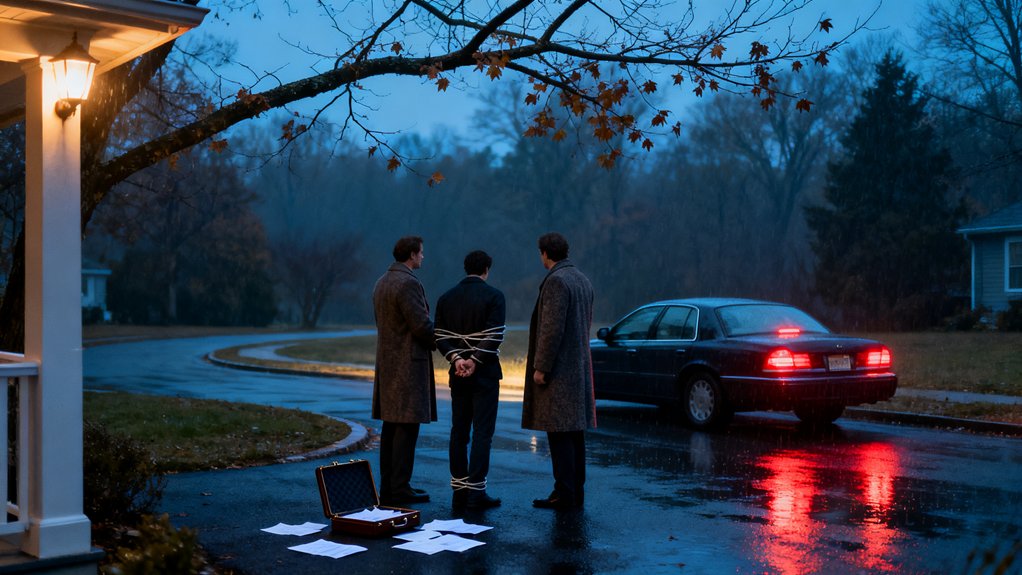
Agents surrounded Aldrich Ames’s 1984 silver Jaguar in a quiet Arlington suburb on February 21, 1994, less than twenty-four hours before he was scheduled to fly to Moscow for a routine CIA debriefing—a trip investigators knew would hand him the final chance to vanish with his KGB handlers.
The takedown wasn’t a gamble; it was the culmination of a nine-year forensic siege.
- FBI agents used a pre-arranged ruse—a bogus parking ticket—to coax Ames out of the driver’s seat, avoiding any violent confrontation.
- They found classified documents in his car and home, proving he’d prepped for a final exfiltration.
- Ames’s wife, Rosario, was arrested simultaneously, cutting off a potential leak.
- His KGB handler’s coded signals had already ceased, confirming Moscow knew the net was closing.
- Court records show Ames confessed within hours, admitting he’d sold names for $2.7 million.
The arrest froze his Moscow flight plan permanently.
Quantifying the Catastrophe: Ten Executions and a Dismantled Covert Network
The toll wasn’t abstract: ten CIA-run agents lost their lives once Ames’s betrayal reached Moscow, and the list began with the most consequential espionage asset in Soviet history, Major General Dmitri Polyakov.
Polyakov’s unmasking and subsequent execution in 1988 didn’t just erase one man—it severed the CIA’s deepest source on Soviet military strategy for nearly two decades.
That loss left a permanent intelligence void in the Russian theater, one that no later recruitment could fully patch, as verified in the declassified post-mortems of the Ames damage assessment.
The Unmasking and Execution of Major General Dmitri Polyakov
Executing Major General Dmitri Polyakov in 1988 wasn’t just a single loss—it was the grim exclamation point on a decimated network.
Polyakov, a GRU general who’d spied for the U.S. and China for two decades, symbolized the crown jewel of Moscow’s penetrated military elite.
Ames’ betrayal unmasked him, leading to a swift, brutal trial.
- The betrayal: Ames identified Polyakov in 1985, ending his silent service.
- The arrest: Soviet counterintelligence detained Polyakov in 1986, after years of meticulous surveillance.
- The trial: A closed military tribunal convicted him of treason without public evidence.
- The execution: A single gunshot to the back of the head in 1988, per declassified KGB records.
- The ripple: His death signaled to every asset that the CIA couldn’t protect them.
Assessing the Permanent Intelligence Void in the Russian Theater
While the Kremlin’s execution squads claimed ten of the CIA’s most valuable Russian assets between 1985 and 1988, the true magnitude of Ames’s betrayal wasn’t measured in body counts alone—it was the wholesale demolition of an intelligence apparatus that took decades to build.
Declassified files show he handed over the entire Moscow station’s agent roster, from military GRU colonels to scientific advisers, ensuring each name’s immediate arrest. That void persists today.
Recruiting fresh Russian sources post-Ames demands years of cultivation, yet the CIA’s institutional memory of reliable handling protocols vanished with those executions.
Analysts now face a stark reality: they operate without the depth of human penetration they once enjoyed, relying on signals intelligence that can’t replace betrayed trust.
The Kremlin’s knowledge of CIA tradecraft, gleaned from Ames’s confessions, permanently altered the espionage environment, leaving a void no new asset can easily fill.
A Devastating Institutional Autopsy: Rewriting the Directives of American Counterintelligence
Because the Agency’s post-mortem had to confront a brutal arithmetic—dozens of dead assets and a decade of compromised intelligence—the Ames affair forced a fundamental rewriting of American counterintelligence doctrine.
Investigators didn’t just hunt a mole; they dissected systemic blindness, turning inward to expose how compartmentation shielded betrayal. The result wasn’t merely procedural tweaks but a strategic overhaul, prioritizing human intuition over bureaucratic inertia.
- Polygraph Overhaul: They mandated random, not scheduled, exams to break predictable cycles.
- Asset Validation: They implemented rigorous, recurring verifications of agent loyalty, not just access.
- Financial Monitoring: They tightened scrutiny of officers’ lifestyle anomalies, a direct lesson from Ames’s cash-heavy existence.
- Case Officer Rotation: They capped station tours to prevent long-term, unchecked relationships.
- Counterintelligence Integration: They embedded CI officers into operational planning from the start, not as a review afterthought.
This institutional autopsy finally codified failure as a teacher, though the tuition proved devastatingly high.
Frequently Asked Questions
How Did Ames Initially Evade Suspicion During the Early Losses?
Ames initially evaded suspicion by exploiting the CIA’s own investigative blind spots. He didn’t hide his behavior; he hid within the sheer volume of it.
Investigators, under immense bureaucratic pressure, clung to technical compromise theories because they lacked physical evidence. Ames’s modest lifestyle and drinking remained consistent with his known habits, and his access to the Moscow files was routine.
Consequently, his name sat buried in a mountain of data, not because he seemed clean, but because his profile wasn’t unique enough to warrant a deeper, earlier look.
What Specific Evidence Finally Linked Ames to the KGB?
The forensic thread unraveled when analysts cross-referenced Ames’s bank deposits against KGB intelligence successes—a financial smoking gun.
His sudden wealth, exceeding $4 million, failed to align with CIA salary records. Investigators also pinpointed a correlation between his access to specific Soviet agent lists and their rapid executions.
They ultimately tied his personal computer’s documents and his wife’s foreign account activity to Moscow’s operational timetables, stitching together a mosaic of betrayal with hard, unshakeable evidence.
How Much Damage Did Ames Cause Beyond Moscow Networks?
Ames’s betrayal didn’t stop at Moscow—it gutted CIA operations worldwide. He exposed over 100 operations, leading to the execution of at least ten agents, including those in Eastern Europe and the Caribbean.
His information crippled the Agency’s human intelligence capabilities for years, forcing a total reassessment of field security.
That’s the hidden cost: a compromised global network, not just a regional loss, that set intelligence gathering back a decade.
Why Did the FBI Take Over From the Cia’s Investigation?
The FBI assumed the case because the CIA‘s internal hunt, after nine years, had failed to identify a single suspect despite losing over 20 agents.
That staggering statistic—20 dead assets—forced a shift. Bureau investigators brought fresh eyes, using financial records the Agency had overlooked.
They didn’t trust the CIA’s own counterintelligence team, which had grown too close to the problem. The FBI’s independent approach cracked the case.
What Key Reforms Resulted Directly From the Ames Case?
The Ames case directly forced sweeping polygraph upgrades, stricter access controls for classified files, and the creation of a dedicated CIA security review board.
Investigators didn’t stop there; they also demanded better financial disclosure for employees. These reforms weren’t optional—they came from brutal lessons.
The agency finally recognized that trusting its own people without rigorous, continuous vetting was a catastrophic gamble. Consequently, they rebuilt their entire internal monitoring structure.