The Church Committee’s 1975 investigation exposed the CIA’s darkest covert abuses, from assassination plots against foreign leaders to spying on 300,000 Americans. Director William Colby’s “Family Jewels” dossier confirmed the rot, but his transparency cost him his job in the Halloween Massacre. The fallout birthed FISA and permanent oversight. The full story of this seismic reckoning awaits.
Key Takeaways
- Senate Resolution 21 empowered the 1975 Church Committee to subpoena buried CIA records.
- The Church Committee exposed illegal domestic spying on 300,000 Americans via Operation CHAOS.
- Declassified files revealed assassination plots against Fidel Castro and Patrice Lumumba.
- The committee’s findings led to FISA, creating a secret court for surveillance oversight.
- Director William Colby’s disclosures triggered his firing in Ford’s 1975 “Halloween Massacre”.
December 1974: The Seymour Hersh Bombshell That Fractured the CIA’s Wall of Silence
In December 1974, Seymour Hersh’s explosive *New York Times* exposé shattered the CIA’s wall of silence, detailing years of domestic spying on American citizens—from wiretapping journalists to infiltrating antiwar groups—in direct violation of the agency’s charter.
The revelations forced the issue of covert intelligence abuses into the public square, leaving Director William Colby with a stark choice. He didn’t hesitate. His subsequent testimony to Congress confirmed the darkest allegations, citing specific operations flagged in the CIA family jewels declassified just months earlier.
That internal report—a litany of assassination plots and illegal mail openings—became his shield. Colby’s calculated candor undercut the old guard’s instinct to stonewall, transforming a simmering institutional crisis into a full-blown fracture.
That internal report—assassination plots, illegal mail openings—became his shield, trading secrets for survival.
He understood that partial denials would destroy the Agency’s credibility; instead, he traded secrets for survival, setting the stage for the deeper congressional reckoning that would follow.
The Architecture of Plausible Deniability Within the Cold War Old Guard
Colby’s gambit forced the old guard’s hand, but their resistance didn’t evaporate—it hardened into a system. Within the CIA old guard, plausible deniability became an engineered firewall, not a passive shrug. They didn’t defend specific operations; they defended the architecture that made them deniable.
Covert operational methodologies were compartmentalized into silos where no single officer held the full picture, ensuring that a probing question met only fragmented answers.
This wasn’t chaos—it was design. The old guard reasoned that if they couldn’t explain an action, they couldn’t be held responsible for it. Yet that logic crumbled under the Church Committee’s subpoenas.
Institutional accountability demanded names, dates, and paper trails, but the system offered only shadows. The old guard’s posture wasn’t treachery; it was survival instinct, calcified into bureaucracy. They protected the mechanism, not the mission, and that distinction became the committee’s sharpest lever.
William Colby and the Family Jewels: A Director’s Unprecedented Pivot to Transparency
Colby’s order to compile the 693-page dossier didn’t just catalog covert transgressions; it weaponized paper against the old guard’s code of silence.
From the director’s chair, he waged psychological warfare on his own agency, forcing colleagues to confront the stigma of treason with every page they reviewed.
That single act of documentation turned a career insider into the institution’s most dangerous outsider.
Compiling the 693-Page Dossier of Covert Transgressions
By mid-1975, the director had assembled a 693-page dossier—the so-called “Family Jewels”—that cataloged two decades of covert transgressions, from assassination plots against foreign leaders to domestic surveillance of American citizens.
This wasn’t a theoretical exercise; it was a raw, operational ledger. The church committee 1975 investigation demanded substance, and the dossier delivered it.
Colby meticulously cross-referenced declassified intelligence memoranda, turning vague rumors into hard, verifiable timelines. Each entry peeled back layers of institutional secrecy.
He recognized that covert action transparency was the only path forward, short-circuiting the old guard’s instinct to stonewall. He didn’t sanitize the record; he exposed its painful truths.
Here, in black and white, lay the agency’s unwritten history. Colby’s choice to hand over this document wasn’t an admission of defeat.
It was a calculated move to control the narrative before the committee’s own digging unearthed even more damaging details.
The 693-page dossier sat on the director’s desk, a ticking bomb wrapped in manila folders. William Colby knew the CIA’s institutional fractures demanded a brutal choice: shield the old guard or expose decades of covert sin.
He pivoted, revealing the Family Jewels to the Church Committee, a move his peers branded treasonous.
- Colby weaponized transparency, transforming a damning catalog into a shield for the agency’s survival.
- He navigated psychological warfare within his own office, enduring accusations of betrayal from spies who valued secrecy over law.
- His pivot forced the US intelligence community oversight debate, exposing historical espionage tactics like assassination plots and domestic surveillance.
Colby’s gamble worked—he traded stigma for survival, but the scars of that decision still haunt Langley’s corridors.
January 27, 1975: Senate Resolution 21 and the Mandate to Subpoena the Shadows
On January 27, 1975, the U.S. Senate passed Resolution 21, a legislative battering ram that tore down the CIA’s wall of silence. This mandate empowered the select committee to subpoena the shadows—forcing the agency to surrender verifiable intelligence records that had long been buried in classified vaults. The 1975 senate investigations didn’t just peek behind the curtain; they ripped it off, demanding answers on domestic surveillance exposure that had poisoned American trust.
| Subpoena Target | Hidden Operation | Committee Revelation |
|---|---|---|
| CIA Director’s Files | COINTELPRO tactics | Surveillance on U.S. citizens |
| NSA’s Cable Logs | Project MINARET | Warrantless watchlists |
| FBI’s Internal Memos | Hoover’s blackmail cache | Political intimidation |
| State Dept. Cables | Operation CHAOS | Civilian infiltration |
| Agency Budget Ledgers | Black site funding | Illegal operational cash |
This wasn’t bureaucratic curiosity—it was a constitutional reckoning, forcing William Colby to choose transparency over institutional loyalty.
Weaponizing Executive Power: The Lethal Blueprint of Foreign Assassination Plots
The Church Committee’s files expose the lethal blueprint for Fidel Castro’s assassination, complete with poison pills and syndicate connections that read like a spy thriller.
Patrice Lumumba’s fate in the Congo reveals a parallel playbook, where covert mechanics of regime change turned diplomatic targets into mortal ones.
These documented plots weaponized executive power, turning the White House’s foreign policy into a death warrant.
The Poison Pill and the Syndicate: Unpacking the Fidel Castro Logistics
Although the Church Committee’s mandate swept broadly, its most lethal focus zeroed in on a singular, explosive thread: the CIA’s plotted logistics to assassinate Fidel Castro.
The committee unraveled a labyrinth of schemes blending Mafia muscle with espionage craft—each plan a chilling indicator of executive overreach. Contract killers, like Johnny Rosselli, linked the Agency to Cuban syndicates, while toxicology became a dark science.
- Infamous poison cigars, lethal pills, and a contaminated diving suit—ready but never cleanly deployed.
- Recruits used underworld figures to mask American fingerprints, creating deniable chaos.
- Multiple plots spanned decades, revealing an obsession that defied operational sanity.
This wasn’t just a hit list; it was an institutional pathology, but Congo’s darker tale lurks next.
Patrice Lumumba and the Covert Mechanics of Regime Change in the Congo
While the Church Committee’s gaze fixed on Havana, a parallel and even more brazen operation was unfolding in the heart of Africa—one that would claim the life of Congo’s first democratically elected prime minister, Patrice Lumumba.
The CIA’s mechanics weren’t subtle; they were lethal. Agency cables show a direct order to assassinate Lumumba, using poison or a “special equipment” stash. They armed and funded his rivals, turning political opposition into a firing squad.
The committee later revealed the CIA station chief’s desperation, even attempting a rushed, crude assassination plan with a borrowed gun.
Lumumba’s murder in January 1961 wasn’t a rogue act—it was executive power weaponized. The blueprint for regime change had found its first African casualty, proving that covert action’s price often comes in blood.
Operation CHAOS and the Illegal Surveillance of 300,000 American Citizens
As William Colby’s transparency pried open the CIA’s vault of secrets, one revelation cut deeper than most: Operation CHAOS, a domestic spying program that had illegally amassed files on roughly 300,000 American citizens. The agency’s reach didn’t stop at foreign threats—it turned inward, surveilling anti-war activists, civil rights leaders, and journalists under the guise of national security.
- The program’s intercepts went beyond names; agents logged personal relationships, political affiliations, and travel patterns without warrants.
- Colby’s decision to hand over the files shattered the CIA’s claim that it never spied on Americans, forcing a reckoning with decades of constitutional breaches.
- The committee’s evidence showed the data was often shared with local police, fueling harassment campaigns against lawful dissenters.
That exposure didn’t just condemn the past; it demanded a future where intelligence agencies answer to the law, not their own unchecked agendas. The vault, once locked, now stood open.
Project MKULTRA and the Cover-Up of the Chemical Interrogation Archives
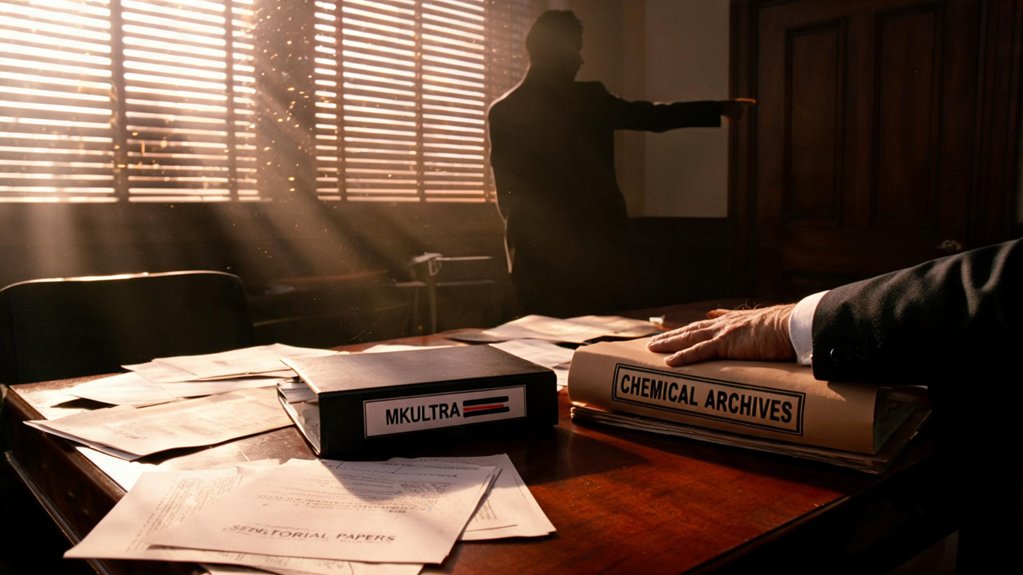
By 1973, Richard Helms wasn’t waiting for the Committee’s subpoenas—he was already shredding MKULTRA’s chemical interrogation archives, erasing evidence of experiments that bypassed informed consent in the hunt for a Cold War truth serum.
His preemptive destruction didn’t just bury the files; it transformed a scientific overreach into a deliberate cover-up that the 1975 investigators would have to dig out from the ashes.
That shredded paper trail now stands as the first confession of guilt, long before any official testimony forced the issue.
Bypassing Informed Consent in the Search for a Cold War Truth Serum
Although the Church Committee’s spotlight glared on CIA abuses in 1975, its most damning revelation wasn’t a single assassination plot but a sprawling, decades-old quest for a chemical truth serum that had trampled medical ethics and human dignity.
Investigators unearthed MKULTRA’s shadowy subprojects, where scientists dosed unwitting subjects with LSD, barbiturates, and electroshock, chasing a hypnotic edge for interrogators. The Committee’s files exposed a stark pattern:
- Subjects—prisoners, patients, even CIA employees—never signed consent forms, often receiving drugs disguised as routine treatments.
- Agency handlers destroyed lab notebooks and test logs, erasing dosages and casualty records before Congress could subpoena them.
- Physicians funded by the CIA published sanitized findings, burying adverse reactions to protect the program’s facade.
This wasn’t rogue science; it was institutionalized deception, cloaked in Cold War urgency.
The archive’s shredding left survivors without names, and the truth serum’s ghost still haunts the oversight gap.
Richard Helms and the 1973 Preemptive Shredding Directives
While Helms’s name rarely surfaced in the Church Committee’s final report, his fingerprints were all over the bonfire.
Two years before the hearings, he issued directives that gutted Project MKULTRA’s paper trail. He didn’t order a simple purge; he mandated a systematic shredding of chemical interrogation archives, erasing the contracts, the budgets, and the names of unwitting test subjects.
Colby’s later transparency couldn’t resurrect what Helms had incinerated.
The committee found empty file cabinets and conflicting testimonies, but no definitive link to Helms’s desk.
That was the point. His preemptive destruction created a legal black hole, forcing investigators to piece together fragments from a smoking crater.
They knew what he’d done, but proving intent became a forensic nightmare—a cover-up so clean it almost looked accidental.
Mutiny at Langley: The Old Guard’s Coordinated Bureaucratic Campaign Against William Colby
As the Church Committee’s subpoenas landed on Langley’s desks in early 1975, the old guard didn’t just resist—they mobilized. They orchestrated a silent mutiny against Director William Colby, whose unflinching transparency they viewed as betrayal.
Their campaign wasn’t overt; it was bureaucratic sabotage, designed to choke his credibility and isolate him internally.
- They fed selective, damning leaks to sympathetic columnists, painting Colby as a reckless leaker of state secrets.
- They stalled his directives through procedural red tape, quietly re-routing his orders into dead-end committee reviews.
- They lobbied congressional allies to whisper doubts about his loyalty, framing his honesty as weakness.
Colby stood alone, his own deputies undermining his authority while maintaining public deference.
Their goal wasn’t to stop the hearings—they knew that ship had sailed—but to guarantee he’d shoulder the blame alone.
The mutiny worked, isolating him politically and setting the stage for his eventual dismissal, though the damage to their wall of secrecy was already done.
September 16, 1975: The Nondetectable Poison Dart Gun and the Theatrics of the Senate Floor
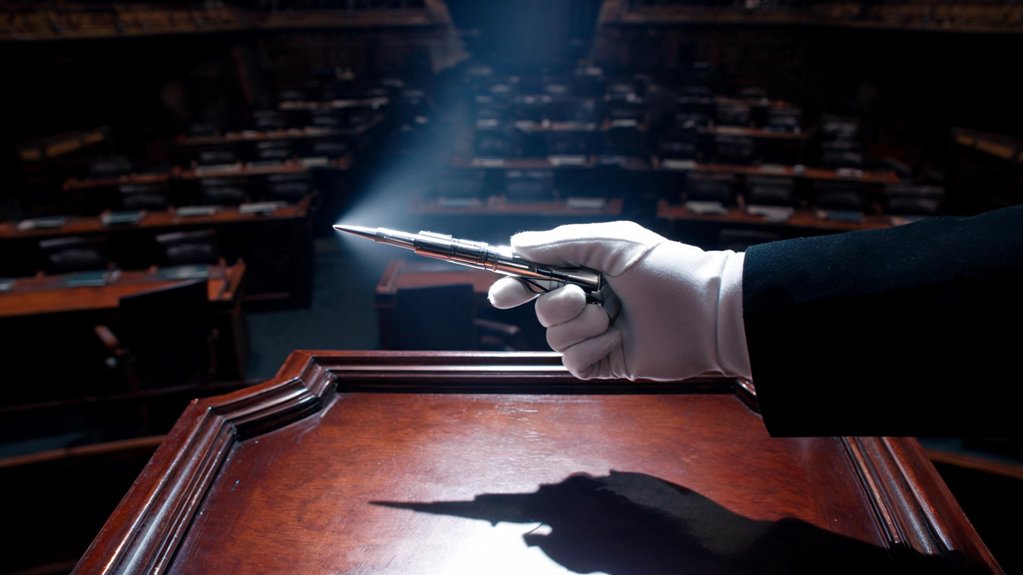
The mutiny’s internal scheming collapsed into public spectacle on September 16, 1975, when Senator Frank Church brandished a nondetectable poison dart gun on the Senate floor. He aimed the CIA’s silenced weapon at a stack of papers, squeezing the trigger to demonstrate how easily an assassin could eliminate a target without leaving forensic traces. The theatrics punctuated his committee’s explosive findings—the agency had developed and tested the device for covert operations, a chilling reality now laid bare for the nation.
| Element | Detail | Impact |
|---|---|---|
| Weapon | Dart gun, silent, plastic | Undetectable by metal detectors |
| Target | Simulated, papers | Visual proof of lethality |
| Witnesses | Senators, press | Public shock, media frenzy |
| Testimony | CIA technicians | Confirmed operational readiness |
| Aftermath | Weapon decommissioned | Boosted reform momentum |
Church’s performance wasn’t mere drama; it converted classified jargon into visceral proof, forcing colleagues to confront the human cost of unchecked espionage. The image of that gun—small, innocuous, lethal—became the committee’s starkest symbol of intelligence overreach, crystallizing the stakes of its investigation.
Publishing the 14-Volume Church Committee Report and Mandating Federal Accountability
The committee’s 14 volumes didn’t just catalog abuses; they forced a legal reckoning.
Congress codified the Foreign Intelligence Surveillance Act of 1978 to restrain warrantless spying, while the permanent Senate Select Committee on Intelligence guaranteed no dark corner could hide again.
That institutional embrace of oversight, born from Colby’s transparency, became the enduring shield against future overreach.
Codifying the Foreign Intelligence Surveillance Act of 1978
While institutional resistance still simmered within the intelligence community, the Church Committee’s findings couldn’t remain sealed. The push for codified boundaries wasn’t just bureaucratic; it was a direct response to documented warrantless surveillance abuses. FISA’s architecture emerged from that raw, verified testimony, demanding a legal framework where none existed before.
- It established a secret court for approving foreign intelligence surveillance requests, injecting judicial oversight into a previously unregulated domain.
- It criminalized unauthorized electronic surveillance within the U.S., shifting the burden of proof and protecting specific civil liberties.
- It acknowledged that credible oversight requires a deliberative, checkable process, not mere institutional trust.
That legislative fiat represented a definitive break from unchecked executive authority, transforming accountability from an ideal into enforceable law.
The Permanent Installation of the Senate Select Committee on Intelligence
Because the Church Committee’s final report ran fourteen volumes, its release didn’t just close an investigation—it forced a reckoning that Congress couldn’t walk away from. Publishing those findings exposed a brutal truth: oversight couldn’t remain ad hoc. So, lawmakers permanently installed the Senate Select Committee on Intelligence in 1976, mandating ongoing federal accountability rather than reactive hearings. This wasn’t a symbolic gesture; it created a standing watchdog with subpoena power.
| Committee Tool | Pre-1976 Reality | Post-Installation Impact |
|---|---|---|
| Oversight Scope | Reactive, crisis-driven | Continuous, proactive review |
| Access | Restricted, filtered | Direct, classified briefings |
| Legal Leverage | None permanent | Subpoena authority codified |
| Public Reporting | Rare, vague | Annual unclassified summaries |
That shift transformed intelligence from a secret club into a supervised institution—with teeth.
November 2, 1975: The Halloween Massacre and the Executive Termination of William Colby
As Colby’s disclosures during the Church Committee hearings shredded decades of clandestine precedent, his fate within the executive branch was already being sealed behind closed doors.
On November 2, 1975, President Gerald Ford executed a brutal political purge—dubbed the “Halloween Massacre”—that swept Colby from the CIA’s helm. The termination wasn’t mere administrative routine; it was a calculated strike against transparency itself.
- Colby’s removal replaced him with George H.W. Bush, a loyalist trusted to rebuild CIA walls against congressional scrutiny.
- The firing occurred amid Ford’s broader cabinet reshuffle, leveraging chaos to deflect attention from the Committee’s mounting revelations.
- Colby learned of his dismissal via a single phone call—no ceremony, no gratitude, only silent exile.
The massacre signaled that executive power would no longer tolerate institutional candor.
Colby’s fate crystallized the stakes: transparency came with a price, and the old guard intended to collect.
The Permanent Eradication of Unilateral Secrecy in the United States Intelligence Apparatus
The Halloween Massacre’s message was unmistakable, but the Church Committee’s momentum proved impossible to reverse—Colby’s exile didn’t erase the evidence he’d placed on the public record. His testimony cracked the vault of unilateral secrecy, forcing a structural shift where oversight ceased being optional. The committee didn’t just document abuses; it weaponized transparency as a permanent check on executive power.
| Mechanism | Pre-1975 Practice | Post-Committee Reality |
|---|---|---|
| Budget Review | Congressional rubber-stamp | Mandatory audit trails |
| Covert Ops | Presidential sole discretion | Statutory notification rules |
| Classified Files | Eternal sealing | Automatic declassification cycles |
| Whistleblowers | Silenced by loyalty oaths | Legal protections enacted |
Colby’s quiet defiance had brittle consequences for the old guard. Intelligence chiefs now faced subpoenas, not just salutes. The apparatus couldn’t retreat into shadow; every operation bore the fingerprint of legislative scrutiny. Unilateralism died, not by revolution, but by persistent procedural erosion. The Committee’s legacy endured as a bureaucratic firewall—no director could again claim ignorance absolved them of answerability.
Frequently Asked Questions
What Specific Abuses Did the Church Committee Uncover?
The committee uncovered systematic abuses: assassination plots against foreign leaders, illegal mail opening, and domestic surveillance of anti-war activists.
It documented CIA infiltration of student groups and covert attempts to destabilize governments, like Chile’s.
These operations ran without oversight, violating charters.
William Colby’s disclosures forced these actions into public record, proving the agency’s reach exceeded its legal mandate, and the revelations shattered trust in intelligence’s self-regulation.
How Were the Family Jewels Obtained and Verified?
The Family Jewels surfaced via Director William Colby’s decision, acting as the rope in a tug-of-war. He compiled them from internal CIA files, then verified each operation against agency records.
Colby bypassed the old guard, handing over documents to investigators. Their validity rests on cross-checked memoranda and testimonies, not whispers—turning classified secrets into a public ledger.
This wasn’t speculation; it’s documented fact.
Was William Colby Fired Solely for His Testimony?
No, Colby wasn’t fired solely for his testimony. His dismissal stemmed from a deeper institutional betrayal perceived by the Ford administration and intelligence “old guard.”
They saw his unprecedented transparency—handing over the Family Jewels—as capitulation, not patriotism. Ford, pressured by hardliners, replaced him to restore loyalty and control.
His firing was the price of exposing uncomfortable truths, a political consequence for prioritizing accountability over institutional protection.
What Happened to the MKULTRA Interrogation Archive?
The MKUltra archive’s destruction was the single most colossal act of historical vandalism in American espionage lore.
Director Richard Helms ordered the files burned in 1973, leaving investigators with only fragments.
Consequently, the Church Committee couldn’t reconstruct full interrogation methodologies. They pieced together scattered memos and survivor testimony, proving the program’s existence but losing countless details forever.
That’s the brutal reality: the archive’s absence remains the definitive, unanswered question.
Which Assassination Plots Were Directly Confirmed by the Report?
The report directly confirms plots against Fidel Castro, including the CIA’s Mafia-linked poison attempts and exploding cigar schemes.
It also verifies operations targeting Patrice Lumumba of the Congo and Rafael Trujillo of the Dominican Republic, though it notes the CIA’s role in Trujillo’s case remained murkier.
These findings don’t just list failures—they expose a pattern of sanctioned assassination as a policy tool, forcing the agency to own its lethal overreach.
Final Thoughts
The Church Committee didn’t just pry open a vault; it detonated the very foundation of covert impunity, turning classified sin into public scripture. By forcing Colby’s confession and the assassin’s toolkit into daylight, it forever weaponized oversight against the shadows. The old guard’s wall crumbled, and from its rubble rose a permanent, unforgiving mirror—a mandate that intelligence, once hidden, now answers to the nation’s stare.