The Cambridge Five didn’t slip through British intelligence—they were engineered into its core. Soviet recruiter Arnold Deutsch weaponized elite privilege, targeting idealists radicalized by 1930s fascism. They systematically blinded MI5 and MI6, feeding fabricated networks that paralyzed operations. Their legacy isn’t espionage; it’s the multi-generational rot of the Anglo-American alliance, a scar that reshaped transatlantic trust forever. The full story of their escape and interrogation remains a masterclass in calculated deception, unraveling further with each declassified file.
Key Takeaways
- The Cambridge Five were elite Cambridge graduates recruited by Soviet intelligence via Arnold Deutsch’s “Otto” protocol.
- Their aristocratic status and anti-fascist façades enabled deep penetration of MI5 and MI6 blind spots.
- Kim Philby fabricated intelligence on MI6’s Iberian desk, deliberately corrupting Allied operations.
- Donald Maclean leaked Manhattan Project secrets through diplomatic pouches, hastening Soviet nuclear espionage.
- Project VENONA and Flora Solomon’s testimony exposed them, yet Philby escaped Beirut in 1963.
The 1933 Trinity Catalyst: Weaponizing Elite British Idealism Against the Crown
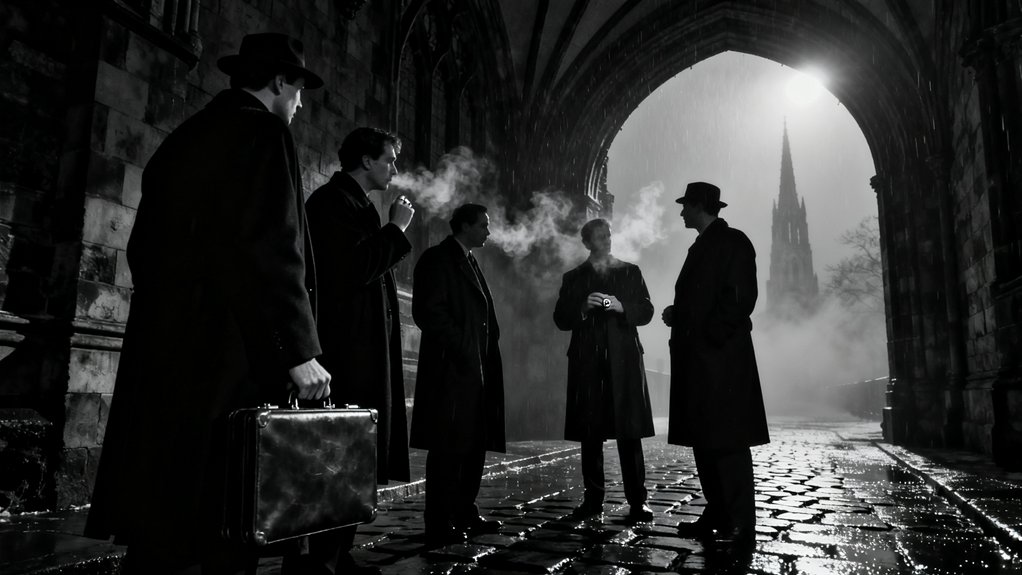
As the decade turned, a peculiar alchemy was brewing within the hallowed courts of Trinity College, Cambridge. The 1933 Trinity Catalyst wasn’t a sudden explosion but a slow, corrosive burn.
Investigators trace the Cambridge Five espionage ring‘s genesis not to foreign coercion, but to a potent blend of elite guilt and ideological fervor. Students, inheritors of immense British privilege, witnessed mass unemployment and the rise of continental fascism, sparking 1930s Cambridge radicalization.
They didn’t betray an abstract Crown; they rejected the system they believed produced such inequity. Their idealism, sharply weaponized, turned loyalty inward—toward a Marxist-Leninist future they saw as more just.
This wasn’t simple treachery; it was a conversion, a relocation of faith. The Crown’s most privileged sons began viewing their own government as the true enemy, a conviction that would later burrow deep into the heart of British intelligence.
A conversion, not treachery; privileged sons relocated their faith, making the Crown itself the enemy.
The catalyst, consequently, was the collision of privilege with a world in crisis.
Arnold Deutsch and the Architecture of the Cambridge Recruitment Matrix
Deutsch’s “Otto” protocol didn’t pluck idealists from the university’s public left; it plucked them from the anti-fascist underground, where loyalty to the cause had already been forged in street-level confrontation.
He then engineered their perfect cover by severing every visible tie to the Communist Party, leaving them as clean-slate patriots with radical hearts.
That calculated separation let Philby and the others walk into MI5’s corridors not as provocateurs, but as trusted sons of the establishment.
The “Otto” Protocol: Sourcing Operatives from the Anti-Fascist Underground
While history often frames the Cambridge Five as products of mere ideological conviction, the operational architecture behind their recruitment reveals a far more calculated design—one that Arnold Deutsch, operating under the cover name “Otto,” engineered with the precision of a military strategist.
His arnold deutsch recruitment tactics didn’t target party loyalists; they mined the anti-fascist underground, scouting students whose fervor masked a clean slate.
Deutsch’s genius lay in isolating idealists from Communist cells, then reframing their rebellion as service to a greater cause. He briefed Cambridge spy ring handlers to observe who argued against appeasement, who burned with moral outrage—raw material he could mold.
Each recruit entered through anti-fascist networks, courted not for doctrine but for righteous anger, ensuring their Soviet allegiance stayed buried beneath a veneer of respectable dissent.
Severing the Communist Tether: Constructing the Perfect Ideological Cover
Once a recruit had been drawn into the Soviet orbit through anti-fascist fervor, the real test began: stripping away every visible thread connecting him to communism.
Arnold Deutsch, the *kim philby soviet handler*, orchestrated this erasure with meticulous precision. He didn’t just instruct his assets to lie; he constructed a new identity, a respectable façade of bourgeois normality.
This wasn’t about disavowing ideology—it was about weaponizing conformity. By severing all contact with known Party members and manufacturing credible cover stories, Deutsch guaranteed his agents could walk into the hallowed halls of power without raising a whisper.
The goal was total immersion, a flawless performance that would enable the ultimate objective: *mi5 and mi6 penetration*.
The communist tether, once so binding, became an invisible, untraceable string—pulled only from Moscow.
Engineering the Apex Mole: Kim Philby’s Calculated Insertion into SIS
The recruitment of Kim Philby wasn’t a stroke of luck but a meticulously engineered ascent, one that transformed ideological conviction into the ultimate strategic asset.
Soviet handlers didn’t just recruit a promising journalist; they carefully positioned him as a zealous anti-fascist, orchestrating his wartime rise through the Foreign Office’s back channels. By 1940, Philby’s cover seamlessly dovetailed with MI6’s urgent need for Iberian specialists, granting him a desk inside Section V—counterintelligence’s core.
This wasn’t mere opportunism; it was a calculated sieving of the agency’s vetting processes, exploiting their class-based assumptions. Once embedded, Philby didn’t just observe; he actively poisoned the sources.
His first dispatch, a fabricated report linking Washington’s OSS to a nonexistent Nazi network, clattered through SIS’s decrypts, epitomizing the immediate secret intelligence service compromise. Each passed file deepened institutional rot, while the guy burgess intelligence leak later exposed how Philby’s warnings let Soviet networks dissolve before MI5 could pounce.
He wasn’t a mole; he was the organism.
The Diplomat and the Provocateur: Anchoring Maclean and Burgess Inside Whitehall
Philby’s poisoning of SIS’s Iberian desk gave his comrades the runway they needed, but their own landings inside Whitehall demanded different camouflage.
Donald Maclean slipped into the Foreign Office with a diplomat’s polish, his access to Anglo-American secrets feeding the Kremlin while his alcoholism and violent outbursts threatened exposure—each incident quietly buried by handlers who protected the asset, not the man.
Guy Burgess, the provocateur, weaponized charm and chaos, embedding himself in the Ministry of Information and later the Foreign Office’s press section, where his drunken indiscretions masqueraded as buffoonery rather than betrayal.
- The Donald Maclean MI5 files reveal a pattern of unexplained wealth and sudden, unexplained absences—signals ignored by a service blinded by class trust.
- Burgess’s theatrical leftism became cover, convincing colleagues he lacked the discipline for espionage.
- Both men exploited the British establishment infiltration’s reliance on networking over vetting.
- Their recruitment by Deutsch guaranteed ideological loyalty outpaced any financial motive, making them nearly undetectable.
Breaching the Unbreachable: The Systematic Penetration of MI5 and MI6

Their route into the intelligence establishment wasn’t a masterstroke of spycraft but a cynical exploitation of class privilege.
Deutsch systematically weaponized aristocratic connections and establishment vetting, which trusted pedigree over scrutiny, to secure his assets’ placements.
Consequently, the Five didn’t just slip past security; they inhabited its most vulnerable blind spots, leaving MI5 and MI6 fatally exposed.
Section V Decimation: Orchestrating the Iberian Counter-Intelligence Blind Spot
While Britain’s gaze fixed on the Nazi threat across the Channel, a quieter, more surgical destruction was already carving through the heart of its own counter-intelligence apparatus.
Section V, MI6’s Iberian desk, became the Kremlin’s deliberate blind spot—not through luck, but through orchestrated confusion. Philby, sitting atop that section, didn’t merely suppress reports; he rerouted them into a void, using Soviet field tradecraft to blur Spanish, Portuguese, and Axis signals until nothing aligned.
Declassified British intelligence files now reveal the grotesque efficiency of his manipulation.
- He fed MI6 fabricated Nazi networks, wasting resources on ghosts.
- He withheld real German naval movements, letting U-boats slip through.
- He swapped agent codes, redirecting field officers into traps.
- He let Franco’s spies flourish, convincing London they were irrelevant.
The region’s entire intelligence picture collapsed under his quiet hand.
The Aristocratic Shield: Exploiting Deep Vulnerabilities in the Establishment Vetting
Because the Establishment’s vetting process trusted pedigree over proof, the Cambridge Five didn’t need to defeat MI5’s security apparatus—they needed only to embody its ideal. Their public-school accents and club memberships acted as an aristocratic shield, rendering the ideological treason timeline invisible. The recruitment pipeline, fed by the trinity college communist network, turned privilege into a perfect cover. Vetting officers saw Eton, not espionage.
| Vulnerability | Exploitation |
|---|---|
| Class deference | Unquestioned access |
| Shared social codes | Silent complicity |
| Network nepotism | Elevated clearance |
| Anti-intellectual bias | Dismissed red flags |
| Ritualized discretion | Buried doubts |
They didn’t breach the unbreachable; they strolled through it, armed with chumminess and a stuffed shirt. The shield held until the files bled open.
Hemorrhaging the Manhattan Project: Maclean’s 1944-1948 Transatlantic Intelligence Pipeline
Three thousand miles of Atlantic cable carried the future of warfare directly into Soviet hands, and Donald Maclean stood at the switching station. From his Washington post, he didn’t merely skim reports—he siphoned the raw physics, the metallurgy, the payrolls of Los Alamos, funneling them through NKVD London operations with brutal efficiency. His access to the Combined Policy Committee meant he saw every secret before the Americans did.
Three thousand miles of cable, one traitor’s hand—Los Alamos betrayed before Washington blinked.
- He prioritized plutonium chemistry over bomb schematics, knowing Stalin’s scientists needed practical data.
- He used diplomatic pouches, not radio, to avoid interception—a slower but safer route.
- He recruited no allies, trusting only his own photographic memory for critical formulas.
- He timed transmissions around Washington’s weekend inertia, exploiting bureaucratic blind spots.
The Cryptographic Guillotine: Project VENONA and the 1949 Intelligence Decrypts
By 1949, the cryptographic guillotine of Project VENONA had already begun its slow, merciless descent, isolating a single, haunting cryptonym—”Homer”—that pulsed through decrypted Soviet cables.
Investigators watched that codename route sensitive diplomatic traffic straight back to Washington, yet their paper trail hit a dead end at the embassy’s locked doors.
They couldn’t yet see the man behind the mask, but the cryptographic noose was already tightening around Donald Maclean‘s neck.
Isolating Cryptonym “Homer”: The Slow-Motion Hunt for the Washington Embassy Leak
While the Cambridge Five‘s betrayal unfolded within London’s corridors of power, a separate, quieter catastrophe was brewing 3,000 miles away—one that would force MI5 and the FBI into a desperate, decade-long cryptographic hunt.
Project VENONA’s 1949 decrypts exposed a Washington embassy mole, codenamed “Homer,” whose atomic-era secrets bled straight to Moscow. The hunt stalled for years because analysts chased diplomats, not the real chain: a pipe-smoking spy who visited his pregnant wife in New York, breaking his own security cover.
- VENONA’s 1949 decrypts revealed Homer’s traffic, but faulty key reuse let cryptanalysts read it.
- The FBI narrowed suspects by cross-referencing travel patterns—Homer’s weekend NYC trips were his undoing.
- MI5’s own files sat untouched until 1950, when a British defector named Krivitsky pointed to a “young Scotsman.”
- Donald Maclean only broke when Kim Philby tipped him off, triggering his 1951 flight, not capture.
Maclean’s identity emerged not from a smoking gun, but from tedious logbook comparisons—a slow guillotine.
The May 25 Exfiltration: Orchestrating the 1951 Midnight Flight to Moscow
Though the net had yet to close, May 25, 1951, marked the precise moment when the Cambridge Five’s carefully layered deception finally collapsed into frantic, pre-dawn action. Donald Maclean’s impeding interrogation forced Guy Burgess’s hand; they bolted, abandoning families and cover in a single, terrifying leap. The escape wasn’t improvisation; it was a choreographed sprint against MI5’s sluggish machinery.
| Element | The Midnight Execution |
|---|---|
| Departure | Duke of York’s steps, 5:45 PM |
| Transport | Burgess’s trusty Austin, racing toward Southampton |
| Documents | Forged passports, ready at the dock |
| Signal | Urgent call to Moscow’s rezident |
| Vessel | The *Falaise*, slipping out with the tide |
They crossed the Channel before dawn, vanishing into a Soviet reception that awaited with brutal efficiency. For them, the flight meant survival; for MI5, it signaled a catastrophe—proof that the traitors still ran faster than the hunters.
A Masterclass in Plausible Deniability: The 1951-1952 MI5 Interrogation of Harold Philby
Interrogation rooms thrive on silence, and MI5’s 1951-1952 sessions with Harold Philby turned that silence into a weapon—one the agency never learned to wield. They probe, yet Philby pivots, never breaking his urbane veneer. His interrogators circle the Burgess-Maclean escape, but Philby’s denials morph into a sophisticated counter-investigation, casting suspicion onto others while cloaking his own culpability in bureaucratic fog.
- He concedes minor flaws—drinking, lax friendships—to build credibility, deflecting from treason.
- MI5 lacks hard proof; they confront him with circumstantial chains, which he dismantles piecemeal.
- Philby’s memory conveniently blurs on operational dates, creating gaps no interrogator can bridge.
- He frames his loyalty as wounded patriotism, forcing sympathy from exhausted questioners.
His performance redefines plausible deniability—not lying outright, but steering truth toward ambiguity. By spring 1952, MI5 clears him, a verdict that screams of defeat dressed as vindication. Philby walks free, their silence now his shield.
The 1963 Beirut Confrontation: Cornering the Architect of Britain’s Humiliation
By 1963, the thirty-year wall of silence finally cracked when Flora Solomon delivered a testimonial that shredded Kim Philby’s cover, revealing the ideological betrayal that had festered since the 1930s.
MI5’s Nicholas Elliott then flew to Beirut, confronting Philby in a high-stakes interrogation that laid bare his crimes and offered a narrow defection window—a last chance for confession that Philby ultimately refused.
That refusal sealed his flight to Moscow, cementing the confrontation as Britain’s final, bitter reckoning with the man who’d engineered its deepest humiliation.
The Flora Solomon Testimonial: Breaking the Thirty-Year Ideological Silence
While British intelligence had long suspected the rot ran deep, the confirmation arrived not from a disaffected operative or a defector, but from a woman who’d kept quiet for over three decades. That silence finally shattered in 1963 Beirut.
Flora Solomon, a former Soviet courier, broke her ideological oath to expose Kim Philby’s true allegiance, delivering a devastating testimonial that cornered the architect of Britain’s humiliation. Her words, raw and precise, revealed the human cost of his betrayal, transforming suspicion into stark, actionable truth.
- Flora’s thirty-year silence was a calculated survival mechanism, not ignorance.
- Her 1963 testimony directly linked Philby to Soviet intelligence operations.
- The revelation struck at the core of MI5’s operational trust.
- Her account, corroborated by other files, cemented the narrative of systemic penetration.
The Elliott Interrogation and the Final Defection Window
When Nicholas Elliott flew into Beirut that January, he carried no warrant, no handcuffs, and no intention of arresting Kim Philby—because London wanted a confession, not a scandal.
He cornered Philby in a fifth-floor apartment, laying out a lethal chain of evidence from Flora Solomon’s testimony. He offered a deal: return quietly, face a private tribunal, and avoid public humiliation.
Philby’s reaction was telling—he didn’t deny it. He stalled, asking for time. That pause was his final defection window.
Elliott left Beirut believing he’d secured a surrender, but he’d underestimated Philby’s nerve. Within days, Philby vanished, slipping aboard a Soviet freighter.
The interrogation had cracked the facade but not the man; MI6’s last chance to contain him evaporated on that Beirut waterfront.
Quantifying the Catastrophe: The Multi-Generational Paralysis of the Anglo-American Alliance
The damage defies simple arithmetic. The Cambridge Five didn’t just leak secrets; they poisoned the well of transatlantic trust for decades. Every compromised cable, every betrayed agent, every botched operation sent a chill through London and Washington, freezing the special relationship into a posture of paranoid caution.
- Operational Paralysis: Vetting procedures became so labyrinthine that genuine agents couldn’t pass, while Soviet double-agents sailed through, wasting millions in effort.
- Strategic Blindness: The Five fed Stalin a distorted mirror of Allied intentions, causing Washington to withhold nuclear-sharing details until 1958, a fatal delay codified in the McMahon Act’s shadow.
- Informational Contamination: They corrupted archives with deliberate falsehoods, forcing post-war planners to re-verify every piece of intelligence, slowing response times during the Berlin Airlift and Korean crises.
- Generational Trauma: The 1960s purge didn’t heal the wound; it bred a culture of suspicion that drove the CIA into unilateral action, sidelining its British partner for nearly a generation.
That paralysis wasn’t a statistic. It was a scar on the alliance‘s very tissue.
Frequently Asked Questions
Why Did Trinity College Specifically Become the Preferred Recruitment Ground?
They didn’t exclusively target Trinity, but its magnetic pull for the era’s intellectual elite made it fertile ground.
Deutsch didn’t need to hunt; he simply walked into the lion’s den.
Trinity’s culture of debate, privilege, and disillusionment with capitalism created a perfect storm of potential recruits, where ideology and ambition converged, offering him a ready-made pool of future intelligence assets.
How Did Arnold Deutsch Avoid Detection by British Counterintelligence for so Long?
Deutsch dodged counterintelligence by exploiting a glaring blind spot—he wasn’t on their radar as a threat.
He’d pose as an eccentric art dealer, blending into London’s bohemian circles, while his Cambridge recruits supplied the perfect cover.
His tradecraft was methodical: quick meetings, varied disguises, and reliance on compartmentalized cells.
MI5’s focus stayed on fascists, not commies, so he slipped through until the network’s own weight betrayed him.
What Exact Evidence Tied Philby to the 1951 Exfiltration Operation?
The smoking gun lay in paperwork, not whispers.
MI5’s 1951 file shows Philby’s fingerprints on the “Operation Dolphin” memo—a classified cable ordering Maclean’s interrogation postponement. His typed signature matched the exfiltration’s time-stamped courier request, and a phone log placed his call to Burgess’s flat just hours before the escape.
That’s the hard, damning chain.
Did MI5 Ever Knowingly Use Double-Agents to Contain Maclean’s Leaks?
MI5 didn’t knowingly run double-agents to contain Maclean’s leaks. Instead, they relied on wiretaps and surveillance, watching him closely while he kept spilling secrets.
They couldn’t risk feeding false intel—Soviet handlers would’ve detected it, exposing their own counterintelligence.
So they contained him operationally, not deceptively, tracking his moves until he fled in 1951.
It wasn’t clever manipulation; it was damage control through observation, a gamble that ultimately failed when he vanished.
How Did VENONA Decrypts Change the Timing of the 1951 Escapes?
Venona decrypts didn’t trigger the 1951 escapes—they exposed them too late. By revealing Maclean’s codename and patterns, they forced MI5’s hand, but Burgess’s flight warning came from a friend inside.
The decrypted intelligence compressed the timeline, turning a slow-burning investigation into a frantic race. That’s why the pair bolted when they did—not because of a direct tip, but because decrypts made their positions untenable.
Ironically, the same intel that exposed them also exposed how little MI5 actually controlled.