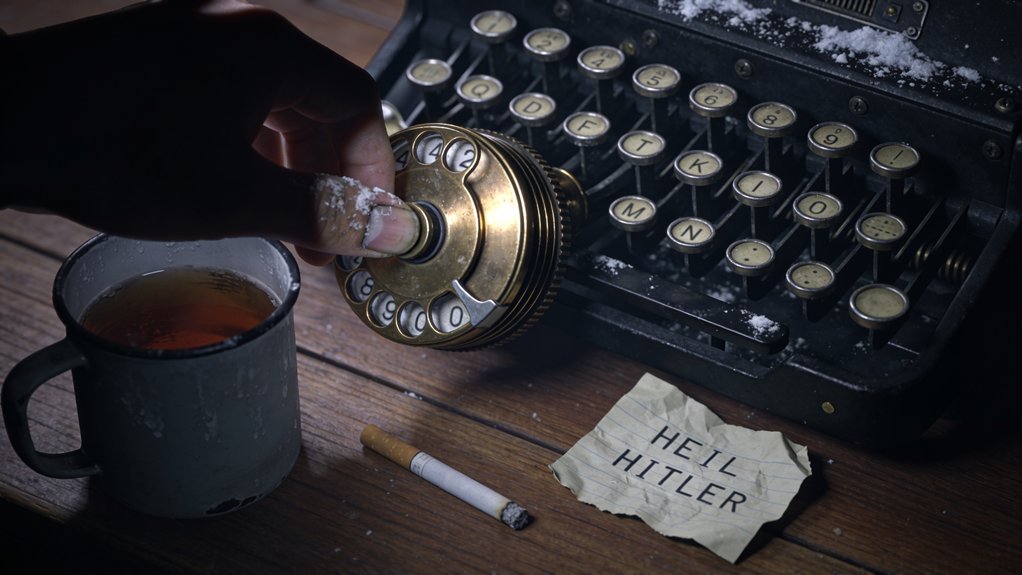
In February 1942, Admiral Dönitz deployed the Enigma M4, a four-rotor machine boasting over 103 sextillion permutations, and declared it unbreakable. This arrogance blinded the Kriegsmarine as Bletchley Park’s codebreakers faced a ten-month intelligence blackout. The M4’s fourth rotor lacked notches, halting Bombe machines cold. Yet, by October, a desperate boarding of U-559 yielded blood-soaked weather keys. Statistical analysis shattered the cipher’s fortress, turning encrypted German triumphs into death sentences. The fatal flaw was never mathematical—it was hubris. The full story of this algorithmic slaughter awaits.
Key Takeaways
- February 1942 M4 deployment caused a ten-month intelligence blackout at Bletchley Park.
- Hut 8’s Bombes failed against the M4’s fourth rotor, halting naval codebreaking.
- Captured *Wetterkurzschlüssel* codes from sinking U-559 restored M4 decryption in October 1942.
- Statistical analysis of weather reports neutered the M4’s fourth rotor complexity.
- Restored decryption enabled Allied ambushes, leading to the “Black May” U-boat defeat.
February 1942: Admiral Dönitz and the Deployment of the Invulnerable M4
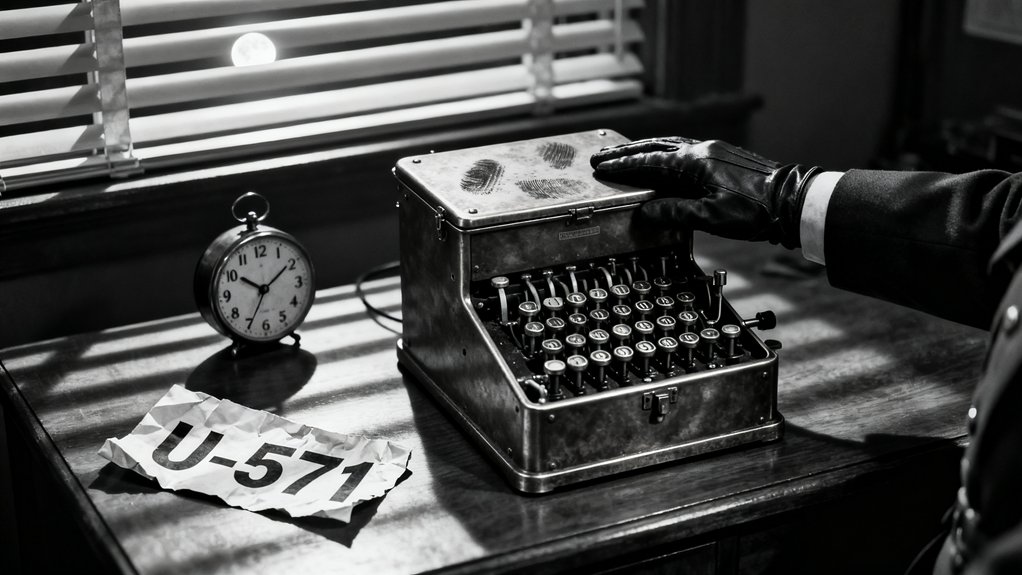
Although confidence ran high within the Kriegsmarine‘s upper echelons, Admiral Karl Dönitz personally sanctioned the full deployment of the Enigma M4 machine to the U-boat fleet in February 1942, genuinely believing he’d sealed the Atlantic from Allied eavesdroppers.
These admiral karl dönitz directives redefined 1942 u-boat communications, mandating the M4’s four-rotor system to lock down tactical signals. Dönitz considered the machine unbreakable, a fortress against cryptanalysis.
Yet his conviction blinded him. He didn’t suspect that Bletchley Park‘s codebreakers—housed in a quiet manor—had already pried open earlier Enigma variants.
His conviction blinded him; Bletchley Park had already cracked the code.
The M4’s deployment wasn’t a liberation for Germany; it was a trap. Dönitz’s orders, based on flawed assumptions, actually delivered a rich mine of intercepted traffic to Allied analysts. They exploited this perceived invulnerability, reading U-boat movements with chilling accuracy.
For an audience seeking liberation from tyranny, this irony stings: the very system meant to enslave the seas instead signed its own doom, leaking secrets Dönitz never imagined could flow.
Operation Drumbeat and the Arrogance of Absolute Cryptographic Security
From the wreckage of Dönitz‘s flawed confidence, Operation Drumbeat roared to life in early 1942—a devastating U-boat assault along the American eastern seaboard, launched under the absolute faith that the M4’s four-rotor cipher remained a sealed vault.
Dönitz’s arrogance blinded him to the enigma m4 machine vulnerabilities that Bletchley Park‘s cryptanalysts already probed. They didn’t need every key; they needed just enough to track the wolf packs.
The German intelligence blind spots were catastrophic—they never suspected that their “unbreakable” system was bleeding secrets into British hands. U-boats sank tankers and freighters with impunity, believing their coordinates vanished into ether. Instead, Allied escorts navigated around them, intercepting supply lines while Dönitz raged against phantom betrayals.
His cryptographic confidence wasn’t just misplaced; it was a fatal vulnerability, one that liberated the seas from iron tyranny as surely as it doomed his fleet.
Mathematical Fortress: Dissecting the Enigma M4’s 103 Sextillion Permutations

The M4’s designers added a fourth rotor, the Beta or Gamma configuration, to an already complex system, boosting its theoretical permutations past 103 sextillion.
They coupled this with elaborate plugboard and pin settings, constructing what appeared to be an impenetrable mathematical fortress.
Yet this illusion of infinite complexity masked a fatal flaw, a chink Bletchley Park’s cryptanalysts would ruthlessly exploit.
The Addition of the Fourth Rotor: Beta and Gamma Configurations
- The thin fourth rotor increased the cipher’s cycle time, forcing the Bombe to grind through 26 times more rotor stop checks.
- Beta and Gamma rotors lacked notches, meaning they stepped only after the reflector advanced, altering chain mechanics.
- This innovation blocked the Bombe’s ability to find consistent loops, reducing crib match rates drastically.
- The M4’s mathematical brute forced Bletchley Park to devise new, slower electromechanical approaches for decryption.
Plugboards and Pin Settings: Constructing the Illusion of Infinite Complexity
Bolstering the Enigma M4’s already formidable rotor mechanics, the plugboard—or *Steckerbrett*—introduced a layer of permutation chaos that was, in theory, insurmountable. It swapped letters in pairs, multiplying possible settings into a mathematical fortress of 103 sextillion permutations.
Yet this bewildering complexity masked profound cryptographic security flaws.
Cryptanalysts at Bletchley Park didn’t need to brute-force every combination; they needed only the daily key. Exploiting cribs and weather reports, they turned that fortress into a gilded cage, revealing how allied cryptanalytic capabilities could dismantle any illusion. The plugboard’s chaos was never true randomness—just engineered confusion the Germans fataly overestimated.
The 1942 Intelligence Blind Spot: Dönitz’s Refusal to Acknowledge Compromise
Dönitz’s intelligence staff dismissed the precision sinking of the “Milch Cow” supply submarines as mere coincidence, refusing to connect the dots to a systemic compromise.
The BdU’s internal security audits, rather than uncovering the breach, instead devolved into fatal bureaucratic denial, blaming poor operational security instead of the Enigma M4.
This willful blindness allowed Bletchley Park’s exploitation to continue unchecked, sealing the fate of the Atlantic campaign.
Dismissing the Precision Sinking of “Milch Cow” Supply Subs
Consider the damning evidence Dönitz dismissed:
- Targeted Locations: Subs were sunk far from known convoy routes.
- Timing Precision: Attacks occurred exactly when refueling operations began.
- Consistent Accuracy: No other supply vessels were mistakenly hit.
- Bundled Losses: Multiple *Milch Cows* vanished in rapid succession.
The pattern screamed compromise, yet Dönitz refused to break free from his cryptographic delusion.
The BdU Internal Security Audits and Fatal Bureaucratic Denial
Although BdU’s internal security audits periodically flagged statistical anomalies in U-boat losses, the reports never reached Dönitz’s desk with their conclusions intact; instead, they were buried by mid-level bureaucrats who feared challenging the Grand Admiral’s conviction that the Enigma M4 remained unbreakable.
These anxious officers suppressed evidence pointing to the kriegsmarine cipher compromised, dismissing pattern after pattern as mere coincidence.
They couldn’t face the truth that Hut 8 decryption operations steadily devoured their fleet.
This fatal bureaucratic certainty ensured Dönitz remained blind, his cherished wolf packs sailing into prepared killing zones.
The very audits meant to protect them became instruments of their doom, shielding the Admiral from liberating intelligence that could have saved thousands.
Liberation demanded he accept the unacceptable—that his cipher was broken—but his subordinates’ cowardice chose ignorance instead.
The Shark Blackout: Bletchley Park’s Ten-Month Intelligence Starvation

Hut 8’s cryptanalytic machine ground to a halt in February 1942, as the German navy’s new Enigma M4 abruptly severed all trans-Atlantic U-boat transmissions. For ten agonizing months, Bletchley Park suffered a complete intelligence blackout, its codebreakers staring at meaningless gibberish while Allied convoys fell to the wolves. This sudden, devastating silence transformed the naval war, leaving the Allies blind to the Shark cipher’s deadly movements.
Hut 8 Paralyzed: The Sudden Severing of Trans-Atlantic U-Boat Transmissions
When the German navy introduced the four-rotor Enigma M4 in early 1942, Bletchley Park’s Hut 8 suffered an immediate and devastating blackout.
This sudden severing of trans-Atlantic U-boat transmissions paralyzed Allied naval cryptanalysis for ten months, leaving convoys blind and vulnerable.
- Cryptanalysis Collapse: Hut 8’s existing bombe machines couldn’t crack M4’s fourth rotor, halting all wwii naval cryptanalysis progress.
- Tactical Devastation: The blackout forced U-boats into their own tactical disadvantages, as Dönitz’s commanders—unaware of their compromised communications—broadcast freely, yet Britain couldn’t exploit them.
- Starvation of Intelligence: Without decoded signals, the Allies couldn’t reroute convoys, losing the critical edge that had previously saved thousands of lives.
- Desperate Workarounds: Hut 8 scavenged for pinches and captured codebooks, fighting to restore the essential lifeline of U-boat traffic.
October 1942: The U-559 Boarding and the Blood-Stained Wetterkurzschlüssel

On October 30, 1942, as HMS Petard‘s crew swarmed the sinking U-559, two men—Fassberg and Petermann—drowned rather than let their secrets sink with them. But in the chaos, British sailors ripped the short weather cipher keys from the dying submarine, their hands stained with German blood.
These blood-soaked documents cracked the M4‘s final shield, ending Bletchley Park‘s ten-month blackout.
Fassberg and Petermann: The Drowning Men Who Surrendered the Keys
- The drowning duo—Fassberg and Petermann—went under, but the M4’s operational keys surfaced.
- Bletchley Park cryptanalysts soon held the *Wetterkurzschlüssel*, the very key Dönitz swore unbreakable.
- Blood-soaked pages from the U-559 proved more lethal than any depth charge.
- The Nazis’ confidence now fed their own demise; liberation’s tide turned on that sinking hull.
Those two men inadvertently handed the Allies the rope for Dönitz’s noose.
Extracting the Short Weather Ciphers Before the Bulkhead Collapsed
Fassberg and Petermann went under, but the briefcase they’d clutched didn’t. Royal Navy boarding parties, sweating in the darkness, hauled it aboard HMS Petard. Inside lay the *Wetterkurzschlüssel*—the short weather cipher. This wasn’t a codebook; it was a master key to the M4‘s daily settings.
Bletchley Park’s analysts, working against a collapsing bulkhead of time, knew the risk. Each weather report, broadcast in this reduced cipher, revealed the Enigma’s rotor order and ring settings. They’d extract the daily key within hours, not days. The German assumption of absolute security? A shattered illusion.
This blood-stained briefcase, snatched from the Atlantic’s grasp, liberated Allied intelligence from its greatest bottleneck, handing them the very architecture of the U-boat’s own secrets. The war had turned.
Weaponizing the Weather: How Hut 8 Reverse-Engineered the M4 Architecture
Hugh Alexander turned Banburismus into a probabilistic strike weapon, using overlapping weather reports to narrow the M4’s key space with ruthless efficiency.
He then fed captured cipher text directly into the high-speed Bombes, turning the German weather shorthand into a cryptanalytic scalpel.
This marriage of statistical reasoning and brute-force machinery shattered the M4’s architecture long before the Germans suspected a thing.
Hugh Alexander and the Banburismus Probabilistic Strike
Banburismus wasn’t just a codebreaking tool—it was a probabilistic scalpel, and Hugh Alexander wielded it with surgical precision. He exploited the M4’s weather cipher, breaking the daily Enigma key by scoring letter pair probabilities on special paper strips. This cut work hours, not days.
- Probability Over Brute Force: Alexander calculated odds that two messages shared the same key, reducing colossal search spaces.
- Weather as Weakness: He targeted recurring meteorological reports, creating a decryptable anchor.
- M4’s Fourth Rotor Fallacy: Banburismus neutered the new rotor’s supposed advantage, exploiting its statistical redundancy.
- Liberation’s Engine: Each decrypted U-boat signal freed Allied convoys from the Atlantic’s death grip.
Alexander’s strike wasn’t guesswork—it was a mathematical demolition of Nazi secrecy, delivering tactical freedom.
Feeding Captured Cipher Text into the High-Speed Bombes
As captured German weather cipher text streamed into Bletchley Park‘s high-speed Bombes, Hut 8’s cryptanalysts turned a suspected weakness into a systematic weapon.
They’d discovered that M4‘s fourth rotor didn’t step predictably during weather reports—a fatal flaw. Operators fed these predictable cribs into the Bombes, which then brute-forced the initial three-rotor settings. Once cracked, the Bombes exposed the fourth rotor’s wiring.
This wasn’t mere decryption; it was mechanical reverse-engineering. Each successful run chipped away at Dönitz’s fortress, turning his secure channel into a conduit for liberation. The Bombes didn’t just break codes—they dismantled an illusion of invulnerability, one weather report at a time.

Although the German Navy had convinced itself that the Enigma M4, with its fourth rotor, was impenetrable, Bletchley Park’s cryptanalysts systematically dismantled that confidence by achieving real-time decryption of the Triton network.
They didn’t just break the code; they shattered the operational rhythm of Admiral Dönitz’s wolf packs, liberating Allied convoys from the Atlantic’s death grip.
- Bombe-Assisted Pivot – The Bombes didn’t attack the fourth rotor directly. Instead, they reconstructed daily key settings from captured cipher text, allowing analysts to backfill the fourth rotor’s position.
- Traffic Analysis Fusion – Analysts married decrypted signals with intercepted radio direction-finding data, pinpointing U-boat patrol lines before they could strike.
- Delayed-Report Exploitation – Real-time meant intercepting and decrypting urgent fuel‑status reports, revealing when U-boats had to surface for resupply—making them vulnerable.
- Continuous Re‑keying – Each new day’s Enigma settings required fresh decryption runs, but Bletchley’s process turned this burden into a cadence: a daily liberation of intelligence.
The Ultra Secret: Orchestrating Tactical Fictions to Protect Cryptanalytic Success
To shield the Ultra secret, the Allies didn’t just hide their decryption—they staged elaborate cover stories.
They deployed reconnaissance aircraft and naval patrols to deliberately “discover” U-boats, crafting false narratives that attributed their kills to chance encounters or improved radar.
These tactical fictions guaranteed the Germans never suspected that every intercepted signal was read before the order was given.
Deploying Allied Reconnaissance to Fabricate False Discovery Narratives
Because Bletchley Park couldn’t risk the Germans discovering their Enigma M4 codebreaking, Allied intelligence didn’t simply intercept U-boats—they carefully engineered how those intercepts appeared to happen. They dispatched reconnaissance aircraft on specific, visible patrols, creating false discovery narratives that blamed German losses on chance sightings, not decryption.
- Staged Searches: Planes flew obvious routes to “find” U-boats after Ultra pinpointed them, manufacturing plausible encounters.
- Cover Stories: Commanders filed fake reports claiming visual spotting, radar contact, or convoy defense, burying the truth in paperwork.
- Sacrifice Play: Allied forces let some convoys take damage to sell the fiction, preserving the codebreak’s secrecy.
- Liberation’s Price: Every staged narrative bought time for Dönitz’s blindness, but cost sailors’ lives.
May 1943: Black May and the Algorithmic Slaughter of the Wolfpacks
As the wolfpacks roamed the North Atlantic in early 1943, Admiral Dönitz still believed his U-boats sailed beneath an unbreakable shield of encryption. Behind the scenes, Bletchley Park‘s algorithmic decryption had already shattered that illusion.
By May, the mathematical exploitation of Enigma M4 became operational slaughter. British cryptanalysts fed decoded coordinates directly into convoy routing software, transforming the ocean into a killing field for U-boats.
The German Navy couldn’t grasp why its wolfpacks encountered Allied escorts waiting in ambush. Dönitz’s blinded command saw forty-one submarines destroyed in that single month—over a quarter of his operational force. The algorithm turned their encrypted triumphs into death sentences. U-boats surfaced to find destroyers already circling. Search patterns designed by Nazi intelligence became perfect traps.
This wasn’t luck or superior numbers. This was the cold, precise execution of code-breakers reducing tactical warfare to inputs and outputs. Black May broke the back of the Atlantic campaign, and the German Admiralty never understood what hit them. Liberation came through calculation.
The Strategic Verdict: How a Single Assumption Collapsed the Atlantic Campaign

What single decision could doom an entire naval campaign? Admiral Dönitz’s unshakable belief in the Enigma M4‘s invincibility did exactly that. He locked the Kriegsmarine into a fatal trap, blind to Bletchley Park‘s silent reading of every coded order. That single assumption—that the machine’s four-rotor complexity was unbreakable—transformed the Atlantic into a shooting gallery, not a hunting ground.
- Intelligence Blindness: Dönitz issued directives based on a fantasy, never questioning his own cipher’s vulnerability.
- Cryptanalytic Exploitation: Bletchley Park operators decoded U-boat signals in near real-time, rerouting convoys away from wolfpacks.
- Operational Stagnation: German commanders lost tactical surprise, their attacks repeatedly meeting empty ocean or prepared defenses.
- Strategic Collapse: By 1943, the U-boat campaign hemorrhaged boats and crews, its momentum shattered by a single, avoidable oversight.
This wasn’t a failure of technology; it was a failure of pride. Liberation from the Nazi blockade depended on breaking that hubris.
Declassified Paper Trails: The Post-War Autopsy of the Kriegsmarine’s Fatal Hubris
Although Dönitz never doubted his cipher’s impregnability, declassified post-war files tell a different, damning story: a mountain of intercepted orders, decoded signals, and internal memos that lay bare the Kriegsmarine’s fatal hubris.
These documents, pried from British archives decades later, expose a command structure blind to its own transparency. One memo, dated March 1942, boasts of the M4’s “unbreakable” four-rotor complexity—yet Bletchley cryptanalysts had already cracked its traffic.
Another reveals Dönitz dismissing a U-boat commander’s report of suspicious Allied flanking maneuvers as “coincidence.” The paper trail’s autopsy dissects the arrogance: no contingency, no independent security audit, only a stubborn faith in machines. For an audience craving liberation from such tyranny, these records serve as a stark lesson—hubris, not code, sealed the Kriegsmarine’s fate beneath the Atlantic waves.
Frequently Asked Questions
How Did Bletchley Park Initially Discover the M4’s Vulnerability?
Bletchley Park’s cryptanalysts didn’t stumble upon the M4’s vulnerability; they pried it open.
They’d captured a German weather ship, the *München*, netting its Enigma keys.
Those documents revealed the new fourth rotor’s wiring.
This wasn’t blind luck—it was systematic, aggressive intelligence gathering.
The team then reverse-engineered the rotor’s inner workings, cracking the code that Dönitz swore was unbreakable.
That initial break liberated them to read the U-boat’s deadly hand.
What Specific Intelligence Did the U-559 Capture Provide?
The U-559 capture unlocked a treasure chest of secrets. It provided the Enigma M4’s codebooks and the critical “Kurzsignale” weather-shortening procedure, giving Bletchley Park a master key to decrypt U-boat traffic.
This wasn’t just a leak; it was a flood of tactical positions and operational orders, shattering Germany’s illusion of security. They’d finally seized the thread to unravel the Atlantic wolf packs’ deadly web.
Why Did Dönitz Reject Evidence of Enigma Compromise?
Dönitz rejected evidence of Enigma compromise because his psychological investment in the M4’s supposed invincibility outweighed scattered intelligence warnings.
He’d convinced himself the machine’s four-rotor complexity was unbreakable, dismissing anomalies as Allied deception or lucky guesses.
His arrogance, coupled with bureaucratic pressure to maintain U-boat morale, created a fatal blind spot.
He couldn’t accept that Bletchley Park was reading his most sensitive signals, so he chose to ignore the truth—a decision that cost countless German sailors their lives.
How Long Did the “shark Blackout” Intelligence Gap Last?
The “shark blackout” intelligence gap lasted ten agonizing months. It wasn’t a brief lapse but a sustained rupture, allowing U-boats to hunt with terrifying freedom.
Bletchley Park couldn’t crack the new M4 cipher, so convoys sailed blind. Dönitz’s forces exploited this silence, sinking hundreds of ships.
That gap finally closed when a captured U-boat yielded the critical clue, shattering the enemy’s secure illusion.
What Post-War Documents Confirmed German Cryptographic Hubris?
Post-war interrogations, captured German naval records, and the official “British Intelligence in the Second World War” volumes confirmed German cryptographic hubris.
They show commanders blindly trusting the Enigma M4’s absolute security, despite clear evidence their codes were compromised.
Instead of investigating weaknesses, they blamed intercepted U-boats on treason or bad luck.
This fatal arrogance, exposed in the files, liberated historians from myth—proving the defeat stemmed not from superior German tech, but from a refusal to confront their own vulnerabilities.
Final Thoughts
The Kriegsmarine’s cryptographic fortress never truly fell; it simply failed to recognize its own open doors. Dönitz’s faith in an unbreakable machine became the Atlantic’s most fatal flaw, turning a mathematical marvel into a strategic graveyard. Bletchley didn’t shatter the M4’s steel; they merely exploited the illusion of its imperviousness. History’s lesson is chilling: the best cryptologic defense cannot survive a commander’s unwavering certainty. The wolfpacks didn’t die from a code broken—they starved from a confidence never questioned.