
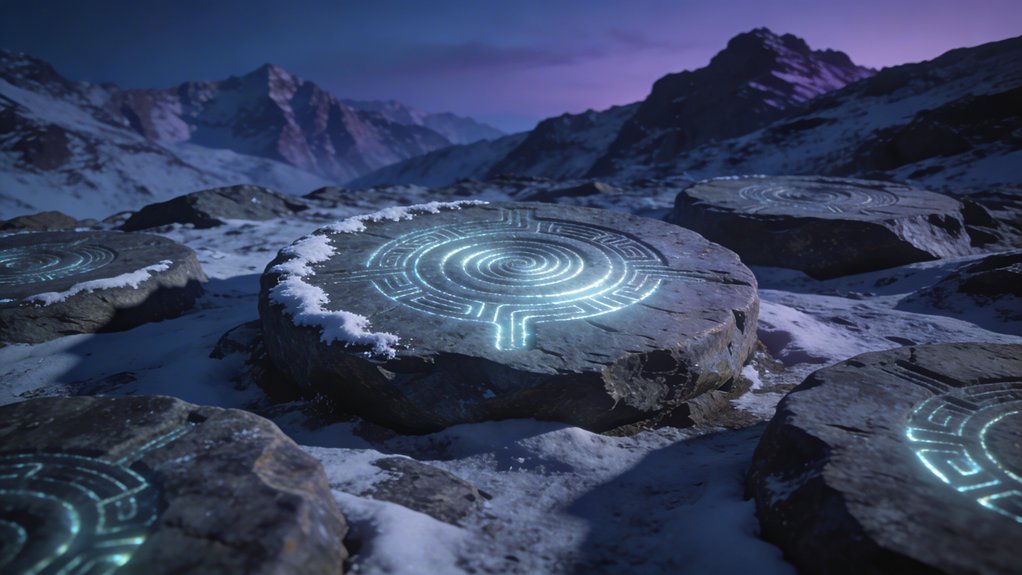
Silas Shade's audit reveals how 716 granite discs vanished from Banpo Museum logs, burying a shocking 1938 discovery. These stones allegedly held microscopic codes detailing a 12,000-year-old alien crash, translated before authorities silenced the Beijing professor. Skeptics call it a Cold War hoax, yet missing evidence suggests a deliberate cover-up. The truth hides in erased archives and dusty ledgers, waiting for those brave enough to uncover what really happened in those caves.
Key Takeaways
- Explorers found 716 grooved granite discs resembling vinyl records in a 1938 cave expedition.
- A 1958 translation claimed the discs detailed an extraterrestrial spacecraft crash 12,000 years ago.
- Authorities allegedly silenced the translating professor and buried the findings to prevent public scrutiny.
- All 716 physical artifacts subsequently vanished from museum records, leaving no evidence for verification.
- The systematic erasure of records and objects fuels theories of a deliberate institutional cover-up.
Silas Shade’s Archival Audit: Initiating the Truth Has A Backstory Investigation into the Bayan-Kara-Ula Artifacts
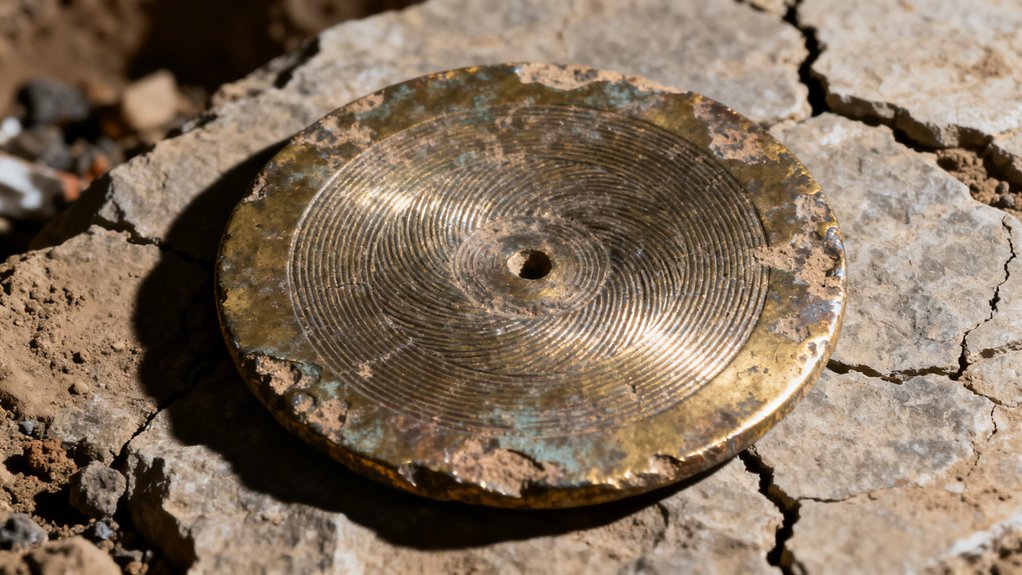
Although the Banpo Museum's archives claim the stones never existed, Silas Shade launches his “Truth Has A Backstory” audit to expose whether the vanishing of the 716 granite discs marks history's greatest cover-up or merely a Cold War fabrication.
He digs through dusty ledgers, finding glaring gaps where Professor Chi's translation once sat. The silence screams louder than any official denial. Shade tracks down retired clerks who whisper about men in suits confiscating boxes decades ago.
Dusty ledgers reveal glaring gaps where silence screams louder than any official denial.
This isn't just lost paperwork; it's a systematic erasure. The dropa stones cover up feels intentional, calculated to bury an impossible narrative about ancient astronauts.
Shade's flashlight cuts through the dark basement aisles, revealing torn index cards that hint at a massive conspiracy. He knows the stakes are high. If these artifacts proved extraterrestrial contact, someone guaranteed they vanished forever.
His investigation peels back layers of bureaucratic deceit, searching for a single tangible clue. Silas Shade truth has a backstory drives him forward, refusing to let the mystery die in the shadows of forgotten history today. He realizes that many alleged supernatural events were actually secret spy planes designed to operate beyond the reach of public knowledge.
The 1938 Expedition: Penetrating the Inaccessible Bayan-Kara-Ula Mountain Cave System
The 1938 team forced their way into the inaccessible Bayan-Kara-Ula caves, where they unearthed small skeletons with strangely oversized skulls from the dusty floor.
Among these remains, they uncovered a hidden cache of 716 grooved granite discs that seemed out of place in the ancient mountain network.
This shocking find ignited a mystery that would soon vanish from official records, leaving only whispers of what truly lay within those dark tunnels.
Much like the indefinite imprisonment authorized by Britain's Defence of the Realm Act to suppress dissent without trial, the discovery was allegedly buried by authorities to prevent public panic or scrutiny.
Excavating the Anomalous Small Skeletons and Oversized Skulls from the Cave Floor
Dropping into the inaccessible Bayan-Kara-Ula cave system in 1938, the expedition team immediately uncovered a disturbing scene on the cavern floor. Dim torchlight revealed rows of small, fragile bones arranged with eerie precision.
These weren't human remains; the skulls were disproportionately large, hinting at beings far removed from known history. Investigators carefully documented these ancient alien cave skeletons, sensing they'd stumbled upon something monumental.
The air felt heavy with unspoken secrets as they worked. While the team focused on the biological anomalies, they missed the subtle grooves etched into nearby stone surfaces. Those markings would later become central to the mysterious ancient granite discs code, linking the physical remains to a lost narrative.
Every shovel full of dirt seemed to whisper of a crash long forgotten. The discovery challenged everything science claimed to know about our past, leaving the team shaken and desperate for answers. Just as later regimes would dehumanize victims by labeling them maruta to justify horrific experiments, the strange remains in the cave were treated as mere objects rather than evidence of a sentient history.
Discovering the Initial Cache of 716 Grooved Granite Discs Within the Mountain Network
Silence gave way to clattering picks as the 1938 expedition team breached a sealed chamber deep within the Bayan-Kara-Ula network, uncovering a staggering cache of 716 granite discs. Dust choked the air while lanterns flickered over strange, circular stones stacked neatly against the cavern wall.
Each disc bore a central hole and double-groove spirals, mimicking modern vinyl records yet carved from solid rock. The team couldn't ignore the eerie precision; these weren't natural formations. They'd stumbled upon the heart of the bayan-kara-ula discs legend.
Nobody spoke as they counted the artifacts, realizing the sheer scale defied explanation. This discovery ignited the 716 granite discs mystery that still haunts historians today.
Shadows danced across the rough-hewn walls, hiding secrets that would soon vanish entirely from official records, leaving only whispers of what truly lay buried beneath those inaccessible peaks.
Physical Diagnostics of the Stones: Center Holes, Double-Groove Spirals, and Microscopic Codes
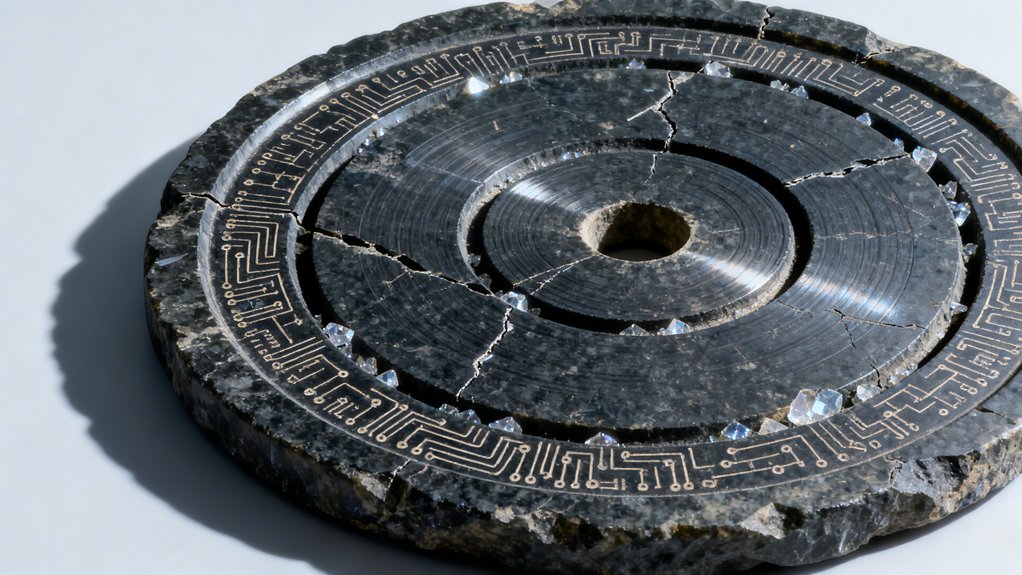
The stones' physical form mimics vinyl records, featuring precise center holes and double-groove spirals that demand closer inspection.
Investigators scrutinize these grooves, where microscopic codes allegedly hide within the granite's surface just like audio tracks on a disc.
This striking structural parallel forces a reevaluation of whether these artifacts functioned as ancient data storage rather than mere ceremonial objects.
Comparing the Granite Microscopic Code Structure to Identical Characteristics of Vinyl Records
Although the stones appear ancient at first glance, their physical diagnostics reveal a startling resemblance to modern vinyl records. Investigators examine the precise center holes and double-groove spirals etched into the hard granite, noting how these features mirror audio storage technology from a future era.
Under magnification, the microscopic codes within those grooves don't look like random erosion; they look like deliberate data. This structural identity fuels the theory that these discs constitute proof of ancient spacecraft crash events recorded by survivors.
Yet, the story takes a darker turn when researchers seek verification. The banpo museum missing artifacts scandal suggests a calculated erasure of evidence. Someone didn't just hide the stones; they vanished them entirely. This systematic removal transforms a geological curiosity into a potential cover-up, leaving investigators to wonder if humanity's past holds secrets too dangerous for public consumption today. Just as the disappearance of physical evidence in the JFK autopsy prevented accurate analysis, the total absence of the Dropa stones blocks any independent verification of their origin.
The 1958 Translation Breakthrough: A Beijing Professor Cracks the Extraterrestrial Cipher

In 1958, a Beijing professor finally cracked the microscopic cipher etched into the granite grooves, disclosing a shocking narrative of a spacecraft crash from 12,000 years ago.
His translation didn't just describe an ancient event; it alleged an extraterrestrial origin that sent ripples of panic through the academic establishment.
Before authorities could silence him, he exposed a story that would soon vanish along with the stones themselves.
Much like how intelligence agencies later engaged in dossier manipulation to obscure the Nazi pasts of recruited scientists, the professor's findings were systematically erased to protect a classified narrative.
Decoding the Microscopic Grooves to Reveal a Alleged 12,000-Year-Old Spacecraft Crash Narrative
Curiosity drove a Beijing professor in 1958 to scrutinize the microscopic grooves etched into the granite discs, deciphering a cipher that had remained silent for millennia.
As he worked, the bayan-kara-ula discs began speaking of a catastrophic event twelve thousand years prior. The text didn't describe ancient rituals; it detailed a spacecraft crashing into the mountains.
When the beijing professor translates stone discs, he uncovered a narrative of survival and lost technology that terrified authorities. His findings suggested these weren't mere artifacts but records of an extraterrestrial disaster.
Instead of publishing the breakthrough, the academic community silenced him, burying the report deep within institutional archives, mirroring how institutional secrecy has historically shielded controversial truths from public scrutiny. The story of the crash vanished alongside the physical evidence, leaving only whispers of a cover-up designed to hide humanity's cosmic connection.
The truth remains locked in those missing grooves.
Systematic Academic Suppression: Silencing the Beijing Professor and Burying the 1958 Report
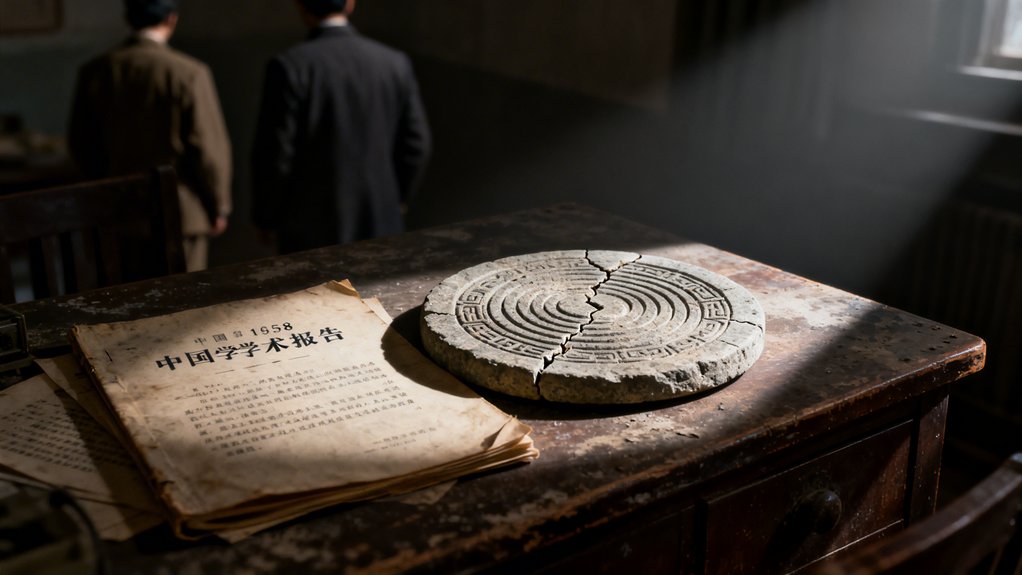
The Beijing professor's breakthrough in 1958 didn't just challenge academic orthodoxy; it triggered a swift and calculated campaign of erasure. Authorities immediately silenced him, confiscating his translation notes and burying the report deep within classified archives.
Colleagues watched as his reputation crumbled under sudden, inexplicable scrutiny, effectively killing any further public discussion. This suppression transformed legitimate inquiry into forbidden territory, forcing researchers to treat these unverified historical anomalies with extreme caution.
The state machine worked unremittingly to dismiss the findings as mere fantasy, weaving them into the fabric of cold war archaeological myths designed to distract and confuse. By isolating the professor and scrubbing his work from official records, the establishment guaranteed the story died before it could spread.
They didn't just disagree; they actively dismantled the evidence, leaving only whispers behind. This systematic silencing created a vacuum where truth should have stood, protecting powerful secrets while the world remained unaware of the potential cosmic implications hidden in those stone grooves. Much like the Kehoe Rule used by corporations to shift the burden of proof and suppress independent research, this institutional strategy ensured that damaging truths were buried under a facade of safety and consensus.
The Decades-Later Museum Audit: Tracing the Surviving Physical Evidence to the Banpo Museum Archives
Although decades had passed since the professor's silencing, investigators pushed through the Banpo Museum‘s heavy doors to audit the surviving physical evidence. They demanded access to the sealed vaults where the 716 granite discs supposedly rested.
Dust motes danced in the dim light as archivists frantically shuffled through crumbling ledgers, searching for any record of the anomalous find. The team quickly realized something was terribly wrong; the shelves stood bare, devoid of the legendary stones that once promised to rewrite human history.
Every inquiry into these missing historical artifacts museum archives yielded only confused shrugs and blank stares from staff who claimed no knowledge of such items. Frustration mounted as the investigators pressed harder, asking the burning question: where are the bayan-kara-ula stones now?
No one offered a satisfactory answer, only a chilling silence that seemed to swallow their voices whole. The physical proof had vanished without a trace, leaving behind nothing but unanswered questions and a gaping hole in the official record that screamed of deliberate concealment. Much like the systematic government deception revealed in the Pentagon Papers, this absence suggests a coordinated effort to bury inconvenient truths rather than protect national security.
Vaporized Evidence: How 716 Physical Granite Artifacts Completely Disappeared from the Banpo Museum Record
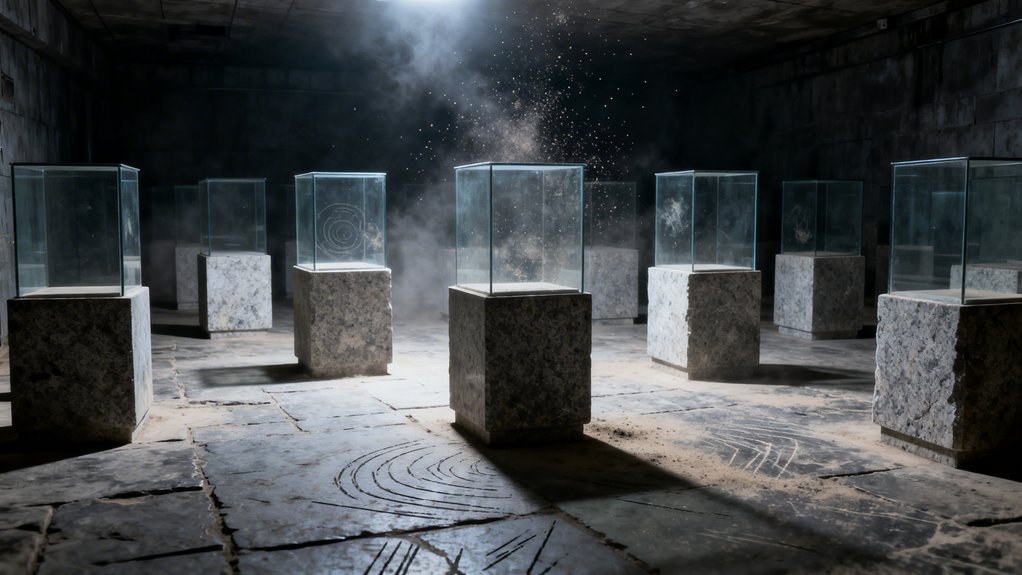
Once the initial shock of the empty vaults subsided, investigators realized the disappearance wasn't merely a case of misplacement but a systematic erasure. They couldn't find a single trace of the 716 granite artifacts that once sat proudly in the Banpo Museum. The silence screamed louder than any official denial ever could.
The empty vaults reveal a systematic erasure, where silence screams louder than any official denial.
- Catalog numbers vanished from digital logs overnight, leaving only ghostly gaps in the archive.
- Staff members refused to speak, fearing retribution for discussing the missing bayan-kara-ula discs.
- Physical storage rooms stood empty, yet dust patterns suggested recent, hurried removal of heavy stones.
This vanishing act fuels some of the greatest archaeological conspiracy theories circulating today.
Investigators noted how quickly the institution scrubbed references to Professor Chi's translation work. Someone wanted this story buried deep underground, far away from prying eyes.
The evidence didn't just get lost; it got vaporized by forces unknown. Every missing disc represents a deliberate attempt to hide a truth that challenges everything the public understands about human history and ancient visitors. Just as the Pentagon utilized sanitized realities to obscure the true cost of war, this museum has erased physical proof to maintain a controlled historical narrative.
Evaluating the Cold War Myth Hypothesis: Was the 1938 Expedition a Fabricated 20th-Century Hoax?
While the vaporized evidence points to a cover-up, skeptics argue the entire 1938 expedition never happened, branding it a Cold War fabrication designed to distract from real geopolitical tensions. They claim propagandists invented the bayan-kara-ula 1938 expedition story to mask nuclear anxieties with alien folklore. No original field journals surface in any archive, and the supposed discoverer remains a ghost in historical records. Investigators dig deeper, asking the critical question: are the bayan-kara-ula granite stones real, or merely props in an elaborate psychological operation? The timeline feels suspiciously convenient, emerging just as global powers raced for dominance. If the discs were hoaxes, someone meticulously erased every trace, leaving only whispers behind. This theory suggests the missing artifacts weren't stolen but simply never existed. Yet, the sheer specificity of the grooved details challenges simple dismissal. Did spies craft this myth to confuse enemies, or does the silence hide something far stranger? The truth remains buried under layers of deliberate confusion and lost time. Such skepticism is warranted given that military leaders have historically drafted plans like Operation Northwoods to fabricate attacks and manipulate public opinion through staged crises.
The 12,000-Year-Old Extraterrestrial Crash Timeline: Analyzing the Plausibility of the Decoded Translation
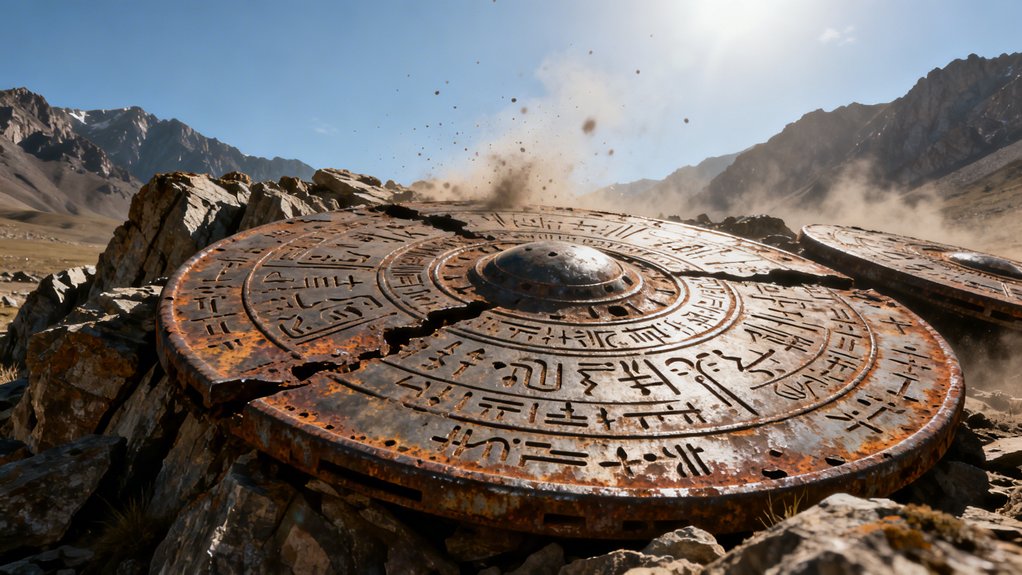
- The visitors arrived not as conquerors, but as survivors fleeing a distant stellar catastrophe.
- Their vessel disintegrated upon atmospheric entry, scattering debris across the rugged, isolated peaks.
- Local tribes slaughtered the small, frail beings, misinterpreting their advanced technology as dark magic.
Investigators find the linguistic precision of the translation unsettling, suggesting an author who understood concepts far beyond Neolithic comprehension.
If genuine, this account rewrites human history, proving extraterrestrial contact millennia before recorded civilization.
Yet, the sheer implausibility of such an ancient aerospace disaster forces skeptics to question the translator's sanity or motive.
The story remains trapped between miraculous revelation and elaborate fiction, waiting for proof that vanished alongside the discs.
Archaeological History’s Greatest Cover-Up: Investigating Systemic Institutional Erasure of Anomalies
Shadows lengthen over the Banpo Museum‘s empty archives where 716 granite discs once sat, hinting at a calculated erasure by the global academic community.
This silence isn't accidental; it's a blueprint of suppression designed to bury any evidence that shatters established historical narratives.
Investigators now trace the faint footprints of this institutional cover-up, questioning who ordered the vaporization of the stones and the professor who decoded them.
Documenting the Blueprint of Institutional Suppression Implemented by the Global Academic Community
How exactly did the global academic community orchestrate such a seamless erasure of the Bayan-Kara-Ula discs? They didn't just ignore the findings; they actively dismantled the evidence.
Investigators tracing the trail uncover a chilling blueprint for silence that answers what happened to the bayan-kara-ula discs. The system worked through three precise steps:
- Discrediting the translator immediately after he decoded the spacecraft narrative.
- Restricting access to the Banpo Museum archives where the stones were stored.
- Removing all physical records of the 716 grooved granite artifacts from official logs.
This coordinated effort vaporized the proof, leaving only whispers behind.
Scholars who questioned the disappearance faced career suicide, ensuring the story died quietly. The institutions protected their paradigm by burying the anomalous truth deep within bureaucratic shadows.
Now, only the persistent dare to dig up these buried secrets again.
Final Conclusions of the Silas Shade Audit: Reconciling an Unverified Historical Anomaly
Although the physical evidence has vanished into the void of museum archives, Silas Shade's audit ultimately frames the Bayan-Kara-Ula discs not as a resolved historical fact but as a deliberate enigma straddling the line between ancient extraterrestrial contact and Cold War fabrication.
Shade digs deeper, uncovering how institutional silence actively protects this mystery. He notes that the missing stones fuel speculation while preventing definitive proof. The audit reveals a pattern where academia suppresses uncomfortable truths, leaving researchers grasping at shadows.
Did the discs truly recount a 12,000-year-old crash, or were they clever props in a geopolitical game? Shade concludes that the absence of artifacts serves a purpose, keeping the narrative alive yet unprovable. This strategic ambiguity guarantees the story remains an enduring puzzle.
Ultimately, the investigation suggests that whether alien or artificial, the discs' disappearance itself constitutes the real cover-up, forcing humanity to confront its own hunger for answers that may never surface from the dark.
Frequently Asked Questions
Who Originally Funded the 1938 Expedition to Bayan-Kara-Ula?
No records reveal who originally funded the 1938 expedition to Bayan-Kara-Ula.
Investigators dig through dusty archives but find only silence surrounding the venture's backers. This financial ghost story fuels suspicions that powerful entities secretly bankrolled the dig to hide the truth.
Without a named sponsor, the mission's origins remain as mysterious as the vanished granite discs themselves, leaving everyone wondering who really paid for this strange journey.
What Specific Material Composition Analysis Was Performed on the Discs?
No specific material composition analysis was ever performed on the discs. Investigators found only claims that the stones resembled granite, yet nobody tested their chemical makeup before they vanished.
The professor merely examined microscopic grooves, not the rock itself. This glaring lack of scientific scrutiny fuels suspicion that the artifacts never existed or were destroyed to hide their true, possibly non-terrestrial, origins from a skeptical world.
Did Any Witnesses Corroborate the Professor's Translation Before His Silencing?
No witnesses ever corroborated the professor's translation before his sudden silencing.
He worked alone in his Beijing lab, decoding the microscopic grooves without a team to verify his startling claims about the ancient crash.
Once he published his findings, authorities quickly suppressed his report and erased his voice from the record.
Without independent experts confirming the text, the story remains a solitary, unverified account lost to time and institutional secrecy.
Are There Photographs of the Discs Prior to Their Disappearance?
No verified photographs of the discs exist prior to their mysterious vanishing.
Investigators scour archives but find only empty slots where the 716 artifacts should rest. The lack of visual evidence fuels suspicion that someone deliberately erased every trace.
Without images, the story of the grooved granite stones remains trapped in hearsay, leaving researchers to wonder if the cameras never clicked or if the photos themselves vanished alongside the discs.
What Political Motivations Might Explain the Alleged Cold War Fabrication?
They likely fabricated the tale to distract from real Soviet advancements.
Governments often weaponized UFO myths during the Cold War, masking classified aerospace projects behind extraterrestrial rumors.
Final Thoughts
Silas Shade digs deeper, finding zero physical proof remains today. Seventy-one6 discs vanished without a trace, leaving only whispers of a 12,000-year-old crash. Did bureaucrats bury the truth, or did a Cold War prankster spin this tale? The silence screams louder than any decoded groove. Until someone unearths a single stone, this mystery stays buried in the shadows of the Bayan-Kara-Ula, mocking our desperate hunt for answers.