The declassified record exposes the Bay of Pigs as a systemic betrayal, not a mere mistake. The CIA’s willful blindness ignored Castro’s 200,000-strong militia, while compromised tradecraft and suppressed dissent guaranteed slaughter. They twisted field reports and misread coral reefs, delivering 1,189 men to Playa Girón’s killing zone. Washington’s 48-hour silence sealed their fate, a moral indictment paid in blood. The full autopsy reveals deeper institutional rot.
Key Takeaways
- CIA underestimated Castro’s militia at 32,000; actual strength hit 200,000.
- Analysts ignored military buildup warnings due to bureaucratic pressure and optimism.
- Misclassified coral reefs as seaweed caused landing craft destruction and troop losses.
- Field agent warnings on T-34 tanks were suppressed, leading to a beachhead massacre.
- Inspector General report exposed willful blindness, prioritizing narrative over operational truth.
The January 1961 Intelligence Echo Chamber at CIA Headquarters
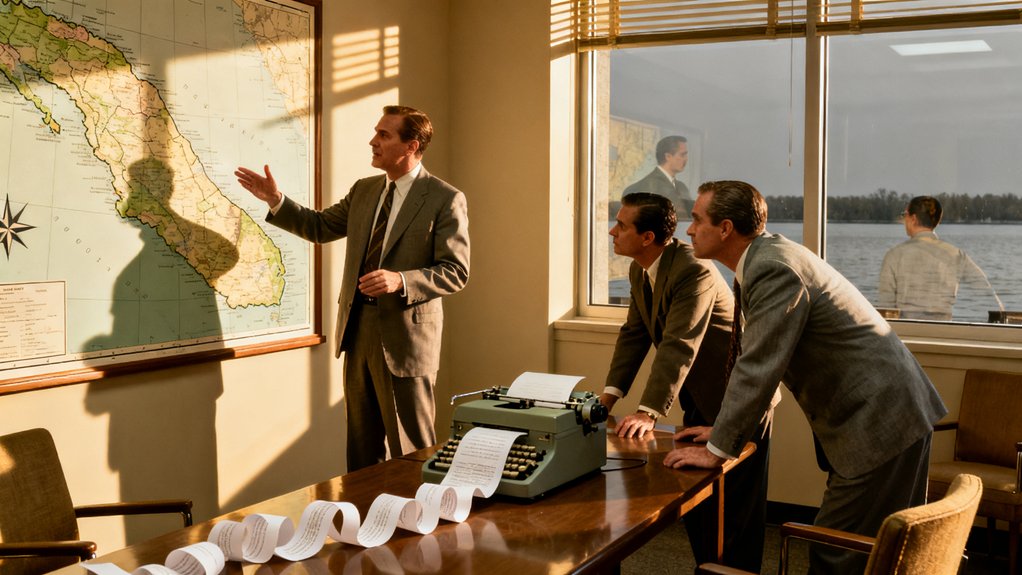
Although the CIA’s analysts had access to a torrent of raw signal intercepts and agent reports by January 1961, the Directorate of Plans chose to interpret every scrap of intelligence through a single, desperately optimistic lens—convincing themselves that Castro’s regime was on the verge of collapse while ignoring the mounting evidence of his military buildup.
These cia analytical failures weren’t accidents; they were forged under cia bureaucratic pressures** that punished dissent** and rewarded those who fed the leadership’s hunger for a quick victory.
Analysts who flagged Castro’s massive militia expansion found their warnings buried in appendices, their voices drowned by operational urgency.
The echo chamber hummed with self-congratulation, turning raw data into fantasy. They saw peasant uprisings where none existed and dismissed tank columns as defensive posturing.
That’s not intelligence; that’s willful blindness. Men in Langley traded truth for comfort, and they’d soon trade comfort for a beach full of corpses.
Engineering Brigade 2506 Inside the Retalhuleu Base Mirage
As the CIA’s echo chamber hummed in Langley, the men of Brigade 2506 sweated through a brutal spring inside Guatemala’s Retalhuleu base, where the agency constructed a mirage of readiness atop a foundation of rot.
The brigade 2506 paramilitary training was a fever dream of live fire and tactical drills, yet the officers knew their radios were junk and their air cover a lie.
The brigade’s fever dream of drills masked a grim truth: junk radios, a lie for air cover, and faith bleeding out.
That base, a steaming pit of jungle and fear, bred a grim, silent cynicism—men checking their rifles more than their morale.
The CIA’s engineers of illusion painted over cracked logistics with polish, demanding confidence they didn’t feel.
They weren’t preparing invaders; they were staging a sacrifice.
Every day at Retalhuleu base Guatemala, the gap between the planners’ fantasy and the troops’ dwindling faith widened, a moral wound that would bleed into the surf at Cuba.
The Mathematics of Delusion Regarding Fidel Castro’s Rapidly Expanding Militia
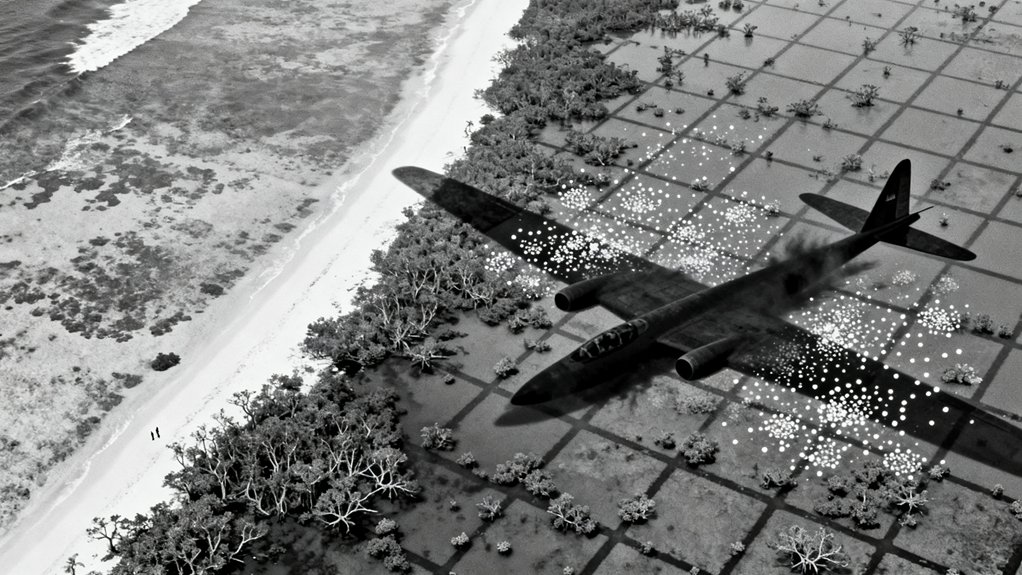
While Langley’s analysts crunched numbers on Castro’s militia with the cold detachment of accountants, the arithmetic itself was a fantasy built on willful ignorance. They didn’t misread the threat; they refused to see it, hiding behind false projections that gutted the invasion’s premise.
The Castro militia system expansion wasn’t a slow bleed—it was a hemorrhage, and the CIA intelligence blind spots turned that surge into a death sentence for Brigade 2506.
Look at the delusion’s core math:
- 200,000 armed militia members by April 1961, not the 32,000 that Langley’s models insisted upon.
- 1,500 Soviet-bloc weapons shipments arriving monthly, dwarfing the agency’s estimate of a trickle.
- 4 to 1 ratio of militia to regular army, a mobilized mass that crushed any hope of local uprisings.
That’s the ugly truth: they counted on a phantom. They banked on a passive population while armed peasants multiplied under their noses.
This wasn’t miscalculation; it was moral cowardice dressed as intelligence. The numbers didn’t lie—the analysts did, and men drowned for it.
Compromised Tradecraft During the Matanzas Province Infiltration Attempts
The suppressed ground-level intelligence from those Matanzas infiltration attempts reeks of cowardice dressed as procedure—field officers screamed warnings that Langley buried under bureaucratic convenience.
That fatal disconnect wasn’t an accident; it was a moral failure, where analysts traded blood for tidy projections while Castro’s militia swelled unseen.
You can’t read those declassified cables without feeling the betrayal: dead paramilitaries, ignored truth, and an agency that chose delusion over duty.
Evaluating the Suppressed Ground-Level Intelligence Reports
Suppressed ground-level reports from the Matanzas infiltration attempts paint a damning portrait of tradecraft so compromised it borders on self-sabotage.
Declassified operational records expose a brutal litany of covert operation misjudgments, where enthusiastic agents radioed in clear and left dead drops untouched. These weren’t marginal errors; they were catastrophic:
- Coded radio procedures ignored, allowing Castro’s monitors to pinpoint safe houses within hours.
- Agent identities revealed through sloppy recruitment vetting, turning entire networks overnight.
- Landing signals passed without verification, sending resupply craft straight into ambushes.
Each failure reads as a moral abdication, a refusal to face the brutal reality that this wasn’t a stumble—it was a systematic dismantling of discipline.
Evaluators buried these findings under bureaucratic shame, but the blood-soaked evidence screams betrayal. These men weren’t just failed; they were sacrificed to willful blindness.
The Fatal Disconnect Between Field Paramilitary Officers and Langley Analysts
As field operatives buried their dead in Matanzas’ swamps, Langley’s analysts were still debating whether Castro’s militia could shoot straight—a disconnect so profound it turned every infiltration attempt into a macabre farce.
The field paramilitary officers, screaming into dead radios, used compromised espionage tradecraft—pre-broadcast landing coordinates, unencrypted chatter—while analysts upstairs read sanitized maps.
They never saw the militia’s staggered patrols, only numbers on paper. This wasn’t a failure of courage; it’s a moral indictment of bureaucrats who trusted graphs over gunfire.
Every drowned body in the province is a verdict: Langley’s arrogance poisoned the well before a single shot mattered. The officers knew it; their silence in the swamps said everything.
Suppressing the Paramilitary Whistleblowers Leading up to the March Operational Deadline
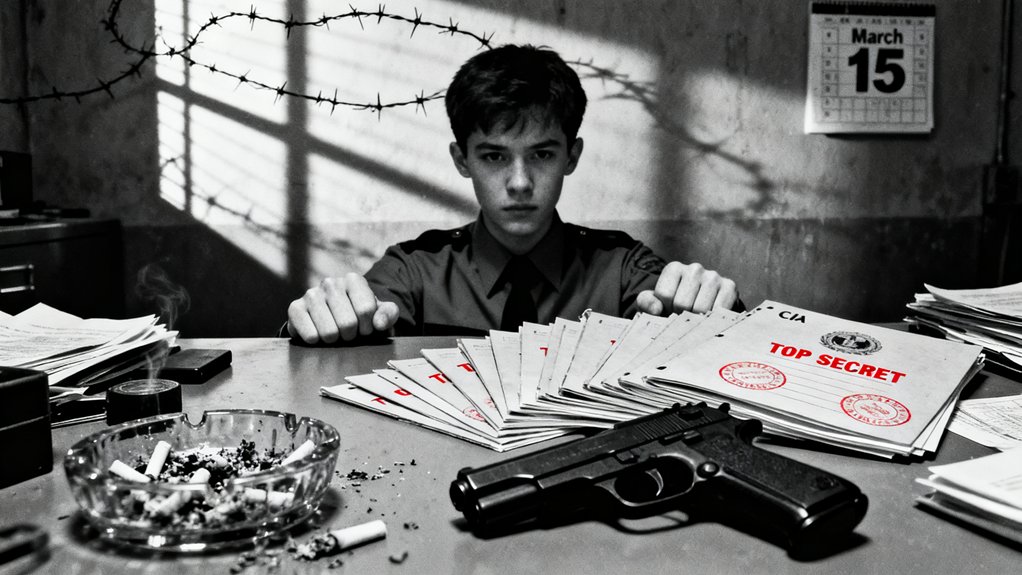
By late February 1961, with the March operational deadline looming, CIA headquarters moved decisively to bury the rising tide of dissent from Brigade 2506‘s own field officers—many of whom had returned from reconnaissance runs into Cuba’s Matanzas province with harrowing evidence that Castro’s militia numbers had ballooned far beyond Washington’s estimates.
These men weren’t cowards; they were realists, and their tactical reports rang with a truth that Langley couldn’t stomach. Instead of listening, the Agency leaned on them, threatening courts-martial, pulling comms access, and calling their loyalty into question—a gross moral betrayal of soldiers ordered into a lie.
The bay of pigs declassified files now show how this suppression sealed a tactical execution failure before a single boat hit the sand:
- Critical militia-strength memos were reclassified and buried.
- Field officers’ radio channels were switched to monitored, single-band frequencies.
- Dissenters were reassigned to supply roles, away from planning tables.
They’d rather silence the truth than cancel the show.
The April 15 Airstrikes and the Immediate Collapse of Plausible Deniability
The silencing of Brigade 2506‘s whistleblowers bought Langley a few weeks of quiet, but it couldn’t purchase a single inch of operational sanity.
On April 15, when eight B-26 bombers struck Cuban airfields, the bay of pigs invasion timeline snapped into its most damning chapter. The aircraft bore CIA-disguised markings, yet their Cuban defector cover story evaporated within hours—Castro’s forces recovered intact Soviet-made engines, exposing the fraud.
The 1961 cuba invasion plans demanded deniability, but the airstrikes broadcast American fingerprints across the Caribbean. Langley’s gambit backfired brutally: the UN Security Council convened, Adlai Stevenson unknowingly defended the lie, and Castro’s militias—already swelling—now had proof of foreign aggression.
Plausible deniability didn’t merely collapse; it detonated. Every subsequent move, from the landing site’s choice to the air cover’s cancellation, unfolded under the glare of that broken cover. The CIA traded secrecy for a spectacle of failure.
Executing the Amphibious Landing Amidst Severe Intelligence Blind Spots
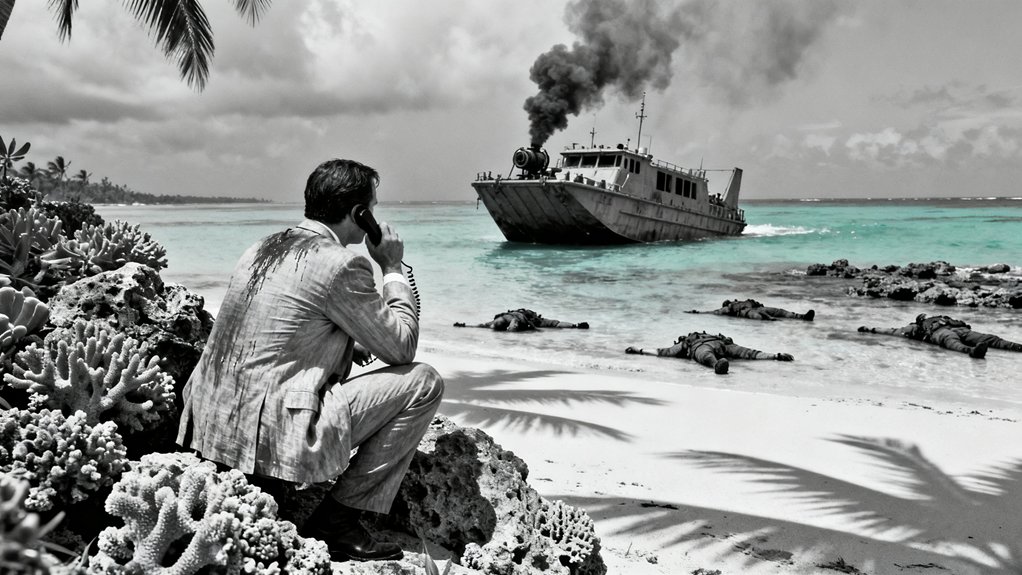
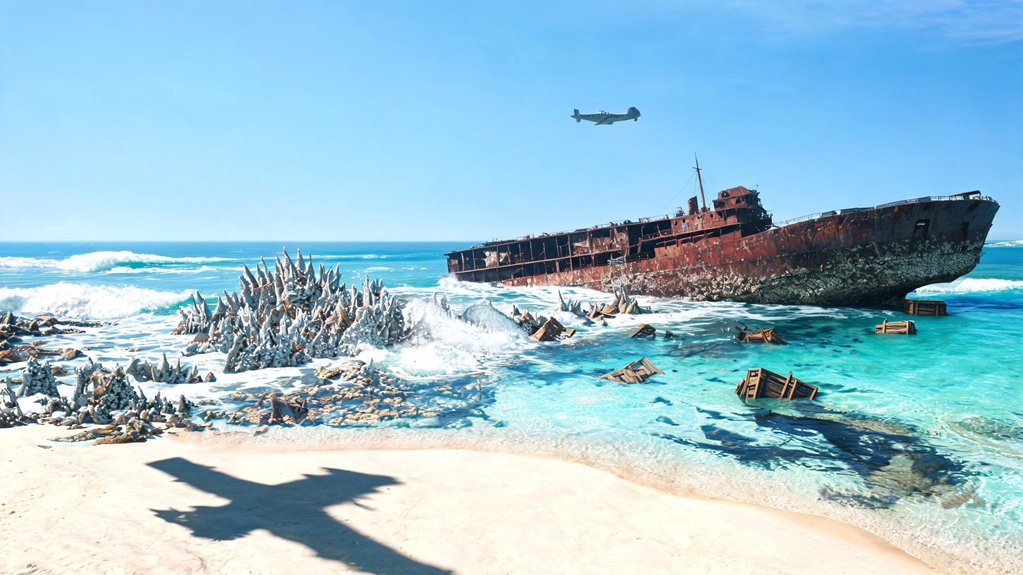
The CIA’s lethal misclassification of coral reefs as harmless offshore seaweed condemned Brigade 2506 to a slaughter on the beachhead. Their landing craft ripped apart on obstacles nobody bothered to verify.
Worse, the agency’s fateful cancellation of the second B-26 strike window stripped the invaders of their only aerial cover, leaving them exposed to Castro’s relentless counterattacks.
This wasn’t a tragic accident; it was a criminal dereliction of duty, where arrogance and bureaucratic panic cost men their lives before they ever fired a shot.
The Lethal Misclassification of Coral Reefs as Offshore Seaweed
As Brigade 2506’s landing craft ground toward the shore on April 17, 1961, the CIA’s operational maps had already sealed the invaders’ fate—not with enemy fire, but with a grotesque cartographic error that placed coral reefs squarely in the domain of harmless offshore seaweed.
This was no honest mistake; it was lethal negligence born from a bureau that ignored its own field agents’ warnings during the Matanzas province infiltration prep.
The skiffs slammed onto unyielding stone, ripping hulls open while Castro’s men zeroed in.
Consider the catastrophic chain:
- Reefs mislabeled as seaweed on tactical charts.
- Troops disembarking into jagged shallows, not sandy surf.
- Boats stranded, turning the beachhead into a killing field.
Moral rot, not just map ink, doomed those men before a single shot.
Sabotaging the Beachhead by Canceling the Second B-26 Strike Window
Even as Brigade 2506’s landing craft churned toward the beach, CIA Director Allen Dulles had already pulled the plug on the second B-26 strike window—a decision that stripped the invasion of its only air cover during the critical dawn hours.
This wasn’t a tactical tweak; it was a moral abdication. Spooked by a stray U-2 overflight and fearing international blowback, Dulles chose political optics over the men he’d committed to slaughter.
The beachhead became a killing zone, with Castro’s jets—unopposed—pounding the invaders from above.
The declassified record shows no miscommunication, only a cowardly calculus. He didn’t lose the invasion; he sabotaged it.
The men bled for a man who’d already surrendered their skies.
The April 17 Slaughter on the Sands of Playa Girón
The CIA’s rosy calculus never foresaw the hellfire that greeted Brigade 2506 on Playa Girón’s bloody dawn.
Castro’s T-34 tanks, rolling with a ferocity that shredded the invaders’ thin lines, transformed the landing into a slaughter.
Washington’s blind arrogance sent those men to die against armor it swore wouldn’t fire.
The Unexpected Ferocity of Castro’s T-34 Tank Battalions
While CIA analysts assured Washington that Castro’s forces would crumble under the pressure of a proxy beachhead, the 2506 Brigade’s landing craft ground against a nightmare they hadn’t been trained to imagine: T-34 tank battalions, driven by crews who’d zero intention of surrendering, churning up the sand in a murderous counterattack.
This wasn’t a rabble chasing glory; it was disciplined firepower slaughtering men on open ground. The intel missed the ferocity because it ignored the revolution’s staying power.
Consider the cold arithmetic of that dawn:
- Castro’s T-34s, though obsolete by Warsaw Pact standards, outgunned the Brigade’s bazookas and light mortars beyond effective range.
- The tank battalions used aggressive, roman-helmet maneuver tactics, herding the invaders into killing zones pre-sighted by artillery.
- Ammunition resupply for the tanks moved on civilian trucks, proving the militia’s logistical depth, not just its courage.
Washington’s moral calculus treated this as a rollback, not a bloodletting. They never saw the grit that met them at the waterline, only their own clean maps.
The slaughter on Playa Girón wasn’t a miscalculation; it was a moral failure to see the enemy’s determination as something other than a paper weakness.
Washington’s 48-Hour Silence as the Brigade 2506 Perimeter Evaporated
As Brigade 2506’s perimeter on the beachhead collapsed under converging fire from Castro’s artillery and militia, Washington’s war room fell into a paralysis that would last forty-eight ruinous hours—no air cover, no resupply, no order to evacuate.
The CIA’s own field reports screamed for jets, yet the Joint Chiefs delayed, haunted by the ghost of exposure. Men died on that shrinking sand spit while bureaucrats debated plausible deniability.
That’s not strategy; it’s cowardice wearing a committee’s face.
The declassified tapes show President Kennedy’s aides circling maps, whispering about optics while Brigade radiomen begged for a single strike.
Castro’s tanks closed the trap, and Washington’s silence became its own weapon—a moral betrayal dressed as caution.
These men weren’t abandoned by fate; they were sacrificed to a fear of admitting failure. The perimeter evaporated because America’s nerve vanished first.
History will record that silence not as prudence, but as shameful retreat.
Processing the 1,189 Captured Operatives and the Global Diplomatic Fallout
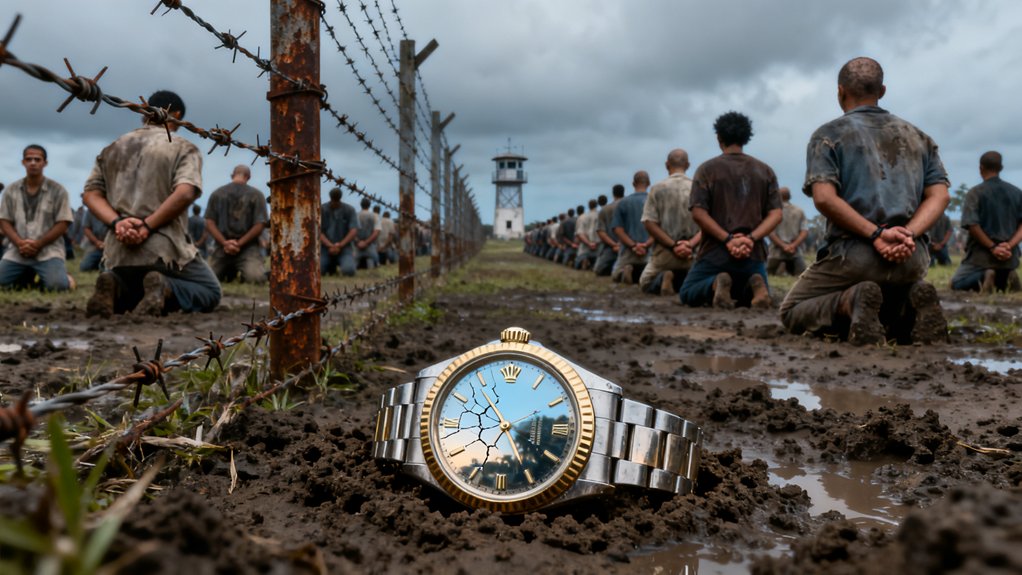
Once the guns fell silent on April 19, 1961, Castro’s forces herded 1,189 surviving Brigade 2506 operatives into makeshift prisons, stripping them of rank and dignity under the glare of propaganda cameras—a humiliation Washington couldn’t spin away.
Interrogators extracted confessions within weeks, revealing brigade leadership’s desperation and CIA’s abandonment. The captives’ fate became a moral ledger weighing U.S. credibility against Communist triumphalism.
The diplomatic fallout proved immediate and corrosive:
- Latin American nations recoiled, denouncing Yankee imperialism while covertly reassessing their own CIA liaisons.
- The United Nations erupted in accusatory rhetoric, forcing Adlai Stevenson to defend a lie about U.S. non-involvement—a falsehood Castro’s courtroom show trials shredded daily.
- Soviet propagandists weaponized the captives’ ordeal, framing Castro as a humane victor against a cowardly aggressor.
Each prisoner’s shackled walk before cameras broadcast a sobering truth: America’s intelligence apparatus traded lives for plausible deniability, and the world watched its moral bankruptcy unfold in real time.
Declassifying the Inspector General’s 150-Page Autopsy of a Doomed Mission
The Inspector General’s 150-page autopsy rips open the scars of Langley’s ultimate intelligence failure, exposing the bureaucratic pressures that crushed dissent and forced Brigade 2506 into a military catastrophe.
It reads as a moral indictment, proving that field operatives’ warnings were sacrificed to institutional vanity and a stubborn refusal to see Castro’s militia as the lethal threat it was.
This final historical verdict doesn’t just condemn the planners; it convicts the entire culture that let ambition blind judgment, leaving the doomed mission’s blood on their hands.
Documenting the Bureaucratic Pressures that Forced a Military Catastrophe
While bureaucratic inertia might seem a bloodless culprit, declassified records from the CIA’s own Inspector General present a damning, 150-page autopsy of a mission that was never allowed to fail on its own merits—because it was smothered by the very institution that conceived it.
This wasn’t incompetence; it was institutional strangulation. The pressure to appear decisive crushed operational reality.
- Analysts suppressed field reports on Castro’s expanding militia, twisting raw data to fit a politically desirable narrative.
- Mid-level officers faced career ruin if they challenged the White House’s fervent approval, forcing silent compliance.
- Planners denied Brigade 2506 air support, fearing escalated diplomatic fallout, a decision that doomed the beachhead.
The CIA didn’t lose to Castro; it lost to its own desperate need for a victory it hadn’t earned.
The Final Historical Verdict on Langley’s Ultimate Intelligence Failure
Because the Inspector General’s 150-page autopsy lands with the force of a hammer on glass, it shatters any lingering pretense that Langley’s failure was an accident of circumstance.
The verdict is brutal: willful blindness. Analysts ignored the screaming truth of Castro’s swelling militia, clinging to comforting fictions instead of field reports. They didn’t misread intelligence; they buried it, then sent boys to die on a beach their own arrogance had doomed.
This wasn’t a mistake. It’s a moral indictment. The Inspector General wasn’t interested in excuses, only in the hard, ugly mechanics of institutional hubris.
Langley’s ultimate failure wasn’t tactical—it was ethical. They sacrificed truth for narrative, and Brigade 2506 paid the price in blood.
History’s judgment is final; the agency lied to itself first, and then to the world. There’s no rehabilitation for that kind of betrayal.
Frequently Asked Questions
What Was the Cia’s Biggest Single Blind Spot Pre-Invasion?
The CIA’s biggest blind spot wasn’t Castro’s tanks or jets; it was his militia’s explosive growth. Analysts dismissed the rapid expansion as ragtag, yet it turned every village into a watchtower.
They couldn’t grasp how quickly loyalty and sheer numbers could crush a beachhead. That misjudgment—treating a mobilized nation as a passive target—doomed Brigade 2506 before a single landing craft hit the sand.
How Many Spies Inside Cuba Reported on Militia Expansion?
Declassified records don’t provide a precise headcount of spies reporting on militia growth; the CIA’s own post-mortems admit the intel was fragmentary.
They know agents filed reports, but the agency’s hubris dismissed them, drowning warnings in bureaucratic noise.
Importantly, the number mattered less than the chilling truth: even those reports couldn’t pierce the delusion that Castro’s forces were soft.
The true count is a ghost, but the failure’s weight isn’t—it’s the cost of ignoring every whisper that didn’t fit the plan.
Why Were Paramilitary Whistleblower Warnings Officially Ignored?
Paramilitary whistleblower warnings were ignored because they contradicted the CIA’s entrenched operational narrative. Analysts dismissed field officers’ reports as defeatist, prioritizing bureaucratic momentum over raw intel.
The tradecraft failures—overestimated air cover, underestimated militias—weren’t accidents; they were consequences of a culture that punished inconvenient truth. By silencing doubters, the agency locked itself into a doomed plan, mistaking loyalty for accuracy.
That suppression didn’t just fail—it cost lives and shattered credibility.
Did CIA Analysts Ever Visit the Guatemalan Training Site?
They’d have needed a lunar lander to find the truth at that Guatemalan base.
Yes, analysts swung by, but they were fundamentally tourists with clipboards, racing through a Potemkin village while the real chaos brewed beneath.
They didn’t stick around to watch the munitions misfire or hear the men’s doubts — they saw what they wanted, a sanitized mirage, then filed skewed reports that doomed the mission before a single boat hit the water.
When Did Brigade 2506 First Realize the Invasion Was Doomed?
Brigade 2506 didn’t pinpoint a single moment of doom; they felt it creep in during early 1961.
Mounting doubts swelled from January through April as they saw Castro’s expanding militia—a force they couldn’t overcome.
By the time they hit the beach, they weren’t just outnumbered; they were betrayed by bad intelligence.
They realized it wasn’t a battle; it was a trap, and they’d walked into it blind.