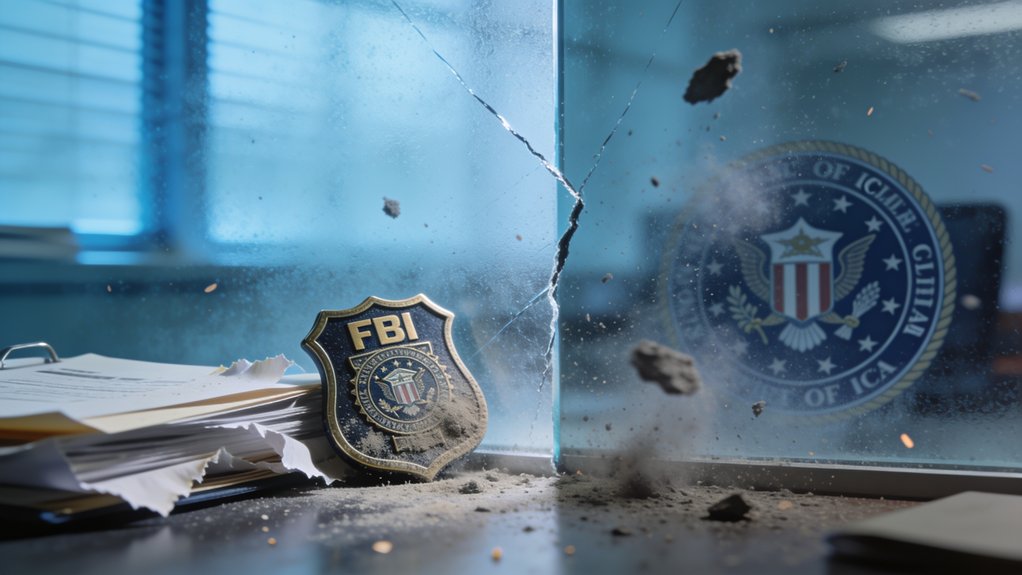
The CIA tracked Nawaf al-Hazmi and Khalid al-Mihdhar through a January 2000 Malaysia summit, logging their U.S. visas and watching them fly into Los Angeles. Yet not one name reached the FBI. A legal barrier—Attorney General Reno’s 1995 guidelines and FISA reinterpretations—forged a wall between intelligence and law enforcement. FBI Agent Ali Soufan hit an information black hole at Alec Station. The wall’s brutal efficiency guaranteed two known operatives boarded Flight 77. The full anatomy of this systemic collapse reveals far more.
Key Takeaways
- The CIA tracked 2000 Malaysia Summit attendees but withheld names from the FBI.
- 1990s legal directives created “The Wall” barring CIA-FBI intelligence sharing.
- CIA systematically redacted al-Hazmi and al-Mihdhar from briefings sent to FBI.
- The Wall prevented FBI from acting on known al-Qaeda operatives inside the U.S.
- Hijackers exploited the 18-month information gap to plan attacks undetected.
Monitoring the January 2000 Malaysia Summit and the Inception of a Fatal Blind Spot
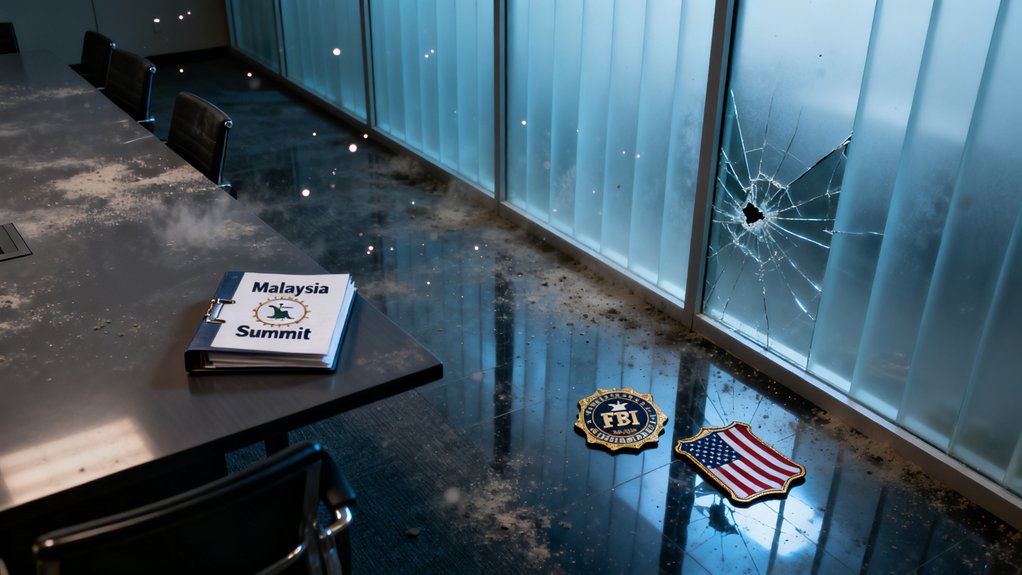
Although the CIA had been tracking the movements of known al-Qaeda operatives throughout 1999, it wasn’t until January 2000 that the agency’s surveillance reached a critical juncture, monitoring a pivotal summit in Malaysia. This was the 2000 al-qaeda malaysia summit, a clandestine gathering that the CIA observed in real time. But here’s the rub: they never shared the intel. They built a blind spot right when clarity mattered most.
The agency’s analysts watched operatives like Nawaf al-Hazmi and Khalid al-Mihdhar, cataloged their faces, and logged their travel plans—yet the ali soufan fbi investigation never saw a single file. Agent Soufan, the FBI’s premier al-Qaeda hunter, was left in the dark, denied the names and identifiers that would have lit up his radar.
The “Wall” wasn’t just a policy; it was a strategic chokehold. It transformed a surveillance victory into a systemic failure, ensuring that the summit’s intelligence became a tomb for actionable leads rather than a weapon for prevention.
Shadowing Nawaf al-Hazmi and Khalid al-Mihdhar Through the CIA’s Surveillance Lens
As the CIA tracked Nawaf al-Hazmi and Khalid al-Mihdhar from that Kuala Lumpur hotel lobby, their surveillance lens captured every move—the men’s meetings, their aliases, their travel documents. The nawaf al-hazmi surveillance operation logged each phone call, each handoff of cash, each departure time. They watched al-Hazmi’s confident stride and al-Mihdhar’s nervous glances, cataloging every detail but never sharing it. The operation mirrored pre-1974 abuses of warrantless surveillance that the Church Committee later exposed. The khalid al-mihdhar tracking revealed a clear path: a flight to Bangkok, then onward to Los Angeles. They knew their U.S. visas were valid. They knew they’d already entered America. Yet the CIA’s lens focused only on gathering, not alerting. The agency possessed the keys—the names, the photos, the flight manifests—yet chose to watch, not warn. They could’ve broken the chain right there. Instead, they let the operatives vanish into the crowd, their trail growing cold behind the Wall.
Erecting the Institutional Wall: Weaponizing Pre-9/11 Intelligence Bureaucracy
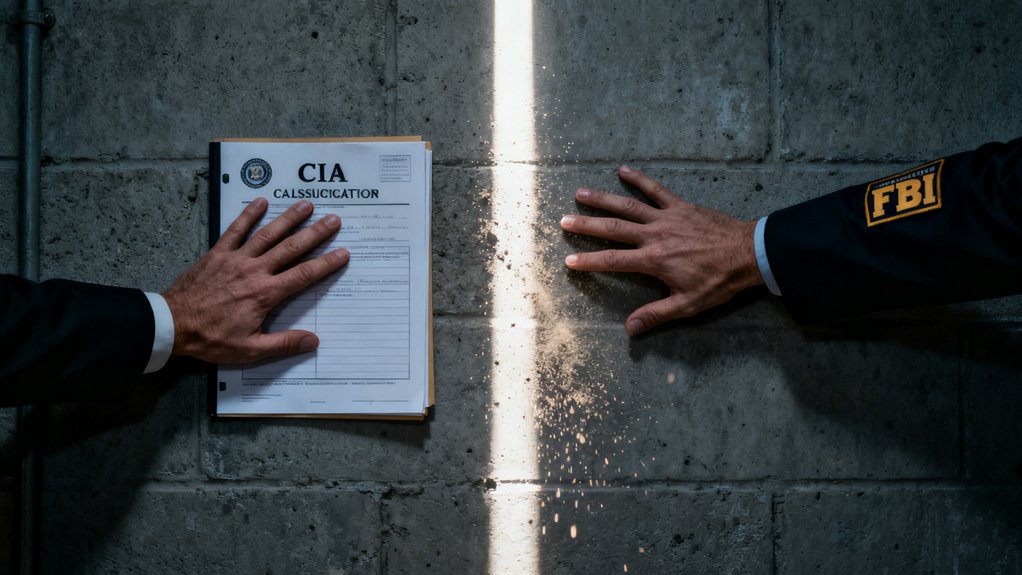
By 1998, legal directives forged the “Wall” into a bureaucratic weapon, explicitly forbidding the CIA from sharing foreign surveillance with FBI law enforcement.
Intelligence handlers then exploited that barrier to systematically sequester actionable data on al-Qaeda operatives, treating the information as a sealed compartment.
This process turned a policy into a practice of deliberate non-disclosure, choking off leads that could have unraveled the hijackers’ plotting.
The 1998 Legal Directives Forbidding Interagency Law Enforcement Sharing
Since the mid-1990s, the Attorney General’s office had quietly issued a series of legal directives that would, by 1998, construct the “Wall” in concrete—not to protect civil liberties, but to weaponize bureaucratic boundaries against counterterrorism.
These directives codified a stringent law enforcement intelligence barrier, explicitly forbidding FBI agents from consulting CIA analysts on shared targets. This wasn’t a mere oversight; it was a deliberate pre-9/11 intelligence failure engineered through legal prose.
The regulations transformed cooperation from a practical necessity into a prosecutable offense. Field officers like Ali Soufan found themselves locked out of critical data flows, their hands tied by a policy that prioritized jurisdictional purity over operational speed.
The Wall‘s 1998 foundation meant the CIA could monitor al-Qaeda summits, but the FBI couldn’t ask about them.
How Intelligence Handlers Systematically Sequestered Actionable Foreign Surveillance
Although the 1998 directives had built the “Wall” on paper, intelligence handlers actively weaponized it in practice by systematically sequestering actionable foreign surveillance from the FBI.
This wasn’t passive compliance; it was deliberate gatekeeping. They withheld hijackers intelligence from January 2000’s Malaysia Summit, knowing its operational value.
- CIA handlers cataloged al-Qaeda operatives’ movements but never flagged them to FBI counterterrorism units.
- The agency refused to share surveillance logs linking hijackers Nawaf al-Hazmi and Khalid al-Mihdhar to known plots.
- Analysts classified intercepts as “foreign intelligence” to dodge sharing mandates under the cia fbi intelligence wall.
- They blocked FBI liaison requests, citing “legal separation,” when agents explicitly asked for actionable leads.
This systematic sequestering guaranteed the FBI remained blind to threats it could’ve intercepted—power preserved through bureaucratic sabotage.
FBI Special Agent Ali Soufan’s Collision With an Information Black Hole
Struggling to connect the dots in real time, FBI Special Agent Ali Soufan slammed directly into an information black hole between 1998 and 2001. He’s the man who knew the questions but couldn’t access the answers. His relentless pursuit of al-Qaeda operatives hit a dead end—not because of enemy action, but because of a bureaucratic wall he couldn’t scale. This bureaucratic wall mirrored the CIA’s willingness to violate scientific ethics under the covert MKUltra program. The fbi counterterrorism obstacles weren’t overseas; they were institutional, embedded in the very system meant to protect America. For fbi special agent ali soufan, every file he requested, every lead he chased, vanished into a void where the CIA held the keys but refused to turn them. He watched the pieces—names, meetings, movements—stay locked in Langley’s vaults. By 2001, he’d exhausted his options, his warning signals ignored, his hands tied by a policy that prioritized separation over survival.
The Anatomy of an Intelligence Embargo Inside the CIA’s Alec Station
Alec Station’s analysts systematically stripped the names and visa details of known al-Qaeda operatives from counterterrorism briefings destined for the FBI.
This deliberate omission didn’t just hide Nawaf al-Hazmi and Khalid al-Mihdhar; it imposed a complete operational paralysis on Bureau field investigators, who couldn’t search for men they didn’t know existed.
The intelligence embargo guaranteed that the very identities needed to disrupt the plot remained sealed within the CIA’s silo, a bureaucratic veto over life-or-death investigation.
Stripping al-Qaeda Names and Visas From Critical Counterterrorism Briefings
Even as the CIA’s Alec Station analysts compiled the identities and visa statuses of known al-Qaeda operatives—including those who’d already entered the United States—they systematically scrubbed those names from the counterterrorism briefings delivered to the FBI. This deliberate omission, buried in cia alec station operations, guaranteed Bureau field agents never connected the dots.
- Analysts redacted Nawaf al-Hazmi and Khalid al-Mihdhar from intelligence summaries, despite tracking their visa approvals and U.S. travel.
- The joint inquiry declassified records later revealed Alec Station withheld not just names but critical visa numbers and entry dates.
- Briefings omitted mention of the Malaysia Summit, erasing the operational context from FBI awareness.
- Senior CIA officers personally approved these scrubbed versions, enforcing the “Wall” as policy.
This wasn’t a mistake—it was a calculated embargo. Power demands understanding that bureaucracy, not incompetence, killed the investigation.
The Operational Paralysis Imposed on Bureau Field Investigators
The Bureau’s field agents weren’t just kept in the dark—they were handcuffed by design. The law enforcement intelligence barrier didn’t merely slow them; it dismantled their ability to act.
Declassified 9/11 commission files reveal the precise anatomy of this embargo inside Alec Station. CIA analysts hoarded critical data on al-Hazmi and al-Mihdhar, refusing to relay it to FBI counterterrorism squads.
Field agents like Ali Soufan repeatedly requested operative names and travel records, only to meet silence or deflection. Each denial compounded operational paralysis, transforming investigators into blind bureaucrats.
Power requires information; the CIA’s wall ensured the Bureau had none. The consequence wasn’t confusion—it was calculated incapacitation. The files don’t lie: the system deliberately choked the field.
Squandering 18 Months of Counterterrorism Jurisdiction Inside the United States
- The CIA tracked the January 2000 summit but classified the attendees’ names, preventing FBI counterterrorism from opening a domestic case.
- Soufan’s squad, ready to investigate, had zero legal authority to access CIA cables detailing the operatives’ flight plans to the U.S.
- The 18-month window—from the summit to 9/11—saw the hijackers rent apartments, open bank accounts, and enroll in flight schools.
- No search warrants, no arrests, no monitoring occurred inside the U.S. because the wall made jurisdiction a phantom.
Domestic Ghosts: How Known al-Qaeda Operatives Exploited the Interagency Chasm
Though the CIA had confirmed al‑Qaeda operatives’ identities and travel plans after the Malaysia summit, FBI Special Agent Ali Soufan’s team couldn’t act because the “Wall” legally barred the CIA from handing over those cables.
This 9/11 institutional intelligence gap didn’t simply delay justice—it unleashed known threats onto American soil. Nawaf al-Hazmi and Khalid al-Mihdhar, their names and faces already catalogued in Langley’s files, slipped into California undetected. They exploited the chasm with surgical precision.
They rented apartments, opened bank accounts, and even appeared in the FBI’s local field office to report a petty crime—a brazen test of the system’s blindness. The Bureau lacked the context to connect those domestic traces to the Malaysia warning.
They rented apartments, opened bank accounts, walked into the FBI—and vanished in plain sight.
The operatives moved freely, embedding themselves in the hijacking plot’s logistics. The wall didn’t just separate agencies; it created blind spots where al-Qaeda’s ghosts could operate openly. No barriers existed for them—only for the men who needed to stop them.
Agent Soufan’s Documented Field Requests and the Persistent Bureaucratic Stonewalling
While Soufan’s team had finally obtained the CIA’s Malaysia cables by late August 2001, their ability to act on that intelligence had already been crippled by months of systematic stonewalling.
Each field request Soufan submitted, each urgent cable he drafted, hit an immovable bureaucratic wall designed to preserve institutional turf, not national security.
- Rejected Access to al-Hazmi and al-Mihdhar: The CIA repeatedly refused to share the operatives’ identities, despite Soufan’s explicit requests based on his own investigative leads.
- Withheld Summit Intelligence: The CIA never disclosed the Malaysia Summit’s location, participants, or surveillance footage to Soufan’s team, leaving them blind to the hijackers’ training.
- Blocked Visa Tracking: Soufan sought visa applications for suspected operatives; the CIA blocked the data, claiming it fell under intelligence jurisdiction, not law enforcement.
- Silenced Direct Liaisons: When Soufan bypassed formal channels to contact CIA analysts, those analysts faced reprimands for sharing even basic threat assessments.
These deliberate obstructions turned a field agent’s legitimate pursuit of a terrorist network into a futile exercise against his own government’s machinery. This mirrored the JFK autopsy pattern where military and intelligence officials systematically suppressed and withheld physical evidence from civilian investigators.
The September 11 Cataclysm Unleashed by a Manufactured Intelligence Vacuum
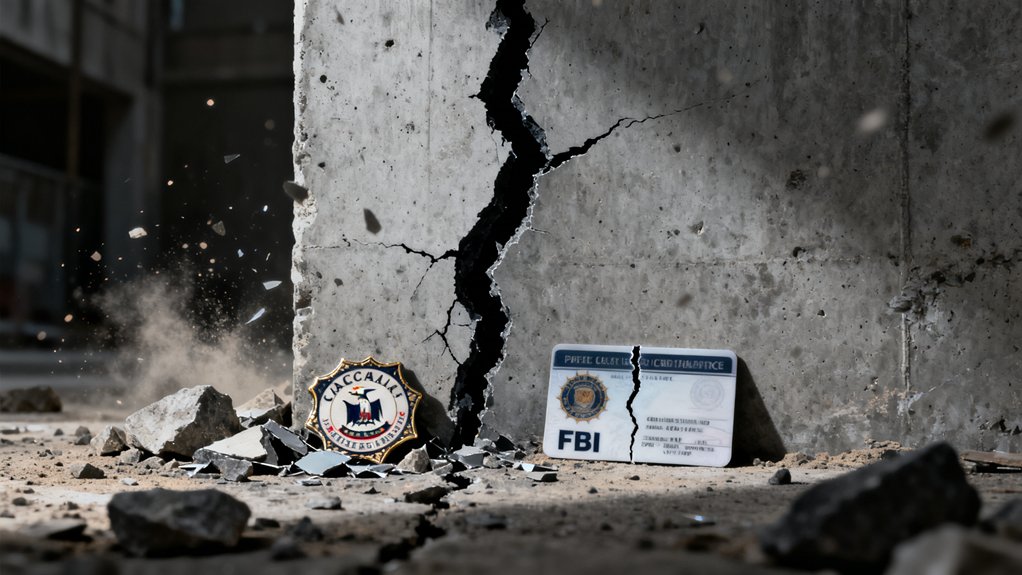
The manufactured intelligence vacuum allowed Nawaf al-Hazmi and Khalid al-Mihdhar to board American Airlines Flight 77 without a single flag from U.S. authorities.
The CIA possessed their full biographies, including their al-Qaeda summit attendance, yet the “Wall” guaranteed the FBI never received this critical data. Consequently, the hijackers moved through security undetected, their lethal identities buried within a broken system.
Boarding American Airlines Flight 77 With Undetected Terrorist Biographies
Even as Nawaf al-Hazmi and Khalid al-Mihdhar cleared security at Dulles International Airport on the morning of September 11, 2001, their terrorist biographies remained sealed behind the CIA’s wall—files Bureau investigators had demanded, but never received.
These two men, surveilled at the 2000 Malaysia Summit, boarded American Airlines Flight 77 as ghosts—operationally alive but jurisdictionally dead.
- The CIA possessed Hazmi and Mihdhar’s passports, travel records, and known associates but invoked the “Wall” to deny FBI access.
- By August 2001, FBI agents had identified both operatives, yet critical cables remained classified, blocking a coordinated manhunt.
- The agency didn’t deny the threat; it simply refused to arm the Bureau with the intelligence.
- Consequently, no watchlist entry existed—no flag, no barrier, no stop—as they targeted the Pentagon.
The manufactured vacuum wasn’t a mistake; it was structural, fatal, and total.
Autopsy of a Systemic Collapse Through the Declassified Post-Mortem
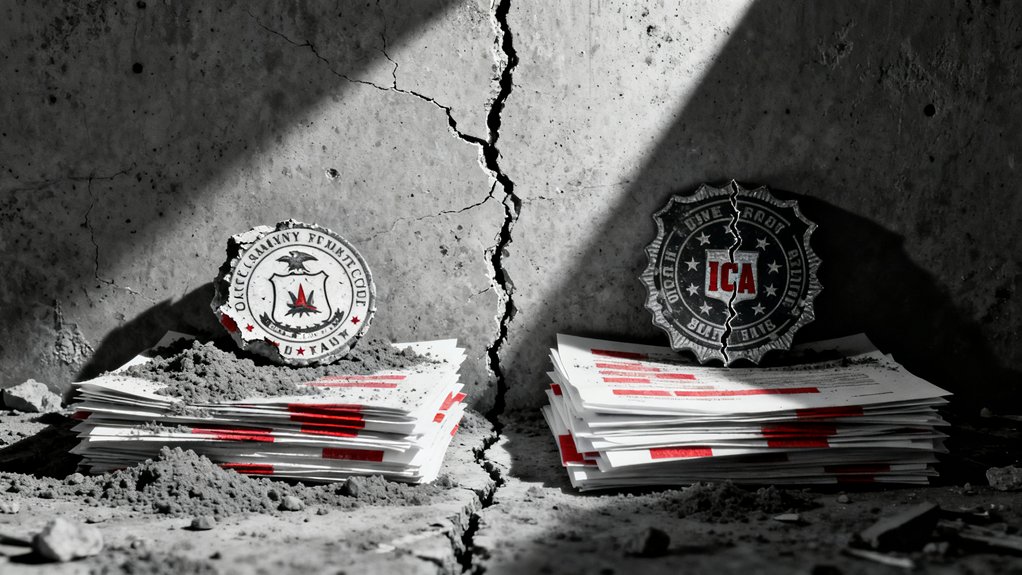
The declassified post-mortem tears open the suppressed memos and ignored warnings, laying bare the precise moments the Wall killed action.
It meticulously dismantles the legal framework that protected this intelligence embargo, showing how prosecutors and lawyers built the cage.
These documents prove the collapse wasn’t a failure of collection, but a systemic refusal to connect the dots.
Excavating the Paper Trail of Suppressed Memos and Ignored Warnings
Declassified post-mortems reveal a paper trail of suppressed memos and ignored warnings that forms the autopsy of a systemic collapse.
Within the CIA’s own files, analysts documented the precise movements of al-Qaeda operatives but never flagged the FBI. This wasn’t incompetence; it was a deliberate embargo.
- The Phoenix Memo: A July 2001 FBI field office memo warned of bin Laden’s potential to hijack planes, yet headquarters buried it.
- The Moussaoui Arrest: French intelligence flagged Zacarias Moussaoui as a radical; the FBI agent’s repeated requests to search his laptop were denied by the “Wall.”
- The Malaysia Summit Tapes: CIA surveilled an al-Qaeda meeting in January 2000, but refused to share the names of two future hijackers with Soufan’s team.
- The CIA’s Own Inspector General Report: A 2005 internal review conceded that the agency blocked at least 60 critical intelligence leads from reaching the FBI.
Dismantling the Legal Framework That Protected the Intelligence Embargo
Those suppressed memos and ignored warnings didn’t arise from mere bureaucratic inertia; they were enforced by a specific legal architecture.
The 1995 Guidelines—Attorney General Janet Reno’s reinterpretation of FISA—erected a concrete barrier between intelligence and law enforcement.
That wall wasn’t accidental; it was a calculated legal bulwark, designed to prevent the contamination of criminal investigations with intelligence-derived evidence.
Declassified post-mortems now reveal its brutal efficiency: CIA officers legally refused to share the Malaysia Summit data with FBI Special Agent Ali Soufan.
They cited the wall explicitly, not as an excuse but as binding law.
The Irreversible Bloodshed Authorized by Institutional Silos
Because the CIA and FBI operated as hermetically sealed silos, Bureau agents couldn’t trace two known al-Qaeda operatives already on American soil. Nawaf al-Hazmi and Khalid al-Mihdhar moved freely within San Diego, their surveillance of the Capitol already underway.
The CIA’s refusal to share the Malaysia Summit intelligence didn’t just create a knowledge gap—it authorized an irreversible chain of bloodshed.
- Al-Hazmi and al-Mihdhar boarded American Airlines Flight 77, crashing into the Pentagon and killing 184 people.
- The FBI’s inability to link them to the wider conspiracy left the hijackers’ logistical network intact.
- CIA Director George Tenet later admitted the “Wall” prevented actionable warnings from reaching operational field agents.
- A 2004 Senate inquiry confirms: timely intervention could have disrupted the plot as late as August 2001.
The silos didn’t just withhold information. They stripped Bureau agents of their power to intervene, transforming intelligence hoarding into a death warrant. Those 2,977 lives were lost not to failure, but to structural refusal.
Frequently Asked Questions
Why Was the “Wall” Originally Created Between the CIA and FBI?
The “Wall” originally emerged from a post-Watergate and FISA-era legal doctrine, designed to prevent intelligence agencies from tainting criminal prosecutions with improperly gathered foreign surveillance. It rigidly separated CIA’s foreign intelligence mission from FBI’s domestic law enforcement role.
Officials feared that sharing intelligence would compromise constitutional protections in court. This bureaucratic firewall, however, prioritized legal purity over operational unity, inadvertently creating a fatal blind spot. It ironically transformed a safeguard into a strategic vulnerability.
CIA analysts *couldn’t* legally share the Malaysia Summit data.
The “Wall” wasn’t a vague guideline—it was a rigid legal barrier, treating intelligence as separate from criminal investigation.
Sharing that intel risked violating rules designed to prevent intelligence agencies from driving prosecutions.
Analysts locked the data within CIA channels, leaving FBI agents like Ali Soufan blind.
They chose compliance over connection, and that choice cost everything.
Did FBI Director Louis Freeh Personally Know About the Withheld Intelligence on Al-Hazmi and Al-Mihdhar?
[Anticipated objection: “Surely the FBI director was briefed on such critical intelligence.”] He wasn’t. Director Freeh didn’t personally know about the withheld intelligence on al-Hazmi and al-Mihdhar.
The “Wall” didn’t just block field agents—it kept the FBI’s top leadership in the dark. Ali Soufan’s team couldn’t climb that barrier to inform Freeh.
The CIA’s operational secrecy was so absolute that the Bureau’s most powerful figure remained ignorant of the surveillance, giving the hijackers a fatal head start.
What Specific Data Did Alec Station Refuse to Provide to Agent Soufan Regarding the Summit?
Alec Station refused to provide Agent Soufan with the operatives’ full names, passport details, and travel itineraries from the Malaysia Summit. They wouldn’t share the surveillance photos or video of Nawaf al-Hazmi and Khalid al-Mihdhar.
This blackout meant Soufan couldn’t link them to known al-Qaeda cells or monitor their U.S. entry. It’s a deliberate data hoard that hamstrung his investigation.
Were There Any Internal CIA Warnings About the Dangers of Withholding Intelligence From the FBI?
Yes, they did. “A chain is only as strong as its weakest link“—CIA analysts on the ground warned their superiors that withholding the Malaysia Summit intelligence would cripple the FBI’s hunt for al-Qaeda operatives.
Declassified cables reveal these agents explicitly flagged the legal “Wall” as a lethal vulnerability, yet their cautions were ignored.
That silence didn’t just break the chain; it forged the catastrophe.
Final Thoughts
The Wall didn’t just block data; it erected a mountain of blood between the CIA’s knowledge and the FBI’s hands. Ali Soufan’s desperate requests weren’t just denied—they were swallowed by a bureaucratic abyss that could’ve stopped the hijackers cold. This manufactured silence didn’t merely fail; it transformed intelligence into a weapon against the very people sworn to protect America, making the September 11 cataclysm not just likely, but inevitable.