

On April 16, 1985, Aldrich Ames drove a red Fiat to the Soviet Embassy, handing over the actual names of every CIA asset inside the USSR for $50,000. He weaponized his counterintelligence access to erase personal debts, receiving $2.7 million through chalk-mark signaling and dead drops. His betrayal triggered the systematic execution of over 100 deep-cover operations, gutting American intelligence. Nine years later, the FBI intercepted Ames in Arlington, securing a life sentence. The Agency’s hollowed infrastructure tells a darker story still unfolding.
Key Takeaways
- Ames handed over all active CIA Soviet assets in April 1985 for $50,000.
- He received $2.7 million over nine years while flagging two polygraph exams.
- The KGB executed over 100 sources, including General Dmitri Polyakov.
- Security reviews and audits failed despite lavish spending and bank deposits.
- The betrayal destroyed the CIA's human intelligence network in the USSR.
April 16, 1985: The 50,000 Dollar Walk-In at the Washington Soviet Embassy

Why would a CIA counterintelligence officer, sworn to protect national secrets, simply walk into the Soviet Embassy with classified documents and a demand for cash? On April 16, 1985, Aldrich Ames drove his red Fiat to the Soviet embassy in Washington, initiating his infamous Soviet embassy walk-in 1985. He carried a sealed envelope containing the identities of CIA assets working inside the USSR.
Ames didn't offer ideology or patriotism. He offered intelligence for a price. His financial motive and KGB payoffs were immediately clear. He demanded $50,000 and received it in prearranged stacks of cash. The KGB agents, stunned by his brazenness, quickly recognized the opportunity. His betrayal mirrored the CIA's own covert use of BCCI’s offshore accounts to move classified funds with no audit trail.
Ames's first payment transformed his betrayal into a sustained enterprise. It set the stage for a nine-year campaign that would dismantle over a hundred operations and lead to the execution of vital assets. He didn't just sell secrets. He sold lives, starting with that single, calculated walk-in.
Liquidating the Agency: Weaponizing Counterintelligence Access to Erase Personal Debt
That initial $50,000 from the Soviet embassy walk-in didn't go to ideological warfare or illicit accounts. It went straight to Ames's personal debts, setting a pattern of treating the CIA as an ATM.
He wasn't a spy for revolution. He was a spy for relief from a looming financial collapse, turning his counterintelligence access into a personal liquidation tool.
Over nine years, Ames weaponized his position to erase roughly $2 million in credit card charges, mortgage burdens, and luxury purchases, funneling secrets to Moscow in exchange for cash. The CIA's security clearance flaws allowed this. No one flagged his sudden $540,000 bank deposits because his lavish lifestyle was seen as a wealthy wife's inheritance.
Those blinded eyes cost lives. Ames's tradecraft directly caused executed Soviet informants, assets he'd been paid to protect.
He didn't just sell secrets. He sold out human beings, turning their deaths into his debt cancellation.
His actions weren't treason for ideology. They were a calculated, financial betrayal masked by a clearance system that failed to see the man spending the agency's trust.
This pattern of institutional blindness mirrored how the CIA buried its own oversight failures, destroying evidence and obstructing accountability for decades.
The June Exfiltration Protocol: Surrendering the Actual Names of CIA Assets
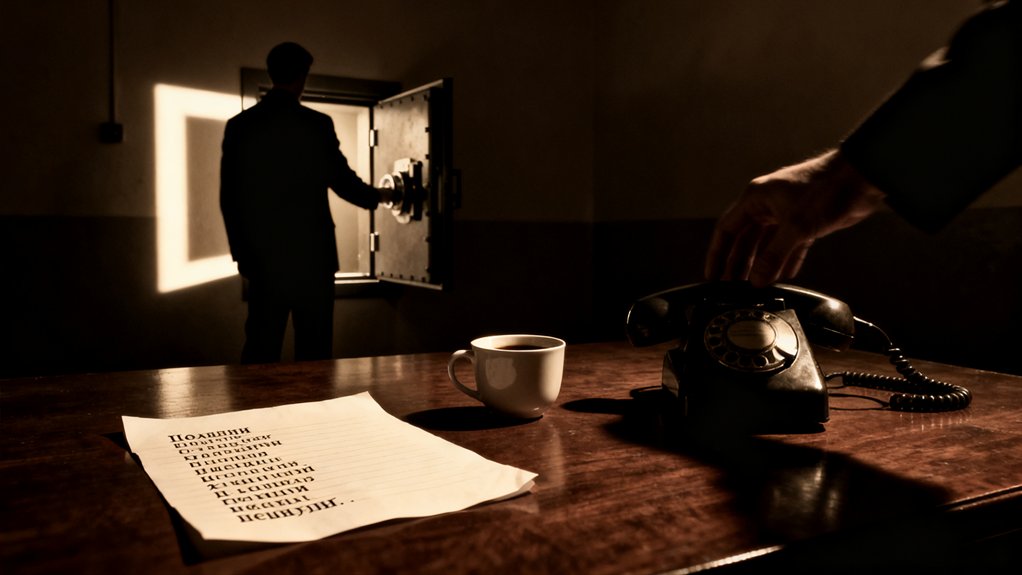
Ames didn't rely on high-tech tradecraft. He stuffed classified documents into a shopping bag and walked them past security.
This single exfiltration method dismantled over 100 deep-cover operations, handing the KGB the actual names of every asset.
The June protocol exposed a catastrophic failure in internal defenses, not just a spy's cunning.
The Shopping Bag Smuggling Method: Exploiting Lax Internal Security Defenses
While Ames's financial motives had already been established by his June 1985 embassy walk-in, the true scale of his treachery became undeniable only when he physically smuggled the actual names of CIA assets out of Langley that same month.
He exploited shockingly lax internal security, stuffing classified documents into a common shopping bag. This wasn't a sophisticated ruse; it was a bold and simple exploitation of trust.
Ames then employed standard dead drop concealment mechanics, leaving the incriminating papers in prearranged locations for his Soviet handlers.
Each delivery represented condemned U.S. intelligence assets, men whose fates Ames sealed inside that paper sack.
The sheer volume of data he bagged and walked past security undetected made clear his betrayal wasn't just possible, it was horrifyingly easy.
Dismantling Over 100 Deep-Cover Operations in a Single Document Drop
How could one man single-handedly cripple the CIA's entire Soviet network? He simply surrendered the actual names of CIA assets in a single document drop.
In June 1985, Aldrich Ames handed over a devastating package identifying every human source the Agency ran inside the USSR. He didn't leak vague intelligence gaps; he delivered identities.
The deep-cover operations fallout was immediate and absolute. Soviet agents who'd risked everything for the United States, men like Dmitri Polyakov and Sergey Fedorov, faced arrest and execution within months. This wasn't just a breach; it was a systematic liquidation.
Ames, the CIA counterintelligence mole, destroyed decades of careful human intelligence work. He gutted the Agency's Soviet capability with one terrible transaction, proving that a single motivated traitor can collapse an entire espionage network.
The 1985-1986 Slaughter: Systematic Execution of Compromised Human Intelligence
Ames's betrayal hit its most ghastly mark with General Dmitri Polyakov, a high-ranking Soviet source the CIA had cultivated for decades.
The KGB didn't simply execute him. They launched a sophisticated disinformation campaign, fabricating false leads to mask their own mole's identity.
This cold, calculated slaughter of Polyakov and other compromised assets marked a systematic purge of human intelligence that left the CIA's Soviet network in ruins.
Researchers and the USPHS similarly withheld penicillin from study participants, ensuring deliberate withholding of treatment for untreated syphilis.
General Dmitri Polyakov: The Brutal Fall of the Highest-Ranking Soviet Source
Because Ames fed Moscow the actual names of US assets, not just operational leads, General Dmitri Polyakov‘s fate became inescapable.
Polyakov, a decorated GRU officer who'd secretly served Washington for two decades, represented the highest-ranking Soviet source ever run by the CIA. His exposure triggered a catastrophic human intelligence network collapse across Eastern Bloc operations.
KGB handler communications intercepted later revealed Moscow's grim satisfaction: they finally had the traitor who'd fed them fabricated military data for years.
The Soviets didn't just arrest Polyakov in 1986. They broke him methodically, forcing a full confession before a secret military tribunal. In March 1988, they executed him by firing squad, then buried his remains without ceremony.
Ames's greed erased an intelligence legend.
The KGB Masking Campaign: Fabricating False Leads to Protect Their Apex Mole
The 1985–1986 slaughter wasn't merely tactical; it was strategic camouflage.
Each execution, from Polyakov to others, came wrapped in KGB spread rumors of a “mole in the Moscow station.”
Declassified espionage documents later confirmed the KGB's intent.
They aimed to protect their apex asset by making every death look like routine counterintelligence, not a targeted betrayal from within.
Misinformation became their perfect shield.
Blue Ridge Dead Drops and Mailbox Chalk Marks: The Covert Mechanics of a 2.7 Million Dollar Payout
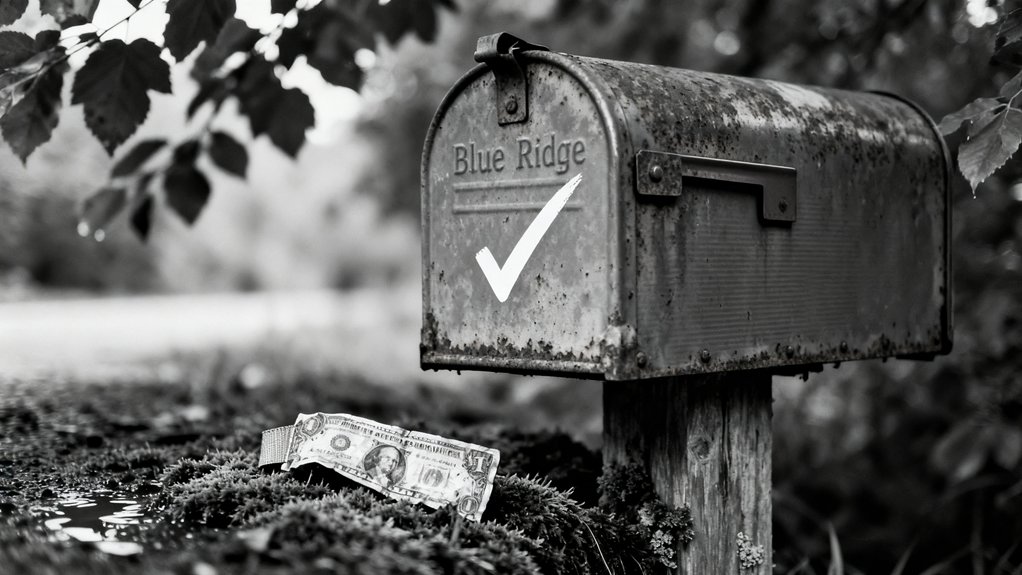
While his colleagues assumed he was attending routine meetings, Aldrich Ames was instead executing a tradecraft system straight out of a spy novel to collect his massive Soviet payments.
Using the Blue Ridge Mountains' remote terrain, Ames established dead drops, prearranged hiding spots for cash and instructions.
He'd drive from Langley to rural Virginia, then walk into wooded areas to retrieve bags stuffed with hundreds of thousands of dollars.
A simple chalk mark on his mailbox signaled the drop was ready; another mark confirmed collection.
Over nine years, this crude yet effective system funneled $2.7 million into his bank accounts.
The FBI‘s Operation Nightmover later traced these patterns, analyzing Ames's travel logs and financial records.
When agents finally moved in, Aldrich Ames arrest records documented the physical evidence: the chalk marks, the drop locations, and the cash stashes.
All of it was irrefutable proof of his treasonous mechanics.
Institutional Blindness: Defeating the 1986 and 1991 Polygraphs in Plain Sight
Despite failing two agency polygraph exams in 1986 and again in 1991, Aldrich Ames faced no serious consequences. This exposed a catastrophic blind spot within CIA security protocols. He didn't cheat the machine. He simply exploited its human handlers' willful disbelief. Investigators scrutinized his charts yet rationalized the deceptive results, attributing them to stress or workload. This institutional blindness allowed a traitor to continue inflicting counterintelligence infrastructure damage while sitting in plain sight. This failure echoed the FBI's COINTELPRO era, where agents conducted thousands of covert operations without warrants or oversight, revealing a pattern of systemic accountability gaps in national security agencies. Exam one in 1986: The polygrapher noted strong reactions to questions about unauthorized contacts with Soviets, but a supervisor dismissed the findings as inconclusive. Exam two in 1991: Ames admitted to minor financial irregularities but never disclosed his $2.7 million Soviet payments, and the examiner let it slide. Both sessions lacked follow-up interviews or access to Ames's bank records, which would have revealed his sudden wealth. No security clearance suspensions occurred, enabling him to name Soviet agents. Dozens of those agents were later executed.
The Phantom Mole Hunt: Tracing the Sudden Collapse of the Eastern Bloc Network
By 1986, an unprecedented wave of burned agents forced the CIA to form a Special Task Force, desperately analyzing a network collapse that defied conventional explanations.
The Agency, however, couldn't overcome its own institutional denial, stubbornly blaming technical leaks rather than a human traitor in its ranks.
Only after years of internal failure did leadership reluctantly switch the hunt to a criminal FBI probe, finally shifting focus toward catching the real mole.
This mirrored a prior era when the U.S. Joint Chiefs of Staff drafted Operation Northwoods to justify war through fabricated attacks on American targets.
The 1986 Special Task Force: Analyzing an Unprecedented Wave of Burned Agents
As the CIA's Eastern Bloc network collapsed in a cascade of burned agents and aborted missions, the agency had no choice but to act. In 1986, Director Casey convened a Special Task Force to dissect the catastrophe.
- A silent room in Langley, where analysts spread classified charts across every available table.
- A stack of red-flagged files, each denoting a source who'd fallen silent after a coded meeting.
- A single Moscow hotel room, where a handler waited hours for a contact who never arrived.
- A fragmented photograph, showing an empty safe house, its radio gone silent for weeks.
The task force couldn't find the mole. They only confirmed the scale of the damage. Over a dozen critical agents were gone, their network dismantled before anyone could sound a single alarm.
Overcoming Agency Denial: The Delayed Transition to a Criminal FBI Probe
The task force's charts and silent rooms painted a grim picture, yet inside the CIA the prevailing mindset was denial.
For years, leadership resisted the obvious: a mole was gutting their network. They blamed faulty tradecraft, imagined technical leaks, and even suspected their own loyal officers. Only after the Agency's internal hunt failed and the cascade of dead agents grew louder did they reluctantly hand the case to the FBI in 1993.
That changeover wasn't smooth. The FBI ran a targeted financial investigation, scrutinizing Ames's unexplained wealth. They didn't share their progress, which fueled further tension. But their independence broke the logjam. By focusing on dollars, not loyalty, they finally cornered the traitor. The denial had cost precious time, but it couldn't shield Ames forever.
Forensic Auditing the Traitor: Tracing a 540,000 Dollar Cash Home Purchase in Arlington
Operation Nightmarch first surged forward when forensic auditors discovered a glaring inconsistency. Ames's tax returns could never justify the 540,000 dollar cash purchase of his Arlington home. This mirrored the CIA’s MKUltra pattern of using front organizations to conceal illicit funding. They then launched a relentless paper trail, reconciling his declared income against the classified leaks' scale, and the gap screamed of Soviet payments. The pivotal break came during the infamous trash run, where agents intercepted typewriter ribbons and discarded intel. This provided the tangible evidence that cemented his betrayal.
Operation Nightmarch: Reconciling the Ames Tax Returns Against Classified Leaks
How could a CIA officer earning a modest government salary suddenly afford a $540,000 Arlington home in cash, without raising a single red flag? Operation Nightmarch's forensic auditors found the answer hidden in plain sight. Ames's tax returns told a damning tale of unreported wealth.
- Bank deposits documented $1.4 million in unexplained payments from Soviet sources.
- Ames reported just $60,000 in total income during the purchase year.
- Mortgage applications showed no debt, but tax forms listed zero capital gains.
- The $540,000 cash down payment exceeded his entire declared lifetime earnings.
The auditors reconciled these contradictions by cross-referencing classified intercepts. Leaked Soviet payment schedules matched Ames's deposit dates precisely. His tax returns didn't just show missing money. They exposed a systematic plan to launder espionage proceeds through legitimate real estate. The numbers didn't lie. They simply revealed a treasonous truth.
The Trash Run Breakthrough: Intercepting Typewriter Ribbons and Discarded Intel
Ames’s tax returns had screamed fraud, but the team at Forensic Auditing the Traitor needed a different kind of proof to confirm the cash source for that $540,000 Arlington home. They found it in his trash. FBI agents, executing a covert “trash run,” seized Ames’s discarded household waste and office debris, uncovering the physical mechanics of his betrayal.
| Intercepted Item | Intel Value |
|---|---|
| Typewriter ribbon | Revealed typed drafts of classified cables to Moscow |
| Torn meeting notes | Listed dead-drop signals and payment codes |
| Personal calendar | Tracked clandestine meetings at Soviet embassy |
| Discarded KGB receipts | Proved cash delivery dates totaling $1.8 million |
| Crumpled map | Marked specific drop locations in Virginia woods |
Each ribbon bore the faint impressions of treason, each map gave coordinates to his handlers. The trash did not just confirm the cash; it decoded the entire operational blueprint Ames had tried to burn.
February 21, 1994: The FBI Intercept and Arrest Before the Moscow Departure
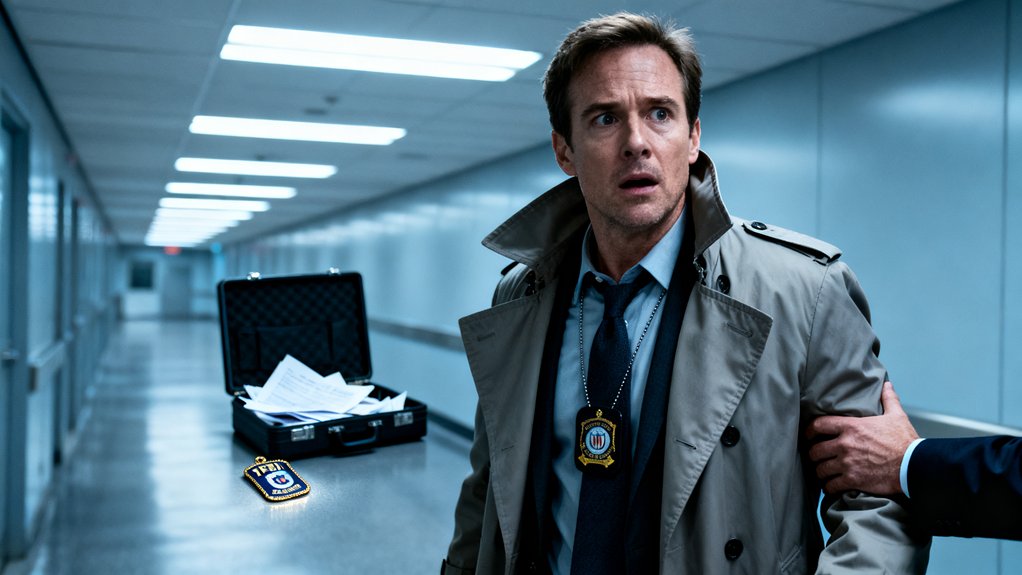
Because the FBI had been secretly building a case for nearly a year, Aldrich Ames never suspected the trap closing around him on the morning of February 21, 1994.
The FBI had secretly built a case for nearly a year; Ames never saw the trap closing.
He'd planned to flee to Moscow that day, but agents had other intentions. They intercepted his Jaguar in a quiet Arlington neighborhood, executing a swift arrest that ended his nine-year betrayal.
The scene unfolded with precise, chilling details:
- The Jaguar's Stall: Agents boxed his red 1987 Jaguar in traffic, forcing the engine to die in a suburban street's silence.
- Handcuffs Snap: FBI personnel swarmed, snapping handcuffs on his wrists before he could reach for the diplomatic pouch of classified documents in his trunk.
- Briefcase Panic: Ames's hand trembled over his briefcase, only to find agents had already secured it inside their unmarked sedan.
- Moscow's Lost Prize: His wife's suitcase sat packed in the backseat, ready for the flight he'd never board.
Agents escorted him into custody without a struggle, ending his calculated escape.
The operation proved precise, meticulous, and final.
The Declassified Debriefings: Analyzing the Psychological Profile of Financial Treason
Why would a man earning a six-figure CIA salary sell his country's secrets for a few thousand dollars, then deposit the cash directly into a bank account easily linked to him?
The declassified debriefings expose a man driven by a pathological need for immediate gratification, not sophisticated ideology.
Ames didn't see himself as a traitor; he rationalized his betrayal as a financial transaction.
He needed cash for a lavish lifestyle, a Jaguar, a house renovation, Colombian coffee imports.
His salary couldn't sustain this income.
Psychologically, he compartmentalized the morality.
He'd trade a handful of agent names for $50,000, then deposit the money as if it were routine income.
The debriefings reveal a startling lack of guilt.
He expressed more concern about his wife's legal jeopardy than the dead assets.
His treason wasn't a grand betrayal but a series of small, greedy choices.
He never planned to be a mole; he just kept taking the money.
This pattern of prioritizing personal profit over public health mirrors the lead industry's long-running strategy of denying harm to maintain economic gain.
The Life Sentence Without Parole: Prosecuting the Ultimate Insider Under the Espionage Act
How could a man who spent nine years systematically destroying the CIA's human intelligence network and directly causing the deaths of assets he'd once protected escape the death penalty?
The answer lies in a strategic plea deal, struck to squeeze every last classified secret from his corroded mind. Prosecutors under the Espionage Act traded lethal injection for a life sentence without parole, knowing his debriefings could stitch together the damage he'd done. The imagery of his fall is chilling.
- A sterile courtroom, where Ames shuffles in shackles, his tailored suit swapped for orange prison fabric.
- The prosecutor's voice, flat and factual, reading the counts. Every one a severed thread in the nation's security blanket.
- A sealed document, signed by Ames, swearing his cooperation in exchange for oxygen, not a needle.
- The judge's gavel: a final, silent punctuation to nine years of bloodied betrayal.
In the end, the state chose containment over spectacle, locking him away so his secrets could be excavated, not buried with him.
A Crippled Counterintelligence Infrastructure: The Generational Fallout of the Ames Leaks
While the Espionage Act secured a living prison sentence for Aldrich Ames, the true punishment fell upon the CIA's counterintelligence infrastructure, which lay shredded for a generation.
Ames didn't just leak secrets; he systematically handed over the names of every Soviet asset the Agency had cultivated. The cost wasn't measured in dollars but in blood. Over a hundred deep-cover operations collapsed overnight. The Agency lost its eyes inside the Kremlin, unable to trust its own human sources.
The fallout wasn't immediate; it metastasized. CIA officers became paralyzed with suspicion, questioning every asset's loyalty. A new generation of case officers entered a world where recruitment felt futile. They couldn't build trust when the last generation's network died by execution.
The fallout metastasized; CIA officers grew paralyzed, questioning every asset’s loyalty.
The damage wasn't just operational; it was institutional. The CIA spent the next decade rebuilding from scratch, but the knowledge gap remained. It learned the brutal lesson: one greedy man could dismantle decades of painstaking work, leaving a hollowed-out intelligence apparatus for years to come.
Frequently Asked Questions
How Did Ames Initially Meet the Soviet Embassy Without Raising Suspicion?
He didn't require a covert meeting. His cover was his job. As a CIA officer, walking into the Soviet Embassy was standard business, which allowed him to slip inside without raising alarm.
He used his official duties as a shield.
This made the initial betrayal look like routine intelligence gathering.
This pretense of professional necessity bought him nine years of unhindered access.
What Specific Methods Did Ames Use to Hide His Cash From Colleagues?
Ames hid his cash like a squirrel stashing acorns, slowly and without fanfare. He deposited his Soviet payments in small increments, never exceeding $10,000 to avoid bank reporting requirements.
This meticulous layering disguised the funds' origin. The CIA counterintelligence staff noted his lavish spending, including a new Jaguar and a house, but never connected the dots to his gradual deposits. This financial camouflage let his nine-year betrayal slip past suspicion.
Why Did Multiple Polygraph Screenings Fail to Detect His Lies?
Multiple polygraph screenings failed because Ames exploited the CIA's own procedural weaknesses.
He maintained a calm demeanor, relying on countermeasures like controlled breathing and mental distraction.
Investigators later admitted they didn't challenge him aggressively, as he was a colleague, not a suspect.
Fundamentally, the system trusted a man it shouldn't have, undervaluing the polygraph's limits against a trained deceiver who knew its flaws.
How Much Total Money Did the Soviets Pay Ames Over Nine Years?
The Soviets paid Aldrich Ames approximately $4.6 million over nine years. That money didn't simply sit in a bank, he spent it lavishly on a Jaguar, a new house, and expensive suits, all while earning a modest CIA salary.
His handlers gave him cash in staged payments, often $50,000 per meeting, totaling over $10 million when adjusted for inflation. It's a staggering sum for a traitor who traded lives for luxury.
What Triggered the Fbi's Final Investigation That Led to His Arrest?
The dots finally connected when an internal CIA review flagged a pattern of operational disasters that had no other explanation. Investigators noticed the Agency's prized assets were vanishing, executed or silenced, right after Ames's meetings. That wasn't coincidence; it was a trail of blood.
The FBI then scrutinized his unexplained wealth. His lavish spending, far exceeding his government salary, didn't match his financial profile. It wasn't just bad luck; it was treason staring them in the face.
Final Thoughts
Ames’s greed was a cancer hidden in plain sight, the tumor of a blood-price quietly metastasizing through the CIA’s arteries. His deal, a Faustian bargain scrawled on a napkin for $50,000, sacrificed the living for ledger lines. By the time the FBI scalpel cut him out, the body of US intelligence was already metastasized, hollowed of its most loyal cells, leaving only a scar of silence where comrades once breathed.