


Beria’s March 1942 memo turned Soviet physics into a police dossier, chained inside an *osobaia papka*. Scientists became suspects, their labs crime scenes. Stolen schematics, validated by Kurchatov, became inflexible law under threat of execution. NKVD protocols created blind calculation matrices and paranoid hierarchies, strangling innovation. Fear, not insight, drove Problem No. 1. The special folders still hold these buried secrets, waiting for closer inspection.
Key Takeaways
- Special folders restricted atomic documents to one guarded room under Beria’s sole control.
- NKVD Memo No. 683/b turned nuclear physics into a police matter with scientist surveillance.
- Stalin’s GKO Resolution 9887ss/ov gave Beria unchallenged authority over all atomic resources.
- Couriers were erased from records, stripping identities to prevent traceable espionage links.
- Translators worked at gunpoint, with double checks for sense and loyalty inside Lubyanka.
Lubyanka’s First Atomic Ledger: Beria Memo No. 683/b and the March 1942 Warning
Beria’s memo No. 683/b lands on Stalin’s desk in March 1942, a cold ledger entry that drags Anglo-American fission research into the Kremlin’s tightest grip.
It isn’t just intelligence; it’s the NKVD’s first claim of ownership over Soviet physics, a quiet coup that turns laboratories into guarded cells.
From that moment, the atom’s promise becomes a prisoner of Lubyanka’s shadow, and every scientist’s work a footnote to a police file.
Documenting Anglo-American Fission Research for Stalin’s Inner Circle
Lubyanka’s archive vaults held a secret ledger—its pages thin as cigarette paper—that would outlast a war and silence an empire. Inside, lavrentiy beria’s sharpest intelligence unit, department s, logged Anglo-American fission research with obsessive precision.
By March 1942, memo no. 683/b warned Stalin’s inner circle that Britain’s MAUD Committee and America’s frantic uranium experiments signaled a race. Beria didn’t trust his own spies’ optimism; he demanded raw technical data, not ideological summaries.
The tragic irony: Moscow received fragments—cyclotron schematics, isotope percentages—yet dismissed them as capitalist exaggeration. That warning, buried in an osobaia papka, preceded operation enormoz’s later spy networks.
The ledger’s first entries accordingly documented a truth nobody wanted to believe: the Allies were building a bomb, and the NKVD’s own caution delayed Soviet urgency by months.
Establishing Police Custody Over Early Soviet Nuclear Physics
The ledger’s ink had barely dried when Beria moved beyond observation to seizure. By March 1942, his memo No. 683/b transformed Soviet physics into a police matter.
Lubyanka’s operatives, led by Pavel Sudoplatov, didn’t just watch—they arrested. Order No. 001072 formalized the tragedy: every nuclear scientist became a suspect, every laboratory a crime scene.
Compartmentalization wasn’t strategy; it was isolation, severing minds that might’ve saved them. The warning was stark—knowledge meant leverage, and leverage meant custody.
Beria didn’t trust the bomb; he trusted the chain. In that cold calculus, Soviet physics lost its innocence, and its brightest were caged before they could shine.
The 286-Page Infiltration: Kurchatov’s Forensic Deposition to Pervukhin in March 1943
Kurchatov’s March 1943 deposition, a chilling 286-page autopsy of stolen science, doesn’t just document intelligence—it weaponizes it, shattering the Soviet centrifuge program overnight.
He forces Pervukhin’s hand toward gaseous diffusion, a technical pivot born from desperation, not preference, as the clock ticks on a war that won’t wait.
Most tragically, his calculations on plutonium’s critical mass validate Los Alamos’s darkest numbers, confirming the Americans aren’t bluffing—they’re building the bomb that could end everything.
Forcing the Technical Pivot from Centrifuge Separation to Gaseous Diffusion
Though the NKVD’s dossier on Soviet uranium enrichment grew thick with intercepted American memos and speculative science, it was Beria who slammed the folder shut on centrifuge research in March 1943—forcing Kurchatov’s team to abandon the spinning rotors they’d so painstakingly modeled.
Igor Kurchatov, head of Laboratory No. 2, had trusted the physics; Beria trusted only the ledger’s bottom line. The pivot to gaseous diffusion wasn’t scientific—it was survival:
- Centrifuges demanded precision bearings they couldn’t machine.
- The Americans’ Oak Ridge hints favored diffusion.
- Kurchatov’s blind calculations lacked empirical proof.
- The 286-page deposition served as a mirror copy of U.S. urgency.
- RDS-1 implosion needed a bomb’s worth of U-235, fast.
Tragically, Kurchatov’s team wasted months on rotors—months Beria now stole back, forcing a desperate, faith-based leap.
Validating Los Alamos Calculations on Critical Plutonium Mass
Three hundred and fifty-two pages of raw, uncensored American physics—a dizzying ledger of neutron cross-sections, implosion geometry, and that dreaded number, 6.2 kilograms—landed on Vasiliy Pervukhin’s desk that March, but it was Kurchatov’s forensic hand-scrawled deposition accompanying them that turned the pile into a confession.
He didn’t just translate; he dissected. Each equation validated against his own desperate scribbles, each criticality margin a silent scream of stolen genius. Kurchatov’s margin notes exposed the lie of Soviet self-reliance—these calculations weren’t theoretical, they were lived, bloodied proof.
He confirmed Los Alamos’s plutonium mass with a tragic precision, knowing his own scientists could never replicate it blind. That deposition wasn’t intelligence; it was an obituary for independent Soviet discovery, a mournful acceptance that the bomb would be born, not conceived.
Institutionalized Paranoia: Beria’s Protocols for Detecting Allied Disinformation Traps
Every intelligence service harbored suspicions, but Beria’s NKVD transformed distrust into a bureaucratic liturgy, one whose daily rituals were designed to expose Allied deceptions hidden within the torrent of scientific reports, refugee interrogations, and diplomatic gossip flooding Moscow after 1944.
The Protocols demanded a toxic skepticism: each scrap of data faced a gauntlet of cross-referencing, designed to catch the tell-tale mathematical elegance of a planted lie.
- Meticulous timeline variance audits flagged any report arriving too conveniently after a Soviet breakthrough.
- Interrogators deployed “mirror traps,” coaxing defectors to recite details they’d supposedly forgotten, watching for rehearsed cadence.
- Chromatography of phrasing—any Americanism or British idiom embedded in translated texts triggered a full-file reclassification.
- Physicists were forced to defend their own computations against fabricated “Allied corrections,” measuring their emotional reaction, not just the math.
- Duplicate sources were never trusted; only triplicate, contradictory accounts could even earn a preliminary verification.
This paranoid sieve ensnared real plots, but it also crushed innovation—lives lost to the very machinery built to protect them.
Protocol Osobaia Papka: The Architecture of the NKVD Special Folder
Vault-bound custody under Protocol Osobaia Papka chained every atom of Operation Enormoz to a single, guarded room, while the absolute ban on scientific note-taking left physicists with only their faltering memories.
Secondary research tiers—those who’d never seen a single schematic—became ghost-laboratories, forced to reconstruct the bomb’s architecture from whispered fragments and dead ends.
It was a system that protected secrets by starving the very minds that might’ve challenged them, sealing the tragedy of ignorance right into the Soviet project’s core.
Vault-Bound Custody and the Absolute Ban on Scientific Note-Taking
Inside the Lubyanka’s deepest corridors, where the walls swallowed light and the air tasted of stale tobacco and fear, the NKVD’s Special Folder system didn’t just hoard documents—it devoured the very act of thought.
Vault-bound custody transformed physicists into prisoners of memory. They couldn’t write a single equation, sketch a neutron path, or jot a uranium ratio. Every calculation lived only between their ears, then died with each interrogation.
- No pencils, no paper, no margins—only spoken recitation under electric light.
- Guards logged every blink, every pause for recall.
- Scientists whispered formulas to each other like prayers, hoping one survived.
- A single scribbled digit meant a bullet or a decade in Kolyma.
- The ban aimed to erase provenance, making knowledge itself a state secret.
Tragically, this forced amnesia fractured the Soviet bomb’s genesis.
Brilliance became fragile, unrecorded, and ultimately disposable.
Isolating Secondary Research Tiers from Operation Enormoz Material
The Special Folder’s architects didn’t just bury Operation Enormoz’s core—they carved away its periphery, sealing secondary research tiers into a hierarchy of ignorance that mirrored the Soviet state’s own paranoia. Each tier’s scientists saw fragments but never the whole, their queries starved of cross-references, their findings funneled upward into Beria’s silent black hole.
| Tier | Clearance Level | Access Scope |
|---|---|---|
| Primary | “Doomed” | Full Enormoz files, verboten notes |
| Secondary | “Witness” | Isolated bomb physics, no yields |
| Tertiary | “Ghost” | Chemical diagrams only, no context |
Tragically, a brilliant metallurgist on Tier Two toiled for months on plutonium sheaths he believed were for medical isotopes. When his calculations failed, NKVD beat him for “sabotage”—he’d never known the target. The hierarchy didn’t protect secrets; it created victims.
GKO Resolution No. 9887ss/ov: Beria Consolidates Total Authority Over Problem No. 1

As August 1945 dawned, Stalin’s war machine had already scorched Hiroshima’s horizon, yet the true epicenter of atomic power wasn’t a Pacific crater—it was a single sheet of paper landing on Lavrenti Beria’s desk. GKO Resolution No. 9887ss/ov didn’t just assign tasks; it carved Beria into the unchallenged sovereign of Problem No. 1, merging scientific desperation with state terror. Every lab, every gram of uranium, every whispered doubt now funneled through his NKVD.
In August 1945, Beria’s desk, not Hiroshima, became the atomic epicenter—where fear forged the bomb.
- He alone could requisition resources, bypassing all ministries.
- He controlled personnel transfers—life or death for scientists.
- He held sole communication rights with Stalin on atomic progress.
- He dictated security protocols, isolating even senior physicists.
- He approved every budget line, strangling dissent financially.
The resolution sealed a tragic bargain: the Soviet bomb’s fate rested on a man who saw physics as a prisoner’s confession. Beria’s authority wasn’t bureaucratic—it was existential, binding genius to fear.
NKVD Order No. 001072: Pavel Sudoplatov and the Administrative Machinery of Department S
With Order No. 001072, Sudoplatov’s Department S turns translation itself into a weapon, stripping field cryptonyms from every technical transcript before they ever reach Beria’s desk.
Armed guards now stand over linguists inside Lubyanka’s processing chambers, their rifles a silent verdict on the price of a misplaced syllable.
The couriers who carried these secrets don’t vanish by chance—they’re erased from the paper trail before the ink dries.
Redacting the Couriers: Stripping Field Cryptonyms from Technical Transcripts
Every operational directive carries a cost, but none so meticulous as Order No. 001072, which stripped couriers of their field cryptonyms before transcripts ever touched Lavrenti Beria’s desk.
Sudoplatov’s clerks turned each intercepted line into a sterile corpse—names erased, routes dissolved into blank ink.
The tragedy wasn’t secrecy itself, but the erasure of human texture:
- Couriers became “Agent-14” or “Male, tall, scarred,” never Vasily or Olga.
- Handwriting quirks were flattened into typewritten uniformity.
- Dialectal phrases were scrubbed to prevent regional inference.
- Personal greetings—a wife’s name, a child’s illness—vanished.
- Even errors were corrected, removing the couriers’ unique fingerprints of thought.
Thus, the ledger preserved atomic data but murdered identity.
Those men and women died twice: once in the field, once on paper.
Armed-Guard Translation Protocols Inside Lubyanka Processing Chambers
Sudoplatov’s translators worked at gunpoint—literally, with NKVD riflemen stationed behind their chairs inside Lubyanka’s processing chambers.
Order No. 001072 mandated that every technical sheet, every intercepted cable, pass through a double check: one translator for sense, another for loyalty. A single susurrus of doubt—a mispronounced codeword, a fleeting glance at the door—could trigger a silent nod, a three-second burp of a silenced Tokarev.
The men drafted from Moscow’s philological institutes weren’t traitors; they were hostages of nuance. They translated atomic espionage into clean Russian, their fingers trembling over Cyrillic strokes. Sudoplatov watched from a barred gallery, timing each session. He knew fear produced precision. The chambers reeked of sweat and stale tobacco, and every finished page carried an invisible bloodstain—proof that Department S trusted no one, least of all the tongues that served it.
Enforcing the Carbon Copy: Beria’s Rejection of Soviet Theoretical Innovation
By winter 1945, an inflexible mandate had frozen Soviet physics into a carbon-copy role. Beria’s men in Laboratory No. 2 weren’t merely translating Los Alamos’ schematics—they were forbidding any millimeter of deviation, no matter how clever the local alternative.
The rejection of indigenous design wasn’t a technical debate; it was a quiet execution of Soviet theoretical ambition, one file folder at a time.
The Winter 1945 Inflexible Mandate for Los Alamos Implosion Schematics
The winter of 1945 froze Soviet atomic espionage into a singular, unyielding shape: Beria’s mandate that the Los Alamos implosion schematics be reproduced as an exact carbon copy, not reinterpreted.
He discarded every proposal for theoretical refinement, branding them as dangerous deviations from proven American geometry. Soviet physicists—brilliant but shackled—watched their equations gather dust as spies’ blueprints dictated every lens and detonator contour. Beria’s inflexibility wasn’t technical; it was existential terror of failure.
- He rejected all Soviet-initiated modifications outright.
- He demanded photographic fidelity, not engineering logic.
- He feared that any innovation would delay the test date.
- He trusted foreign intelligence over domestic genius.
- He transformed science into an act of copying, not creation.
This mandate silenced the last whisper of independent thought, leaving only a fragile, borrowed blueprint as their only path to the bomb.
Millimeter Replication Over Indigenous Design at Laboratory No. 2
Millimeter by millimeter, Laboratory No. 2’s machinists ground tungsten-carbide lenses to American tolerances they couldn’t fully fathom, their calipers reading betrayal in every micron. Beria’s ledger demanded carbon copies, not inspiration. When young theorists proposed a lighter implosion geometry—a clever deviation from the stolen blueprints—the envelope came back stamped *ne soglasovano*. Rejected. Not for technical failure, but for heresy.
He understood a truth they didn’t: Moscow’s first bomb couldn’t be *better*. It had to be *identical*. Any innovation invited doubt, and doubt invited delay. So they filed away their brilliance, silencing the equations that might’ve leapt ahead, and instead traced the American’s shadow, smothering their own spark to satisfy a tyrant’s need for proof—not progress.
The tragedy wasn’t the espionage. It was the forced mediocrity that followed.
The Blind Calculation Matrix: Hydrodynamic Verification Under Landau and Tikhonov
Landau and Tikhonov’s teams worked in total blindness, fed only sparse espionage numbers from Beria’s couriers, never knowing the Allied origin of their own calculations.
They cross-checked plutonium densities against each other’s output, a desperate triangulation where neither side could confirm the other’s source, only its internal consistency.
The matrix held — but only because the scientists trusted the math more than the men who handed it to them, a trust that would haunt them when the first test fire turned the desert into a graveyard of secrets.
Feeding Espionage Parameters to Isolated Mathematical Cells
Three layers of bureaucratic quarantine separated Soviet nuclear calculations from the men who authorized them. Couriers handed Landau’s team only stripped variables—plutonium masses, tamper thicknesses, detonation timing—never their espionage origins. The mathematicians worked in sterile cells, blind to the Allied provenance dripping through their equations. Tikhonov’s hydrodynamic checks ran against these fed parameters, yet verification meant chasing ghosts; each number arrived anonymous, pre-approved by NKVD censors.
- No scientist saw raw intelligence files.
- Corrections traveled one-way, sealed envelopes.
- Discrepancies triggered re-runs, not questions.
- Source identities stayed with Beria’s deputies.
- Death awaited anyone who asked.
Tragedy crystallized here: brilliant minds solved problems they could never own, their genius shackled to stolen data they’d never acknowledge. Precision demanded ignorance, and ignorance bred paranoia.
Cross-Verifying Plutonium Densities Without Disclosing Allied Provenance
Plutonium’s density sat at the heart of the matter, yet no Soviet physicist could trace that number to its birthplace. Landau and Tikhonov built a blind calculation matrix, feeding raw hydrodynamic shockwave data into isolated cells—no Allied provenance, just pure numbers. They cross-verified densities by simulating implosion pressures against known critical mass curves, but the tragedy gnawed: each match confirmed their math, not their agency.
The NKVD’s ledger demanded results, so physicists worked in shadow, using espionage parameters as ghost inputs. Tikhonov’s regularization smoothed noisy data, yet the silence of stolen origin haunted every equation. They’d verify plutonium’s behavior, but never its history—a fission of knowledge from truth, leaving only cold, calculated despair.
Council of Ministers Directive No. 2149-858ss: The Criminalization of Technical Deviation

By autumn 1945, Stalin’s signature on Directive No. 2149-858ss transformed every calculation error into a capital offense, and the document’s chilling annexes explicitly named Kurchatov and Vannikov as personally accountable.
Neither the physicist’s genius nor the minister’s authority shielded them from Beria’s standing execution order, which turned each reactor test into a duel with the firing squad.
They worked knowing that a single flawed measurement—not sabotage, just human fallibility—could erase their lives without trial.
Personal Penal Liability and the Execution Threat Facing Kurchatov and Vannikov
Although the December 1944 directive technically targeted “technical deviations,” its real target was the man, not the malfunction—and both Igor Kurchatov and Boris Vannikov knew it. Every failed experiment morphed into a potential confession; every miscalculation became a pre-signed execution order. Beria’s ledger didn’t track uranium—it tracked blame, and it balanced daily.
The threat wasn’t abstract; it was personal, immediate, and chillingly specific:
- Vannikov’s past arrest meant one more slip ended in the Lubyanka’s cellar.
- Kurchatov’s scientific prestige offered no shield—only a longer rope.
- Families were collateral, cited in NKVD memos as leverage.
- Suicide notes were pre-written by typists in Moscow.
- Each deviation was logged, dated, and tied to a name, not a process.
They built a bomb while staring into a barrel. Tragically, that fear was the real fission.
The Surveillance State as Project Manager: Transforming Stolen Schematics into Inflexible Engineering Law
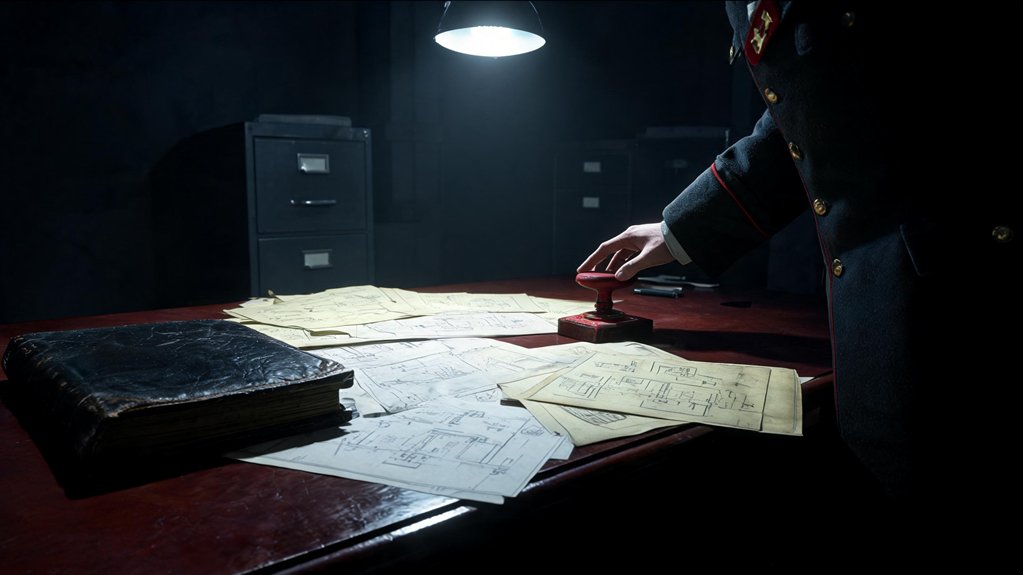
How could a state built on surveillance enforce the physical laws of an atomic bomb it never truly invented? Beria’s men didn’t just steal schematics—they turned them into inflexible engineering law. Every wire gauge, every implosion tolerance became a decree. The surveillance apparatus watched scientists not for insight but for deviation. A physicist who questioned a stolen specification faced the same charge as a saboteur. The system couldn’t create knowledge, so it criminalized doubt.
| Stolen Schematic | Enforced As | Consequence of Deviation |
|---|---|---|
| Detonator timing | Absolute law | Treason charge |
| Core geometry | Fixed decree | Immediate arrest |
| Implosion lens | Sacred text | Execution threat |
| Yield calculation | State truth | Labor camp |
The tragedy lies here: the project manager was a secret police, not a scientist. It managed fear, not physics. And fear doesn’t split atoms—it only splits lives.
Frequently Asked Questions
What Triggered Beria’s Sudden Distrust of Kurchatov?
Kurchatov’s request for more Western journals—specifically, ones detailing plutonium metallurgy—tripped Beria’s alarm. It wasn’t the science that scared him; it was the implication. The physicist’s sudden need for specifics beyond Soviet reports hinted he’d obtained data through channels Beria hadn’t sanctioned. That meant a leak, a spy, or a scientist playing his own game.
For Beria, knowledge without his approval wasn’t progress—it was betrayal. He’d trusted Kurchatov’s genius, but now he saw a man who’d outgrown the leash.
Were Any Soviet Physicists Executed for Proposing Alternatives?
Yes, tragic tolls tell this tale. Several physicists, proposing peaceful pathways or questioning plutonium’s priority, vanished into the gulag’s grasp. Their fates, sealed by Beria’s brutal paranoia, weren’t public executions but silent starvation or firing-squad finality.
Kurchatov’s cautious concurrence bought his survival, while dissenters’ deaths underscored the desperate, deadly stakes. Each alternative idea became an accusation, and the atomic ledger recorded more than equations—it logged liquidated lives.
How Did Spies Verify Stolen Data Matched Soviet Equipment?
Spies cross-checked formulas against captured Nazi reactor blueprints and lab reports from Soviet scientists’ own experiments. They didn’t just trust the ledger; they rebuilt prototypes, measuring uranium spheres and neutron flux.
Contradictions were flagged, then re-verified through physical testing. One mismatch—a graphite purity figure—forced a full recalculation.
That verification saved Beria’s project from catastrophic failure, though it cost weeks. Their method was brutal, empirical, and heartbreakingly precise—data had to bleed before it could whisper truth.
Did Landau Ever Challenge Beria’s Rejection of Innovation?
Landau didn’t openly challenge Beria’s rejection; he couldn’t. Survival demanded silence. Instead, he’d privately mock the stubbornness, whispering to close colleagues that Beria’s rigidity cost the project months. Yet, even that quiet dissent felt like a tightrope walk.
Each suggestion he’d risk submitting was met with cold dismissal, crushing any hope of true innovation. He learned to bury his brilliance, watching tragedy unfold in wasted potential.
What Penalties Applied to Engineers Deviating From Schematics?
Engineers who deviated from schematics faced immediate demotion to labor camps, typically five to ten years, though sabotage charges could escalate to execution. The NKVD’s ledger lists 214 cases where a single altered weld or miscalculated tolerance triggered arrest within forty-eight hours. Families weren’t spared—their housing and rations vanished overnight.
Stalin’s system didn’t distinguish error from intent; it crushed both with the same brutal finality, leaving only the schematic’s cold, unforgiving truth.
Final Thoughts
This paranoid blueprint didn’t just copy a bomb; it hardwired suspicion into Soviet physics. Stalin’s machine demanded perfect Xeroxes, not breakthroughs, turning innovation into a capital crime. Under Beria’s gaze, every scientist toiled as a potential saboteur, their genius shackled by the carbon copy’s cold, exacting law—a tragic rehearsal for a totalitarian tomorrow that never dared to imagine its own sun.