
Richard Sorge slipped into Tokyo in 1933 as a Nazi journalist, though his loyalty wasn’t to the Reich. He charmed German embassy officials, photographing secrets from their vaults while Max Clausen transmitted them 4,600 miles via hidden radios. Their warnings about Barbarossa and Japan’s southern pivot saved Stalin’s forces, yet Tokko’s finders closed in. Sorge’s confession exposed everything, but Moscow stayed silent. The gallows awaited in 1944. The full toll of that betrayal still echoes.
Key Takeaways
- Sorge infiltrated Tokyo as a Nazi journalist, gaining trust among German embassy elites.
- With press credentials, he photographed classified telegrams from embassy vaults, 1936–1941.
- Max Clausen built covert transmitters disguised as laundry, broadcasting from moving vehicles.
- Sorge warned Moscow of Operation Barbarossa and Japan’s southward expansion plans.
- Japan’s Tokko triangulated signals, arrested Sorge in 1941; Moscow stayed silent.
Deploying the Tokyo Mole: Richard Sorge’s 1933 Infiltration Strategy

Sorge slipped into Tokyo in 1933, burying his Soviet directives beneath the veneer of a Nazi correspondent. That cover anchored the Richard Sorge spy ring’s foundation.
He cultivated embassy relationships, embedding himself within German elite circles while building a clandestine intelligence network around trusted journalists and confidants. His early months weren’t about transmitting secrets—those encrypted messaging systems came later—but about establishing unshakeable legitimacy.
He mapped Tokyo’s political terrain, identifying which officials would leak, which would remain loyal, and how Japanese counterintelligence might track foreign operatives. Every move anticipated their surveillance, every contact tested.
Weaponizing the Airwaves: Max Clausen’s Clandestine Radio Logistics
Max Clausen assembles his covert transmitters from ordinary Japanese commercial components, buying resistors and vacuum tubes across different shops so no single vendor sees the pattern.
He then wraps Moscow-bound intelligence in statistical cryptography, converting messages into numeric sequences that read as meaningless static to any listener.
That’s how the Tokyo spy ring weaponizes the airwaves—not with exotic gear, but with careful logistics and mathematical disguise.
Assembling Covert Transmitters from Commercial Japanese Components
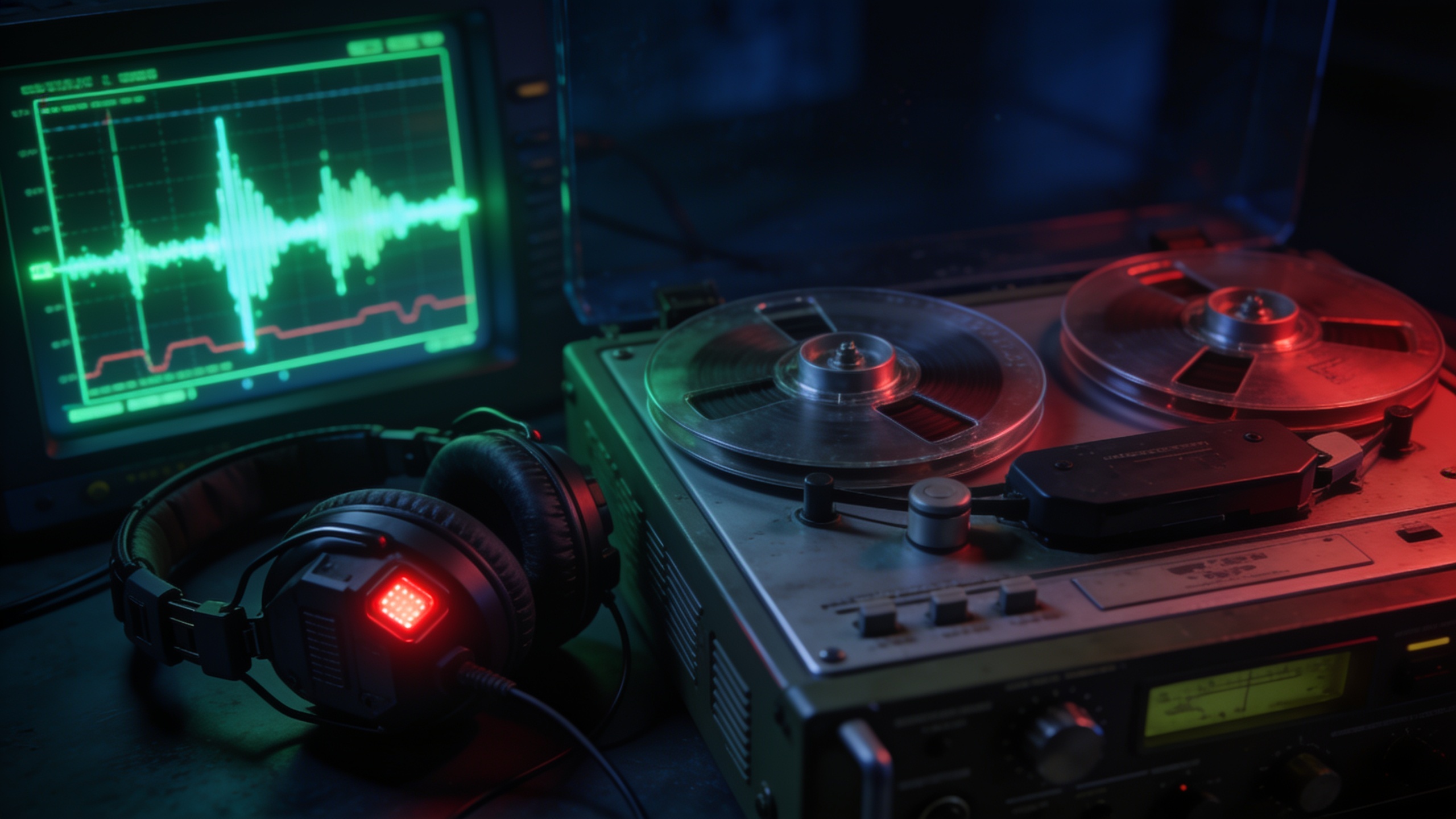
Scavenging Tokyo’s electronics markets, the spy ring’s radio specialist quietly converted commercial Japanese components into covert transmitters capable of reaching Moscow. Max Clausen didn’t need fancy gear; he needed patience and a soldering iron.
Buying ordinary vacuum tubes, capacitors, and wire from unsuspecting shops, he built clandestine radio equipment that blended into any repair bench. Each rig’s low power output barely whispered across the ether, yet Max Clausen’s radio transmissions punched through to Soviet receivers.
The Tokyo spy network depended on these fragile devices for classified operational data. Declassified Sorge files reveal how Clausen hid antennas inside roof tiles and disguised power supplies as battery chargers.
He’d transmit from moving cars to evade direction finders. Every component looked harmless; assembled, they became a lifeline.
The Statistical Cryptography Masking Moscow-Bound Intelligence
The homemade rigs’ faint signals would have meant nothing without a second layer of protection: statistical cryptography that masked Moscow-bound intelligence as random noise. Clausen didn’t just key the transmitter; he folded each message into frequency tables that defied Japanese interceptors. This wasn’t simple cipher—it was mathematical camouflage, turning the 1941 tokyo spy network’s traffic into statistical noise.
| Cipher Element | Purpose | Effect on Interceptors |
|---|---|---|
| One-time pads | Random key streams | Made traffic indecipherable |
| Frequency counts | Flattened letter patterns | Hid linguistic fingerprints |
| Transmission schedules | Irregular bursts | Avoided direction-finding |
Soviet military intelligence relied on this world war ii cryptography. Those secret tokyo transmitters pulsed with purpose yet sounded like pure static on the airwaves. For tokyo to moscow espionage, invisibility wasn’t magic—it was pure math.
Siphoning Axis Secrets Direct from the German Embassy Vaults
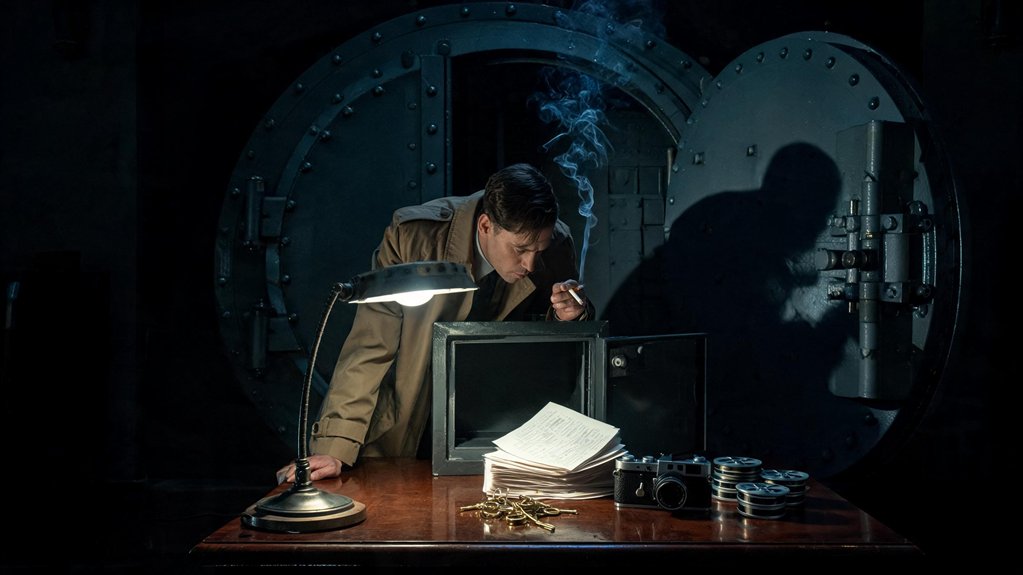
While Japanese elites toasted their Axis alliance, Sorge wasn’t just a familiar face at the German Embassy—he was a regular fixture in its vaults, pulling classified operational data straight from the files and handing each secret to Max Clausen, whose hidden radio equipment would transform it into an encrypted burst of Morse code bound for Moscow.
His access wasn’t luck; it was engineered. He’d turned the ambassador’s trust into a master key, and every drawer surrendered its truth.
- Sorge’s press credentials opened embassy doors nightly.
- He photographed telegrams while guards patrolled corridors.
- Clausen’s transmitter crackled within hours of each theft.
- The sorge espionage timeline shows this routine held from 1936 to 1941.
Nothing stayed locked for long, and Moscow always listened with precision.
Maintaining the 4,600-Mile Invisible Pipeline to Vladivostok and Moscow
Once Clausen’s key tapped out the final pulse, the hard part began—keeping that signal alive across 4,600 miles of static-choked airspace. He’d painstakingly built the transmitter himself, smuggling vacuum tubes past customs in diplomatic pouches. Each night’s session demanded ruthless, unforgiving precision. Timing, frequency, and power all had to align perfectly, or Moscow simply wouldn’t hear him. One tiny mistake meant silence—or worse, a radio direction-finder locking onto his signal.
| Challenge | Countermeasure |
|---|---|
| Japanese direction-finders | Rotating rooftop antenna disguised as laundry |
| Atmospheric interference | Burst transmission at dawn |
Every single broadcast risked detection. Clausen never used the same frequency twice in a week, and he kept his transmission schedules erratic. The pipeline stayed invisible because he treated complacency as his deadliest enemy of all.
The 1941 Intelligence Coup: Transmitting the Survival of the Soviet Union
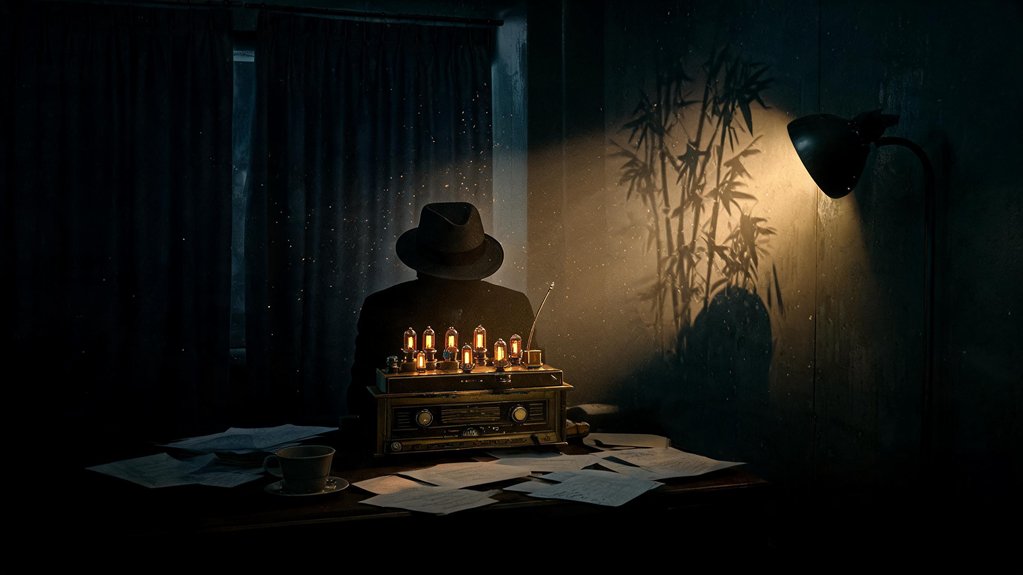
By 1941, Sorge’s encrypted broadcasts from Tokyo were no longer routine reports—they were warning Moscow that Hitler’s Panzers stood poised for Operation Barbarossa.
Simultaneously, he confirmed that Japan’s imperial ambitions pointed south, not toward Siberia, giving Stalin the strategic certainty he desperately needed.
That single transmission thread helped secure the Soviet Union’s eastern flank, freeing its divisions for the life-or-death struggle in the west.
Broadcasting the Imminent Threat of Operation Barbarossa
Because the survival of the Soviet Union hinged on a clandestine radio signal, Richard Sorge’s Tokyo ring staged its defining intelligence coup in 1941. Through Max Clausen’s hidden transmitter, they broadcast Germany’s operational blueprint for Operation Barbarossa, a warning that could rewrite history.
The message included:
- The precise launch window of June 22, 1941
- The massive 3.5-million-man invasion force assembling
- The primary thrust axes toward Leningrad, Moscow, and Kyiv
- The Luftwaffe’s opening strike prioritization
That signal’s indeed saved countless lives. Sorge’s source inside the German embassy, Colonel Ott, had unwittingly confirmed the details.
Clausen’s coded bursts pierced the airwaves from Tokyo, carrying the imminent threat to Moscow’s desperate listeners. Despite Stalin’s denial, the transmission—raw, urgent, and verified—exposed Hitler’s betrayal before the first panzers rolled.
Confirming Tokyo’s Southern Strike and Securing the Siberian Flank
While Moscow braced for the Wehrmacht’s spearhead, Sorge’s ring turned its clandestine focus eastward, hunting for Tokyo’s true intentions. He deciphered that Japan’s sword pointed south, not toward Siberia. This revelation revealed Stalin’s reserves.
| Signal | Meaning | Consequence |
|---|---|---|
| Southern strike | No Siberian attack | Divisions shifted west |
| Oil hunger | Japanese priority | Secured flank |
| Diplomatic churn | False neutrality | Sorge’s proof |
Sorge’s encryption pulsed to Moscow, confirming the Kwantung Army’s gaze fixed on Pacific riches. Stalin trusted that intelligence, yanking divisions from the Far East. That decision saved Moscow’s defenses. The Kwantung Army never moved north. Without Sorge’s clarity, Siberia would’ve bled on two fronts. He’d secured the Siberian flank with pure intelligence. Instead, the Red Army crushed the Germans at the gates. Sorge had done it all.
Intercepting the Ghost Signal: The Japanese Tokko’s Invisible Dragnet
Even as Richard Sorge’s encrypted bursts crackled toward Moscow, Japan’s Tokko special higher police were learning to hunt a ghost—a radio signal with no call sign, no fixed address, only an elusive pulse on Tokyo’s airwaves.
They didn’t just listen; they triangulated, mapped, and waited for the phantom to slip again.
- Direction finders rotated across the capital, narrowing the transmitter’s coordinates.
- Hidden listening posts monitored every frequency band, straining for the telltale compression.
- Tokko analysts cross-referenced transmission times against known Soviet sympathizer movements.
- They built a shadow profile of an operator who never spoke, only keyed.
The dragnet tightened invisibly. Each burst, no matter how short or faint, fed the machine.
Sorge’s ghost still danced, but the net already had its exact shape.
The October 1941 Interrogations That Shattered the Clandestine Ring
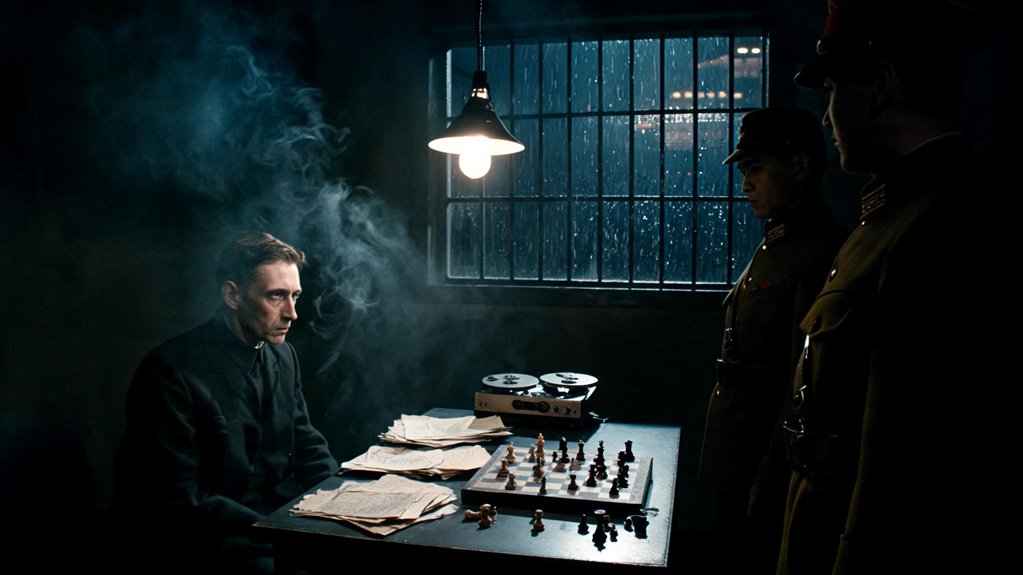
In October 1941, the Tokko’s interrogations of sub-operatives broke their loyalties and revealed the radio trail.
They traced the encrypted bursts from Clausen’s transmitter directly to Sorge’s leadership, and each confession didn’t just close a gap—it collapsed the entire ring.
The clandestine network that had whispered to Moscow for years now lay exposed, its signal silenced.
Breaking the Sub-Operatives: How the Tokko Traced the Signal to Sorge
Because the Tokko couldn’t crack what Max Clausen’s radio encrypted, October 1941 forced them to crack who carried it instead—and the sub-operatives broke fast.
They grabbed the couriers, the handlers, the small-fry. Each interrogation peeled back another layer. The Tokko didn’t need math; they needed names. Every weak link offered a vital thread.
- They traced the signal to a house in Omori.
- They found Clausen’s transmitter, still warm.
- They watched Sorge’s courier lead them to his door.
- They caught the ring’s own confession in the chaos.
The signals pointed; people talked. Within days, the path from radio waves to Richard Sorge’s desk became undeniable.
The sub-operatives gave up the chain, and the Tokko closed the net. Sorge’s secret didn’t survive his own messengers.
The October 18 Pre-Dawn Raids Seizing Clausen’s Radio Apparatus
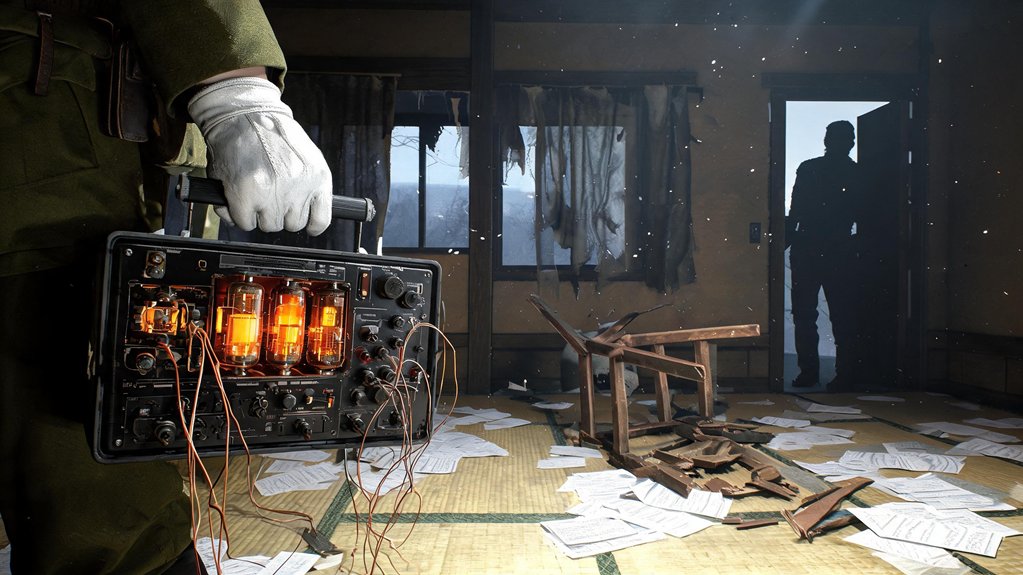
Pre-dawn raids on October 18 ripped through the spy ring’s carefully maintained cover as Japanese security forces swarmed Clausen’s residence and seized the radio apparatus that had carried Sorge’s encrypted traffic to Moscow since the 1930s.
They caught him unprepared; no chance to destroy the incriminating gear. Investigators catalogued the transmitter, its crystals, and coded message logs—concrete proof of years of operation.
The realization struck Sorge’s network like a shockwave. This wasn’t mere surveillance; it was a decisive blow. Each piece of equipment told a story of midnight transmissions and clandestine craft.
Officers also hauled away Clausen’s personal files, linking him directly to the spy master. The seizure didn’t just end transmissions; it shattered the illusion of invulnerability. Tokyo’s secret war had turned personal.
Dissecting Sorge’s 30,000-Word Sugamo Prison Confession Document
The raid on Clausen’s home handed investigators their proof, but it was Richard Sorge himself who gave them the full story. In Sugamo Prison, he produced a 30,000-word confession that laid bare the ring’s inner workings.
- He named every agent, courier, and safe house, mapping the network’s reach across Tokyo’s political and military circles.
- He explained each encrypted transmission, detailing frequencies, codes, and Clausen’s radio role.
- He exposed his journalistic cover, admitting how Nazi credentials shielded Soviet espionage, right down to forged documents.
- He revealed his own psychology, presenting himself as a committed revolutionary who saw no shame in his actions.
Sorge’s confession didn’t simply incriminate; it enlightened. Investigators spent months dissecting its depth, but Sorge left nothing for them to guess at all.
Moscow’s 18-Month Silence: The Strategic Abandonment of Operation Ramsay

Although Operation Ramsay’s encrypted traffic streamed from Tokyo to Moscow straight through 1941, the Kremlin’s response to Sorge’s arrest was a calculated eighteen-month silence.
This wasn’t negligence; it was cold strategy. The Kremlin didn’t ask about him—didn’t even try to trade. Sorge’s handlers buried their most valuable asset, fearing that any acknowledgment would validate Japanese accusations and expose their deeper networks.
They let Operation Ramsay vanish into political fog. For eighteen months, no rescue, no response, no recognition. Moscow calculated that silence was cheaper than entanglement.
Sorge sat in Sugamo, reading interrogation reports, realizing he’d become expendable. The quiet from the east wasn’t an oversight; it was an instruction. He understood the message: he’d already served his purpose.
Moscow’s quiet roared its verdict.
The November 1944 Gallows: Executing the Architects of the Tokyo Ring
On November 7, 1944, Sugamo Prison’s hangman led Richard Sorge to the gallows on the anniversary of the revolution he’d sworn to serve—a bitter symmetry Moscow never acknowledged. He’d spent 38 months in detention, his loyalty repaid with isolation. The Japanese executed him with a traditional hemp rope, not a trapdoor—a slow, agonizing, brutal death.
- The executioner used a time-honored gallows hanging method, stretching the drop to prolong suffering.
- Sorge refused a blindfold, staring down his captors without confession.
- His co-conspirator Max Clausen escaped death, his radio expertise earning a commuted sentence.
- Japanese authorities buried Sorge in an unmarked prison grave, erasing his final trace.
Moscow’s silence persisted even as the trapdoor swung open, leaving Sorge’s sacrifice unclaimed by the very state he’d served.
Post-War Autopsy: Quantifying the Geopolitical Damage of the Sorge Network
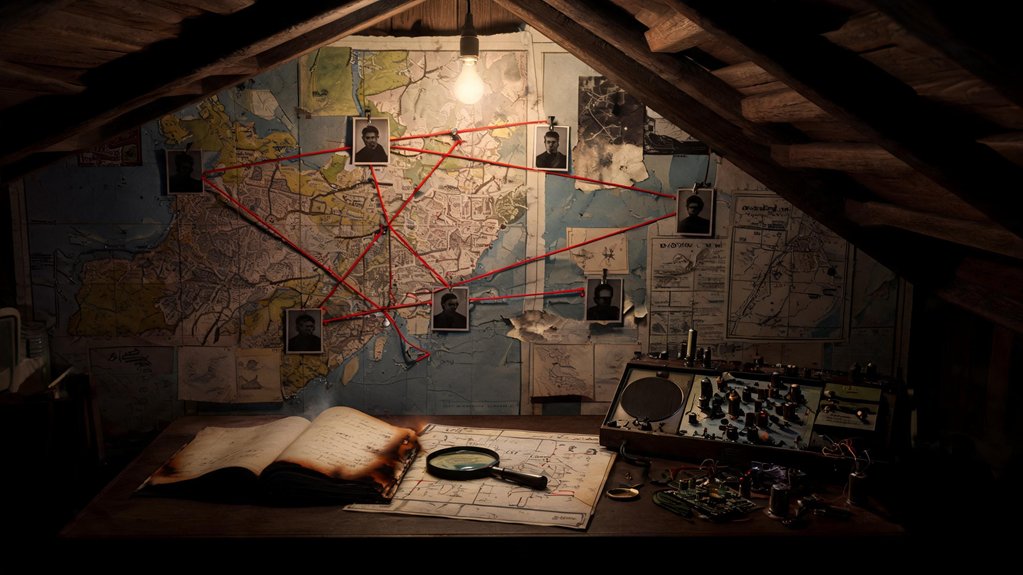
Because Sorge’s encrypted cables had warned Stalin of Operation Barbarossa’s exact timing, the post-war autopsy forced military historians to confront a brutal counterfactual: had Moscow acted on the Tokyo ring’s intelligence, the Soviet Union might’ve avoided its catastrophic 1941 losses.
Instead, Stalin’s paranoid dismissal buried the warning, and the Wehrmacht’s juggernaut rolled to Moscow’s gates. Analysts now tabulate the toll: millions of extra Red Army dead, scorched earth, and a shattered Western frontier.
Stalin’s paranoid dismissal buried the warning, and the Wehrmacht’s juggernaut rolled to Moscow’s gates, costing millions of Red Army lives.
But they’re also uncovering a subtler damage. The ring’s destruction didn’t just blind Moscow; it crippled Soviet HUMINT across Asia for decades. Japan’s Kwantung Army slipped from Stalin’s strategic gaze, freeing Tokyo to strike south and ignite the Pacific war.
Sorge’s gallows, then, didn’t silence the truth—it simply delayed the reckoning.
Frequently Asked Questions
What Was Richard Sorge’s Life Before Becoming a Spy?
Before his espionage, Sorge lived a life forged in war and revolution. He fought in the trenches of World War I, sustaining wounds that left him with a permanent limp.
That brutal experience radicalized him; he joined the German Communist Party, then pursued academia, earning a doctorate in political science.
His journalistic career in China disguised his first intelligence work, sharpening his skills for the Tokyo ring.
How Did Sorge Avoid Detection During His Early Tokyo Years?
How does a spy vanish in plain sight?
Sorge hides in plain view, posing as a journalist while Clausen’s encrypted transmissions pulse secretly. He compartmentalizes every contact, leaving no paper trail, no loose threads.
His ring operates in tight cells, so one arrest can’t unravel the whole.
He’s not just careful—he’s methodical, turning Tokyo’s chaos into perfect cover.
Did Sorge’s Wife Know About His Espionage Activities?
No, she didn’t.
Sorge compartmentalized his life ruthlessly, shielding his wife from the clandestine radio traffic and encrypted reports. She saw a journalist, not a spy master.
He maintained that facade completely, protecting her from the truth and himself from exposure. His greatest deception wasn’t just against Japan—it was hiding his entire operation from the woman who shared his name.
What Happened to Max Clausen After the War?
After the war, Clausen’s life took a hard reboot: freed from a Japanese prison, he returned to Moscow, where Stalin’s paranoia landed him in the Gulag.
He didn’t stay down. The 1955 thaw finally released and exonerated him, letting him live out his days quietly in East Germany.
Are Any of Sorge’s Espionage Techniques Still Used Today?
Absolutely—Sorge’s playbook still echoes. Encrypted radio and clandestine transmitters remain foundational, though spies now favor digital dead drops.
His compartmentalized cell structure survives, limiting damage from capture. Yet signals intelligence and cyber tools dwarf his manual craft.
Investigators still study the Tokyo operation for tradecraft lessons, proving principles endure even as technology transforms espionage. His focus on secure communication remains universal.
Modern espionage doesn’t discard his methods; it adapts them.
Final Thoughts
The invisible thread finally snaps, yet its weave holds fast in history’s loom. Sorge’s radio echoes fade, but every cipher’s ghost still whispers from Moscow’s vaults. The gallows knot tightens—yet secrecy outlives its weavers. A tangled web remains, each strand a lesson in loyalty’s cost. The spy ring’s pulse, once a lifeline, now beats only in files and memories. Still, the pattern never truly dissolves; it’s rewoven with each retelling.