At FOB Hammer, Chelsea Manning weaponized trust, burning over 700,000 classified files onto CDs disguised as pop music. Analysts left terminals open while auditors ignored write logs, letting a single workstation bleed secrets for months. These weren’t just leaks; they were the systematic collapse of SIPRNet’s operational security. The forensic trail sealed the case, but the Pentagon’s real reckoning had only just begun.
Key Takeaways
- Disguised classified files as music CDs to bypass security checks.
- Exploited unsecured SIPRNet terminals during shift changes and breaks.
- Exfiltrated over 1 gigabyte, including 251,287 diplomatic cables by May 2010.
- Forensic logs and file hashes traced stolen data to Manning’s workstation.
- Pentagon banned writable media after audits revealed systemic oversight failures.
Deploying to Forward Operating Base Hammer: The 2nd Brigade’s Intelligence Blind Spot
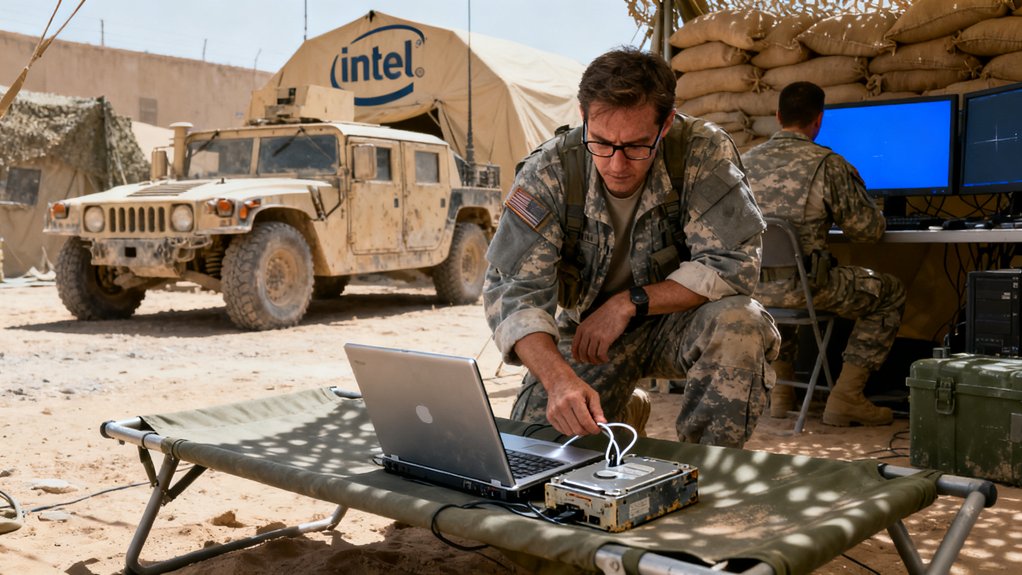
Though the 2nd Brigade Combat Team’s intelligence section was supposed to be the eyes of the division, its deployment to Forward Operating Base Hammer in 2009 revealed a critical blind spot—one that Chelsea Manning would exploit with chilling ease.
The unit’s focus on kinetic threats left digital protocols lax, a textbook operational security failure. Analysts routinely left SIPRNet terminals logged in, and supervisors rarely audited removable media usage. This indifference created fertile ground for the Chelsea Manning exfiltration to begin.
Manning arrived as an all-source analyst, yet found no enforced separation between music CDs and classified data. The brigade’s counterintelligence posture prioritized insurgent networks, not insider threats.
Consequently, writable discs passed through checkpoints without question, bypassing the very safeguards meant to protect the network. This gap wasn’t sophisticated—it was mundane negligence.
Writable discs slid past checkpoints unnoticed—not a sophisticated breach, just mundane negligence.
The unit’s leadership trusted the perimeter, forgetting that the danger had already breached it from within. That trust, not encryption, was the first casualty at FOB Hammer.
Late 2009: Initiating the Massive SIPRNet Hemorrhage in the Iraqi Desert
By late 2009, the desert heat at FOB Hammer wasn’t the only thing burning—Manning had begun siphoning SIPRNet’s classified veins, turning the intelligence section’s own lax protocols into a hemorrhage.
Inside the cramped analysis cell near FOB Hammer Baghdad, she exploited a glaring oversight: analysts routinely left terminals accessible during shift changes. Manning initiated unauthorized data access with chilling method, downloading cables, field reports, and diplomatic traffic onto writable discs, each transfer bypassing audit trails that nobody monitored.
The scale escalated weekly. She’d queue bulk pulls during meal breaks, masking the exfiltration behind routine file searches.
Colleagues noticed her unusual hours but never questioned the stack of CDs piling beside her workstation—they assumed it was music. By December, Manning had already extracted more than a gigabyte, a figure that would spiral into terabytes, yet no alarm sounded.
The 2nd Brigade’s blind spot wasn’t technical; it was complacency, and Manning weaponized it daily.
The Camouflage of Pop Music: Subverting Operational Security with Writable CDs

Manning didn’t break into SIPRNet with sophisticated malware; she exploited glaring gaps in a restricted military environment where blank writable CDs were practically standard issue.
The decoy was audaciously simple—she slapped pop music labels on discs holding hundreds of thousands of classified files, betting that security checks would bounce off the mundane exterior.
Exploiting Workstation Vulnerabilities in a Restricted Military Environment
While the technical barriers around SIPRNet seemed formidable—encryption, authentication protocols, and physical security—Manning found the human layer was the softest target.
The workstations themselves harbored siprnet workstation vulnerabilities that weren’t in the hardware but in the operational culture. Analysts routinely left terminals ajar during shifts, and supervision rarely audited disc-burning activity.
Manning exploited this drift with chilling precision:
- She targeted low-traffic hours when oversight lagged.
- She leveraged her legitimate clearance to access classified data exfiltration points without raising flags.
- She tested the system’s logging gaps by burning harmless files first.
Each step chipped away at the façade of invincibility. The restricted environment’s real weakness wasn’t the network—it was the assumption that no insider would dare.
Manning proved otherwise, turning routine trust into a weapon.
The Audacity of the Decoy: Masking High-Level Espionage as Contraband Audio
Inside the cramped intelligence shop at FOB Hammer, the unremarkable act of burning a CD became the perfect cover for a breach that would ripple across the global security apparatus.
Manning weaponized the mundane: a writable music cd disguise, stocked with Britney Spears tracks, masked gigabytes of SIPRNet dumps. Nobody questioned a soldier’s need for contraband audio during downtime, so she cycled discs labeled as pop albums, each swallowing classified cables and war logs.
The audacity lay in the banality—this wasn’t slick spycraft but a brazen subversion of every protocol. When the trail finally led to her Kuwait espionage arrest, investigators found a trove of these innocuous discs, proving that operational security’s greatest blind spot was trusting the ordinary.
The decoy didn’t hide the crime; it hid the criminal.
Exfiltrating the Shadow War: The Systematic Theft of Diplomatic and Military Archives
From late 2009 until her arrest in May 2010, the U.S. military’s classified shadow war in Iraq and Afghanistan bled out through a single compromised workstation at FOB Hammer.
The 2nd brigade combat team’s intelligence shop became the epicenter of a staggering military intelligence breach, as Manning methodically drained diplomatic cables and war logs onto writable CDs disguised as music.
She didn’t grab random files; she targeted archives revealing civilian casualties, detention abuses, and State Department duplicity.
The scope defies simple description, but envision this:
- 251,287 diplomatic cables exposing back-channel deals and coerced alliances.
- 482,000 Army reports tracking IED strikes, raids, and insurgent body counts.
- 92,000 Afghanistan war logs documenting night raids and friendly-fire incidents.
Each disc, labeled with track titles, slipped past guards who saw contraband, not espionage.
The archive’s sheer volume reveals a calculated sweep, not a desperate grab—a systematic theft that turned a single terminal into a leak that drowned the shadow war’s secrets.
The Illusion of the Secure Internet Protocol Router Network
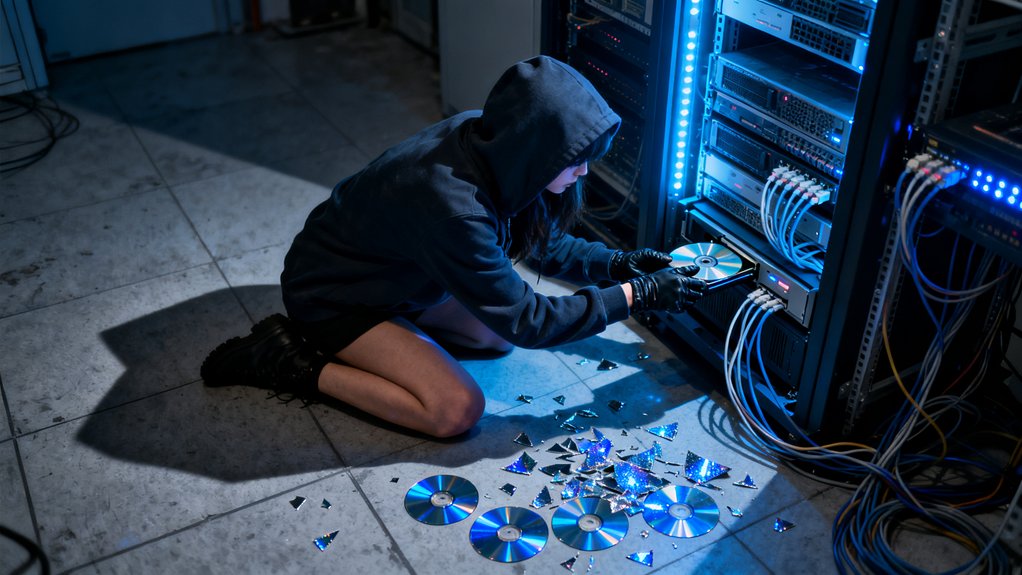
The 2nd Brigade Combat Team’s oversight failures weren’t a simple lapse—they formed a layered illusion of security that let Manning operate undetected for months.
Auditors kept signing off on SIPRNet protocols while writable CDs slipped past physical checks and routine monitoring, exposing a systemic blindness to insider threats.
That multi-month window of extraction wasn’t a fluke; it was the predictable result of trusting the network’s reputation over its real-world vulnerabilities.
Auditing the Systemic Oversights within the 2nd Brigade Combat Team
Although every soldier at FOB Hammer was briefed on counterintelligence fundamentals, the 2nd Brigade Combat Team’s operational security posture crumbled precisely because its leadership treated SIPRNet as a trusted enclave rather than a target-rich environment.
They never audited the mundane acts that enabled a diplomatic records leak or questioned why one analyst kept accessing restricted SIPRNet files at odd hours.
Several systemic oversights stand out:
- No correlation between CD write logs and shift assignments.
- Zero review of removable media policies despite prior warnings.
- Blind faith in badge access, ignoring physical proximity to burn stations.
Each omission built a ladder for exfiltration.
Manning didn’t hack the network; she exploited the brigade’s refusal to inspect its own routines.
That’s the real illusion—not SIPRNet’s encryption, but the assumption that protocol equals vigilance.
The Multi-Month Window of Undetected Data Extraction
Months slipped by as Manning fed disc after disc into the same writable CD drive, each spin a quiet theft that SIPRNet’s own architecture never flagged. The system’s audit logs, designed for external threats, ignored her routine, low-volume downloads. This multi-month window wasn’t a failure of encryption; it was a blindness to pattern.
| Phase | Duration | Signature Escalation |
|---|---|---|
| Recon | Weeks | Zero file flags |
| Harvest | ~3 Months | CD-burn caching |
| Cover | Continuous | Music disc labels |
Each extraction relied on mundane batching, blurring into her daily intelligence work. The declassified military records show no alert triggered until a colleague spotted the discs—not a network defense. Her espionage mechanics timeline reveals a brutal truth: SIPRNet promised security but offered only an illusion, vulnerable to the patient, the quiet, the unseen.
From a Dust-Choked Baghdad Outpost to a Historically Significant Global Leak
- She labeled discs with pop songs, masking exfiltration as personal media burns, while guards never questioned the stacks.
- She targeted diplomatic cables and war logs, not for immediate impact, but to build a trove with global resonance.
- She timed downloads during shift changes, when oversight lagged and trust in the section’s routines ran thick.
From that isolated compound, the mundane became monumental—a single soldier’s quiet insistence that secrecy had been weaponized against the public.
May 2010: The Kuwait Takedown and the Termination of the Intelligence Breach
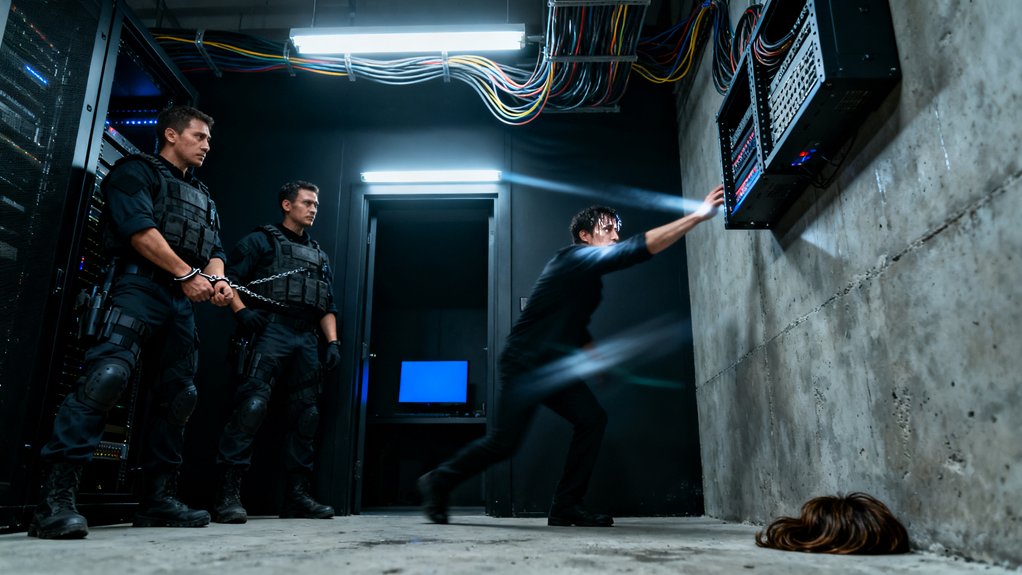
Investigators traced the stolen data back to the compartmented terminals at FOB Hammer by matching file hashes and server logs, locking onto Manning’s workstation as the sole source.
They executed the takedown in Kuwait on May 27, 2010, pulling her from a forward-deployed unit and severing her access to the SIPRNet for good.
The arrest didn’t just end a breach; it froze an unprecedented information flow that had already reshaped global perceptions of U.S. operations.
Tracing the Forensic Digital Footprints Back to the Compartmented Terminals
The forensic trail snaps shut in May 2010 when military counterintelligence finally zeroes in on the compartmented terminals at FOB Hammer, tracing the exfiltrated SIPRNet files directly back to Chelsea Manning’s workstation.
Digital breadcrumbs reveal a deliberate pattern of evasion, not random access. Analysts piece together the breach mechanics:
- Writable CD ghosting – Manning masks data burns as music discs, timestamped during low-traffic night shifts.
- Terminal access anomalies – Login logs show recurrent, unauthorized sessions on a single SIPRNet terminal, bypassing standard audit flags.
- File-size discrepancies – Batch downloads of gigabytes lack corresponding uploads to authorized drives, marking them as extraction points.
Each footprint threads through encryption gaps and physical blind spots, converging on a singular workstation.
The evidence doesn’t guess; it states—Manning’s terminal was the funnel, and the covert channels now seal shut.
Executing the Arrest and Halting the Unprecedented Information Flow
May 2010 snapped the breach shut in Kuwait, where military authorities executed a coordinated takedown of Chelsea Manning, halting the unprecedented flow of classified SIPRNet files before additional damage could unfold. Investigators, tracing the digital trail from FOB Hammer, pinpointed Manning’s location and coordinated with Kuwaiti-based units for a swift, quiet apprehension. The arrest wasn’t a dramatic raid; it was a precision operation, isolating Manning without alerting other potential collaborators.
| Takedown Element | Execution Detail |
|---|---|
| Intelligence Lead | Forensic logs matched Manning’s workstation activity |
| Arrest Location | Kuwait, during a routine transit stop |
| Immediate Outcome | Seizure of CDs and termination of access |
That seizure ended the exfiltration cold, but it didn’t erase the damage—it just stopped the bleeding. The breach’s scale, hidden for months, now demanded a full accounting.
Securing the Compromised Outpost: The Immediate Forensic Seizure of FOB Hammer
Within hours of Manning’s apprehension in Kuwait, forensic teams swooped into FOB Hammer to lock down the compromised intelligence hub. They immediately severed every SIPRNet terminal from the network, halting any residual bleed. The scene resembled a surgical strike on digital infrastructure, not a chaotic scramble.
Investigators executed a meticulous triage:
- Physical Seizure: They confiscated every writable disc, hard drive, and peripheral within Manning’s intelligence cell, bagging them as evidentiary exhibits.
- Access Log Review: Analysts pulled exhaustive server logs to map every file Manning touched, reconstructing her exfiltration timeline with forensic precision.
- Credential Rotation: They instantly invalidated all active user credentials tied to the compromised section, ensuring no ghost access remained viable.
This wasn’t just cleanup; it was a quarantine. The teams scrubbed hardware for latent data traces while isolating the unit’s operational chatter.
Their urgency reflected a stark reality: the outpost’s defenses had failed, and securing the scene meant confronting how easily a disguised CD had become a weapon of mass disclosure.
Quantifying the Catastrophe: Analyzing the Evidentiary Basis of the Declassified Files
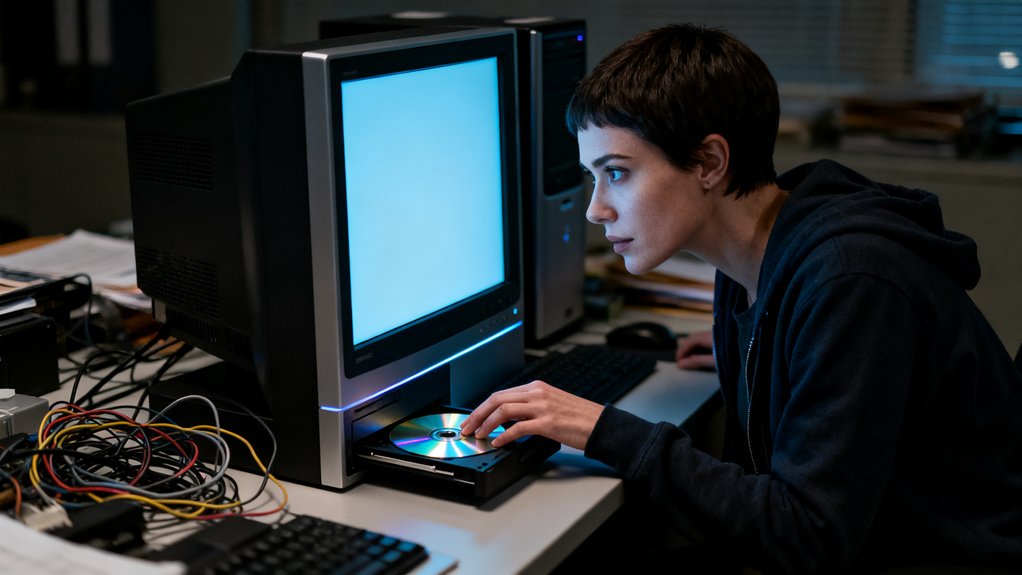
Every declassified file from the Manning case reads like a smoking gun, and together they form a forensic mosaic that quantifies the catastrophe with chilling exactness.
Analysts trace a distinct architectural flaw: SIPRNet’s unrestricted lateral access meant a single operator could touch hundreds of thousands of records without triggering initial alarms.
The evidentiary trail doesn’t rely on witness speculation; it rests on immutable metadata from 240,000 diplomatic cables and 400,000 Army reports.
Each succession of timestamps plots a deliberate, methodical crawl through compartmented folders, not a haphazard grab. That chronological precision exposes the sheer volume’s crux—Manning’s captures weren’t opportunistic; they were systematic sweeps supported by delegated credentials.
The declassified files also spotlight the weak audit logging; their existence proves the system lacked the thresholds to distinguish routine retrieval from mass exfiltration until it was far too late.
Consequently, the numbers don’t just measure leaked bytes; they measure a betrayed trust’s sheer scope.
Post-Mortem on the 2nd Brigade: Exposing the Pentagon’s Insider Threat Vulnerability
The 2nd Brigade’s chain of command ignored escalating OPSEC red flags, from Manning’s erratic behavior to her odd fixation on data, and that negligence handed her the keys to SIPRNet.
Those supervisors never questioned the writable CDs she labeled as music, a failure that transformed a preventable moment into a historic breach.
That’s why the post-mortem’s real demand isn’t just punishment—it’s an outright ban on removable media across every DoD network, because nothing less could have stopped her.
The Chain of Command’s Failure to Intercept Escalating OPSEC Red Flags
Although hindsight offers perfect clarity, those scrutinizing the 2nd Brigade’s post-mortem find a glaring, undeniable pattern: Manning’s superiors were confronted with a series of escalating operational security (OPSEC) red flags that should have triggered an immediate lockdown.
The post-mortem reveals a chain of command paralyzed by bureaucratic inertia, failing to connect discrete incidents into a coherent threat picture. They watched, apparently mesmerized, as the risk profile climbed.
- Behavioral instability: Manning’s erratic mood swings and bizarre conduct, including a physical altercation with a superior, were documented but never flagged as a security risk.
- Mishandling of media: The lieutenant witnessed Manning carrying labeled CDs marked “Lady Gaga” into a classified space—a violation of standing policy—yet took no corrective action.
- Suspicious technical queries: Manning asked a fellow analyst about cracking passwords and using encryption software, queries that were reported but never escalated.
Each warning sign, alone, seemed minor; together, they screamed for intervention.
The command’s failure wasn’t a single mistake—it was a systemic refusal to see the obvious.
Mandating the Eradication of Writable Media Across DoD Networks
Because the 2nd Brigade’s post-mortem laid bare how a single writable CD—disguised as a Lady Gaga album—could bleed the nation’s secrets dry, the Pentagon’s response pivoted not to better surveillance, but to the wholesale eradication of writable media across the DoD’s networks.
Investigators concluded that no software could outpace a determined insider’s manual theft, so they removed the vector entirely. The new mandates force SIPRNet terminals to operate with sealed chassis and no optical drives, while USB ports get physically disabled.
It’s a blunt architectural fix for a human failure. Yet the question lingers: Manning didn’t need a CD to copy files—she needed trust.
The Final Court-Martial: Reconstructing the Chain of Decisions from Public Records

Even as the military court prepared to hear the government’s case, the public record reveals a delicate chain of decisions that would ultimately seal Manning’s fate—each one rooted in the exfiltration mechanics at FOB Hammer.
Reconstructing the docket shows prosecutors didn’t hinge on the sheer volume of leaked files, but on the method’s deliberateness, transforming a security breach into a treasonous pattern.
- The CD’s Labeling: Forensic logs tied each writable disc to Manning’s workstation, with handwritten titles like “Lady Gaga” masking classified folder structures—a detail that demolished any claim of accidental exposure.
- The Chat Logs: Archived FBI extracts captured Manning’s own admissions to confidants, using precise SIPRNet terminology that only an insider could replicate, directly linking intent to action.
- The Timing Sequence: Access timestamps align perfectly with Manning’s guard shifts, proving the exfiltration wasn’t opportunistic but a scheduled ritual—undermining the defense’s portrait of impulsive distress.
Each exhibit fortified the next, painting a deliberate, methodical operation the court couldn’t ignore.
Frequently Asked Questions
What Happened to the CDS After Manning’s Arrest?
The CDs didn’t vanish; investigators seized them, linking each disc to Manning’s workstation logs. They weren’t destroyed—they became evidence, cataloged for the court-martial.
The disguised music discs, once tools of exfiltration, transformed into proof of the breach’s scale. That’s the ironic twist: they survived her arrest, ensuring her conviction.
The data on them, though, was already out, distributed globally. So, while the physical discs sat in evidence lockers, their copied contents had escaped any jurisdiction.
Did Manning Act Alone or With Outside Help?
No evidence suggests Manning had outside help. Declassified files point strictly to a solo effort.
She acted alone, exploiting her own access within the 2nd Brigade Combat Team, personally copying SIPRNet files onto those music-labeled CDs.
Investigators found no accomplice, no co-conspirator, only her singular method and motive.
The breach’s success truly relied on her individual knowledge of the system’s weak spots, not on any external hand guiding the operation.
How Were the Copied Files Originally Classified?
The files Manning copied were classified as SIPRNet material, meaning Secret-level data on the Secret Internet Protocol Router Network. This wasn’t top-secret compartmented intelligence but still carried significant restrictions due to its diplomatic and military sensitivity.
Why Was SIPRNET Accessible to Lower-Ranking Intelligence Staff?
SIPRNet’s access wasn’t a mistake—it was by design. Lower-ranking intelligence staff required real-time data to perform their duties, so the network’s architecture prioritized functional need over rigid clearance tiers.
This reliance on trust over robust compartmentalization created a critical flaw: once inside, junior analysts possessed the same download capability as senior officers. Isn’t that the unsettling truth—that operational necessity, not oversight, paved the road for the breach?
The system’s very efficiency demanded that access exceed its safeguards.
What Specific Diplomatic Cables Were Included in the Leak?
The leak included over 250,000 diplomatic cables, primarily State Department communications.
These dispatches, often sent by U.S. ambassadors and their staffs, detailed candid assessments of foreign leaders, backchannel negotiation tactics, and requests for intelligence support.
They exposed the raw, unfiltered opinions of U.S. diplomats, revealing pressure campaigns on allied nations and specific demands for U.N. Security Council votes.
The cables didn’t just record policy; they laid bare the private leverage and blunt trade-offs that defined global diplomacy at the time.