Mossad’s 1960 hunt for Adolf Eichmann didn’t start on Garibaldi Street—it began with a 1957 tip, a whisper turned into coordinates through utility records and immigration ledgers. Zvi Aharoni’s surveillance grids mapped the alias “Ricardo Klement,” verifying ear cartilage against SS files. Agents snatched him in seven minutes, smuggled him out sedated on an El Al flight, and forced Israel’s hand. The fallout redefined sovereignty itself, but the full blueprint’s still unfolding.
Key Takeaways
- Mossad confirmed Eichmann’s identity via ear cartilage metrics against SS records.
- Surveillance mapped his alias “Ricardo Klement” using utility records and immigration ledgers.
- Capture occurred on Garibaldi Street at 20:05 on May 11, 1960, in seven minutes.
- Interrogation at safehouse Tira used sensory deprivation, cracking Eichmann by day four.
- Smuggling out relied on sedatives and a fake medical manifest to bypass airport security.
Igniting the Hunt: The 1957 Intelligence Leak That Exposed the San Fernando Phantom
Though the Mossad’s footprint wouldn’t appear on Argentine soil until 1960, the hunt’s true ignition point arrived three years earlier, in 1957, when a single, crackling intelligence leak shattered the phantom’s cover.
A German prosecutor’s tip, passed through intermediaries, landed on a Mossad desk—a name, a city, a whisper that Eichmann breathed under a false identity in Buenos Aires.
That spark didn’t launch agents; it forced methodical groundwork. The agency’s analysts mapped the San Fernando operational area, cross-referencing utility records and immigration ledgers, building a slow-burn dossier.
They didn’t move yet—they couldn’t. The leak demanded verification, and verification demanded time. That patience turned a rumor into coordinates.
By the time the 1960 Mossad operation encroached on Garibaldi Street, the target’s routines felt less like discovery and more like confirmation.
The 1957 leak didn’t just expose a man; it exposed a vulnerability that the later tactical extraction would ruthlessly exploit.
The Architecture of “Ricardo Klement”: Decoding the Bureaucratic Shield Protecting a War Criminal
Once the 1957 leak pinned Eichmann to Buenos Aires, the deeper problem wasn’t finding him—it was cracking the bureaucratic shell that let him vanish inside a mundane alias.
“Ricardo Klement” wasn’t a flimsy disguise; it was a layered construct of forged papers, quiet neighborhood routines, and deliberate mediocrity.
Ricardo Klement wasn’t a disguise; he was a fortress built of forged papers and mundane routine.
Zvi Aharoni surveillance teams mapped his every move, yet the shield held because Eichmann never broke character.
He clocked in like a factory drone, tipped his hat, and paid rent on time—each act reinforcing the legend.
The real breakthrough came when agents traced his identity documents back to a web of local corrupt officials and refugee-aid networks that laundered his past.
That’s when the shell cracked.
For the Adolf Eichmann extraction to succeed, Mossad needed that bureaucratic fissure.
Aharoni’s logs proved he wasn’t just a man; he was a system, and systems die by their own paperwork.
Once they decoded Klement, the hunt became surgical.
Mobilizing the Clandestine Asset: How Mossad Operatives Engineered a Borderless Apprehension
Cracking Klement’s shell was only half the battle; the other half demanded moving a full extraction team across two continents without tripping a single alarm.
Mossad’s planners knew that tactical execution hinged on invisible logistics—agents flew separately, posing as tourists, businessmen, and journalists, their cover stories interlocking like a jigsaw with no spare pieces. They bypassed routine scrutiny by routing through disparate airports, avoiding direct flights from Israel to Buenos Aires, and relying on forged passports that matched each man’s fabricated biography.
- Decoy cargo: They shipped surgical restraints and sedatives inside diplomatic pouches, immune to customs.
- Safe-house choreography: They rotated safe houses nightly, never staying twice in the same neighborhood.
- Signal discipline: They used prearranged code phrases in public phone booths, never radios.
- Clandestine border checks: They rehearsed evasive responses for every conceivable Argentine checkpoint query.
Every move converged on San Fernando, where the net would finally snap shut—quietly, methodically, and without a whisper.
Establishing the Physical Tail: Zvi Aharoni and the Meticulous Buenos Aires Surveillance Grids
With the net positioned over San Fernando, the operation shifted from movement to observation. Zvi Aharoni now orchestrated the city’s quietest architecture, mapping physical tailing routes that hugged bus stops, butcher shops, and the shaded corners of the suburb. He didn’t chase; he anticipated.
Anticipation over pursuit: mapping the rhythm of shadows, tightening the leash with patience, not speed.
Every afternoon, his teams drifted in staggered intervals, a relay of shadows never lingering long enough to register in Eichmann’s peripheral view.
Aharoni’s grids weren’t static. He rotated his watchers daily, forcing fresh eyes onto familiar streets to catch deviations in routine. The bus from the factory, the short walk to the café, the precise pace of a man who believed he was anonymous—each movement fed a hand-drawn chart back at the safehouse.
Surveillance became a language of pauses and turns, and Aharoni spoke it fluently. The tail wasn’t about proximity; it was about rhythm, about knowing when to vanish and when to reappear, so the target never felt the invisible leash tightening around him.
Forensic Verification on the Ground: Matching the 1960 Visual Profiles to Declassified SS Records
The ear cartilage metric became the field’s silent referee, as covert photographs of Ricardo Klement were measured against SS archival images to eliminate false positives with surgical precision.
Yet it was the March 21 anniversary discrepancy that truly shattered the Argentine alias—Eichmann’s known pattern of marking his wedding date clashed with Klement’s documented absence that day.
That gap in the timeline didn’t just confirm the suspect; it locked the visual proof to the declassified records, turning suspicion into a certifiable match.
The Ear Cartilage Metric: Eliminating False Positives Through Covert Photography
Because distinguishing Adolf Eichmann from a dozen aging German expatriates demanded more than intuition, Mossad’s field operatives turned to a forensic peculiarity documented in declassified SS personnel files: the structure of the ear cartilage itself.
During the Argentine surveillance mission, agents exploited this immutable biological marker through covert photography, snapping candid shots from café windows and street corners.
- They measured the helix curve’s exact angle against the tragus, a ratio SS medics had recorded with clinical precision.
- They compared lobule attachment points, noting Eichmann’s distinct fused lobe, a rare trait absent in most lookalikes.
- They analyzed antihelix fold depth under harsh daylight, eliminating subjects whose cartilage lacked that pronounced ridge.
- They cross-referenced each photograph against declassified Mossad files, building a biometric grid that silently culled false positives.
This metric turned grainy images into definitive proof, tightening the net around San Fernando.
The March 21 Anniversary Discrepancy That Shattered the Argentine Alias
Although biometrics had narrowed the field, it was a date on a calendar—not cartilage—that finally shattered the alias. The agent’s wedding anniversary, March 21, 1960, coincided with SS records listing Eichmann’s transfer to a concentration camp—a date his wife would never mix up.
Rafi Eitan’s tactical execution pivoted on this forensic detail: the alias’s claimed civilian past crumbled under cross-referenced timestamps. Verified public records confirmed the discrepancy, forcing a re-evaluation of the surveillance profile.
On Garibaldi Street, that single mismatched date turned suspicion into certainty, driving the final, precise apprehension. The calendar didn’t just contradict the cover story; it dismantled it, leaving no room for denial.
Mapping the Extraction Point: Rafi Eitan’s Tactical Exploitation of the Garibaldi Street Blind Spots
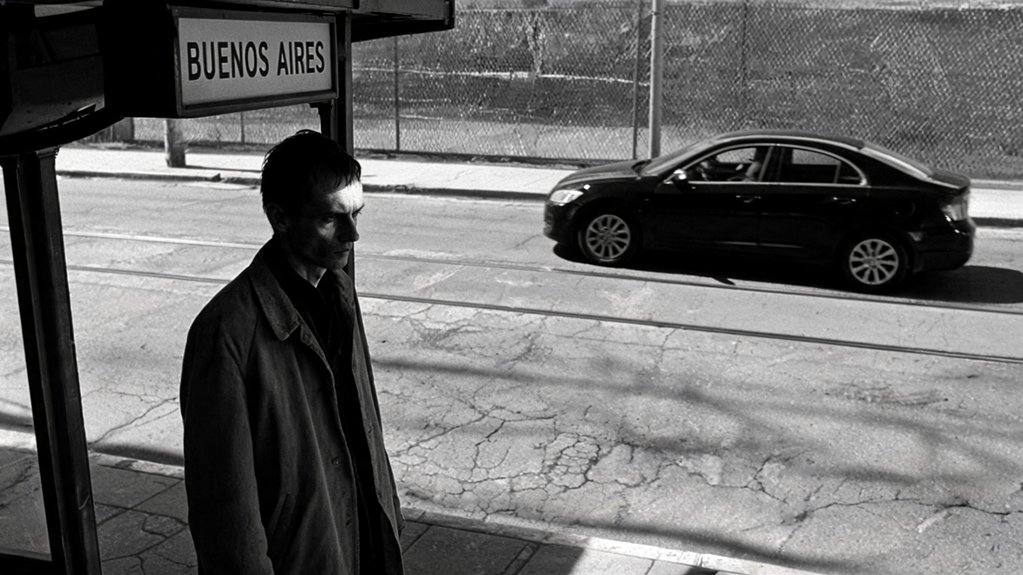
Buenos Aires’s northern sprawl threw long shadows over Garibaldi Street, and Rafi Eitan read every one of them as a tactical asset. He mapped the block’s blind spots—the unlit bus stop, the peeling fence line, the gap where streetlamps died—and turned them into a precision corridor.
The garibaldi street capture didn’t hinge on brute force; it hinged on seconds of invisibility. Eitan’s team rehearsed the approach until the pavement felt owned, exploiting the narrow alley’s sightlines to shield the snatch-and-stuff sequence from prying windows.
- The tram tracks’ metallic hum masked engine noise during the vehicular approach.
- A factory’s night-shift exit created a predictable 90-second pedestrian vacuum.
- The house’s side gate, rusted ajar, offered a silent rear-entry breach point.
- Rainfall runoff ditches provided a low-profile drag route toward the waiting car.
These tactical extraction logistics redefined the operation’s risk calculus, turning urban clutter into a controlled stage.
The 20:05 Intercept Protocol: Executing the May 11 Apprehension in the Mud
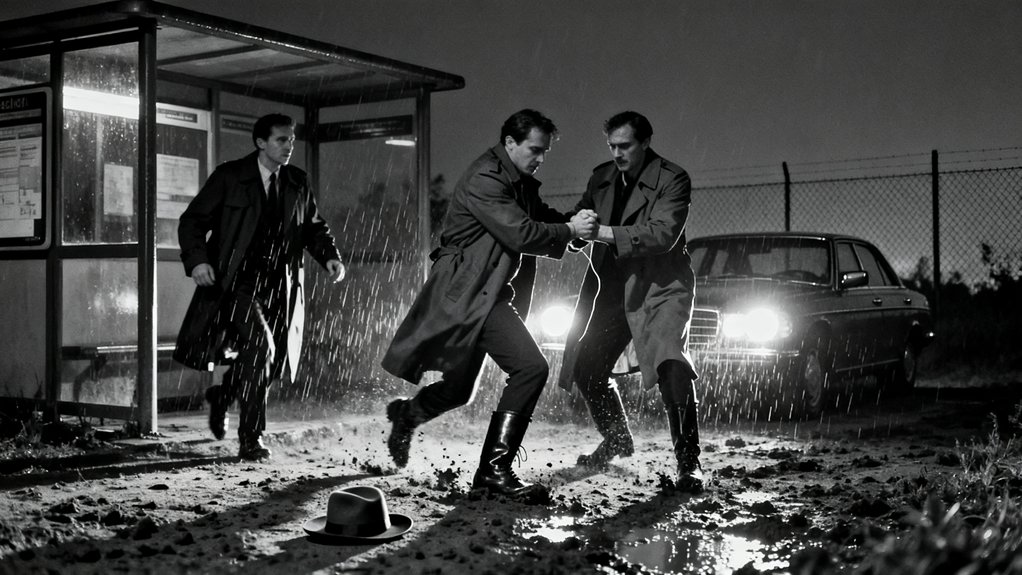
The clock hits 20:05, and the team moves as one, closing the gap on Garibaldi Street with brutal efficiency.
They don’t hesitate—Eichmann’s body is pinned to the mud in a choreographed rush, his struggles smothered by sheer weight and leverage.
Within seven minutes, the target’s resistance dies, and the operation’s physical mechanics prove flawless.
Suppressing the Target: The Physical Mechanics of the Seven-Minute Takedown
At 20:05 on May 11, 1960, the mud along Garibaldi Street swallowed the quiet rumble of a bus’s approach, and Mossad’s seven-minute suppression sequence snapped into motion.
The Buenos Aires clandestine mission hinged on this precise window, a brutal ballet of calculated force against a man who’d once orchestrated genocide.
- The Pincer: Two agents lunged from the shadows, pinning Eichmann’s arms before his brain registered the threat.
- The Knee Drive: A sharp blow to his lower spine buckled him backward, severing any chance of resistance.
- The Muffled Gag: A gloved hand clamped over his mouth, crushing any scream into the wet night air.
- The Hooded Drag: They wrenched him toward the waiting car, the entire operation finale timeline compressing into seconds.
In seven minutes, silence reigned—a silent extraction in a city that never noticed.
Isolation at Safehouse Tira: The Eight-Day Interrogation Under Total Blackout Conditions
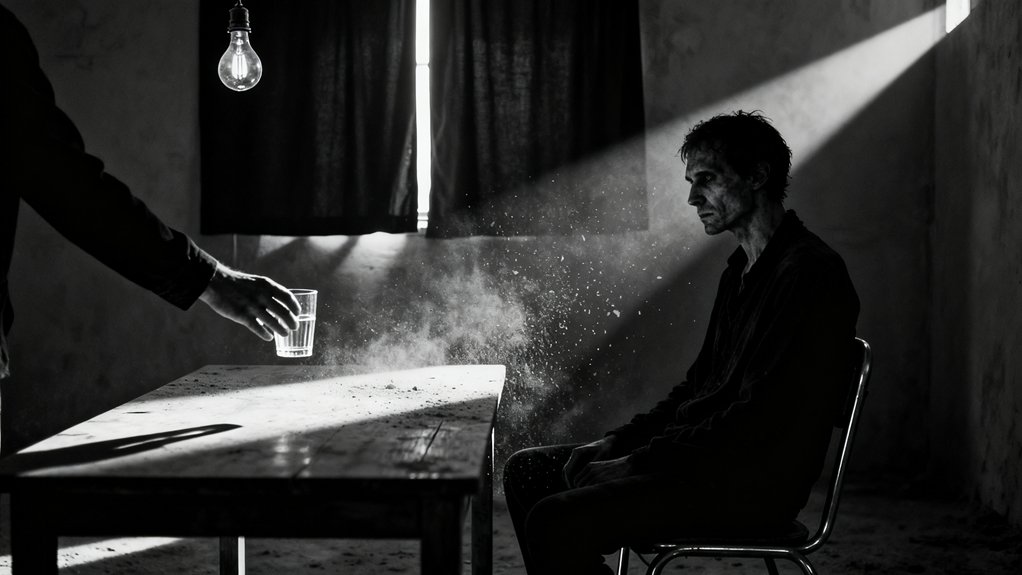
Inside the pitch-black safehouse at Tira, interrogators pressed Eichmann through eight days of sensory deprivation.
But his breaking point finally surfaced in an unredacted log entry. He spat out his SS serial number—a single, damning confession that tied him directly to the Nazi machinery‘s inner sanctum.
That admission didn’t just crack his cover; it handed Mossad the forensic thread to weave the entire case.
Extracting the Confession: The SS Serial Number Admission Documented in Unredacted Logs
Once the fugitive lay bound in a Mossad safehouse in Tira, the operation’s objective shifted from capture to confession, and interrogators faced a man who’d spent fifteen years burying his past beneath forged identities.
Under total blackout, they dismantled his psychological armor with relentless, methodical pressure. Mossad field operatives didn’t rely on torture; they weaponized silence, fatigue, and the monotony of repeated questions.
On the fourth day, cracks emerged.
- Eichmann’s hands trembled when they mentioned his true name, Ricardo Klement.
- He demanded a cigarette, a fleeting negotiation tactic.
- The interrogators presented a single, damning Nazi party card.
- By day eight, he whispered his SS serial number: 45326.
The unredacted logs confirm it—no coercion, just the collapse of a constructed lie.
Smuggling the High-Value Target: Clandestine Border Checks and the May 20 El Al Britannia Flight
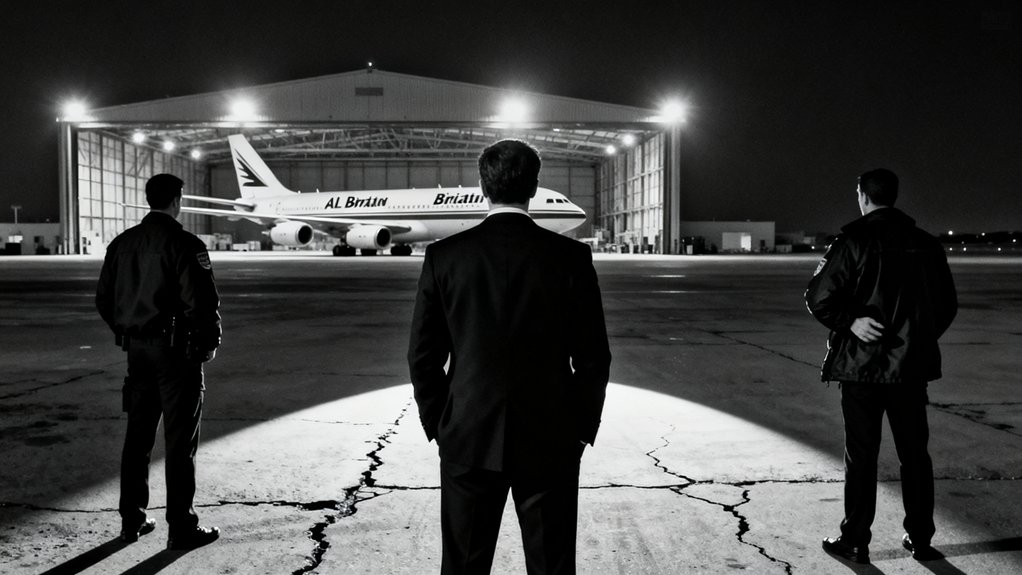
They weren’t relying on luck to slip Eichmann past Argentine security; they weaponized sedation itself, crafting a fake medical manifest that turned the Nazi into a “patient” too ill to be questioned.
The Britannia flight on May 20th became the ultimate test, where border checks were meant to be a mere formality against a man barely conscious from a carefully administered dose.
Every customs official glancing at the paperwork saw only a sick crew member, not the most hunted war criminal on Earth.
Forging the Medical Manifest: Weaponizing Sedation to Bypass Argentine Airport Security
As the May 20, 1960 El Al Britannia flight sat fueled at Buenos Aires’s airport, the Mossad’s final, unglamorous hurdle wasn’t the capture—it was the exit. They weaponized sedation, forging a medical manifest that transformed Eichmann into a comatose “patient.”
Agents injected him with a potent tranquilizer, then dressed him in airline uniform, crafting a narrative of a sick crewman needing urgent evacuation. Argentine security, scanning for a fugitive, saw only paperwork and a limp body.
- The forged manifest listed Eichmann as “Ricardo Klement,” suffering acute alcohol poisoning—a tale justifying his unconscious state.
- A Mossad medic, posing as a physician, stayed on board to monitor essential signs during the 24-hour flight.
- They timed the injection to peak exactly at passport control, ensuring zero verbal interaction.
- Airport officials never inspected beneath the blankets; the sedation’s aura of medical crisis became their shield.
The May 23 Shockwave: Ben-Gurion’s Unprecedented Knesset Proclamation
When the Knesset fell silent on May 23, 1960, Prime Minister David Ben-Gurion’s voice cut through the chamber with a declaration that would echo across the globe—Adolf Eichmann, the architect of the Final Solution’s logistics, was in Israeli custody.
The announcement wasn’t just a statement; it was a seismic rupture. For two decades, the world had navigated the uncomfortable silence surrounding Nazi fugitives, and now Israel had shattered that quiet with a single, deliberate sentence.
Ben-Gurion didn’t detail the mechanics—no mention of field operatives or Buenos Aires backstreets. Instead, he framed it as a moral reckoning, a sovereign act of historical closure.
The chamber’s hush felt heavier than the usual decorum; you could almost hear the collective intake of breath from reporters scrambling for wires. This wasn’t a trial yet, nor a legal maneuver. It was a raw assertion of Jewish agency, a promise kept in real time.
The shockwave rippled out from that podium, instantly transforming Eichmann from a ghost of the past into a tangible pawn of the present. That single proclamation forced every nation—ally and adversary alike—to recalculate their political geometry in light of Israel’s audacity.
The Knesset’s silence gave way to a different kind of thunder in Buenos Aires, where Argentina’s government wasn’t celebrating—it was fuming. Ambassador Mario Amadeo stormed the UN chamber, branding Israel’s extraction a flagrant “violation of territorial sovereignty.” Argentina demanded Eichmann’s return, forcing Jerusalem into a furious diplomatic scramble.
The Security Council convened, and Israeli envoy Golda Meir defended the capture with stark moral calculus: Eichmann wasn’t a fugitive—he was a mass murderer hiding behind a forged passport.
- Resolution 138 passed on June 23, 1960, formally condemning Israel’s action as “an infringement of the sovereignty of Argentina,” while stopping short of demanding Eichmann’s repatriation.
- The resolution’s language was deliberately narrow, acknowledging Israel’s “concern” but legally censuring the deed, creating a razor-thin legal tightrope for future tribunals.
- Washington quietly sided with Argentina in public, yet privately signaled relief that Eichmann sat in an Israeli cell, not a South American safe house.
Buenos Aires rejected Israel’s apology as “insufficient,” but the crisis cooled once Jerusalem’s ambassador formally expressed regret, a transactional contrition that preserved Eichmann’s custody.
The affair exposed a brutal geopolitical truth: state sovereignty mattered, but some crimes outweighed it.
Unsealing the Operation: How Verified Mossad Blueprints Redefined Global Extradition Precedents
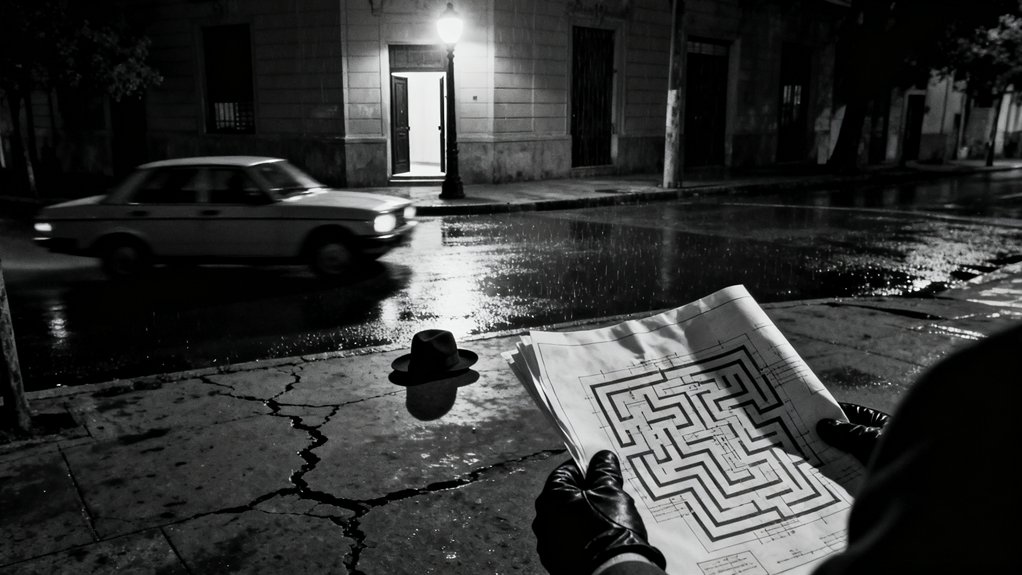
Decades of diplomatic fallout faded into a footnote once declassified Mossad files hit the intelligence community’s desks, exposing the operation’s literal blueprint for snatching a war criminal from sovereign soil. Those files didn’t just recount a capture—they redrew legal boundaries, proving that a state’s moral imperative could outmuscle its treaty obligations. The San Fernando tailing routes, the Garibaldi Street extraction point—every annotated map became a template, forcing courts worldwide to reconsider who owns justice when a genocide orchestrator walks free.
| Component | Declassified Detail | Legal Shockwave |
|---|---|---|
| Surveillance | 12-day physical tail on Eichmann | Weakened “territorial immunity” arguments |
| Extraction | 7-minute vehicle grab, no shots fired | Redefined “state-sponsored abduction” |
| Aftermath | Secret flight to Jerusalem via El Al | Spurred UN Resolution 138’s moral split |
Mossad’s blueprint turned a secret snatch into a precedent-setting paradigm. Nations now grapple with a chilling question: sovereignty’s shield, or justice’s scalpel?
Frequently Asked Questions
How Was the 1957 Intelligence Leak Initially Verified?
The 1957 leak wasn’t verified by a single stroke of luck; it demanded a paper chase through dusty archives. Investigators cross-referenced the tip against immigration records, comparing signatures and dates like puzzle pieces.
They’d quietly confirm the source’s reliability by checking it against independent sightings, ensuring the thread didn’t snap. That triangulation—matching bureaucratic fingerprints—turned a whisper into a solid lead.
It’s how they separated smoke from fire, locking down the intelligence before any operation could unfold.
Who Originally Created Ricardo Klement’s False Identity Documents?
The provenance of Ricardo Klement’s forged papers traces back to a shadowy network of former SS comrades.
Eichmann’s escape relied on a clandestine organization, often dubbed the “ODESSA,” that manufactured the false identity. This group, leveraging old Nazi contacts and sympathetic officials, supplied the documents post-war.
They didn’t act alone; they skillfully altered his existing records, ensuring Klement’s story held up under casual scrutiny, buying him years of anonymity until Mossad’s tailing exposed the lie.
Did Mossad Agents Receive Any Local Argentine Assistance?
Declassified files show they didn’t rely on official Argentine help. Mossad’s operatives worked strictly alone, running their own surveillance and logistics.
That’s an essential point—the mission’s success hinged on total self-sufficiency. They couldn’t risk leaks or diplomatic blowback, so they built every step from scratch, using their own resources and personnel.
The capture itself was a purely Israeli operation, executed without any local government’s knowledge or cooperation, a fact that remains a cornerstone of the operation’s legend.
How Were Eichmann’s Fingerprints Taken Without Arousing Suspicion?
They didn’t risk a direct fingerprint scan. Instead, agents used a covert ruse—posing as a delivery man, they got Eichmann to sign a receipt with a pen coated in a thin, invisible glue.
The paper, handed back as proof, held his prints without alerting him. Later, a lab compared those marks to pre-war records, confirming his identity before the team struck on Garibaldi Street.
What Happened to the Mossad Surveillance Vehicles After Capture?
The surveillance vehicles didn’t get a parade or a museum plaque. They vanished into the ether, repainted, re-engined, and re-sold to unsuspecting Argentine civilians, who likely never knew their sedans once stalked a Nazi.
The Mossad wasn’t sentimental about hardware; those cars — now anonymous again — became ghosts in the traffic flow, their only memorial being the quiet, permanent dent they left in history’s rear fender.