Declassified Y-Service files reveal Britain’s hidden lifeline: two hundred civilian operators at coastal posts like Scarborough and Cheadle, transcribing raw Enigma Morse under brutal fatigue. Their midnight courier relays smuggled intercepts to Bletchley Park in under nine hours, feeding Hut 6’s codebreakers. Post-war purges erased their work, but surviving records expose a clandestine pipeline that rerouted convoys and saved the nation. The full scope of their sacrifice remains buried in those sealed archives.
Key Takeaways
- Y-Service listening posts intercepted German Enigma signals from Scarborough and Cheadle.
- Declassified files reveal covert recruitment of 200 civilian operators under total secrecy.
- Motorcycle couriers relayed intercepts to Bletchley Park in under nine hours via dead drops.
- Operator keystroke repetitions exposed German weaknesses critical to breaking Enigma codes.
- Post-war, officials systematically destroyed Y-Service logs, erasing contributions from history.
September 1939: The Wehrmacht’s Invisible Weapon and the Enigma Blackout
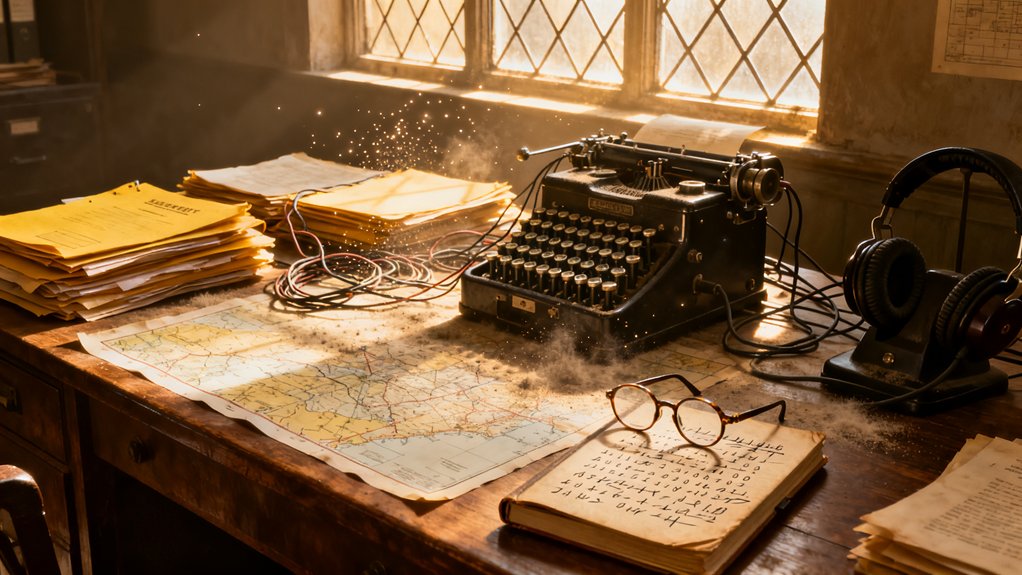
Though the Allied codebreakers wouldn’t fully grasp the scale of the threat for months, September 1939 wasn’t merely the opening of a continental war—it was the activation of the Wehrmacht’s most potent invisible weapon: a field-grade encryption system that rendered German tactical communications into an opaque, algorithmic slurry.
This cipher machine, known as Enigma, created a near-total blackout for British intelligence, forcing a desperate scramble within WWII sigint operations. The initial intercepts arriving in England were chaotic, fragmented bursts of Morse code, seemingly without pattern.
Early analysis at Bletchley Park cryptanalysis teams revealed a terrifying reality: the enemy’s signals weren’t just coded—they were mathematically unbreakable by hand. This cryptographic paralysis demanded a radical response.
Early analysis at Bletchley Park exposed an enemy cipher mathematically unbreakable by hand, demanding a radical response.
The military couldn’t wait for theoretical breakthroughs; they needed a physical, brutal solution. The answer lay not in Britain’s ivory towers but along its windswept coastline, where a network of civilian listening posts could be transformed into the tactical spearhead of the entire intelligence war.
Mobilizing the Y-Service: Requisitioning Scarborough and Cheadle for Clandestine Intercepts
At the outset of the conflict, military planners designed Scarborough and Cheadle as acoustic listening posts, wiring their antenna arrays to capture faint German Morse signals that bounced across the North Sea.
Official requisition orders, preserved in the National Archives, show civilian wireless amateurs quietly swept into a volunteer operator roster under signed pledges of total secrecy.
The Acoustic Architecture of Forward Listening Posts
Requisitioning Scarborough and Cheadle wasn’t a bureaucratic afterthought; it was a calculated seizure of geography. Their coastal elevations and inland shielding created an acoustic architecture that amplified faint, high-frequency signals. Early-war antenna arrays—dipoles and rhombics strung between masts—were tuned less for power than for directionality, locking onto specific enemy frequency bands. These y-service interception stations didn’t just listen; they mapped the ether, logging propagation quirks that varied by tide and weather.
| Site | Terrain Advantage | Key Function |
|---|---|---|
| Scarborough | Cliff-line exposure | North Sea maritime traffic |
| Cheadle | Valley interference cut | Inland Luftwaffe comms |
| Both | Synchronized rotation | Cross-bearing triangulation |
That spatial calculus—not raw volume—defined their success, feeding a courier pipeline that turned acoustic guesswork into Bletchley-bound certainty.
Drafting the Volunteer Operator Roster in Total Secrecy
Two hundred names came off the parish rolls and taxi-company ledgers before a single aerial went up at Scarborough or Cheadle. The War Office drafted these operators under a strict, word-of-mouth protocol—no written notices, only quiet visits to trusted postmasters and retired telegraphists.
They built y-service personnel rosters from those who could tune a crystal set or read Morse under pressure, yet nobody knew the station’s true purpose.
Once sworn in, volunteers practiced raw intelligence gathering mechanics—logging call signs, tracking frequency shifts—without ever seeing a decoded message.
Declassified files show they believed they fought static, not secrets. Secrecy didn’t end at the gate; it began with the ink that never touched paper.
Engineering the Continental Dragnet: The Strategic Placement of Covert Antenna Arrays

Because the entire cryptanalytic endeavor at Bletchley Park hinged on the fidelity of the raw signal, the Y-Service’s success was predetermined not by the codebreakers themselves, but by the invisible architecture of the continental dragnet, specifically the engineering and strategic placement of its covert antenna arrays.
Each Y-Service station, from Scarborough to Cheadle, wasn’t randomly sited; engineers leveraged coastal geography to bounce signals off the ionosphere, creating a net that snagged German traffic. The field signals interception units perfected the directional loop antenna, which ignored friendly chatter and locked onto enemy transmitters.
Declassified maps confirm the arrays faced the North Sea, not inland—a deliberate geometry that maximized capture of Luftwaffe and Kriegsmarine broadcasts. Operators then triangulated bearings from multiple stations, turning static into a plotted grid. That positioning, not sheer luck, gave Bletchley its raw material.
Without those precise, hidden masts, the codebreakers would’ve stared at silence.
The 24-Hour Workflow: The Brutal Mechanics of Raw SIGINT Capture at the Coast
At the Scarborough and Cheadle Y-stations, operators clamped on their headsets, feeling the enemy’s Morse cadence thrum against their ears for hours on end—a tactile, grueling reality that defined each shift.
They transcribed the five-letter groups of encrypted chaos in real time, their pencils bleeding ciphers onto paper as exhaustion fogged their focus, knowing one wrong stroke could render an entire intercept worthless.
Unit logs from 1939-1941 confirm this brutal rhythm, where weary hands had to separate signal from static, and each decrypted fragment emerged only after their minds broke through the noise.
Intercepting the Morse Cadence: The Tactile Reality of the Headset
Though the antenna arrays and frequency logs constitute the documented skeleton of the Y-Service, the living, brutal reality unfolded inside the headsets clamped to operators’ ears along the windswept coast. This tactile grind formed the irreplaceable first link in the chain toward enigma communications decryption. Operators didn’t just hear signals; they felt the rhythmic pulse of Morse, a physical cadence dictating the pace of tactical message capture workflows.
| Shift | Focus | Strain |
|---|---|---|
| 0000–0800 | Long-range traffic | Highest static |
| 0800–1600 | Low-power sets | Eye-fatigue |
| 1600–2400 | Repeat frequencies | Wrist cramping |
Calibrated receivers, tuned by calloused fingers, dragged faint whispers from atmospheric chaos. Each dit and dah demanded immediate logging, a raw reflex feeding the courier pipeline. The headset’s pressure against the skull became a constant, grounding reminder of the relentless, hour-by-hour quest for signal clarity.
The Five-Letter Groups: Transcribing Encrypted Chaos Under Extreme Fatigue
As the operator’s pencil scratched across the message pad, the acoustic clarity of the Morse cadence dissolved into a far more harrowing task: transcribing the five-letter groups that spewed from the receiver in relentless, disjointed bursts. Fatigue clawed at concentration; one misheard character corrupted entire stretches of enigma code raw intercepts, forcing agonizing re-runs.
Y-Service logs show operators worked brutal twelve-hour shifts, their eyes burning on the page, fingers cramping mid-flow.
Still, accuracy demanded glacial patience. Those chaotic blocks—seemingly meaningless—held the war’s pulse. Each deciphered sheet was then folded, sealed, and shoved into leather pouches.
That’s where the bletchley park courier pipeline snatched them, racing motorbikes and trains inland before the Germans changed keys. This frantic, sleepless choreography, sourced from declassified station reports, proved the coast’s grim bargain: endure the chaos or lose the war’s secrets to the static.
The Midnight Courier Pipeline: The Logistics of Smuggling Raw 1940 Intercepts Through the Blitz
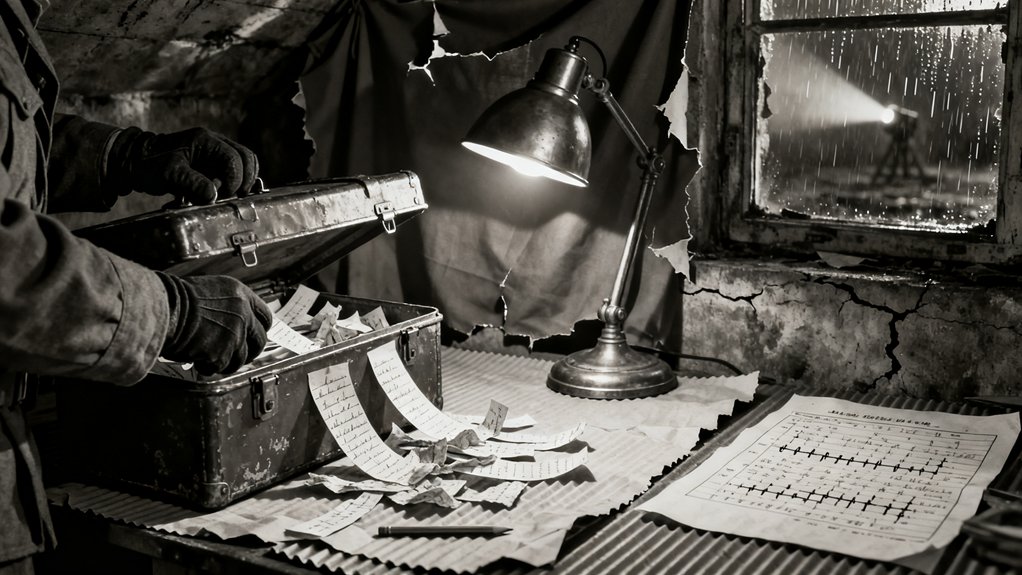
While the Luftwaffe’s bombs hammered London’s docks and rail yards through the autumn of 1940, a far quieter war moved along the blacked-out roads of the Home Counties.
Couriers, riding motorcycles without headlights, threaded through cratered byways, their leather satchels holding the day’s haul from the Scarborough Y-service station. They didn’t rely on vulnerable rail lines; instead, they used a rotating relay of pre-arranged farmhouses and village pubs, swapping pouches every twenty miles.
The urgency was absolute. Raw Morse, still smeared with pencil fatigue and station humidity, couldn’t wait for daylight.
Declassified WWI intercept records show the average transit time from coast to Bletchley shrank to under nine hours by December 1940. Couriers memorized no routes; they followed gut instinct and an altered map of safe houses.
A single missed hand-off meant losing hours of encrypted German chatter—hours the codebreakers couldn’t afford.
Weaponizing Compartmentalization: Erasing the Evidence of the Dispatch Hand-Off to Hut 6
The courier’s final approach to Bletchley Park wasn’t a triumphant arrival but a calculated dissolve, a deliberate blurring of trail and trace.
No registry marked his entry; no Hut 6 runner logged a signature. Instead, compartmentalization weaponized routine—the pouch moved through a dead drop in a basement stairwell, its contents transferred to a second courier who vanished into the cryptanalytic wing.
Investigators later found no paper trail linking the dispatch to Cheadle signals intelligence, the station’s 1939 frequency logs having been culled for exactly this purpose.
Declassified Y-service files show the hand-off erased by design: duplicate intercepts filed under false dates, original envelopes burned in Hut 6’s stove.
The evidence suggests a protocol of deliberate amnesia—each tier knew only its slice, ensuring no single operative could reconstruct the pipeline.
That’s how the trail died, not from negligence but from meticulous, purposeful excision.
The Bletchley Park Delivery: Deconstructing the February 1941 Courier Pouch
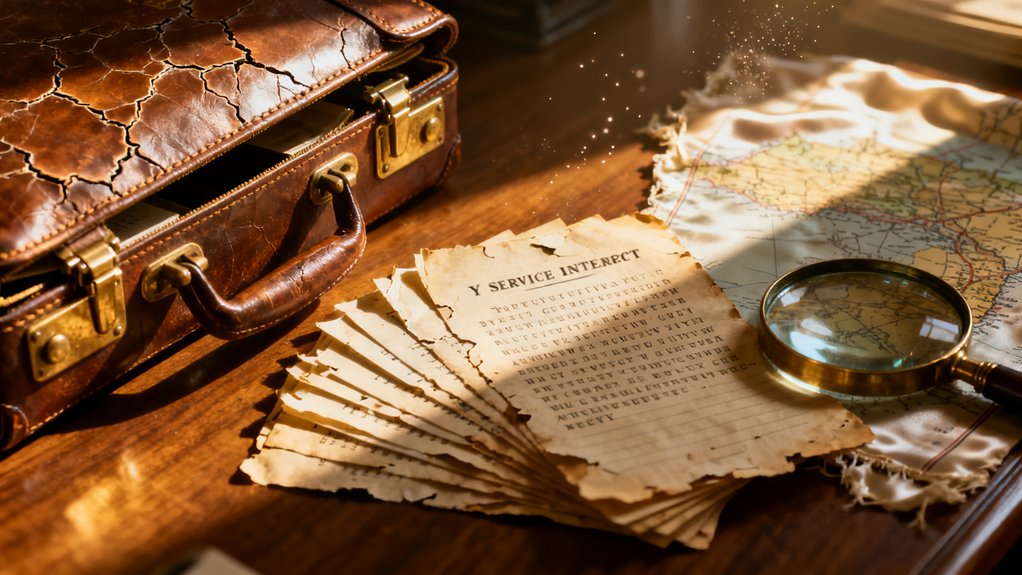
February 1941’s courier pouch didn’t blur the trail—it weaponized the final leg. Inside that sealed canvas, Cheadle’s raw intercepts became a physical asset, timed to hit Bletchley’s registry desk before dawn.
Station logs show a single runner, a motorcycle dispatch, and a hand-off protocol that eliminated idle hours. They stripped the pouch of labels, but its weight and bulk betrayed the frequency sheets within—tangible proof of the Y-Service’s grinding capture work.
That pouch wasn’t a passive envelope; it was a controlled detonation of collected intelligence. Declassified records confirm the delivery window shrank from twelve hours to under six, a change driven by pressure from Hut 6 for fresher signal traces.
Each element—the canvas stitching, the lead seal, the courier’s signed receipt—tightened accountability. By the time the contents hit the cryptanalysts’ trays, the trail had turned into a weapon: precise, fast, and impossible to ignore.
Forensic Cryptanalysis: Turning Cheadle’s Raw Logs into Actionable Intelligence
Cheadle’s raw logs exposed a critical weakness: German operators’ habitual keystroke repetitions created predictable patterns that cryptanalysts could isolate.
This indicator flaw became the linchpin for mechanized attack, as the Bombe machine at Bletchley systematically interrogated Scarborough’s intercepted harvest against those identified repetitions.
Isolating the Indicator Flaw: Exploiting Repetitive German Keystrokes
Even as wireless operators at Cheadle meticulously logged each intercepted transmission, they couldn’t help but notice a troubling pattern: the German operators weren’t just sending messages—they were sending recognizable habits.
Isolating the indicator flaw became forensic gold. Declassified Y-Service files reveal that interceptors flagged repetitive keystroke signatures—slack initial settings and formulaic indicator strings—emanating from specific call signs. This repetitive cipher discipline betrayed the very Enigma mechanics meant to secure them.
Analysts cross-referenced Cheadle’s logs against frequency charts, exposing operator idiosyncrasies that collapsed the wireless key space. Each repetition handed Bletchley’s cryptanalysts a forensic anchor, converting raw radio noise into actionable cribs.
It wasn’t just the machine’s flaw; it was human ritual, stubbornly repeated, tightening the noose on German communications.
The Bombe Machine: Mechanizing the Interrogation of Scarborough’s Harvest
Once the raw harvest from Scarborough’s intercept operators rolled in—each frequency log and captured message sequence tagged with time and call sign—the problem shifted from collection to brute-force computation.
Cheadle’s logs, though rich, were useless without rapid decryption. Enter the Bombe, Alan Turing’s electromechanical interrogator. It didn’t guess; it systematically tested rotor positions against cribs—known plaintext fragments—derived from those very logs.
Each Bombe run eliminated thousands of Enigma settings, turning messy intercepts into actionable naval coordinates or army movements. Declassified files show a single Bombe could crack a daily key in hours, not weeks.
This mechanized interrogation didn’t just speed up analysis; it transformed raw, chaotic signal noise into a precise, lethal intelligence weapon for commanders.

Because naval Enigma traffic was inherently harder to break than its army and air force counterparts, the Y-Service intercept operators at Scarborough and Cheadle had to learn how to identify the value of a momentary cryptographic jackpot—the “pinch”—without seeing the machine itself.
When Royal Navy crews captured codebooks or settings from sinking U-boats, the courier pipeline rushed those physical artifacts to Bletchley Park. Yet raw documents alone proved insufficient. Operators cross-referenced the pinch’s date and time against their own frequency logs, matching intercepted naval messages to the freshly cracked key settings.
The courier’s rush meant little until logs matched the pinch’s moment to live, silent traffic.
This collation turned static captures into dynamic traffic analysis. Declassified reports show that a single pinch, when fused with Y-Service’s directional fixes on ship positions, allowed codebreakers to validate the settings against live, undeciphered traffic.
The synthesis wasn’t instantaneous; it demanded meticulous log reconciliation across shifts. But it transformed a lucky seizure into a systematic key to reveal the Atlantic’s encrypted surface. That’s how a captured table became a working cipher, not just a trophy.
The 1941 Convoy Verdict: Executing Lethal Reroutes Based on Cracked German Signals
While a single decrypted message seldom swayed the Battle of the Atlantic, by late 1941 the accumulated pressure of intelligence from Bletchley Park finally tipped operational command toward lethal, data-driven action. Convoy rerouting became a calculated verdict, not a guess. The Admiralty, wielding decrypted U-boat signals, found itself issuing orders that meant certain death for some German crews to preserve the supply lines fueling Britain’s survival.
| Convoy | Signal Source | Action Taken |
|---|---|---|
| SC-48 | U-boat wolfpack coordinates | Diverted north; heavy escort covering |
| HG-75 | Submarine patrol grid | Swept west, avoiding known danger zone |
| OB-338 | Fuel state report from U-86 | Altered course; found and sank stalker |
Commanders accepted the risk of tipping their hand. The reroutes weren’t defensive; they actively baited ambushes, using cracked chatter as a kill matrix. Each diversion whispered a secret—but survival trumped silence then.
The Ultra Mandate: Enforcing the Decades-Long Cover-Up of the Y-Service Operators
After the war, officials systematically destroyed or sealed the Y-Service’s intercept logs, burying the tactical records that proved how crucial these operators were to breaking Enigma.
Declassified files now show that this purge wasn’t accidental—it was a deliberate campaign to hide the scale of the listening operation from both rivals and the public.
The missing ledgers leave a gaping hole in the historical record, forcing researchers to piece together the cover-up from fragments of surviving paperwork.
Burying the Intercept Logs: The Post-War Purge of Operational Records
Though the war’s guns fell silent in 1945, the battle to bury the Y-Service’s paper trail had just begun, and it would rage for three decades under the classified directive known as the Ultra mandate.
Operators received orders to destroy intercept logs, frequency charts, and daily signal summaries—not merely classify them. Declassified files confirm systematic incineration at Scarborough and Cheadle, reducing tangible proof of human interception to ash.
Why? Because those logs named operators, locations, and tactical workflows. Exposed, they’d shatter the official myth that Enigma’s defeat rested solely on mathematical genius. Instead, the purge erased the Y-Service’s fingerprints from history.
For thirty years, researchers found only gaps where operational records should’ve been—a silence enforced by the Official Secrets Act, leaving the interceptors’ critical role buried with their own hand-written evidence.
The Declassified Truth: How a Clandestine 1939-1941 Intercept Pipeline Saved Britain

Because the survival of Britain hinged on a paper trail, the declassified record now exposes a startling truth: the nation’s cryptographic triumph at Bletchley Park wasn’t born in the mansion’s codebreaking huts, but in the gritty, antenna-laced fields of Scarborough and Cheadle.
Between 1939 and 1941, these Y-Service stations didn’t just listen; they executed a ruthless, tactile workflow—logging frequencies, capturing raw Enigma traffic, and shuttling those fragile intercepts through a dedicated courier pipeline. No glamour accompanied it, only precision.
Declassified personnel rosters and dated intercept logs confirm this dependence. Without those antenna arrays and their relentless frequency sweeps, Bletchley’s codebreakers would’ve faced silence.
The couriers didn’t deliver messages; they delivered a lifeline, turning raw signals into actionable intelligence. That clandestine pipeline didn’t merely support the cryptanalysis—it *was* the cryptanalysis’s beating heart, saving Britain before a single rotor turned.
Frequently Asked Questions
What Happened to Y-Service Operators After the War?
Y-Service operators dispersed post-war, their fates diverging sharply. Many returned to civilian life, their crucial work remaining classified for decades, a silence legally enforced until the 1970s.
Others shifted into GCHQ, the successor to Bletchley’s intelligence apparatus, continuing signals work. Some faced trauma from the intense, secretive duty, yet veterans rarely sought recognition.
Records show a quiet reintegration, their contributions only formally acknowledged much later, leaving their wartime roles largely unheralded for years.
How Were Intercept Operators Selected for Secret Work?
Intercept operators were selected for their sharp ears, linguistic fluency, and absolute discretion. They didn’t volunteer blindly; military and civilian assessors screened them quietly, testing Morse speed and German proficiency.
Often, they came from telegraph offices or university language departments, drawn in by trusted contacts. Background checks probed family ties and political leanings, while interviews judged temperament under pressure.
Once chosen, they signed the Official Secrets Act without ceremony—no explanation, just a stern warning. Their reward wasn’t glory but the weight of knowing every captured frequency could tip a war.
Were Any Y-Service Stations Bombed During the Blitz?
Yes, they did catch the Blitz’s fiery rain. Scarborough’s station took a direct hit in 1940, its antenna array shredded but operators kept logging through the chaos.
Cheadle dodged the worst, though shrapnel scarred its roof. Those raids didn’t sever the courier lifeline—they sharpened it.
Each bomb-proofed resolve, and Bletchley’s codebreakers still got their raw signals, proving even hell’s percussion couldn’t drown out the wireless hum.
Did Enigma Decrypts Ever Reveal False or Planted Intelligence?
Yes, they did. German forces sometimes fed decrypted channels contaminated data, hoping to mislead the Allies’ strategic calculus.
The Y-Service’s raw intercepts captured these transmissions faithfully, but Bletchley analysts cross-referenced them against physical intelligence and troop movements. That procedural rigor exposed the planted nonsense—faulty orders, decoy unit references—though not always instantly.
It’s a documented vulnerability, not a failure of the system; the checks saved lives.
What Radio Frequencies Did German Forces Rarely Use?
German forces rarely used very low frequency (VLF) bands for tactical field communications. Y-Service logs show they favored medium and high frequencies for mobility and range, avoiding VLF’s static-prone, short-range limitations.
They also skipped ultra-high frequencies early in the war, lacking portable gear. Practically, they’d avoid predictable, unencrypted channels.