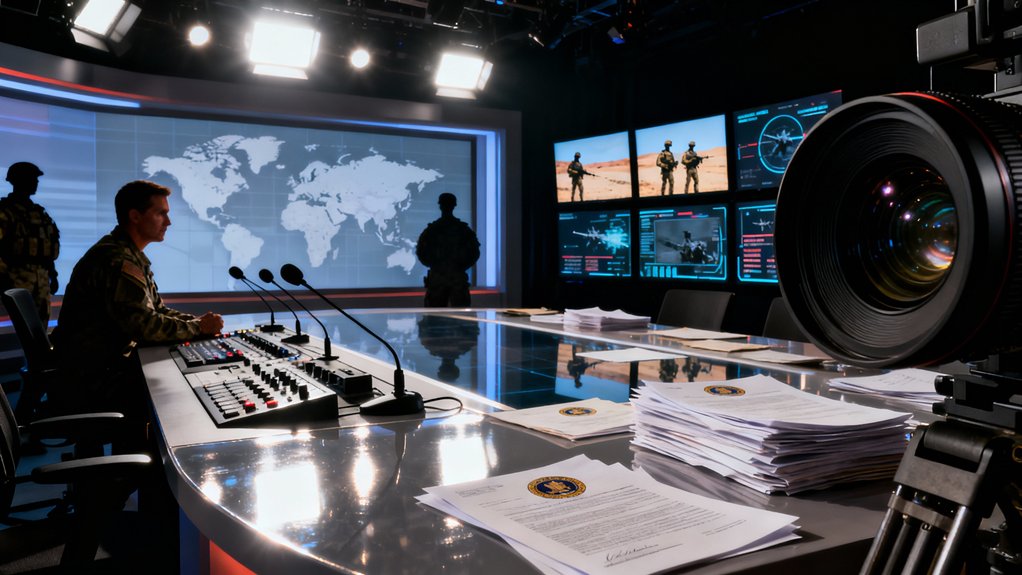
Between 2002 and 2008, the Pentagon produced hundreds of slick television segments promoting military operations in Iraq and Afghanistan, then distributed them to local news stations across America. These Video News Releases looked identical to independent journalism—because they were designed that way. Former network correspondents narrated. Professional crews filmed. Station managers aired them without disclosure. Millions of viewers never knew they were watching government propaganda repackaged as objective reporting, a systematic deception that exploited shrinking newsroom budgets and circumvented laws prohibiting domestic psychological operations.
Key Takeaways
- Pentagon produced pre-packaged VNRs mimicking authentic news, distributed via DVIDS to local stations that aired them without disclosure of military origin.
- Over 50 VNRs reached 33 million viewers with 75% of broadcasts omitting Pentagon attribution, violating FCC sponsorship identification rules.
- Bell Pottinger received $540 million for covert operations, creating fake al-Qaeda videos and manipulated bombing footage for Arabic networks.
- Economic pressures led smaller stations to rely on free Pentagon packages for 80% of national coverage, filling 10–15 minutes daily.
- Smith-Mundt Act and anti-propaganda laws were systematically bypassed as government content aired as independent journalism to unsuspecting audiences.
What Video News Releases Are and How They Work
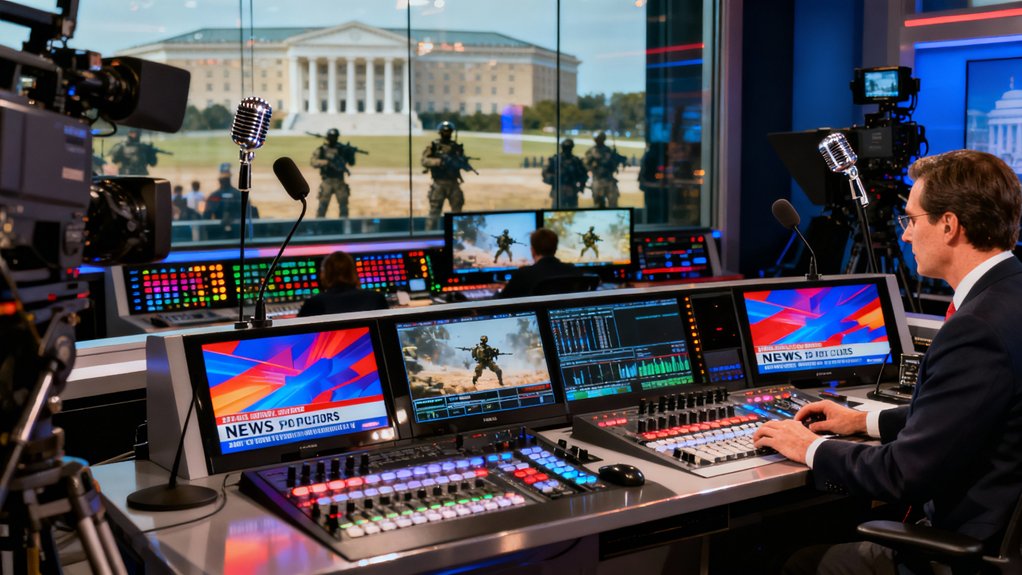
A Video News Release (VNR) operates as a sophisticated instrument of persuasion disguised as journalism. These pre-packaged segments emerge from government agencies and corporations, professionally scripted by former journalists who exploit their insider knowledge to mimic authentic news reporting. The Pentagon and PR firms construct these broadcasts with b-roll footage, spokesperson interviews, and scripted narratives—all designed to bypass critical editorial oversight. Television stations receive these ready-made stories via satellite or digital feeds, often airing them verbatim with minimal modification. The deception succeeds because VNRs replicate genuine journalism’s format while serving propagandistic objectives. VNRs complement written press releases by adding visual and audio elements that make propaganda more persuasive than text alone. Media literacy becomes essential when half of perceived news content originates from public relations sources, challenging viewers to distinguish between ethical broadcasting and manufactured messaging that shapes public opinion without disclosure.
The Multi-Billion Dollar Pentagon VNR Industry
The Pentagon’s annual budget authorization exceeding $900 billion in 2026 provides vast resources for information operations, including video news releases distributed through sophisticated systems reaching thousands of media outlets. These propaganda budgets, buried within broader defense appropriations, fund contractors who produce broadcast-ready segments designed to appear as independent journalism rather than government messaging. The scale of this industry remains deliberately opaque, with defense information distribution networks operating across multiple agencies and private firms that transform taxpayer dollars into manufactured news content. The Department of Defense’s “commercial first” approach to expanding AI partnerships with firms like OpenAI and Google through contracts worth up to $200 million each demonstrates how public funds flow to private contractors for technological capabilities that shape information warfare.
Defense Information Systems Distribution
Behind closed doors at the Defense Information Systems Agency, billions of dollars flow through networks most Americans have never heard of—DoDNet, DIBNet-U, and the Defense Information Systems Network—infrastructure that serves dual purposes far removed from public understanding. While DISA consolidates over 32,000 users under Fourth Estate Network Optimization, these same networks provide secure access and data encryption for approximately 1,000 cleared contractors in the voluntary DIB Cybersecurity Program.
| Network System | User Base | Primary Function |
|---|---|---|
| DoDNet | 32,000+ workstations | Consolidated defense operations |
| DIBNet-U | 1,000 contractors | Industrial base intelligence sharing |
| DISN | Enterprise-wide | Voice, video, data transmission |
The architecture enables bidirectional threat information flow between Pentagon operations and private defense contractors—infrastructure built for warfare that simultaneously channels information control. The Pentagon’s vulnerability disclosure program processed its 45,000th vulnerability report in February 2023, revealing the scale at which crowd-sourced cybersecurity researchers probe defense networks that intersect with public-facing systems across the defense industrial base.
Government Propaganda Budget Scale
Information warfare infrastructure means nothing without funding to sustain it, and the Pentagon commands financial resources that dwarf the GDP of most nations. The FY26 defense appropriations bill reached $838.7 billion, with Trump requesting an unprecedented $1 trillion—a 12% increase that illuminates the scale of military communications operations embedded within broader defense spending.
Budget transparency remains elusive when examining propaganda expenditures:
- Operations and maintenance budgets doubled from $175 billion in 2000 to $338 billion
- Electronic warfare markets project $20.01 billion in specialized information capabilities
- Multiyear munitions procurement contracts totaling $28.8 billion create cover for communication operations
Despite DOGE identifying $80 million in wasteful Pentagon spending, propaganda accountability measures fail to penetrate classified information operations budgets, allowing military narrative control to flourish without public oversight. The claimed $80 million represents a mere 0.009% of the total budget, revealing how minuscule such cuts appear against the Pentagon’s massive appropriations even as Trump previously promised DOGE would uncover hundreds of billions in fraud.
How the Pentagon Uses VNRs to Promote Wars

Why would the Pentagon spend $540 million on a single public relations contract during wartime? The answer reveals sophisticated media manipulation beyond traditional propaganda. Bell Pottinger’s operation involved covert scripting of fake al-Qaeda videos embedded with tracking technology, transforming propaganda into surveillance tools. When viewers inserted CDs, Google Analytics code transmitted their IP addresses directly to Pentagon commanders. The firm produced low-quality bombing footage, manipulated to appear authentic, then distributed through Arabic news networks disguised as local reporting. Hundreds of Bell Pottinger employees worked from Baghdad’s Camp Victory headquarters, reporting to the Pentagon, CIA, and National Security Council. This viewer tracking infrastructure identified sympathizers while simultaneously shaping narratives. General Petraeus and occasionally the White House authorized these operations, blurring lines between information warfare and domestic manipulation. U.S. law prohibits domestic propaganda, so the Pentagon hired a foreign firm to conduct the operations.
The DVIDS System: How the Pentagon Distributes VNRs
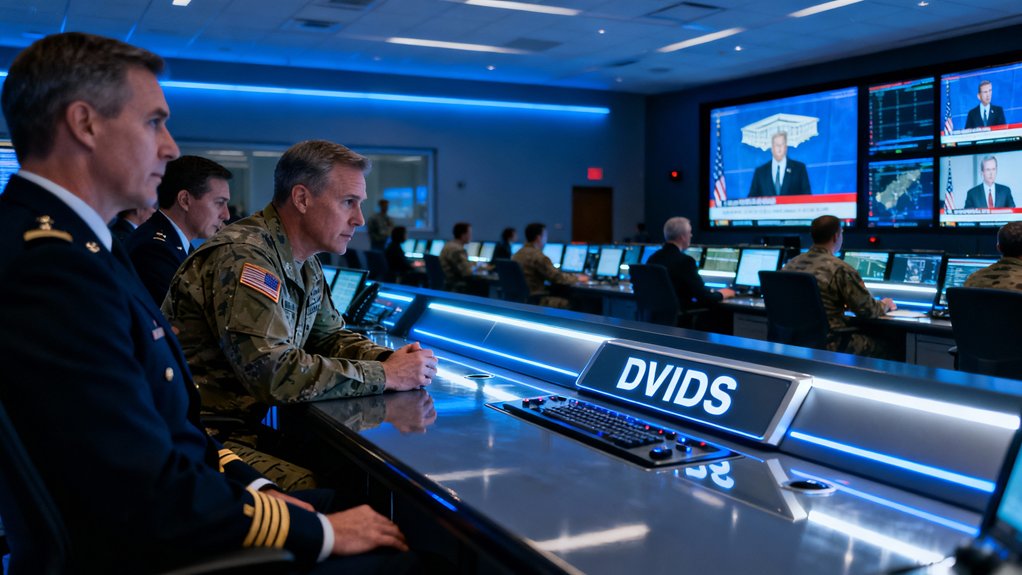
While Bell Pottinger’s covert operations represented the Pentagon’s darkest propaganda tactics, the military’s most expansive media manipulation system operates in plain sight. The Defense Visual Information Distribution Service transforms Fort Meade into a round-the-clock propaganda hub, pumping military-friendly content through satellite broadcasting and cloud streaming infrastructure directly into newsrooms worldwide.
Fort Meade operates as a propaganda factory, streaming military-curated narratives directly into global newsrooms under the guise of legitimate information distribution.
DVIDS reaches audiences through three critical channels:
- A 24/7 Cloud Network Operations Center processing combat footage and PR materials
- Consumer streaming apps (DefenseTV, Military 24/7) embedding military narratives into daily media consumption
- Broadcast-quality HD downloads enabling television stations to air Pentagon content as authentic news
This infrastructure-as-a-service model connects global media to carefully curated military messaging, laundering official propaganda through technological sophistication that makes editorial gatekeeping nearly impossible to maintain. A network of portable Ku-band satellite transmitters enables DVIDS to support content delivery from remote locations, ensuring continuous transmission of military messaging regardless of geographic constraints.
Why Local Stations Air Pentagon VNRs Undisclosed
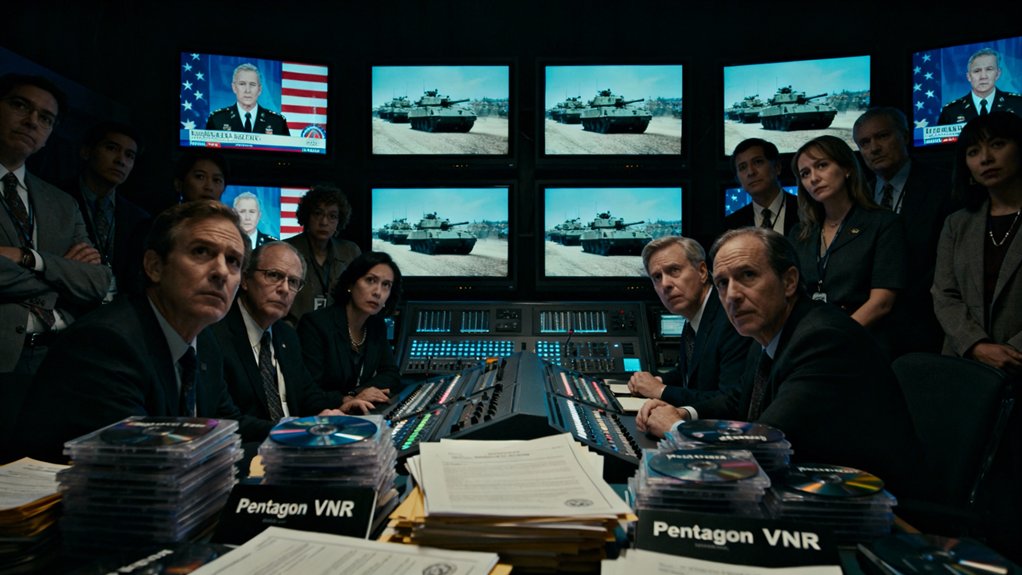
Behind the seamless integration of Pentagon video news releases into local television broadcasts lies a convergence of financial desperation and structural vulnerability that transformed newsrooms into distribution channels for military propaganda. Budget cuts averaging 20-30% in the early 2000s, combined with 40% staffing reductions, left stations unable to produce original reporting. Free Pentagon packages filled 10-15 minutes of daily programming, with smaller markets relying on VNRs for 80% of national coverage. The absence of disclosure requirements until 2006 enabled stations to omit Pentagon origins in 75% of broadcasts, eroding media trust while manufacturing news authenticity. Production quality that exceeded local capabilities, combined with 15% ratings gains and post-9/11 patriotism, incentivized undisclosed integration during prime slots, completing propaganda’s transformation into trusted journalism. Newsrooms struggling with resource constraints increasingly relied on press releases rather than enterprise storytelling, further normalizing pre-packaged content as legitimate news.
Which Federal Laws Pentagon VNRs Violate

The legal framework governing Pentagon video news releases rests on three primary federal statutes that explicitly prohibit undisclosed government propaganda disseminated to American audiences.
Three federal statutes explicitly ban undisclosed government propaganda aimed at American audiences, yet Pentagon video news releases violated each provision systematically.
- The Smith-Mundt Act of 1948 bars domestic dissemination of government information campaigns designed for foreign audiences, establishing firewalls between international messaging and American media.
- The Anti-Propaganda Provisions embedded in annual Defense Appropriations Acts since 1951 explicitly prohibit using taxpayer funds for publicity or propaganda purposes not authorized by Congress.
- Communications Act disclosure requirements mandate identification of sponsorship for broadcast material, ensuring Public Transparency. The Trump administration’s efforts to suppress press access through legal and regulatory mechanisms represent a continuation of government attempts to control information reaching the public.
These statutes emerged from democratic principles demanding Freedom of Information while preventing state manipulation of public opinion. Pentagon VNRs systematically circumvented each provision, transforming broadcast news into covert propaganda channels without viewer knowledge or congressional authorization.
How Ex-Journalists Create Pentagon Propaganda Segments

Between 2007 and 2011, Pentagon contractors transformed former journalists into producers of covert propaganda, none more extensively than Bell Pottinger, a British public relations firm that secured over $500 million in classified contracts under the military’s Information Operations Task Force. Ex-employees applied professional scriptwriting techniques to manufacture fake al Qaeda videos and anti-insurgent commercials disguised as Arabic news segments. These operatives filmed actual bombings, then deployed narrative framing to edit the footage into deceptive broadcasts distributed across Iraq, Syria, and Iran. Teams produced “grey ops” and “black ops” materials mimicking regional TV production standards, complete with Arabic voiceovers and deliberate low-definition quality. Daily print-outs tracked where audiences consumed these fabrications, turning journalistic skills into weapons of psychological warfare. The operation employed nearly 300 British and Iraqi staff at its peak, operating from a highly classified zone inside Camp Victory.
Iraq and Afghanistan VNRs That Aired as Real News
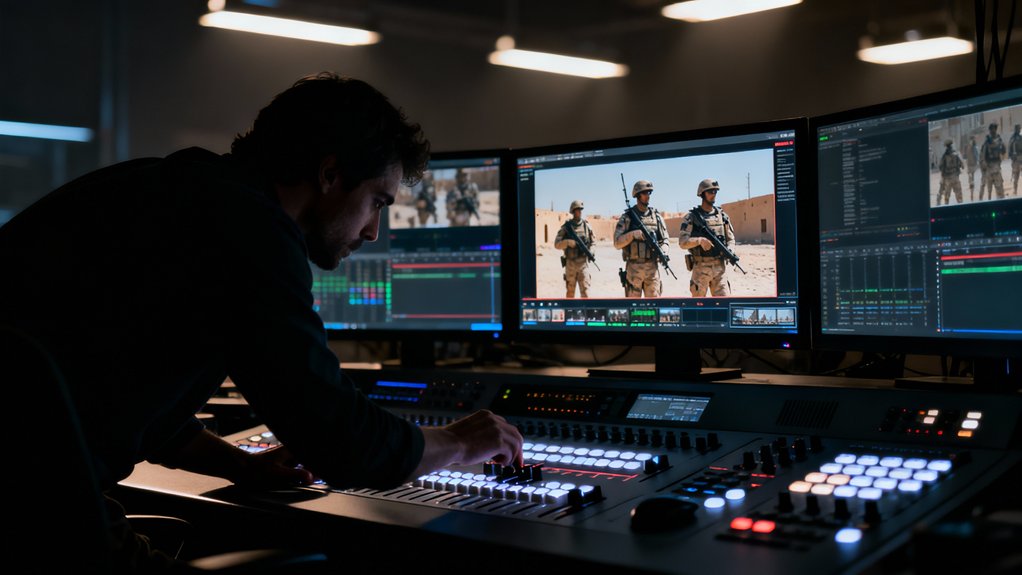
The Pentagon’s Defense Video and Imagery Distribution System (DVIDS) flooded American newsrooms with hundreds of Iraq and Afghanistan segments shot in the embedded journalist style—complete with combat footage, soldier interviews, and mission briefings. Local television stations aired these military-produced packages without disclosing their origin, allowing Pentagon narratives about progress and success to masquerade as independent reporting. The system laundered propaganda through a veneer of journalistic format, transforming military public affairs operations into prime-time news segments that bypassed editorial scrutiny entirely. Meanwhile, classified documents revealed that over 66,000 Iraqi civilians had been killed during the war, a reality largely absent from the sanitized military footage distributed to newsrooms.
DVIDS Military Footage Distribution
During Operation Iraqi Freedom and Operation Enduring Freedom, military-produced video packages flowed from combat zones through the Defense Visual Information Distribution Service into American living rooms with remarkable efficiency. DVIDS served as the central clearinghouse for Pentagon-approved footage, facilitating systematic information laundering on an industrial scale.
The distribution mechanism operated through three primary channels:
- Direct feeds to network affiliates requiring only minimal editing before broadcast
- Pre-packaged segments complete with voice-over narration and suggested scripts
- High-definition combat footage designed for seamless integration into evening news programs
This media manipulation infrastructure transformed military public affairs offices into de facto news production studios, creating ready-made content that cash-strapped local stations hungrily adopted without disclosure of governmental origin.
Embedded Journalist Style Production
How closely did Pentagon-produced video news releases mimic legitimate journalism? The answer reveals calculated deception. Bell Pottinger’s $500 million contract produced TV segments indistinguishable from Arabic news networks, while embedded journalist programs provided template authenticity. Combat narratives from over 800 embedded reporters established trusted formats that propaganda realism could exploit.
| Authentic Embedded Reports | Pentagon VNRs |
|---|---|
| Reporters with combat units | Staged Arabic broadcasts |
| Live battlefield footage | Fake al Qaeda videos |
| Identified military sources | Unattributed distribution |
The productions surfaced across Iran, Syria, and America as genuine coverage. Networks aired this content without attribution, while embedded journalism’s sympathetic bias—termed “inbedded” by critics—created psychological cover. Information warfare dominated the environment through manufactured credibility.
Airtime Without Attribution Warnings
Between 2002 and 2005, Pentagon-produced propaganda segments infiltrated American living rooms disguised as independent journalism. Over 50 VNRs reached an estimated 33 million viewers without disclosure of military origin, transforming viewer deception into broadcast complicity. Local stations aired these packaged narratives as their own reporting, violating FCC sponsorship identification rules.
The deception manifested through:
- “Attack in New Iraq” – broadcast on 34 stations as legitimate local news coverage
- Reconstruction footage – CNN and network affiliates presenting Pentagon-embedded material as journalistic content
- Troop morale segments – 90% aired without verbal or graphic disclaimers identifying military production
A 2006 study revealed 76% of VNRs from various producers reached audiences without sponsor disclosure. Polls confirmed 90% of viewers remained unaware they’d consumed government propaganda, while 75 hours of unreported Pentagon content saturated American networks.
How Media Consolidation Created VNR Dependence
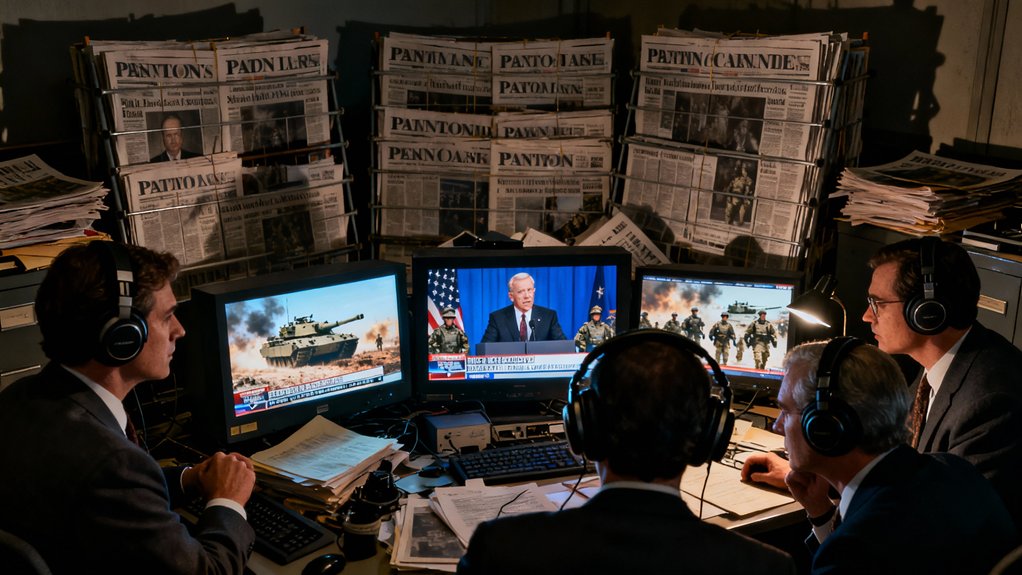
The erosion of American television newsrooms created a vacuum that Video News Releases rushed to fill. Consolidation triggered massive layoffs—Hawaii alone lost 65 television staffers, one-third of its workforce—leaving skeleton crews struggling to produce content. Budget cuts forced stations toward content uniformity, recycling programming from co-owned outlets rather than generating original reporting. Resources shifted from local coverage to cheaper alternatives, making Pentagon VNRs irresistible: free, broadcast-ready propaganda requiring zero journalistic effort. This dependency masked media bias behind professional production values. Stations with news sharing agreements presented markedly less local content than competitors, creating standardized programming across markets. As Sinclair and Nexstar increased advertising time while slashing newsroom budgets, the economic pressure made government-supplied footage essential. Corporate owners prioritized profitability over journalism, transforming newsrooms into distribution channels for state narratives.
How to Spot Pentagon VNR Content in Local News
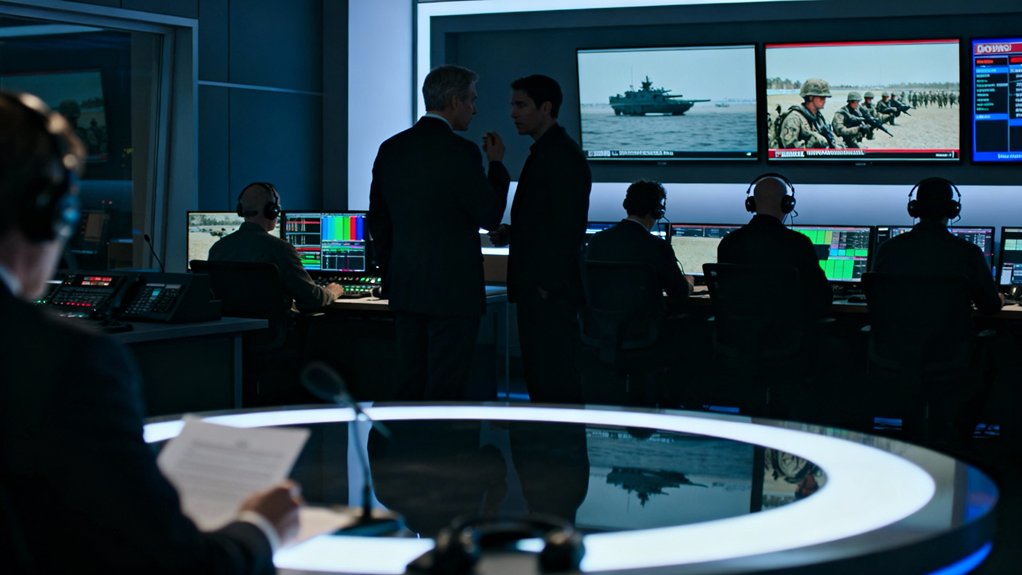
When local news broadcasts Pentagon footage, specific visual signatures betray its manufactured origins. Media literacy demands scrutinizing these telltale signs that compromise news authenticity:
- Identical footage sequences appearing across unrelated stations nationwide, revealing centralized military distribution rather than independent journalism
- Missing bylines and reporter contacts, replaced by generic voiceovers lacking local station branding or journalist attribution
- Verbatim script matches between distant affiliates, exposing coordinated messaging instead of original reporting
Verification requires cross-referencing clips against the Defense Visual Information Distribution Service archives, where Pentagon-produced segments often appear with matching timestamps. The absence of opposing viewpoints, combined with sanitized language emphasizing “precision strikes” without casualty counts, signals propaganda rather than journalism. Reverse video searches expose government origins stations deliberately obscure.
Frequently Asked Questions
Can Viewers Request Source Disclosure When They Suspect VNR Content?
Viewers possess limited formal mechanisms to demand source disclosure for suspected VNR content, exposing critical gaps in media transparency. While the FCC technically requires broadcasters to identify sponsored material, enforcement remains weak and complaint processes opaque. Grassroots pressure through direct station contact, social media campaigns, and freedom of information requests offers the most viable path toward viewer accountability. Yet without robust regulatory teeth, corporate media outlets routinely evade disclosure obligations, perpetuating information asymmetries that undermine democratic discourse and public trust.
Do Journalists Face Consequences for Knowingly Airing Undisclosed Pentagon VNRS?
Journalists rarely face formal sanctions for airing undisclosed Pentagon VNRs, exposing critical gaps in ethical accountability. While professional integrity demands transparency, enforcement mechanisms remain weak across newsrooms. Industry codes condemn deceptive practices, yet systemic pressures—tight budgets, ratings competition—incentivize complicity. The absence of meaningful consequences perpetuates propaganda laundering, undermining democratic oversight. Until broadcasters implement rigorous disclosure standards and face tangible repercussions, viewers remain vulnerable to state-manufactured narratives disguised as independent journalism.
Have Any Stations Been Actually Fined for Airing Pentagon VNRS?
Despite widespread documentation of Pentagon VNR propaganda flooding American airwaves, not a single station faced FCC fines. Media accountability proved illusory as regulatory loopholes protected broadcasters from consequences. The FCC’s sponsorship identification rules theoretically applied, yet enforcement remained nonexistent. This regulatory vacuum exposed the hollow promise of oversight, allowing military propaganda to masquerade as journalism without penalty. The system’s complicity became undeniable—stations knowingly deceived viewers while regulators looked away, their inaction speaking louder than any fine could.
What Percentage of Pentagon VNRS Get Aired Versus Rejected?
Approximately 77% of Pentagon VNRs secured broadcast placement, with only 23% rejected—a troubling success rate that exploited audience perception through deliberate obscuring of source material. This propaganda penetration exposed systemic failures in media transparency, as stations prioritized ready-made content over disclosure obligations. Post-2005 exposure triggered increased scrutiny, yet the damage persisted: thousands of airings had already contaminated public discourse, manufacturing consent through journalistic deception.
Do Other Countries’ Militaries Use Similar VNR Tactics Domestically?
Foreign militaries enthusiastically embrace domestic media manipulation—why let America have all the fun? Russia perfects staged explosions with corpses, China produces slick recruitment rap videos, North Korea releases nuclear holocaust fantasies on YouTube, and Britain pioneered cinematic propaganda through WWI newsreels. Each state-controlled apparatus floods domestic channels with carefully choreographed content, from Telegram floods to carrier operations mimicking Hollywood blockbusters, proving authoritarian regimes and democracies alike weaponize storytelling against their own citizens.
Final Thoughts
When a Kansas viewer watched her evening news in 2005, she saw what appeared to be battlefield reporting from Iraq—complete with combat footage and a journalist’s standup. The Pentagon produced every frame. Like a magician’s misdirection, the VNR apparatus transforms state messaging into the trusted language of local journalism. The screen flickers with the same blue glow, but the mirror reflects only what power wants seen—a democracy watching its own managed image.
References
- https://www.trizcom.com/blog/video-news-release
- https://courses.lumenlearning.com/snhu-cfacontrolthemessage/chapter/video-news-release-vnr/
- https://www.sourcewatch.org/index.php/Video_news_releases
- https://www.mediaed.org/handouts/VNRhandout.pdf
- https://www.cpsc.gov/Business–Manufacturing/Recall-Guidance/Video-News-Release-Guide
- https://www.law.cornell.edu/wex/video_news_release
- https://en.wikipedia.org/wiki/Video_news_release
- https://www.ap.org/the-definitive-source/announcements/ap-statement-on-pentagon-press-policy/
- https://time.com/7324568/pentagon-press-restrictions/
- https://www.openpr.com/wiki/video-news-release